Heads up: This post contains affiliate links. As an Amazon Associate I earn from qualifying purchases, at no extra cost to you. Learn more
Specs are compiled from manufacturer listings and verified buyer reviews and can change over time — please confirm the key details on the product page before buying.
Most cats are not picky about fish oil — they are picky about the delivery method. A liquid you pump over wet food gets licked up; a pill the size of a pea gets spat onto the floor and face-planted by a paw. That single difference decides whether the omega-3s ever reach your cat’s skin. Below are five options that actually get eaten, ranked by how reliably they work for cats specifically, not for the dog in the same house.
This guide is built by comparing the manufacturers’ published specifications and the patterns across verified customer reviews, so you get each pick’s real strengths and trade-offs instead of marketing spin.
What separates these five is concentration, oil form, and cat acceptance — the Nordic Naturals Cod Liver Oil leads the group for purity and tolerance, while the Zesty Paws salmon oil wins on sheer volume of owner experience. Every pick here has earned its place in a real feline household, and the full fish oil for cats breakdown below covers dosage, pill size, and which formulas cats actually finish.
Top Picks
How To Choose The Best Fish Oil for Cats
Your cat does not read the label. It smells the oil, decides in half a second, and either eats or walks. So the buying decision is really two decisions: which oil is concentrated enough to matter at a cat-sized dose, and which form your particular cat will tolerate. Get those two right and the rest is bookkeeping.
Liquid, capsule, or soft chew — pick for your cat, not for you
A liquid oil is pumped or dropped over wet food, which is the easiest way to sneak a supplement into a cat who does not take pills. A capsule is simpler to store and dose but has to be given whole or cracked open — and a gel cap that is fine for a Labrador can be too big for a cat’s mouth. A soft chew is the most treat-like option, but it is also the one cats are most likely to turn their nose up at if the flavor does not land. Match the form to what your cat already accepts — liquid over wet food, a pierced capsule, or a soft chew — or the supplement never gets eaten.
Read the EPA and DHA numbers, not the bottle size
Total oil weight tells you very little. What supports skin and coat is the combined EPA and DHA — the two omega-3 fatty acids your cat’s body cannot make on its own. A bottle that is twice the size but half the concentration gives you no advantage. Look for a product that states the EPA and DHA per capsule or per serving in milligrams, then check that the serving is one your cat can physically take. The liquid products on this list list omega-3 content per serving; the capsule product states its EPA and DHA per capsule plainly, which makes it the easiest to compare.
Check the oil source and the preservative list
You want a short ingredient list and fish that was caught in the wild. Cod liver oil, salmon oil, and pollock oil all supply omega-3s (healthy fats that support skin and coat). But cod liver oil also carries naturally occurring vitamin A. That is why the Nordic Naturals bottle is labeled for pets, not for human use, and why you should not swap in a human cod liver oil product. Look for oils preserved with vitamin E or tocopherols (natural preservatives) rather than a long list of stabilizers. Skip anything with artificial colors or flavors in a product your cat will eat daily.
Start with a cat-sized serving, not the dog-sized one
Most bottles print a feeding guide that runs from small pets to large ones. The cat line is almost always the smallest. Zesty Paws, for example, lists 1/4 teaspoon for pets weighing 5-15 lbs, which is squarely cat territory. Going heavier than the label suggests does not speed results and can upset a cat’s stomach, so begin at the low end and hold there for a couple of weeks before you judge the results. A cat’s coat and skin respond on their own schedule.
Side-by-Side Comparison
| Model | Best For | Form | Key Strength | Size | Amazon |
|---|---|---|---|---|---|
| Nordic Naturals Cod Liver Oil★ Best Overall | Purity and gentle digestion | Liquid | 1048 mg Omega-3 | 8 oz | Amazon |
| Zesty Paws Wild Alaskan Salmon OilMost Popular | Everyday value for multi-pet homes | Liquid | Salmon + pollock oil | 8.5 oz | Amazon |
| NaturVet Omega-Gold Plus | Cats who take treats easily | Soft chew | Omega-3 and Omega-6 blend | 90 ct | Amazon |
| VetriScience Omega Plus | Precise capsule dosing | Gel capsule | Over 750 mg omega fatty acids | 90 ct | Amazon |
| Nature’s Diet Norwegian Salmon Oil | Large bottles and pump dosing | Liquid | Omega 3, 6 and 9 | 32 oz | Amazon |
Detailed Reviews
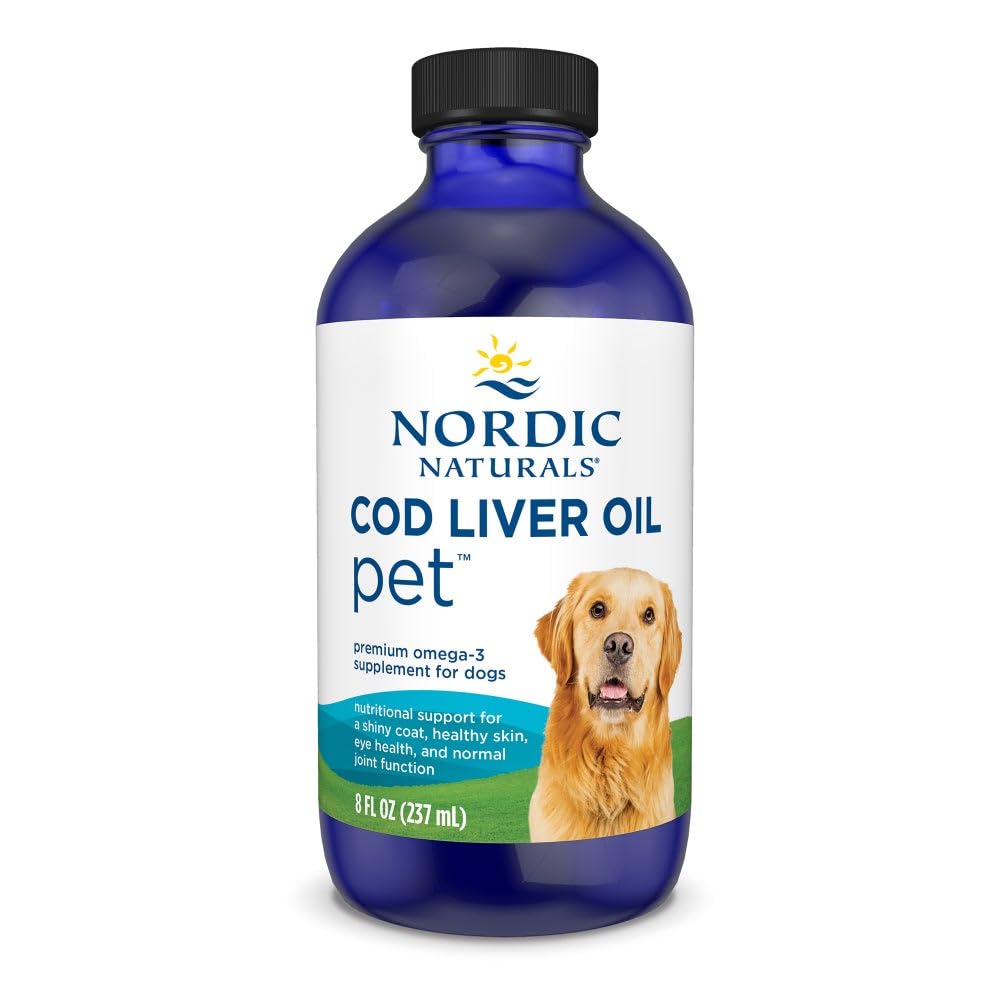
1. Nordic Naturals Cod Liver Oil 8 oz
Our pick — 4.5+★ from 800+ verified ratings; the strongest balance of quality and price.
The unflavored oil that disappears into a bowl of pate without a fight — and delivers 1048 mg of omega-3 per serving while it does.
Here is the number that decides the pick: 1048 mg of omega-3, split between EPA and DHA, in a single 8 oz bottle of liquid. For a cat’s supplement, that is a serious concentration per serving, and it means a small measured amount is doing real work rather than just scenting the food. The oil is in triglyceride form — the molecular shape omega-3s naturally take in fish — which is the form a cat’s gut is built to absorb. Nordic Naturals also states every batch is made from wild-caught arctic cod and is non-GMO, gluten-free, and dairy-free, with no artificial colors, flavors, or preservatives.
In daily use, the purity claim holds up. Buyers rate quality and effectiveness highest, and cite skin and coat results alongside them. Digestion matters most for cats, and it holds up here. A small serving of unflavored oil stirred into wet food goes down without the lip-curl or the foil-licking refusal that flavored chews trigger. An oil with no fishy smell also means your cat is not put off before the first bite, which is the whole battle with a feline.
The catch is straightforward: this bottle is labeled for pets, and it is a pet product specifically, not a human supplement. Do not substitute it into your own routine, and do not swap a human cod liver oil bottle in for the cat. Cod liver oil also carries naturally occurring vitamin A, so the label serving is the serving — pushing past it does not help. The other thing to know is that a cod liver oil product is held to the serving size on the bottle, and this bottle’s guide is written for medium to large dogs. A cat needs a fraction of that.
Your cat’s eating style decides if this bottle is right for you. If your cat takes wet food and will accept a flavourless oil stirred through it, this is the most straightforward route to a high omega-3 dose with the least fuss. It is also the option that requires the most attention to serving size, since the label is not written for cats.
The crowd’s read on it: quality is the clear favourite — well over a hundred owners single it out, with effectiveness the next most-cited plus. Skin improvement and coat shine both show up strongly in the discussion.
What to watch: the value-for-money topic runs genuinely split, with some owners happy and others feeling the bottle is pricey for the amount. That is a fair caveat, not a flaw in the formula.
Best fit: the cat who eats wet food without argument and whose owner wants the highest omega-3 concentration with the least flavor interference.
Think twice if: your cat turns their nose up at oil textures entirely — a soft chew may get further than a pouch of liquid.
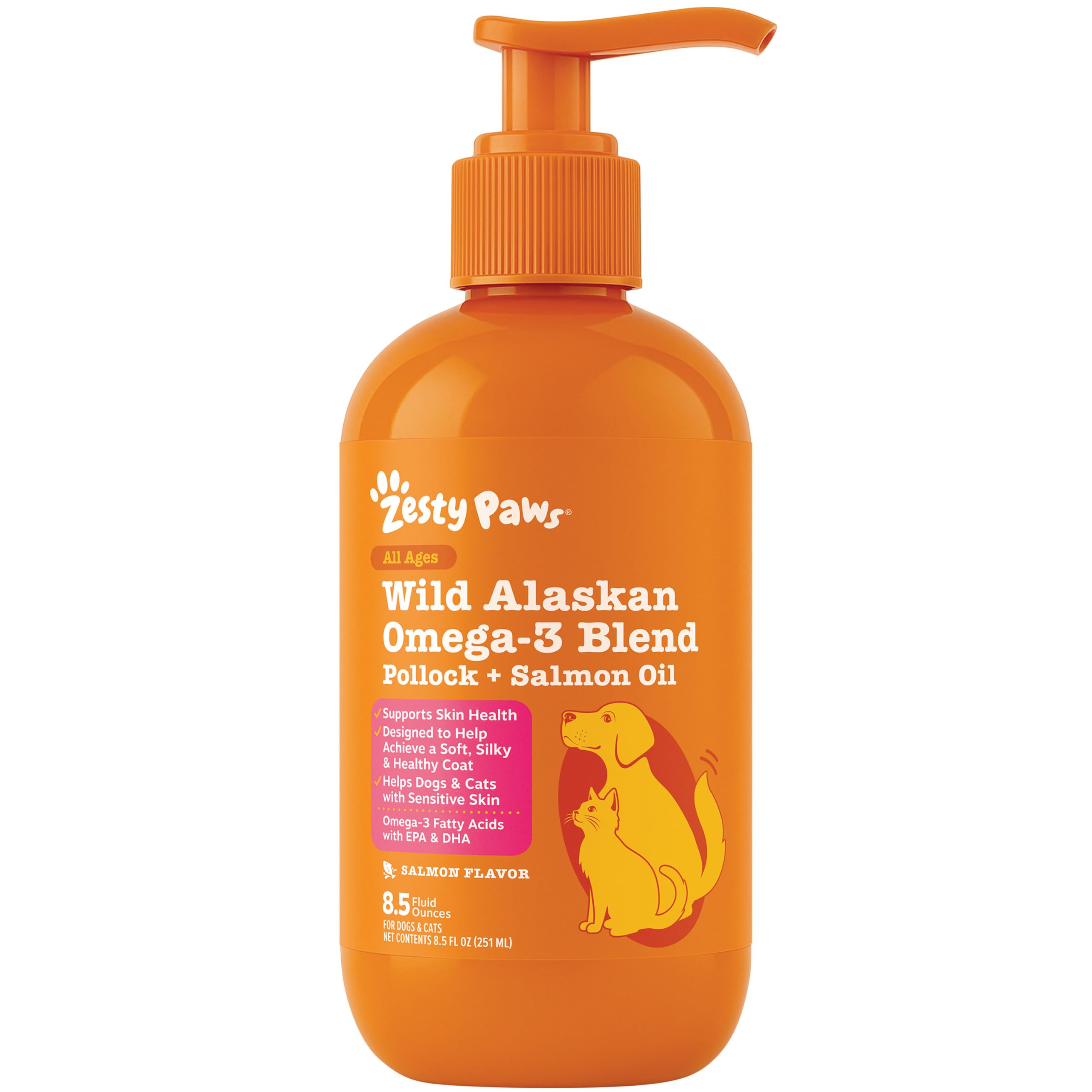
2. Zesty Paws Wild Alaskan Salmon Oil 8.5 Oz
10,000+ owners have tried this pump bottle on their own cats, and repeat orders track how reliably the bowl gets cleaned.
Wild Alaskan salmon oil plus pollock oil plus vitamin E is the entire ingredient list, which is about as short as a fish oil gets. That simplicity is the selling point for a cat on a limited diet. The oil is explicitly labeled for both cats and dogs of all ages, and the dosing is layered: 1/4 teaspoon for pets in the 5-15 lb range, with the label carrying more options beyond that. A quarter teaspoon is cat-sized, and the pump makes it repeatable without a measuring spoon.
The daily-use picture is what sets this apart from the cod liver oil above. It pours as a topper over wet or dry food, so the cat gets omega-3s whether they eat pate or kibble. There is a weight note worth stating plainly: this bottle is 8.5 ounces, and that matters next to the VetriScience capsules at 6.4 ounces — the liquid format simply carries more product weight for the same shelf space. Buyers report dandruff clearing and shedding easing within a week of daily salmon oil.
Now the honest part. Cats are more divided on this one than dogs are — the multi-pet household reviews make that clear, and taste and digestibility both run mixed in the owner conversation. Some cats clean the bowl; others refuse outright, and a handful of pets get loose stools when the oil is introduced too fast. The smell is another divisive point, since a salmon-based oil is never going to be unscented. Start at the smallest serving and give it a week, then decide whether your cat is in the accepting camp.
Why it earns its spot
- A three-ingredient list — salmon oil, pollock oil, vitamin E — nothing to puzzle over
- Dosing starts at 1/4 teaspoon for 5-15 lb pets, which is a cat-sized scoop
- Works as a topper on either wet or dry food
- Labeled for all ages of both cats and dogs
Where it gets awkward
- Taste and digestibility split owners down the middle — cat acceptance is genuinely not guaranteed
- A salmon-based oil announces itself; the smell is a recurring discussion point
- Fast introduction can upset a cat’s stomach
Go with this one: if you have both a dog and a cat, since one pump bottle serves the whole house at different serving sizes.
Look elsewhere: if your cat has already rejected salmon-flavored toppers — the formula is not hiding that taste.
3. NaturVet Omega-Gold Plus Salmon Oil 90 Ct
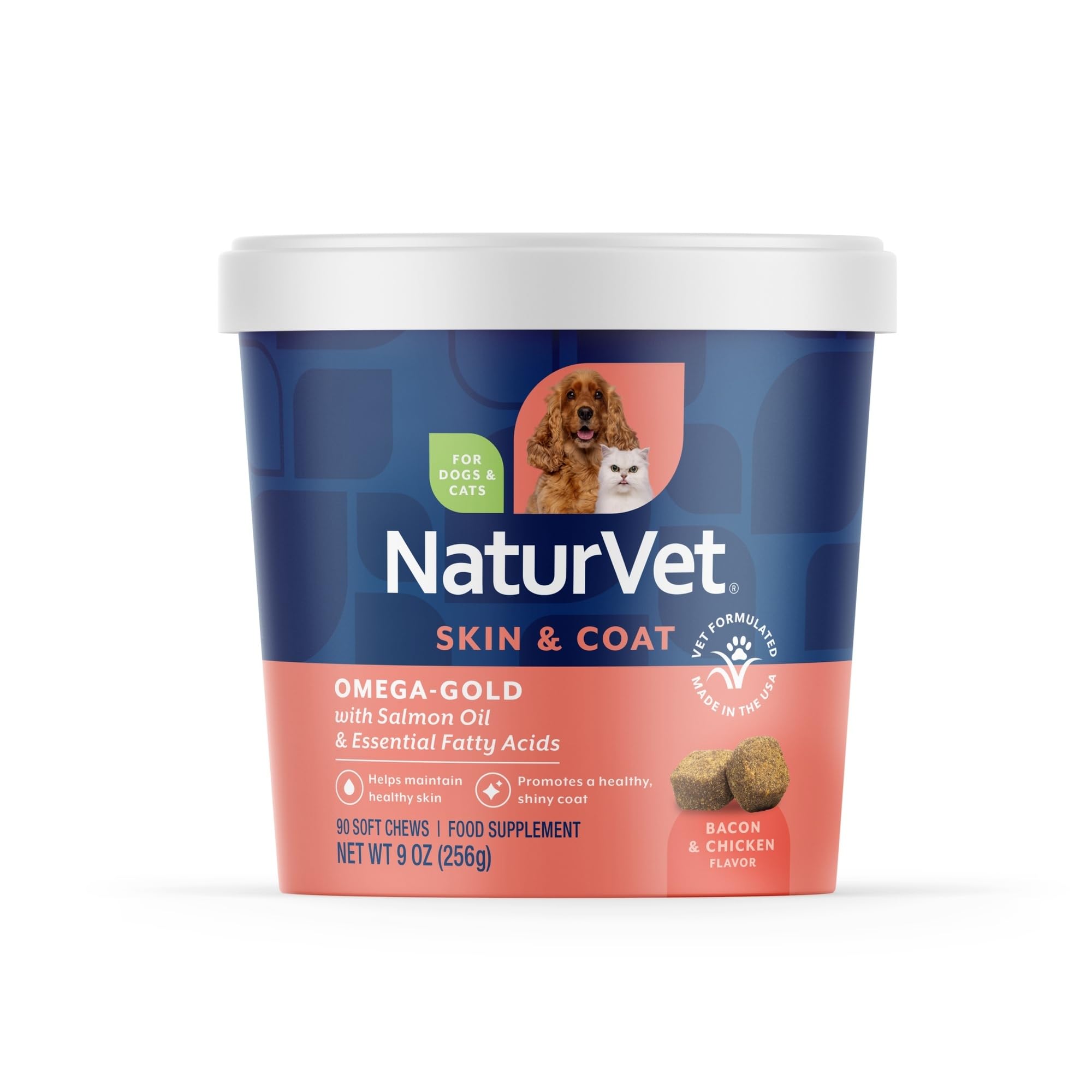
For the cat who will not touch oil but will absolutely accept a bacon-and-chicken soft chew on the kitchen tiles.
Ninety soft chews, flavored with bacon and chicken, built around salmon oil plus a blend of omega-3 and omega-6 fatty acids including DHA and EPA. The formula is veterinarian formulated and labeled for dogs and cats over 12 weeks. If your cat has already shown they will not eat a liquid supplement, this is the format that removes the whole delivery problem: the chew is the treat, and the fatty acids come along for the ride.
Cats that accept it tend to accept it enthusiastically — the treat framing does a lot of the work. Skin and coat feedback is where the chews earn compliments: dandruff reduction and healthier-looking skin recur, with itchiness easing alongside. The chew format also means no measuring, no pumping, and no chance of over-pouring oil into a bowl. Owners who live with limited cabinet space will appreciate that 90 chews sit in one small tub.
This one needs a clear warning. Cat consumption is the single most divided topic in the whole review set. This is not a formula your cat is guaranteed to accept, and a substantial slice of feline households find their cat flatly refuses the chew. It is the one product here where the cat’s opinion decides the purchase before you buy. Buy a smaller count first if you are unsure, or treat it as a backup plan behind a liquid your cat already eats. The chew does contain chicken, so a cat with poultry restrictions is out.
Format wins the day: no dropper, no pump, no measuring — one chew is one serving, and the bacon and chicken flavor is what gets cats to actually eat a supplement.
The refusal rate is real: it is the most-mentioned concern in the owner discussion, and it splits cleanly. This is the pick to try only if your cat is a confident treat-taker.
Right call for: households where the cat already takes soft treats daily and the idea of oil on food has already failed.
Second thoughts if: you have a cat with a poultry sensitivity, since chicken is part of the flavor base.
4. VetriScience Omega Healthy Skin and Coat 90 Count
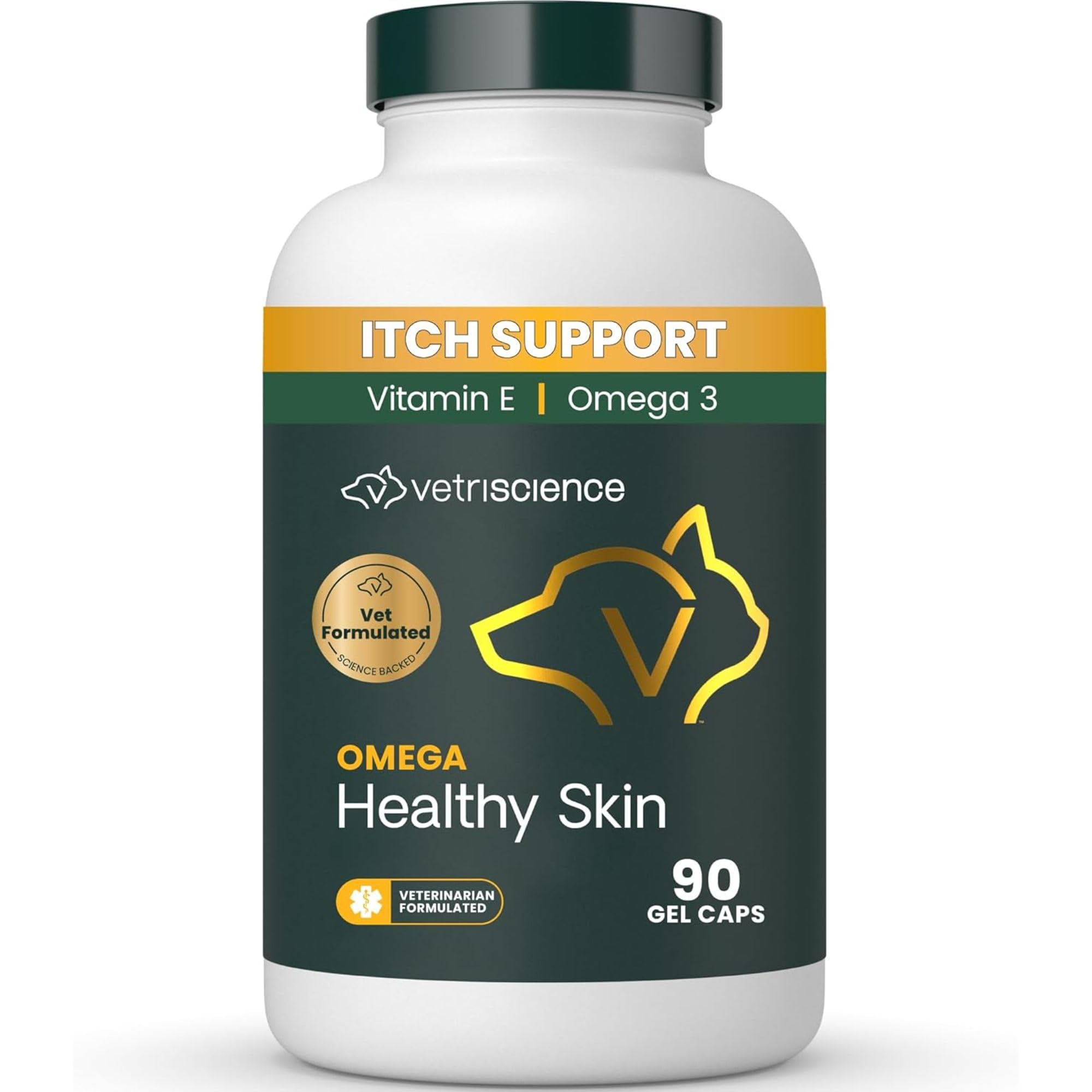
Every capsule prints its own numbers — 120 mg of EPA and 80 mg of DHA — so you know exactly what your cat is getting.
Capsules give you a fixed dose with no guessing. Each gel cap carries over 750 mg of omega fatty acids, built from fish oil plus borage and flax seed oils. The breakdown is stated plainly: 120 mg EPA and 80 mg DHA per capsule, alongside 72.8 mg of GLA. That GLA — gamma linolenic acid, an omega-6 from the borage oil — is what separates this from a plain fish oil. Vitamin E rounds out the formula, and the ingredients are allergen-free and unflavored.
The VetriScience bottle is 6.4 ounces for 90 capsules, which is a denser, more compact format than the 8.5 ounce Zesty Paws liquid — a smaller footprint in a crowded cabinet, even if the serving math is different. Where this really pulls ahead for a precise owner is the shoulder-to-shoulder comparison: the Zesty Paws bottle gives you a topper with a pump, while these capsules give you a stated EPA and DHA number per dose. If your vet has given you a target, that stated figure is what you want to see. The formula is labeled for all coat types and all ages, sizes, and breeds of both dogs and cats.
The pill size is the thing to reckon with, and it is the most-discussed complaint in the entire review set for this product. Multiple owners mention it is too large for a cat, and the capsule casing is not always easy to crack open. This is not a defect — it is a format mismatch, and a very fixable one. Prick the gel cap and squeeze the oil over a wet food portion rather than trying to give it whole. One owner noted improvements as early as three days in — but only after piercing the cap and squeezing the oil over wet food. If a capsule cannot be pried open in your kitchen without a struggle, a liquid bottle will serve you better.
The dose is on the label: 120 mg EPA, 80 mg DHA, 72.8 mg GLA per capsule — numbers a vet can actually work with, not a vague “omega blend.”
Sizing limits its use: the capsule was built with a dog’s mouth in mind. For a cat, plan on piercing and squeezing rather than pilling.
Best for: the owner who wants a fixed, stated dose and does not mind a two-second routine of piercing the cap over wet food.
Skip if: your cat will not eat wet food at all — there is no other delivery route for a capsule this size.
5. Nature’s Diet Pet 32 oz Norwegian Salmon Oil for Dogs & Cats

A full 32 fluid ounces of Norwegian salmon oil on a pump — the bottle that lasts long enough to actually judge results.
Most cat supplements get ditched before the coat has had time to respond, because the bottle runs dry first. Thirty-two fluid ounces is the answer to that, especially for a household where a dog is also getting a daily pump. The oil is sourced from salmon raised in ocean environments off the south-western coast of Norway. It is naturally rich in omega 3, 6, and 9 with both EPA and DHA, and it is dye-free — the orange color is the oil’s own, not an additive. The pump bottle measures directly into the bowl, so there is no funnel, no dropper, and no guessing.
Appetite is where this formula earns its reputation. Cats and dogs of all life stages are the stated target, and the pitch is specifically about palatability for aging, sick, and picky pets. The feedback line bears that out strongly, with pets enjoying it being the standout positive and coat and skin improvement close behind. Owners also praise the smell: this one is not the fish-market hit that some salmon oils are, which is a real advantage when the food bowl is in the kitchen.
Two honest notes before you commit to a bottle this size. Leakage is the recurring issue: the pump mechanism can spill oil down the side and onto the counter, and owners mention this often enough that you should store it upright on something wipeable. It also runs more expansive in value conversation — some find the large bottle sensible, others feel the oil runs out faster than expected. And while the label covers cats, the enthusiastic eatin’ feedback skews towards dogs, so an optimistic dog is not proof that a cat will agree. Introduce the pump slowly and keep the bottle off the counter during fills.
One bottle, many months: 32 fluid ounces with a measuring pump is the least-fuss way to run a daily supplement routine for a multi-pet home.
Pump the problem: leakage is the biggest single complaint, and it is a storage problem — sit it in a shallow tray and the issue disappears.
Choose this: if you want the largest bottle in the group and a pump that keeps dosing identical day to day.
Hold off if: your cat is skittish about new oil flavors — a giant bottle is a lot to store if they turn it down.
Know the Specs
EPA and DHA
These are the two omega-3 fatty acids your cat’s body cannot manufacture, so they have to come from food or a supplement. DHA is the one most associated with skin and coat condition; EPA works alongside it. A label that states EPA and DHA in milligrams per capsule or per serving tells you the actual payload. A label that only says “omega-3 rich” tells you nothing you can act on. When comparing bottles, put the EPA and DHA numbers side by side and ignore the total bottle size — a smaller bottle with higher concentration can out-deliver a larger one.
Triglyceride form
Fish oil can be processed two ways: back into triglyceride form, the molecular shape found in fish, or into ethyl ester form. The triglyceride version is the natural shape, and it is what your cat’s digestive system is set up to handle. Nordic Naturals states plainly that its oils are in triglyceride molecular form for absorption, which is why its label calls this out as a selling point. When you see that phrase on a bottle, it means the oil has been returned to its natural structure after refining, rather than left in the ethyl ester form that purification produces.
Common Questions
Can I give my cat a fish oil supplement made for dogs?
How much fish oil should a cat get each day?
Why does my cat refuse the fish oil that the dog eats happily?
Is a liquid fish oil better than a capsule for cats?
Can fish oil upset a cat’s stomach?
Does cod liver oil contain vitamin A that regular salmon oil does not?
How long before I see a difference in my cat’s coat?
Can the pump bottle leak if I store it sideways?
The Bottom Line
For most homes, the best fish oil for cats is the Nordic Naturals Cod Liver Oil. It delivers 1048 mg of omega-3 in triglyceride form (a highly absorbable form) per serving — the strongest concentration in this group. The unflavored liquid slips into wet food with the least resistance. If your cat has already refused oil on a plate and will only take a soft treat, the NaturVet Omega-Gold Plus chews are the alternate route — bacon and chicken flavor, 90 to a tub, no measuring. And if you have both a cat and a dog or simply want a bottle that outlasts the season, the Nature’s Diet 32 oz Norwegian Salmon Oil gives you a pump and more oil than the rest — just keep it upright.
One last nudge from the pattern of owner experience: the crowd favourite across the widest base is the Zesty Paws bottle at 4.0+ stars with 10,000+ owners behind it. That volume of feedback is the closest thing to a crowd-sourced trial run you will find. The Nordic Naturals bottle earns its top slot on concentration and purity rather than popularity. Both are worth your cat’s next bowl of dinner.
How we choose
We do not accept paid placement. Every pick is matched to a real buyer and a real use-case; we do not hands-on test units.
Sources
Specifications: manufacturer listings and product documentation. Review insights: verified customer reviews, as of November 2026. Pricing: not shown on this page (it changes often); check the current price via the retailer link.
As an Amazon Associate, My Heart Lives Here earns from qualifying purchases. This does not affect which products we feature.