Heads up: This post contains affiliate links. As an Amazon Associate I earn from qualifying purchases, at no extra cost to you. Learn more
Specs are compiled from manufacturer listings and verified buyer reviews and can change over time — please confirm the key details on the product page before buying.
Killing clover without wrecking the grass around it is the whole job, and most products fail at one half or the other. Some are straight weed killers that leave your lawn thin and open to re-invasion; others feed grass beautifully but let clover creep back. The picks below split into two camps — feed-and-kill granules and liquid spot sprays — and each one earns its place for a different kind of yard.
This guide is built by comparing the manufacturers’ published specifications and the patterns across verified customer reviews, so you get each pick’s real strengths and trade-offs instead of marketing spin.
The honest starting point: clover wins wherever grass is weak, so the product you pick should kill the weed and thicken the turf at the same time. This breakdown shows where each fertilizer to kill clover does exactly that and where it leaves you doing a second pass.
Top Picks


How To Choose A Fertilizer That Kills Clover
Three things decide whether a product actually clears clover or just knocks it back for a month.
Grass type first
Check your grass against the label, because several clover products are safe on fescue and bluegrass yet forbidden on St. Augustinegrass.
Granule or liquid
Granules feed the whole lawn as they kill, while a liquid concentrate lets you spot-treat clover patches without feeding weeds you missed.
Coverage honesty
Match the stated square footage to your actual lawn size, since stretching a bag or bottle thin is the fastest way to a second round of clover.
Side-by-Side Comparison
| Model | Best For | Form | Coverage | Grass Types | Amazon |
|---|---|---|---|---|---|
| Scotts Turf Builder Weed & Feed5★ Best Overall | Whole-lawn feed and clover control | Granule | 4,000 sq. ft. | Bahiagrass, Bermudagrass, Bluegrass, Centipedegrass, Fescue, Ryegrass, Zoysiagrass | Amazon |
| Roundup for Lawns2 ConcentrateNorthern Lawns | Northern lawns with mixed weeds | Liquid concentrate | 5,000 sq. ft. | Kentucky Bluegrass, Perennial Ryegrass, Fescue, Zoysiagrass | Amazon |
| Ortho WeedClear with Comfort Wand | Spot-treating clover patches | Ready-to-use liquid | 20,480 sq. ft. | Bermudagrass, Buffalograss, Fescues, Kentucky Bluegrass, Ryegrass, Zoysiagrass | Amazon |
| Pennington Full Season 4M 32-0-5 | Season-long feeding and greening | Granules | 4,000 square feet | — | Amazon |
| Spectracide Large Plot Weed Stop | Big lawns on a single bottle | Liquid concentrate | 32,000 sq. ft. | Northern and Southern grasses | Amazon |
Detailed Reviews
1. Scotts Turf Builder Weed & Feed5, 11.32 lbs.
Our pick — 4.0+★ from 37,000+ verified ratings; the strongest balance of quality and price.
One bag that kills the clover and feeds the grass that replaces it.
This is the pick for a lawn where clover has spread across the whole yard and the grass underneath looks thin. It is a granule product — dry pellets you scatter with a spreader — that combines a clover and dandelion killer with lawn food. One 11.32 lb. bag covers 4,000 sq. ft. (square feet), which is a typical suburban front lawn. The bag weighs 11.3 pounds, so it is a comfortable carry across the yard.
What wins people over is the greening. Lawns come back thick and dark, and the crowd consensus is that this is where the product shines. On clover itself, results split — some yards clear out, others need a second pass. That coverage figure is also where Scotts slots in against the big-bottle liquid picks: this bag treats 4,000 square feet while the Spectracide bottle reaches 32,000.
Apply it to wet grass when weeds are actively growing and daytime temperatures sit between 60°F and 90°F. Do not use it on St. Augustinegrass, Dichondra, Lippia, Carpetgrass, or Bentgrass. And do not apply more than twice a year — overfeeding is a real risk.
Where it earns its keep
- Feeds and kills in one pass, so bare spots fill back in
- Simple granule spread with no mixing
- Clear label limits keep you from over-applying
The honest catch
- Small coverage per bag, and clover control is not guaranteed for every yard
Reach for this if: you have cool-season or Bermuda-type grass and want weed control plus feeding in a single afternoon.
Look elsewhere if: your lawn is St. Augustinegrass — the label rules this one out.
2. Roundup for Lawns2 Concentrate, 32 fl. oz.
A 32-ounce bottle built for northern grass and a long weed list.
If your lawn is Kentucky Bluegrass, Perennial Ryegrass, Fescue, or Zoysiagrass, this concentrate targets weeds down to the root, clover included. It claims control of 253 weed types and up to 3 months of suppression. Rainproof in 3 hours means an afternoon shower will not undo your work. One 32 fl. oz. (fluid ounce) bottle covers 5,000 sq. ft. — that is 32 fluid ounces against the Spectracide’s 128, so plan on four bottles to match its reach.
It is a tank-mix product: you dilute it into a sprayer or a Dial ‘N Spray and apply it evenly. Results are genuinely split — some yards clear out, others show nothing, and the mixed value feedback usually traces back to that same inconsistency. At 8 ounces shipping weight, the bottle itself is feather-light.
The short read: a strong fit for northern grass and a broad weed list, but buy it expecting to do a second application if your first pass underperforms.
Choose this when: your lawn is one of the listed northern grasses and you already own a sprayer.
The trade-off: results are inconsistent yard to yard, so budget the time for a follow-up spray.
3. Ortho WeedClear Lawn Weed Killer 1 gal.

A battery wand that lets you nail clover patches without mixing a thing.
For clover that shows up in clumps rather than across the whole yard, this is the straightforward answer. The 1 gal. (gallon) bottle comes ready to use with a battery-powered Comfort Wand, which is a powered spray head that fires a targeted stream at the weeds you choose. No mixing, no tank, no measuring. That bottle claims 20,480 sq. ft. of coverage — more than four times the Roundup’s 5,000, though you will be walking it out patch by patch.
It kills crabgrass, dandelion, clover, chickweed, and creeping charlie down to the root, and it is designed not to harm listed lawn grasses when used as directed. Apply it to young, actively growing weeds in spring or fall and lightly coat the leaves. The 1 gallon container weighs 9.4 pounds.
The one thing to know: spot spraying is precise but slow, so this suits a yard with scattered clover rather than a blanket takeover.
Apply it right: young, growing weeds only — mature clover in summer heat is a tougher target.
Best fit for: the gardener who wants to walk the lawn and hit each patch on sight.
Not the pick if: clover covers most of the yard and you would rather treat the whole thing at once.
4. Pennington Full Season Lawn Fertilizer 4M 32-0-5, 11.2 lbs.
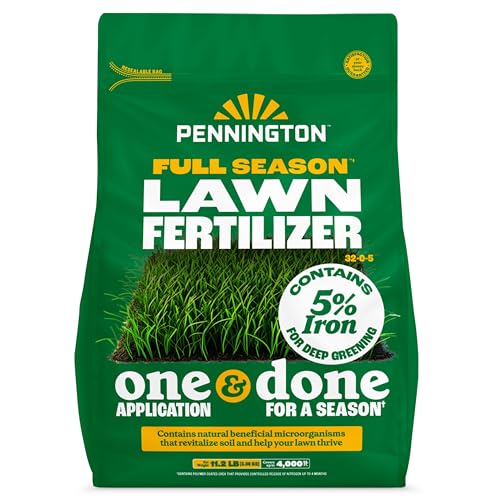
The thickener, not the killer — for grass that needs to out-compete clover.
This one is a straight fertilizer, not a weed killer, and that matters for how you use it. Its job is to thicken turf so clover has no room to move back in after you treat. The 32-0-5 numbers are the nutrient ratio, and 5% iron is what drives the deep greening. Polymer coated urea — a slow-release nitrogen bead — feeds for up to 4 months off one application, covering 4,000 square feet. The bag weighs 11.2 pounds, slightly lighter than the Scotts bag’s 11.3 pounds.
The quality and greening hold up well, and lawns come back visibly darker. Effectiveness is less certain — some yards respond and others do not — and there are reports of bags arriving past their prime, so check the date before you spread.
What it does well
- One application feeds for up to 4 months
- Iron gives quick visible color
What to watch
- No clover control on its own, and freshness can vary
Pair it with a killer if your lawn is already clear and you want to keep clover from returning.
Do not buy it expecting clover to die — it feeds grass, it does not treat weeds.
5. Spectracide Weed Stop For Lawns Concentrate 1 Gal

One bottle, 32,000 square feet — the pick for lawns that swallow a bag whole.
If your lawn is measured in acres rather than feet, this is the coverage answer. One 1 gal. bottle treats up to 32,000 square feet of Northern grasses or 42,500 square feet of Southern grasses. That is 128 fluid ounces against the Roundup’s 32, and 32,000 square feet against the Scotts bag’s 4,000 — a comparison that matters when a single bag barely dents your property. It kills over 200 types of weeds down to the root, clover included.
Results come in hours, and rainfall or watering 6 hours after application will not wash away the effectiveness. The 9-pound bottle mixes into a sprayer. Effectiveness is the standout here, and the value holds up.
The practical note: big coverage only works if your sprayer is properly calibrated — an uneven mix means patchy clover control.
Best value read: the largest square-footage reach in this group for the money.
Pick this for: large properties where bottles and bags run out fast.
Skip if: you have no tank sprayer or Dial ‘N Spray — this needs dilution before it goes down.
Know the Specs
Coverage in square feet
This is how much lawn one bag or bottle treats, so match it to your actual yard size before buying — stretching coverage thin means uneven clover control.
Granule vs concentrate
Granules go on dry with a spreader and feed as they kill; concentrates get diluted into a sprayer, which lets you spot-treat or cover acres from one bottle.
Common Questions
Will a weed and feed product kill clover in one application?
Can I use these products on St. Augustinegrass?
Does a fertilizer alone kill clover?
The Bottom Line
For most yards, the fertilizer to kill clover that does both jobs in one pass is the Scotts Turf Builder Weed & Feed5 — it kills clover and feeds the grass that fills back in. If you are treating a large property, the Spectracide Large Plot reaches 32,000 square feet from one bottle. And if clover shows up in patches, the Ortho WeedClear Comfort Wand lets you hit each one precisely.
How we choose
We do not accept paid placement. Every pick is matched to a real buyer and a real use-case; we do not hands-on test units.
Sources
Specifications: manufacturer listings and product documentation. Review insights: verified customer reviews, as of November 2026. Pricing: not shown on this page (it changes often); check the current price via the retailer link.
As an Amazon Associate, My Heart Lives Here earns from qualifying purchases. This does not affect which products we feature.