Heads up: This post contains affiliate links. As an Amazon Associate I earn from qualifying purchases, at no extra cost to you. Learn more
Specs are compiled from manufacturer listings and verified buyer reviews and can change over time — please confirm the key details on the product page before buying.
Raspberries punish the wrong feed. Give them too much nitrogen and you get a wall of green leaves and almost no fruit. Give them the right balance and the canes throw out more laterals, more flowers, and heavier berries. This shortlist covers the products that get that balance right, from a granular berry-specific blend to a liquid feed you mix in a watering can.
This guide is built by comparing the manufacturers’ published specifications and the patterns across verified customer reviews, so you get each pick’s real strengths and trade-offs instead of marketing spin.
Raspberries are acid lovers, so the number on the bag matters less than whether the blend actually suits them — and the five picks below are the ones that do. These are the best fertilizer for raspberries if you want fruit, not foliage.
Top Picks

How To Choose The Best Fertilizer for Raspberries
Three things decide whether a raspberry feed earns its place in your shed.
The N-P-K Ratio
Look for a blend where the first number (nitrogen, which drives leafy growth) does not dwarf the other two — the 4-3-4 and 4-3-6 ratios here keep growth and fruiting in balance.
Granular or Liquid
Granules are scattered once and feed slowly, while liquids are mixed into a watering can and reach the roots fast.
Soil Acidity
Raspberries grow best in slightly acidic soil, so a blend made for acid-loving plants suits them better than a general-purpose feed.
Side-by-Side Comparison
| Model | Best For | N-P-K | Form | Size | Amazon |
|---|---|---|---|---|---|
| Berry Tone Plant Food★ Best Overall | All-round berry feeding | 4-3-4 | Granules | 128 Ounce | Amazon |
| Bloom City Organic Berry FertilizerBest for Containers | Potted berries | — | Liquid | 32 fl oz | Amazon |
| Down To Earth Organic Fruit Tree | Bigger plots | 6-2-4 | Powder | 5 pounds | Amazon |
| TPS Nutrients Raspberry Fertilizer | Raspberry-only beds | — | Liquid | 32 fl oz | Amazon |
| Down To Earth Organic Acid Mix | Acid-loving plants | 4-3-6 | Granules | 400 Ounce | Amazon |
Detailed Reviews
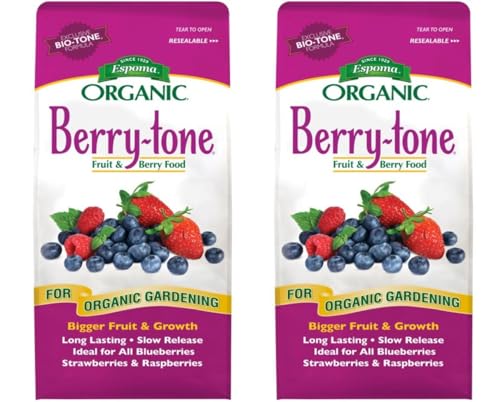
1. Berry Tone Plant Food, 4-3-4, 4-Lbs.
Our pick — 4.5+★ from 500+ verified ratings; the strongest balance of quality and price.
One shake of granules, twice a year, and the canes do the rest.
A 4-3-4 ratio plus 5% sulfur, which is a soil-acidifying mineral that raspberries like, puts this at the top for a simple reason: it suits raspberries by name and by formula. It covers blueberries, strawberries, raspberries and blackberries in the same bag.
No scooping and no mixing — you scatter it and water it in. Espoma recommends feeding established plants twice a year, in early and late spring. The 128-ounce bag is the equivalent of 400 ounces of product, so it stretches across several seasons on a home patch.
It is also registered as an Organic Input Material, which is one step beyond the loose word “organic” on a label. The thing that earns it the top spot is that raspberry growing is what this blend is built for.
What Sells It
- 4-3-4 with 5% sulfur suits acid-loving cane fruit
- No mixing — scatter and water in
Before You Buy
- Granular feed needs watering in to activate
Go for this if: you want one bag that handles your whole berry bed with two feeds a year.
Pass if: you prefer a liquid feed you can measure straight into a watering can.
2. Bloom City Organic Berry Fertilizer 32 oz
A quart bottle built for raised beds and potted berries.
This is a liquid organic feed at 32 fluid ounces, made for garden beds, raised beds and pots. Root development and steady growth are what the formula is aimed at.
Here is where it earns its slot: at 2 pounds it is a fraction of the 5-pound bag of Down To Earth Fruit Tree, which makes it far easier to lug to a balcony or a raised bed. Quality is what wins people over in the reviews, and the reported results run to strawberries, blueberries and seedlings, with new growth and more flowering.
The honest catch is the smell. Opinions split down the middle, so treat the odor as a real trade-off rather than a surprise.
Container winner: a 32 fl oz bottle that suits pots and raised beds, with root support as the formula’s focus.
Fair warning: some find the liquid odor noticeable, so store it somewhere it can breathe.
Reach for this if: your raspberries live in pots or a small raised bed and you want a liquid feed.
Look elsewhere if: smell is a dealbreaker in a small space — the granular picks avoid it.
3. Down To Earth Organic Fruit Tree 5 lb

Five pounds of fruit-tree feed that works the cane fruit too.
A 6-2-4 powder at 5 pounds, with added calcium for proper fruit development. It is listed by OMRI, the Organic Materials Review Institute, for organic production.
The maker lists fruiting canes and shrubs alongside apples, pears and plums, so raspberry rows are squarely in scope. It is a bigger bag than the Bloom City bottle, at 5 pounds against 2 pounds, which suits a full plot rather than a single pot. It also keeps: the maker says it does not expire if stored in a cool, dry place.
The trade-off is the ratio. At 6-2-4 the nitrogen leads, so raspberries get more leafy push than a berry-specific blend gives them.
Plot-scale pick: 5 pounds of OMRI-listed 6-2-4 with added calcium, built for fruiting canes and shrubs.
Trade-off: the higher first number pushes leaves, so go easy if your canes already run rampant.
Best match for: a decent-sized berry patch where one bag should last, and you want calcium in the mix.
Think twice if: your soil is already rich and you want fruit over foliage.
4. Raspberry Fertilizer 32 oz
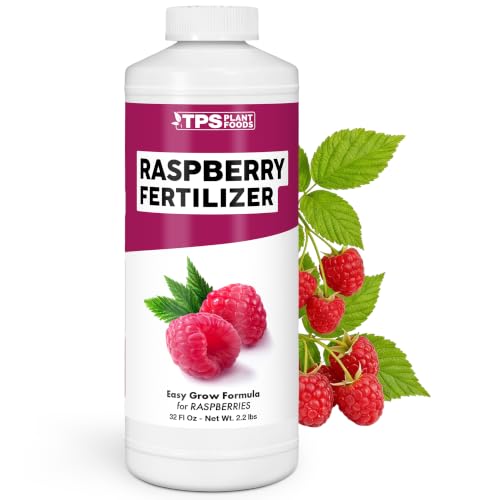
The only bottle here that names raspberries and nothing else.
This one is locked to a single target species: raspberry. Red, yellow and black raspberries all sit within its scope, in garden beds and landscapes. It is a 32 fluid ounce liquid at 2.2 pounds, with calcium and magnesium added.
Application is a soil drench — you pour it from a watering can or a hose-end sprayer. The formula’s focus is deep root development and stronger canes, with flowering and fruiting support.
The caveat is experience level. This is the narrowest pick on the list with the shortest track record, so it is best treated as a crop-specific feed you build your own schedule around.
Worth it when: your bed is planted only in raspberries and you want a feed that names only raspberries.
The catch: a 1:0:0 mixing ratio means you mix it yourself, and it is not a one-bag-fits-all product.
5. Down To Earth Organic Acid Mix 25 lb
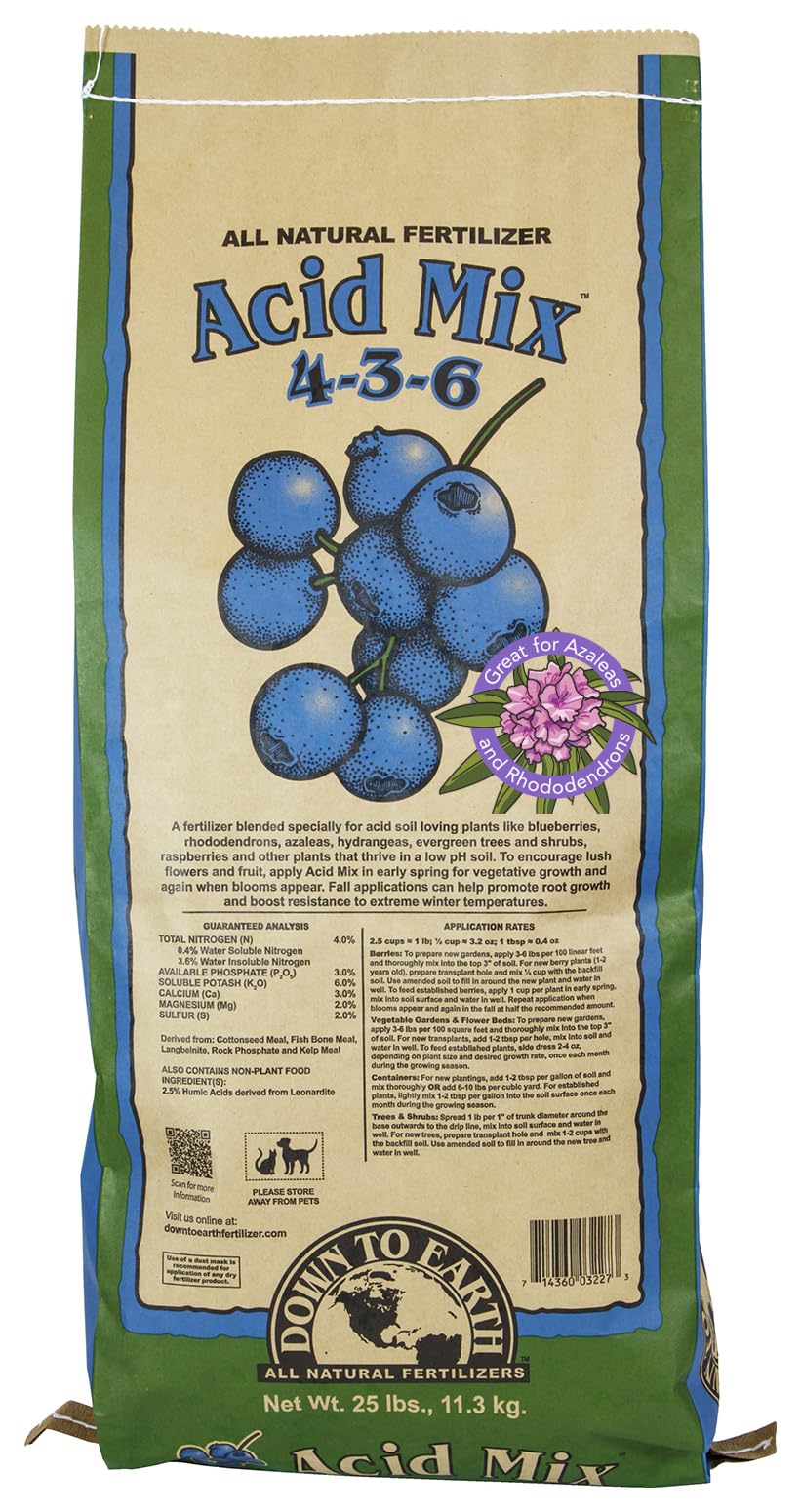
Four hundred ounces of low-pH feed for gardeners with a lot of acid lovers.
Raspberries share a shelf with blueberries, azaleas and camellias here, because all of them want low pH. This 4-3-6 granular mix sits at 400 ounces, the biggest bag on the list. Against the 128-ounce Berry Tone it is a serious step up in volume.
The feeding pattern is flexible: early spring for vegetative growth, again when blooms appear, or in fall to push root growth. Going into the ground are cottonseed meal, langbeinite, fish bone meal, rock phosphate, humates and kelp meal.
One caution worth knowing: durability depends on the bag itself, which has a mixed reputation in shipping, so check it on arrival.
Why It Stands Out
- 4-3-6 granule with a low-pH focus for acid lovers
- 400 ounces covers a large garden over seasons
One Honest Note
- Bag durability is the weak point — inspect it when it lands
Buy it if: you garden a lot of acid lovers and want the volume in one bag.
Skip the bulk if: you have a single raspberry row — the smaller bags go further for less.
Know the Specs
The Three Numbers
The N-P-K figure on the bag, such as 4-3-4, lists nitrogen, phosphorus and potassium by percentage — the first pushes leafy growth, the other two drive roots and fruit. A raspberry feed keeps the first number from running away.
Granular vs Liquid
Granules are scattered on the soil and break down slowly over weeks, while liquids are mixed into water and reach the roots in a single watering. Granules suit a whole bed; liquid suits pots and fast corrections.
Common Questions
How often should I fertilize raspberries?
Do raspberries need acidic soil?
Can I use fruit tree fertilizer on raspberries?
The Bottom Line
The best fertilizer for raspberries here is Berry Tone, because its 4-3-4 ratio with 5% sulfur is built for cane fruit and needs no mixing. If you are feeding pots rather than a bed, the Bloom City liquid does the job. And if you want a crop-specific liquid feed, the TPS Nutrients bottle has raspberries in its sights.
How we choose
We do not accept paid placement. Every pick is matched to a real buyer and a real use-case; we do not hands-on test units.
Sources
Specifications: manufacturer listings and product documentation. Review insights: verified customer reviews, as of November 2026. Pricing: not shown on this page (it changes often); check the current price via the retailer link.
As an Amazon Associate, My Heart Lives Here earns from qualifying purchases. This does not affect which products we feature.