Heads up: This post contains affiliate links. As an Amazon Associate I earn from qualifying purchases, at no extra cost to you. Learn more
Specs are compiled from manufacturer listings and verified buyer reviews and can change over time — please confirm the key details on the product page before buying.
If your deck boards drink a splash of water and turn dark within a minute, the wood is unprotected and every season makes it worse. The fix is a penetrating sealer that soaks into the grain and blocks water, not a film that sits on top and peels. That distinction separates a penetrating oil that survives a winter from a film coating you are re-coating by fall.
This guide is built by comparing the manufacturers’ published specifications and the patterns across verified customer reviews, so you get each pick’s real strengths and trade-offs instead of marketing spin.
Buying the wrong can means sanding off a failed finish next spring. To pick the right exterior sealer for wood, match the formula to your surface first. Below you will see what each can covers, how long the maker stands behind it, and where buyers report it falls short. That way you buy the right number of cans once and spend your weekend on the deck, not sanding it again.
Top Picks


How To Choose The Best Exterior Sealer for Wood
A failed sealer costs you a full re-sand, or leaves a grey deck that gets greyer while you wait for a dry weekend. Four things decide the right can: the condition of your wood now, how much grain you want to see, how much sun and rain it takes, and whether you can live with a film (a coating that sits on top of the wood) on the surface.
Oil-based versus water-based formulas
An oil-based stain and sealer soaks into the grain and leaves the texture visible underfoot. A water-based acrylic or urethane forms more of a protective skin on top and cleans up with soap and water. Oil-based products tend to smell stronger and take longer before rain is safe; water-based ones dry faster and are friendlier on a hot afternoon.
Understand what “semi-transparent” actually delivers
Semi-transparent means the manufacturer intends for you to see medium wood grain through the color. In practice, how much grain survives depends on the wood and how heavy your coat is. If you want the grain gone, buy an opaque finish and stop fighting it. If you want the grain visible, read the buyer notes before you commit.
Do the coverage math before you buy
Coverage is printed on the can as a range, and the lower number is the one to trust on rough or old wood. A can rated at 250-500 square feet can cover four times as much as one rated at 125-150 square feet. Measure the deck, divide by the low end of the range, and round up — a second trip for one more can costs a whole weekend.
Match the warranty to your structure
Deck boards take foot traffic and standing water, so makers back them for shorter periods than fences and siding. A warranty that promises five years on fences and siding but only three on decks is telling you where the product works hardest. Read the deck number as a wear forecast, not marketing.
Side-by-Side Comparison
| Model | Best For | Base / Finish | Stated Coverage | Color | Amazon |
|---|---|---|---|---|---|
| Ready Seal Stain & Sealer★ Best Overall | One-coat decks and fences | Oil-based, oil finish | 125-150 sq. feet | Dark Walnut | Amazon |
| Minwax Helmsman Spar UrethaneClearest Finish | Doors, trim and outdoor furniture | Water based, semi-gloss | — | Clear | Amazon |
| Thompson’s WaterSeal | Budget deck refresh | Waterproofing coating, semi-transparent | 150-400 ft²/gal | Natural Cedar | Amazon |
| Seal-Once Nano Clear | Clear, grain-visible protection | Water based, gloss | — | Clear | Amazon |
| KILZ Waterproofing Wood Stain | Large decks, best coverage | Acrylic, satin | 250-500 sq. ft. | Cedar Naturaltone | Amazon |
| #1 Deck Premium Solid Color | Hiding old, mismatched boards | Water-based, opaque | 100-150 sq. ft. per gallon | Simply White | Amazon |
Detailed Reviews
1. Ready Seal Stain & Sealer for Wood, 1 Gallon, Dark Walnut
Our pick — 4.5+★ from 650+ verified ratings; the strongest balance of quality and price.
One can does the staining and the sealing, and you never pick up a brush twice.
The Ready Seal can is built for people who want the deck finished by Sunday night, not next weekend. It is an oil-based stain and sealer as one product, so you skip the separate sealing step and the primer. No diluting, and no going back over wet edges with a brush — the formula is designed to self-blend so you are not chasing lap marks where one pass met the next.
One gallon covers 125-150 square feet, a modest working area, so measure a small deck or a fence run and buy accordingly. You trade coverage for protection depth: this oil finish carries UV resistance (it resists sun fading) and is meant to hold up against fading and water damage through the seasons. Owners keep coming back to the finish itself. The smooth, even result and the warm brown Dark Walnut tone are what the review pages mention most, and with a 4.5+ star score across 600+ ratings, buyers are firmly on side.
Plan for this: “semi-transparent” here is genuinely see-through in the right conditions, but not when you lay it on thick. The recurring honest note is that heavy coats darken and hide more grain than some buyers expected, so treat the first coat as the whole coat and stop there. Weight is also a surprise. The quart-sized Seal-Once below weighs 2.1 pounds, against this can’s 5.29 ounces on the listing. Read that again: the quart clear sealer is the heavier tub of the two, so check the label before you assume the gallon is heavier to carry.
What earned the top spot
- Stains and seals in a single pass, with no primer or thinning step
- Self-blending formula fights lap marks on long boards
- UV resistance and an oil base meant for full sun and rain
- Holds a 4.5+ star rating across 600+ buyer ratings
Where it asks patience
- 125-150 square feet per gallon is on the low side — a big deck needs several cans
- Heavy coats come out more opaque than some buyers want
Reach for this if: you want the whole job — color plus waterproofing — done in one afternoon on a deck, fence or set of outdoor furniture.
Size your order carefully: at 125-150 square feet per gallon, running short halfway across the deck is the most common way this job stalls.
2. Minwax Water Based Helmsman Spar Urethane, Quart, Semi-Gloss
Clear film, not color — for the front door and furniture you want to look like wood.
Some outdoor wood should not change color at all. A front door, a set of teak chairs, window trim: these want protection you can see through. That is the Helmsman job. It is a water-based spar urethane (a clear coating built to flex outdoors) that lays down a semi-gloss clear finish. The special oils in it let the coating move with the wood as temperatures swing. That is the difference between a finish that flexes and one that cracks.
The formula includes UV blockers, which are the ingredients that slow the sun’s greying and fading of bare wood. It is also formulated to bead and shed rain rather than soak it. The quart is 32 fluid ounces, a quarter of the volume you get from a gallon can like the Thompson’s below, so a whole deck is out of scope — this is a doors-and-furniture product. Drying is quick and cleanup is warm water, which owners rate as the second-best thing about it after the finish quality itself.
The next question is the sheen. Semi-gloss reflects light, and reviews split on the finish: most find it smooth and modern, while a share report a rougher surface than they wanted. The fix is usually surface prep and a thin coat, not a different product. Budget for durability too. Multiple buyers describe it holding up well over time, and the manufacturer frames it as protection against rain and moisture year-round. Still, a film finish on a door that faces full sun will want attention sooner than a shaded one.
What it does best: protects wood’s natural look with UV blockers and a flexible clear barrier, then washes out of the brush in warm water.
The trade-off to know: 32 fluid ounces is a furniture-and-trim quantity — expect to buy several quarts for anything deck-sized.
For doors, trim and outdoor furniture: this is the clear-coat pick when you want the wood grain to stay exactly as it is, just protected.
Not a deck product: the quart volume and film finish suit vertical and furniture surfaces far better than a full walking deck.
3. Thompson’s WaterSeal Semi-Transparent Wood Sealer, 1 Gallon
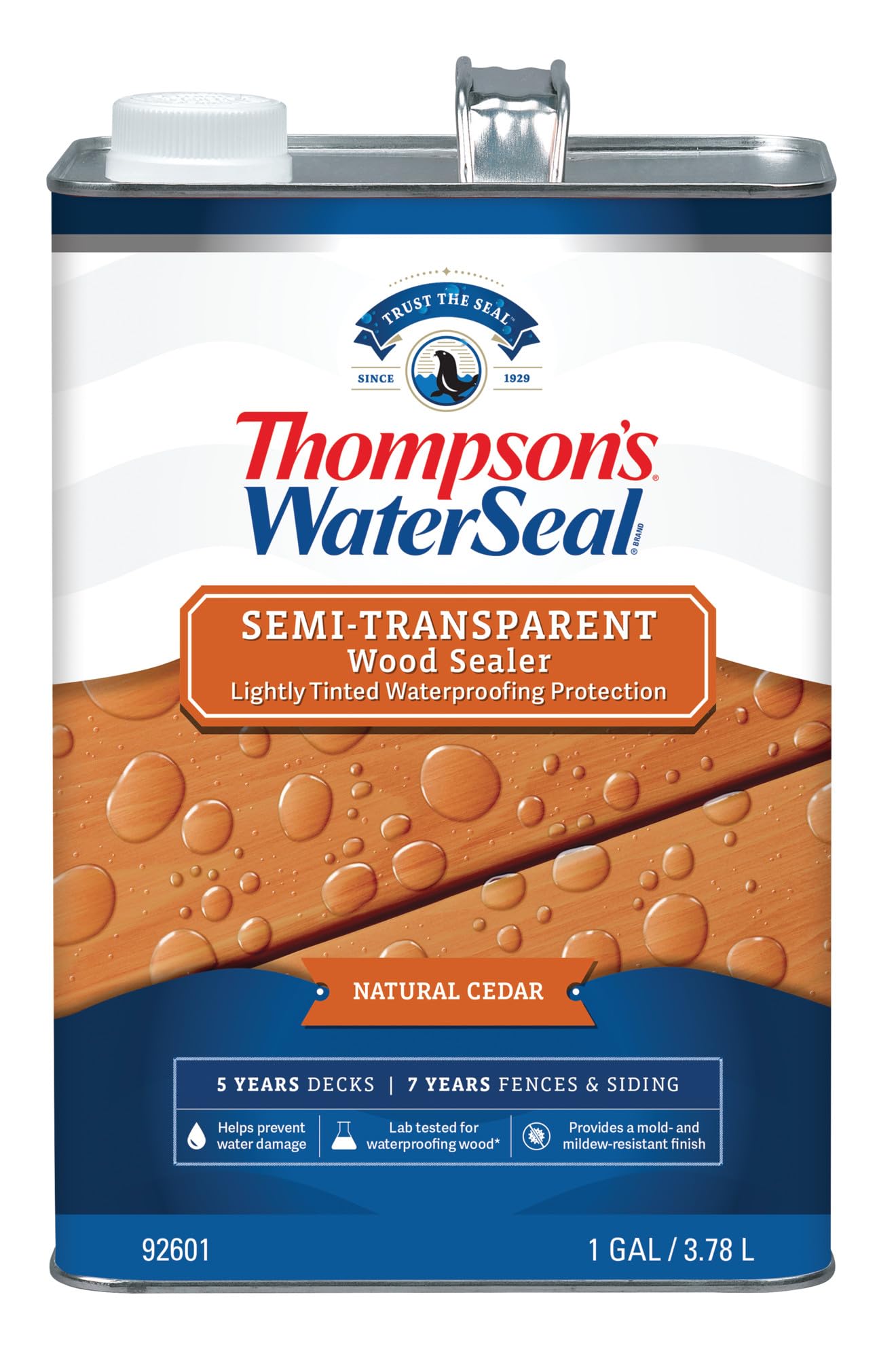
A gallon that stretches to 400 square feet and adds a cedar tint on the way through.
The label rates this can at 150 to 400 square feet per gallon, depending on how thirsty the wood is. That is the widest spread in this group, and on a smooth, previously sealed deck it lets one gallon do real work. On raw, weathered boards you will land nearer the low end. The can holds 128 fluid ounces — four times the volume of the Minwax quart above — so for a fence run or a mid-size deck this is the volume play.
It applies in a single recommended coat and is designed to resist mold and mildew on the cured surface, plus it exceeds ASTM D4446, a standard test for how well a coating sheds water. That matters in humid shade where boards never fully dry. Cleanup is soap and water, and the manufacturer backs decks for five years and fences and siding for seven. Note that this is the most-rated pick in the group at 4.5+ stars across 1,000+ ratings, so plenty of buyers have tested those claims.
Here is the honest catch, and it is a real one: this product’s own buyer feedback splits on two points — color match and longevity. Some buyers love the warm cedar tone; others find it does not land on the advertised brown. On lifespan, results vary from a full season to several years, which usually tracks back to how well the old surface was prepped. Treat it as a freshening coat on sound wood, and it rewards you; expect multi-year protection on bare or neglected boards and you may be disappointed.
Why buyers keep coming back: the easiest application in this group — one coat, soap-and-water cleanup and a mildew-resistant finish.
What to set expectations on: color lands differently from the swatch for a share of buyers, and the coating is a freshening layer rather than a permanent shield.
Reach for it when: your existing finish is sound and you want an affordable cedar-tinted refresh with the widest stated coverage of any can here.
Prep is not optional: clean and dry boards are what separate a two-season result from a five-year one.
4. Seal-Once Nano Clear Penetrating Wood Sealer, Quart
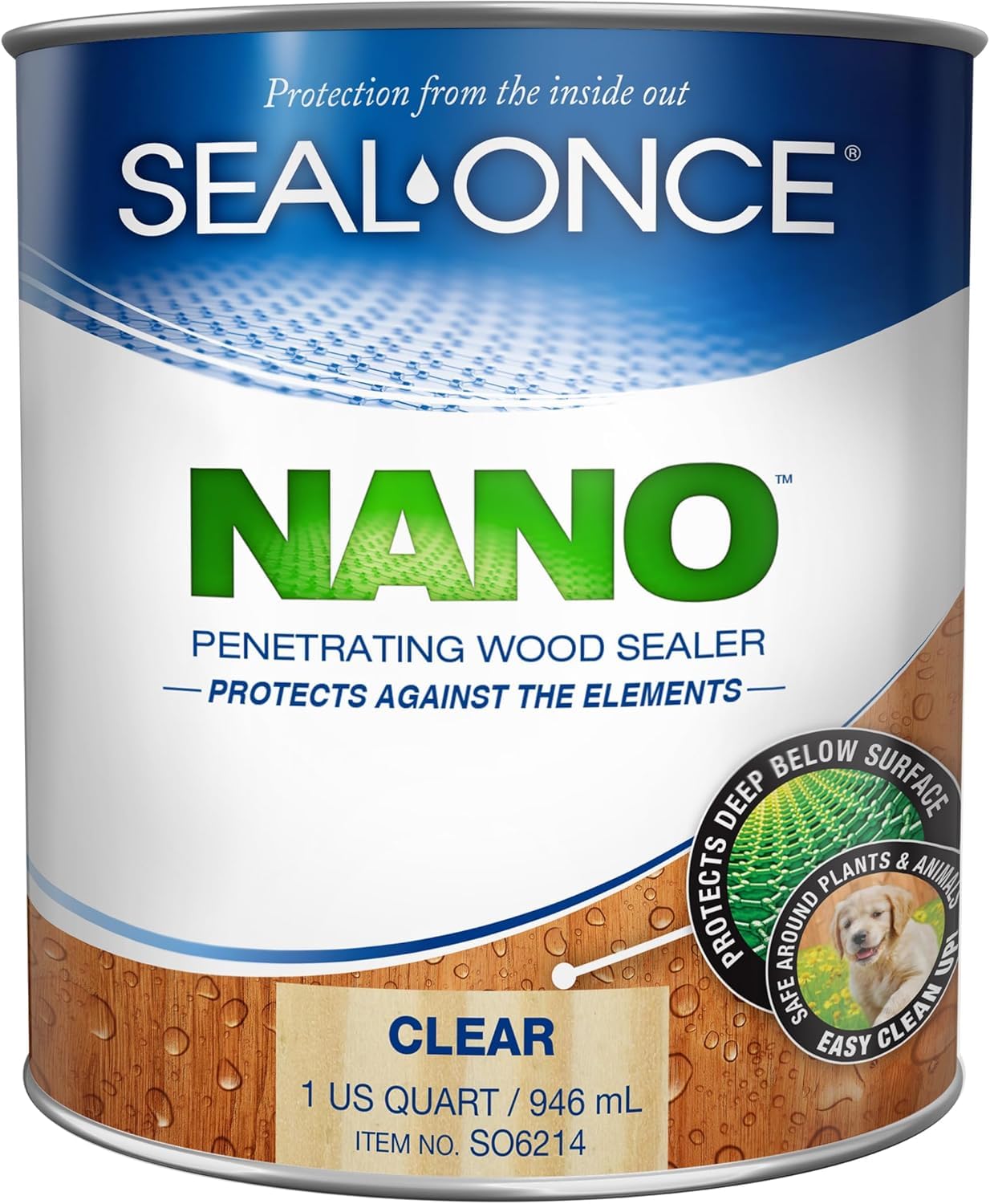
Clear, odorless and thin enough to sink in, so the timber stays timber-colored.
If you like the grey-silver look a cedar fence takes on and just want it to stop rotting, this is the one. Seal-Once goes below the surface instead of forming a topcoat, wrapping the wood fibers in a water-resistant shield while the surface continues to grey naturally. It is clear, water-based and odorless, which makes it a sane choice for a garage or a windless afternoon when an oil-based product would have you retreating indoors.
The quart weighs 2.1 pounds and measures 5 x 4 x 4 inches, so it stores on a shelf and pours easily into a small applicator. Compatible surfaces are broad: siding, log homes, swing sets, outdoor furniture, decks and fences. The ultra-low VOC profile is what lets it qualify as a friendlier option on fumes. Drying is quick, cleanup is soap and water, and the formula is UV-stable, so the coating itself is not the thing that fades.
The part that separates the fans from the doubters is longevity. Water beading up after a rain is the signature owners describe, and it shows up fast. But the reviews split hard on how long it keeps working — some describe a durable shield, others put its lifespan in weeks rather than seasons. That pattern usually points to application: a penetrating sealer must go on a dry, absorbent surface, and a second coat on thirsty wood is not a scam, it is the job. Go in expecting to reapply sooner than a film finish and you will be pleased with the result.
The standout: a clear, odorless penetrating barrier that shows off wood grain and lets the surface grey naturally, with soap-and-water cleanup.
Plan on reapplication: lifespan is the contested point here, so buy enough to touch up rather than expecting a single coat to ride for years.
Best match: log homes, swing sets and furniture where you want protection with zero color change.
Look elsewhere if: you need one application to protect a hard-traffic deck for multiple seasons without a recoat.
5. KILZ Waterproofing Semi Transparent Wood Stain, 1-Gallon

The can that covers the most ground per gallon, in a satin cedar tone.
Start with the number that decides how many trips you make: one gallon covers approximately 250-300 square feet on the first coat and 500-600 square feet on the second. Nothing else here touches that on a single can. The catch that buys it is in that sentence — KILZ expects two coats, with a 1-2 hour wait between them, so the coverage advantage depends on you applying both. From there the fully cured coating can be washed after 72 hours.
Cleanup is easy because the formula is 100% acrylic (a water-based coating you rinse with water), and acrylic resists fading. It carries UV protection plus mildew resistance, and is warrantied up to 3 years on decks and up to 5 years on fences and siding. It works on properly prepared wood with 0-10 years of exposure, including decks, shingles, patio furniture, railings, siding, shakes and fences. At 9.3 pounds and 6.63 x 6.63 x 7.65 inches, it is the heaviest can in this group. The Seal-Once quart, at 2.1 pounds, is 7.2 pounds lighter to carry up a ladder if weight is your concern.
The buyer verdict on color is warm: owners describe the finish as looking better than the bare boards did before, and that is the aspect that gets brought up most. The honest wrinkle is transparency — several owners mention it goes down more opaque than “semi-transparent” led them to expect, so if showing grain matters to you, test a hidden board first. Longevity also splits, with some getting multiple seasons and others wanting more. Given the 4.5+ star rating, the finish quality itself is not in question.
Where it wins: 250-300 square feet on coat one and 500-600 on coat two is the best coverage claim of any can reviewed here.
The fine print: that coverage assumes two coats — and the finish reads more opaque than the semi-transparent label suggests.
Pick it for: a large deck or long fence line where fewer cans means fewer trips to the store.
Test first if grain matters: brush a sample board to confirm the opacity lands where you want it.
6. #1 Deck Premium Advanced Solid Color Wood Stain and Sealer, 1 Gal

Full white coverage that erases mismatched boards instead of highlighting them.
Some decks are beyond saving with a tint. Boards from different batches, old patch jobs, a fence that was already stained twice — these call for opacity, not transparency. This #1 Deck product is an opaque finish with UV protection, and it covers the wood grain entirely while guarding against fading, greying, peeling and mildew. It is the only solid-color option in this group, and that is the whole reason it is here.
Two coats cover 100-150 square feet per gallon, which is the smallest coverage figure reviewed here — plan for that on a big deck. What you get in return is a low-odor, water-based formula with low VOCs under 60 g/L, soap-and-water cleanup, and a matte finish. It can go over existing solid stains that still have good adhesion, which saves a full strip-back on a deck that has held its coating. It works on pressure-treated lumber, fir, redwood and mahogany, horizontally and vertically. With 4.0+ stars across 80+ ratings, this is the most lightly reviewed pick in the group — fewer voices, but the direction is clear.
This pick is not about quality; it is about if you want to see wood at all. Buy it when the grain is the problem and an even, solid white surface is the goal. If you want the warm brown transparency that the Ready Seal delivers, this is exactly the wrong can. Six solid colors exist in the line, so Simply White is a style choice, not the only option.
What it solves: mismatched, patched or over-stained boards that a semi-transparent product would just highlight in different shades.
What you give up: the grain, entirely — plus the smallest coverage of the group at 100-150 square feet per gallon over two coats.
Made for: someone who wants a clean, solid-color deck and is happy to bid the wood grain goodbye.
Wrong tool if: you want the grain visible or you are covering a large deck without buying extra cans.
Know the Specs
Coverage per gallon
The square-foot range on the label tells you how far one can stretches, and the low number is the honest one for rough or bare wood. A range like 250-500 square feet means the high figure assumes a smooth surface and the low figure assumes thirsty boards. Always divide your deck’s square footage by the low number of the range and round up. Running out mid-job leaves a visible seam where the new can starts.
Film-forming versus penetrating
A film finish — a urethane or an opaque acrylic — sits on the surface and shields the wood. A penetrating sealer soaks in and protects from within, leaving no skin to peel. Films generally give more weather resistance but demand more surface prep. Penetrating products are forgiving on application and keep the grain honest, but they tend to need recoating sooner. Neither is better — your surface decides: film for maximum weather resistance, penetrating for grain and easy application.
Stated warranty as a wear forecast
When a maker backs decks for fewer years than fences and siding, that gap is a signal about foot traffic and standing water. Read the deck number, not the headline. It tells you how long the coating is expected to hold on the surface that takes the most punishment.
UV protection and fade resistance
Sun is what turns bare wood grey and fades a colored finish. UV blockers and UV-resistant formulas are the ingredients that slow it. On a south-facing deck or fence, prioritise products that name UV resistance directly on the label, rather than assuming any sealer handles sun.
Common Questions
Can I put a sealer over a deck that already has an old stain on it?
What is the difference between semi-transparent and opaque wood stains?
How long should I wait between coats of exterior wood stain?
Will a sealer stop my deck from going grey?
How long does exterior wood sealer actually last?
Can I apply a water-based sealer over an oil-based stain?
How much sealer do I need for a 12×12 deck?
Do I need to sand before sealing a weathered deck?
Is a clear sealer better than a colored stain and sealer?
How soon can rain hit a freshly sealed deck?
The Bottom Line
For most people sealing a deck, fence or outdoor furniture, the Ready Seal Stain & Sealer is the right call. It stains and waterproofs in one pass, self-blends away lap marks (the darker lines where coats overlap), and carries the highest rating in this group at 4.5+ stars. If you need a clear finish that keeps the grain visible on doors and trim, the Minwax Helmsman Spar Urethane is built for exactly that. And if you are coating a large deck and want the fewest cans per square foot, the KILZ Waterproofing Wood Stain stretches the furthest per gallon, just plan for its two-coat application. Whichever you pick, prep the boards and buy by the low end of the coverage range. Prep the boards and buy by the low end of the coverage range, and the finish lasts.
How we choose
We do not accept paid placement. Every pick is matched to a real buyer and a real use-case; we do not hands-on test units.
Sources
Specifications: manufacturer listings and product documentation. Review insights: verified customer reviews, as of November 2026. Pricing: not shown on this page (it changes often); check the current price via the retailer link.
As an Amazon Associate, My Heart Lives Here earns from qualifying purchases. This does not affect which products we feature.