Heads up: This post contains affiliate links. As an Amazon Associate I earn from qualifying purchases, at no extra cost to you. Learn more
Specs are compiled from manufacturer listings and verified buyer reviews and can change over time — please confirm the key details on the product page before buying.
If you are caring for someone with a pressure sore on the tailbone or lower back, the dressing you pick decides how often you have to disturb the wound, whether a shower ruins your morning, and whether the person you care for has to look at the damage every time the sheets are changed. The short answer: a bordered foam dressing cut for the sacrum (the triangular pad that sits over the base of the spine) does the most work per change, and the ALLEVYN Life in the 5″ x 5″ box is the one to beat. The rest of this list covers the jobs foam cannot do: a clear film for intact skin and IV sites, a silver foam for heavier drainage, and an alginate pad for deep, wet wounds that need something to gel up inside them.
This guide is built by comparing the manufacturers’ published specifications and the patterns across verified customer reviews, so you get each pick’s real strengths and trade-offs instead of marketing spin.
You will see exactly which dressing suits which wound stage, how the shapes differ, and where each one falls short before you commit. Everything below comes from the makers’ own spec sheets and what long-term carers actually report, so the right pick for dressings for bed sores lands in your hands on the first order.
Top Picks


How To Choose The Best Dressings for Bed Sores
A bed sore (also called a pressure ulcer or bedsore) is skin and tissue damage caused by staying in one position too long, and it most often lands on the sacrum, heels and hips. The dressing you choose has to do three jobs at once: hold drainage away from the skin, keep the wound bed moist so it can heal, and stay put when a person shifts, is turned, or is helped to the bathroom. Get one of those wrong and you are back changing it every few hours.
Match the shape to where the sore sits
The sacrum is not flat. It curves, and it takes body weight when someone lies on their back. A quadrilobe shape — four rounded corners built around a wide border, as on the ALLEVYN Life — is drawn to follow those body contours so the pad does not lift at the edges when the person turns. A flat rectangle on the same spot tends to wrinkle and peel first at the corners. If the wound is elsewhere, on a limb or a surgical line, shape matters far less than the size of the absorbent centre.
Decide how wet the wound is, then pick the layer
A lightly oozing or intact area needs a thin barrier, not a thick pad. A clear polyurethane film (a see-through plastic sheet), like the 6″ x 8″ sheets here, seals over the skin and lets you watch the site without pulling anything off. A wound that weeps steadily needs a foam core to hold that fluid: the Dimora pad carries a foam layer and a semi-permeable film backing (a film that blocks liquid but lets air through), and the EVERLIT pad builds five layers to spread, absorb and lock drainage away. For a deep, heavily draining cavity, an alginate pad (a seaweed-based pad that turns to gel) such as the LotFancy dressing turns into a soft gel as it soaks, which fills the space instead of sitting on top of it.
Check the border, the backing and the change interval
A bordered dressing seals on all four sides, which is what lets a person take a short shower without the pad floating off. An unbordered pad is placed over the wound and needs a separate tape or film to hold it. Ask yourself how often you are willing to redo it: a pad rated to hold fluid under pressure lasts longer between changes, and fewer changes means less trauma to raw skin. Where skin is fragile, a silicone contact layer is the gentler choice — the Dimora and EVERLIT pads both use silicone against the wound, so the adhesive grabs dry skin at the border rather than the moist centre.
Side-by-Side Comparison
| Model | Best For | Dressing Size | Pads Per Pack | Backing / Contact Layer | Amazon |
|---|---|---|---|---|---|
| Smith+Nephew ALLEVYN Life★ Best Overall | Sacrum and body-contour pressure sores | 5″ x 5″ | 10 | Waterproof film with wide border | Amazon |
| Waterproof Transparent Film DressingBest Value | Intact skin, IV sites and shower cover | 6″ x 8″ | 20 | Adhesive polyurethane film | Amazon |
| Dimora Ag Silver Sacrum Foam | Stage 1-4 sacrum sores with thicker drainage | 7″ x 7″ border (foam pad 5.5″ x 4.9″) | 5 | Semi-permeable PU film over silicone | Amazon |
| LotFancy Calcium Alginate | Deep, wet, exuding wounds that need gelling | 4″ x 8″ | 10 | Non-adherent alginate pad | Amazon |
| EVERLIT Sacrum Silicone Foam | Large sacrum coverage with cushioning | 9″ x 9″ | 10 | 5-layer build, silicone contact layer | Amazon |
Detailed Reviews
1. Smith+Nephew ALLEVYN Life Wound Dressing 5″ in X 5″ in
Our pick — 4.5+★ from 750+ verified ratings; the strongest balance of quality and price.
The four-lobed pad that hugs the curve of a lower back instead of fighting it.
The shape is the whole argument here. This is a quadrilobe dressing — four rounded lobes set around a wide border — built to follow body contours so the edges stay down on a curved sacrum. Each pad is 5″ x 5″, and the box holds 10. That wide border is also what allows a patient to shower with it in place, which changes the daily routine more than any other single feature on this list. For a person on long-term bed care, a dressing that survives a shower is a dressing that lasts.
What it does underneath matters just as much. The protective masking layer is designed to limit the visual impact of strikethrough — the moment drainage soaks far enough through a pad to become visible from outside. That is a quiet feature with a loud effect on dignity: the person wearing it is not advertising their wound to every visitor. The dressing also locks fluid under pressure and absorbs common wound odour when tested, so a loaded pad does not announce itself across a room.
What wins carers over, more than any other trait, is the build quality, with effectiveness right behind it. It holds on through turning and bending, it is comfortable across repeat changes, and the cushioning is real padding without being bulky under a sheet. The honest catch is cost: value is the one place opinion splits, and a box of 10 at this tier asks you to commit. If the sore is small and dry and you are changing rarely, a cheaper film may be enough. If it is a sacrum wound in daily use, this is the one that keeps its word.
Where it earns its place
- Quadrilobe shape made to sit on the sacrum’s curve — 5″ x 5″ pads, 10 to the box
- Masking layer limits visible strikethrough so drainage stays hidden
- Wide border lets the patient shower with the dressing on
- Holds fluid under pressure and absorbs common wound odour
- Cushioned without bulk, and comfortable across repeat changes
What to weigh first
- Value is the split opinion — this sits at the upper end for a 10-pack
- Overkill for a small, dry area that only needs a thin film
Reach for this if: the sore is on the tailbone or lower back and you want fewer changes, fewer leaks and shower-proof wear.
Pass it by if: the site is intact skin or a small dry patch — a clear film covers that job for far less.
2. Waterproof Transparent Film Dressing 6″ x 8″
Twenty clear sheets that let you watch a sore heal without touching it.
Count is the reason this one is here. You get 20 individually packed 6″ x 8″ sheets against 5 pads in the Dimora box — four times the number of dressings for the same shelf space. Each sheet is a thin adhesive polyurethane film with a release paper backing, and the latex-free adhesive is made to lower the chance of skin irritation. Cut or used whole, one sheet covers a sacrum or a surgical line easily.
The clear film is doing two things at once. It holds a moist environment over the area, which is what a healing wound bed wants, and it lets you look straight through to check the site without lifting a pad and breaking the seal. Water beads off it, so a quick shower is fine — the maker is clear that prolonged soaking is not what it is for. It is also elastic enough to move with skin at the hip or shoulder rather than tugging at the edges.
Adhesion is where you need to be careful, and it is the most-discussed topic around this product. The split runs both ways: plenty of sheets hold a whole area securely, and a share of buyers report they lift early. The irritation reports run the same mixed line: mostly no itching, occasionally burning or blistering. The maker’s own instruction explains it: do not stretch the film as you apply it, because stretched film pulls back and irritates the skin. It is also not meant to go straight onto a deep or heavily weeping wound; put gauze or a non-woven pad underneath first. Apply it calmly, on dry skin, and it behaves.
The daily-use case: for protecting intact skin at risk of breaking down, holding a pad in place, or covering an IV site, a clear 6″ x 8″ sheet you can see through and change cheaply is the practical answer, and 20 in a pack means you are not rationing.
The trade-off to plan around: this is a cover, not a cushion. It will not absorb drainage on its own, so any weeping sore needs an absorbent pad underneath before the film goes on.
Right pick for: intact or lightly broken skin you want to keep an eye on, and any sore that needs a pad held down through a shower.
Not the tool for: a deep, heavily draining wound — those need an absorbent layer first, with the film only as the outer seal.
3. Dimora Ag Silver Sacrum Foam Dressing 7″x7″

A sacrum-shaped foam with silver built into the pad and silicone where it touches skin.
Start with the layer that touches the wound. This dressing uses a silicone contact layer at the wound face, which will not cling to a moist wound bed but still grips dry skin at the border. That combination matters when you are changing a dressing on raw, fragile tissue day after day — the pad lifts away instead of tearing. The foam core holds up to 15 times its weight in fluid and cushions the site, while the semi-permeable polyurethane film outside lets oxygen and water vapour pass but blocks liquid. The 7″ x 7″ border surrounds a foam pad of 5.5″ x 4.9″, so it sits as a proper sacral island.
The silver is the differentiator. The foam layer contains roughly 0.25 to 0.35 mg of silver per square centimetre and releases silver ions (tiny charged silver particles) into the dressing as wound fluid arrives. In plain terms, that is a built-in barrier against bacteria colonising the pad, which is why it is indicated for Stage 1 through Stage 4 sacrum bedsores, pressure ulcers, surgical incisions and skin tears. It is used in hospitals, senior care homes and hospices, and the quality and effectiveness scores reflect that: carers who have handled a lot of these rate it as a serious piece of kit rather than a home-care stopgap.
Where it asks for patience is wear time. Adhesion divides opinion, and the recurring note is that some pads hold firm while others start to let go after three or four days — so plan your change schedule around that rather than expecting a full week. Size also splits: some find the 7″ x 7″ border generous, others find it longer than their incision needs. The five-pad box is small, so keep a second box on hand rather than running out mid-week.
What the silver buys you: a barrier layer inside the dressing itself, aimed at keeping bacteria from settling into the pad — useful when a sore is being managed over weeks rather than days.
Set your expectations on wear time: treat three to four days as the working window and you will not be caught out by an edge lifting.
Fit for: a Stage 1-4 sacrum sore with thicker drainage where you want cushioning, a silver barrier and a silicone contact layer in one pad.
Look elsewhere if: you need a flat pad for a limb wound or a quick, cheap cover — the sacral shape and the five-pad box both work against that.
4. LotFancy Calcium Alginate Wound Dressing 4”x8”
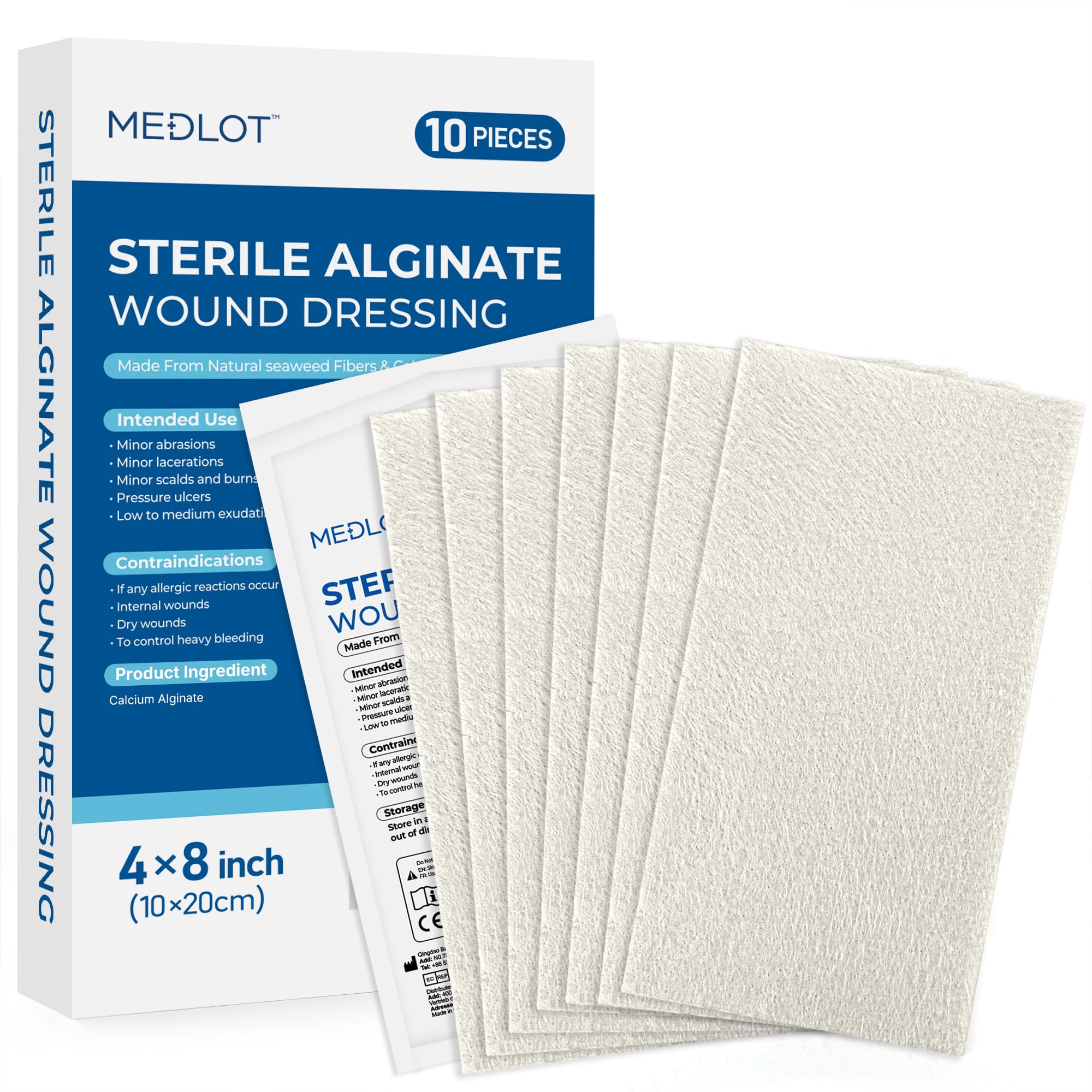
Ten pads of seaweed fibre that turn to gel and lift away without pulling.
This pad is made from natural seaweed fibre — alginate — with calcium ions, and that material does something a foam cannot: as it meets wound fluid it forms a soft hydrophilic gel over the wound bed. The effect is a moist healing environment that stays put rather than drying out. The maker rates the pads as up to 20 times more absorbent than regular gauze and softer and more flexible, so they mould to a curved or awkward site instead of bunching.
Size and weight tell you how it handles. Each pad is 4″ x 8″, sterile and individually wrapped, and the whole 10-pad pack weighs 4.16 ounces — against 15.84 ounces for the 9″ x 9″ EVERLIT box, which is the lightest-to-heaviest spread on this list. That flat, thin profile matters because these pads are meant to sit inside a cavity or over a wet wound and be held by a secondary dressing, not to carry their own adhesive border. Because they are non-adherent, they do not stick to the skin, so removal does not scrape a raw bed. Trim them with scissors to fit the site.
Their strength is on wounds that are actually wet. Moderate to high exudate (wound fluid) is the balance: chronic or acute weeping wounds, diabetic and leg ulcers, pressure sores, surgical incisions and burns. Value is the standout here: buyers consistently call these good value and say they would buy again. The catch is that an alginate pad needs a cover over it and does nothing for a dry wound; on a dry sore it will simply sit there. And because it holds so much fluid, do not leave it past the point where it has gelled through.
The job it is built for: soaking up heavy drainage in a deep or weeping sore while keeping the bed moist, then coming away cleanly without disturbing new tissue.
The catch: it has no adhesive of its own and no place on dry skin — you will need a film or bordered pad over the top to hold it down.
Buy it when: the sore is deep or draining heavily and you want a pad that gels, cushions and removes without pain.
Skip it when: the wound is dry or shallow and needs a self-sticking bordered dressing instead.
5. EVERLIT Sacrum Silicone Foam Dressing, 9″ x 9″, 10 Pack

The biggest pad on the list, for a sacrum sore that needs a wide cushion around it.
At 9″ x 9″ this covers a lot of ground, and the 10-pack weighs 15.84 ounces, the heaviest box here by a wide margin against the 4.16-ounce LotFancy pack. That bulk is the point: five layers stacked to do separate jobs. A silicone layer sits against the skin for gentle hold, a super-absorbent layer takes and keeps drainage, a non-woven spreading layer pushes fluid outward to use the whole pad, a foam layer soaks up what is left, and a breathable film on top forms a waterproof barrier against germs and dirt. Every pad is individually wrapped and produced under aseptic conditions (clean, germ-controlled conditions).
For a sore that has spread across the lower back, that big footprint means the edges sit on healthy skin rather than on the wound itself. The multi-layer centre cushions the site and controls humidity, which limits maceration — the white, waterlogged skin that forms around a wound kept too wet. The hypoallergenic, latex-free border seals on all sides. The maker lists it for moderately exudating sacrum bedsores, surgical incisions, pressure ulcers, neuropathic and arterial ulcers, skin tears and burns.
The honest limiting factor is stickiness. Adhesion is the most discussed trait here and it splits almost down the middle: some pads hold well, and a share of them keep coming off, which is a real problem on a site that takes body weight. Prep the skin dry and press the border firmly, and check the edges at every turn. Size is the other reason people like it: the coverage lets one pad do the work of two smaller ones. If you need a guaranteed stick on a wriggling patient, the bordered ALLEVYN above is the steadier bet; if you need width and cushioning, this is the one.
Where the size pays off: a 9″ x 9″ island keeps adhesive on healthy skin and lets the cushioned core do its work over a broad, weeping sacrum sore.
The catch to manage: adhesion is genuinely mixed on this pad, so budget for edge checks and dry, firm application rather than assuming it will stay for days.
Choose it for: a large sacrum sore where wide coverage and five-layer cushioning matter more than a smaller footprint.
Think twice if: the person shifts a lot and you need the surest hold — the bordered ALLEVYN holds its edge more reliably.
Know the Specs
Sacrum shape and border width
A sacrum dressing is cut to sit over the base of the spine, where the skin curves and takes body weight. The border is the adhesive ring around the absorbent centre, and it is what seals the pad on all four sides. The ALLEVYN Life’s quadrilobe border (a four-lobed shape) and the Dimora’s 7″ x 7″ border with a 5.5″ x 4.9″ foam pad are two ways of doing the same job. A wider border means more adhesive on healthy skin and less chance of the centre lifting when the person is turned.
Absorbency and the backing film
Absorbency is how much drainage a pad holds before it has to be changed; the Dimora foam rate up to 15 times its weight and the alginate pads up to 20 times against regular gauze. The backing is the outer layer, and a semi-permeable film lets oxygen and water vapour out while keeping liquid and germs out. That is what makes a shower possible without soaking the wound. A pad that holds fluid under pressure lasts longer between changes, which matters because every change disturbs raw tissue.
Silicone versus adhesive film
A silicone contact layer sits against the wound and releases without pulling, while the border grips dry skin — that is the setup on the Dimora and EVERLIT pads. A plain adhesive film, like the transparent 6″ x 8″ sheets, sticks directly to skin and stays for as long as the skin tolerates it. Silicone suits fragile or repeated-change sites; adhesive film suits intact skin and quick cover.
Silver in the pad
Silver-containing foams release silver ions into the dressing as wound fluid arrives, which limits bacteria settling into the pad. The Dimora’s foam layer carries roughly 0.25 to 0.35 mg of silver per square centimetre. Silver changes the pad’s chemistry, not its absorbency — you still pick by wound wetness and site shape first.
Common Questions
Can a sacrum foam dressing be used on a bed sore on the heel or hip?
How often should I change a dressing on a pressure sore?
Can the person shower with a waterproof dressing on a bed sore?
What is the difference between a foam dressing and a calcium alginate pad?
Do I need a silver dressing for every bed sore?
Should I put a clear film dressing directly on an open bed sore?
Can I cut a foam or alginate dressing to fit the sore?
Why does a waterproof dressing sometimes cause redness or blistering?
Is a thicker foam dressing better for preventing a sore getting worse?
The Bottom Line
The strongest all-round pick for Dressings for Bed Sores is the Smith+Nephew ALLEVYN Life, because its quadrilobe 5″ x 5″ shape is drawn for the curve of the sacrum, its masking layer keeps drainage out of sight, and its wide border survives a shower. If the sore is on intact or lightly broken skin and you want to watch it without disturbing it, the Waterproof Transparent Film Dressing gives you 20 clear 6″ x 8″ sheets to do that cheaply and safely. For a Stage 1-4 sacrum sore with thicker drainage, the silver foam in the Dimora adds a barrier layer and silicone contact in one pad. For a deep, wet wound that needs gelling and pain-free removal, reach for the LotFancy alginate pads. And when you need the widest padded coverage on the list, the 9″ x 9″ EVERLIT box does that job; just check the edges at every turn. Buy one for the shape you need, keep a film pack on the shelf, and you will not be caught mid-week without a dressing.
How we choose
We do not accept paid placement. Every pick is matched to a real buyer and a real use-case; we do not hands-on test units.
Sources
Specifications: manufacturer listings and product documentation. Review insights: verified customer reviews, as of November 2026. Pricing: not shown on this page (it changes often); check the current price via the retailer link.
As an Amazon Associate, My Heart Lives Here earns from qualifying purchases. This does not affect which products we feature.