Heads up: This post contains affiliate links. As an Amazon Associate I earn from qualifying purchases, at no extra cost to you. Learn more
Specs are compiled from manufacturer listings and verified buyer reviews and can change over time — please confirm the key details on the product page before buying.
You do not need a plumber or a chemistry degree to get clean water at every tap. What you need is a system sized to your water problem — whole-house for chlorine and sediment, under-sink for lead and PFAS, or a countertop unit when you rent and cannot touch the pipes.
This guide is built by comparing the manufacturers’ published specifications and the patterns across verified customer reviews, so you get each pick’s real strengths and trade-offs instead of marketing spin.
Below, each pick is judged on its filter stages, gallon capacity, flow rate, and how honestly simple the install really is, so you can match a diy home water filtration system to your own sink in minutes.
Top Picks

How To Choose
Three numbers decide almost everything about which system belongs in your home.
Where the water needs fixing
A whole-house unit treats every tap, shower and appliance at once, while an under-sink or countertop model treats only the drinking water you actually pour.
Filtration depth
Carbon blocks and ultrafiltration membranes (a fine mesh that traps particles down to a stated micron size) handle chlorine and sediment, while a reverse osmosis membrane is the stage that pulls dissolved solids out.
Capacity versus filter life
A 100,000-gallon rating with a one-year filter cycle means very different upkeep than a 600-gallon cartridge rated for 12 months.
Side-by-Side Comparison
| Model | Best For | Capacity | Filter Life | Install Type | Amazon |
|---|---|---|---|---|---|
| iSpring WGB32B★ Best Overall | Whole home | 100000 gallons | 1 years | DIY | Amazon |
| Waterdrop G3P800Top Performer | Big families | 800 gallons | — | Under Sink | Amazon |
| Waterdrop TST-UFFast Flow Pick | Fast flow | 8000 gallons | 24 months | Under Sink | Amazon |
| Purewell 1.0 Gallon | Camping and RV | 1 gallons | — | Countertop | Amazon |
| iSpring WCB32C-GAC | Clear housing | 30000 gallons | 6 months | Under Sink | Amazon |
| Brondell Coral UC300 | Replacement filters | 600 gallons | 12 months | Under Sink | Amazon |
| AquaTru Glass Carafe | No plumbing at all | 4 pounds | 6 months | Countertop | Amazon |
| Aquasana AQ-MF-1 | Existing faucet | — | — | Under Sink | Amazon |
| Brita Hub | Renters | 96 fluid ounces | 6 months | Freestanding | Amazon |
Detailed Reviews
1. iSpring WGB32B Water Filter System
Our pick — 4.5+★ from 2,000+ verified ratings; the strongest balance of quality and price.
One filter set that treats every shower and tap in the house for a full year.
This is the pick for a homeowner who wants chlorine gone from the shower as well as the glass. It carries a 100,000-gallon capacity and a one-year filter cycle, with 20″ x 4.5″ cartridges feeding 1″ NPT inlet and outlet ports up to 15 GPM — enough that laundry and showers run at the same time without a pressure drop.
Three stages do the work: a 5-micron sediment filter, then two coconut-shell carbon block filters tested to NSF/ANSI standards. What wins people over is the sheer quality of the build, and the water quality, taste and odor results follow close behind. It weighs 45 pounds, so plan a second pair of hands.
The recurring gripe is leakage at the manifold and canister threads — tape them properly and check the fittings after the first day.
Holds up over a year
- Keeps minerals in, unlike an RO stage
- 15 GPM keeps whole-house pressure high
Watch the joints
- Thread sealing matters — check for drips
Reach for this if: you own your home and want one install to cover every tap.
Look elsewhere if: you rent — this is a plumbing job, not a countertop swap.
2. Waterdrop G3P800 Water Filter System
Ten filtration stages in a tankless box that tucks under the sink.
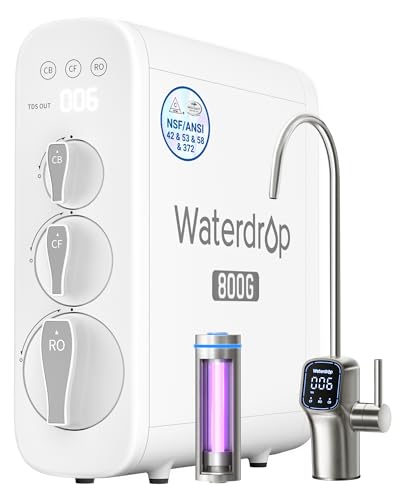
Where the iSpring leaves dissolved solids alone, this one removes them. Its 10-stage reverse osmosis setup is tested to NSF/ANSI 42, 53, 58 and 372 and rated at 800 GPD, and the tankless body keeps the cabinet floor clear. A 3:1 pure-to-drain ratio means one cup of wastewater for every three of drinking water, and a cup fills in about 5 seconds.
The smart faucet shows TDS and water quality at a glance, which spares you guessing whether the membrane is still working.
The honest catch is reliability and running cost — the pump is the part that fails, and the long-term maintenance adds up.
Best for the big household: 800 GPD of genuinely purified water beats any pitcher.
Count the upkeep: plan on filter and membrane costs as part of ownership.
The spec that sells it: 10 stages and 800 GPD in one tankless unit.
Budget note: the faucet and pump are the premium you pay for.
3. Waterdrop TST-UF Water Filter System
Six layers of lead-free 304 stainless steel that never make you wait for water.
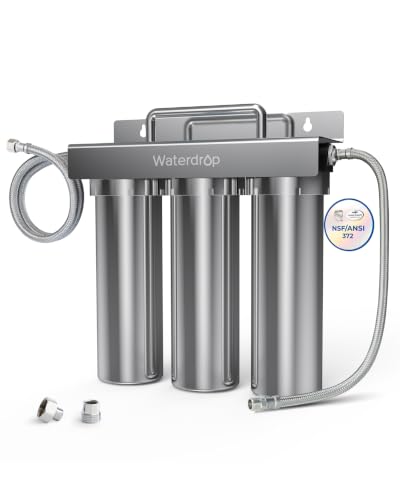
An ultrafiltration membrane traps impurities larger than 0.01 microns (a fine mesh for particles big enough to cloud water), and this system keeps minerals rather than stripping them. You get a 2.5 GPM flow rate and an 8,000-gallon capacity, with the PP stage lasting 6-8 months, the UF stage a year and the CT stage 12-24 months. It hooks to 3/8″ or 1/2″ pipes with no drill.
The install wins the most praise by a clear margin, and the fast, steady flow is the thing people notice day to day.
It cannot reduce TDS, so do not buy it expecting reverse-osmosis results.
Built to go under the counter
- 2.5 GPM fills a pot quickly
- Hangs on the wall or sits on the floor
Know before you buy
- Leaves dissolved solids untouched
Suits you if: your water is municipal and you want mineral retention at speed.
Not for you if: you need dissolved solids removed — that calls for RO.
4. Purewell 1.0 Gallon Portable Gravity Water Filter System
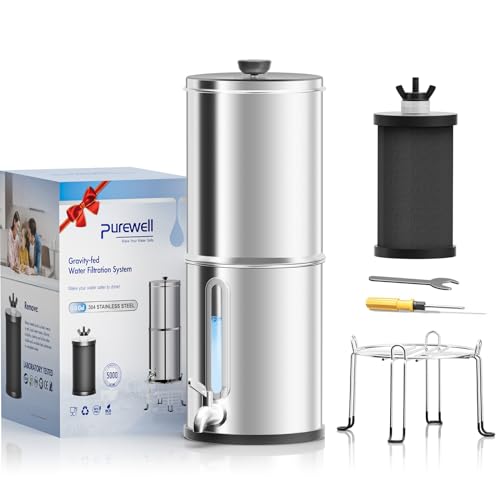
Gravity does the pumping, so this one works on a campsite with no outlet in sight.
Fill the upper chamber and clean water collects below — no power, no plumbing. The 0.01μm hollow fiber ultrafiltration membrane plus a silver ion membrane and activated carbon block bring a 2nd-generation carbon wall for longer contact time. The carbon filter is NSF/ANSI 42 certified and NSF/ANSI 372 certified, and one filter is rated for up to 5000 gallons. A window in the stainless steel body lets you see the level without lifting the lid.
Running costs go the other way here — the filter is cheap to replace and the water tastes clean. Some units arrive dripping, and the filtering pace divides people depending on how much they are filling.
Its whole point: 5000 gallons of filter life with no electricity required.
Set your patience: it is a gravity system, so plan ahead on a full jug.
Your pick if: you camp, RV or want backup water without a power source.
Second thought if: you need gallons on demand at a kitchen tap.
5. iSpring Whole House Water Filter System
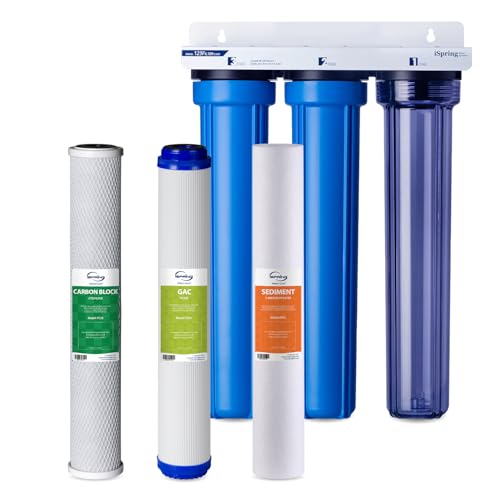
You can watch the sediment collect before you ever need to guess.
The transparent first-stage housing is the reason to pick this one over its sibling. A 5-micron PP sediment filter does the catching, then a granular activated carbon stage tackles chlorine, PFAS, THMs, radon, chloramine and H2S, and a CTO stage mops up what is left. Capacity runs 30,000 gallons with a six-month cycle — enough for a family of four.
Water quality and taste both land strongly positive, and the chlorine taste disappearing is the change people notice first. It has the same thread-leak reputation as the brand’s bigger unit, so seal the inlet and outlet carefully.
See it working
- Clear housing shows filter condition
- Three stages cover GAC and CTO
Fit with care
- Inlet and outlet threads need proper sealing
Reach for this if: you want to see dirt building up before flow drops.
Think twice if: 30,000 gallons over six months means more changes than the 100,000-gallon model.
6. Brondell Coral UC300 Under Sink Water Filtration System
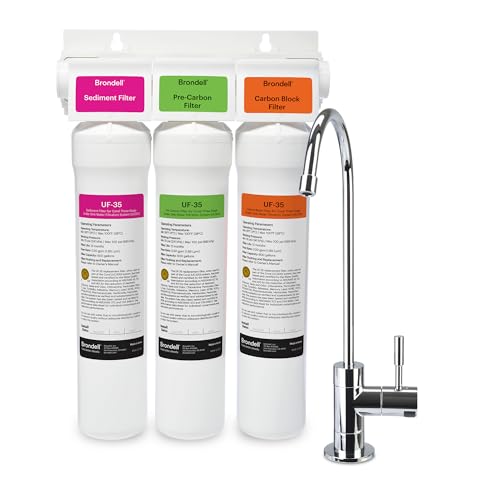
A dedicated chrome tap and three stages that keep what your body needs.
The Coral runs a sediment filter, a pre-carbon filter and a carbon block, pulling out PFAS, lead and chlorine while leaving beneficial minerals in place. The filters are rated 600 gallons over 12 months, sealed with a double O-ring to hold back drips. It is Gold Seal-certified by the Water Quality Association and certified for NSF/ANSI 42, 53 and 372 plus CSA B483.1 for Lead.
Installing it is the standout — 176 of the mentions land on that aspect, and filter changes are quick. Water clarity and the faucet’s looks round it out nicely. A handful of owners do get a drip over time, so check the O-rings.
Taste and clarity: three stages keep minerals while pulling chlorine and lead.
Space note: a dedicated faucet means one extra hole in the counter.
Your pick if: you want a separate filtered tap and cheap replacement filters.
Pass if: drilling a faucet hole is off the table.
7. AquaTru Glass Carafe Countertop Reverse Osmosis System
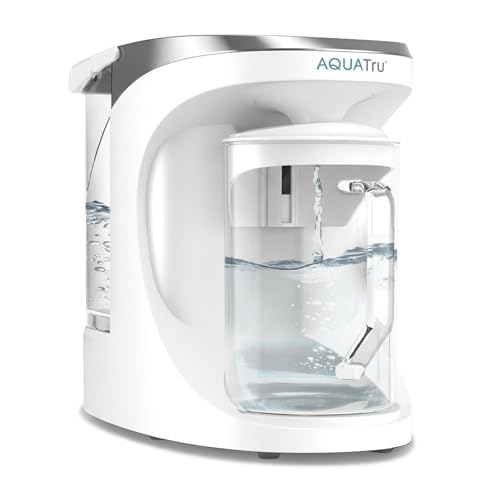
Reverse osmosis without a single tool, a pipe or a drilled hole.
Fill the tank, plug it in, and pure water fills a borosilicate glass carafe with a lid. The 4-stage setup removes 84 contaminants including PFOA and PFOS, lead, fluoride, chromium-6, arsenic and microplastics, and it is tested and certified to NSF standards by IAPMO. Filter life runs a pre/carbon stage at 6 months or 300 gallons, the RO stage at 1 year or 600 gallons, and the VOC carbon at 1 year or 300 gallons.
Water quality earns the most praise and taste follows — many describe it as the best water they have had. Reliability is the split note: some units simply stop, and the glass carafe cracks if handled roughly.
Freedom from install: plugs into any outlet, no plumbing touched.
Ongoing bill: three filter types to replace on their own schedules.
Best for: renters and anyone who cannot touch the plumbing.
Know the trade: it filters on its own schedule, not a fast-pour tap.
8. Aquasana AQ-MF-1 Water Filter

Hooks straight onto the cold line you already own.
This Claryum filter installs on any cold water line without a dedicated faucet or a hole in your counter. The carbon stage removes up to 99% of 78 contaminants including lead, PFAS, mercury, asbestos and pharmaceuticals, and it keeps calcium, magnesium and potassium. It fits 3/8″ plumbing, and it is certified for NSF/ANSI 42, 53 and 401, rated 784 gallons with a 1-year limited warranty.
The simplest part is the install, and taste and odor removal follow through. The honest catch is flow and filter life — the water trickles as the cartridge fills up, and some replacements only last weeks in heavy use.
Easy start: installs on the cold line you already have.
Expect slow pours: flow drops as the filter loads with sediment.
Suits you if: you want lead and PFAS filtered with no new faucet.
skip it if: you live on well water or have hard water — a pre-filter helps.
9. Brita Hub Instant Powerful Countertop Water Filter System

Plug it in, push a button, and skip the plumbing entirely.
The Hub reduces 70+ contaminants including lead, chlorine and microplastics, and dispenses at 12 oz or 20 oz presets or a manual pour. The 12-cup reservoir lifts off for refilling, the spout clears glasses and bottles up to 12″ tall, and each filter lasts 6 months or 120 gallons. It weighs 8.2 pounds — this is the lightest pick here by a wide margin against the 45-pound iSpring.
Setup is the easy win, and the slim design looks tidy on a counter. The water flow is slow because the maximum rate is 0.5 gpm, and some units drip during use.
Countertop simplicity
- No tools, no installation
- Two pour presets plus manual
Slow and drippy
- 0.5 gpm flow rate is a trickle
Reach for this if: you need filtered water on a counter today with zero install.
Look elsewhere if: you want a fast fill for cooking.
Know the Specs
Micron rating
A micron figure states the smallest particle a filter catches — a 5-micron sediment filter stops visible grit, while a 0.01μm membrane goes far finer and pulls out bacteria-scale particles.
GPD and GPM
GPD (gallons per day) is total output over a day for RO systems, while GPM (gallons per minute) is the tap speed you feel — a 2.5 GPM under-sink unit fills a pot far quicker than a 0.5 GPM countertop unit.
Common Questions
Will an under-sink filter connect to my existing faucet?
Do these systems remove TDS from water?
How often do filters need changing?
Can I use a whole-house system on well water?
Do I need a plumber for a countertop filter?
Why does water flow slow down over time?
Is a 0.01μm membrane the same as reverse osmosis?
Will a whole-house filter fit my cabinet space?
The Bottom Line
For a homeowner who wants every tap covered, the diy home water filtration system to beat is the iSpring WGB32B, because its 100,000-gallon, one-year filter set and 15 GPM flow handle the whole house. If you need dissolved solids pulled out, the Waterdrop G3P800 brings 10-stage RO and 800 GPD. And if you rent, the Brita Hub gives you filtered water with no plumbing at all. The iSpring has been the crowd favorite at 4.5+ stars across 2,000+ ratings — a track record worth leaning on.
How we choose
We do not accept paid placement. Every pick is matched to a real buyer and a real use-case; we do not hands-on test units.
Sources
Specifications: manufacturer listings and product documentation. Review insights: verified customer reviews, as of November 2026. Pricing: not shown on this page (it changes often); check the current price via the retailer link.
As an Amazon Associate, My Heart Lives Here earns from qualifying purchases. This does not affect which products we feature.