Heads up: This post contains affiliate links. As an Amazon Associate I earn from qualifying purchases, at no extra cost to you. Learn more
Specs are compiled from manufacturer listings and verified buyer reviews and can change over time — please confirm the key details on the product page before buying.
You want one box that can hold a week of frozen meals in January and a shelf of cold drinks in July — and you don’t want to buy two appliances to do it. That is exactly what a convertible refrigerator freezer does: flick a switch or press a button and the same cabinet runs as a full freezer or a full fridge. The picks below are sorted by what each one is genuinely good at, from a 21-quart portable you can carry to a 21 cu. ft. upright that swallows hundreds of pounds of food.
This guide is built by comparing the manufacturers’ published specifications and the patterns across verified customer reviews, so you get each pick’s real strengths and trade-offs instead of marketing spin.
You’ll see that capacity, cooling range, and defrost style change the experience far more than brand names do, and the picks ahead spell out exactly where each one fits. This is the plain-English breakdown of the best convertible refrigerator freezer choices for a garage, a kitchen, or the back of a truck.
Top Picks

How To Choose The Best Convertible Refrigerator Freezer
The first decision is not brand, it is footprint. A portable 12-volt box lives in a truck bed or a camp trailer; an upright cabinet lives in a garage or a spare kitchen corner. Measure the doorway and the wall gap before you compare a single spec.
Match the cooling range to what you actually freeze
What matters most is the temperature range a convertible fridge-freezer can actually hold. The ICECO GO20 spans 0°F to 50°F, so you can keep meat hard-frozen at one end and cold drinks at the other. The Upstreman 7.0 Cu.Ft covers -7.60°F to 6.80°F in freezer mode and 37.94°F to 46.94°F in fridge mode. That leaves a gap between 6.80°F and 37.94°F where food neither freezes nor stays safely cold. So check the temperature band, not just the word “convertible.”
Cubic feet versus quarts — the number that trips most buyers
Full-size uprights are sold in cubic feet, the volume of the whole interior. Portable boxes are sold in quarts or liters, the volume of the tub. A 21-quart portable and a 21 cu. ft. upright sound similar on paper and are nowhere near each other in real life. Decide which class you need first, then compare numbers only inside that class.
Defrost style and where the unit will sit
Frost-free (also called auto-defrost) means the cabinet clears ice buildup on its own; manual defrost means you chip it out. Most full-size picks here are frost-free. Garage-ready insulation is the other spec worth hunting for — it tells you the unit is built to hold temperature when the room swings hot and cold, which is exactly the situation in an unheated garage or basement.
Compressor quality is the whole ballgame
Every serious pick here uses a compressor, the sealed pump that actually moves heat from the start. A compressor unit cools fast and holds a set temperature; a cheap thermoelectric cooler just can’t keep up in a hot car. Look for a named compressor and a stated warranty — the ICECO carries 5 years on the compressor and 1 year on accessories, the BODEGACOOLER rates its compressor at 5 years, and the Kenmore 21 cu. ft. unit backs the whole appliance with 2 years.
Side-by-Side Comparison
| Model | Best For | Capacity | Cooling Range | Defrost | Amazon |
|---|---|---|---|---|---|
| ICECO GO20 Dual Zone★ Best Overall | Road trips and truck cabs | 21 quarts | 0°F to 50°F | Automatic | Amazon |
| Dometic CFX5 75 DZMost Versatile | Long off-grid camping | 75 liters | -7°F to 68°F | — | Amazon |
| BODEGACOOLER RV RefrigeratorBest for RV Life | RV and van life | 116.2 quarts | 5°F to 50°F | Automatic | Amazon |
| Kenmore 18.1 cu. ft. | Small kitchens and garages | 18.1 cubic feet | — | Automatic | Amazon |
| BLACK+DECKER 17 Cu. Ft. | Converting a garage freezer | 17 cubic feet | — | Frost Free | Amazon |
| KoolMore 21 cu. ft. | Big families and bulk storage | 21 cubic feet | — | Automatic | Amazon |
| Hamilton Beach 20 Cu. Ft. | Kitchen or bar add-on | 20 cubic feet | — | Frost Free | Amazon |
| Kenmore 21.0 Cu. Ft. Upright | Hunting lodges and full garages | 21 cubic feet | — | Auto Defrost | Amazon |
| Upstreman 7.0 Cu.Ft | Apartments and dorms | 7 cubic feet | -7.60°F to 46.94°F | — | Amazon |
| Hamilton Beach HBFRF6892 | Tight corners and RVs | 6.8 cubic feet | — | Automatic | Amazon |
| BLACK+DECKER 10 Cu. Ft. | Apartment kitchens | 10 cubic feet | — | Frost Free | Amazon |
Detailed Reviews
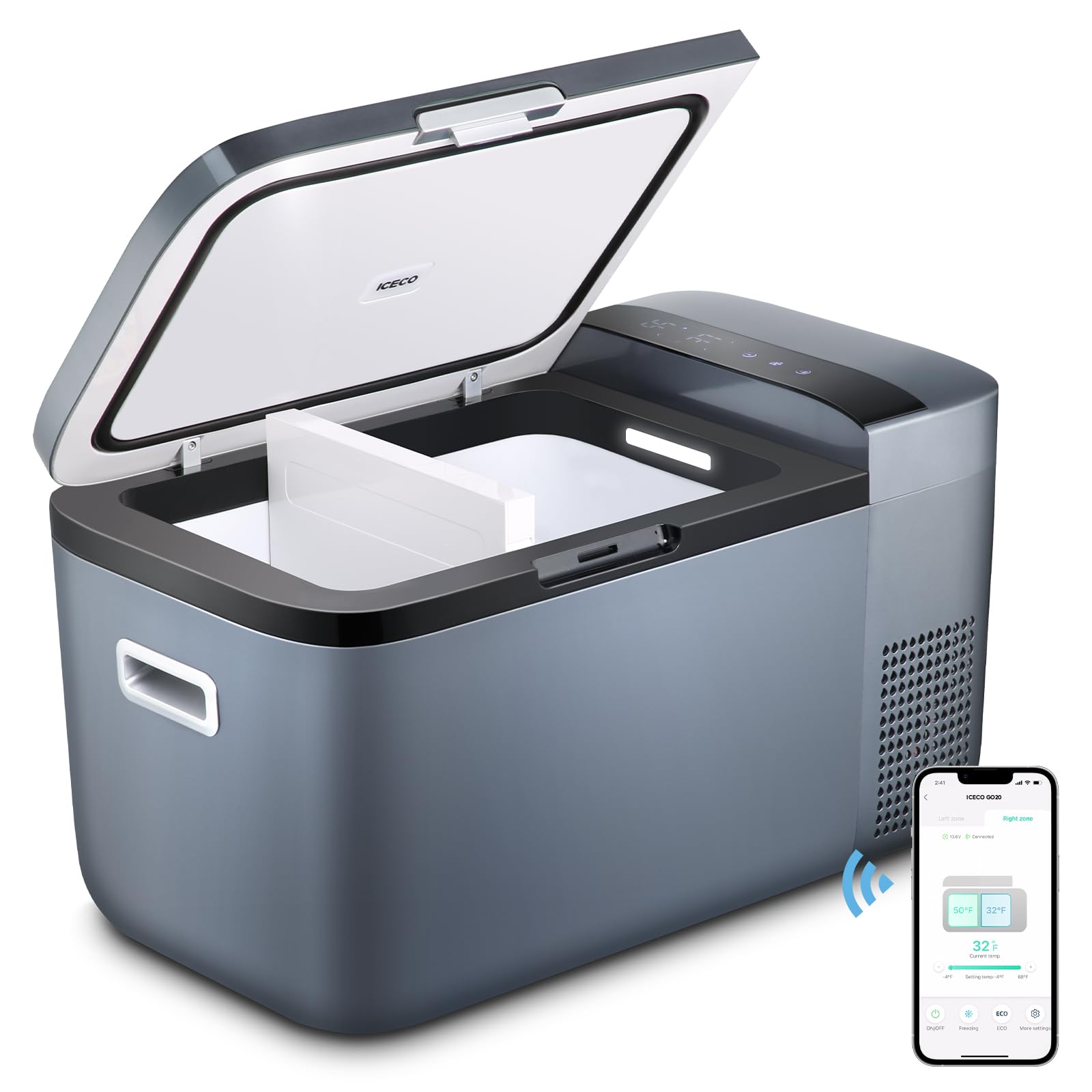
1. ICECO GO20 Dual Zone 12V Refrigerator
Our pick — 4.0+★ from 850+ verified ratings; the strongest balance of quality and price.
A 21-quart box that splits into two zones and shrugs off a bumpy road.
Here is the pick that earns the top spot for the widest range of buyers: a portable that runs on 12/24V DC in the truck and 110/240V AC at home. Its cooling range stretches from 0°F to 50°F, which means you can hold hard-frozen food in one compartment and cool drinks in the other at the same time. Remove the detachable partition and it merges into a single-zone box; put it back and you get two independently controlled zones.
The SECOP compressor is the reason this works so well. It has a fast-cooling mode and an anti-bump design rated to keep working stably even at a 40° tilt, so a rough trail doesn’t upset it. It draws 275 kwh a year — compare that with the KoolMore 21 cu. ft. upright’s 552 kwh, roughly double. And it comes with a 2.5m cigarette lighter cable plus an AC adapter, so you can carry it from car to kitchen without buying anything extra.
What wins people over is the construction — the build quality is the single most-praised thing about this unit, and it feels solid in hand. It also earned the German Red Dot Design Award and an IDEA International Design Excellence Award. The honest catch is temperature control: it’s a mixed bag, with some units holding the set point quickly and others struggling to reach it. Pair that with a mixed read on value, and this is a unit to buy from a seller with an easy return path. That said, a 5-year compressor warranty softens the worry considerably.
What earns the crown
- Two zones you can separate or merge with the partition removed
- Works on vehicle power and wall power with the included cables
- Five years of compressor coverage backs the part most likely to fail
Where it asks patience
- Temperature control splits reviewers — some units hit the set point fast, others lag
- Value reads mixed, so weigh it against the bigger portables before you commit
Grab this one if: you split your life between a vehicle and a kitchen and want one box that handles both.
Think twice if: you need a guaranteed deep freeze for long-term meat storage — a full upright does that job with more certainty.
2. Dometic CFX5 75 DZ Electric Cooler
Two cooling zones, 113 cans of room, and a freezer floor that hits -7°F.
For a week-long camping trip or a nomadic stretch where the cooler is your only fridge, the CFX5 75 DZ brings real capacity — 75 liters, enough for up to 113 x 12 oz cans. Its temperature band runs from -7°F to 68°F, a wider spread than the ICECO’s 0°F to 50°F, so you can push deeper into true freezing. Two compartments let you keep fresh food on one side and frozen on the other at the same time.
The flexibility is what you’re paying for. It runs on AC at 110-240V, on DC at 12/24V, or off-grid with Dometic batteries and Obsidian solar panels. The 3-stage dynamic battery protection watches incoming power and either stops before it drains your vehicle battery or allows a deep draw on a dual-battery setup — a genuinely useful safeguard when you’re parked far from a socket. The whole unit weighs 59.8 pounds, so plan on moving it with two hands.
Reviews center on function and versatility: it does what it says, particularly on AC power, and RV owners recommend it for exactly that role. Dometic claims it draws less than a 60W light bulb, but that’s a manufacturer figure, not a measured draw. This is the most expensive class of portable here, so it makes sense only if long trips are your normal, not your once-a-year.
Built for the long haul: AC, DC, and solar input in one unit, with dual zones and a -7°F floor — that combination is why RV owners keep recommending it.
What to plan around: at 59.8 pounds this is a two-person lift, and the premium tier means it only pays off if you travel often.
Made for the road: the traveler who needs a real freezer compartment in the middle of nowhere.
Not your pick: if the cooler mostly sits in a garage — a plug-in upright gives you far more room for the money.
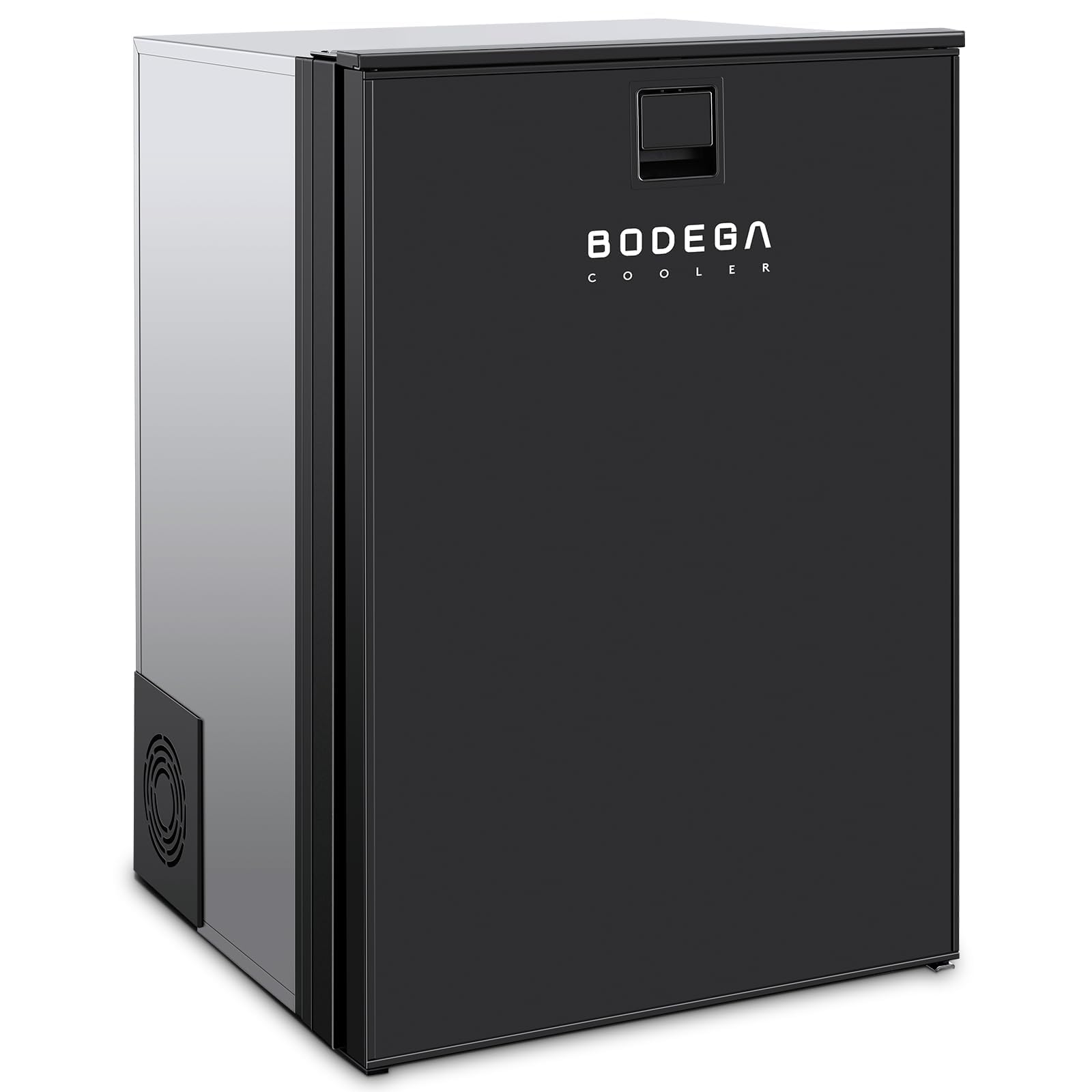
3. BODEGACOOLER RV Refrigerator, 3.88 Cu.Ft
Fridge and freezer running at once inside a cabinet built for a van.
Most portable coolers make you choose one temperature. This one splits the space: 97.2 quarts of refrigerator and 19 quarts of freezer running simultaneously, in a 116.2-quart cabinet that fits the footprint of an RV galley. The cooling range runs from 5°F to 50°F, so you get true freezing alongside fridge-cold storage without switching modes.
Two operating modes do the power management for you. Day Mode pulls hard for fast cooling; Night Mode dials back for energy saving, which matters when you’re parked and running off a battery bank. The 3-level battery protection (H/M/L) keeps the unit from overloading your vehicle’s supply or short-circuiting it. It runs at under 45dB — a whisper compared with an idling engine — and a 45° anti-tip design keeps it working on rough roads.
Performance is what the feedback keeps coming back to: it reaches temperature in under two hours and holds it, and owners note it doesn’t drain a battery bank the way they expected. The recurring gripe is the door — it doesn’t always latch cleanly and can be stiff to open — so treat the hinge with care. The compressor is rated for a 5-year service life, with 1 year on the rest of the parts.
Why van owners like it: two independent zones, a proper fast-cool mode, and battery protection you can set to match your setup.
The honest snag: the door latch is the weak point — it doesn’t always catch cleanly, so check it every time you close up before a drive.
Best matched to: RV, camper, and van owners who want a fridge and a freezer running side by side.
Look elsewhere if: you need a chest-style box for a tight truck bed — this is a tower that wants floor space.
4. Kenmore 18.1 cu. ft. Top Mount Refrigerator
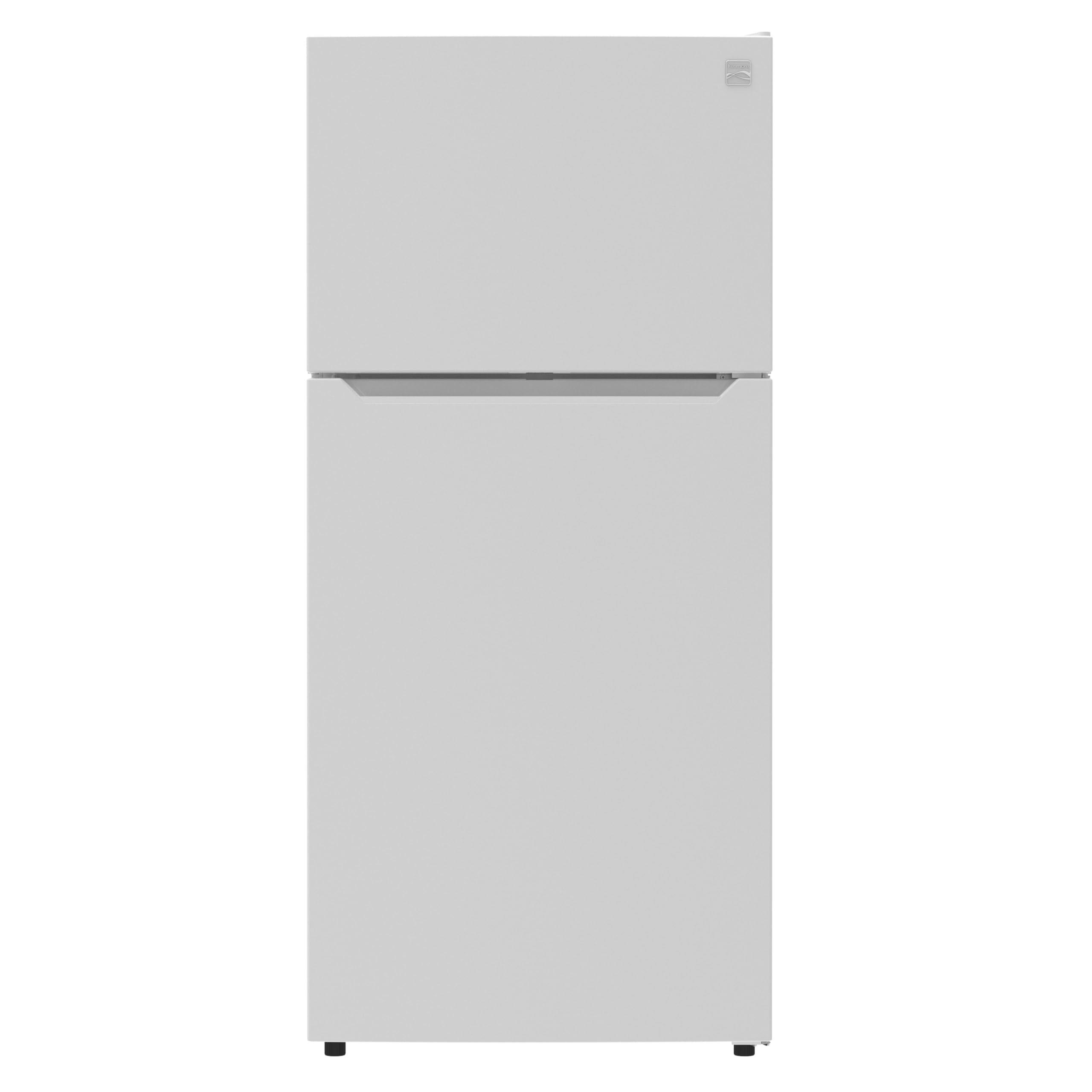
A slim 30-inch cabinet that holds 18.1 cubic feet without crowding the room.
If your problem is a narrow galley kitchen or a garage wall with limited width, the 30-inch frame here is the headline. Inside that footprint you get 18.1 cubic feet of standard-depth storage split between the fresh section and a 4.77 cu. ft. top freezer. Edge-to-edge tempered glass shelves slide to fit party trays, drink pitchers, or a sheet cake, and the door gives you 4 clear bins plus a gallon-sized bin for jugs.
Two clear humidity-controlled crispers handle produce, and an inverter compressor quietly holds a steady temperature rather than cycling hard. It’s ENERGY STAR certified and rated at 367 kwh a year. LED lighting brightens the interior, and the door is reversible, so left- or right-hand opening is your call at install time.
The reliability reputation is the strongest thing here — it’s the quality owners talk about most, and they describe it as well-designed and deeply roomy for the width. Quiet operation earns steady praise too. The fair caveat is temperature: it’s a mixed area, with some units cooling perfectly and a few that don’t cool at all, so unbox and test it while the return window is open.
Where it shines
- 30-inch width fits gaps a full-width fridge can’t
- Gallon door bin and four clear bins keep tall items upright
- Inverter compressor holds temperature without loud cycling
Worth knowing up front
- Temperature control is the mixed spot — test it right after delivery
- The freezer is a 4.77 cu. ft. top compartment, not a convertible-chest volume
The fit: narrow kitchens, garages, and anyone upgrading from a tiny apartment fridge.
Look past it if: you want a true convertible that can flip its whole interior into a freezer — this one keeps a fixed top freezer.
5. BLACK+DECKER 17 Cu. Ft. Convertible Freezer Refrigerator
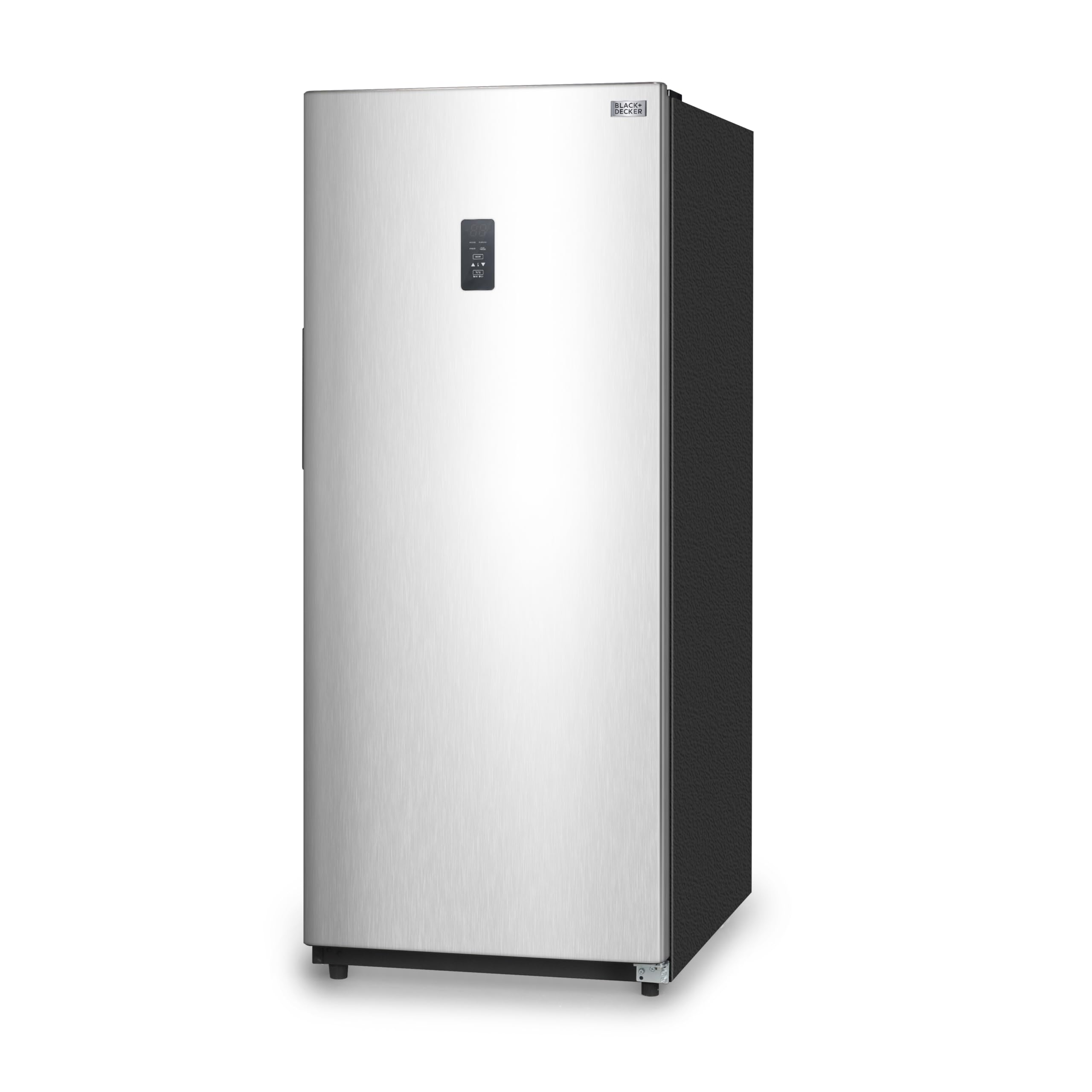
The upright that flips its whole 17 cubic feet from freezer to fridge.
This is a different kind of convertible: the entire 17 cu. ft. interior changes over from stand-up freezer to full-size refrigerator, so you get one big compartment that does either job. That makes it the natural pick for a garage where you freeze bulk meat in winter and want cold drink storage in summer. Electronic controls with an LED display handle the temperature, and frost-free operation means no ice-chipping.
It’s ENERGY STAR qualified and stands 68.1 inches tall on a footprint about 28 inches wide. Glass shelves inside are removable, and the stainless-look finish means it doesn’t look out of place if it ends up in a kitchen instead. For capacity it lands between the smaller 7 cu. ft. Upstreman and the massive 21 cu. ft. KoolMore — enough for a family’s bulk buying without taking over the room.
Performance is the strongest recurring note: it cools to spec and runs quietly, and the appearance gets consistent approval. The honest caveat is long-term reliability — that’s the mixed area, with most units running fine and a small share reported to stop after several months. Buy it knowing the first month is the test window.
The draw: a true full-cabinet switch between freezer and fridge, in an ENERGY STAR qualified frame that fits a garage wall.
What to watch: reliability is the uneven part — a small fraction quit early, so register it and keep the receipt.
Reach for this if: you want one upright that can be a freezer this season and a fridge next.
Pass if: you need simultaneous fridge-plus-freezer zones in one cabinet.
6. KoolMore 21 cu. ft. Upright Convertible Freezer/Refrigerator

Twenty-one cubic feet that go from freezer to fridge with one quick-swap button.
When the job is bulk — a side of beef, a party’s worth of drinks, a year of garden produce — volume wins, and this is the biggest cabinet on the list. At 21 cubic feet it holds over three times what the Hamilton Beach HBFRF6892 does at 6.8 cubic feet. The whole interior converts: it runs as a full freezer or a full fridge, depending on your season and your shopping habits.
Inside you get four adjustable shelves, two clear drawers, and adjustable door trays, plus an electronic control panel and interior LED light. Four cold settings and a quick-swap fridge/freezer button make the mode change simple. Adjustable legs level it on an uneven garage floor, and 2 rear wheels let you roll it into position rather than dragging it. It’s garage-ready by design, so it suits a space that swings in temperature.
What buyers respond to most is the sheer quality of the build, followed closely by how much it swallows. Value and appearance both get strong approval too. The energy figure is worth noting: 552 kwh a year, which is roughly double the 275 kwh the ICECO portable consumes — a real running cost over time. That’s the honest trade for all that space.
Why it wins on space
- 21 cubic feet converts whole-cabinet between freezer and fridge
- Four shelves, two clear drawers, and adjustable door trays keep it organized
- Rear wheels and leveling legs make it manageable in a garage
The real trade-off
- At 552 kwh a year, expect more on the power bill than a portable
- It’s a freestanding upright — plan the doorway before delivery day
Built for bulk: large families and anyone stocking a full freezer for the season.
Skip the hassle if: you have a small space — a 21 cu. ft. cabinet needs room to breathe against a wall.
7. Hamilton Beach 20 Cu. Ft. Refrigerator/Freezer

A single click switches this stainless upright from freezer to fridge.
Twenty cubic feet in a stainless finish, with one-button switching between freezer and refrigerator modes. That’s the whole pitch, and it’s a good one for a kitchen, bar, basement, or trailer where the storage need changes with the season. The frost-free system means you never manually defrost after a mode swap — a small thing until you’ve chipped ice out of a chest freezer.
Organization is handled with four removable tempered glass shelves, five in-door shelves, and a bottom slide-out transparent bin. Electronic controls adjust the temperature with a button press, and an interior LED lights up the contents. It’s a compressor-cooled, upright form factor, so it cools like a real appliance rather than a cooler.
One thing to weigh honestly: this is a very new listing with a small review base, so the long-term track record isn’t established the way the Kenmore or the KoolMore’s is. You’re buying on the spec sheet and the brand, not on years of owner feedback. For a first unit in a finished space, that’s a reasonable trade if you value the 20 cu. ft. size and the frost-free convenience together.
The clean setup: one click, frost-free, and glass shelves you can pull out to reconfigure — a low-maintenance converter.
Buy with open eyes: a thin review history means you’re an early owner, so unbox and check the cooling immediately.
Fits the bill for: kitchens and bars that want a convertible with a stainless finish.
Wait if: you need a proven track record — pick a model with a longer review history instead.
8. Kenmore 21.0 Cu. Ft. Refrigerator/Freezer
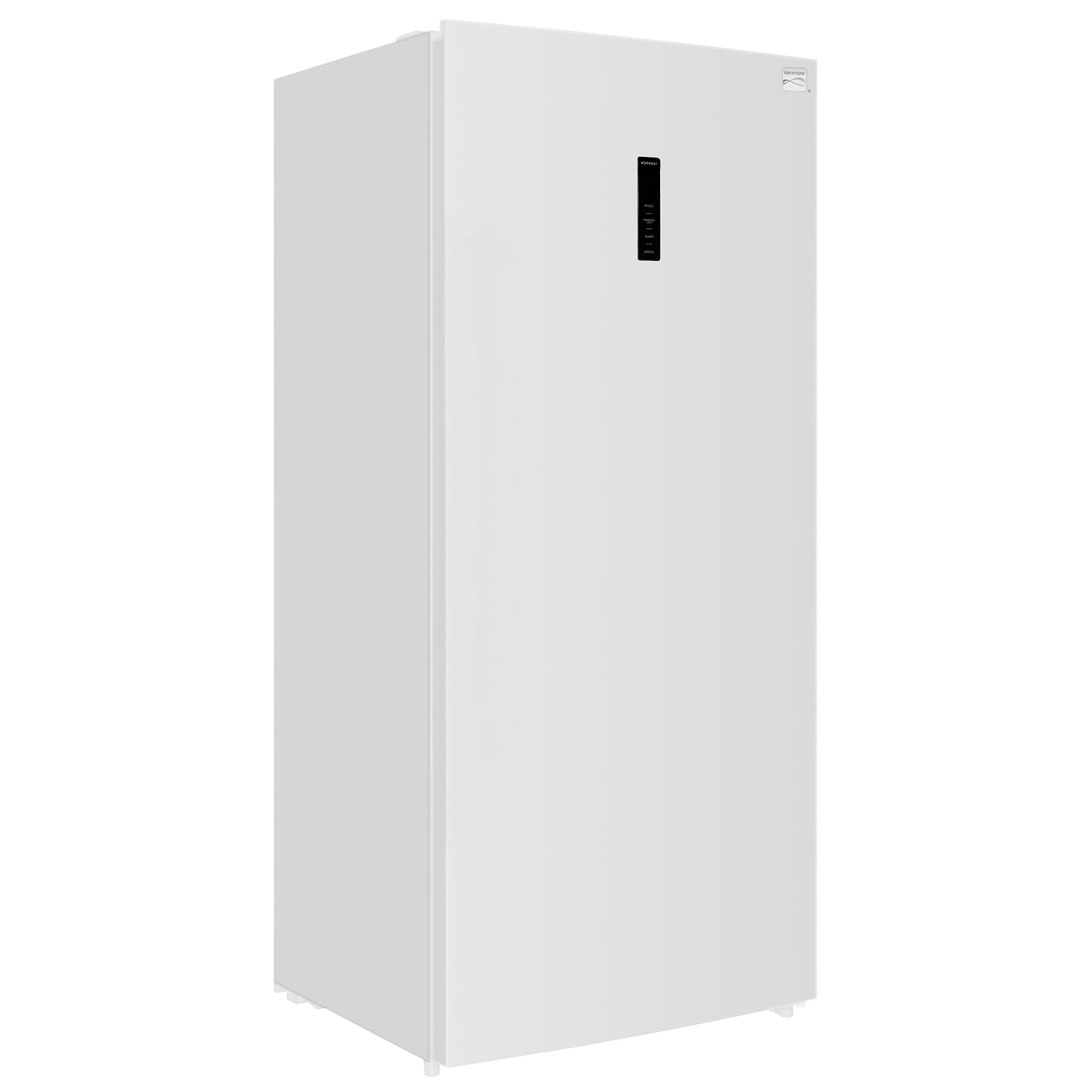
Twenty-one cubic feet rated to hold hundreds of pounds of meat and produce.
This is the heavyweight of the group in more ways than one: 21 cubic feet, or 600 liters, with a stated capacity of up to 735 lbs of food. Door bins and repositionable shelves adjust to whatever you’re storing, and a digital control panel with LED display offers one-touch switching between refrigeration and freezing. Quick-freeze mode drives temperature down fast when you’ve just brought home a haul.
It’s built for a non-traditional space. Premium insulation and sealing technology hold a consistent temperature in a basement, garage, or hunting lodge where the room isn’t climate-controlled. A total no-frost design auto-defrosts so you never chip ice, and it’s ENERGY STAR certified. Built-in door-open and high-temperature alarms warn you before food spoils, and a 2-year warranty covers the whole unit.
What owners fixate on is performance — it exceeds expectations for cooling, and it handles a full grocery load without straining. Capacity is just as well received. The honest caveat is temperament: the reliability record has a rough edge, with some units running beautifully and a smaller share failing outright. The 2-year warranty is the safety net here, and it’s a better one than most of the field offers.
The promise: 21 cu. ft. of convertible space, up to 735 lbs of food, alarms, and a 2-year warranty.
Watch this: reliability is uneven — a 2-year warranty helps, but register the unit and test it the day it arrives.
Choose this for: a garage or hunting lodge that needs serious capacity and frost-free convenience.
Better to skip if: you need a guarantee of years of service — the reliability record isn’t as clean as the Kenmore 18.1’s.
9. Upstreman 7.0 Cu.Ft Upright Freezer
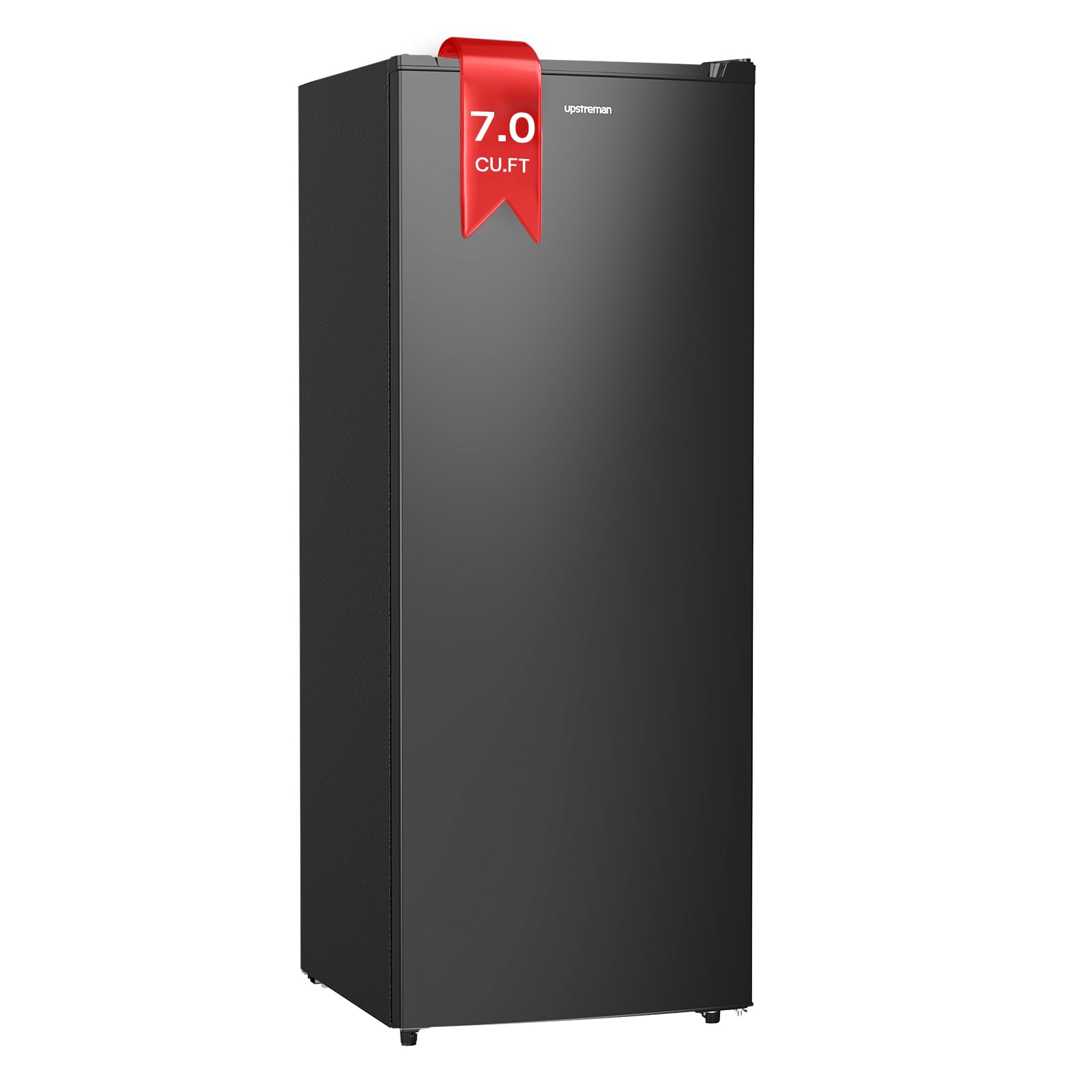
A slim upright that flips between deep freeze and fridge in seconds.
Seven cubic feet fits well in an apartment, a dorm, or along a workshop wall. This unit switches between freezer mode at -7.60°F to 6.80°F and refrigerator mode at 37.94°F to 46.94°F using an adjustable control, not a complicated menu. Five removable glass shelves let you arrange space for pizza boxes or tall bottles. A crisper drawer keeps produce separate from frozen goods.
Its size makes it easy to live with: 21.3 inches wide, 22.8 inches deep, and 56 inches tall, with a flush back and recessed handle to fit tight spaces. You also get a reversible door, adjustable leveling feet, an ice tray, and a removable defrost tool. The listed running cost is 0.89kWh/24hrs, which works out to 7056 kilowatt hours a year versus the Hamilton Beach HBFRF6892’s 300. That is a real difference to know before you commit.
Quality is the strong suit — it’s what draws the most favorable reaction. Functionality is more divided, with most units cooling quickly and a few not working at all. Frost resistance and temperature control split similarly. The mixed reports don’t make this a bad buy, but they do mean the first 24 hours matter: plug it in, let it run, check the temperature before you load it up.
Why the size clicks
- 21.3-inch width and flush back fit tight corners
- Crisper drawer and five removable shelves organize mixed loads
- Reversible door and leveling feet suit uneven floors
Before you commit
- Annual energy runs 7056 kwh, against 300 kwh on the Hamilton Beach HBFRF6892
- Functionality is uneven — a small share arrive not cooling at all
The right size for: apartments, dorms, and workshops where a full fridge won’t fit.
Not the one if: you care about long-term energy bills — the power draw is the weak spot.
10. Hamilton Beach HBFRF6892 Fridge/Freezer

Six-point-eight cubic feet with a reversible hinge for left- or right-hand corners.
Small footprint, flexible setup: 6.8 cubic feet with a single door, a recessed handle, and a reversible hinge that you can set for either handedness. That hinge matters in a tight corner or an RV where the door would otherwise swing into a wall. A bottom slide-out transparent bin catches loose items, and the flat back plus leveling legs let it sit flush against a wall.
It switches between freezer and fridge with a single click, and it’s rated at 300 kilowatt hours per year — the lowest annual figure on this list. For a starter unit or a backup in an RV or dorm, that low draw is a real advantage. The 6.5 cu. ft. freezer capacity is enough for backup meat, frozen meals, and celebration ice.
The honest picture is mixed: reliability is the strongest point, and owners describe it doing its job well, but durability is the weak spot — reports of dents on arrival and doors coming loose are the recurring issue. Frost protection also splits, with some units keeping food properly cold and others not staying frost-free. Treat the low annual energy as a bright spot and inspect the unit at delivery before accepting it.
Where it wins: the lowest annual energy draw here at 300 kwh, plus a reversible door that fits awkward corners.
The catch: durability is the weak area — dents on arrival and door issues show up often enough to check carefully at unboxing.
Best for: tight corners, RVs, and dorms where a low power draw and small size matter most.
Not ideal if: you need a rock-solid build — this is a budget cabinet and the durability shows.
11. BLACK+DECKER 10 Cu. Ft. Top Mount Refrigerator
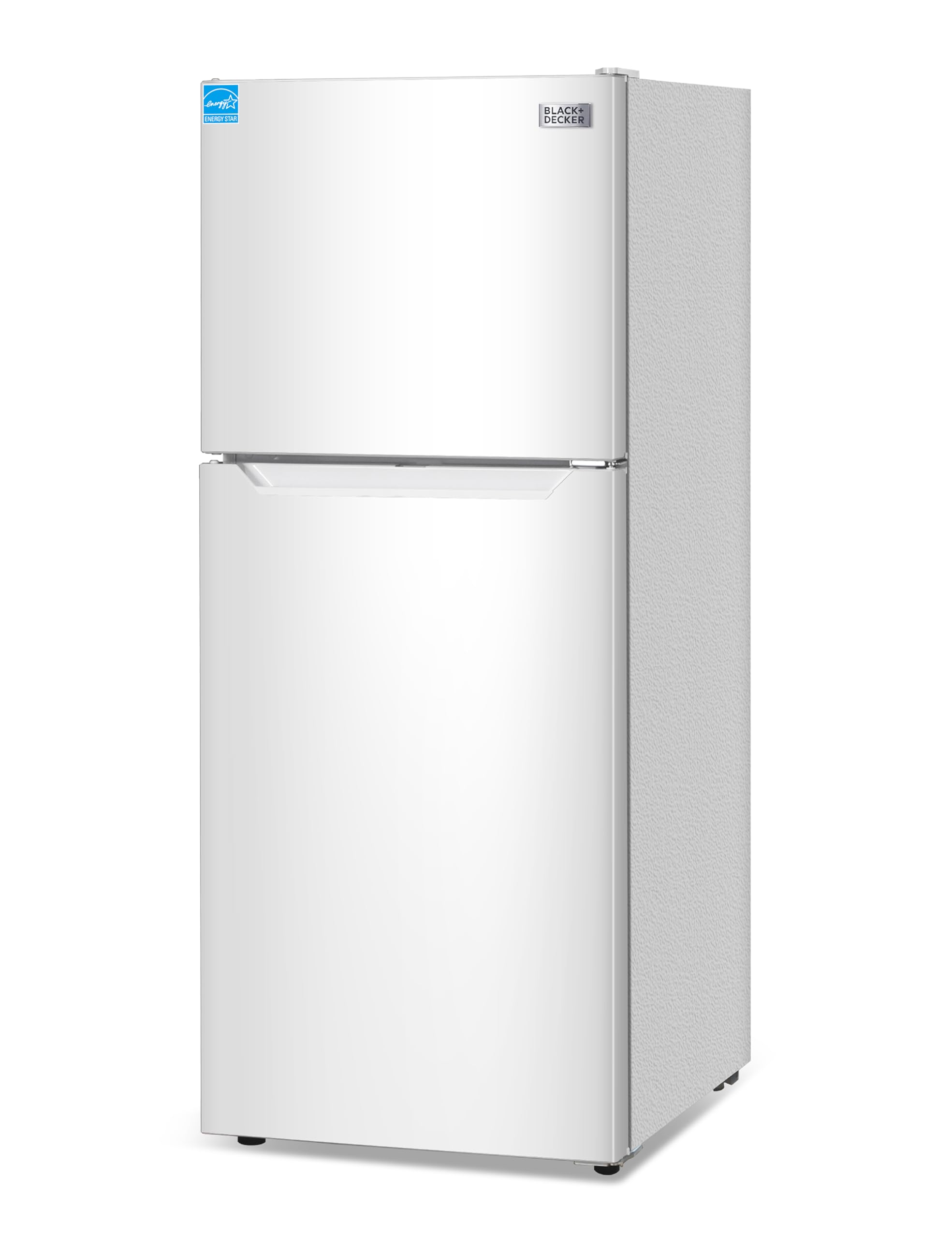
Ten cubic feet of apartment-sized kitchen appliance with auto-defrost built in.
For a small apartment kitchen, a 10 cu. ft. top-mount is the classic size: enough for a week of groceries without dominating the room. The fresh section takes the bulk, and the 2.8 cu. ft. top freezer handles frozen meals, packaged meat, and ice cream on a removable wire shelf. Adjustable temperature control lets you set the fridge and freezer sections separately.
Frost-free auto-defrost means no ice scraping, and the compressor is ENERGY STAR certified at 297 kwh a year — the second-lowest annual figure in this group. The door is reversible, and four door shelves hold bottles and jars. It’s a straightforward appliance done the conventional way.
Worth being straight about: the owner feedback is genuinely split, with quality and reliability both landing in mixed territory rather than one clear side. Some units run perfectly; others have been a real disappointment. There isn’t a large enough review base to call it either way, so buy it as an apartment workhorse and lean on the return window if yours arrives off.
The practical case: ENERGY STAR certified at 297 kwh, frost-free, reversible door — a conventional fridge done right on paper.
The unknown: quality and reliability are genuinely split in the feedback, so test the cooling as soon as it’s plugged in.
Suited to: a small kitchen that needs a standard top-mount without paying for bells and whistles.
Think again if: you want a convertible — this one keeps a fixed freezer on top and does not switch modes.
Know the Specs
Freezer vs refrigerator temperature bands
A convertible’s usefulness depends on the temperature range it can actually hold. Freezing usually sits below 0°F, while safe fridge-cold storage runs roughly in the high 30s to high 40s. The best units cover both ends of that band, so you get a real freezer and a real fridge from one cabinet. Check the numbers — a unit that tops out at 6.80°F in freezer mode and starts at 37.94°F in fridge mode leaves a gap where food is neither safely frozen nor safely cold.
Annual energy consumption in kwh
Kwh (kilowatt hours) is a measure of electricity used over time, and the annual figure tells you roughly what it takes to run the unit for a year. A portable that draws 275 kwh a year uses less than a big upright at 552 kwh, because there’s less interior to keep cold. That’s physics, not a design flaw. The bigger the box and the colder you run it, the more it costs to keep.
Compressor cooling
A compressor is a sealed pump that moves heat from the start, the same way a kitchen fridge works. It cools fast and holds a set temperature, which is why every serious pick here uses one. Thermoelectric coolers, by contrast, struggle in high heat and can’t freeze reliably. If you need true frozen storage, look for the word “compressor” in the spec sheet.
Frost-free vs manual defrost
Frost-free (auto-defrost) means the cabinet clears ice buildup on its own, usually with a heating cycle. Manual defrost means you chip the ice out. For a garage or a basement that swings in temperature, frost-free is worth paying for — it removes one chore you’d otherwise repeat every few months. The trade is that auto-defrost units can be a little less energy-efficient than manual ones.
Garage-ready insulation
“Garage ready” means the unit is built with insulation and sealing designed to hold temperature when the surrounding room isn’t climate-controlled. An ordinary kitchen fridge in a freezing garage may struggle to run correctly. For an unheated garage or basement, garage-ready insulation matters more than any smart feature.
Quarts, liters, and cubic feet
Portable coolers are sold in quarts or liters, which measure the volume of the tub. Uprights are sold in cubic feet, which measures the whole interior. They’re not interchangeable, and comparing a 21-quart portable to a 21 cu. ft. upright will fool you. Decide your class first, then compare within it.
Common Questions
Can I run a convertible refrigerator freezer in a garage that gets very cold?
Will a 12V portable fridge freezer drain my car battery overnight?
What is the difference between a convertible freezer and a regular upright freezer?
How much food fits in a 21 cubic foot upright freezer?
Do portable 12V fridge freezers need ice?
How loud is a portable compressor fridge freezer?
What is the difference between frost-free and automatic defrost?
Can a convertible refrigerator freezer be used as a full freezer all year?
How long will the compressor last on these units?
Will the BODEGACOOLER or ICECO fit under a counter?
Is a 7 cubic foot upright too small for a family of four?
The Bottom Line
For most people, the convertible refrigerator freezer that makes the most sense is the ICECO GO20 Dual Zone. It splits into two temperature zones with a removable partition, runs from a cigarette lighter or a wall outlet with the cables in the box, and its 5-year compressor warranty covers the part you’d otherwise worry about. It’s the pick that works whether you’re parked or plugged in.
If your need is a big garage cabinet rather than a portable, the KoolMore 21 cu. ft. gives you the most interior without the premium-tier price framing, and its whole-cabinet switch means one appliance does the work of two. For off-grid trips where the cooler is your only fridge, the Dometic CFX5 75 DZ carries the widest temperature spread of anything here — -7°F to 68°F — and runs from AC, DC, or solar. If you’re building around a tight 30-inch gap, the Kenmore 18.1 cu. ft. is the one that fits where a full-width model won’t.
Here’s the honest nudge: read the temperature band and the warranty on whichever model you pick, because those two specs separate the units that quietly do their job from the ones that end up as an expensive mistake. A cabinet that holds its set point for five years beats one with the longest feature list.
How we choose
We do not accept paid placement. Every pick is matched to a real buyer and a real use-case; we do not hands-on test units.
Sources
Specifications: manufacturer listings and product documentation. Review insights: verified customer reviews, as of November 2026. Pricing: not shown on this page (it changes often); check the current price via the retailer link.
As an Amazon Associate, My Heart Lives Here earns from qualifying purchases. This does not affect which products we feature.