Heads up: This post contains affiliate links. As an Amazon Associate I earn from qualifying purchases, at no extra cost to you. Learn more
Specs are compiled from manufacturer listings and verified buyer reviews and can change over time — please confirm the key details on the product page before buying.
Which contact cement is actually worth your money? The short answer: match the glue to the job, not to the biggest can. A cement that cures in 10 minutes is wrong for a countertop, and a slow-curing wood glue is wrong for a pool liner. This shortlist separates five cements by what they actually bond and how fast they set.
This guide is built by comparing the manufacturers’ published specifications and the patterns across verified customer reviews, so you get each pick’s real strengths and trade-offs instead of marketing spin.
You apply cement to both surfaces, let it go tacky, then press hard — get that timing wrong and the bond fails. Choose the right formula from these best contact cement picks and your repair holds the first time.
Top Picks
How To Choose The Best Contact Cement
Contact cement is a rubber-based glue you spread on both surfaces, let dry until tacky, then press together for an instant grab. Get the material match and the timing right and the bond outlasts the part. Get either wrong and the seam peels within a day.
Match the formula to your material first
Neoprene-based cements, the standard for wood, laminate and leather, grab firm on porous surfaces. Vinyl cements are different — they soften flexible PVC so a pool liner or tarp patch fuses instead of sitting on top. Read the compatible-materials line on the can before you buy, because a wood cement on a vinyl pool is money wasted.
Know what open time means before you spread
Open time is the window after you apply the glue when it is still tacky enough to bond. The DAP can lists a 2-hour open time, which gives you room to position a large laminate sheet. Fast-setting vinyl cements close that window in seconds, so alignment has to be right on the first press.
Plan your project around the cure time
Full cure time ranges wildly across these picks — from 10 minutes on the 3M spray to 24 hours on the vinyl and S-18 formulas. A 10-minute cure suits craft work and headliner patches. A full-day cure suits a load-bearing repair you are not rushing. Match the cure to your deadline, not the other way round.
Side-by-Side Comparison
| Model | Best For | Form | Full Cure Time | Pack Quantity | Amazon |
|---|---|---|---|---|---|
| DAP 00107 Weldwood Original★ Best Overall | Laminate and woodwork | Liquid (can) | 2.5 hours | 3 | Amazon |
| S-18 All-Purpose AdhesiveBest for Upholstery | Headliners and upholstery | Liquid (can) | 24 hours | 1 | Amazon |
| Wonshine Contact Cement with Brush | Precision brush-on repairs | Liquid (brush cap) | 24 hours | 1 | Amazon |
| HH-66 Vinyl Cement | Pool liners and vinyl | Liquid (brush cap) | 24 hours | 1 | Amazon |
| 3M Max Strength Contact Adhesive | Large flat surfaces fast | Spray (aerosol) | 10 minutes | 1 | Amazon |
Detailed Reviews
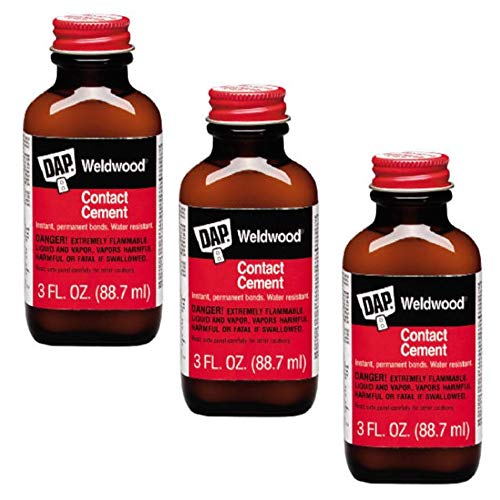
1. DAP 00107 Weldwood Original Contact Cement, 3 oz – 3 Pack
Our pick — 4.5+★ from 600+ verified ratings; the strongest balance of quality and price.
The forgiving classic: a two-hour working window and a grab that skips the clamps.
This is the pick for someone laying plastic laminate on a countertop or pressing a wood veneer flat. The neoprene rubber formula bonds on contact, so you skip clamps, temporary fasteners and long set times. The open time runs a generous 2 hours — you can spread the glue, adjust the sheet, then press when it is tacky and glossy.
What wins people over is how reliably it does the job it was designed for: laminate, wood, leather, tile, rubber, cork, foam and cardboard all sit on the compatible list. The full cure lands at 2.5 hours, which is the quickest liquid cure in this group. Compare that to the HH-66 and S-18 cans, both of which need 24 hours before the bond is fully set. The three-can pack also outlasts a single can on repeat jobs — you get 3 cans here versus 1 with the S-18.
Here is the honest catch: adhesion is the mixed part of the record, not the reliability. Some jobs grab beautifully and a few report it not matching their hopes, which usually traces back to skipping the pre-fit step. The can itself says pre-fit all parts before applying, and that step matters with a contact glue. Spread it on both surfaces, let it go touch-dry, then press hard.
Where it earns the top spot
- Neoprene rubber formula bonds on contact with no clamping needed
- 2-hour open time leaves room to align laminate before the press
- 3-can pack covers repeat jobs before you reorder
- Cures in 2.5 hours, the fastest liquid cure on this list
Worth knowing before you buy
- Adhesion results vary, so pre-fit every part before gluing
- Needs touch-dry timing on both surfaces, not a wet press
Reach for this if: you are bonding laminate, veneer, leather or foam and want time to align before the press.
Look elsewhere if: you need a vinyl or PVC-specific fuse, because that calls for the HH-66.
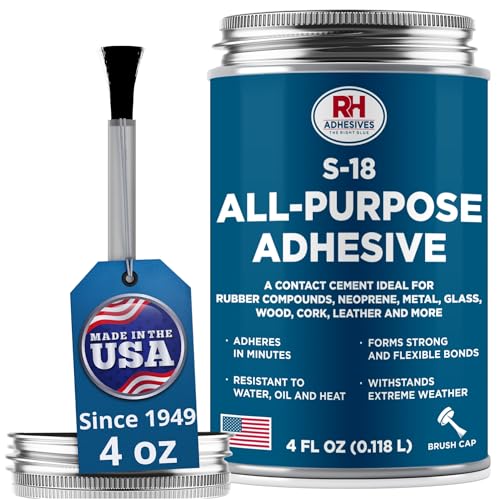
2. S-18 All-Purpose Adhesive 4 oz
Built for sagging headliners and peeling upholstery — a neoprene cement that grips fabric to foam.
The S-18 is the one to grab when a car headliner is drooping or a chair seat has let go. It bonds porous and non-porous materials alike, which is why fabric, felt, cork and foam sit comfortably alongside glass and metal on its compatible list. The formula is neoprene adhesive made in the United States — the maker says since 1949 — and it lays down a film with strong peel strength.
Owners describe this as one of the best adhesives on the market, with effectiveness and quality both earning heavy mention on the review page. Ease of use is the third recurring theme — spread it, join, done. Water resistance is the reason it also works for marine jobs, where a damp environment would lift an ordinary cement.
The snag you should expect is the smell. Odor is the weakest part of its record, and this is a solvent neoprene glue, so plan on ventilation. Adhesion is the other mixed note — some report a hold that stays put, others find it never quite becomes tacky enough. The full cure takes 24 hours, so resist load-testing the patch before then. Spread evenly, give it time to become glossy-tacky, and press the full surface.
Material range that pays off: Rubber to metal, fabric to foam, and leather are all on the compatible list, so this one can cover more than one repair in a single can.
The solvent trade-off: Strong smell and a 24-hour full cure mean you plan this job, not rush it.
Suits: headliner, upholstery and leather repairs where the bond will be hidden but must last.
Not for: a job you need finished in an hour, or a room with no airflow.
3. Contact Cement Adhesive 4.16 Oz
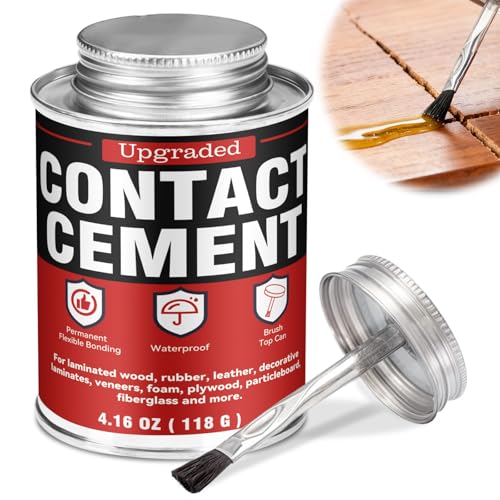
The brush-in-the-cap can for shoe repairs and tight woodworking joints where a smear would ruin the finish.
Small jobs fail on messy application more than on weak glue. This can puts a brush right in the lid, so you control the spread on a decorative laminate edge, a shoe sole or a veneer strip without a separate applicator. The chloroprene formula is waterproof and heat-resistant, and it stays flexible after curing — useful when the joint flexes like a shoe or a foam cushion.
Functionality is what the review page keeps celebrating, with quality close behind. The bond carries across wood, leather, rubber, laminate and foam, and the label scale covers woodworking, furniture restoration, wall repairs and leather crafting. The method is straightforward: coat two clean dry surfaces, wait roughly 10-15 minutes until tacky and glossy, press firm, then let it sit a full 24 hours to cure.
Where it can let you down is stickiness — some find it strong and hard to peel back, others watch it pull away. That variance usually tracks back to skipping the glossy-dry check. Do not press while it is still wet; wait until it looks slightly dry and shiny, then join. It has a smaller review footprint than the giants here, so weigh the precision brush against the longer track record of the HH-66 or DAP if the job is structural.
Built for small, fussy jobs: The integrated brush reaches tight spaces you cannot get a spreader into, which is why it suits shoe soles and veneer edges.
Set your expectations on the scale: Fewer ratings than the big names here, so on a load-bearing structural repair the longer-proven picks are the safer bet.
Ideal for: shoe soles, laminate edges and small leather or foam patches where clean application matters.
Skip for: large surface coverage — a 4.16 oz can with a brush head slows you down on a big panel.
4. HH-66 Vinyl Cement 4 oz

The pool-liner specialist that can be applied underwater and stays flexible from one repair to the next.
If your inflatable pool has a rip or your boat seat is splitting, this is the cement formulated for that exact job. HH-66 softens PVC and vinyl surfaces so the two sides fuse instead of sitting on top of each other. It bonds from 35 °F to 95 °F, which means a cold garage or a hot driveway is not a dealbreaker, and it can go on underwater.
The durability record is the story here: a flexible vinyl hold independently verified to stay serviceable from -10 °F to 150 °F. Effectiveness is what owners praise most, and quality sits right behind it. It stands out for tarps, pool liners, inflatable boats, marine vinyl, awnings, bounce houses, mats, upholstery and roofing membranes where a normal wood cement would just peel off.
Read the label limits before you buy. It is not for polyethylene or polypropylene, which covers most blue tarps, and not for extremely thin vinyl used in lettering or wraps. On the mixed side of the record, some report instant strong bonds and others poor adhesion — the drying window is tight, so a patch can curl if you press too late. Set it up in about 30 seconds, and expect a full 24-hour cure. Compare that to the DAP at 2.5 hours: this one takes about ten times longer to fully cure, so plan the repair for a day you can leave it alone.
The flexibility advantage: Bends and flexes with inflatables and pool liners through a huge temperature swing, which is why it holds where rigid glues fail.
Read the fine print: Polyethylene blue tarps and ultra-thin vinyl are not compatible, and the cure is a full day.
Best used on: pool liners, inflatable boats, PVC awnings and marine vinyl repairs.
Wrong tool for: blue poly tarps, thin vinyl wraps, or a fix you need set the same afternoon.
5. 3M Max Strength Contact Adhesive, 12.6 oz (357 g)
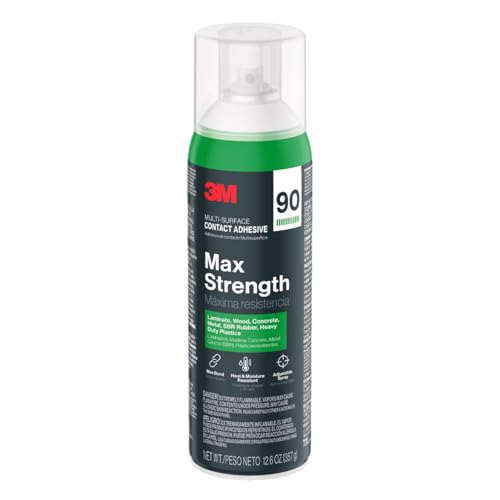
The fast-set spray: a max bond in 10 minutes when you are covering a wall or a large sheet.
Spread a brush-on cement across a full acoustic panel and you will be there all afternoon. This 3M can sprays a web pattern instead, which suits laminates, wood, concrete, metal, rubber and heavy-duty plastics when the surface is large. The adjustable nozzle gives you control over the spray, and the maker states it meets California Air Resources Board VOC requirements.
The quality reaction is strong — this is the pick people reach for on dash repairs and carpet-to-sound-deadener jobs. Heat and moisture resistance are built in, so a humid garage or a warm car interior is a fair place for it. The claimed max bond lands in 10 minutes, the fastest cure on this list. Compare that to the HH-66 at 24 hours: this one is measured in minutes, not days.
Now the caution. Drying time is the weakest part of its record — the spray can wrinkle material if it grabs too fast, so position the piece right the first time. Adhesiveness is mixed, with some finding a strong hold and others reporting it not sticky in spots. Keep the nozzle moving for even coverage, work in a well-lit area, and do not try to reposition after contact.
The coverage play: A web spray and a 10-minute max bond mean you cover large panels fast with one hand on the can.
Watch the grab: It can wrinkle if the piece is not positioned right away — lay the material down in one confident placement.
The right fit: acoustic panels, dash repairs, corkboard and large laminates that need fast coverage.
Think twice if: you need to slide a sheet into position after contact — a spray grabs and will not let it slide.
Know the Specs
Open time (working window)
Open time is how long the glue stays tacky after you spread it, before you must press the two surfaces together. A longer window like the DAP’s 2-hour open time gives you room to align a laminate sheet. A short window is fine for a patch, but unforgiving on a big panel.
Full cure time
Full cure is when the bond reaches its final strength, not when parts first grab. Times range here from 10 minutes on the 3M spray to 24 hours on the S-18, Wonshine and HH-66. Until that time has passed, avoid loading or stress-testing the joint.
Compatible material
Each cement is formulated for specific surfaces. Neoprene cements like the DAP suit wood, laminate and leather. Vinyl cements like the HH-66 soften PVC so it fuses. Check the compatible-materials line — a wood cement on poly tarp or thin vinyl will peel.
Water and heat resistance
Waterproof and heat-resistant cements suit pool liners, marine vinyl and warm interiors. The HH-66 is verified to stay flexible from -10 °F to 150 °F, and the 3M spray resists heat and moisture. For a dry craft job, resistance is less important.
Common Questions
How long does contact cement take to dry before you press the surfaces together?
Can contact cement be used on a vinyl pool liner underwater?
Why did my contact cement peel off the blue tarp?
Is DAP Weldwood Original Contact Cement strong enough for a countertop laminate sheet?
Can I use contact cement instead of clamps on a wood joint?
Does contact cement smell strong?
How do I repair a car headliner that is sagging?
Is a spray adhesive or a brush-on contact cement better for large panels?
Will contact cement stay flexible after it cures?
How long should I leave the piece alone after applying contact cement?
The Bottom Line
For most jobs around the house, the DAP 00107 Weldwood Original is the one to buy — a two-hour open time to align the sheet, a 2.5-hour cure and a three-can pack that covers more than one repair. If you are patching a pool liner or a boat seat, grab the HH-66 Vinyl Cement, which fuses flexible PVC and can be applied underwater. And for a fast coverage job over a big acoustic panel or a car interior, the 3M Max Strength spray sets in 10 minutes with a web pattern.
How we choose
We do not accept paid placement. Every pick is matched to a real buyer and a real use-case; we do not hands-on test units.
Sources
Specifications: manufacturer listings and product documentation. Review insights: verified customer reviews, as of November 2026. Pricing: not shown on this page (it changes often); check the current price via the retailer link.
As an Amazon Associate, My Heart Lives Here earns from qualifying purchases. This does not affect which products we feature.