Heads up: This post contains affiliate links. As an Amazon Associate I earn from qualifying purchases, at no extra cost to you. Learn more
Specs are compiled from manufacturer listings and verified buyer reviews and can change over time — please confirm the key details on the product page before buying.
Big holes and spalled edges are where cheap patching fails — the material sags, crumbles, or shrinks away from the sides within a season. You want a patch that goes in deep and stays put. The pick that does that most reliably here is the PC Products PC-Masonry Epoxy Paste, a two-part paste (you mix two components together) that sets hard, resists moisture, and holds itself on overhead surfaces without running. Below are seven proven fillers sorted by what each one is actually good at, so you can match the product to your hole.
This guide is built by comparing the manufacturers’ published specifications and the patterns across verified customer reviews, so you get each pick’s real strengths and trade-offs instead of marketing spin.
Start with hole depth and traffic load, then match the material form. The right concrete patch for large holes should fill deep in one pass, grab the edges, and dry hard enough to walk or drive on.
Top Picks

How To Choose The Best Concrete Patch for Large Holes
Large-hole repair fails for one of three reasons: the patch sags out of the hole before it sets, it dries too fast and cracks, or it never bonds to the old concrete edges. Pick a product that solves the problem you actually have.
Match the form to the shape of the hole
A paste stays where you push it and works on vertical faces and overhead spots. A pourable mix flows into a deep cavity and finds its own level. A powder you mix with water is the cheapest way to cover area, but it asks more of your mixing arm.
If your hole is deeper than a finger-width, check the maximum single-application depth. Rust-Oleum’s pourable patch lists up to 4 inches deep in one application — that is a genuine one-pour repair instead of a build-up in layers.
Think about what rolls over it
A walkway patch only needs to take footsteps. A driveway patch needs to hold a tire. Rust-Oleum lists foot traffic in 1 hour and vehicle traffic in as little as 3 hours, which tells you the material hardens fast enough to reopen the surface the same day.
Check coverage before you commit
Powder products are sold by weight and quoted by coverage at a stated thickness. BondsOn lists coverage of 10 sq. ft. based upon 1/8″ thickness, so a wide shallow resurface job needs a different size buy than a narrow deep hole.
Side-by-Side Comparison
| Model | Best For | Form | Weight | Standout Spec | Amazon |
|---|---|---|---|---|---|
| PC Products PC-Masonry Epoxy Paste★ Best Overall | Overhead and vertical fills | Two-part paste | 16 ounces | Non-sagging; service range -20 to +200°F | Amazon |
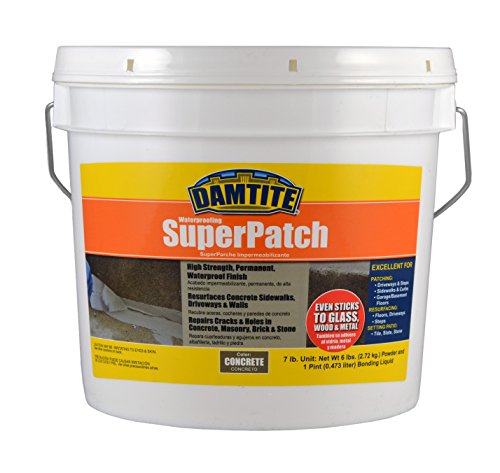
| Damtite 04072 Concrete Super PatchBest for Crack Filling | Sidewalks and driveway cracks | Powder plus bonding liquid | 5.3 pounds | 6 lb powder with 1 pint bonding liquid | Amazon |
| DAP Ready-Mixed Concrete Patch | Spot leveling and tuck pointing | Ready-mixed latex | 11.68 pounds | 1 gallon, non-shrinking | Amazon |
| Red Devil 0641 Concrete Repair Patch | Everyday crack and hole filling | Pre-mixed | 1 gallon | Water cleanup with soap and water | Amazon |
| BondsOn Vinyl Concrete Patch | Thin resurfacing to feather-edge | Powder | 12.3 pounds | Spreads to 1/16″ thickness | Amazon |
| Rust-Oleum Pourable Concrete Patch | Deep floor cavities | Pourable cement | 5 pounds | Up to 4 inches deep in one application | Amazon |
| Abatron Abocrete Kit | Structural and salt-damaged rebuilds | Self-leveling epoxy | 32 pounds | Shrink-free at any thickness | Amazon |
Detailed Reviews
1. PC Products PC-Masonry Epoxy Adhesive Paste 32 oz
Our pick — 4.5+★ from 250+ verified ratings; the strongest balance of quality and price.
A paste that holds its shape on an overhead pour instead of dripping onto your shoes.
The problem with filling a hole in a wall or under a lintel is gravity. This two-part epoxy paste is non-sagging, so you can push it into a vertical or overhead cavity and it stays where you put it while it cures. It also bonds on wet or dry surfaces, which matters when you are repairing a damp basement wall or a spot that never quite dries out.
Workability is what wins people over on this one — over 40 mentions in Amazon’s topic read, the overwhelming majority positive. The paste spreads and pushes into place without fighting you. Durability backs it up: it holds up over years without crumbling or sagging, and once fully cured it can be painted, stained, or machined, so you are not stuck with a gray smear that clashes with the surrounding wall.
Temperature is the spec to check before you buy. You can apply it between 35 and 115 degrees F, and it keeps working from -20 to +200 degrees F after curing. The honest catch is consistency and mixing: a fair number of buyers find it stiff, and the two-jar measuring and blending is not a pour-and-go job. skip it if you want the laziest possible repair.
Where it wins
- Non-sagging paste holds on horizontal and overhead surfaces
- Applies to wet and dry masonry, indoors or out
- Service range of -20 to +200 degrees F after cure
- Can be painted, stained, and machined once fully cured
Where it asks more
- Two-part mixing takes more time than a ready-mixed tub
- Some buyers find the paste stiff out of the jar
Reach for this if: your hole is in a wall, a step riser, or any spot where the patch has to defy gravity.
Think twice if: you want zero mixing and the quickest possible fill on a flat floor.
2. Damtite 04072 Concrete Super Patch Repair, 7 lb. Pail
A waterproof powder-and-liquid kit built for the driveway crack that comes back every winter.
This pail arrives as two parts — 6 lb of powder and a 1 pint bottle of bonding liquid — and the two-stage mix is what gives it a high-strength, permanent, waterproof finish. It is aimed straight at sidewalks, driveways, and walls, and it repairs cracks and holes in concrete, masonry, brick, and stone, so one pail covers several surfaces around the property.
What people respond to is the finished quality and the sheer usefulness of it. Effectiveness runs high in Amazon’s read, with owners leaning on it most for filling cracks in driveways and sidewalks. Drying time also gets a warm reception — it sets quickly and sticks to the surface rather than sitting on top of it.
The thing to plan for is application. Ease of use is genuinely split, and the consistency draws real criticism — reviewers compare it to play dough or pancake batter, and some find the liquid content or the mixing instructions off. Pour and mix carefully, add liquid in stages, and it behaves. Rush the water and it turns soupy.
Mix discipline pays off: the bonding liquid is what separates this from a plain cement powder, so measure rather than eyeball it.
Good match for: a homeowner patching several driveway and walkway cracks in one weekend.
Less ideal if: you want to open a tub and start spreading with no measuring at all.
3. DAP Ready-Mixed Concrete Patch, Gray, 1 Gal (7079831090)

No powder, no bucket, no mixing arm — open the gallon and start filling dents.
Open the tub and go. This latex-emulsion patch is ready-mixed and non-shrinking, and it fills holes, cracks, dents, and defects in interior or exterior concrete and masonry. It dries gray to blend into the surrounding surface, and it doubles as a spot-leveler or tuck-point filler when a joint needs tidying rather than a full rebuild.
The quality read on this one is strong, and the functionality backs it up — it shines on small spaces and localized damage. Ease of use is the other steady positive: no mixing means no ruined batches on a hot afternoon. No mixing means no ruined batches, and it goes on straight from the tub.
Drying time is the split. Some find it sets quickly, others find it takes far longer than expected, and a few report it simply not curing. The tub’s own instructions tell you to let the sealer dry 24 hours before driving over a patched area, so plan a day of downtime for anything a tire touches. The lid is worth a mention too — several note it coming off, so store it somewhere it will not get knocked over.
Small-jobs specialist: it repairs, spot-levels, and tuck-points with one tub, which is why it earns a spot for dents and defects rather than deep structural voids.
The 24-hour note: vehicle traffic waits a day, so this is a weekend patch, not a run-out-and-drive patch.
Pick this when: you want a grab-and-go tub for interior floor dents and small exterior defects.
Leave it on the shelf if: your hole is deep enough that you need a material designed to fill in one thick pour.
4. Red Devil 0641 Concrete Repair Patch 1 Gallon

The gallon that thousands of driveways have already trusted with a cracked edge.
Sheer numbers tell you something here. This is the most-reviewed patch in this whole lineup, and what it does well is exactly what most people buy a patch for: filling cracks and holes in concrete sidewalks, walls, and outdoor surfaces. The premixed blend saves you a mixing step, and the formula is built not to shrink or crack, holding flexibility for a permanent repair.
Application is the strong suit — the overwhelming majority of owners find it easy to work and convenient to apply, and effectiveness is the second-strongest theme, with sidewalks and outdoor repairs coming up again and again. Cleanup is simple: soap and water while it is still wet. It dries a light to medium gray, which suits lighter concrete well.
Durability is where it is honestly mixed. Some report it holding firm with no cracking after four weeks, while others see it crack quickly or never harden the way they expected. Texture draws similar split opinions — smooth and great for some, hard to smooth out and softening over time for others. Work it in thin, packed layers and press it hard into the crack edges for the best odds.
What earns its place
- Premixed formula removes the mixing step entirely
- Water cleanup while the patch is still wet
- Dries a light to medium gray to suit lighter concrete
- Interior and exterior use from one gallon
What to keep in mind
- Reports are split on how well it hardens and holds
- Texture can be hard to smooth out on a wide patch
Best fit for: filling sidewalk and slab cracks where a premixed gallon gets you going immediately.
Worth a second look if: you need a structural rebuild that takes heavy, repeated traffic.
5. Rust-Oleum Pourable Concrete Patch

Four inches deep in one pour, and you can walk on it before lunch.
For a real crater in a garage floor, the depth figure is the headline: this pourable patch can go up to 4 inches deep in a single application. You just add water, mix, and pour, and it fills large cracks, holes, spalls, gouges, and crevices without you troweling in layers. It sets in temperatures as low as 40 degrees Fahrenheit, so a cool-morning repair is on the table.
Speed is the other selling point. Foot traffic is fine after 1 hour, and vehicle traffic after as little as 3 hours. Ease of use scores cleanly across the board and drying time is universally praised — people report it setting and hardening rapidly and performing as described. Effectiveness and quality both read strongly too, with owners noting it holds up well in smaller cracks.
Now the honest part: this is a small bag, and the weight tells the story at 5 pounds. Value for money draws heavy criticism, quantity draws heavy criticism, and coverage comes in for the same complaint — several find the material runs out before the job is done. Weigh it in at 12.3 pounds against the BondsOn, and the difference is a real gap to plan around. Buy the size that matches your hole.
The 4-inch advantage: most patches ask you to build up in thin lifts; this one fills a deep cavity in a single pour, which saves hours.
The quantity trap: the coverage is modest for what you get, so a large floor repair may need more than one bag.
The one to grab for: a deep, awkward floor crater you want filled and walkable the same day.
Measure your hole first if: the repair is wide as well as deep, because the material does not stretch far.
6. BondsOn Vinyl Concrete Patch 12lb
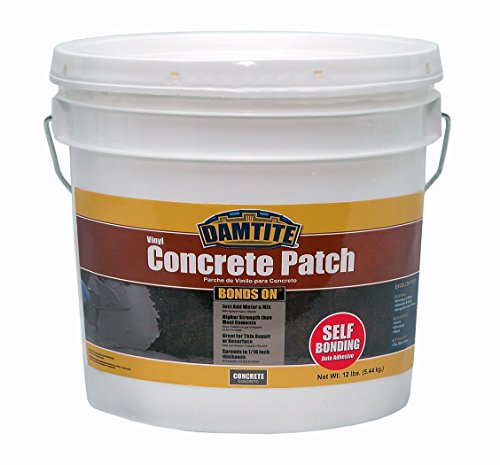
The patch you can feather to nothing, so a chipped edge disappears instead of stepping up.
Feather-edge is the term that matters here. This powder mixes with water and spreads from 1/2″ down to nothing at the edge, on concrete, stucco, and masonry. That makes it the answer when a hole has a shallow, flaking rim you want to blend into the surrounding surface rather than leave as a raised lip.
At 12.3 pounds it is the heavyweight of this group — 12.3 pounds against the 5 pounds of the Rust-Oleum, a 2.5x gap, which tells you the box holds substantially more material for wide, thin jobs. Coverage runs 10 sq. ft. based upon 1/8″ thickness, so a patio resurface is a real use case, not just a single crack. It is also listed as higher strength than most cements, so thin does not mean weak.
What holds up in use is adhesion and solid durability — buyers report it grabbing the surface well and staying hard. The trade-off is that a powder means a bucket, a measuring jug, and the patience to mix to the right consistency before it touches the concrete. Mix small batches and it is far easier to control.
Thin-section stand-out: spreading down to a feather edge is the one job most paste and pourable products cannot do, and this nails it.
Plan for the bucket: as a powder it asks for water, mixing, and the right consistency before application.
Dial it in for: chipped edges, spalled rims, and shallow resurfacing where the patch has to disappear into the concrete.
Not the pick for: someone who wants to skip the mixing bowl entirely.
7. ABATRON Abocrete Kit 1.25 Quarts
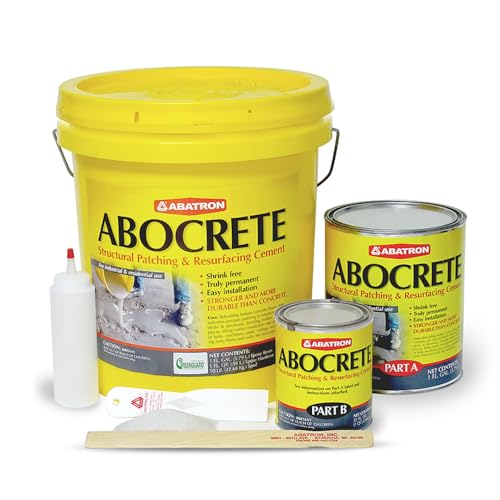
The epoxy you reach for when the concrete itself is failing and the repair has to outlast it.
This is a structural compound, not a cosmetic filler. Abocrete is a self-leveling epoxy that bonds, levels, fills, rebuilds, and resurfaces concrete and most rigid surfaces. It is aimed at pitted, spalled, worn, or cracked concrete, and it is built for salt damage repairs — the kind of failure you see on a garage floor after a few winters of road salt.
Three specs separate it from everything else here. It is shrink-free and can be applied in any thickness, so a deep void and a hairline crack are both within its range. It resists salt water, oils, and chemicals that erode ordinary concrete, and the maker states it will hold up to heavy forklift and truck traffic. It is also GREENGUARD certified and contains almost no VOCs, with no water or solvents and a low odor.
Weigh the practical side before buying. It is a liquid two-part epoxy with sand included in the kit, and it is the heaviest product in this lineup at 32 pounds of pail. That is an industrial-grade kit for a structural rebuild, not a dime-sized chip. Effectiveness reads cleanly across the board, and quality is right behind it.
Why it justifies the shelf space
- Shrink-free and applicable at any thickness
- Unaffected by salt water, oils, and chemicals
- Holds up to heavy forklift and truck traffic
- GREENGUARD certified with almost no VOCs and low odor
What you give up
- A two-part liquid epoxy demands careful measuring and mixing
- A 32-pound pail is heavy to move around a job site
Made for: salt-damaged, pitted, or structurally failing concrete where cosmetic filler would just crumble again.
Step back if: you have a single small crack that does not need an industrial-grade epoxy.
Know the Specs
Maximum Application Depth
This is how thick a patch can be laid in one go before it needs a second lift. A pourable cement listed for up to 4 inches deep lets you fill a real crater in one pour; a paste or thin-section product is better for shallow or feathered repairs. Deeper than that and you build up in layers or switch products.
Non-Sagging vs Pourable
Non-sagging means the material holds its shape on a vertical or overhead surface instead of sagging downward, which is what you need on a wall or under an overhang. Pourable means it is fluid enough to find its own level, which suits a flat floor crater in a garage or driveway.
Application and Service Temperature
The application range tells you what weather you can work in — PC-Masonry lists 35 to 115 degrees F, while Rust-Oleum sets in temperatures as low as 40 degrees Fahrenheit. The service range tells you what temperatures the cured patch survives afterward.
Coverage and Container Weight
Powder products are sold by weight and quoted as coverage at a set thickness, like 10 sq. ft. based upon 1/8″ thickness. Weight alone does not tell you area — a heavy pail of dense material may cover less than a lighter bag spread thin. Match both figures to your job size.
Common Questions
What is the best patch for a hole that is several inches deep?
Can I use a concrete patch on a vertical wall or an overhead surface?
How soon can I walk or drive on a patched area?
Can I patch concrete when the surface is wet?
What does feather-edge mean and why does it matter?
Why is the BondsOn 12.3 pounds compared to the 5 pounds of the Rust-Oleum?
Can a concrete patch be painted or stained afterward?
Will a patch survive salt and winter road chemicals?
How much area does a 1 gallon tub of concrete patch cover?
Does a concrete patch shrink after it dries?
The Bottom Line
For most large-hole repairs, the winner is the PC Products PC-Masonry Epoxy Paste because it is a non-sagging two-part paste that holds on walls and overheads, applies to wet or dry masonry, and keeps working from -20 to +200 degrees F after cure. Its 4.5+ star score across 200+ ratings makes it the safest bet for a repair that has to hold where gravity fights back. If you are filling a deep floor crater and want to walk on it the same day, grab the Rust-Oleum Pourable Concrete Patch with its up-to-4-inch single-application depth. And for a chipped edge that has to blend invisibly into the concrete, the BondsOn Vinyl Concrete Patch and its spread-to-1/16″ feather edge is the one to reach for.
How we choose
We do not accept paid placement. Every pick is matched to a real buyer and a real use-case; we do not hands-on test units.
Sources
Specifications: manufacturer listings and product documentation. Review insights: verified customer reviews, as of November 2026. Pricing: not shown on this page (it changes often); check the current price via the retailer link.
As an Amazon Associate, My Heart Lives Here earns from qualifying purchases. This does not affect which products we feature.