Heads up: This post contains affiliate links. As an Amazon Associate I earn from qualifying purchases, at no extra cost to you. Learn more
Specs are compiled from manufacturer listings and verified buyer reviews and can change over time — please confirm the key details on the product page before buying.
If you are short, you already know the drill: a “knee-high” sock arrives and the top band lands somewhere south of your knee, or the heel pocket sits halfway up your calf. The fix is not to size down — it is to pick a sock with a short-length cut and a heel pocket that lands where your heel actually is. That short-leg fit is the filter for everything below, and every pick is a real graduated compression stocking, not a fashion tight with a medical label.
This guide is built by comparing the manufacturers’ published specifications and the patterns across verified customer reviews, so you get each pick’s real strengths and trade-offs instead of marketing spin.
What follows is a shortlist built around one narrow problem: getting true graduated pressure on a shorter leg without the top band digging in or the toe box bunching. Every option here was checked against that brief, so treat this as a shortlist of compression socks that fit short women.
Top Picks

How To Choose Compression Socks for Short Women
Ordering the smallest size in a standard-length sock is the mistake most short buyers make. You get a tighter tube, not a shorter one. The graduated profile (the pressure that eases from ankle to calf) still assumes a longer calf, so the squeeze lands in the wrong place. The top band then rides up over the knee or bunches at the ankle. Pick your length and heel placement first, then worry about the pressure rating.
Read the mmHg figure as a pressure level, not a score
mmHg stands for millimeters of mercury, and it measures how much pressure the sock puts on your leg. The highest number sits at the ankle, and the pressure drops as the sock climbs toward the knee — that drop is what “graduated” means. A 15-20 mmHg sock is a lighter, everyday level, while 20-30 mmHg is a firmer level. Which level is right depends on your calf size and how long you are on your feet, not on a ranking.
Check where the heel pocket lands
On a shorter calf, a heel pocket cut for an average leg ends up sitting low, which drags the whole sock down and puts the top band in the wrong spot. Look for listings that name a short length explicitly, and read the fit feedback carefully. A sock that fits well at the ankle but runs long at the knee will still slide.
Decide between sheer and opaque before anything else
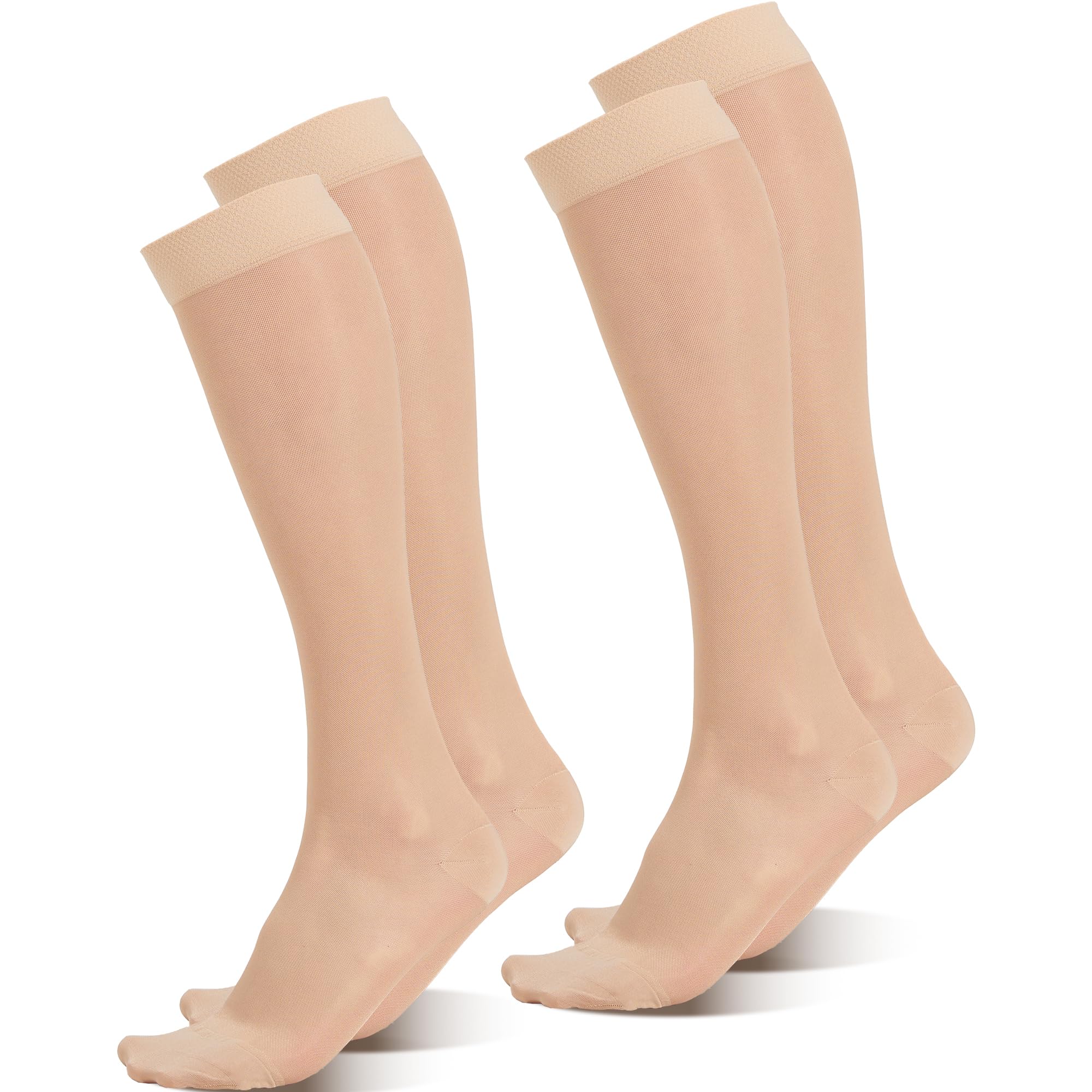
A sheer stocking looks like regular hosiery and slips under a skirt or trousers without announcing itself. An opaque knit looks and feels like a classic sock and tends to be the more forgiving option when you need firmer pressure. If you want to wear these to the office without them reading as medical gear, sheer matters; if you want them for long days on your feet, knit usually wins.
Open toe or closed toe
An open-toe design leaves your toes free, which helps if your feet swell or if you want to check toe colour easily. A closed toe gives a smoother finish inside a shoe and keeps the whole foot covered. Toe style says nothing about quality — it depends on whether your toes swell by evening.
Side-by-Side Comparison
| Model | Best For | Compression | Toe Style | Length | Amazon |
|---|---|---|---|---|---|
| BSERA 2 Pairs Sheer Compression Socks★ Best Overall | Discreet office wear | 15-20 mmHg | Closed toe | Knee high | Amazon |
| Truform 20-30 mmHg Closed ToeEveryday Firm Pick | Everyday firm support | 20-30 mmHg | Closed toe | Knee high | Amazon |
| Truform 20-30 mmHg Open Toe | Swollen toes and sandals | 20-30 mmHg | Open toe | Knee high | Amazon |
| JOBST Relief 20-30 mmHg | Long standing shifts | 20-30 mmHg | Open toe | Knee high | Amazon |
| DYNAVEN by Sigvaris Calf-High | Shorter calf, medium short | 20-30 mmHg | Closed toe | Calf high | Amazon |
Detailed Reviews
1. BSERA 2 Pairs Sheer Compression Socks
Our pick — 4.0+★ from 1,000+ verified ratings; the strongest balance of quality and price.
The pair that passes as ordinary hosiery while still doing a real job on your legs.
Here is the thing about being short and needing compression: the sheer ones almost always give you away. Not these. At 15-20 mmHg — a lighter, everyday pressure level — the BSERA set is aimed at the woman who wants her legs supported under a skirt or trousers without anyone at the desk noticing. Two pairs in the box means you always have a clean one, which for daily wear is the difference between a habit and a drawer ornament.
You get a natural look that wins people over. The fabric reads thin and close to regular hose, and buyers praise the sheerness most — these keep a natural appearance rather than a shiny, medical sheen. Pulling them on is not the wrestling match firmer stockings can be, the other theme in the feedback. That is why these get worn on a Tuesday rather than saved for a bad day. The pressure does its job too: buyers single out the compression, and the sheer number of positive remarks on that point tells you it is not a token squeeze.
Fit is the honest catch. Feedback splits hard here: plenty of women find these stay put and feel right, while a chunk report the plus size runs short and the sock is not as tight around the leg as they expected. That is a sizing mismatch, not a faulty sock. Measure your calf and ankle before you order rather than guessing from your shoe size. Want a firm, medical-grade grip up the whole leg? This is the wrong shelf. Want a light, invisible layer that makes a long day on your feet easier? It is the right one.
Where these earn their keep
- 15-20 mmHg graduated pressure — a light everyday level that suits a shorter, smaller calf without feeling like a tourniquet.
- Sheer, natural finish that passes as normal hosiery under office clothing.
- Two pairs in every set, so daily rotation is realistic.
- Easy to pull on and off compared with firmer 20-30 mmHg stockings.
What to weigh before you click
- The plus size reportedly runs short — measure your calf and ankle, do not assume from shoe size.
- Some find the leg grip looser than expected for a compression sock.
- Sheer fabric will not hold up to the wear of a thick knit over months of daily use.
Reach for these if: you want discreet support under work clothes and light pressure is enough for your legs.
Look elsewhere if: you need firm, medical-level compression or you have a fuller calf and need a generous cut.
2. Truform 20-30 mmHg Compression Stockings Closed Toe
Medical-grade pressure in a sock that looks like a plain everyday knit.
Step up one level from the everyday sheer pairs and you reach 20-30 mmHg (millimetres of mercury, the scale that measures how hard the sock squeezes). That is a noticeably firmer squeeze, and Truform calls it the next rung above the 15-20 mmHg starting point most new users begin on. The brand describes it as Class II medical compression with a verified graduated profile, made in its own FDA-registered factory in Cincinnati. Whatever you make of the label language, the practical read is a firmer sock aimed at real leg fatigue rather than light support.
For a shorter leg, the useful detail is that the closed-toe cut here reportedly accommodates shorter legs and leaves room in the toe box — roomy toes are specifically what comes up in the fit discussion. That matters if your usual problem is a sock that pulls tight across the toes and leaves you counting the hours. In use, the pressure is the strongest point: the feedback on the compression itself is overwhelmingly positive, and tired legs feel better rather than just constrained.
Set against the sheer BSERA pick, this is a firmer world — 20-30 mmHg versus 15-20 mmHg — so the squeeze is the whole point, but so is the effort. Getting them over the heel takes patience, and the feedback on ease of use is genuinely split down the middle. Sizing is the other split: some women find the short length exactly right, others say it runs very small. Measure your calf and ankle, pick from the size chart rather than your sock size, and you will land on the right side of that line.
What holds up: Truform’s build quality is the most-praised thing by a wide margin — the knit is substantial, the graduated pressure is real, and a lot of buyers come back for a second pair. The short-length option is the reason this earns a spot on a short-women list at all.
What demands patience: these take real effort to pull on, and a minority report the fabric giving out within a couple of weeks. Ordering the wrong size is the most common route to disappointment here, so the tape measure is not optional.
The short version: firmer, better-built support for a shorter leg that wants real pressure, not a light hug.
The trade: you will spend real time and effort getting them over your heel each morning.
3. Truform 20-30 mmHg Compression Stockings Open Toe
Same firm Truform squeeze, with your toes left out of the conversation.
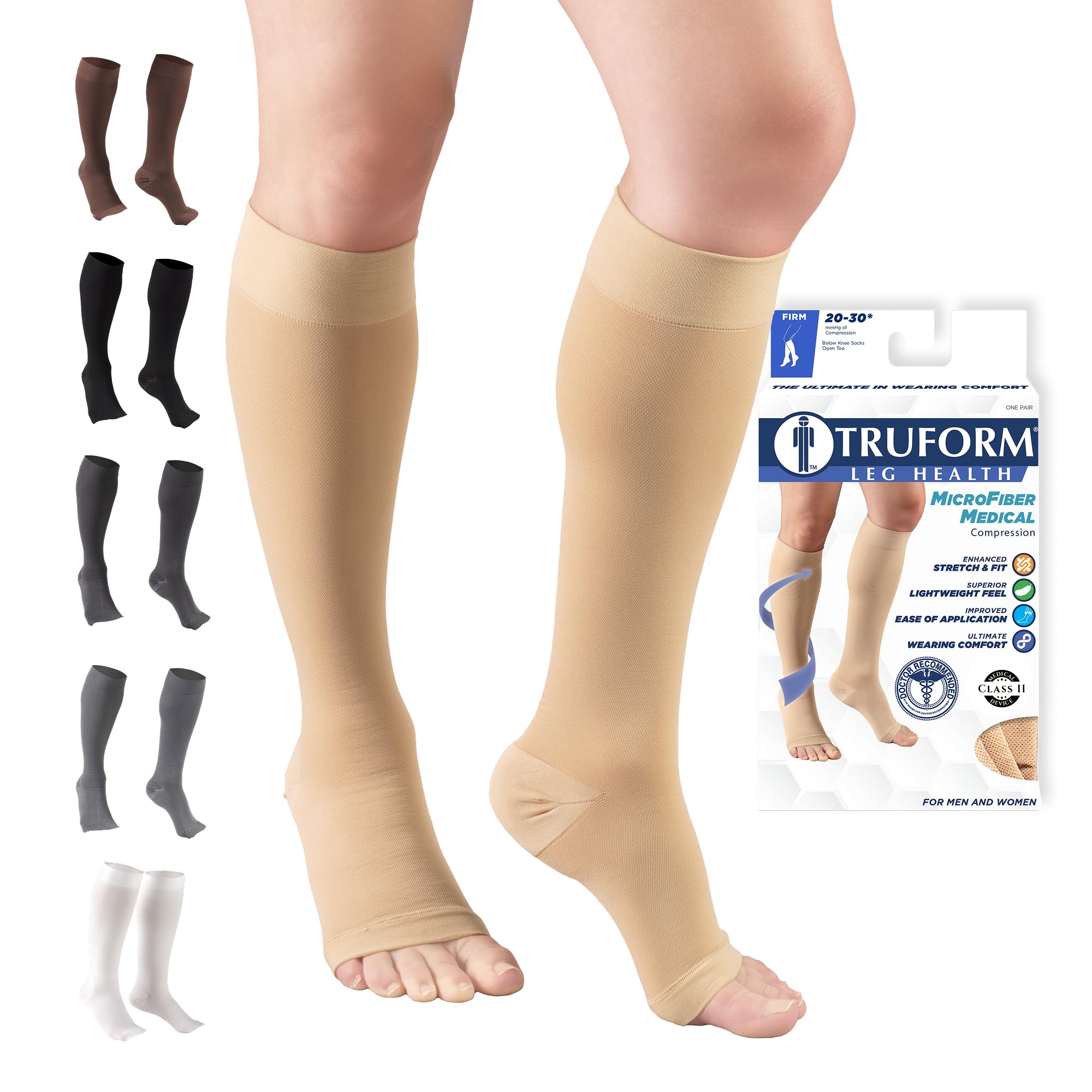
When your feet are the part that swells, an open toe changes your day. This is the same 20-30 mmHg Truform knit as the closed-toe version above, but the toe box is cut away. Nothing presses on your toes, you can see at a glance how your circulation is doing, and the sock works with open footwear. The compression level is identical, so the choice between the two is purely about your feet, not about how much support you get.
Buyers respond to the quality of the knit and the strength of the support. They describe the pressure as genuine relief rather than a squeeze, and say the stockings wear all day without discomfort. Value comes up warmly too. That combination makes this a realistic daily driver for a shorter leg rather than a pair you dread.
Length is where this one needs honesty. The length feedback is mixed: some women find it great for short legs — and the XL short is specifically called out as working for a shorter frame — while others say it still runs too long. Fit feedback splits the same way, with some finding it comfortable and others finding it tight and prone to shifting. The knit is also not built to last forever; a slice of buyers report rips. Treat the tape measure as your first step and this sock as a wear item rather than an heirloom.
Who this suits: anyone whose toes need breathing room, or who wears open shoes and wants the compression hidden up the calf but absent from the foot.
The honest limit: with the toe open there is one more edge to keep flat and one more place for the sock to shift during the day.
Pick this one when: swollen or sensitive toes are the reason you are shopping for compression in the first place.
Choose the closed toe instead when: you want the smoothest finish inside a shoe and one less edge to manage.
4. JOBST Relief 20-30 mmHg Knee High Compression Stockings

The premium-tier option built for the woman who is on her feet for a full shift.
JOBST Relief sits in the premium bracket, and your money buys a 20-30 mmHg graduated stocking with an open toe and a regular band at the top. That spec sheet is written for someone who stands through a whole shift, not someone who wants an hour of relief at their desk. The brand describes the line around long standing and vein support — exactly the brief a nurse, a teacher, or a retail worker brings to a sock like this.
The open toe is the practical part for a shorter leg. It lets you check your toes through the day without peeling the whole sock down, and the sock ends where swelling most often does — at the foot. The regular band at the top is a design choice worth thinking about: it is a straightforward band rather than a sculpted one, so the fit at the knee comes down almost entirely to you picking the right size.
One thing to be straight about: this listing gives you less fit feedback to work from than the others on this list, and at a premium tier that makes measuring more important, not less. Get your ankle and calf circumference right and order from the chart. If you are between sizes on a shorter leg, that half-size gap is where the top band either sits quietly or makes itself known by mid-afternoon.
The tier you are buying: a premium graduated stocking at 20-30 mmHg, open toe, regular band — built around long days upright rather than short bursts.
Do this first: measure your ankle and calf with a tape, not with your memory of a sock size you bought years ago.
Best for: long standing shifts where you want a firmer graduated sock and free toes.
Think twice if: you want to try compression for the first time on a shorter leg and would rather start at a lighter, more forgiving level.
5. DYNAVEN by Sigvaris Compression Calf-High Socks Medium Short

Sized as “medium short” — the one here that names your leg length in the product title.
Most compression socks make you guess at length from a size chart. This one puts it in the name: medium short. For a shorter woman that is not a marketing flourish — it is the reason to look here at all. The calf-high cut and the short designation together mean the graduated profile can sit where it is meant to. At 20-30 mmHg it delivers a level the manufacturer frames around everyday support, travel, and post-procedure recovery. Unlike the lighter 15-20 mmHg sheer pick above, there is no question about whether the pressure is firm enough.
The fabric is the standout spec: 79% Nylon and 21% Spandex, with double-covered inlay yarns the maker says are built for durability and lasting comfort. In practice that translates to a sock that feels substantial and holds its shape rather than going slack. A fortified heel, roomy toe space, and a secure fit are the design points the maker calls out, and the closed toe gives you a clean line inside a shoe. Quality is what wins people over most here — the knit earns a clear majority of positive comment — with comfort a close second, particularly the fact that standing all day in them does not leave you dragging.
The trade-off is the top band. Fit feedback splits, and the specific gripe is that the band is exceedingly tight at the top — constrictive enough to be the deal-breaker for some legs. Sizing feedback splits alongside it, with some finding the size right and others finding it too small and too long at once. That is the classic short-leg problem in reverse: the leg length is addressed, but the band tension still varies by calf shape. If your calves are fuller at the top, size up or look at the open-toe Truform instead.
What the spec sheet gives you: 20-30 mmHg with a real short-length designation, 79% Nylon and 21% Spandex double-covered inlay yarns, fortified heel, and a closed toe — a genuinely durable knit rather than a thin stocking.
The thing to plan around: a firm top band. If your calf is wider up top, that band is the part that will decide whether these stay in your drawer.
Made for: the shorter woman who wants firm 20-30 mmHg pressure and a durable knit, and whose calf shape suits a firm top band.
Not the one if: you need a gentle band at the knee — that is the exact point where these divide opinion.
Know the Specs
What mmHg really means
mmHg is millimeters of mercury, a measure of pressure. In compression socks the highest figure sits at the ankle and the pressure decreases as the sock climbs the leg — that gradient is what “graduated” refers to. A 15-20 mmHg sock is a lighter level; a 20-30 mmHg sock is firmer. On a shorter calf, the same mmHg level is spread over less length, so a 20-30 mmHg sock can feel stronger than it would on a longer leg.
Why heel placement decides the fit
A compression sock is cut to put pressure in a specific pattern, and the heel pocket is the anchor point that holds that pattern in place. If the heel sits low, the sock rides down and the top band ends up somewhere it should not be. On a shorter leg, a short-length designation or a medium short size is the clearest signal that the pattern was cut for you.
Sheer versus opaque knit
Sheer stockings are thin and read like regular hosiery, which makes them the choice for office wear and skirts. Opaque knits look and feel like a classic sock and generally hold their shape and pressure better over repeated washing. The trade-off is visibility: sheer disappears under clothing but wears faster, while opaque lasts longer but announces itself.
Open toe versus closed toe
An open toe leaves your toes uncovered, so you can check circulation easily and nothing presses on a swollen foot. A closed toe covers the whole foot and gives a smoother finish inside a shoe. Both toe styles come in the same 15-20 and 20-30 mmHg levels, so pick on toe comfort, not on pressure.
Common Questions
Will 20-30 mmHg feel too tight on a short leg?
How do I measure for compression socks if I am short?
What is the difference between 15-20 mmHg and 20-30 mmHg?
Can I wear open-toe compression stockings with sandals?
How long do compression socks last before they lose their stretch?
Why do compression socks slide down on short legs?
Can I wear sheer compression socks to the office without anyone noticing?
Is a firmer sock better for varicose veins?
How do I put on a 20-30 mmHg stocking without struggling?
Should I buy two pairs instead of one?
The Bottom Line
Short and want something you will actually wear every day? The BSERA sheer pair is the one — 15-20 mmHg of light graduated pressure that lives under work clothes, in a two-pair set, and the crowd favourite on this list. Want it firmer at 20-30 mmHg? The Truform closed-toe stocking is the better knit, with a short-length cut that genuinely accommodates a smaller leg. If your toes are the problem, the open-toe Truform gives you the same firm pressure with the foot left free. On the premium end, the Sigvaris medium short is the only one here that names your leg length in the product — worth it if you want a durable 20-30 mmHg knit and can live with a firm top band.
One last practical note: measure your ankle and calf before you order any of them. Every pick on this list has sizing or fit feedback that splits both ways, and on a shorter leg, half an inch is the whole difference between a sock you reach for and one that sits in the drawer. New to compression? Start with the lighter BSERA level, then move up to a 20-30 mmHg pair once you know how your leg responds.
How we choose
We do not accept paid placement. Every pick is matched to a real buyer and a real use-case; we do not hands-on test units.
Sources
Specifications: manufacturer listings and product documentation. Review insights: verified customer reviews, as of November 2026. Pricing: not shown on this page (it changes often); check the current price via the retailer link.
As an Amazon Associate, My Heart Lives Here earns from qualifying purchases. This does not affect which products we feature.