Heads up: This post contains affiliate links. As an Amazon Associate I earn from qualifying purchases, at no extra cost to you. Learn more
Specs are compiled from manufacturer listings and verified buyer reviews and can change over time — please confirm the key details on the product page before buying.
You want a patio that shrugs off rain, freeze-thaw cycles and spilled drinks — and the fastest way to get there is to match the coating to the finish you actually want. A wet-look acrylic darkens the concrete and pops the color. A penetrating silane sealer soaks in and leaves the surface looking exactly as it does now. Those are the two paths, and picking the wrong one is the single most common reason people end up unhappy with a concrete coating.
This guide is built by comparing the manufacturers’ published specifications and the patterns across verified customer reviews, so you get each pick’s real strengths and trade-offs instead of marketing spin.
The seven coatings below are split by what they do to the look of your slab and how many square feet a container will treat, so you can stop reading labels and start rolling. Here is the practical breakdown of the best coating for concrete patio.
Top Picks


How To Choose The Best Coating for Concrete Patio
Start with one decision: do you want the patio to look different when you finish, or the same? A wet-look acrylic coating darkens the slab and deepens its color, like the surface looks after a rain shower. A penetrating sealer sinks into the pores and cures invisible. Everything else — how much you need, how you apply it, how long it lasts — follows from that choice.
Film-forming versus penetrating
A film-forming acrylic sits on top of the concrete and builds a visible layer. That layer is what gives you the gloss and the color pop, and it is also what wears away under foot traffic and vehicle tires. A penetrating sealer bonds below the surface and lines the pores so water beads and rolls off. It cannot peel or yellow because there is nothing sitting on the slab to peel. The trade-off is simple: the acrylic changes the look, the penetrating sealer does not.
Do the coverage math before you buy
Every container lists coverage in square feet per gallon, and those numbers vary widely. One gallon of the Armor AR350 treats up to 175-225 ft2, while the MasonryDefender gallon covers 90-150 sq. ft. That gap matters on a large patio. A concentrate changes the math entirely — the Lithi-Tek 9500 gallon is mixed with four gallons of water and then treats up to 1,000 sq ft per coat. Measure your slab length times width, then divide by the coverage figure to get your container count.
VOC rules differ by state
VOC stands for volatile organic compounds — the solvents that evaporate as the coating cures. Solvent-based acrylics carry higher VOC numbers, and some states cap what you are allowed to buy and apply. The Armor AR350 comes in 700 VOC, 350 VOC and 50 VOC versions to satisfy requirements across all 50 states. Check your local rule before ordering a solvent-based product, because the wrong version will not ship to you.
Match the coating to your climate
A patio that sees road salt, snow and ice needs a coating rated for that exposure. So does a pool deck that catches splash-out, or a slab next to a saltwater spa. Look for explicit language about de-icing salt, UV resistance and freeze-thaw in the product description. If your slab sits in a coastal or snowy region, that line item matters more than the gloss level.
Side-by-Side Comparison
| Model | Best For | Finish Type | Coverage | Material | Amazon |
|---|---|---|---|---|---|
| Armor AR350★ Best Overall | Wet-look color pop on patios and pavers | Low gloss wet look | 175-225 ft2/gallon | Acrylic (solvent-based) | Amazon |
| MasonryDefender All PurposeBest Invisible Finish | Invisible waterproofing on brick and stone | Penetrating, clear | 90-150 sq. ft./gallon | Silane-Siloxane | Amazon |
| Valspar 1534 Porch and Floor | Colored satin finish on mixed surfaces | Satin enamel | 300-400 sq ft/gallon | Latex | Amazon |
| Lithi-Tek 9500 | Big slabs and basement-adjacent patios | Penetrating, clear | Up to 1,000 sq ft per coat | Water-based densifier | Amazon |
| McKinnon Concrete & Paver 5 Gallon | Contractor-size wet look on driveways and patios | Semi-gloss wet look | — | Penetrating formula | Amazon |
| STONETECH Salt Water Resistant | Pool decks and salt-exposed stone | Clear penetrating | — | Water-based acrylic | Amazon |
| DOMINATOR 5 Gallon | Natural-look protection on big surfaces | Zero sheen, invisible | — | Silane Siloxane | Amazon |
Detailed Reviews
1. Armor AR350 Low Gloss Wet Look Concrete Sealer 1 Gallon
Our pick — 4.5+★ from 850+ verified ratings; the strongest balance of quality and price.
The coating that makes old concrete look like it just rained — and keeps it that way.
If your concrete already looks great when it is wet, this is the one that keeps that look permanently. The Armor AR350 is a solvent-based acrylic that darkens the slab and pulls the color out of it — the maker calls it dramatic color enhancement, and the effect is the whole point. You are not buying a clear coat here. You are buying a look.
What earns it the top spot is that it is genuinely easy to put down. It is self-priming, meaning no separate primer step, and it rolls or sprays straight onto a properly cleaned surface. A single gallon covers up to 175-225 ft2, so a typical patio takes one container and a reseal later takes one coat with no stripping. It cures to a low gloss rather than a mirror shine, which is the more forgiving look on a patio that sees real foot traffic.
The catch is the smell. This is a 700 VOC solvent formula, and people who have used it are blunt about the fumes — plan the job for a well-ventilated day and keep the family off the patio until it cures. Also check your state’s VOC limit before you order, because the AR350 comes in 700 VOC, 350 VOC and 50 VOC versions and the 700 will not ship where the cap is lower.
glossy wet finish
- Deepens color and pulls out the wet look — the reason most people pick it
- Self-priming, so it rolls or sprays straight on with no starting coat
- One gallon treats up to 175-225 ft2, enough for a typical patio
- Low gloss rather than high shine, which hides scuffs better
- Resists UV, road salts and water absorption once cured
slippery when wet
- Strong solvent smell — you need ventilation and a clear curing window
- Solvent-based, so state VOC caps may block the 700 version
- Film-forming, so heavy traffic wears it and it needs periodic reapplication
want high shine: you want your patio to look richer and wetter, and you are willing to ventilate the job properly.
prefer matte: your slab sits in a state with a tight VOC cap and you need the version that ships there, not the standard one.
2. MasonryDefender Sealer 1 Gallon
No gloss, no color shift, no film — just water beading and running off.
Some patios do not need to be prettier. They need to stop soaking up water. That is what the MasonryDefender does, and it does it while leaving the slab looking exactly the way it looked before you opened the jug. The active ingredient is a silane-siloxane mix that soaks into the pores of concrete, brick and stone and lines them from the inside.
The physical details are practical: it weighs in at 8.6 pounds, and if you stack that against the 8.91-pound McKinnon five-gallon pail, you are looking at a container that is a fraction of the size but a comparable lift. It ships as a 128-fluid-ounce gallon and covers 90-150 sq. ft. — so scope your patio carefully before you commit, because that coverage figure is lower than the acrylic options above.
Applied with a pump-up garden sprayer, it lays down evenly and cleans up without drama. Surfaces bead water hard once it cures. The one honest caution: color change splits opinion. Some slabs warm up slightly, others pick up a faint white haze where it pooled. Spray in even passes and do not let it puddle, and you sidestep the issue.
works on brick too: brick walkways, patios next to masonry walls and any slab where you want protection without a sheen. Water rolls off within days of application.
needs two coats: at 90-150 sq. ft. per gallon you buy more containers than you would for a wet-look acrylic, and the color result depends on your spray technique.
mixed masonry jobs: the current look of your concrete is fine and you only want to stop moisture.
single-surface only: you were hoping to darken or enrich the slab — this sealer deliberately will not.
3. Valspar 1534 Porch and Floor Enamel

A paint rather than a sealer — and that is exactly why you would pick it.
Every other product on this list treats the concrete as it is. This one covers it. The Valspar 1534 is a latex satin enamel in dark gray — a paint, not a clear coat — and it goes on wood, concrete, floors, primed metal, steps, railings and porches. If your patio is stained, patched, or a color you simply cannot live with, a coating that hides the surface is the only real answer.
The numbers behind it are worth knowing before you start. One gallon covers 300-400 sq ft, which is broad for this category. Dry time is 24 hours and full cure is 24 hours, so you need a day of good weather and a clear path around the job. It cleans up with water, which keeps solvent fumes out of the picture entirely.
The honest limit is that a latex enamel on a patio is a different animal from a sealer. It is a colored film on top, so high-traffic corners will show wear before a penetrating sealer would. It also has a thinner review base than the clear coatings here — the ratings pool on this one is small compared to the wet-look acrylics, so treat it as the specialist pick it is. For a patio that needs a color change and sees moderate use, it does a job nothing else on this list does.
porch floor refresh: the patio is ugly, stained or the wrong color, and you want to paint over the problem with something rated for floors and weather.
need fast dry: you want a clear protective coat that lets the concrete show through.
4. Lithi-Tek 9500 Ultra Concentrate 1 Gallon (Makes 5 Gallons)
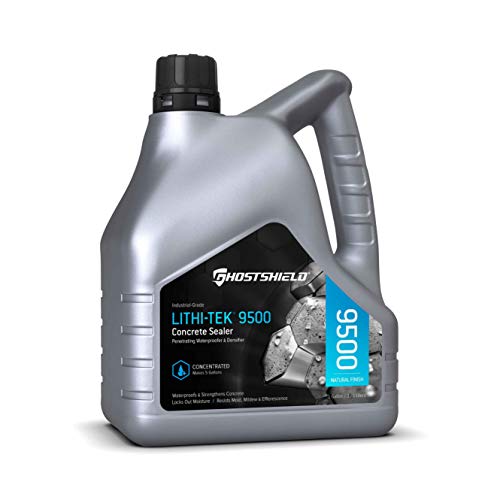
One gallon becomes five, and those five treat up to 1,000 square feet.
The coverage math on this one is unlike anything else here. You mix the single gallon with four gallons of water and end up with five gallons of ready product that treats up to 1,000 sq ft per coat. On a large patio, that is a container count you can carry in one hand.
It is also doing more than sealing. The water-based formula is a densifier as well as a waterproofer — it hardens the concrete, increases abrasion resistance, and the maker states it strengthens concrete by up to 50%. It reduces moisture vapor transmission and hydrostatic pressure, and helps prevent efflorescence, the white chalky salt bloom that shows up on basement and outdoor slabs. If you have ever scraped that white crust off a garage floor, you know why that matters.
The pragmatic detail: existing efflorescence has to be cleaned off before you apply, or you are sealing the stain in. And residue is the one area where results split — some slabs come out clean and clear, others show white spots where the mix sat too heavy. Dilute exactly as directed and keep the passes even. The easy-mixing, sprayer-friendly application is what most people comment on, which is a good sign for a DIY patio job.
concentrate makes five: a densifying, waterproofing concentrate that stretches to 1,000 sq ft per coat from one jug, applied with a sprayer and mixed in minutes.
mixing required: clean off any existing white bloom first and measure your dilution carefully, because uneven mixing is where the white spotting comes from.
bulk coverage cheap: a big slab, a garage-adjacent patio, or any concrete where you want hardening and moisture control in one step.
want ready to pour: do not apply over existing efflorescence — clean it first or the coating traps it.
5. McKinnon Concrete & Paver Sealer 5 Gallon

Five gallons of the wet look contractors actually use, in one heavy pail.
This is the size that makes sense when the job is bigger than one patio. The McKinnon comes as a five-gallon pail of semi-gloss wet-look sealer, blended for concrete, pavers, brick and natural stone on driveways, patios, pool decks, walkways and garage floors. It is made in Tampa, Florida by a family-owned industrial coatings supplier, which is the kind of detail that explains the formulation — this is built for hardscape that lives outdoors.
The formula penetrates rather than building a heavy film on top, so the finish deepens color without the plastic look. Outside, the UV-resistant mix is designed to hold up against sun, rain, freeze-thaw and foot traffic. Inside, it works on sealed concrete floors too, which makes it a rare crossover. Application is a roller, brush or pump sprayer in even coats, with tools cleaned before cure.
Pick this up and you feel the weight — 8.91 pounds of pail versus the 8.6-pound MasonryDefender gallon, which is a real difference when you are hauling it to the back of the yard. The finish is also the honest sticking point. It lands semi-gloss for most people, but a whitish sheen turns up on some slabs. Over-application is the usual culprit, so pull your coats thin and keep them even.
large paver driveway: a full driveway-plus-patio job where a single five-gallon pail beats buying individual gallons.
small touch up: if you are sealing one small patio and want the lowest-risk finish, the smaller pail with the tighter gloss control is safer.
6. STONETECH Salt Water Resistant Sealer

The specialty pick for a deck that gets splashed with salt water or de-icer.
Most patio sealers are built for rain. This one is built for salt. The STONETECH formula is rated for maximum protection against salt water and de-icing salt damage, which is the specific failure mode that eats natural stone, masonry and grout around a pool or a coastal walkway. It is a water-based acrylic that goes on clear and cures weather and UV resistant for exterior use.
The whole point here is that salt is a different enemy. It works into porous stone and grout, crystalizes, and pushes the surface apart over repeated freeze cycles. A general-purpose sealer can handle rain and still lose ground to salt. Seal quality is what this product is known for, and it is the strongest single argument for paying more for the specialty formula.
Where it needs honesty: durability is the sore point. The recurring report is that it does not hold up beyond a couple of years, which means you reseal more often than you might hope. Color response is inconsistent too — some stone shows no change at all, other pieces darken. If your deck is near a saltwater spa, a pool with splash-out, or a road that gets salted, that shorter cycle is a fair trade for the protection. Away from salt, it is overkill.
salt water resistant: salt water and de-icing salt damage is a specific threat that ordinary waterproofers do not fully address, and this one is formulated for it.
pricey per gallon: a reseal cycle of roughly a couple of years, plus a color result that varies from slab to slab.
coastal pool decks: coastal patios, pool decks with saltwater splash, and any slab in a region that gets de-iced in winter.
inland dry climate: an inland patio that only ever sees rain — a general acrylic or silane does that job for a lot less.
7. DOMINATOR Concrete Sealer 5 Gallon
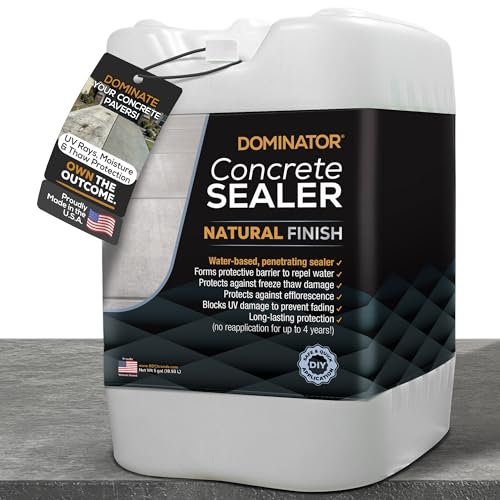
Cures invisible — no sheen, no film, nothing to peel in a few summers.
If the idea of a glossy film on your concrete makes you uneasy, this is the alternative. The DOMINATOR is a silane siloxane penetrating sealer in a five-gallon pail, and it is formulated to bond below the surface rather than sit on top. The maker is explicit about the result: zero sheen, zero film, no yellowing, no peeling. Your stamped concrete, pavers and stone look exactly as they do now, just protected.
The application matches that promise. Clean, spray, walk away — it is ready to spray out of the pail, water based, low odor and fast drying. The formula is built for driveways, patios, pool decks, garage floors, flagstone and masonry, indoors and out. It lines the pores so water beads on contact, and because nothing is forming a film, there is no layer to wear away under tires.
Here is the fair warning. Water resistance is the split point on this one — some slabs repel water hard, but staining from dogs and rust from sprinklers has been reported even after sealing. That does not make it a bad sealer. It makes it a waterproofer rather than a stain-blocker, so do not expect it to shrug off everything that lands on the concrete. It also carries the thinnest track record of the wet-look and silane options here, so buy it for the invisible finish it delivers, not as a proven all-rounder.
deep sealing job: you want a natural, film-free finish on a large surface and you are sealing for water, not for stains.
want visible sheen: if you need stain resistance against pets or irrigation rust, look at the acrylic and densifier options above instead.
Know the Specs
Coverage Rate (Square Feet Per Gallon)
This number tells you how far one container goes, and it is the single figure that decides how many jugs you buy. The Armor AR350 treats up to 175-225 ft2 per gallon. The MasonryDefender gallon covers 90-150 sq. ft. The Valspar enamel stretches to 300-400 sq ft. A concentrate changes the math — the Lithi-Tek 9500 gallon mixes with four gallons of water and then covers up to 1,000 sq ft per coat. Measure your patio (length times width) and divide it by the coverage figure before you order.
VOC Level
VOC stands for volatile organic compounds — the solvents that evaporate while the coating cures. Higher VOC solvent formulas carry a stronger smell and better penetration on some surfaces, but many states cap what you can legally buy and apply. The Armor AR350 ships in 700 VOC, 350 VOC and 50 VOC versions to meet the rules in all 50 states. If you order the wrong version for your state, it will not arrive. Check the cap before you buy any solvent-based acrylic.
Finish Type: Film-Forming vs Penetrating
A film-forming acrylic builds a visible layer on the concrete — that layer delivers the gloss, the color pop and the wet look, and it also wears away under tires and foot traffic. A penetrating silane or siloxane soaks into the pores and lines them so water beads, but changes nothing about the look. Neither is better in the abstract. The film gives you a result you can see. The penetrating coat gives you a result you cannot see but that cannot peel.
Efflorescence and Densifiers
Efflorescence is the white, chalky salt bloom that pushes up through concrete, usually on basements and outdoor slabs. A densifier like the Lithi-Tek 9500 hardens the concrete, increases abrasion resistance and helps prevent that bloom. The catch is timing: existing efflorescence has to be cleaned off before you seal, or the coating traps the stain in. For any slab that has already shown white patches, clean first, then seal.
Common Questions
Is a wet-look acrylic or a penetrating sealer better for a concrete patio?
How many gallons do I need for a patio of a certain size?
Will a solvent-based concrete sealer ship to my state?
How long does a concrete patio coating actually last?
Can I seal over concrete that already has white efflorescence on it?
What does the coverage difference mean for the McKinnon pail versus the MasonryDefender gallon?
Does a concrete patio sealer stop stains or just water?
Can I use a porch and floor paint on a concrete patio instead of a sealer?
What is the difference between a sealer and a densifier?
Do I need to strip the old coating before reapplying?
The Bottom Line
For most patios, the coating for concrete patio that gives the strongest all-around result is the Armor AR350, because it darkens the concrete into a low-gloss wet look, self-primes for a one-coat reseal, and stretches up to 175-225 ft2 per gallon. If you want protection with no visible change at all, reach for the DOMINATOR and accept its film-free finish. For a big slab that needs hardening as well as waterproofing, the concentrate value of the Lithi-Tek 9500 — one gallon making five — is hard to argue with. And if your deck catches salt water or de-icer, the specialty formula of the STONETECH is the one to plan around.
Whatever you pick, the coat is only as good as the prep. Sweep, clean and let the slab dry fully before the first pass, and pull your coats thin — over-application is what causes the whitish sheen and hazy patches that turn up in reviews of both wet-look formulas. Do that, and your patio holds its finish for years.
How we choose
We do not accept paid placement. Every pick is matched to a real buyer and a real use-case; we do not hands-on test units.
Sources
Specifications: manufacturer listings and product documentation. Review insights: verified customer reviews, as of November 2026. Pricing: not shown on this page (it changes often); check the current price via the retailer link.
As an Amazon Associate, My Heart Lives Here earns from qualifying purchases. This does not affect which products we feature.