Heads up: This post contains affiliate links. As an Amazon Associate I earn from qualifying purchases, at no extra cost to you. Learn more
Specs are compiled from manufacturer listings and verified buyer reviews and can change over time — please confirm the key details on the product page before buying.
Poison ivy does not die because you sprayed it — it dies because you reached the root, and that is the whole difference between a chemical that works and one you waste a season on. The picks below cover the two real jobs: a brush killer that soaks down into the root system of a vine, and a stump treatment that stops a cut trunk from sending up new shoots. Match the product to the job and you stop the cycle once.
This guide is built by comparing the manufacturers’ published specifications and the patterns across verified customer reviews, so you get each pick’s real strengths and trade-offs instead of marketing spin.
Tordon RTU leads this shortlist because it is the only pick here built specifically for cut-stump treatment, the step most people skip. Below you get the coverage numbers, the active ingredients, and where each formula belongs, so you can pick the right chemical to kill poison ivy without spraying the wrong one twice.
Top Picks


How To Choose The Best Chemical to Kill Poison Ivy
The mistake most people make is buying one jug and expecting it to handle both a leafy vine climbing a fence and a freshly cut stump in the same afternoon. Those are two different jobs. A foliar spray has to land on leaves and travel down. A stump treatment has to be painted onto bare cut wood so the roots take it in directly. Get that split right and coverage, active ingredient and rainfast timing all follow from it.
Decide the job before you decide the jug
If the vine is still standing with leaves on it, you want a sprayable concentrate you can mix in a tank sprayer. If the trunk is already cut down to a stump, you want an undiluted liquid you can brush straight onto the fresh cut surface. Products built for one job are not automatically good at the other, and the label on each pick below tells you which job it was designed for.
Read the active ingredient, not the brand name
Glyphosate at 41% is a broad-spectrum herbicide that moves through the plant and has no residual soil activity, which is why you can replant in the same spot later. Diquat dibromide works fast on contact and is often paired with a measurement cap. Triclopyr is the brush-and-woody-vine ingredient. Knowing which one is in the bottle tells you more about how it will behave than the picture on the front.
Match coverage to the patch, not the jug size
Coverage is quoted in square feet and it varies a lot between formulas even when the bottle is the same size. A 32-fluid-ounce jug can be rated for 1,000 square feet or for 1,500 square feet depending on the mix ratio. Measure the patch roughly before you buy — a strip along a fence line eats far less product than a full bank of vines.
Rainfast timing is the clock you race
Rainfast means how long the product needs to sit on the plant before rain will not wash it away. Some formulas are rainfast in hours. That number decides whether an afternoon shower ruins your application or not, and it is the single most practical figure on the label for anyone spraying in an unpredictable season.
Side-by-Side Comparison
| Model | Best For | Active Ingredient | Coverage | Form | Amazon |
|---|---|---|---|---|---|
| Tordon RTU Herbicide QT Size★ Best Overall | Cut stumps and fence lines | Herbicide | 50–100 cut stumps | Liquid, ready to use | Amazon |
| Roundup Poison Ivy Plus Tough Brush Killer2 ConcentrateBiggest Coverage | Large vine and brush patches | Triclopyr, Fluazifop-P-Butyl, Diquat Dibromide | 1500 square feet | Liquid concentrate | Amazon |
| Control Solutions 82004318 Eraser & Grass Killer Concentrate | Replanting the same bed | 41% Glyphosate | — | Liquid concentrate | Amazon |
| Spectracide Weed and Grass Killer Concentrate with Accumeasure | Driveways, walkways and fences | Diquat Dibromide | 1,350 sq ft | Liquid concentrate | Amazon |
| Bonide Poison Ivy & Brush Killer BK-32 Concentrate | Lawns with brush and vines | — | 1000 square feet | Liquid concentrate | Amazon |
Detailed Reviews
1. Tordon RTU Herbicide QT Size
Our pick — 4.5+★ from 6,500+ verified ratings; the strongest balance of quality and price.
The ready-to-use liquid you paint on a fresh cut stump to kill the root crown.
Poison ivy wins by regenerating. Cut a vine at ground level and leave the stump untreated, and the root system simply pushes up new growth from the same crown. Tordon RTU is built for exactly that moment — it is a ready-to-use liquid you apply directly to the cut surface of a stump, and the label lists control of unwanted trees by cut surface treatment in non-crop areas such as fence rows, roadsides and rights-of-way. No mixing, no measuring, no tank to rinse.
One quart covers approximately 50-100 cut stumps depending on stump size and application rate, so a single bottle handles a serious fence line rather than a single vine. It weighs 2.4 pounds, which makes carrying it along a property line on foot perfectly reasonable. Compare that to the Control Solutions jug at 2 pounds and the two are close enough in hand that the decision should be made on which job you are doing, not weight.
Two things sold this one to me over the sprays. First, effectiveness is what the product is known for — the overwhelming majority of buyers describe it as doing its job, with stump killing called out specifically. Second, it is genuinely hard to misuse: buyers consistently describe quick, straightforward application because there is nothing to dilute. The catch is that this is a stump treatment, not a leaf spray. If your poison ivy is still climbing a fence with leaves on it, this is the wrong bottle.
What earns it first place
- Ready-to-use liquid — no mixing, no measuring, no tank to rinse afterward
- Covers roughly 50-100 cut stumps per quart, so one bottle handles a long fence row
- Purpose-built for cut surface treatment on stumps in fence rows, roadsides and rights-of-way
- Application speed is the most consistent positive in owner feedback
Where it stops
- Not a foliar spray — leafy standing vines need a different product
- The cut surface has to be fresh for the treatment to travel down
Go with Tordon if: you have already cut the vine or trunk and need the stump to stay dead.
Hold off if: the poison ivy is still growing and leafy — you want a sprayable concentrate instead.
2. Roundup Poison Ivy Plus Tough Brush Killer2 Concentrate
Three herbicides in one jug, aimed squarely at woody vines that shrug off a basic weed spray.
If your poison ivy is a wall of vines rather than a single stump, this is the pick with the most ground under it. One 32-fluid-ounce bottle of concentrate covers 1,500 square feet. The Bonide bottle of the same 32-ounce size is rated at 1,000 square feet, so you are getting meaningfully more treated ground from the same shelf space — a real difference when you are staring at a bank of growth along a property line.
The formula is not a single ingredient. It combines triclopyr triethylamine salt at 2.50%, fluazifop-P-butyl at 2.00%, and diquat dibromide at 1.50% — one part aimed at woody brush, one at grasses, one working on contact. The label lists poison ivy, poison oak, poison sumac, wild blackberry and kudzu among the targets. Rainproof in as fast as 30 minutes and visible results in hours, per the label, which shortens the window where a passing shower can undo your afternoon.
Here is the honest trade-off. The label allows planting 1 to 30 days after application, but only per the booklet — that is a wide window, and it exists because the wait depends on what you are planting and where. It also weighs 8 ounces, half the heft of the 16-ounce Bonide concentrate, which makes pouring and mixing a cleaner job. The one thing to plan for is a tank or hose-end sprayer, because this is a concentrate and it goes nowhere useful without one.
Why it leads on area: 1,500 square feet of coverage from a 32-fluid-ounce concentrate is the largest treated area on this list, and that is the number that matters when the vine patch is wide rather than tall.
The planning it asks of you: you need a sprayer, and you need to read the booklet before replanting, because the re-entry window runs from 1 to 30 days depending on the situation.
The right jug for: a broad bank of poison ivy, kudzu or blackberry where you need the mix to stretch across a lot of ground.
Not your bottle if: you have no tank or hose-end sprayer, since a concentrate cannot be applied straight from the container.
3. Control Solutions 82004318 Eraser & Grass Killer Concentrate
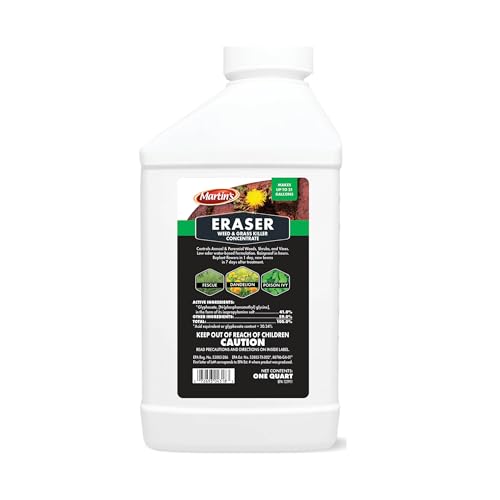
The 41% glyphosate pick for a bed you plan to clear and replant.
Most poison ivy fights happen in a bed you actually want back. That is where the Control Solutions jug makes its case: 41% glyphosate as the active ingredient, with no residual soil activity once it has done its work. Glyphosate moves through the plant into the root system rather than sitting in the dirt, so your plan for that patch is not blocked by a lingering chemical. It is 2 pounds of liquid in a 32-fluid-ounce bottle, and it is described on the label as a low-odor, water-based formula — a small mercy when you are working close to a patio.
The label covers a wide target list: annual weeds, perennial weeds, trees, vines and shrubs, and it is rainproof in hours. That last bit is what separates a wasted spray from a successful one, since a shower shortly after application can otherwise rinse away everything you just did.
What people report most is that it simply works — grass and weeds come up dead, and the same crowd considers it fairly priced for what it delivers. It weighs 2 pounds, which reads a touch heavier than the Tordon bottle at 2.4 pounds only because the Tordon carries a different job entirely; here the weight is a normal quart of concentrate. The thing to know is that this is a broad-spectrum herbicide, so it does not distinguish between the poison ivy you want gone and the lawn grass beside it.
The replanting advantage: a 41% glyphosate formula with no residual soil activity means the ground is not locked out after treatment, unlike a product that leaves a barrier behind.
Be careful where you aim: broad-spectrum means anything the spray lands on is a target, so shield the plants you want to keep.
Buy it when: the poison ivy is in a bed or border you intend to replant once the vine is dead.
Think twice if: the vines are woven into plants you care about, because this formula does not tell them apart.
4. Spectracide Weed and Grass Killer Concentrate
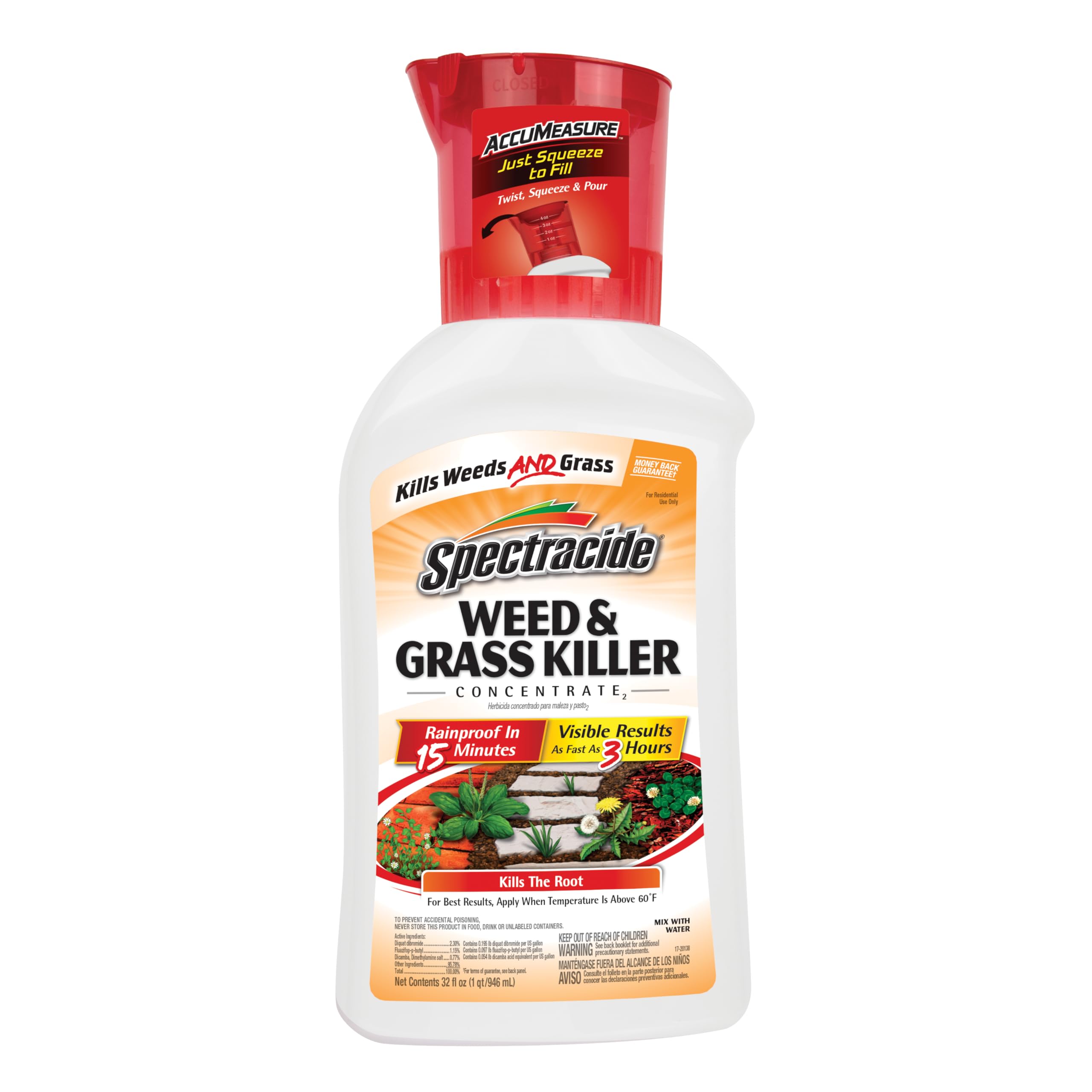
Visible browning in about the time it takes to drink a coffee — three hours, per the label.
Patience is not the fun part of killing poison ivy, and Spectracide attacks that directly. The label claims visible results as fast as 3 hours and says you can replant new flowers, trees and shrubs the same weekend. It is also rainfast in 15 minutes, which is the shortest rain window on this list — a real advantage if you spray in a season where the sky changes its mind without warning. Coverage runs 1,350 square feet from the 32-fluid-ounce bottle.
The active ingredient is diquat dibromide, a contact herbicide, and the label points it at driveways, walkways, fences, trees, flower beds and shrubs. The Accumeasure cap tries to remove the guesswork: twist, squeeze and pour instead of hunting for a measuring cup in the garage. It weighs 2 pounds, and the whole package is aimed at the person who wants the job done in one afternoon, not one week.
The fair caveat sits with that measuring cap. Opinions on the Accumeasure system split down the middle — some find the self-measuring cap genuinely convenient, others find it fussy. Then there is the bottle itself: a small number of buyers report leakage in transit. Neither issue touches the formula, which is the part that kills the weeds, but both are worth knowing before the box arrives.
Why the speed matters
- Visible results as fast as 3 hours, per the label
- Rainfast in 15 minutes — the shortest window on this list
- Coverage rated at 1,350 square feet per 32-fluid-ounce bottle
- Kills weeds and grasses down to the root on driveways, walkways and around fences
Small annoyances to expect
- The Accumeasure cap divides opinion — convenient to some, fiddly to others
- The occasional bottle arrives leaking, so check the seal on arrival
Choose this one for: hard surfaces and fence lines where you want to see browning the same afternoon.
Skip the measuring cap expectation: if you would rather mix with your own cup, treat Accumeasure as a bonus rather than the reason to buy.
5. Bonide Poison Ivy & Brush Killer BK-32, 32 oz Concentrate

The only pick here whose label names the lawn grasses it spares: Bluegrass, Fescues, Rye, Bent, Bermuda, Bahia and Zoysia.
Poison ivy often creeps out of a bed and into turf, and that is the scenario Bonide addresses head-on. The label names Bluegrass, Fescues, Rye, Bent, Bermuda, Bahia and Zoysia lawns as the intended turf, and states the product is designed to kill weeds rather than lawn grasses when used as directed. It also lists a long target range — poison ivy, poison oak, kudzu, wild blackberries, chickweed, dandelion, clover, thistle and over 240 other tough weeds — plus a stump method where you paint the undiluted product onto a freshly cut stump with a brush.
The numbers: coverage of 1,000 square feet from a 32-fluid-ounce concentrate, and 16 ounces of product weight. That 1,000 square feet is a smaller footprint than the 1,500 square feet the Roundup concentrate covers, so if area is your priority the Bonide is the tighter option. It mixes instantly with water and goes on through a tank or hose-end sprayer.
Now the honest part, because it matters here more than on any other pick. Feedback on this one is genuinely split — plenty of owners mention it did the job, and plenty report it did nothing at all. That spread usually points at application conditions rather than a bad bottle: mixing rate, leaf coverage, and how established the vine was all change the outcome. Read the label directions closely, apply at the stated rate, and give it the full time to work before judging it. Mixed to the label rate and applied to full leaf coverage, it performs far more consistently.
Its real strength: the label commitment to named lawn grasses — Bluegrass, Fescues, Rye, Bent, Bermuda, Bahia and Zoysia — is the most specific turf guidance on this list.
The honest caveat: results are inconsistent across users, so mix it exactly to the label rate and be patient rather than spraying a second dose early.
Reach for it when: the poison ivy has spread into a lawn you want to keep and you need a product that names your grass type.
Look elsewhere if: you want the largest treated area per bottle — the Roundup concentrate covers more ground from the same jug size.
Know the Specs
Active ingredient and its percentage
The active ingredient is the chemical actually doing the killing; everything else is carrier and surfactant. A figure like 41% glyphosate tells you the strength of the concentrate before you dilute it. Different actives behave differently — glyphosate travels into the root system, diquat dibromide works on contact, and triclopyr targets woody brush and vines. Reading that line tells you more about how a product will behave than any marketing claim.
Coverage in square feet
Coverage tells you how much ground one bottle treats once mixed to the label rate, and it is the fairest way to compare two same-size jugs. A 32-fluid-ounce concentrate can be rated for 1,000 square feet or 1,500 square feet depending on the formula and mix ratio. Pace out the patch roughly before buying — a narrow strip along a fence uses far less than a full bank of vines.
Rainfast timing
Rainfast means the number of minutes or hours the product needs on the plant before rain will no longer wash it off. A short window means an unexpected shower is not a disaster. A longer one means you should check the forecast before you start mixing. It is the single most practical timing figure on any herbicide label.
Residual soil activity
Some formulas leave activity in the soil after the plant dies, which can affect what you plant next. Others, like a 41% glyphosate formula, list no residual soil activity, so the ground is not locked out. If your plan is to clear the bed and replant it, that line is the one to check before you buy.
Common Questions
Should I spray poison ivy or cut the stump and treat it?
How long after spraying can I replant the same spot?
What does rainfast mean and why does it matter?
Will a brush killer also kill my lawn grass?
How much ground does one bottle actually cover?
Can I use a hose-end sprayer with these concentrates?
What is the difference between glyphosate and diquat dibromide?
Is the measure cap on Spectracide worth relying on?
Do I need to treat the stump if I have already sprayed the leaves?
How heavy are these bottles to carry around a property?
The Bottom Line
Match the product to the job — stump treatment or foliar spray — and the choice narrows fast. Tordon RTU is the one to own if you have cut the vine and want the roots finished off — it is ready to use, covers roughly 50-100 cut stumps, and it does the one job the sprays cannot. If your poison ivy is still leafy and covering ground, the Roundup Poison Ivy Plus Tough Brush Killer2 covers 1,500 square feet with three actives aimed at woody brush. And if the vines have crept into turf you want to keep, the Bonide Poison Ivy & Brush Killer is the only bottle here that names Bluegrass, Fescues, Rye, Bent, Bermuda, Bahia and Zoysia as its intended lawn. Buy the one built for your job, mix it to the label rate, and wait the full labeled window before judging results.
How we choose
We do not accept paid placement. Every pick is matched to a real buyer and a real use-case; we do not hands-on test units.
Sources
Specifications: manufacturer listings and product documentation. Review insights: verified customer reviews, as of November 2026. Pricing: not shown on this page (it changes often); check the current price via the retailer link.
As an Amazon Associate, My Heart Lives Here earns from qualifying purchases. This does not affect which products we feature.