Heads up: This post contains affiliate links. As an Amazon Associate I earn from qualifying purchases, at no extra cost to you. Learn more
Specs are compiled from manufacturer listings and verified buyer reviews and can change over time — please confirm the key details on the product page before buying.
Close-up photography punishes the wrong camera. You point at a flower petal or a coin’s engraving, the lens hunts for focus, and by the time it locks the light has moved. The picks below all put real macro capability in reach — from a proper lens-mount DSLR bundle to phones that shoot tiny subjects with their ultrawide lens.
This guide is built by comparing the manufacturers’ published specifications and the patterns across verified customer reviews, so you get each pick’s real strengths and trade-offs instead of marketing spin.
Working distance, focus mechanism and sensor size all decide whether a close-up comes out sharp, so each pick below is judged on those. That is what separates a usable camera phone for macro photography from one that only promises it.
Top Picks


How To Choose The Best Camera Phone for Macro Photography
Three things decide whether a close-up lands sharp, and none of them is megapixels.
Minimum focus distance
This is how close the lens can get before it stops focusing, so a shorter distance lets you fill the frame with a single petal.
Autofocus points
More points mean the camera can lock onto a tiny subject off to the side instead of hunting in the centre.
Image stabilization
At close range every wobble shows, so built-in stabilization reduces the blur that ruins handheld macro shots.
Side-by-Side Comparison
| Model | Best For | Autofocus Points | Sensor | Stabilization | Amazon |
|---|---|---|---|---|---|
| Canon EOS Rebel T7 Bundle★ Best Overall | Beginners building a lens kit | 9 | 24.1MP APS-C | — | Amazon |
| Google Pixel 7 ProPhone-First Pick | Phone-only close-ups | — | — | — | Amazon |
| Google Pixel 6 ProBudget Macro Phone | Budget macro phone | — | — | — | Amazon |
| LUMIX S9 | Full frame in a small bag | 255 | Full frame | — | Amazon |
| LUMIX G9II | Stacking and burst work | 779 | 25.2MP Micro Four Thirds | 5-axis Dual I.S. 2 | Amazon |
| Fujifilm X-S20 Kit | Handheld close-ups | 171 | 26.1MP | Five-axis IBIS | Amazon |
| Nikon COOLPIX P1000 | Reach and close focus in one | 100 | 16MP | Dual Detect VR | Amazon |
| FUJIFILM X100VI | Fixed-lens everyday carry | 425 | 40.2MP APS-C | 5-axis IBIS | Amazon |
| Nikon Z f | Full frame with a fast prime | 273 | 24.5MP full frame | — | Amazon |
| Nikon Z6 III Kit | Video-heavy hybrid work | 299 | Full frame | — | Amazon |
| OM SYSTEM OM-1 Mark II | Weather-sealed field work | 1,053 | 20.4MP Micro Four Thirds | 5-axis | Amazon |
Detailed Reviews
1. Canon EOS Rebel T7 DSLR Camera with 18-55mm Lens Bundle
Our pick — 4.5+★ from 1,000+ verified ratings; the strongest balance of quality and price.
The kit that trades autofocus cleverness for a lens mount that actually fits a macro lens.
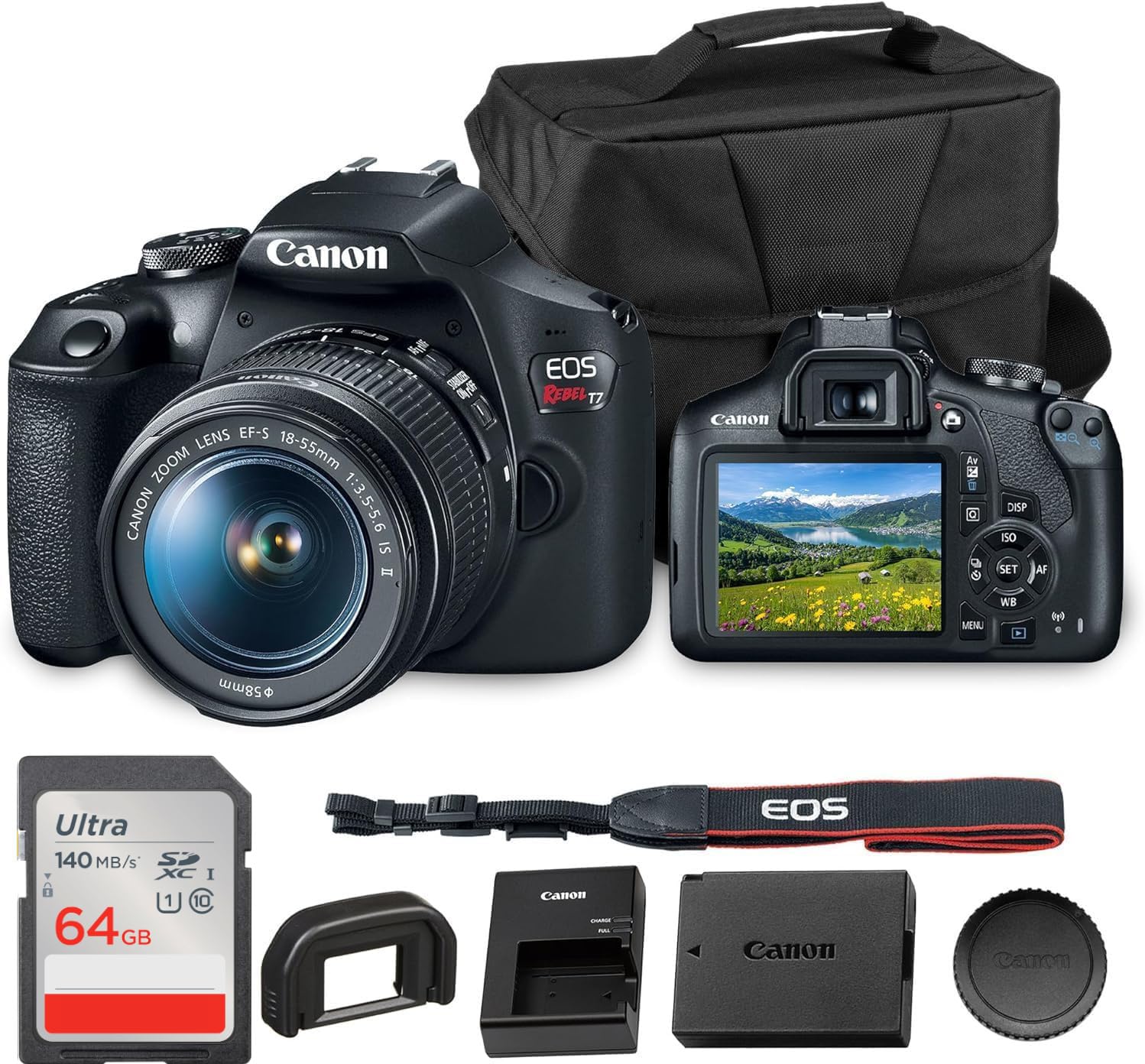
Here is the honest truth about close-up photography: the body matters less than what you can screw onto it. The Rebel T7 uses the Canon EF mount, which the maker lists as compatible with wide-angle, telephoto and macro lenses — so a dedicated macro lens is a real upgrade path, not a dead end.
Its 24.1MP APS-C sensor and DIGIC 4+ processor produce the sharp detail close-ups need. What wins people over is sheer build and kit quality — the bundle lands with a 64GB card, shoulder bag, LP-E10 battery and charger already inside.
The catch is autofocus: just 9 points, against 255 on the LUMIX S9 above. Nine points is fine for still petals on a tripod and cramped for anything that moves. Still, it’s a beginner-friendly DSLR with an optical viewfinder and a 3.0-inch LCD.
What earns its place
- Canon EF mount opens the door to dedicated macro lenses
- Complete starter kit — card, bag, battery and charger included
Where it holds you back
- Only 9 autofocus points, so tracking a moving subject is a struggle
Reach for this if: you want a real lens mount and a full starter kit in one box.
Look elsewhere if: you shoot skittish insects and need fast subject tracking.
2. Google Pixel 7 Pro – 5G Android Phone – 512GB – Snow
The phone that turned its ultrawide lens into a close-up tool, no case or clip needed.
Google built Macro Focus into the ultrawide lens, so the Pixel 7 Pro focuses on tiny subjects just by moving closer. The 5x telephoto lens with 30x Super Res Zoom gives you a second way in when you cannot physically reach the subject.
The 6.7-inch Smooth Display adjusts up to 120Hz, which makes framing a fiddly close-up far easier on the eye. A 4926 battery figure sits in the specs, and Adaptive Battery is rated for over 24 hours. IP68 protection means dust and water are covered on outdoor shoots.
The trade-off is price-per-megapixel of sensor control — a phone still cannot swap lenses the way the Canon above can. Think of it as the pick for someone who wants macro shots without carrying a camera bag at all.
Best-fit buyer: someone who shoots close-ups on walks and wants one device for everything.
The honest limit: there is no flash, so tiny subjects in shade need steady light.
Go with the Pixel if: pocket convenience beats lens flexibility.
Think twice if: you plan to grow into dedicated macro glass.
3. Google Pixel 6 Pro – 256GB – Cloudy White
Three lenses and a light-hungry sensor for buyers who want close-up reach on a tighter budget.
The camera system carries wide and ultrawide lenses plus 4x optical zoom, and its main sensor captures 150% more light according to the maker — which matters when a close-up subject sits in shadow. Battery capacity is listed at 5003 milliamp-hours, with talk time around 25.5 hours.
Owners single out the three-lens camera setup as a highlight, and the water-resistant design survives splashes and submersion up to 1 meter. The battery power figure is 4905 against the Pixel 7 Pro’s 4926 — effectively the same tank.
Be realistic about connectivity, which draws far more criticism than the camera ever does. If you shoot and share on the spot, check your carrier’s band support before committing.
What the lens array buys you: three focal lengths in one body, so you can frame a subject several ways without moving your feet.
Pick it when: the camera array is the priority and the budget is not.
Check first: signal reliability in your area, since that is where the complaints land.
4. LUMIX S9 Mirrorless Full Frame Compact Travel Camera

Full-frame depth of field in a body small enough to forget you packed it.
A full frame sensor gives you the shallow, creamy background that makes a close-up subject pop, and the S9 pairs that with 255 autofocus points — against just 9 on the Canon T7. That is a far wider net for locking focus on a small target.
It ships with the compact 18-40mm F4.5-6.3 lens, and LUMIX Lab moves shots to your phone over Wi-Fi so a close-up can go straight to social.
The honest catch is that the bundled lens is not a macro lens, so you will be working at its closest focus rather than true 1:1 reproduction. Some owners find images sharp and others report soft shots, so give yourself time to learn its focus behaviour.
Why it earns the bag space
- 255 autofocus points for confident subject locking
- Full frame look in a travel-sized body
Worth knowing upfront
- Kit lens is not a dedicated macro, so maximum magnification is limited
Best for: travellers who want full-frame rendering without a heavy rig.
Not for: shooters who need true macro magnification straight from the start.
5. Panasonic LUMIX G9II Micro Four Thirds Camera

A 779-point autofocus net built for the tiniest subject in the frame.
Micro Four Thirds cameras get closer to a subject at the same focal length, and the G9II backs that with 779 phase-detection autofocus points — more than double the 255 on the LUMIX S9. Its 8.0-stop B.I.S. (in-body stabilization, which cancels hand shake) keeps slow-shutter close-ups steady.
Burst shooting reaches 60 fps with continuous autofocus, so you can stack frames later. Owners praise the image quality and the depth of customisation on offer.
Autofocus is the split opinion here — some find it excellent, others inconsistent. Learn its subject modes before a critical shoot and you will get far more from it.
The macro payoff: 779 AF points plus 8.0-stop stabilization means you can shoot handheld at close range and still get a usable frame.
Set expectations: autofocus performance divides opinion, so test it on your own subjects early.
Choose it if: stacking and burst work are central to your close-up routine.
Skip past if: you want autofocus that behaves identically every single time.
6. Fujifilm X-S20 Mirrorless Digital Camera XC15-45mm Lens Kit

Seven stops of shake correction for the close-ups you take without a tripod.
Handheld macro lives or dies on stabilization, and the X-S20 offers up to seven stops of compensation from its five-axis in-body system — a one-stop gain over the X-S10 it replaces. At 491g (1.08 lb) it is light enough to hold steady at arm’s length.
The 26.1MP sensor with X-Trans CMOS 4 and the X-Processor 5 engine delivers Fujifilm’s colour straight out of camera. Owners call the photos super aesthetic, and the 171 autofocus points handle modest subject tracking.
Where it stumbles is genuine macro magnification — the 15-45mm kit lens is a general-purpose zoom, not a close-focus specialist. Expect detailed near-shots rather than extreme enlargements.
The case for it
- Seven stops of IBIS makes handheld close-ups realistic
- 26.1MP stills with Fujifilm colour straight from camera
The honest catch
- Kit zoom is not a macro lens, so extreme magnification is out of reach
Suits you if: you shoot handheld and want colour that needs no editing.
Look on if: you need true macro reproduction ratios.
7. Nikon COOLPIX P1000 Superzoom Digital Camera
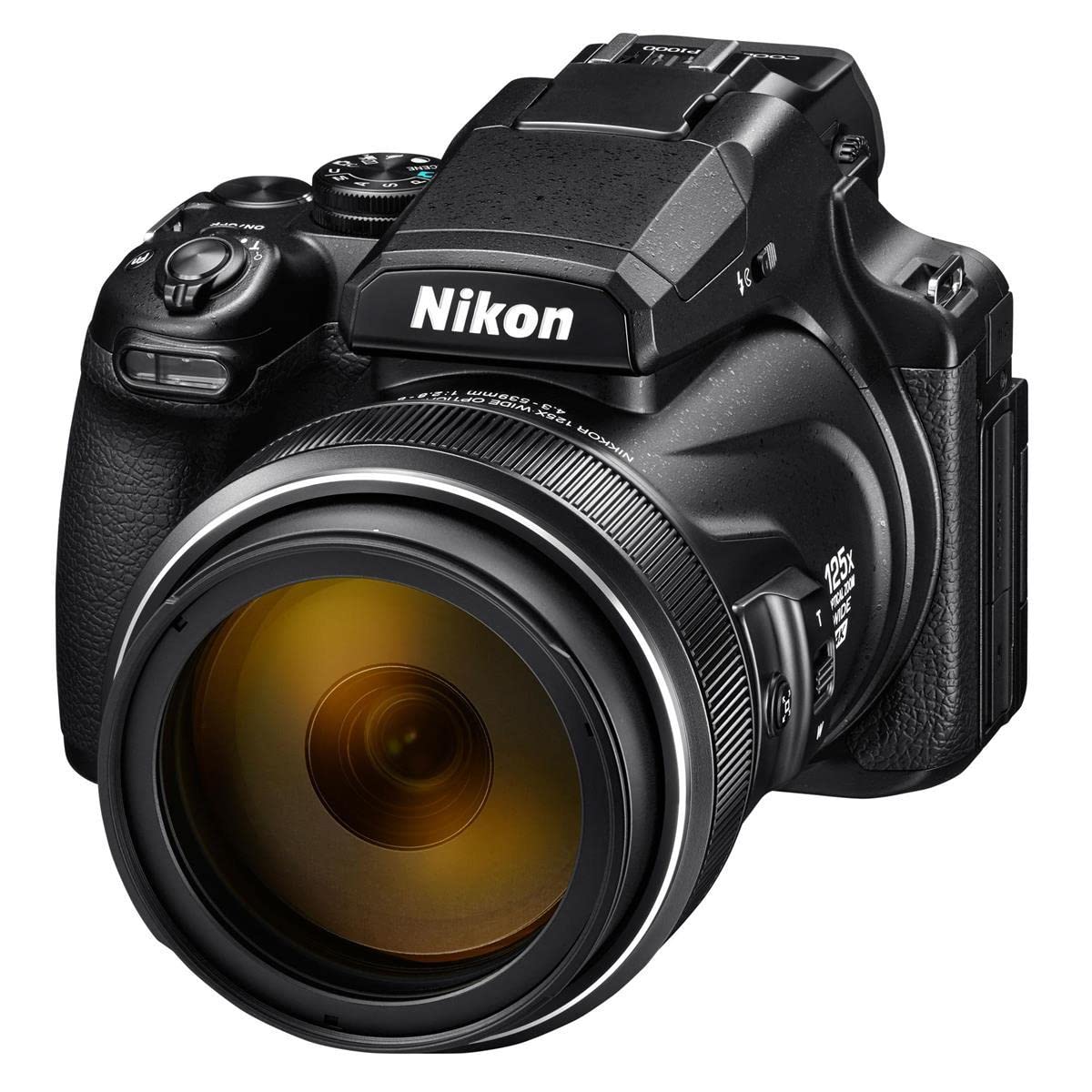
A macro close-up mode that gets within 0.4 inches of the subject.
The number that matters here is the focus range: macro close-up mode reaches approximately 0.4 inches (1 centimeter) from the front of the lens at the wide position. That is genuinely close, and it sits on top of a 125x optical zoom for subjects you cannot approach.
Image quality is what owners praise most, and the 16MP sensor with RAW support gives you room to edit. Dual Detect image stabilization helps at long focal lengths.
Watch two things: weight draws more criticism than praise, and some handheld shots come out soft, so brace the camera or raise the shutter speed. It also starts at F2.8, which is a modest aperture for close work in dim light.
Standout spec: a 0.4-inch macro close-up distance combined with a 3000mm-equivalent zoom — a combination no interchangeable-lens kit above matches in one body.
Worth it when: you want extreme reach and close focus from a single fixed lens.
Weigh carefully if: you plan long handheld sessions, since the bulk is the recurring grumble.
8. FUJIFILM X100VI Digital Camera (Silver)

Forty megapixels and a fixed prime lens that rewards walking closer.
There is no zoom here — just a 23mm f/2 lens on a 40.2MP APS-C sensor, which means composition comes from your feet. That fixed focal length is actually helpful for close-ups, because you learn exactly how near the lens will focus.
Five-axis IBIS compensates for shake up to 6 aperture stops, and 425 autofocus points with face and eye detection handle small subjects well. Build quality is the thing buyers praise most, and the hybrid viewfinder plus flip-out display make low-angle compositions easy.
The limitation is baked in: a single fixed lens cannot become a macro lens, and value for money draws mixed views. Twenty film simulations do soften the blow for JPEG shooters.
Why photographers keep it close
- 40.2MP APS-C detail with 425 AF points
- Six stops of IBIS for steady handheld work
Accept before buying
- Fixed lens means no macro optic, ever
The right call for: a one-camera, one-lens shooter who values craft and colour.
Not the right call for: anyone who needs an interchangeable macro lens.
9. Nikon Z f with Special Edition 40mm f/2 Prime Lens

Nikon’s retro-styled full-framer pairs a fast prime with nine-subject tracking.
The 24.5MP BSI full-frame sensor and EXPEED 7 processor push out images that buyers describe as exceptionally sharp. Its autofocus system recognises nine different subjects for focus and tracking — useful when a small subject will not sit still.
Pixel Shift shooting creates 96MP stills with low noise, which is the closest this camera gets to rendering the fine texture macro work demands. The included 40mm f/2 lens is bright for available-light close-ups.
Image quality, controls and design all draw consistent praise, with a straightforward menu system. Bear in mind the 40mm lens is not a macro optic, so you will be cropping into that 24.5MP frame rather than magnifying optically.
What stands out: 96MP Pixel Shift stills give you generous cropping headroom on tiny subjects.
What to plan for: pixel-shifted frames need a still subject, so wind and insects are out.
The one to grab if: you want full-frame detail plus a design you enjoy picking up.
Hold off if: you need a lens that focuses closer than the 40mm prime can.
10. Nikon Z6 III with 24-70mm f/4 Lens

Low-light autofocus down to -10EV, built for dim close-up work.
Macro scenes are often dark — under a leaf, inside a drawer — and the Z6 III detects focus down to -10EV, one of the lowest light thresholds in this list. Its 299 autofocus points pair with Nikon’s Deep Learning subject recognition.
The bundled NIKKOR Z 24-70mm f/4 S lens offers a constant f/4 aperture across the zoom, so exposure stays consistent as you reframe. Video reaches 6K/60p internal RAW, and the viewfinder hits 4000 nits for visibility in bright daylight.
What holds it back for macro is simply that the 24-70mm is not a close-focus lens — the magnification has to come from the sensor’s resolution and your cropping.
The case for the Z6 III
- AF down to -10EV finds focus in very dim scenes
- Constant f/4 aperture across the 24-70mm range
Where it asks more
- Kit lens is not a macro, so extreme close-ups need another optic
Made for: shooters who split time between close-up stills and video.
Think again if: stills macro is the entire brief.
11. OM SYSTEM OM-1 Mark II with 12-40mm F2.8 PRO II Lens

Focus stacking built in, so you can push depth of field without editing software.
Close-up photography fights shallow depth of field, and the OM-1 Mark II solves it in-camera with Focus Stacking among its computational features. Its 1,053-point Cross Quad Pixel autofocus covers 100% of the frame — more points than any other camera here.
The 20.4MP Stacked BSI sensor and TruePic X processor shoot up to 120 frames per second in RAW. The kit’s 12-40mm F2.8 PRO II lens has a constant bright aperture, and both body and lens carry IP53 weather sealing.
The trade-off is complexity. Focus stacking and high-res modes require setup, and the Micro Four Thirds sensor is smaller than the full-frame options above, so low-light edge goes the other way.
Why field shooters like it: Focus Stacking plus IP53 sealing means rain, dust and depth of field are all handled in one kit.
The learning curve: the computational modes reward practice before a shoot, not during one.
Best suited to: outdoor macro shooters who want depth of field solved in-camera.
Consider a bigger sensor if: low-light rendering matters more than portability.
Know the Specs
Autofocus Points
Each point is a spot the camera can lock focus onto, so a higher count helps it grab a tiny subject off-centre rather than hunting — the OM-1 Mark II lists 1,053 points against 9 on the Rebel T7.
Minimum Focus Distance
This is how close the lens can get and still focus, so a shorter distance means a bigger subject in frame — the COOLPIX P1000 reaches approximately 0.4 inches in macro mode.
Common Questions
Can a phone really shoot macro photos as well as a camera?
What is focus stacking and which cameras here have it?
Do I need a tripod for close-up photography?
The Bottom Line
The strongest all-round starting point for a camera phone for macro photography is the Canon EOS Rebel T7 Bundle, because its EF mount accepts a real macro lens and the kit arrives complete.
If you want close-ups without a camera bag, the Pixel 7 Pro makes Macro Focus a one-tap affair. And for depth of field solved in-camera, the OM-1 Mark II is the field-ready choice.
How we choose
We do not accept paid placement. Every pick is matched to a real buyer and a real use-case; we do not hands-on test units.
Sources
Specifications: manufacturer listings and product documentation. Review insights: verified customer reviews, as of November 2026. Pricing: not shown on this page (it changes often); check the current price via the retailer link.
As an Amazon Associate, My Heart Lives Here earns from qualifying purchases. This does not affect which products we feature.