Heads up: This post contains affiliate links. As an Amazon Associate I earn from qualifying purchases, at no extra cost to you. Learn more
Specs are compiled from manufacturer listings and verified buyer reviews and can change over time — please confirm the key details on the product page before buying.
Brown recluse spiders hide in the gaps you never see — behind baseboards, inside wall voids, under the water heater closet. A contact spray only hits what walks across it. The four picks below split into three jobs: a dust that coats the void spaces where they nest, a glue trap that tells you where they are, and a spray for the spider already on your wall.
This guide is built by comparing the manufacturers’ published specifications and the patterns across verified customer reviews, so you get each pick’s real strengths and trade-offs instead of marketing spin.
Each pick here earns its spot on a different strength, and the gap between a crack-and-crevice dust and a glue trap matters more than any label does. What follows is a practical read on each one for anyone weighing a brown recluse killer.
Top Picks
How To Choose The Best Brown Recluse Killer
Match the product to the form of the problem — a hidden nest, an unknown location, or a spider sitting in the open right now.
Reach the void, not the wall
A pressurized dust pushes into cracks, crevices and wall voids where a recluse actually lives, so it treats places a spray bottle never reaches.
Know where the spiders are
A glue trap catches what crosses it and tells you which corner is the hot one, so you stop treating the whole room blind.
Check the label before the label check
Read the safety, application and storage instructions on the can first, and confirm the product is permitted in your state.
Side-by-Side Comparison
| Model | Best For | Form | Volume / Count | Working Method | Amazon |
|---|---|---|---|---|---|
| BASF PT Tri-Die Pressurized Dust★ Best Overall | Wall voids and hidden gaps | Pressurized dust | 8 fluid ounces | Lambda-cyhalothrin plus silica gel | Amazon |
| Control Solutions D-FENSE NXT | Broad indoor crack treatment | Spray | 15 fluid ounces | Novaluron, deltamethrin, pyriproxyfen | Amazon |
| RESCUE! Spider Traps | Finding the hot corner | Double-sided glue trap | 6 traps | Two-sided glue dot pattern | Amazon |
| Harris Spider Killer 2-Pack | Spraying baseboards and corners | Liquid spray | 64 fluid ounces | Odorless, non-staining residual | Amazon |
Detailed Reviews
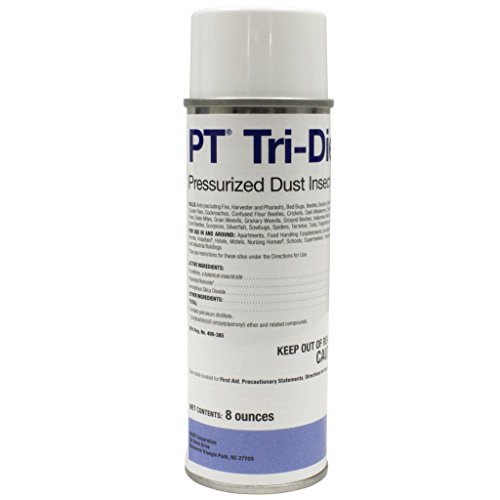
1. BASF PT Tri-Die Pressurized Dust Insecticide
Our pick — 4.5+★ from 500+ verified ratings; the strongest balance of quality and price.
The dust that gets carried into the wall void — exactly where a recluse lives.
The method is what sells this one: a pressurized dust that blows deep into cracks, crevices and void spaces, so the treatment lands where the spider hides instead of only where you can aim. It pairs lambda-cyhalothrin (a pyrethroid insecticide) with a silica gel desiccant, a drying agent that keeps working through the dust. That combination is meant to knock down what it contacts and then keep a residual behind.
What wins people over is raw kill performance across carpentry and stinging insects, with shelf life holding up long after the can is opened. The catch is cosmetic: a white residue can show where the dust settles, and value opinions split. Treated voids and sill plates are the sensible target — not open kitchen counters.
Where it pulls ahead
- Reaches deep into cracks and void spaces a spray cannot
- Silica gel desiccant keeps residual control going in dry spaces
Worth knowing first
- Can leave a visible white residue where it lands
Reach for this if: you have identified gaps, sill plates or wall voids and want them treated at the source.
Hold off if: the surface is visible and you cannot accept a white dust film.
2. Control Solutions D-FENSE NXT Insecticide
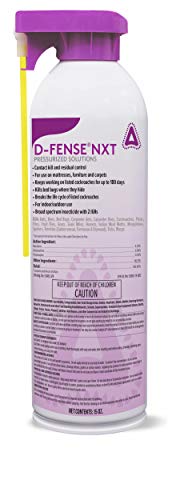
More can in the hand than the dust — 15 fluid ounces against 8.
Pour volume is the headline here. This can carries 15 fluid ounces versus the BASF dust’s 8 fluid ounces, and that extra reach through baseboards and plumbing penetrations is real when you are treating a whole floor. Three actives share the load: novaluron at 0.20%, deltamethrin at 0.06% and pyriproxyfen at 0.02%. The deltamethrin is the contact killer and pyriproxyfen is an insect growth regulator, which interrupts the breeding cycle rather than only the adults.
Insects drop within minutes of contact, and the can is built to be durable in storage. The trade-off is smell — several find it a little strong even if most call it tolerable. One hard limit to check first: it is not for sale in AK, CA or NY, so those buyers need a different route entirely.
Buy it for the coverage: 15 fluid ounces goes a long way across sill plates and floor gaps.
The state list matters: confirm your state is not on the excluded list before you plan the job.
Best match: a multi-room treatment where you want one can and one pass.
Look elsewhere if: you are in AK, CA or NY, or scent sensitivity is a problem.
3. RESCUE! Spider Traps, 2 Pack (6 Traps)

Six glue traps that tell you which corner the spiders use.
No chemical, no mixing, no nozzle. These are ready the moment you open the box, and each trap carries a two-sided glue dot pattern — once one face fills, you flip it and keep going. That double life is the reason six traps stretch further than the count suggests. The list covers black widow, hobo, brown recluse, sac and wolf spiders, so the trap is not guessing at species. A decorative plastic shell helps it sit in a room without shouting pest control.
Pet-safe placement is the thing owners single out most, and effectiveness on what actually crosses the trap follows close behind. Adhesion is the split opinion — some traps stick as they should, and a few arrive less tacky than expected, so press each one down firmly. Sturdiness drew almost no complaints. Compared with the Harris spray, this is the pick for locating rather than eliminating.
What it gives you
- Six double-sided traps, so each one works twice
- No assembly and no chemical around pets
The honest limit
- Glue tack can vary from trap to trap
Pick it when: you need to find the harborage before you treat it, or you want a chemical-free option near pets.
Not for: an active nest inside a wall — that needs a dust, not a floor trap.
4. Harris Spider Killer Liquid Spray, 2-Pack
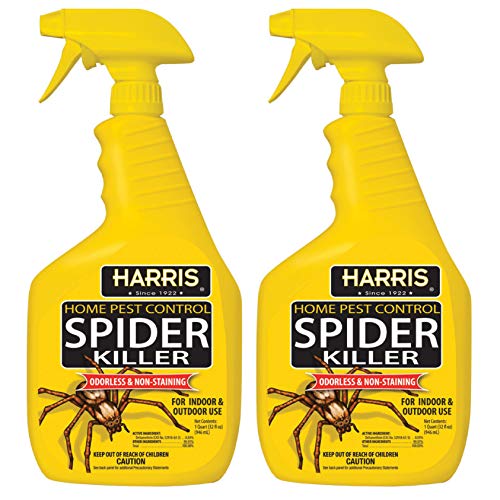
Odorless and non-staining, and it keeps killing after the spray dries.
Two bottles give you 64 fluid ounces of spray, which is the most total liquid on this list. The formula is odorless and non-staining, and the maker says it will not damage fabrics when you follow the label directions. Indoors and outdoors are both on the table, and it is EPA registered under No. 3-11 for indoor residential use.
The wrinkle is the delivery. The sprayer is the most-discussed weak point, and reports of a nozzle quitting after a few pumps are the honest reason to hold the bottle upright and clear the tip. Effectiveness opinions split too. Spray it on the crack and let it dry — it kills once completely dried, so the wet pass is not the finish line.
The real draw: odorless, non-staining, and labeled for a long list of household insects, not just spiders.
One caution: the sprayer head is the failure point people hit, so keep the tip clean.
Go with this: for a broad baseboard pass where smell and staining are deal-breakers.
Skip the guesswork: if you have not located the nest, pair this with the RESCUE! traps first.
Know the Specs
Form: Dust vs Spray
A pressurized dust travels into cracks and wall voids and can leave a visible film, while a liquid spray coats a surface you can see and dries down clean. Match the form to the hiding spot.
Actives and Residual
A pyrethroid such as lambda-cyhalothrin or deltamethrin kills on contact, and an added desiccant or growth regulator keeps working after. Read the label on every can before you apply it.
Common Questions
Does a dust or a spray work better for brown recluse?
Can I use the RESCUE! traps around cats and dogs?
How long does the Harris spray keep working after it dries?
Is the Control Solutions D-FENSE NXT available in every state?
Will the BASF dust stain my walls?
Are these products registered for indoor use?
How many traps come in the RESCUE! 2 pack?
What happens if the Harris sprayer stops working?
The Bottom Line
The one worth starting with is the BASF PT Tri-Die, because a pressurized dust treats the wall void a contact spray can never reach. If you have not found the harborage yet, drop the RESCUE! traps first and let them point you at the right corner. And for a broad, odorless pass along visible baseboards, the Harris 2-Pack covers the most ground.
How we choose
We do not accept paid placement. Every pick is matched to a real buyer and a real use-case; we do not hands-on test units.
Sources
Specifications: manufacturer listings and product documentation. Review insights: verified customer reviews, as of November 2026. Pricing: not shown on this page (it changes often); check the current price via the retailer link.
As an Amazon Associate, My Heart Lives Here earns from qualifying purchases. This does not affect which products we feature.