Heads up: This post contains affiliate links. As an Amazon Associate I earn from qualifying purchases, at no extra cost to you. Learn more
Specs are compiled from manufacturer listings and verified buyer reviews and can change over time — please confirm the key details on the product page before buying.
Most vitamin C pills you swallow never fully reach your bloodstream, so the real question is which formula your body can actually use — and the answer depends on delivery, not dose size.
This guide is built by comparing the manufacturers’ published specifications and the patterns across verified customer reviews, so you get each pick’s real strengths and trade-offs instead of marketing spin.
The picks below split into two camps: liposomal formulas that wrap vitamin C in fat so it survives digestion, and whole-food formulas built from acerola cherry and camu camu. Here is the shortlist that clears both bars for bioavailable vitamin c.
Top Picks

How To Choose The Best Bioavailable Vitamin C
Three things decide whether a vitamin C capsule actually does its job, and none of them is the biggest number on the label.
Delivery format
Liposomal formulas wrap the vitamin in fatty acids so it survives stomach acid, while whole-food formulas pair it with the plant compounds it naturally travels with.
Dose per serving
Check how many capsules make one serving, because a high milligram count spread across three pills is a different daily habit than a single capsule.
Extra nutrients
Zinc, elderberry, and citrus bioflavonoids are often added to support absorption and immune function, and their presence tells you how complete the formula is.
Side-by-Side Comparison
| Model | Best For | Vitamin C Per Serving | Supply | Format | Amazon |
|---|---|---|---|---|---|
| SOLARAY Liposomal Vitamin C★ Best Overall | Everyday immune basics | 500 mg | 100 VegCaps | Liposomal capsule | Amazon |
| Peak Performance Acerola CherryBest Whole Food | Whole-food purists | — | — | Whole food capsule | Amazon |
| Liposomal Vitamin C with Zinc | All-in-one immune stack | 1500 mg | 3 month | Liposomal capsule | Amazon |
| Fresh Healthcare Whole Food C | No synthetic ascorbic acid | 500 mg | 40-day | Whole food capsule | Amazon |
| ALMO Liposomal Vitamin C 2000mg | High-dose liposomal | 2000 mg | 100 Day | Liposomal gel capsule | Amazon |
Detailed Reviews
1. SOLARAY Liposomal Vitamin C 500 mg, 100 VegCaps
Our pick — 4.5+★ from 900+ verified ratings; the strongest balance of quality and price.
The steady everyday pick that makes liposomal C a habit rather than a project.
Each capsule carries 500 mg of vitamin C suspended in fatty acids, a delivery trick the maker describes as making the vitamin more available to your body. The bottle holds 100 veggie capsules and ships in a 3.36-ounce bottle small enough for a kitchen shelf or travel bag.
What wins people over is the everyday ease of it — the soft-gel-like capsule goes down without fuss and settles quietly on the stomach. The one trade-off is dose: at 500 mg you are taking the modest route, so anyone chasing a heavy therapeutic-style load will need more than one capsule.
What earns its keep
- Liposomal delivery in a 500 mg capsule
- Vegan, made in a GMP-certified Utah facility
Where it asks something of you
- 500 mg means multiple capsules for a bigger dose
Reach for this if: you want a daily liposomal C that is easy to swallow and gentle on the stomach.
Pair it with: nothing — it is the standalone baseline most people start on.
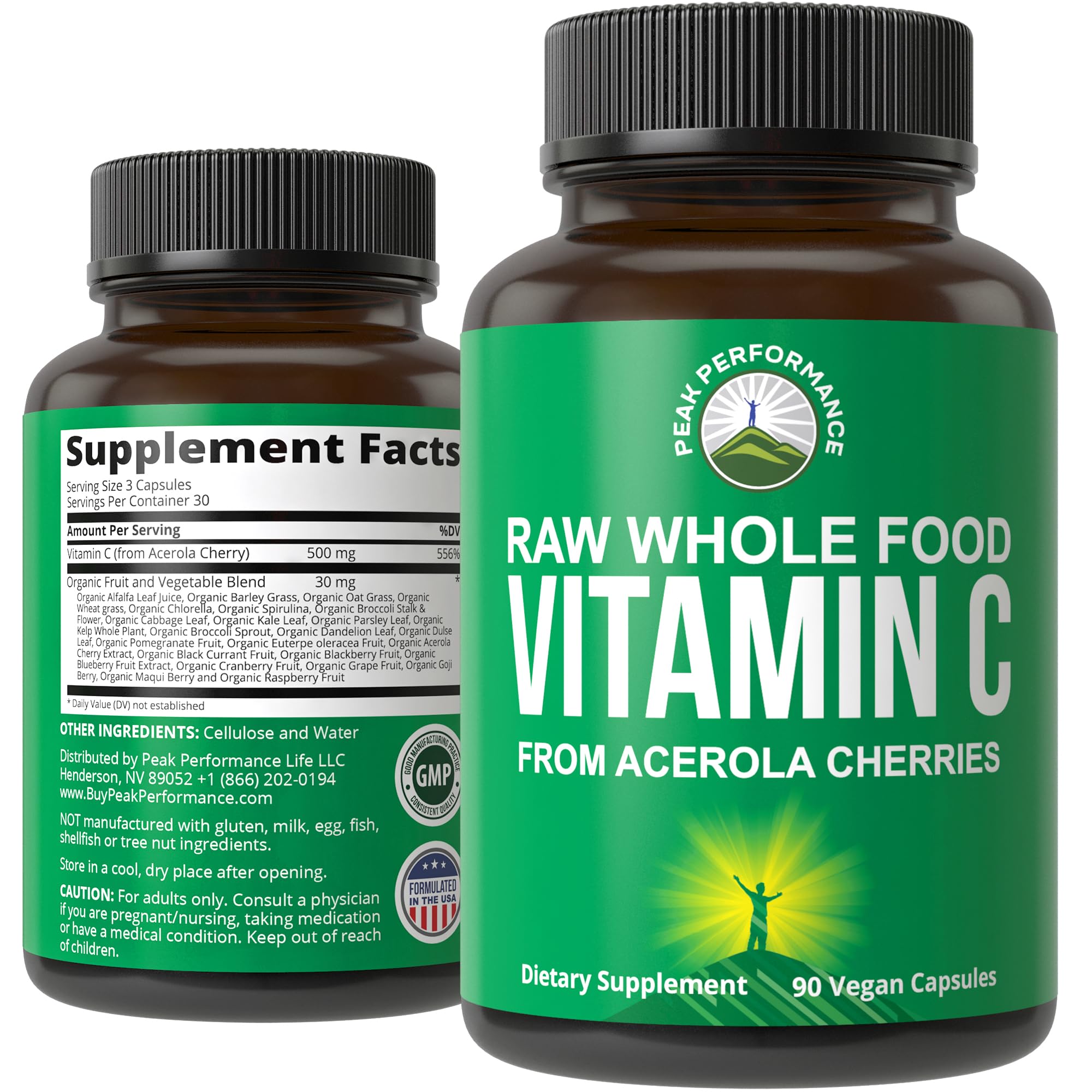
2. Peak Performance Vitamin C Capsules
Built from cherry and real food, not isolated ascorbic acid.
The source here is the whole point: acerola cherry plus an organic vegetable and fruit blend of over 25 whole foods. The cherries carry the vitamin C, and the blend supplies the enzymes and co-factors that normally travel with it in real fruit. The 2.05 x 2.09 x 4.29-inch bottle weighs 3.53 ounces, so it stows easily.
Your body has to work through it — the cherry-sourced vitamin C takes longer to digest than a synthetic pill, which is why some find the newer liposomal forms quicker. The bigger honest fork in the road is dosage: buyers split sharply on whether the milligram load is too high.
Whole food, whole story: no synthetic ascorbic acid, no gluten, soy, or dairy — a clean label for anyone who reads the back of the bottle.
Where the argument starts: dosage is the most-disputed point, and price divides people — some see fair value, others find it pricey per pill.
If plant sourcing is your line: this is the whole-food one worth starting with.
Worth knowing: the vitamin C is not encapsulated in fat, so absorption relies on the food matrix rather than liposomes.
3. Liposomal Vitamin C with Zinc Capsules
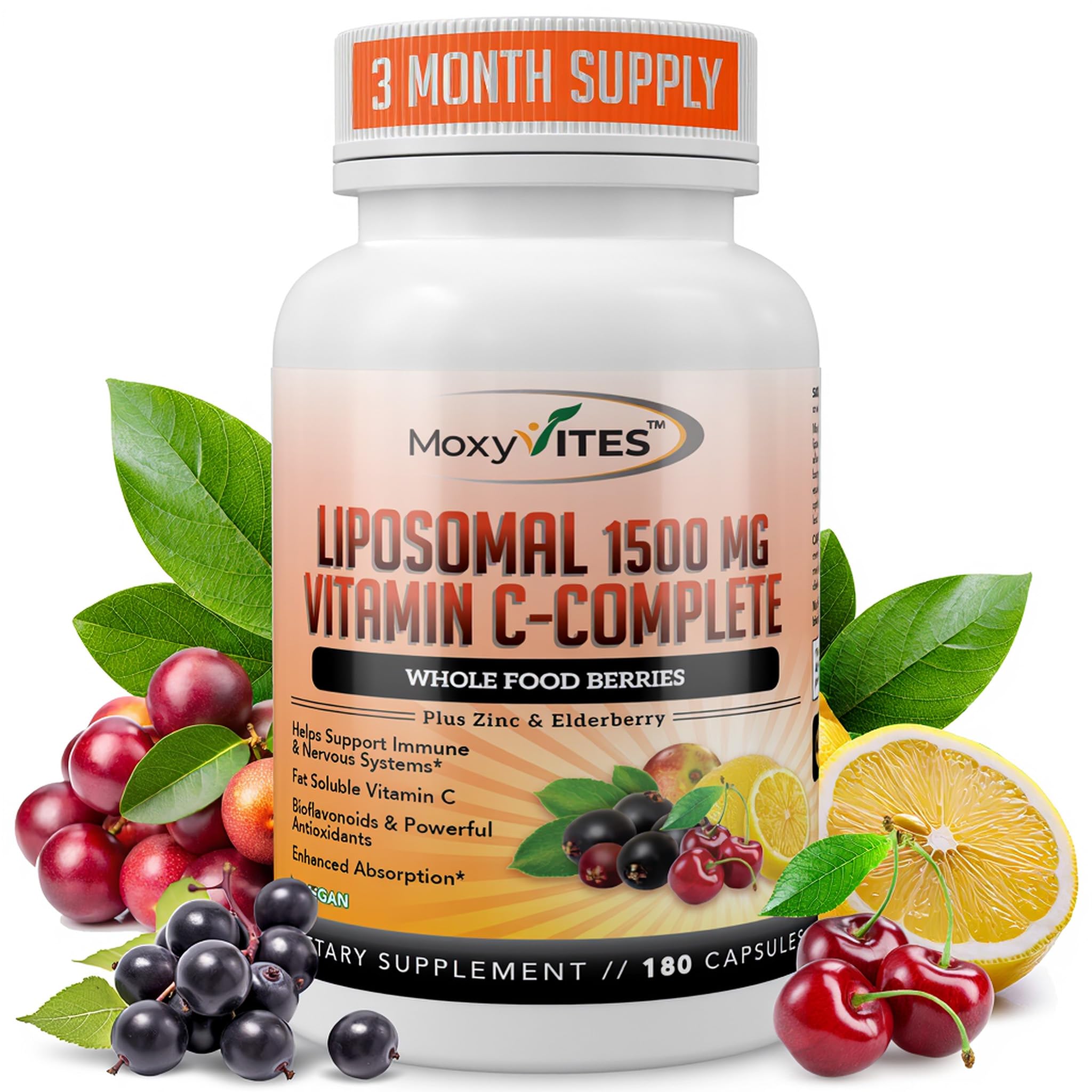
One bottle holds three months of an all-in-one C, zinc, and berry blend.
At 1500 mg per serving with zinc, elderberry, amla, camu camu, and acerola cherry, this is the fullest formula on the list. The fat-soluble vitamin C is micro-encapsulated with sunflower lecithin to protect it during digestion — a dry liposomal method that keeps the capsules easy to swallow. Each bottle carries 180 veggie capsules for a full 3 month supply.
The absorption side has the most weight behind it: the added bioflavonoids are there to support how well the vitamin C gets used, and the vitamin C-zinc-berry trio means you are not stacking three bottles. The recurring gripe, as with any multi-ingredient capsule, is that you are trusting a longer ingredient list at once.
Why it earns third: the combination of liposomal C, zinc, and organic berries in one capsule covers immune support without a shelf of bottles.
The honest catch: 1500 mg per serving is a big daily number — check it fits your routine before committing to three months.
Best for the minimalist stacker: one bottle, one serving, three months covered.
Look elsewhere if: you prefer a single-ingredient vitamin C you can dose loosely.
4. Fresh Healthcare Vitamin C 500mg

A fruit-sourced C that brings its own absorption helpers to the table.
The 500 mg serving comes from rose hips, acerola cherry, and camu camu — three plants packed with vitamin C — with zero isolated ascorbic acid. Citrus bioflavonoids and BioPerine black pepper extract are blended in to support how your body takes the vitamin up, mirroring what you would get from eating the fruit. The 120-capsule bottle runs a 40-day supply at three a day.
Where it leads on paper is the combination: the whole-food C plus a dedicated absorption aid plus a full daily requirement of 500 mg, which the maker states is 550% of your daily value. The bottle is heftier at 5.29 ounces than the SOLARAY’s 3.36 ounces, so it occupies more shelf space. The one thing to accept is the three-capsule daily habit.
Why people keep rebuying
- Whole-food C with BioPerine and citrus bioflavonoids
- 500 mg covers 550% of daily value per serving
What to plan around
- Three capsules a day shortens the supply to 40 days
Pick this when: you want whole-food C and a real absorption booster in the same capsule.
The realistic limit: plan on three pills a day to get the stated serving.
5. ALMO Liposomal Vitamin C 2000mg — 100 Day Supply

The heavyweight dose for anyone who wants maximum milligrams per capsule.
This is the largest serving in the lineup at 2000 mg, and the comparison is stark: double the 500 mg in the SOLARAY above. The formula pairs ascorbic acid with palmitic acid to create ascorbyl palmitate, a fat-soluble vitamin C, then uses non-GMO sunflower lecithin to form the liposomes that carry it past digestion. Zero soy, non-GMO, and made in the USA.
What people notice is how the 2000 mg arrives — three capsules per dose, which is convenient for some and a chore for others. That split is the honest catch, and it is the one thing to weigh before buying. The bottle is the largest of the group at 6 x 3 x 3 inches.
The dose story: 2000 mg is the top of this list by a wide margin — the strongest single-serving hit you can get here.
The habit story: three capsules per dose means a bottle disappears faster than the 100-day claim suggests if you are dosing frequently.
For the high-dose crowd: 2000 mg liposomal in one serving, no stacking required.
If three pills feels like work: the lower-dose single-capsule options suit a lighter routine.
Know the Specs
Liposomal vs Whole Food
Liposomal vitamin C wraps the vitamin in fatty acids (liposomes) so it survives stomach acid and reaches the bloodstream more intact. Whole-food C comes from plants like acerola cherry and camu camu, carrying the co-factors and bioflavonoids that travel with it in real fruit.
Why Per-Serving Beats Per-Capsule
A bottle that reads 2000 mg may need three capsules to reach that number, while a 500 mg bottle may deliver its dose in one. Always check the serving size, not the headline figure, when comparing daily habits.
Common Questions
Is liposomal vitamin C actually better absorbed than regular vitamin C?
Do I need to take vitamin C with food?
Is 2000 mg of vitamin C too much in one day?
What is BioPerine and why is it in vitamin C?
Does whole-food vitamin C contain ascorbic acid?
Why does the vitamin C with zinc also include elderberry?
Are vegan vitamin C capsules as effective as gelatin capsules?
How many capsules make one serving on these bottles?
The Bottom Line
For most people the bioavailable vitamin c answer is the SOLARAY Liposomal Vitamin C, because its liposomal delivery and easy-to-swallow 500 mg capsule make a daily habit painless. If you want one bottle that covers C, zinc, and elderberry for three months, the Liposomal Vitamin C with Zinc is the fuller formula. And for the highest single dose on this list, the ALMO 2000mg is the one to reach for.
How we choose
We do not accept paid placement. Every pick is matched to a real buyer and a real use-case; we do not hands-on test units.
Sources
Specifications: manufacturer listings and product documentation. Review insights: verified customer reviews, as of November 2026. Pricing: not shown on this page (it changes often); check the current price via the retailer link.
As an Amazon Associate, My Heart Lives Here earns from qualifying purchases. This does not affect which products we feature.