Heads up: This post contains affiliate links. As an Amazon Associate I earn from qualifying purchases, at no extra cost to you. Learn more
Specs are compiled from manufacturer listings and verified buyer reviews and can change over time — please confirm the key details on the product page before buying.
If you are shopping for a Group 27 battery, the real question is simple: do you want a lithium battery that weighs about as much as a case of soda, or a lead-acid brick you have to lift out with two hands? A Group 27 is among the most common battery footprints in RVs, boats, and trolling motor setups, so it is worth getting the fit and the chemistry right the first time. This guide covers nine Group 27 batteries that actually match that BCI size (a standard battery size), explains what every number on the label means in plain English, and points you to the one that fits how you actually use your rig.
This guide is built by comparing the manufacturers’ published specifications and the patterns across verified customer reviews, so you get each pick’s real strengths and trade-offs instead of marketing spin.
You will see lithium and AGM options side by side, with the honest trade-offs spelled out, so you can settle on the right fit for battery group size 27 without guessing.
Top Picks

How To Choose The Best Battery Group Size 27
Start with the box, not the badge. A Group 27 battery has a standard footprint that most RV tongue trays, boat compartments, and trolling motor mounts are built around, so if the case does not physically drop in and the terminals land where your cables reach, nothing else on the label matters. Once the fit is confirmed, you are really choosing between two chemistries (lithium and AGM, a sealed lead-acid type) and matching the numbers to your job.
Lead-Acid or Lithium: The Fork in the Road
AGM batteries are sealed lead-acid units. They are heavy, they are affordable, and they are proven. Lithium (LiFePO4) batteries weigh far less for the same usable power and last many more charge cycles, but they cost more upfront. A deep-cycle AGM or lithium battery is built to be drained and recharged over and over. A dual-purpose or starting battery adds cranking power on top, so it can turn over an engine as well as run electronics.
Amp-Hours, CCA, and Depth of Discharge
Amp-hours (Ah) tell you how much energy the battery stores — more Ah means longer runtime before a recharge. CCA (cold cranking amps) measures how much current it can dump in a burst to start an engine in the cold. Depth of discharge (DOD) is how far down you can safely drain it; AGM packs typically recommend stopping at 50%, while a good LiFePO4 pack lets you use far more of its capacity.
Why Weight Becomes a Daily Issue
If you are dropping a battery into a boat or pulling it out of a camper to charge, weight is not a spec-sheet detail — it is your back. An AGM Group 27 can run past 60 or 70 pounds, while the lithium options here sit in the low-to-mid 20s. That gap changes how easily you handle a swap and, on a boat, how the hull floats and planes.
Side-by-Side Comparison
| Model | Best For | Chemistry | Capacity | Weight | Amazon |
|---|---|---|---|---|---|
| Litime 12V 100Ah LiFePO4 Group 27★ Best Overall | All-round RV and trolling motor power | Lithium (LiFePO4) | 100Ah | 22.9 lb | Amazon |
| UPLUS 12V 100Ah Deep Cycle LDC12-100MBudget Smart Pick | Budget deep-cycle for solar and backup | Hybrid Gel AGM (lead-acid) | 100Ah | 60 lb | Amazon |
| Banshee Group 27M AGM MarineDual-Purpose Marine | Dual-purpose marine start plus electronics | AGM (lead-acid) | 90Ah | 56 lb | Amazon |
| Mighty Max MM-G27M | High-cranking AGM for boats | AGM (lead-acid) | 100Ah | 70.5 lb | Amazon |
| Power Queen 12V 125Ah Group 27 | Mid-size lithium with extra runtime | Lithium (LiFePO4) | 125Ah | 25.1 lb | Amazon |
| VMAX MR127 12V 100Ah AGM | All-day trolling motor AGM | AGM (lead-acid) | 100Ah | 68 lb | Amazon |
| VMAX XTR27-110 AGM 110Ah | Premium AGM for heavy trolling duty | AGM (lead-acid) | 110Ah | 70 lb | Amazon |
| Redodo 12V 100Ah Dual-Purpose Group27 | Fuel outboard start plus house power | Lithium (LiFePO4) | 100Ah | 23.1 lb | Amazon |
| Power Queen 12V 150Ah Group 27 | Biggest energy upgrade in a Group 27 box | Lithium (LiFePO4) | 150Ah | 33.5 lb | Amazon |
Detailed Reviews
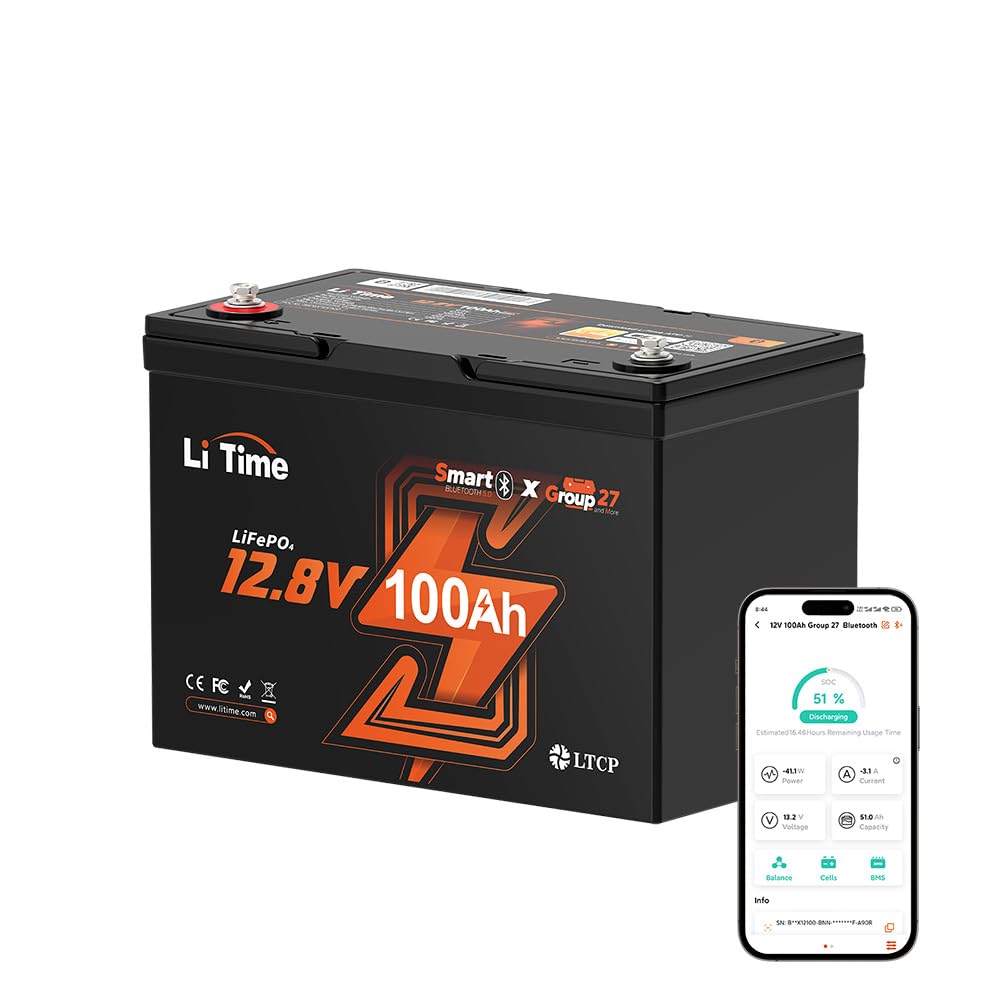
1. Litime 12V 100Ah LiFePO4 Battery Group 27
Our pick — 4.5+★ from 550+ verified ratings; the strongest balance of quality and price.
A lithium Group 27 that drops 22.9 pounds on the tongue and keeps a trolling motor running all tournament day
If your Group 27 tray sits on an RV tongue or under a trolling motor deck, this is the pick that gets the most things right at once. It is a true deep-cycle LiFePO4 pack rated at 100 amp-hours, and it weighs 22.9 pounds — the comparison that matters is against the UPLUS lead-acid unit below, which is 60 pounds. That is a 2.6x gap in the weight you lift every time you pull a battery. It fits the factory Group 27 box on trailers like the Brinkley Z 2900, Four Winds 22E, and Forest River Forester, and the 13.11 x 6.97 x 8.5 inch case drops into standard boxes without a grinder.
Monitoring is where it separates itself. Bluetooth 5.0 lets you read state of charge, voltage, and remaining watts on your phone through the LiTime app, so you stop guessing how much is left. Around that sits a battery management system — the electronics that watch current and temperature so the cells never get abused — with 20+ protections including low-temperature charge cutoff, over-charge and over-discharge cutoffs, and a 30-second overload recovery. The maker rates it at 4,000+ cycles at 100% depth of discharge, and the payback line is simple: you can drain nearly all of it, where AGM wants you to stop at 50%. Owners compare the package to a 200-watt solar setup keeping cells topped up, and the phrase that keeps coming back is how much weight the swap takes off a boat. Trolling motor duty is where it earns its keep — a 45-pound thrust motor ran a full 8-hour tournament, then 4 hours the next day, and still finished the day on a top-up charge.
The catch is the price and the chemistry rules. This is the highest sticker on this list, and LiTime is explicit that it is not a starting battery — no golf carts, no jacks, no engine cranking. It ships needing a lithium-compatible or MPPT charger (a solar charge controller that tracks the best power point) to wake the Bluetooth on first receipt, and a parallel bank can occasionally read full on the app when a light load is present, so check both batteries before you rely on the bank. For a solar setup or trolling motor, none of that is a dealbreaker — it is just a reminder this is a house battery, not a starter.
Where it pulls ahead
- 22.9 pounds vs 60 pounds for the UPLUS AGM below — a 2.6x weight gap you feel every time you lift it
- Bluetooth 5.0 app for real-time state of charge, voltage, and remaining watts
- 20+ BMS protections including low-temperature cutoff and 30-second overload recovery
- 4,000+ rated cycles at 100% DOD, with room to expand to 16 batteries for 20.48kWh
Read before you buy
- Not a starting battery — no engine cranking, golf carts, or jacks
- Needs a lithium-activation or MPPT charger to switch the Bluetooth on first time
- The heaviest hole in your wallet on this list
- Parallel setups can show a false full reading under a light load
Get this if: your rig is solar, RV house power, or a trolling motor, and you want the lightest 100Ah setup with app monitoring. Look past it if: you need cranking amps to turn over an engine — that job belongs to the Redodo dual-purpose battery below.
2. UPLUS 12V 100Ah Battery LDC12-100M Group 27
The entry-level AGM that tops itself back up daily and asks nothing from you but a charger
The most interesting number on this battery is its 80% depth of discharge. Most lead-acid AGM packs want you to stop drawing at 50% to keep the cycle life intact, and this hybrid gel AGM lists 80% as its maximum recommended draw. That extra headroom is why it makes sense for a solar bank or an emergency sump pump, where you want to use more of the stored energy instead of guarding it. It is rated 12V 100Ah over a 10-hour discharge (written 100Ah/10HR), and it carries a 2-year warranty backed by a California and Georgia warehouse that answers within 12 hours.
On the charging side, the numbers are just as friendly. A maximum charging current of 25A fills it in about 5 hours, and its monthly self-discharge rate is under 3%, which cuts down on the equalization charging and topping up that plain flooded lead-acid asks for. It is fully sealed — no acid leakage, no water refilling, no hydrogen gas, so you can leave it somewhere without venting worries. Where it lands on weight is the honest talking point: at 60 pounds it is the lightest of the lead-acid units here, but it is still 2.6x heavier than the Litime lithium at the top of this list.
Performance mirrors that pattern. It runs a 710A max discharge current for a 5-second burst and holds a continuous 45A, which is plenty for fridges, CPAP machines, laptops, and coffee makers. Owners running two of these in an RV with 200 watts of solar report they are always full. The recurring note is that the practical charge cycle is a daily one — a steady drain overnight that wants a re-up each day. That is normal AGM behavior, not a fault, but it is why a solar bank needs more panel than you would guess.
What stands out: an 80% usable draw on a lead-acid battery, a 5-hour full charge on a 25A charger, and a sub-3% monthly self-discharge that keeps it ready without babysitting.
Honest limit: 60 pounds is real lifting, and the daily recharge cycle means it wants a good solar or shore charger behind it.
Best for: solar, house-backup, and off-grid setups where the lowest upfront cost matters more than weight or cycle count. Skip if: you want a one-and-done battery you barely touch — the lithium picks here will outlast it by a wide margin.
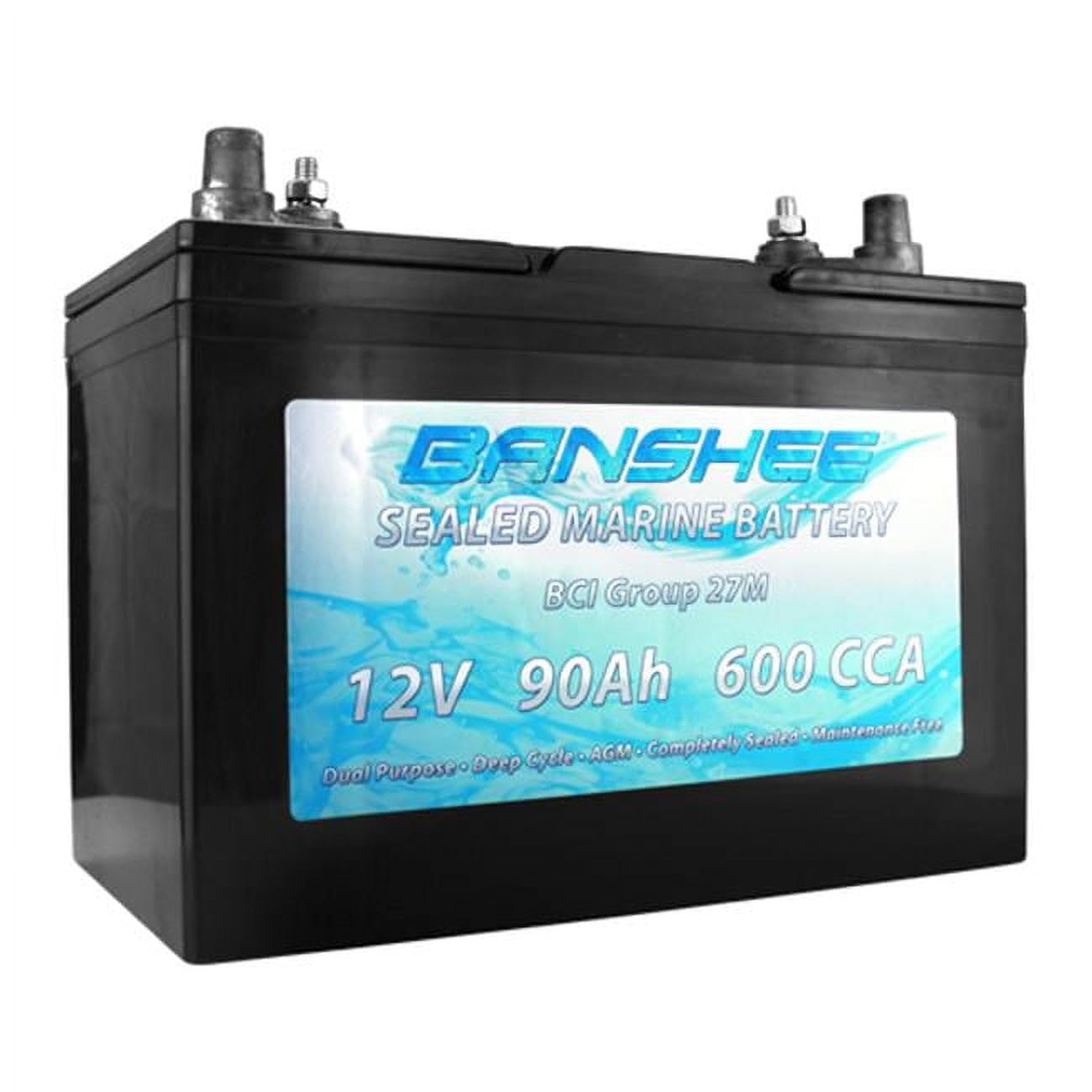
3. Banshee Group 27M AGM Battery 12V 90Ah
A marine AGM built to crank the engine and run the stereo for an hour afterward
Here is the battery for the boat owner who does not want two boxes. It is a Group 27M AGM with 12V 90Ah of storage — the comparison point is the UPLUS 100Ah above, which this one comes in just shy of — and it carries 730 cold cranking amps (the burst of current an engine needs in the cold) plus 185 minutes of reserve capacity (how long it can keep a load running if charging stops). That reserve number matters more than people realize: 185 minutes is a long day’s music and lights. It has SAE dual terminals (standard automotive posts), a built-in carrying handle, and a 10-12 year design life on the label.
The dual-purpose sales pitch is real here. Deep cycling capacity for a trolling motor or a house load, plus starting power for a marine engine, in one sealed 56-pound box. Others use it as a second battery in a boat, where it handles backup start duty and keeps the audio system fed all day.
The honest wrinkles are weight and one shipped-unit risk. At 56 pounds it is in the same class as the AGM pack it replaces, and the plastic handles carry a lot of that load — the built-in grab handles are on the small side. A separate unit can arrive weak from the shipper, with a load test reading well below the rated cold cranking amps, so it is worth testing on arrival. The upside is that this is the most affordable marine-grade AGM on this list.
The draw: dual-purpose AGM that cranks and deep-cycles, with 730 cold cranking amps, dual SAE terminals, and a 10-12 year design life claim.
Weigh the catch: 56 pounds plus undersized handles means a two-hand lift, and it is worth load-testing any unit the moment it lands.
Grab this one if: you run a boat that needs both starting power and house loads, and you want one battery for both jobs. Think twice if: you only need deep-cycle storage with no cranking — the lithium options here will be lighter and last longer.
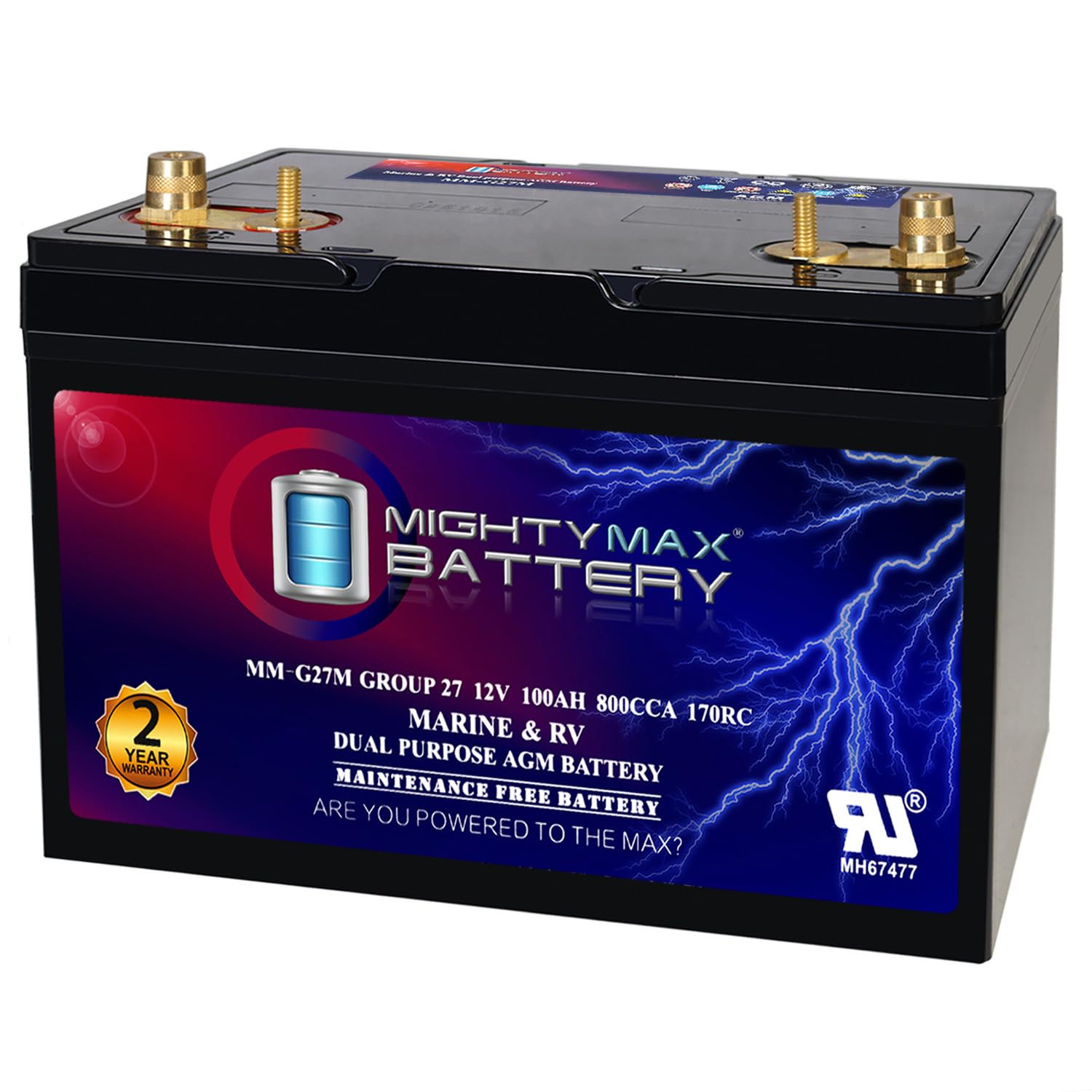
4. Mighty Max Battery MM-G27M 12V 100Ah Group 27M
Big cranking amps for a cold morning on the water, wrapped in a shell that shrugs off impacts
If your launch ramp is cold and your engine is stubborn, the headline here is the cranking figures. This Group 27M AGM delivers 800 cold cranking amps (the burst of current an engine needs in the cold) and 850 marine cranking amps (the same idea, tested at a warmer temperature), which is more starting muscle than the Banshee above at 730CC. It pairs that with 100Ah of deep-cycle capacity (built to be drained and recharged repeatedly) across 700 cycles at 50% depth of discharge (how far you drain it each time), so it works as both an engine battery and a house load for electronics and a trolling motor.
The build is where the marketing turns into something you can feel. It sits in a heavy-duty ABS case (the rugged plastic shell) that resists impact and heat, and the whole unit is sealed and spill-proof, so it does not care about waves, trail bounce, or docking bumps. At 70.5 pounds it is one of the heaviest batteries here — a two-person lift or a hand truck is the smart way to move it. Owners run it on a pontoon through a full season, holding charge without leaks, and report it pushing an 18-foot boat all day. Two years of warranty back it up.
The trade-off to know is the 1-year manufacturer warranty listed alongside the 2-year coverage in the product description. Beyond that, this is a lead-acid battery, which means the usual 50% depth-of-discharge discipline applies — you do not want to run it flat and leave it there. For a camper who needs 800 CCA plus 100Ah of house storage and has help lifting 70.5 pounds, this is a solid marine AGM.
Standout spec: 800 CCA and 850 MCA in a Group 27M case, paired with 100Ah deep-cycle capacity and a tough ABS shell rated for wave and trail abuse.
Think about: 70.5 pounds is a lot for one person, and the 50% depth-of-discharge rule is the same one every AGM here follows.
Made for: boaters and camper owners who need hard cranking amps in cold weather plus deep-cycle runtime in one box. Not the one for: anyone chasing low weight — the lithium Group 27 packs here save you nearly 50 pounds.
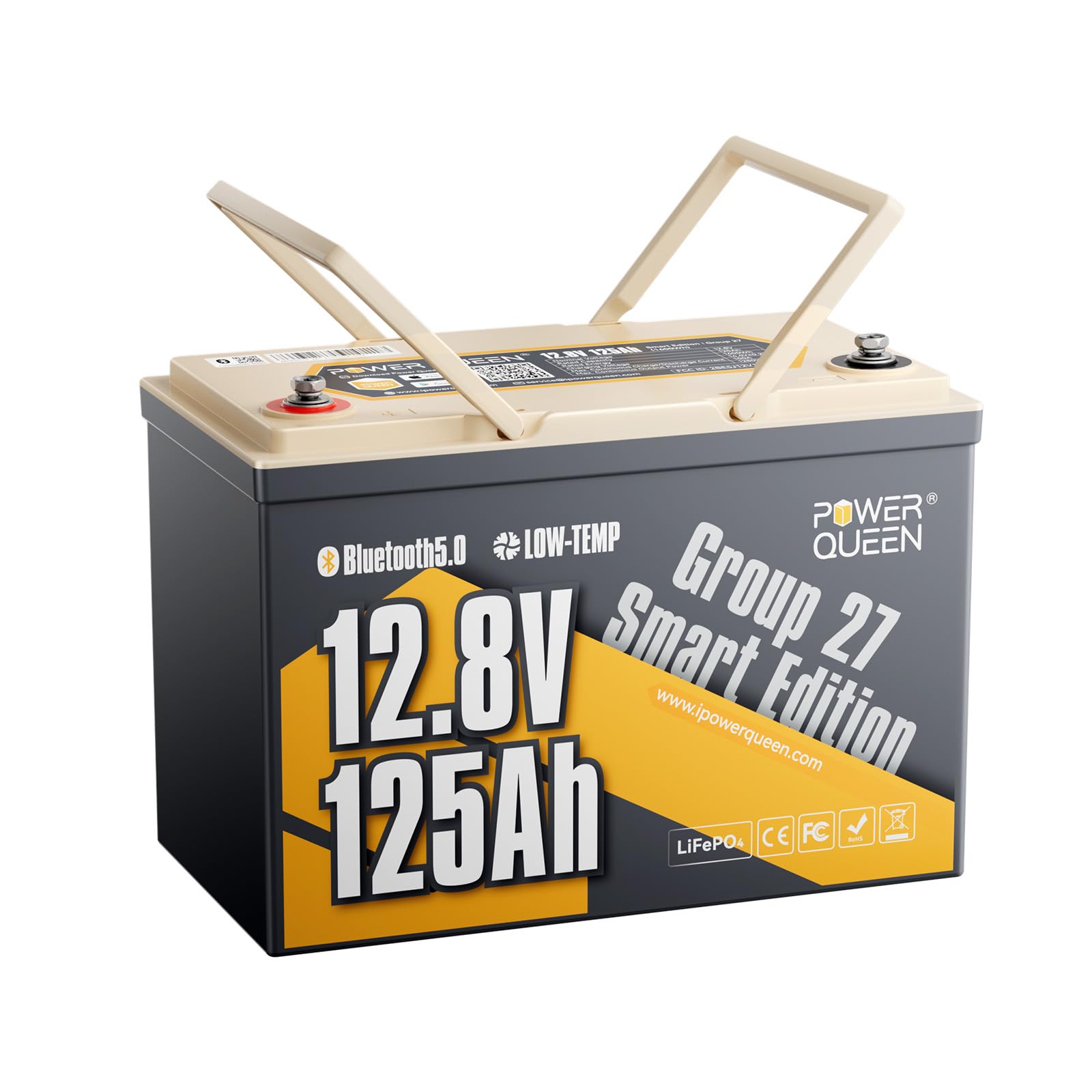
5. Power Queen 12V 125Ah LiFePO4 Battery Group 27
Same Group 27 footprint as a 100Ah lithium, but with 320Wh more energy packed inside
The clever move here is squeezing more runtime into a case that already fits. Power Queen rates this at 125Ah and 1600Wh, and the maker states that versus a same-size 12V 100Ah lithium, you get an energy increase of 320Wh — enough to run a 10W light for about 32 hours longer. The dimensions are a Group 27 12.13 x 6.69 x 8.31 inches, so it slides into the compartment you already have, and it weighs 25.1 pounds. That is over 40 pounds lighter than the AGM units on this list and lets an RV or kayak keep the same tray.
The electronics package behind the cells is the other half of the story. A self-developed battery management system (BMS — the chip that keeps each cell safe) runs 20+ protections covering over-charge, over-discharge, over-current, short circuit, and over-temperature, and it also handles low-temperature cutoff so charging stops below freezing and discharge cuts out in deep cold. A pre-charge function lets it work with standard inverters (devices that convert DC to AC), and power auto-resumes 30 seconds after an overload trip. Bluetooth 5.0 lets you watch state of charge, current, temperature, and protection status from your phone within 10 meters, and you can remotely switch the discharge off. The maker claims up to 15,000 cycles and a 5-year warranty.
Where it earns its name is in the runtime reports from owners. A pontoon running a Minn Kota 45 lb trolling motor used 15% of capacity over 6 hours, then towed another pontoon 4 miles in a level 5 headwind and still had 50% left. On the downside, the Bluetooth app is functional but not polished — one owner installs and reports the battery works fine but the app has quirks. That is an app complaint, not a power complaint, and it does not change the 125Ah the battery delivers on the water.
Why it earns the spot
- 125Ah / 1600Wh in the same Group 27 footprint as a 100Ah lithium — 320Wh more stored energy
- 25.1 pounds versus 60+ pounds for the AGM options here
- Bluetooth 5.0 monitoring plus remote discharge control within 10 meters
- Low-temperature charge and discharge cutoff, 30-second overload recovery, 5-year warranty
The fine print
- The companion Bluetooth app is functional but rough around the edges
- Not a starting battery — this is deep-cycle storage only
- Higher upfront cost than the AGM picks below
Right for: RV and pontoon owners who want more runtime without changing battery compartments, and who value app-based monitoring. Not for: anyone needing cold-cranking amps for an engine start.
6. VMAX MR127 12 Volt 100Ah AGM Battery

A sealed AGM that owners run all day on a trolling motor and still find nearly full
For the angler who trolls from morning to late afternoon, the number that matters on this battery is its reserve. It is rated 12V 100Ah as a true deep-cycle AGM (not a CA/CCA starting battery), and it delivers 5+ hours on a Minn Kota 40# or 55# motor while sitting at around 95% charge afterward. Owners treat that as proof of headroom — you are not watching the gauge, you are just fishing. It arrives on time and well protected, and the AGM build is fully sealed and maintenance free.
The construction notes are worth a look. Inside, VMAX tanks use an electrolyte suspension system made of high-porosity AGM (absorbed glass mat) that holds the acid so nothing sloshes or vents. The plates themselves are heavy-duty lead tin alloy grids, which the manufacturer says push the performance margin and service life through repeated deep discharges. It tops out at 68 pounds, and it carries 6 cells in a single box with marine terminals.
Two honest points. First, it is 68 pounds, and the review pages are blunt about it — this is a gym-weights kind of battery. Second, it is a lead-acid AGM, so it does not like being drained flat; one owner ran it too low and had to jump it to bring the amps back up. That is a care note, not a defect. Owners running it in Canada on a 12-foot aluminum boat with a 55# Minn Kota and recharging every other day with a 10A charger report it holds up over the season, and others point to the long held charge retention as the reason to buy.
What buyers value: a genuine deep-cycle AGM that runs a trolling motor all day and still reads near 95% when you pull up the trolling motor.
Keep in mind: 68 pounds is heavy enough to change how you move it, and this is not the battery to run until it dies.
Choose it if: you want a proven AGM built for all-day trolling motor work and you have help lifting it in and out. Reconsider if: you prefer to swap and go with one hand — the lithium picks here halve the weight.
7. VMAX XTR27-110 AGM Battery 12V 110Ah Group 27
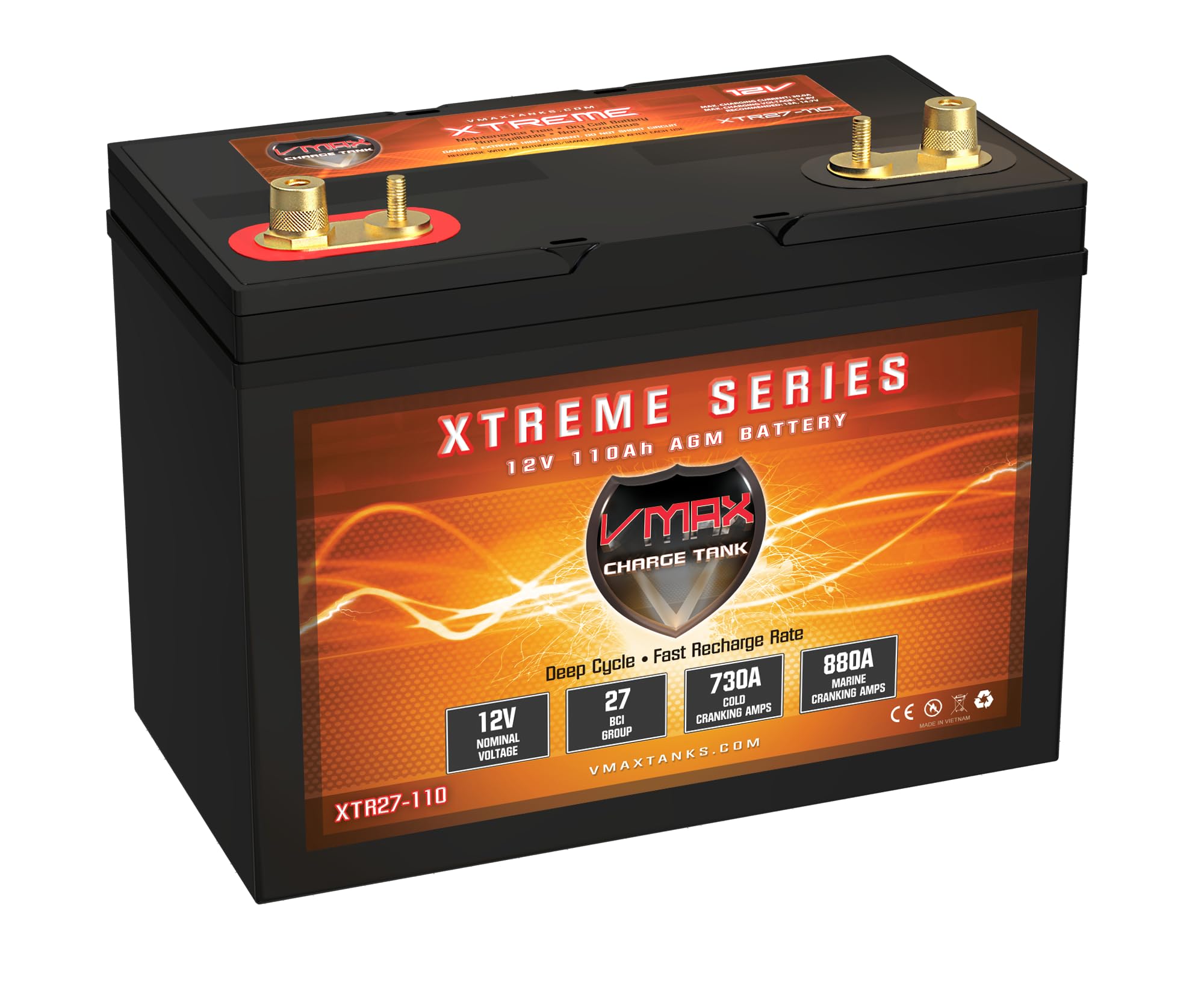
The step-up AGM with the most stored energy of any lead-acid pack on this list
At 110Ah, this is the highest amp-hour AGM here, and the extra capacity shows up in the endurance reports. It runs on a pair of batteries driving a 12V Minn Kota 55 lb trolling motor, and one battery covers a full day from 7am to 8pm while dropping just to about 75%. By the second season owners are getting 6-8 hour fishing days at 80% motor use with no noticeable drop. The reserve capacity is 220 minutes, which tells you how long it can feed a load if the charging stops. It is a sealed, maintenance-free AGM that can be mounted in any position, uses SAE plus a 5/16-inch stud terminal, and has a 1-year replacement warranty with a 30-day satisfaction guarantee.
Owners who made the switch from older sealed lead-acid units are some of the happiest: an all-electric pontoon running two of these was, in the owner’s words, “impressively still on full” after about 2 hours at 3/4 speed. The AGM build handles shocks and vibration, which is what you want on a boat that gets trailered on rough roads. It is also the biggest battery here in stored energy per box, so if you want maximum AGM runtime in an existing Group 27 tray, this is where you point.
The catch is the same one that runs through every AGM on this list: 70 pounds. It is not a one-person lift, especially if you are moving it out of a bilge. And a small number of units have arrived with failing cells — the kind of thing that happens in any sealed battery’s shipping chain, and one that makes the case for buying from a source with a clear return path. For a boat you keep on a lift or a cradle, the 70-pound weight only matters on the days you move it.
Best of the AGMs: 110Ah storage and 220 minutes of reserve capacity in a sealed Group 27 case, with 7am-to-8pm trolling days reported by owners.
Worth knowing: 70 pounds is a two-hand move, and this is the most expensive lead-acid battery here — be sure the extra capacity is worth the lift to you.
For the buyer who: wants the most stored AGM energy possible in a Group 27 tray and runs long fishing or house-battery days. Step away if: portability matters or your rig was designed around a lighter lithium pack.
8. Redodo 12V 100Ah Battery Group27
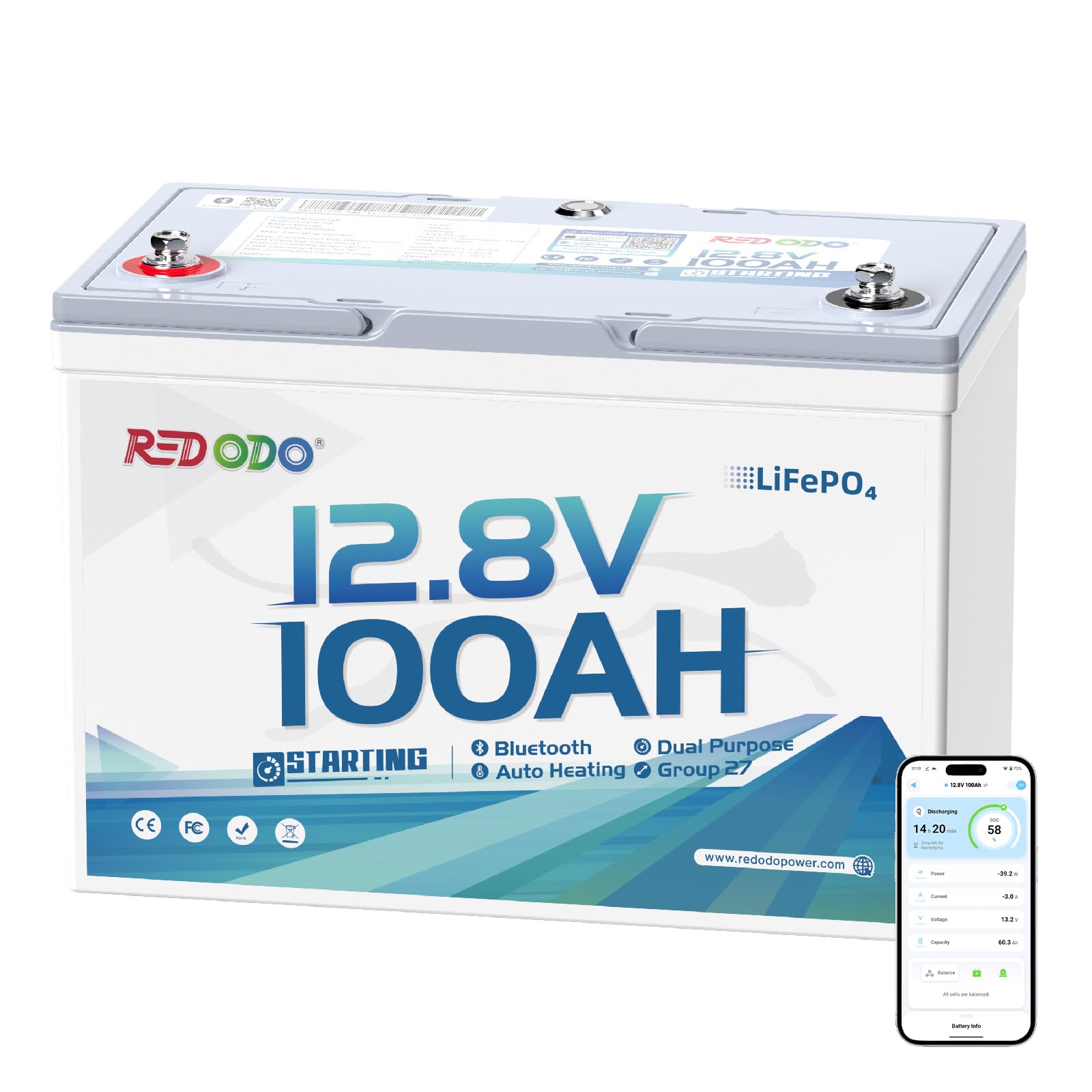
Lithium that can finally crank a fuel outboard and still run your electronics all day
This is the rare lithium Group 27 that does both jobs. Redodo rates it at 900 cold cranking amps and 1000 marine cranking amps, with up to 12C of instant current, and it says it is built for fuel-powered outboard engines — not just deep-cycle storage. It matches that with 100Ah of capacity, 5000+ start times, and 4000+ depth cycles at 100% DOD. The size is a universal Group 27, and it weighs 23.1 pounds. That puts it in the same weight class as the Litime and Power Queen lithium packs above, and saves real pounds versus the AGM cranking options.
The features read like a modern power tool. A self-heating function warms the battery from -20°C until it reaches 5°C, so charging stays safe in cold conditions. The housing is IP67 waterproof (sealed against dust and temporary immersion), and the white casing absorbs less heat than black. It also has an OTA function for firmware updates over Bluetooth, so you do not mail it back for a software fix. The BMS keeps about 25% in reserve to guarantee the engine start, and a forced restart via the app or a 2-second button hold gives you a way out in an emergency.
Owners run it in some serious boats. A 28-foot Edgewater with twin Yamaha 300 engines reports instant starts, faster cranking, and no voltage sag into the Garmin units, with the pair combining for the cranking muscle. A Phoenix bass boat with a 150 Mercury Pro XS 4-stroke runs the engine and electronics off it and stays well charged. The honest limits are in the details: it is not a vehicle starting battery, it does not work with unregulated outboard motors (Evinrude, Johnson, Mercury Black Max named), and it needs a proper charger or DC-to-DC converter. Get those right and it cranks a fuel outboard the way lithium usually cannot.
What makes it different
- 900 CCA and 1000 MCA — a lithium pack that cranks fuel outboards, not just stores power
- 23.1 pounds versus 60+ for the AGM cranking batteries here
- Self-heating from -20°C to 5°C for safe cold charging
- IP67 waterproof housing, OTA firmware updates, 5-year warranty
Check before you commit
- Not compatible with generators lacking a built-in voltage regulator
- Does not work with unregulated outboard motors like Evinrude, Johnson, or Mercury Black Max
- Needs a proper charger or DC-to-DC converter setup depending on your engine
Pick this when: you run a fuel outboard and want to drop both weight and lead-acid maintenance while keeping full cranking power. Look elsewhere if: your motor is one of the unregulated models named, or you only need deep-cycle storage.
9. Power Queen 12V 150Ah Lithium Battery Group 27
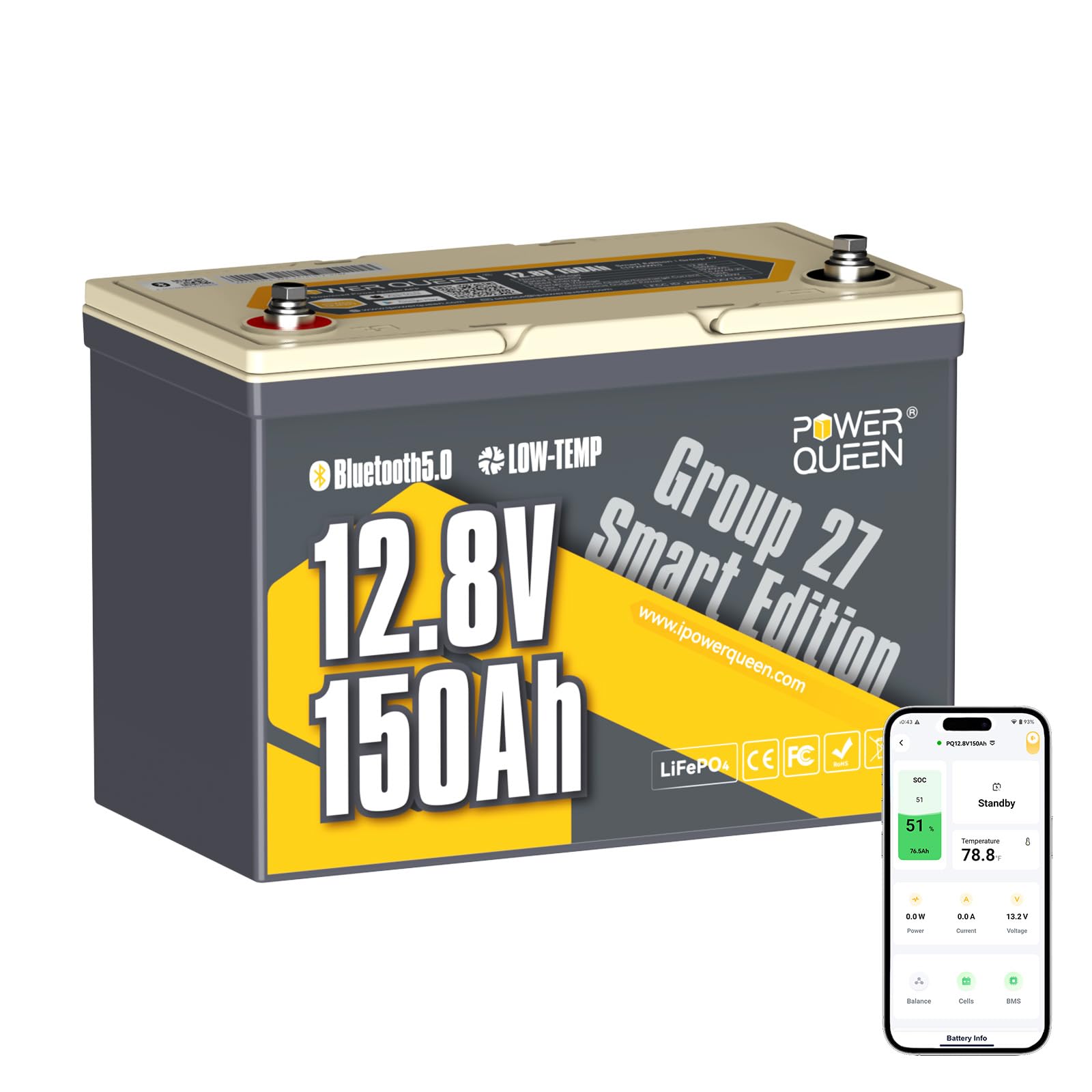
The biggest energy upgrade you can fit into a standard Group 27 compartment
If your RV runs out of power on the second night, this is the battery aimed at you. Power Queen rates it at 150Ah and 1920Wh in a Group 27 footprint (12.13 x 6.69 x 8.31 inches), which the maker describes as 50% more usable energy than a typical 12V 100Ah lithium battery in the same size. It delivers up to 1920W output per battery and 3840W from a two-battery setup, which the maker says is enough to run a microwave, coffee maker, or air conditioner without switching things off. It weighs 33.5 pounds, so it is heavier than the 100Ah lithium packs here but still far lighter than the AGMs.
The management side is well covered. A 150A BMS runs the same 20-ish protections you expect on a modern lithium pack, and there is low-temperature protection so it stops harmful charging and discharging in the cold. Bluetooth 5.0 lets you read state of charge, voltage, temperature, and charge/discharge timing from your phone. It fits A-frame trays and standard compartments without modification, has IP65 waterproofing, and comes with a 5-year warranty.
What owners actually do with it is the interesting part. A truck camper build runs a 2000W inverter powering an induction cooktop, coffee maker, vacuum, and electric heater, paired with a 200W solar panel and a 40A DC-to-DC charger (a device that charges your battery from your vehicle’s alternator), and the owner never draws it below 90%. Another fifth-wheel owner replaced three Group 27 lead-acid batteries with two of these for less weight and longer hold. The trade-off is the highest sticker price on this list, plus the honest note that a few units arrive with the wrong model or fail early — Power Queen’s support has a strong record of replacing those quickly, but it is a real possibility with any battery shipped by mail.
The headline: 150Ah / 1920Wh, up to 3840W with two units, and a 150A BMS with low-temperature protection — the most stored energy here in a real Group 27 case.
Plan for: 33.5 pounds and the steepest price on this page, plus a small chance of a wrong-item shipment that support then has to fix.
Designed for: RV, van, and truck camper owners who run real appliances and want the most runtime per compartment. Overkill if: your loads are small and a 100Ah lithium at a lower cost would cover a weekend.
Know the Specs
Amp-Hours and Watt-Hours
Amp-hours (Ah) describe how much energy a battery stores — think of it as the size of the fuel tank. Watt-hours (Wh) express the same storage in a way that works across voltages; a 12V 150Ah pack lists 1920Wh, while a 12V 125Ah pack lists 1600Wh. The bigger the number, the longer your gear runs before a recharge. A 10W light will drain a large pack much more slowly than a coffee maker or an air conditioner will, which is why the same battery can last a weekend for one owner and a night for another.
CCA, MCA, and Reserve Capacity
Cold cranking amps (CCA) measure the burst of current a battery can deliver to start an engine in the cold, and marine cranking amps (MCA) measure the same thing at a warmer temperature — that is why the two numbers differ on the same battery. Reserve capacity is how many minutes it can keep a load running if charging stops. A deep-cycle battery is built to be drained and recharged repeatedly, while a starting battery is built for short high-current bursts. Dual-purpose models, like several here, try to do both jobs in one case.
BMS and Low-Temperature Protection
A battery management system (BMS) is the electronic brain that watches each cell. It cuts the flow if the battery gets too hot, too cold, or tries to over-charge or over-discharge, which is what protects a lithium pack from damage. Low-temperature protection stops charging below freezing, because charging a cold lithium cell can harm it. Many of the lithium options here also add Bluetooth monitoring so you can see state of charge and temperature on your phone, plus remote control of the discharge.
Group 27 Fit and Chemistry Choice
Group 27 is a physical footprint — the case dimensions and terminal layout your tray and cables expect. Chemistry is the real decision underneath. Lead-acid AGM is heavier and cheaper upfront, with a shorter cycle life and a 50% depth-of-discharge rule on many units. Lithium (LiFePO4) costs more, weighs roughly a third as much, and runs thousands of cycles, but it needs a compatible charger and, on most units, is not a starting battery. Match the chemistry to your job, not to the label.
Common Questions
Will a Group 27 battery fit my RV or boat compartment?
Can I use a lithium Group 27 battery to start my engine?
Is a lithium Group 27 battery worth it over AGM?
How deep can I discharge an AGM Group 27 battery?
What charger do I need for a Group 27 lithium battery?
Do I need low-temperature protection on a battery?
How long will a Group 27 battery run a trolling motor?
Can I connect two Group 27 batteries in parallel?
How much does a Group 27 battery weigh?
Does a Group 27M battery differ from a Group 27?
Do I need Bluetooth on a battery?
The Bottom Line
For most people, the battery group size 27 winner is the Litime 12V 100Ah LiFePO4 Group 27 because it brings 100Ah of deep-cycle capacity at 22.9 pounds — far less than the 60-pound AGM alternatives — plus Bluetooth monitoring and 20+ BMS protections at a mid-range price. It wins on 22.9-pound weight, 4,000+ rated cycles, and Bluetooth state-of-charge readout. If you want the biggest energy upgrade in the same footprint, grab the Power Queen 12V 150Ah Group 27, which fits the same tray with 150Ah and 1920Wh. And for fuel-outboard owners who need cranking power, the Redodo 12V 100Ah Dual-Purpose Group27 is the one to reach for, with 900 CCA and a self-heating pack for cold starts. At 22.9 pounds, it is the lightest Group 27 on this list to lift in and out of a tray.
How we choose
We do not accept paid placement. Every pick is matched to a real buyer and a real use-case; we do not hands-on test units.
Sources
Specifications: manufacturer listings and product documentation. Review insights: verified customer reviews, as of October 2026. Pricing: not shown on this page (it changes often); check the current price via the retailer link.
As an Amazon Associate, My Heart Lives Here earns from qualifying purchases. This does not affect which products we feature.