Heads up: This post contains affiliate links. As an Amazon Associate I earn from qualifying purchases, at no extra cost to you. Learn more
Specs are compiled from manufacturer listings and verified buyer reviews and can change over time — please confirm the key details on the product page before buying.
You want a number you can trust before you throw a battery away or buy a replacement. That is what the picks below deliver: tools that measure a battery’s true condition under a real load instead of just flashing a voltage figure that tells you almost nothing. The short answer is that the Clore Automotive SOLAR Digital 12V Battery and System Tester is the one most people should reach for, with the TOPDON BT600 the choice for anyone who wants a screen and printed proof.
This guide is built by comparing the manufacturers’ published specifications and the patterns across verified customer reviews, so you get each pick’s real strengths and trade-offs instead of marketing spin.
Some tools here read a single AA and some stress a full car battery, so the right pick depends on what sits in your drawer or under your hood. Read on for the battery analyzer picks that match the batteries you actually test.
Top Picks


How To Choose The Best Battery Analyzer
The wrong assumption most people bring to this category is that a voltage reading tells you whether a battery is healthy. It does not. A tired cell can still show a healthy resting voltage while collapsing the moment you ask it for a real current draw — so the tool you want puts the battery under a load and watches what happens.
Match the tester to the batteries you actually own
Household cells and car batteries need completely different tools. A small handheld tester handles AA, AAA, C, D and 9V cells and reads the percentage of capacity left. A car-battery tester works in the 12V and 6V world and reports cold cranking amps (CCA — the burst of current a battery must supply to turn a cold engine). Decide which drawer your dead batteries come from before you shop.
Look at the operating range, not just the headline number
A tester’s CCA ceiling tells you the biggest battery it can judge confidently. A 40-1200 CCA window covers most passenger cars and light trucks, while a 100-2000 CCA range reaches into heavy-duty and marine territory. If your tester’s low-voltage floor is too high, it simply will not power on when you connect it to a deeply drained battery — so check the minimum operating voltage as carefully as the maximum.
Decide if you need charging and analyzing in one box
Some analyzers are testers only; others charge, discharge, refresh and test each cell through independent channels. If you run a lot of rechargeable cells, a four-channel analyzer that handles each battery on its own program saves you from babysitting a single shared charger.
Side-by-Side Comparison
| Model | Best For | Battery Types | Key Range | Weight | Amazon |
|---|---|---|---|---|---|
| Clore Automotive SOLAR BA9★ Best Overall | All-round car and system testing | Flooded, AGM, Spiral, Gel Cell | 40-1200 CCA | 9.6 ounces | Amazon |
| BT-C2400 Charger AnalyzerBest Household Analyzer | AA and AAA rechargeable upkeep | NiMH, NiCd (AA/AAA) | 20,000 mAh capacity limit | 8 ounces | Amazon |
| Battery Tender Load Tester 026-0020 | 12V and 6V load checks | Starter and deep cycle | 100A at 12V / 50A at 6V | 2.1 pounds | Amazon |
| ZTS Mini Multi-Battery Load Tester | Pocket-sized household cell checks | AAA to 9V, Li-Ion, Photo Lithium | 2-second automatic test | 3.68 ounces | Amazon |
| Opus BT-C3400 | Mixed Li-ion and NiMH analysis | Li-ion, NiMH, NiCd | 200-2000 mA charge rate | — | Amazon |
| OTC 3181 | Fast heavy-duty load checks | 6V and 12V batteries | 130 amp load | — | Amazon |
| TOPDON BT600 | Shop-grade testing with printouts | Flooded, AGM Flat, AGM Spiral, GEL, EFB | 100-2000 CCA | 1.29 kg | Amazon |
Detailed Reviews
1. Clore Automotive SOLAR Digital 12V Battery and System Tester
Our pick — 4.5+★ from 800+ verified ratings; the strongest balance of quality and price.
The pocket tester that turns a murky battery question into a clear percentage.
This one earns its spot because it shows you the actual numbers, not a guess. Hook it to a flooded, AGM, Spiral or Gel Cell battery and it reports the real figures plus the percentage of full strength left — so you know whether to keep the battery or replace it. Its 40-1200 CCA window (cold cranking amps, the current a battery must deliver to crank a cold engine) covers the ordinary run of car and light-truck batteries.
It is small enough to keep in a glovebox or tool bag at 9.6 ounces, and its low-voltage floor of 4.5 volts means it still powers up on a battery that has dropped well below a healthy charge. That matters, because a tester that won’t power on at 4.5 volts is useless exactly when a battery is drained. Compared to the Battery Tender load tester, which needs 12 volts to operate, this one keeps working on a deeply flat battery — 4.5 volts vs 12 volts.
The honest catch: the readings come back as text on the screen, so the cord and clamps need a steady connection to get a clean number. It’s the highest-scoring pick here at 4.5+ stars from 800+ owners, and the backlit screen earns its keep in a dim garage.
What earns it the top spot
- Reports actual figures plus percent of full strength
- Works on flooded, AGM, Spiral and Gel Cell batteries
- 4.5V operating floor keeps it usable on drained batteries
- 9.6-ounce body and backlit LCD for dim workspaces
Where it asks for care
- Relies on a clean, steady clamp connection for an accurate read
- Text-only readout means no printed or saved record
Best for the garage owner: anyone who wants a plain yes-or-no answer on a car or truck battery, fast.
Look elsewhere for: AA-cell testing — this one never leaves the 12V/6V automotive world.
2. BT-C2400 Battery Charger Analyzer Tester
Four chargers in one box, each cell running its own program.
If your dead batteries live in a kitchen drawer rather than under a hood, this is the analyzer to start with. Four independent channels let you run charge, discharge, refresh or test on each cell separately — or program them all at once. The backlit LCD shows capacity, voltage, time elapsed and current for every channel, so you can watch a stubborn battery and see whether it is actually taking a charge.
What wins people over is the capacity reading, which lets you sort the strong cells from the weak ones instead of binning a whole set. The ceiling of 20,000 mAh covers any AA or AAA NiMH or NiCd cell you are likely to own. It is simple to set up and behaves like the chargers you already know, which keeps the learning curve short.
The one place to temper expectations is charging speed — a few find it slower than they hoped, and testing every cell takes time by nature. It is a bench tool, not a hurry-up one. Owners rate it 4.5+ stars across hundreds of reviews, with reliability and value as the recurring praise.
What actually separates it: four channels that program individually mean one weak cell never holds up the other three — a real convenience when you are reviving a mixed batch of AA cells.
The trade-off to plan for: a full refresh-and-test cycle on four cells is a patient, sit-and-wait job, so budget an evening rather than five minutes.
Reach for it if: you rotate rechargeable AA and AAA cells and want to know which ones are still earning their keep.
Hold off if: you need a fast turnaround — speed is the recurring gripe on this one.
3. Battery Tender Battery Load Tester
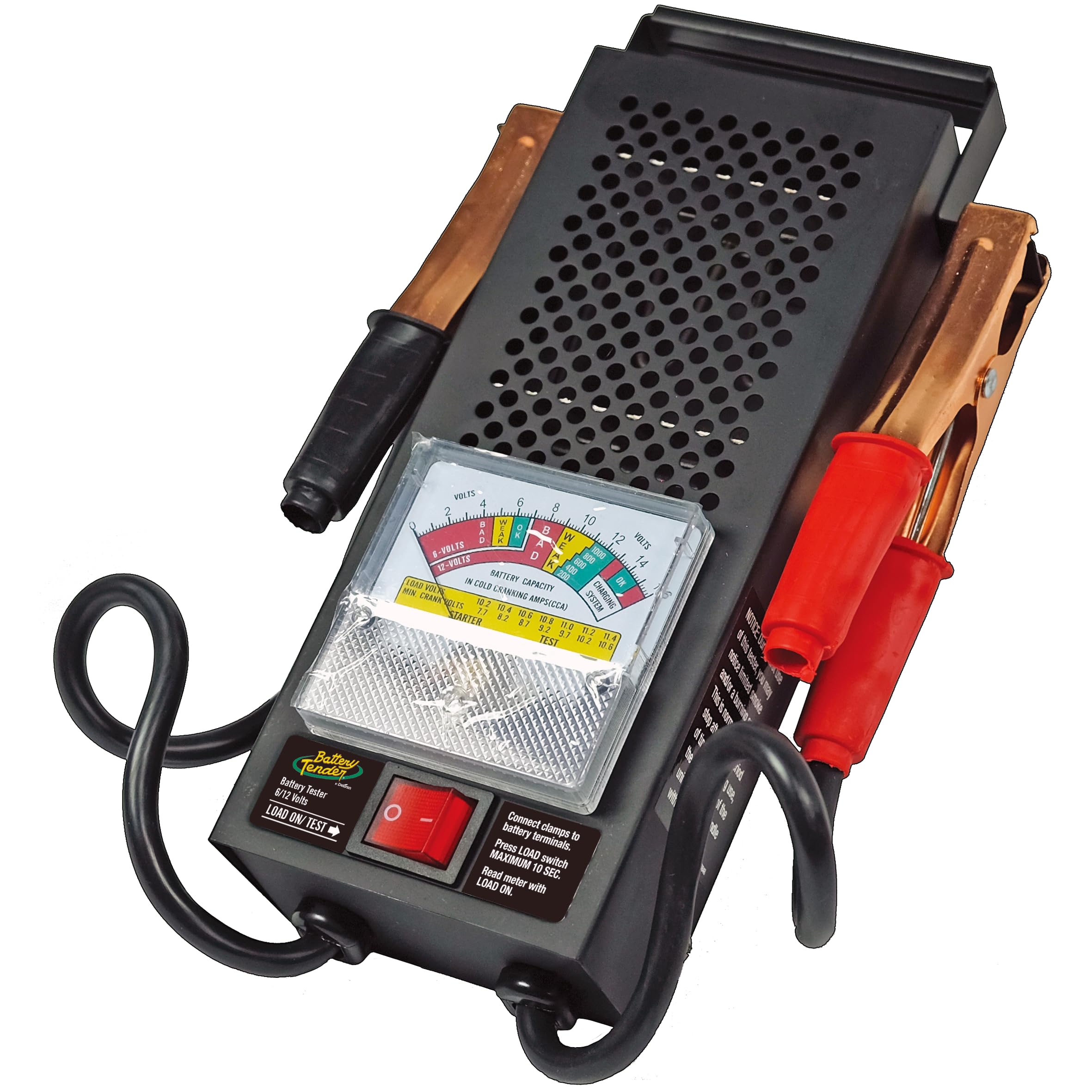
A brute-force load test that also checks your starter draw.
This one does the job a voltage meter cannot: it pulls a real load and watches the battery sag under it. You get a 100-amp load test for 12V batteries or a 50-amp load test for 6V batteries, with a color-coded display that reads at a glance. It also checks starter motor draw and helps diagnose a charging system, so it covers cars, trucks, SUVs, motorcycles, RVs, boats and ATVs up to 1,000 cranking amps.
A single toggle switch runs the whole thing, and the rubber-insulated carry handle plus heavy-duty color-coded alligator clamps make hookup simple. At 2.1 pounds it is heavy enough to feel substantial in the hand.
Two honest notes. A minority of buyers report the clamps getting warm and a burnt-rubber smell on extended testing, and the clamp handle has bent for a few owners after the first session — so treat the clamps with care and keep tests short. Those are the exceptions, not the rule; most owners mention a reliable, easy tool.
Made for the driveway mechanic: someone who wants a fast, physical load check on a car or deep-cycle battery.
Think twice if: you plan long, repeated test sessions — keep them brief and the clamps cooler.
4. ZTS – Mini Multi-Battery Load Tester Mini-MBT

Weighs 3.68 ounces and settles the question in two seconds.
Here is the size contrast that matters: at 3.68 ounces this tester is a fraction of the Battery Tender’s 2.1 pounds, and it slips into a pocket or a kitchen drawer. There are no switches or settings — you touch it to a cell and a fully automatic 2-second test tells you what is left. It reads 1.5V AAA, AA, C, D and N cells, 1.2V NiMH and NiCd, 3.6V Li-Ion, 3V Photo Lithium and 9V alkaline.
The probe and lead wire tuck neatly into a seam in the body, so nothing dangles in a drawer. It’s made in the United States with a one-year warranty, and owners single out its build quality.
Worth knowing before you buy: it runs on four AAA batteries you supply yourself, so it is not power-free on day one. And a slice of owners feel the price is steep for what is essentially a small handheld checker — you are paying for the accuracy, not the size. Most find it reliable enough to trust the result.
Why it earns a spot: a consistent, repeatable reading on nearly every household cell type in one pocket-sized tool, with the lead wire stored away so it travels clean.
The honest catch: it needs its own four AAA cells and asks a premium for a tiny footprint — the accuracy is what you are buying.
Your pick if: you want a grab-and-go checker for the mixed cells in a junk drawer.
skip it if: you are testing car batteries — this stops at household and small-cell sizes.
5. Opus BT-C3400 Battery Charger Analyzer Tester

Handles button-top and flat-top lithiums the smaller chargers will not touch.
This is the analyzer for someone who owns a spread of battery sizes, not just AAs. It takes NiMH and NiCd in AAAA, AAA, AA, A, C and SubC, plus Li-ion cells in a long list of sizes from 10440 up through 26650. Four independent channels run five modes each — charge, discharge, discharge refresh, charge test and quick test — and the adjustable charge rate spans 200 to 2000 mA.
On raw current it leads the BT-C2400 above: 2000 milliamps vs 1400 milliamps, which means a higher charging rate when you need one cell topped up fast. The backlit LCD shows capacity, voltage, time elapsed and current for every channel, and negative delta V detection ends a NiMH charge cleanly while CC/CV protects the lithium cells.
The catch is a limit worth knowing: at the full 2000 mA rate only one channel is available, and running all four together caps at 1000 mA. A slice of owners also question the value given how the accessories are laid out. Still, versatility and quality are what keep this in owners’ good books.
For the multi-format tinkerer: flashlight, camera and device cells of every size, charged and analyzed in one rig.
A limitation to note: the top charge rate is a single-channel affair — all four channels together run at a lower ceiling.
6. OTC 3181 130 Amp Heavy-Duty Battery Load Tester

A 130-amp load test that hands you an answer in ten seconds.
When a battery needs a serious stress test and you want the verdict now, this is the tool. It throws a 130-amp load at 6V and 12V batteries and delivers accurate, reliable results in about 10 seconds. The extra-large display runs a 0-16 volt range with a zero-adjust dial, and the specially shaped clamps grip both top-post and side-post batteries firmly.
Build touches are where this one separates from a bare-bones tester: side tabs hold the clamps when not in use, and back brackets let you hang it on a wall or tuck it into a toolbox. Owners praise how it functions most, and it earns its keep with heavy-duty clamps and cables. Portability helps too — it is a grab-and-go tool for a quick battery check.
There is a real trade-off: extended testing gets the unit warm, and a few owners have seen theirs quit after a month of use. Those are outliers against a strong reliability picture, but it is worth firing short tests rather than leaning on it for long ones.
Where it shines: a fast, high-current load test with oversized clamps that grip both terminal styles, plus wall-mount brackets that keep it organized.
Where to be careful: it runs warm under extended use, so keep individual tests brief and let it cool between jobs.
Ideal for the serious home wrencher: a heavy-duty load check on 6V and 12V batteries without a screen full of menus.
Not for you if: you need digital readouts and saved records — this is a needle-and-dial tool.
7. TOPDON BT600 Car Battery Tester

A shop-grade analyzer that prints a paper trail for every battery it judges.
If you test batteries for other people and need a record, the BT600 is built for exactly that. It works on 12V and 24V lead-acid batteries across a 100-2000 CCA range, covering flooded, AGM Flat, AGM Spiral, GEL and EFB types. It runs full battery, cranking and charging tests, so you can tell whether the fault sits in the battery, the starter or the alternator.
You get a 3.5-inch color screen, bigger than the vast majority of car battery testers, with an interface that is easy to follow. The built-in thermal printer spits out a report on the spot — ideal for a shop handing proof to a customer. A data playback function keeps your last test on hand. It reads VCC (voltage) and CCA accurately, and owners rate its reliability and build quality highly.
The one weak spot is the cables, which a minority report breaking after a few months — so handle the leads gently rather than yanking them off terminals. The mini-USB port only talks to Windows systems, which is worth knowing if you plan to update the software.
The standout spec: a 100-2000 CCA range plus a built-in printer makes this the only pick here that hands you a hard copy of the result — the thing a real shop needs.
The caveat to weigh: the test cables are the fragile link, so treat them well and the tool should serve for years.
Built for the professional: shops, battery dealers and anyone testing used cars who needs a printable report.
Overkill for you if: you only check your own car once a season — the printer and big screen are wasted on a driveway job.
Know the Specs
CCA (Cold Cranking Amps)
CCA is the burst of current a battery must supply to turn a cold engine, and it is the number a car tester is really measuring against. A 40-1200 CCA window suits most cars and light trucks, while a 100-2000 CCA range reaches heavy-duty trucks and boats. If your battery’s CCA falls well below its rated figure, the battery is weak even if it still starts on a warm day.
Load vs. Voltage
A plain voltage readout shows how charged a battery is at rest, which can look fine on a battery that fails under demand. A load test applies real current and watches the voltage sag, which reveals a failing cell. That gap is why a tester built around load — like the OTC’s 130-amp pull — tells you more about battery health than a simple meter.
Independent Charging Channels
A channel is one slot that runs its own program. Four independent channels let you charge, discharge or test each cell separately, so a weak battery is not dragged along by the others. On the Opus BT-C3400 you can set each channel’s mode and rate, while on the BT-C2400 you program them individually or all at once.
Charge Rate in mA
The milliamp rate sets how much current flows into a cell per hour. Higher rates finish faster but generate more heat, and many analyzers cap the top rate when all channels run together. The Opus ceiling of 2000 mA is a single-channel figure; running all four together holds it to 1000 mA.
Common Questions
Will a battery analyzer work on a completely dead car battery?
What is the difference between a load tester and a voltage meter?
Can the BT-C2400 and BT-C3400 test the same battery sizes?
How long does a full analyze cycle take on a four-channel charger?
Do the TOPDON BT600 and Clore BA9 both test cranking and charging systems?
Why does some battery testing equipment get hot or smell?
Can a battery analyzer tell me whether to replace a car battery?
Does the ZTS Mini test lithium and alkaline batteries in the same unit?
What does the BT600 built-in printer let me do that other testers cannot?
The Bottom Line
For most people the battery analyzer winner is the Clore Automotive SOLAR Digital 12V Battery and System Tester, because it reads battery and system health across a 40-1200 CCA range and still powers on at 4.5 volts when a battery is deeply drained. If you need a printable record for a shop, the TOPDON BT600 is the one to reach for. And for the household drawer full of AA and AAA cells, the BT-C2400 charges and analyzes each cell on its own channel.
If household cells are your main worry, the pocket-sized ZTS Mini is a smart little add-on to any of the car testers above. And the Clore’s 4.5+ star rating — the highest score of the bunch — backs up its place at the top of the list.
How we choose
We do not accept paid placement. Every pick is matched to a real buyer and a real use-case; we do not hands-on test units.
Sources
Specifications: manufacturer listings and product documentation. Review insights: verified customer reviews, as of November 2026. Pricing: not shown on this page (it changes often); check the current price via the retailer link.
As an Amazon Associate, My Heart Lives Here earns from qualifying purchases. This does not affect which products we feature.