Heads up: This post contains affiliate links. As an Amazon Associate I earn from qualifying purchases, at no extra cost to you. Learn more
Specs are compiled from manufacturer listings and verified buyer reviews and can change over time — please confirm the key details on the product page before buying.
If you are caring for someone with a bed sore, the dressing you pick has to do three things at once: hold onto fluid, stay stuck to skin that may be paper-thin, and come off without tearing that skin open again. Get any one of those wrong and you are starting over every single day, sometimes twice a day. The nine dressings below are the ones built for exactly that job — foam, hydrocolloid, and silver-infused pads that are designed for sacral and pressure-ulcer wounds rather than the little strips you keep in a kitchen drawer.
This guide is built by comparing the manufacturers’ published specifications and the patterns across verified customer reviews, so you get each pick’s real strengths and trade-offs instead of marketing spin.
Below you will find what each dressing is actually made of, how much fluid its core holds, and where it tends to let people down. The goal is simple: help you choose the right bandages for bed sores the first time.
Top Picks


How To Choose The Best Bandages for Bed Sores
A bed sore — also called a pressure ulcer or decubitus ulcer — forms where constant pressure cuts off blood flow to the skin, most often over the tailbone, heels, hips, and elbows. Once the skin breaks, the dressing has a real job: keep the wound bed moist, pull excess fluid away, and protect the area from rubbing, urine, and stool. That is a very different task from covering a cut on your finger, and it is why an ordinary adhesive bandage is the wrong tool here.
Match the dressing to how much the wound drains
Wounds that weep lightly do well with a hydrocolloid pad, which turns into a gel as it absorbs and holds a moist seal. Wounds draining moderate to heavy fluid need a foam dressing with a thick absorbent core and a fluid-locking layer, so the surrounding skin does not turn white and soggy from sitting in moisture. Getting this mismatch wrong is the most common reason a dressing has to be changed every single day instead of every few days.
Silicone contact layers versus standard adhesive
The part that touches the sore itself matters most on fragile skin. Silicone dressings stick to dry skin around the wound but do not stick to the open wound bed, so they lift away without pulling new tissue and without making the person wince. Standard acrylic adhesive is tackier, holds longer under compression, but comes away harder — which is why it shows up as the complaint most often attached to otherwise effective dressings.
Size, border shape, and where the sore sits
A dressing has to cover the wound plus enough healthy skin for the border to seal. Sacral wounds sit in a curved, high-movement area, which is why several picks here use a contoured or quadrilobe shape that hugs the tailbone instead of a plain square that peels at the corners. Whatever the shape, the pad needs a margin of dry skin all around it or the seal will fail.
How long a dressing should stay on
Manufacturers print a maximum wear time, and most of the dressings here are designed to be left in place for several days at a stretch. Stretching wear time is not laziness — every removal takes a little skin with it on a fragile patient, so fewer changes is genuinely kinder. The trick is knowing when a dressing is done rather than guessing.
Side-by-Side Comparison
| Model | Best For | Type | Dressing Size | Pack Count | Amazon |
|---|---|---|---|---|---|
| Medline Optifoam Gentle EX Bordered Foam Adhesive Dressing★ Best Overall | Fragile skin that reacts to other adhesives | Bordered silicone foam | 3″ x 3″ | 10 | Amazon |
| Dimora Ag Silver Sacrum Foam DressingSilver-Infused Pick | Infected or at-risk sacral sores | Silver foam, sacral border | 7″ x 7″ | 5 | Amazon |
| 30 Pcs Silicone Foam Dressing 2×4 Gentle BorderBulk Supply Pick | Backup supply for long-term care | Bordered silicone foam | 2″ x 4″ | 30 | Amazon |
| Dr. Med Hydrocolloid Wound Dressing | Dry-to-lightly-weeping wounds | Hydrocolloid | 6″ x 6″ | 10 | Amazon |
| Sacral Foam Dressing with Border, 7×7 | Tailbone and buttock sores | Sacral silicone foam | 7″ x 7″ | 10 | Amazon |
| NeuHeils Bordered Silicone Foam Dressing | Post-surgical and ulcer coverage | Bordered silicone foam | 6″ x 6″ | 10 | Amazon |
| EVERLIT Sacrum Silicone Foam Dressing | Chronic sacral wounds that drain heavily | Sacral silicone foam | 7″ x 7″ | 10 | Amazon |
| Smith+Nephew ALLEVYN Life Wound Dressing | Showering and staying sealed | Hydrocellular foam | 5″ x 5″ | 10 | Amazon |
| Carbou Silicone Sacrum Foam Dressing | Very large sacral wounds | Sacral silicone foam | 9″ x 9″ | 5 | Amazon |
Detailed Reviews
1. Medline Optifoam Gentle EX Bordered Foam Adhesive Dressing 3″ x 3″
Our pick — 4.5+★ from 900+ verified ratings; the strongest balance of quality and price.
The small square that hospice nurses reach for when every other adhesive has already left a rash.
This is the dressing to start with if the person you are caring for has skin that turns red or weeps under tape. It is a 3″ x 3″ bordered square, and what separates it from the crowd is the five-layer build: a superabsorbent core that takes in wound fluid, turns it into a gel, and locks it there instead of letting it sit against the skin. Around the edge sits a gentle silicone adhesive that you can lift and re-stick, which matters when a dressing lands slightly crooked the first time.
The other figure worth knowing is the moisture vapor transmission rate — how much water vapor the backing lets escape. On this dressing that rate adjusts to how wet the wound is, so a draining wound gets more breathability and a drier one gets a tighter seal. Applied alongside a pressure-injury protocol it also helps spread pressure across the surrounding skin rather than concentrating it, and it can be used either directly on the wound or as a cover layer over another dressing. Medline sets the maximum wear time at seven days, which is toward the long end for a dressing of this size.
The trade-off is proportion. At 3″ x 3″ it is built for smaller wounds and post-surgical sites, not a wide sacral sore — buyers report using it over dermatology stitches and finding the square size a perfect match, which tells you exactly what this one is for. It also weighs 2.4 ounces, less than half the heft of the larger sacral dressings here, because there is simply less material. Skin that reacts to standard adhesive is what this dressing was made for; a deep, heavily draining tailbone sore is not.
Where it wins
- Five-layer core turns fluid to gel so it stops bathing the skin
- Silicone adhesive can be lifted and re-applied without a fresh dressing
- Breathability rises and falls with how wet the wound actually is
- Up to seven days of wear per dressing
Where it stops short
- 3″ x 3″ only — too small to cover a broad sacral ulcer
- Silicone tack is gentler but gives up sooner than acrylic on joints
Reach for this if: the wound is small, the skin is sensitive, and changing the dressing is the part everyone dreads.
Look elsewhere if: you need a single pad to cover a wide tailbone sore — go larger.
2. Dimora Ag Silver Sacrum Foam Dressing 7″x7″
A sacral dressing with silver built into the foam, for wounds already at risk of infection.
Silver is the headline here, and it is a real, measurable part of the build rather than a label: the foam layer carries 0.25 to 0.35 mg of silver per square centimeter. When wound fluid reaches that foam, the silver releases as ions inside the dressing to help reduce bacterial colonization of the dressing itself. The panel measures 7″ x 7″ overall, and the foam pad underneath is sized at 5.5″ x 4.9″ — that border is what gives the adhesive somewhere dry to grab.
What wins people over is the healing performance, with protection of the open sore a close second. Caregivers describe it holding up over a sacrum sore where thinner dressings slid off, and the semi-permeable PU film on the outside keeps liquid out while still letting oxygen and water vapor through. The thick foam core absorbs up to 15 times its weight in wound fluid, and the fluid-locking layer underneath keeps that fluid from creeping back onto the surrounding skin. It is a single-use sterile dressing and manufacturer Winner Medical lists it for sacral pressure ulcers across stages 1 through 4.
Here is the honest arithmetic: five dressings in a pack against ten in most others here, and each one is bulkier — 5.61 ounces for the pack, compared with 2.4 ounces for the Medline square above. The recurring gripe is adhesion at the edges, so clean and dry the skin before you apply, and press the whole border down rather than just the middle. Caregivers also mention the cost stacking up over a long stretch of daily changes.
Why it earns a spot: silver in the foam plus a 5.5″ x 4.9″ pad gives you infection-support and cushioning in one application, and the waterproof backing means a shower is not a reason to skip a day.
What to plan around: five to a box changes the math on supply runs, so order ahead if you are changing this daily.
Best for: a sacral sore that is already inflamed or weeping, where infection control is the priority.
Think twice if: you want a dozen dressings per box for a long-term routine.
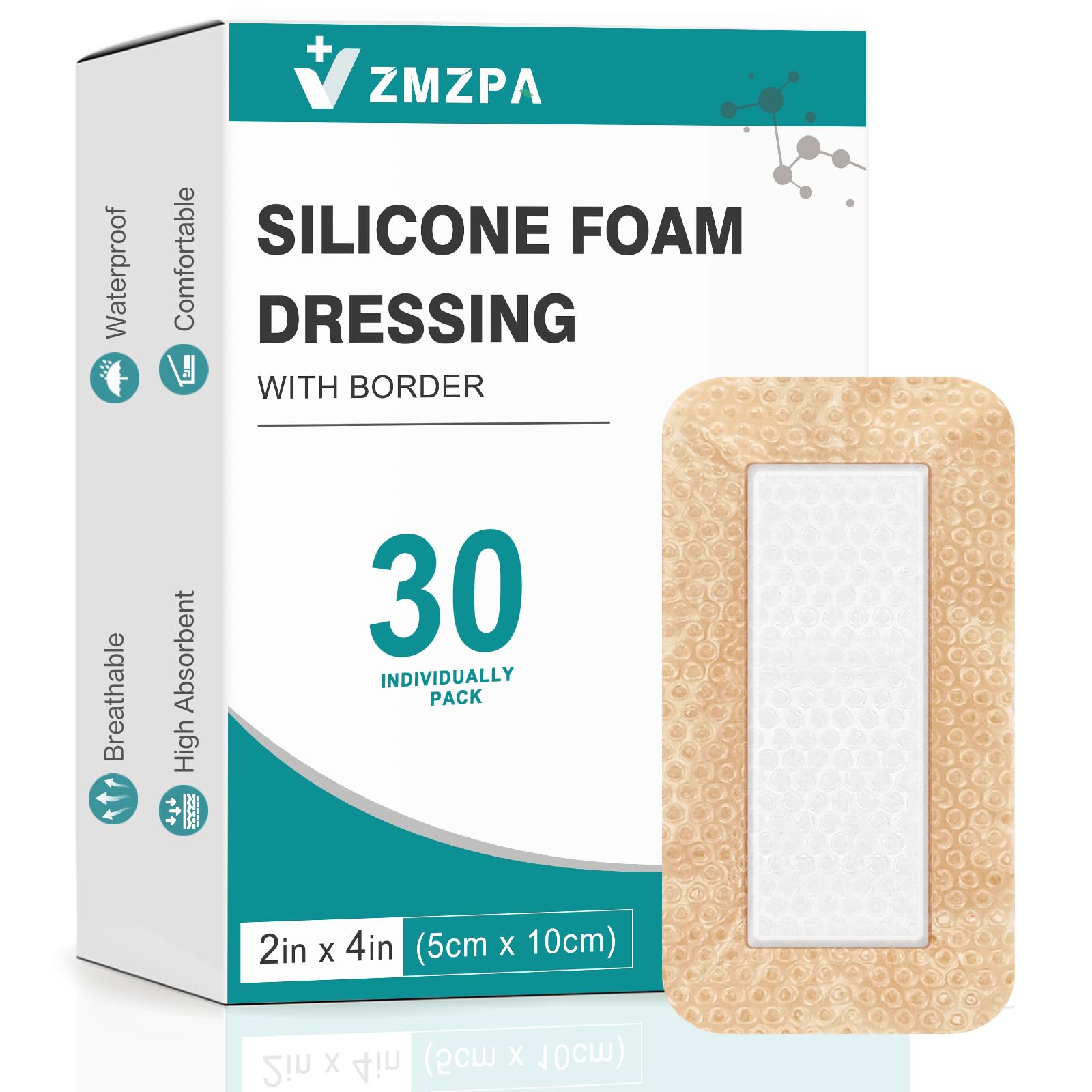
3. Silicone Foam Dressing 2×4 Gentle Border
Thirty small dressings in one box — the sensible way to stop rationing changes.
A 2″ x 4″ pad sounds modest, and it is: the absorbent center inside each one measures 0.98″ by 2.83″, so this is a dressing for narrow wounds and surgical sites rather than a wide sacral ulcer. What you get for accepting that smaller footprint is quantity. Thirty sterile dressings in a single box means you are not watching the last three pads and hoping the next order lands in time.
The build is a four-layer stack with a high-absorbency foam core that holds up to 15 times its own weight in exudate, plus a rapid-absorption layer that gels the fluid within seconds so it stops sitting against the skin. Around the edge sits a stretchy silicone border that follows body contours without curling upward, which is what keeps a small dressing from rolling off a moving patient. The outer fabric is breathable and waterproof, and the whole thing is latex-free — a genuine consideration if there is any latex sensitivity in the household.
Reviews sum it up well: “These bandages are great. They stick well and don’t move around.” The recurring honest note is that the pad itself is not quite shower-proof — fluid can reach the center once it is soaked, so a saturated dressing is a change-it-now situation rather than a ride-it-out one. Buyers with cracked, peeling hands also report using these wrapped around a whole finger, which tells you how the 2″ x 4″ size actually behaves in the real world.
Supply math that works: thirty dressings at a smaller size beats five large ones when you are covering several small sites, or changing dressings on a rotation.
Suits: households running a steady wound-care routine who would rather keep a deep drawer than reorder constantly.
Not for: a single large sacral sore — the 0.98″ x 2.83″ pad will not cover it.
4. Dr. Med Hydrocolloid Wound Dressing 6″x6″ (10 Pack)

A thick gel-forming patch for drier wounds, and the biggest panel per dressing in this group.
Hydrocolloid works differently from foam, and that difference decides whether it belongs in your kit. The main ingredients here are a medical hot-melt adhesive and sodium carboxymethyl cellulose, arranged in three layers: a PU film on the bottom, the hydrocolloid layer itself, and a release film you peel off before applying. When it meets wound fluid, the hydrocolloid layer reacts and turns into a gel-like covering that keeps the wound bed moist. No fluid, no gel — which is exactly why this dressing is specified for light exudate rather than a heavily draining sore.
Each panel measures 6″ x 6″, and ten come individually wrapped so you are not opening a box of dressings that have already met the air. Buyers covering large areas or road rash report the 6″ x 6″ size wrapping a wide surface in one go, with the waterproof top layer letting them keep it on through normal activity. Removal is the part hydrocolloid does beautifully: once the gel forms, the dressing lifts away, and if it is stubborn a little normal saline worked between the skin and the dressing edge loosens it without a fight.
The recurring gripe is edge lift. On non-flexing skin it holds well, but over a joint, corner peeling is the thing people notice — which is why the sensible approach is to back it with an elastic wrap where the dressing crosses a bend. Effectiveness is the aspect that carries this pick, and the manufacturer lists it for bedsores, leg ulcers, and infectious ulcers as its strongest uses.
Best on dry-to-light wounds: hydrocolloid needs some fluid to activate, so a bone-dry wound or a soaking-wet one are both the wrong fit.
Pick this one when: the sore is weeping lightly and you want a dressing that seals flat and disappears under clothing.
Choose foam instead if: the wound is draining heavily enough to need a change within a day.
5. Sacral Foam Dressing 7×7
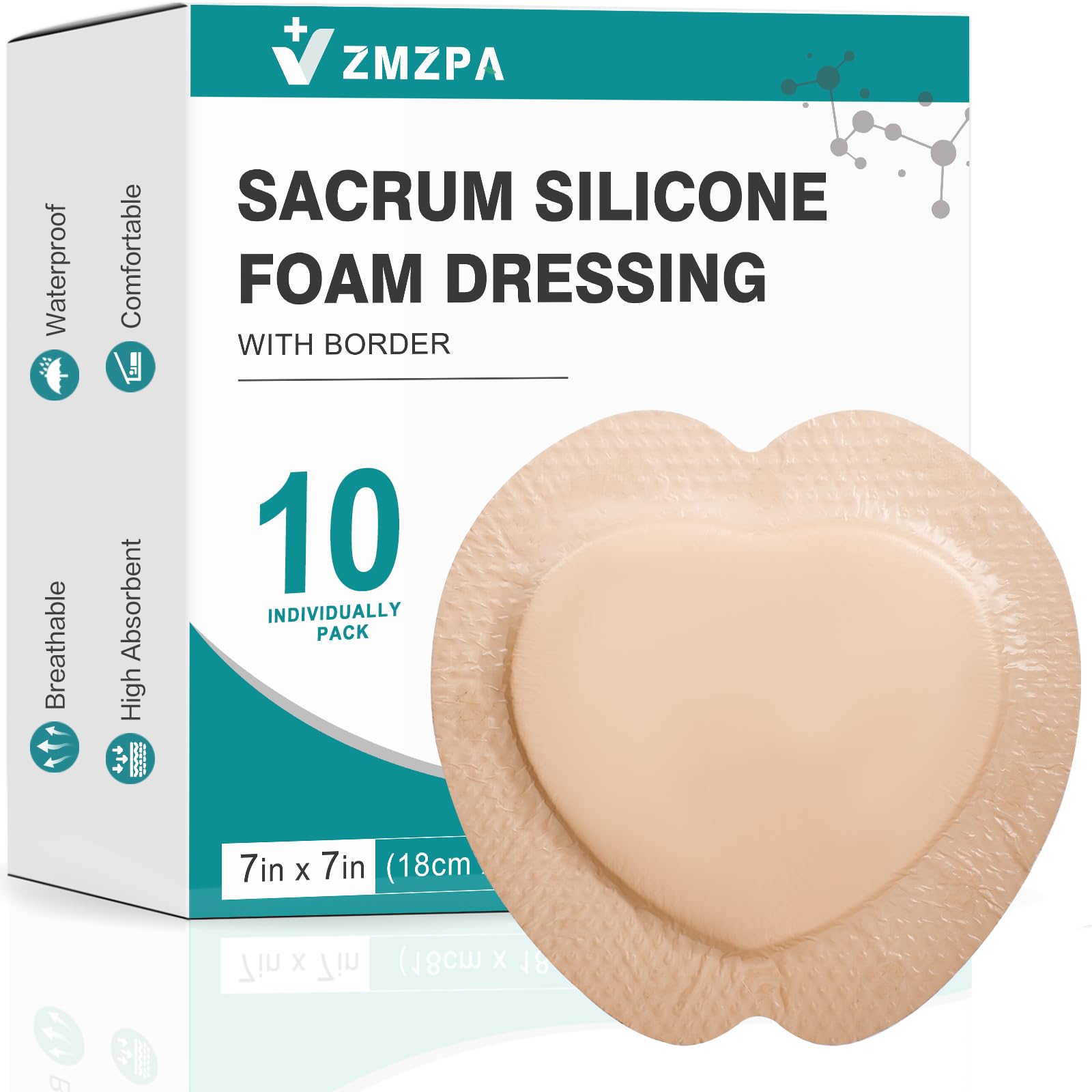
Ten large sacral pads built for the tailbone, where a square dressing quietly fails.
This one is shaped for the job. The panel runs 7″ x 7″ with an absorbent pad of 5.3″ x 4.3″ inside it, and that generous border is what lets the dressing seal across the curve of the sacrum instead of lifting at the corners. The four-layer construction absorbs up to 15 times its weight in exudate, and the fluid-lock layer underneath keeps that moisture from creeping back onto healthy skin.
The medical-grade hypoallergenic silicone border sticks to dry skin but not to the wound bed, so dressing changes are the calm version rather than the painful one — a real factor when the same site is being redressed for weeks. The semi-permeable PU film on the outside blocks liquid and contaminants while letting oxygen and moisture vapor move through, which is the balance you want in a high-moisture area like the buttocks. Manufacturer ZMZPA lists it for sacral bedsores across stages 1 to 4, along with surgical incisions and burns.
What the review pages praise most is the protection the pad provides, with raw effectiveness right behind it and cushioning and comfort following. The mixed note is adhesion, and it splits both ways: some find it truly sticks, while others find the sticky border on the strong side, which can be a problem on very fragile skin. Ease of use also draws mixed remarks — ten large dressings in a box is a solid run, but each application takes a moment of care to lay flat.
Why it fits the tailbone
- 5.3″ x 4.3″ absorbent pad covers a genuine sacral ulcer
- Wide border seals where the body curves, so corners stay down
- Silicone contact layer protects and cushions the wound site
- Waterproof film lets oxygen through to a wound in a damp area
Worth knowing before you buy
- Border adhesion feels strong on thin, fragile skin
- Large size takes a steady hand to place without creases
Great fit for: a sacral or buttock sore that needs real coverage and a border that stays sealed.
Ease off if: the surrounding skin is so fragile that a firm border is more than it can take.
6. NeuHeils Bordered Silicone Foam Dressing 6×6 Inch

The one that repositions without losing its grip — a quiet win when you are dressing someone alone.
A 6″ x 6″ dressing with a 4.1″ x 4.1″ absorbent pad is the middle ground between the small squares and the big 9″ sacral panels, and for a lot of wounds that is exactly right. Ten come in the box, and the pad itself is a soft, high-absorbent hypocellular foam that takes in wound fluid, locks it away, and cushions the site — three jobs in one layer.
The silicone contact layer is the detail that earns this pick its place. It lifts and re-sticks, so a dressing that lands crooked can be adjusted without throwing it away, and it is deliberately built for sensitive, fragile, and older skin where tape marks are the enemy. The breathable waterproof film on top holds a moist environment for the wound while keeping dirt and liquid out. The manufacturer lists bedsores, pressure ulcers, leg ulcers, diabetic foot ulcers, surgical wounds, first- and second-degree burns, abrasions, and skin tears — a genuinely wide brief — and confirms no natural rubber latex is used anywhere in the dressing.
What the review pages focus on is wound care first, with size next: the pad is large enough to cover an entire area, which is the single most practical thing a caregiver can say about a dressing. Adhesiveness draws mixed remarks, which is normal for silicone — it holds on dry skin and refuses to grab on skin that is damp or already moisturized. Durability also splits, mostly from people stretching the wear time past what the pad can handle.
The practical read: a 4.1″ x 4.1″ pad is large enough for most bed sores and small enough to place accurately in one hand, and being able to reposition it means one dressing does the work of two attempts.
One caveat: dry the skin around the wound thoroughly before applying — silicone will not grip damp skin no matter how firmly you press.
Choose this when: you want one dressing that handles most bed sores and forgives a bad first placement.
skip it if: the wound sits in a spot that stays damp — the silicone needs dry skin to hold.
7. EVERLIT Sacrum Silicone Foam Dressing, 7″ x 7″, 10 Pack

Five layers, ten dressings, and a film that keeps germs out while the wound keeps breathing.
Everlit builds this sacral dressing from five layers, and it is worth knowing what each one does because the stack is the reason it absorbs the way it does. The silicone layer sits against the wound for gentle adhesion. A super-absorbent layer takes and holds the exudate. A non-woven spreading layer pushes fluid outward so it spreads evenly rather than pooling in one spot. The foam layer mops up excess moisture. And the breathable outer film manages temperature on the way to forming a waterproof barrier against germs and dirt.
The border seals on all four sides, which is the feature that keeps a dressing planted on a curved sacrum while the person shifts in bed. It is hypoallergenic and latex-free, and the manufacturer describes the center core as a cushion that protects the wound site while letting skin breathe — the combination that reduces the risk of soggy skin around the wound edges. Fluid management matters most on wounds that drain steadily, and this one is specified for moderate exudate across sacrum bedsores, surgical incisions, pressure ulcers, neuropathic ulcers, leg ulcers, arterial ulcers, skin tears, and burns.
Where it separates itself in practice is durability. Dressings that last longer than the competition are a specific relief when every change costs the patient something, and this is the pattern buyers describe — one application holding across the days between routine changes rather than needing a patch job. The size is generous enough for a tailbone sore and second-degree burns both.
Why the layer count matters: spreading fluid evenly across the core is what stops one saturated corner from lifting the whole border, and that is the failure point on cheaper sacral pads.
What to weigh up: this sits at the top of its size class, so if you are changing dressings daily rather than every few days, a smaller pad may be the more sensible repeat purchase.
Ideal for: long-wear sacral care where fewer dressing changes is the whole point.
Worth pausing on if: you go through dressings faster than the extended wear time assumes.
8. Smith+Nephew ALLEVYN Life Wound Dressing, 5″ x 5″, Box of 10

Shaped like no other dressing here, and the shape is the entire argument.
Four lobes and a wide border: that is the quadrilobe outline of the ALLEVYN Life, and it exists for one reason — to follow the contours of a human body more securely than a flat square can. The wide border is where the seal lives, and the shape lets the dressing bend with movement instead of peeling at a corner when someone rolls over or stands up.
The 5″ x 5″ size comes ten to a box, and the design includes a protective masking layer that reduces the visual impact of strikethrough, which is the dark stain that shows through a dressing when fluid reaches the surface. For someone who is self-conscious about a wound, keeping that from showing under clothes is not a small thing. The manufacturer also reports excellent fluid locking under pressure and leakage prevention, both measured in-vitro, along with absorption of common wound odor on representative compounds in the same lab setting — claims worth understanding as lab-tested rather than field-proven.
Showering is what this dressing is known for. As owners put it: “They have staying power and that’s all I cared about was I could take a shower and it didn’t peel off.” The rest of the picture holds up too — comfortable across multiple changes, no irritation to surrounding skin, and cushioning that protects without bulk, which is what lets it sit under clothing without announcing itself. It does require a flat, dry surface to seal properly, so a wound in a crease gets harder to cover.
The shape does real work
- Quadrilobe outline flexes with the body instead of corner-lifting
- Wide border keeps the seal intact through movement
- Masking layer hides strikethrough so the dressing stays discreet
- Waterproof enough to shower without re-dressing
The honest trade-offs
- Fluid-locking and odor claims are in-vitro, not field-tested
- Needs flat, dry skin to seal; awkward in skin folds and creases
Reach for this if: showering without re-dressing is non-negotiable, or the wound needs to stay unnoticed under clothes.
Move on if: the sore sits in a crease where a flat border cannot lay down properly.
9. Carbou Silicone Sacrum Foam Dressing 9″x9″

Nine inches across — for wounds where a smaller pad leaves skin exposed.
Most sacral dressings top out around 7″ x 7″. This one runs 9″ x 9″, which is 23 centimeters on each side, and that jump matters if the ulcer is large or sits alongside a second wound that also needs covering. The bottom border is deliberately wider than the top, so the silicone contact layer follows the curve of the sacrum without curling up at the edge — and no curling means no secondary damage to skin that is already fragile.
The absorbent structure is a polyurethane foam that forms a gel as it takes in wound fluid, locking it inside the dressing rather than letting it pool on the skin. The semi-permeable PU film handles the barrier job: liquid stays out, oxygen and water vapor pass through. High absorbency also stretches how long each dressing can stay on, which matters because a 9″ panel is a significant thing to peel off a painful area. Manufacturer Carbou lists it for post-operative wounds, bedsores, cysts, pressure sores, burns, leg venous ulcers, diabetic foot ulcers, trauma, and first- and second-degree burns, with each dressing wrapped individually.
What people consistently find here is quality — it is the single most-praised trait in the feedback, with effectiveness just behind it, and one buyer puts it plainly: “Of all the different manufacturers, I find Carbou silicone foam dressing to be the best.” The mixed notes are adhesion and size: some find the seal excellent on an open bottom wound, others note it did not stay sealed once soiled, and a few feel the advertised size does not match what arrives. The value side leans the other way, with cost called out as the weak point and the size in the box called out as the weak point — so confirm you know what you are ordering.
Where it earns its keep: a 9″ x 9″ panel covers a sacrum sore with room for the border to breathe, and the asymmetric bottom border is a thoughtful detail for the tailbone curve.
Two things to plan for: five dressings per box and an edge seal that some buyers find gives way once the dressing is soiled.
Best for: a large sacral or gluteal wound that smaller dressings simply cannot reach around.
Weigh carefully if: you want an economical box count or need the seal to survive heavy soiling without a change.
Know the Specs
Absorbency and Fluid Locking
Absorbency is usually written as a multiple — 15x its weight is the figure several dressings here cite, describing what the foam core can hold rather than how much your wound produces. That number describes what the foam core can hold, not how much your wound produces, so use it as a relative guide when comparing two pads rather than as a promise about wear time. The layer underneath matters just as much: a fluid-locking layer keeps absorbed fluid from migrating back and softening the skin around the wound. A dressing that absorbs well but does not lock will still leave the skin around the sore soggy, which is why two dressings with the same absorbency figure can behave very differently over three days.
Silicone Adhesion and Wear Time
Silicone adhesive sticks to dry skin but not to an open wound bed, which is why removing a silicone dressing is a lift rather than a pull. The trade-off is that silicone gives up sooner than acrylic on damp or creased skin, so it needs a clean, dry margin to seal. That clean margin is also what makes multi-day wear possible: manufacturers print a maximum wear time, and the dressings here that run to several days are built around the idea that fewer changes means less repeated trauma to fragile skin. If a dressing is lifting early, the cause is usually damp skin or a border that was not fully pressed down, not the dressing reaching the end of its life.
Backing Films: Waterproof Versus Breathable
Several dressings here use a semi-permeable PU film as the outer layer, and that phrase describes two jobs at once. It keeps outside liquid — shower water, urine, stool — from reaching the wound, while still letting oxygen in and water vapor out. A fully sealed plastic film would trap moisture and soften the surrounding skin. A fully open fabric would let contaminants straight through. The semi-permeable middle ground is what makes these pads suitable for a sacral wound, where moisture exposure from multiple directions is the daily reality.
Common Questions
What is the difference between a foam dressing and a hydrocolloid dressing for a bed sore?
Can I leave a bed sore dressing on for several days?
Will a silicone dressing stay stuck to fragile elderly skin?
Can the person shower with a sacral foam dressing on?
What size dressing do I need for a sore on the tailbone?
How do I remove a silicone dressing without hurting the wound?
Does a silver dressing help with a bed sore that may be infected?
Can I cut a foam dressing to fit a smaller wound?
How many dressings should I keep on hand for daily bed sore care?
Should a bed sore dressing be changed if it is still stuck down and looks clean?
Is a foam dressing better than gauze for a pressure ulcer?
What does “in-vitro” mean on a wound dressing listing?
The Bottom Line
For most households managing a bed sore, the bandages for bed sores winner is the Medline Optifoam Gentle EX Bordered Foam Adhesive Dressing because its five-layer core turns fluid to gel, its silicone border can be lifted and re-set, and skin that reacts to ordinary adhesive tends to tolerate it. The crowd has clearly noticed too — a 4.5+ star average across 900+ ratings, and in a category where a painful dressing change is the thing families dread most, a dressing that lifts without a fight is the one worth starting with. Just size up if the wound is wide: at 3″ x 3″ this square is built for smaller sites.
If the sore sits on the tailbone, grab the Sacral Foam Dressing 7×7 — its 5.3″ x 4.3″ pad and wide border are shaped for the curve of the sacrum where flat squares fail. And when the wound is inflamed or at real infection risk, the Dimora Ag Silver Sacrum Foam Dressing puts 0.25 to 0.35 mg of silver per square centimeter in its foam layer alongside a 5.5″ x 4.9″ pad, so protection and cushioning arrive in one application.
Two smaller notes worth carrying with you. If you are running a long-term care routine across several small sites, the 2×4 silicone foam dressing gives you thirty dressings in a single box, which ends the rationing that makes people stretch a dressing past its useful life. And if showering without a re-dress is the priority, the ALLEVYN Life quadrilobe is shaped and sealed for exactly that. Whatever you choose, match the dressing to how much the wound actually drains — that single decision drives everything else.
How we choose
We do not accept paid placement. Every pick is matched to a real buyer and a real use-case; we do not hands-on test units.
Sources
Specifications: manufacturer listings and product documentation. Review insights: verified customer reviews, as of October 2026. Pricing: not shown on this page (it changes often); check the current price via the retailer link.
As an Amazon Associate, My Heart Lives Here earns from qualifying purchases. This does not affect which products we feature.