Heads up: This post contains affiliate links. As an Amazon Associate I earn from qualifying purchases, at no extra cost to you. Learn more
Specs are compiled from manufacturer listings and verified buyer reviews and can change over time — please confirm the key details on the product page before buying.
If your car or PA system sounds flat, muddy, or harsh no matter what you do with the head unit, the fix is a digital signal processor — a box that splits your audio into channels and reshapes each one. This guide covers nine automatic audio equalizer models, from budget-friendly car DSPs to professional loudspeaker managers.
This guide is built by comparing the manufacturers’ published specifications and the patterns across verified customer reviews, so you get each pick’s real strengths and trade-offs instead of marketing spin.
You will learn which unit fits your dash, which needs a laptop, and which auto-EQ actually saves you tuning time. My top overall pick is the automatic audio equalizer that pairs 8 channels with a 15-band EQ and 12 presets. That is automatic audio equalizer shopping made simple.
Top Picks


How To Choose An Automatic Audio Equalizer
Three things decide which processor actually fits your build.
Count your channels first
Every speaker you want to tune separately needs its own output, so a simple front-stage build can run on fewer channels while a full active system with tweeters, mids, and a sub needs more.
Decide who tunes it
Some units ship with phone app control over Bluetooth, while others want a laptop and a calibration mic, so pick the workflow you will actually use.
Check the crossover range
A wide frequency range lets you set precise crossover points for each speaker, which is what keeps bass out of your tweeters and vocals out of your sub.
Side-by-Side Comparison
| Model | Best For | Channels | EQ Bands | Control | Amazon |
|---|---|---|---|---|---|
| PRV Audio DSP 2.8X★ Best Overall | Everyday car tuning | 2 in / 8 out | 15-band | LCD + 12 presets | Amazon |
| Stetsom STX 2436Phone-First Pick | Phone-first tuning | — | 12-band | Bluetooth app | Amazon |
| Taramps PRO 2.8SBest for Factory Systems | Factory-system upgrades | 8 outputs | 15-band | Parametric + 12 presets | Amazon |
| Banda X8AiR | Deep 79-band tuning | 4 in / 8 out | 79-band | Bluetooth app | Amazon |
| B2 Audio SIXTEN | Big multi-amp builds | 6 in / 10 out | — | iOS/Android app | Amazon |
| Dayton Audio DSP-408 | Home or car flexibility | 4 in / 8 out | 10-band per output | GUI software | Amazon |
| Behringer DEQ2496 | Studio and PA mastering | Stereo modules | 31-band graphic | Front panel | Amazon |
| dbx DriveRack PA2 | Live sound users | 2 in / 6 out | App auto EQ | Wizard + app | Amazon |
| AudioControl DM-810 | Factory-radio integration | 8 in / 10 out | 30-band + auto EQ | DM Smart DSP app | Amazon |
Detailed Reviews
1. PRV Audio Car Audio DSP 2.8X Digital Crossover and Equalizer
Our pick — 4.5+★ from 1,000+ verified ratings; the strongest balance of quality and price.
The do-it-all car DSP that gives you eight tuned outputs and a screen you can read.
For most buyers, this is the one to start with. The PRV DSP 2.8X takes 2 audio inputs (A and B) and spreads them across 8 channel crossover outputs, and you can pick source A, B, or A+B for each output. That is what lets you run front, rear, and sub separately instead of feeding every speaker the same soup.
You get a 15 band graphic equalizer plus 12 presets (Flat, Loudness, Bass Boost, Mid Bass, Treble Boost, Powerful, Electronic, Rock, Hip Hop, Pop, Vocal and Pancadão). A parametric EQ stage adds gain control, specific frequency setting, and bandwidth. The 16×2 character LCD lets you tune in real time at the dash. There is also a sequencer that triggers other gear through the remote (REM) line. What wins people over most is build and function — it simply holds up and does the job.
The catch is the interface: on-screen real-time tuning is slower than dragging curves on a phone. If you want app control, look at the Stetsom below.
Where it wins
- 8 independent crossover outputs from 2 inputs
- 15-band EQ plus 12 ready-made presets
- Sequencer remote triggers other gear
Where it asks more
- LCD menu tuning is slower than a phone app
Go here if: you want a full 8-channel car system tuned without a laptop.
Think twice if: you would rather shape curves on a touchscreen.
2. Stetsom STX 2436 Bluetooth DSP PRO
Tuck it behind the dash and tune from your phone across the cabin.
At 4.6 ounces, this is the lightest box on the list — the B2 Audio SIXTEN weighs 15.8 ounces, roughly three and a half times more. That matters when the unit has to hide behind a factory panel.
Android and iPhone both get the app, with a 6-digit password to lock your setup so a passenger cannot wipe your curves. Bluetooth reaches up to 49 feet unobstructed, so you can sit in the back seat and hear the change. RCA and high input support factory original stereos. The 12-band graphic EQ covers the core tuning job.
For everyday listening, that is rarely the thing you notice.
What you feel daily: you tune once from your phone, then lock it and forget it — no laptop, no dash menu.
The small print: this is a compact single-purpose unit, so plan your amplifier channel layout before you buy.
Made for: drivers who want phone control and a hidden install.
Not your tool if: you need per-band control well past 12 bands.
3. Taramps PRO 2.8S 8-Channel Car Audio DSP
Built to slot behind a factory radio and stay there.
RCA and high-level inputs with auto turn-on mean the unit wakes up with your original stereo, so no separate trigger wire to hunt down. High-precision filters run from 10Hz–22kHz, giving you independent frequency control for each of the 8 outputs. A 15-band graphic EQ, parametric adjustment and 12 presets round out the tuning.
Time alignment and phase controls let you push sound toward the driver’s seat rather than the door panel. Adjustable RMS and peak limiters keep a high-power system in line at volume. Quality is what buyers talk about most — it feels like a serious piece of gear and it is priced fairly.
The recurring gripe is channel behavior: a few units have had outputs that will not stay active or will not power up at all. That is the exception rather than the rule, but buy from a seller with a clean return path.
The daily benefit: your factory head unit keeps working while each speaker gets its own crossover — so the sound cleans up without a new radio.
The risk to size: test every output the day it arrives rather than after the return window.
Reach for this if: you are keeping the stock radio and adding amps.
Look elsewhere if: you want app-based tuning from the driver’s seat.
4. Banda Audiopart X8AiR 32-Bit/96kHz 8-Channel DSP
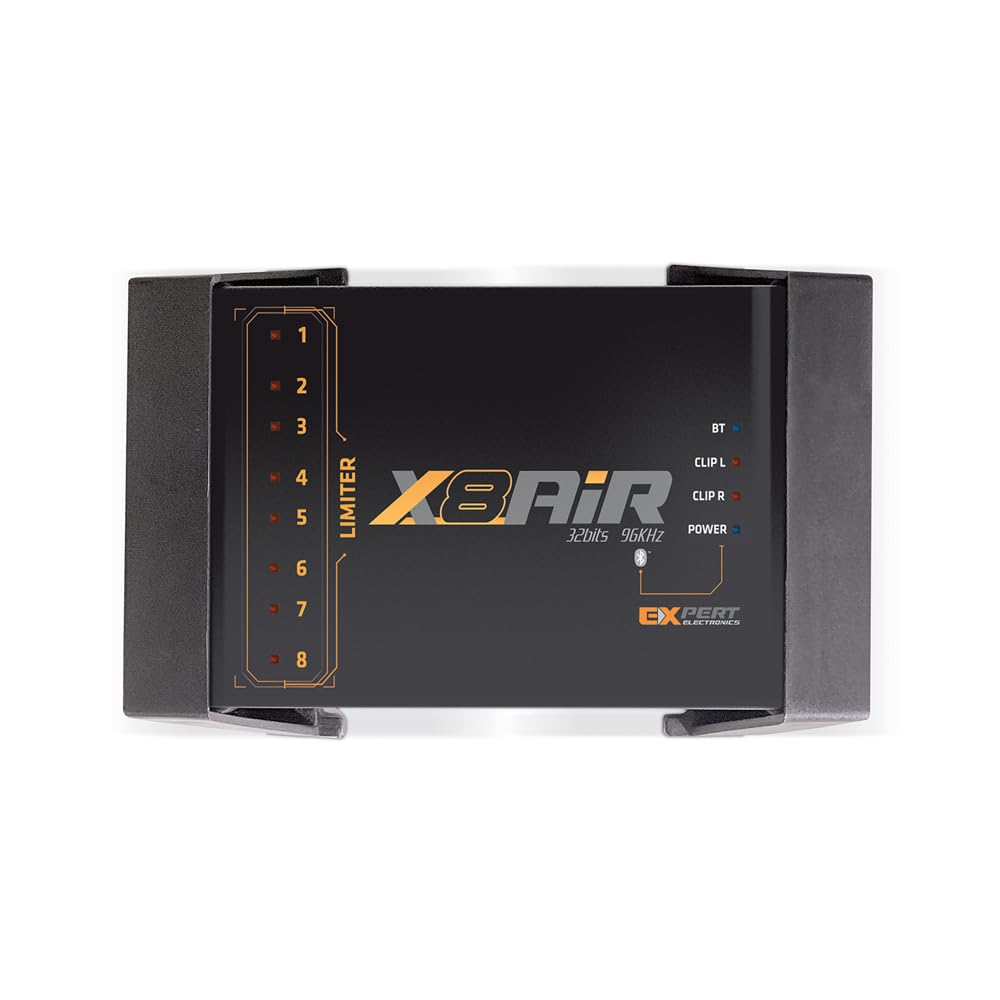
Seventy-nine EQ bands per channel, driven from your phone.
The number that sells this one is 79 — that is the EQ band count per channel, against 10 on the Dayton Audio DSP-408 below. A 32-bit/96kHz processor (the chip’s resolution and sample rate — how finely it reads the signal) does the math, and the app adjusts EQ curves, crossover points, limiter settings and channel gains live over Bluetooth.
Four inputs feed 8 output channels, enough for a multi-amp setup with component speakers and a sub. Time alignment, phase control and a peak limiter are all on board. Performance is what buyers praise most — it does its job and does it consistently.
Two honest notes. Sound quality and input options draw mixed reactions, with some builds picking up added noise and others finding the input set limited. Bluetooth and customizability are likewise split. Tune gently and set your gains correctly and most of that disappears.
Why it earns its spot
- 79 EQ bands per channel
- 32-bit/96kHz processing with 4 in / 8 out
- Real-time app tuning over Bluetooth
What to plan around
- Some installs report added noise and limited inputs
Your match if: you tune per-channel curves and want the band count to do it.
Pass if: you want a simple set-and-done box.
5. B2 Audio Black 4v 10 Channel DSP

Ten outputs at 4 volts each — headroom for a serious multi-amp build.
Six inputs and 10 outputs is more channel flexibility than the Dayton Audio DSP-408 offers with its 4 outputs. Each of those 10 channels sends a 4-volt signal, which keeps noise low when the signal has to travel to amplifiers. Processing runs at 96 kHz, 32-bit.
The form factor is a compact 4.5” x 5.75” x 1.5” block that slips into tight install spaces. iOS and Android both get the control app for real-time changes, and the build quality reads as solid in the hand.
The honest part: the app draws split reactions, with several finding it frustrating to use, and connectivity is likewise mixed — newer Samsung tablets are named as trouble. Bluetooth drops are the thing to watch. Tune with a laptop-ready plan and you lose less time.
Best of this pick: 10 outputs at 4 volts means every amp gets a clean, strong feed.
The real catch: app usability and connection stability are the weak links — allow extra setup time.
Pick it if: channel count is your bottleneck and you want the signal strong.
skip it if: a rock-solid app is the first thing you need.
6. Dayton Audio DSP-408 4 Input 8 Output DSP

A desktop-style GUI that open up deep bass in car or home rigs.
Each of the 8 output channels gets a fully adjustable 10-band parametric EQ, plus time alignment and input/output mixing. That is what lets you shape one seat, not just one speaker. The graphical interface runs on a computer and is described as easy to use, and deep bass response is the thing buyers enjoy most.
It weighs 1.9 pounds, the heaviest unit here — the PRV AUDIO above is about a pound, so this one is truly a stationary install. An optional Bluetooth dongle adds streaming and app control, and a wired remote is available.
Two things to plan around. Noise draws far more complaints than praise — alternator whine, first-start hum and hissing all come up, so grounding and gain staging matter. Reliability is also split, with some units reported to randomly stop. Bluetooth is the weakest input, with drops on connection.
The case for it
- 10-band parametric EQ on all 8 outputs
- Easy-to-use computer GUI with time alignment
The honest trade-off
- Noise complaints are the loudest theme
Right for you if: you enjoy tuning on a computer monitor and value the parametrics.
Wrong for you if: you want plug-and-play with no wiring fuss.
7. Behringer DEQ2496

A rack-mount mastering processor that will auto-tune a whole room.
The draw here is the auto EQ: a 61-band real-time FFT analyzer (a frequency-by-frequency readout of your room) feeds an auto EQ function for room and loudspeaker equalization. That is the closest thing on this list to truly automatic tonal correction. Four EQ modules run at once — a 31-band graphic, a 10-band parametric, a Feedback Destroyer and three Dynamic EQs per stereo channel — and 24-bit/96kHz converters with 113 dB dynamic range handle the audio.
Sound quality is what buyers love most about it, and the 31-band graphic and parametric auto-EQ gets singled out as genuinely useful. The VPQ option lets you drive a graphic EQ with parametric control.
The front-panel interface is dense, and durability is the sore spot — a small handful report short-lived units. Rack it, ventilate it, and treat the power switch kindly.
Why producers like it: the 61-band analyzer plus auto EQ does tonal work in minutes that a manual 31-band sweep takes far longer.
What to accept: you are buying a piece of rack gear with a busy front panel, and the build will not forgive abuse.
Suits: studio and PA users who want auto-EQ room correction on a rack.
Does not suit: a car dash — this wants a rack.
8. dbx DriveRack PA2 Loudspeaker Management System

The wizard-driven box that tunes a PA before the doors open.
The reason live-sound users reach for this one is the Auto EQ algorithm — it is built to be accurate, fast and non-intrusive, so you are not standing in front of a crowd sweeping frequencies. An enhanced AFS algorithm eliminates feedback faster without coloring your tone. Wizard functions walk you through each step, so a venue setup is not a guess.
The processor runs 2 inputs into 6 outputs, rack mountable, with Android and iOS control. Quality is what earns this pick its reputation — it is described as excellent and it works hard in real venues, including alongside JBL EON 515xt speakers.
There is no Bluetooth; connection is USB, so bring a laptop or use the app on a cable. That is a workflow decision, not a defect — just know it before you plan the show.
What makes it worth it
- Fast auto EQ with wizard guidance
- AFS feedback control that preserves tone
- 2 in / 6 out, rack mountable
What you accept
- No Bluetooth — connection is USB only
The one for you if: you run a PA and want auto tuning with minimal fuss.
Better to look on if: you want a wireless tuning workflow.
9. AudioControl DM-810 8×10 Channel Matrix DSP
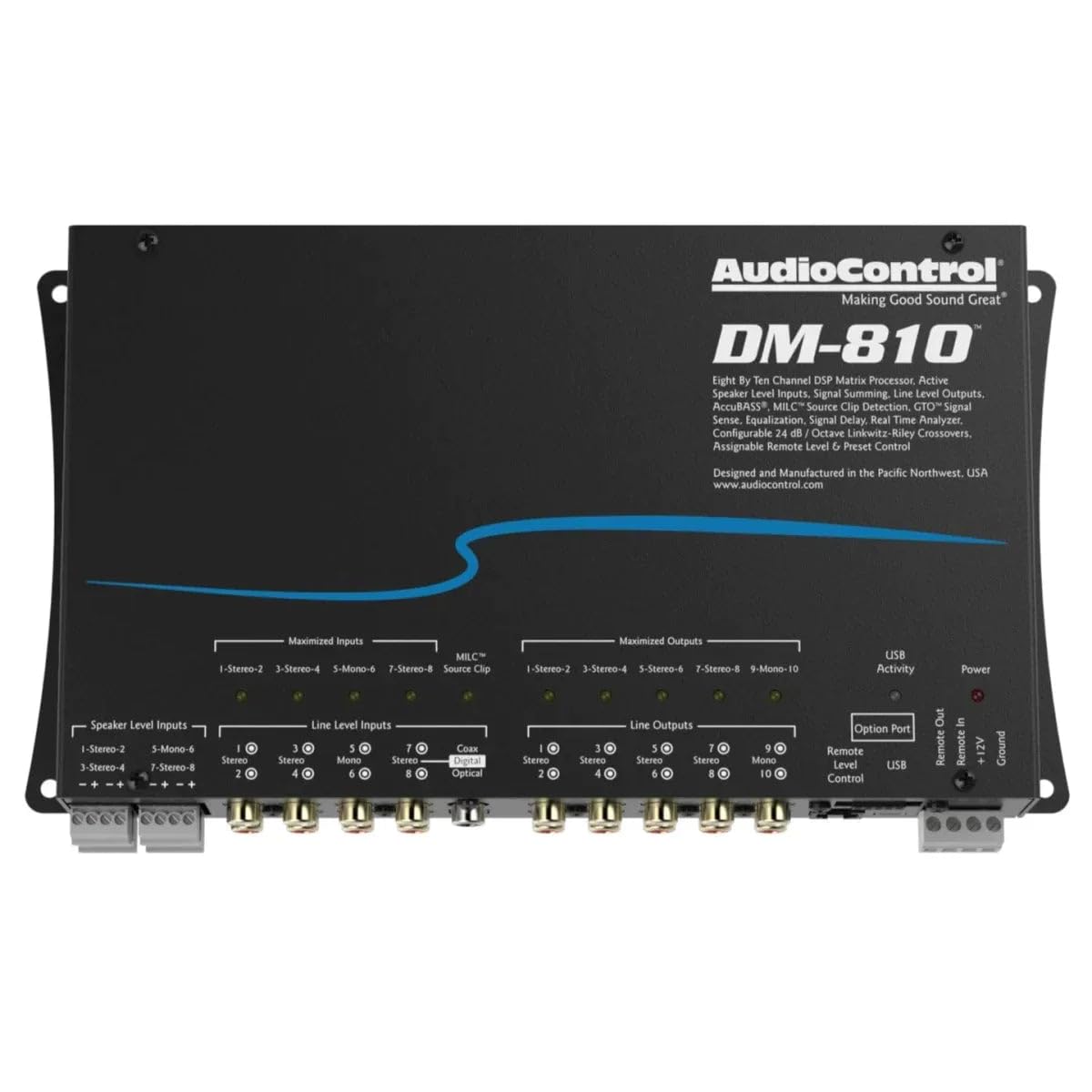
The factory-radio whisperer — four speaker-level inputs and a 30-band auto EQ.
The input set is why this one exists: four sets of speaker-level inputs, four sets of RCA line-level preamp inputs, one S/PDIF input, one TOSLINK input and five sets of RCA preamp outputs. That is the widest connection pool here. A 30-band equalizer with auto EQ does the tuning, and input and output RTAs (real-time analyzers) let you sum factory speaker signals instead of guessing at them.
AccuBASS recovers bass frequencies lost at higher volumes — a real fix for stock radios that roll off bass as you turn up. Internal channel summing hands you a full-range preamp signal from radios with built-in crossovers. GTO signal sense auto-powers your amp, and the MILC clip indicator warns you before distortion damages speakers.
The honest part: the software is the sticking point. Configurability draws negative feedback, and software crashes come up. Tune on a laptop with the DM Smart DSP app, save your config, and you are safe.
Its real edge: 8 inputs and 10 outputs with S/PDIF and TOSLINK — no other pick on this list covers more sources.
The catch to plan for: the software demands patience; back up your tuning file.
Buy it if: you are integrating a factory radio into a full aftermarket system.
Leave it if: you want crash-free tuning software above all else.
Know the Specs
Channel Count
Inputs and outputs decide your system’s ceiling — each output tunes one speaker group, so a 10-output unit goes further than an 8-output one.
EQ Bands & Auto EQ
More bands means finer control; auto EQ uses a measurement and adjusts for you, which saves time on room or cabin correction.
Common Questions
Do I need an automatic audio equalizer in my car?
Will a DSP work with my factory radio?
Can I tune a DSP from my phone?
What is the difference between graphic and parametric EQ?
How many channels do I need?
Does a DSP fix alternator whine?
Is auto EQ better than tuning by ear?
Do these units work for home audio too?
The Bottom Line
For most people, the best automatic audio equalizer here is the PRV Audio DSP 2.8X, because it pairs 8 tuned outputs with a 15-band EQ and 12 presets at a fair price. If you want phone tuning, grab the Stetsom STX 2436. And for live sound, the auto-EQ dbx DriveRack PA2 is the one to reach for.
How we choose
We do not accept paid placement. Every pick is matched to a real buyer and a real use-case; we do not hands-on test units.
Sources
Specifications: manufacturer listings and product documentation. Review insights: verified customer reviews, as of November 2026. Pricing: not shown on this page (it changes often); check the current price via the retailer link.
As an Amazon Associate, My Heart Lives Here earns from qualifying purchases. This does not affect which products we feature.