Heads up: This post contains affiliate links. As an Amazon Associate I earn from qualifying purchases, at no extra cost to you. Learn more
Specs are compiled from manufacturer listings and verified buyer reviews and can change over time — please confirm the key details on the product page before buying.
An auto football thrower is the piece of practice equipment that lets you run real route and catch reps without a quarterback, a coach arm, or a partner who can only throw for ten minutes before his shoulder gives out. The trick to buying one is knowing who is catching the ball: a varsity receiver needs game-speed spirals, while a nine-year-old in the backyard needs a short-range launcher with soft mini footballs. This guide covers three machines built for three very different practice setups, so you can match the thrower to the arm you are training.
This guide is built by comparing the manufacturers’ published specifications and the patterns across verified customer reviews, so you get each pick’s real strengths and trade-offs instead of marketing spin.
You will see what each machine throws, how far, what it weighs, and where it falls short in real yards and backyards. The picks below cover team-grade passing drills down to a kid-sized backyard launcher, which is the full spread of what an auto football thrower can realistically do. (154 characters)
Top Picks
How To Choose The Best Auto Football Thrower
The first question is not which machine throws hardest. It is who is standing under the ball when it comes down. A machine that fires a tight spiral at a receiver running a deep post is useless to a parent tossing floaters to a seven-year-old.
Match the ball to the machine before anything else
Football throwers are built around a specific ball size, and some are strict about it. A launcher designed around mini footballs will not feed a full-size ball no matter how you adjust it. Check the included ball size and any stated compatibility notes first, because a machine that only accepts one brand’s mini footballs ties your whole practice setup to that supply.
Decide where the machine will live
Power source decides this. An AC-powered machine (one that plugs into a standard 110V wall outlet) needs to be within reach of an outlet, which usually means a gym, a field house, or a backyard with a long extension cord. A battery-powered launcher runs on standard AA batteries and goes anywhere, from the beach to the park, but it throws a much lighter ball at a much shorter range. AC suits a field house or gym; AA batteries suit the park or beach.
Read the distance and angle controls together
Launch distance on its own tells you very little. What turns a machine into a real training tool is combining that distance with adjustable launch angles, so you can rehearse a short out route and then a high punt without rebuilding the setup. Machines with several height settings and left-right directional control let you work on reflexes and route timing instead of just catching the same ball on the same line every time.
Weigh portability honestly
A team-grade machine is heavy metal on a tripod, and it stays where you set it up. A youth launcher is light enough for a kid to carry to the park. Be realistic about who is moving the machine and how far it has to travel, because a thrower that never leaves the garage stops being a practice tool and becomes garage furniture.
Side-by-Side Comparison
| Model | Best For | Power Source | Package Weight | Ball / Throw Setup | Amazon |
|---|---|---|---|---|---|
| Sports Attack Aerial Attack★ Best Overall | Team and program practice | 110V AC (not battery) | 68.04 kg | Adjustable speed, arc and direction | Amazon |
| Nerf QB Pro Throw | Backyard and park play | (4) AA batteries, not included | 2.05 kg | 8.5″ NERF mini football included | Amazon |
| Furlihong 389BH | Kids’ catch and reflex drills | AC adaptor included | 6.22 kg | 3 angles, 2 Furlihong mini footballs included | Amazon |
Detailed Reviews
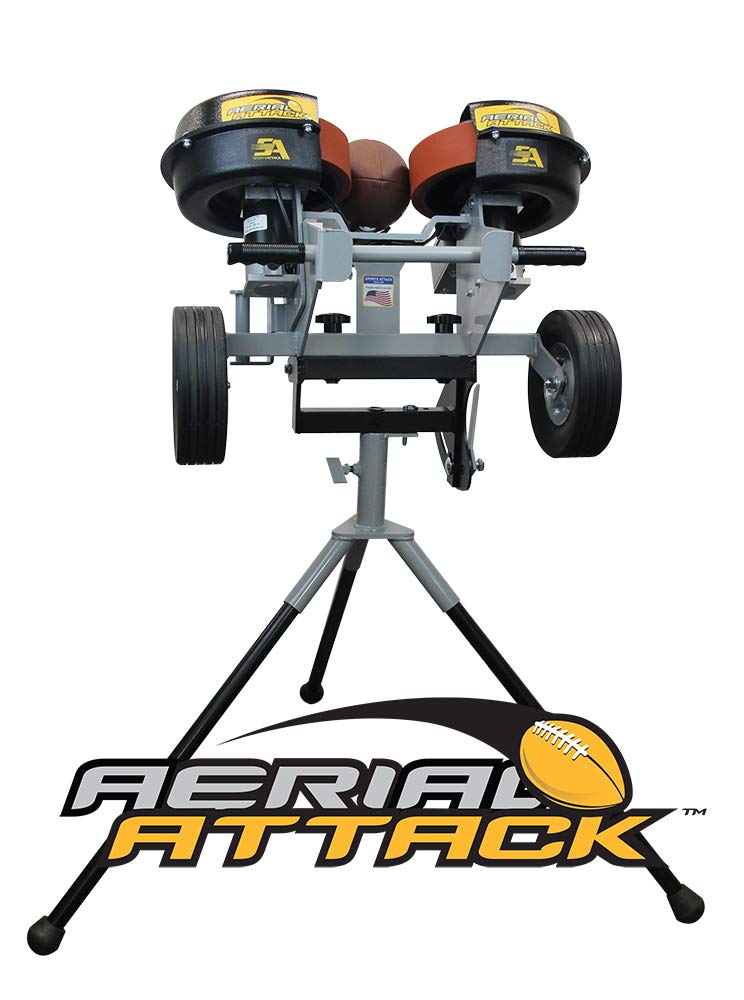
1. Sports Attack Aerial Attack Football Passing Machine
A plug-in passing machine that throws real game-speed spirals so your receivers can run full routes without a quarterback.
This is the pick for a school, a camp, a collegiate program, or any football organization that needs a machine to survive a full season outdoors. It runs on standard 110V AC power and it is not battery powered, so treat it as field equipment you plug in rather than something you carry to the park. What it does is deliver repeatable throws with tight spirals and controlled placement, which is exactly what turns a practice from loose catching into timed route work. Coaches get the same ball on the same line every rep, and players get to build timing and hand-eye coordination against a consistent opponent.
The control set is the reason this earns the top spot. You can change launch speed, arc, and direction, which covers short passes, deep routes and high punts from one machine. That range makes it useful for quarterbacks, receivers, defensive backs, and special teams work — punt return, kickoff return, and reaction drills all live in the same box. The tight spiral is the difference between a drill that trains catching and a drill that trains tracking a wobbly ball, and owners clearly value the quality of the throw itself over anything else.
The catch is weight and power, and both are worth planning around. It ships at 68.04 kg (about 150 pounds), against just 2.05 kg for the Nerf QB Pro below, so this is a permanent or semi-permanent installation rather than a grab-and-go machine. The body is metal and the footprint is genuinely big — this is a tripod machine that wants space. If your practice is in a driveway with no nearby outlet, an AC machine is the wrong tool no matter how well it throws. A 4.0+ star rating across roughly a dozen-plus reviews suggests buyers who commit to a fixed field setup are satisfied with the throw quality.
What the machine delivers
- Adjustable speed, arc, and direction cover short passes, deep balls, and high punts from one unit.
- Repeatable throws with tight spirals keep every rep consistent for route timing work.
- Heavy-duty metal build aimed at schools, camps, and collegiate programs running year-round.
- Handles passing, receiving, punt return, kickoff return, and reaction drills for a whole roster.
What to plan around
- Requires standard 110V AC power — it is not battery powered, so it stays near an outlet.
- 68.04 kg package weight and a 36 x 36 x 56 inch build make it a fixed-installation machine.
- Metal construction and a tripod footprint need real field space, not a small backyard.
Made for: coaches and program directors running scheduled team practices with a reliable power source on site.
Think twice if: you need something a kid can carry to the park — this machine is measured in tens of kilograms, not ounces.
2. Furlihong 389BH Football Machine for Kids

A kid-sized launcher that swings side to side, so young players practice moving to the ball instead of waiting for it.
Where the Aerial Attack above throws downfield to a receiver, this machine throws across the yard to build reflexes. Its oscillating base swings the launch point left and right, which creates changing ball trajectories — the kind of movement that forces a young player to adjust rather than stand still with hands ready. Three height settings (high, medium, low) let you change the ball’s arrival angle, and the automatic and manual launch modes mean you can feed balls steadily or take each rep one at a time. Ball launch distance runs about 39 to 45 ft, which fits a backyard catch-and-pass session rather than a full route tree.
The build decisions are smart for the price tier. A triangular iron base gives it stability under the swing, which matters when the machine is rocking side to side while a kid dives for the ball. At 6.22 kg packaged, it is light enough to be realistically moved and stored, and the set arrives complete: a carry bag, an AC adaptor, two training footballs, the oscillating base, and the triangular iron base. A 12-month warranty backs it. Nothing here is professional-grade, and it does not pretend to be.
Here is the catch, and it is a firm one: this machine is only compatible with Furlihong mini footballs. You cannot drop in a standard youth ball or a full-size ball, so reordering those specific mini footballs becomes part of owning it. The 2.5+ star rating also tells you this is a machine buyers approach with lower expectations than the team-grade pick — the kind of product where you check the return window before a birthday party. For a young player doing solo reps or a pair of kids playing catch in the backyard, the automatic and manual modes plus the oscillating base still give you a genuinely fun drill partner.
Why it fits the yard: the left-right oscillating base is the standout here — it turns a static throwing machine into a reflex drill, and the 39 to 45 ft launch distance keeps every ball inside a normal backyard.
The compatibility catch: only Furlihong mini footballs feed this launcher, so factor in a steady supply of those specific balls alongside the machine itself.
Worth it for: parents of young players who want moving-ball reps at home and do not mind sticking to one brand of mini football.
Hold off if: you need to throw a standard-size football — this launcher will not accept one.
3. Nerf QB Pro Throw Football Passer – 8.5″ Youth Launcher
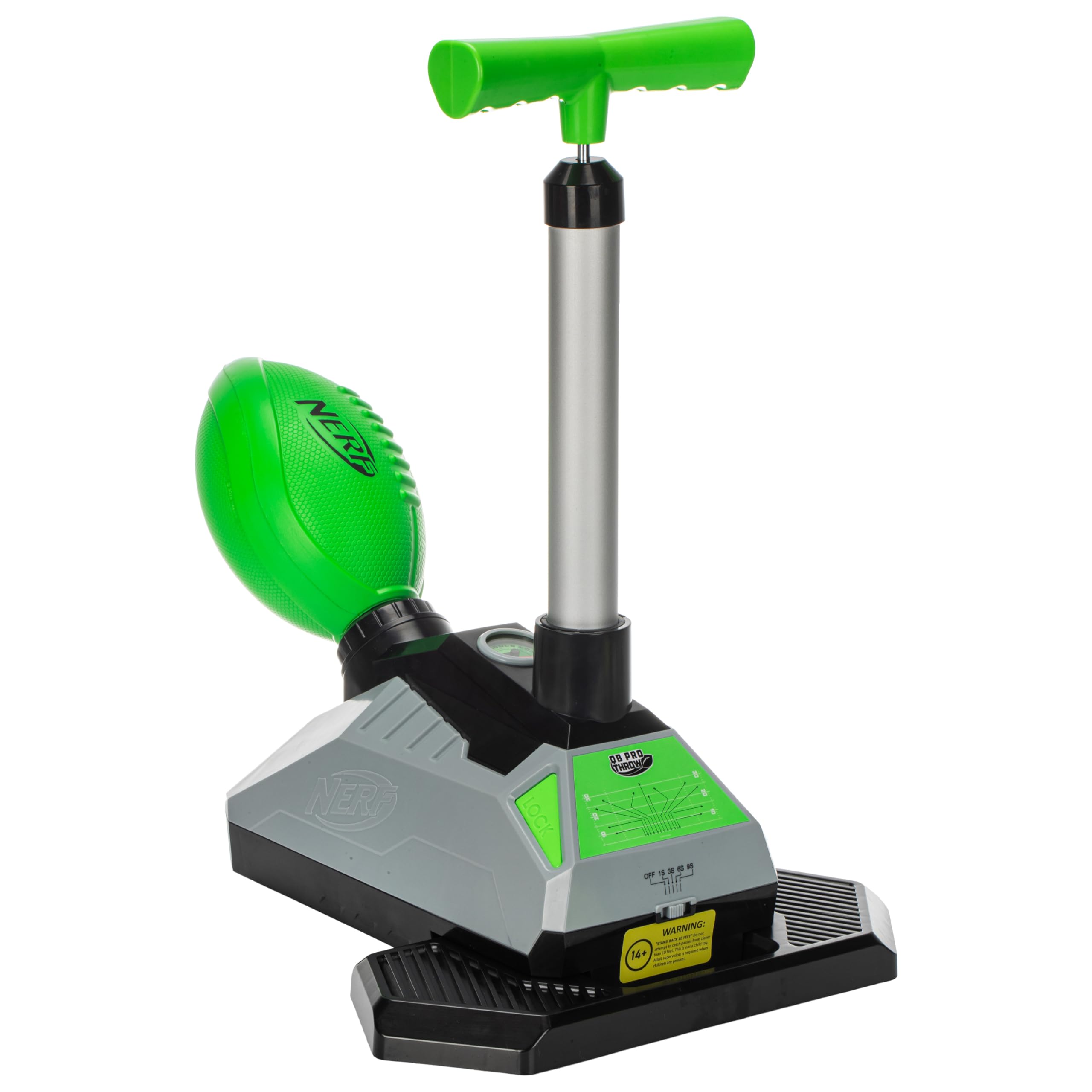
A battery-powered backyard quarterback that pumps up, delays, and launches — then folds into the trunk for the beach.
The play sequence here is what sells it: set the machine down, lock the football, pick a delayed release time, pump it up to your chosen distance, then press launch. That delay is the detail that lets a kid actually get set before the ball arrives instead of watching it fly past. It throws passes of over 30 yards, which is long enough for a real go-long rep in a park or a big backyard, and the included 8.5″ NERF mini football means the game starts straight from the start. Add friends and the solo practice becomes a two-player catch game.
Portability is the real story. At 2.05 kg packaged, this launcher is light enough to carry one-handed, and it runs on four AA batteries rather than a wall outlet — so the beach, the park, and a friend’s yard are all fair game. Compare that with the Aerial Attack’s 68.04 kg package weight and its 110V AC requirement and the split is obvious: one machine lives on a field, this one lives in your car. Its package dimensions of 15.43 x 11.38 x 6.97 inches keep it manageable in a hall closet or a back seat.
The honest trade-off is durability. Reviewers praise the build quality, but several reports describe a unit giving out after a day of use. Treat this as a fun toy that delivers a great afternoon rather than a piece of training equipment you hand down. It also needs batteries you supply yourself, so an extra set in the bag is the difference between a working launcher and a dead one at the park. At a 3.5+ star rating, it is the right buy for casual play and the wrong buy if you expect years of hard use.
Where it wins: the pumped-up distance control and delayed release turn backyard catch into an actual drill, and over 30 yards of throw is real range for a foam-ball launcher.
What to accept: durability is the weak spot — plan on batteries and gentle handling rather than season-long reliability.
Reach for this if: you want a take-anywhere launcher for casual backyard and beach games with kids.
Look elsewhere if: you need a machine that survives a full season of daily team practice.
Know the Specs
Power source and where you can use it
An AC machine plugs into a standard 110V outlet, which gives it the power to throw a real football at game speed but tethers it to a building or an extension cord. A battery launcher runs on standard AA cells and goes anywhere, at the cost of throwing a much lighter foam ball. Decide on your practice location before you decide on anything else, because the power source is the one spec you cannot work around.
Launch angle, direction, and distance
Distance alone is a weak number. A machine that throws far but always on the same flat line trains one skill. Height settings let the ball arrive high or low, and left-right oscillation or directional control makes the player move to the ball. Together they turn a thrower into a drill partner for punts, out routes, and reaction work. Check that the machine offers angle adjustment, not just a distance dial.
Ball size and brand compatibility
Throwers are built around a specific ball. Some take an included 8.5″ mini football, and at least one model is only compatible with its own brand’s mini footballs. Before buying, confirm the ball size the machine accepts and whether you are locked into a single supplier. A machine that cannot feed the ball you already own forces you to buy its specific balls.
Weight and footprint
A team-grade machine is metal on a tripod and weighs in the tens of kilograms — it stays where you set it. A youth launcher is a couple of kilograms and travels in a car. The weight tells you who can realistically move the machine and how often practice will happen.
Common Questions
Can an auto football thrower replace a quarterback for receiver practice?
Do I need an outlet to run a football passing machine?
What size football does a youth launcher accept?
How far can a backyard football thrower launch a ball?
Is the Furlihong 389BH worth it if my kid already owns a standard football?
How much space do I need for a team-grade passing machine?
Can a football launcher help with punt return and kickoff return drills?
What batteries does the Nerf QB Pro Throw need?
Is the Furlihong 389BH easy to store between practices?
Which one should I buy for a high school program?
The Bottom Line
For a program that needs real game-speed spirals and a machine that survives the season, the Sports Attack Aerial Attack is the one — adjustable speed, arc, and direction cover passing, punting, and return drills from a single metal unit that plugs into the wall. If you want moving-ball reflex reps at home for a young player and can stick to Furlihong mini footballs, grab the Furlihong 389BH. And for a take-anywhere launcher that throws over 30 yards on four AA batteries, the Nerf QB Pro Throw is the backyard answer — just keep a spare battery pack in the bag.
How we choose
We do not accept paid placement. Every pick is matched to a real buyer and a real use-case; we do not hands-on test units.
Sources
Specifications: manufacturer listings and product documentation. Review insights: verified customer reviews, as of November 2026. Pricing: not shown on this page (it changes often); check the current price via the retailer link.
As an Amazon Associate, My Heart Lives Here earns from qualifying purchases. This does not affect which products we feature.