Heads up: This post contains affiliate links. As an Amazon Associate I earn from qualifying purchases, at no extra cost to you. Learn more
Specs are compiled from manufacturer listings and verified buyer reviews and can change over time — please confirm the key details on the product page before buying.
Most cassette decks still on sale today are built for dubbing, not for keeping your tape library alive, and that mismatch is what makes shopping hard. This shortlist separates the decks that play and record cleanly from the ones that only look the part.
This guide is built by comparing the manufacturers’ published specifications and the patterns across verified customer reviews, so you get each pick’s real strengths and trade-offs instead of marketing spin.
Below you get a quick comparison, plain-English reviews, and the specs that actually decide whether a deck earns its shelf space in your home. Here is the shortlist worth your attention if you want the best audio cassette deck.
Top Picks

How To Choose A Cassette Deck
Focus on three things and the rest sorts itself out.
Tape type support
Check which tape types the deck plays and records, because a deck that handles Type I, Type II, and Type IV lets you use your whole collection without compromise.
Dubbing and deck independence
A dual deck is only useful for copying if both transports run on separate drives, so you can load the next tape while the first keeps playing.
Noise reduction and USB output
Noise reduction tames the hiss baked into old tapes, and a USB output lets you digitize them at 48kHz/16-bit instead of losing them to a failing cassette.
Side-by-Side Comparison
| Model | Best For | Decks | Weight | USB Out | Amazon |
|---|---|---|---|---|---|
| Tascam 202MKVII★ Best Overall | All-round playback and recording | Dual | 14.5 lb | Yes | Amazon |
| TEAC W-1200 (Silver)Top Performer | Serious archiving and editing | Dual | 12.47 lb | Yes | Amazon |
| TEAC W-1200 (Japan Model) | Tape collectors who want repeat play | Dual | 4.1 kg | Yes | Amazon |
| PyleUsa Dual Cassette Deck | Everyday listening with rack hardware | Dual | 10.43 lb | No | Amazon |
| Pyle Home Dual Cassette Deck | Budget dubbing with RCA cables included | Dual | 9.28 lb | No | Amazon |
| Pyle PT659DU | Converting tapes to MP3 on a computer | Dual | 11 lb | Yes | Amazon |
Detailed Reviews
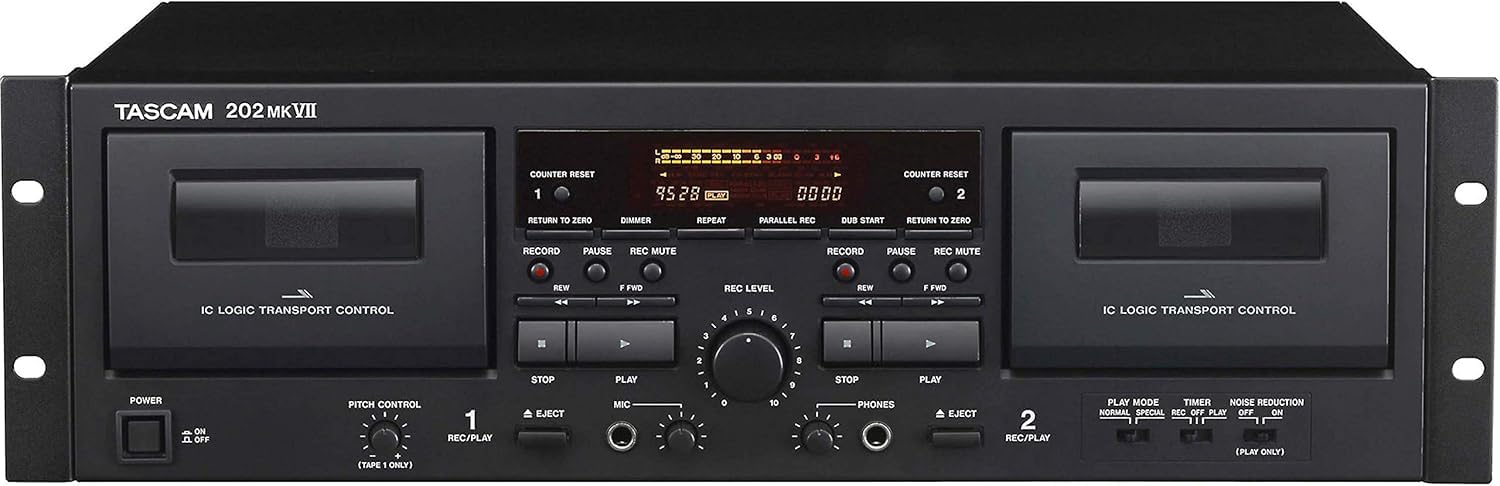
1. Tascam 202MKVII Double Cassette Deck Recorder with USB Port
Our pick — 4.5+★ from 150+ verified ratings; the strongest balance of quality and price.
The dual-transport workhorse that treats your whole tape shelf as fair game.
For anyone with a stack of old tapes and no plan to lose them, this is the deck that does the boring job reliably. It runs two cassettes at once, and the USB connection turns a laptop into your archive — tape goes in, files come out.
What wins people over is the overall build and output quality: it lands 4.5+ stars across 180+ ratings, and the clean, quiet playback is the thing that keeps coming up. The catch is the cost — shoppers consistently wish it landed lower, so go in knowing you are paying for the Tascam name and the dual transport, not for a budget dubbing toy.
What carries it
- Two cassettes running at once means no stopping to swap tapes
- USB output lets you turn tapes into digital files
Where it stings
- The price is the loudest complaint — it is not a cheap dubbing deck
Reach for this if: you want one deck that plays, records, and archives without fuss.
Look elsewhere if: the outlay is your hard ceiling and you only need playback.
2. TEAC W-1200 Dual Cassette Deck
Built for the tape you have to fix, not just the ones that still play straight.
The W-1200 wins on flexibility. Its pitch control nudges speed by ±12% so old tapes recorded off-key come back to the right key, and the dual drive lets you cue the next cassette while the first keeps rolling. It plays Type I, Type II, and Type IV tapes and records on Normal and Chrome.
The USB output archives at 48kHz/16-bit CD quality, and the REC MUTE button drops a 4-second gap between tracks in one press. It is 12.47 pounds, which is lighter than the Tascam. The honest wrinkle is the price — it sits at the premium end, and some owners feel the outlay is steep for what a cassette deck does today.
Why it earns the spot: pitch control plus parallel recording makes this the one to choose if you dub, repair, or transcribe tapes as a hobby rather than a chore.
Fair warning: the tape transport mechanism is the weak point some owners note — handle the doors gently.
Best for: anyone with tapes to copy, correct, or transcribe.
Skip if: you only need quiet playback and the premium layout is overkill.
3. TEAC Double Cassette Deck W-1200 (Silver, Japan Domestic)
The Japan-market W-1200, with repeat playback and a remote in the box.
Same dual-drive core as the W-1200 above, but this Japan-domestic version adds a repeat playback function that stops after 20 plays, plus a dedicated remote. It auto-detects Normal, Chrome, and Metal tapes for playback, records on the first two, and includes noise reduction equivalent to Dolby B NR.
The pitch control is ±12%, kept to TAPE 1 only. It also records to a computer over USB, and a WAV capture runs up to 8 hours of digital recording time. It is a 4.1 kg unit, so it is a bench deck, not a shelf ornament. The hitch: the USB route on this model expects you to supply your own software, and the higher outlay puts it in the collector bracket.
Go this way if: you listen to whole albums repeatedly and want the remote in hand.
Hold back if: you want plug-and-play USB archiving without sourcing software yourself.
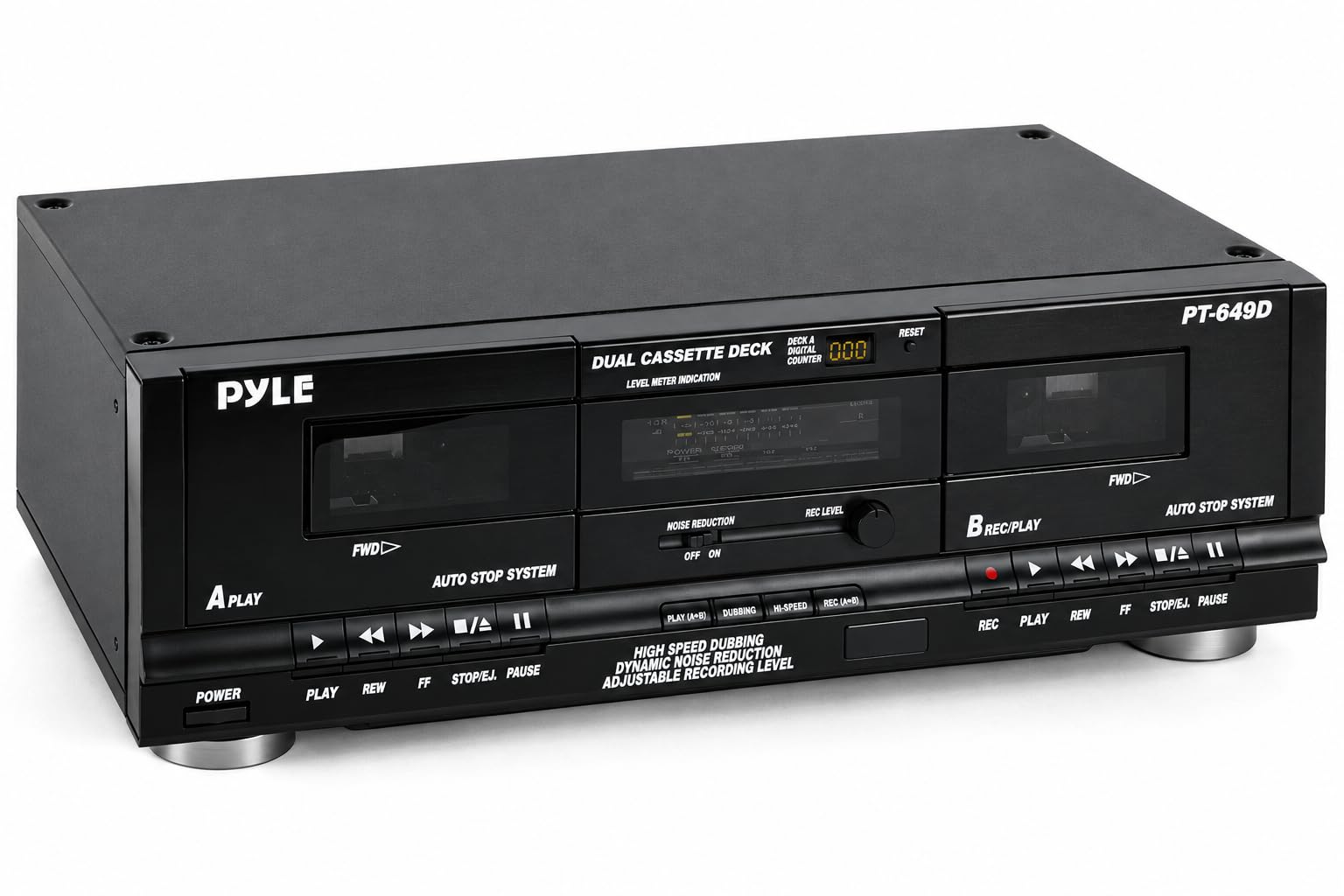
4. PyleUsa Dual Cassette Deck with RCA Cables
A rack-ready daily player that does the basics without asking much.
This one is built around everyday listening, and it shows in the numbers: the playback and sound quality get 100% positive mention where owners bother to weigh in, and the value gets a 92% positive read. You get normal and high-speed dubbing, a 3-digit tape counter, a CrO2 selector, and dynamic noise reduction. The dual-colour fluorescent display stays readable in a dim room.
It measures 18.5 x 8.6 x 5.1 inches and weighs 10.43 pounds, so it is a shade wider than the Pyle Home deck below at 16.5 inches. The removable rack hardware is a genuine plus if you are building a stack. The recurring gripe is auto-play and door closure — the door does not always seat cleanly after you load a cassette.
A good fit for: a home stereo stack where the deck just needs to play cleanly day to day.
Think twice if: you expect tight auto-play behaviour and a door that always latches first time.
5. Pyle Home Dual Cassette Deck with RCA Cables

The lightest deck here, aimed at simple copying and not much else.
If dubbing a handful of tapes is the whole job, this Pyle covers it. You get normal and high-speed dubbing, a 3-digit counter, a CrO2 selector, and RCA inputs and outputs for hooking into an amplifier. It weighs 9.28 pounds, which is lighter than the PyleUsa above and substantially lighter than the 14.5-pound Tascam.
The sound gets a fair shake, with owners surprised at how good tapes sound when the heads behave, but the record and play heads are where the letdowns cluster. Door closure is the other weak spot. Treat it as a cheap second deck for the garage system, not the deck you trust with a prized cassette.
The real draw: the price-to-job ratio — it dubs and plays for a modest outlay, cables in the box.
The real catch: head quality varies unit to unit, so test your first copy before committing a whole shelf.
Worth it for: a cheap second deck and casual tape-to-tape copying.
Not for: anyone whose tapes matter enough to need consistent head quality.
6. Pyle PT659DU Dual Stereo Cassette Deck with MP3 Converter

A converter deck that turns tapes into MP3 files over a plain USB cable.
The PT659DU is the archiving option here. A USB cable runs from the deck to a computer and pulls music off your tapes into MP3, on PC or Mac. It handles Normal and CrO2 tapes, dubs at normal or high speed, and includes a recorder level control plus gain control for the signal heading to your computer.
Both decks play, but only deck B records and dubs — that is the one quirk to plan around when you set it up. It weighs 11 pounds and runs on 110V. The honest note is durability: it is the most fragile-feeling of the group, and units that fail tend to fail early, so keep your original tapes safe until the digital copies are confirmed.
Where it delivers
- Straight USB conversion to MP3 on PC or Mac
- Simple to set up and operate
What to watch
- Durability is the weak link — confirm your files before retiring a tape
Pick it for: a one-time push to get a tape collection onto your computer.
Pass on it if: you need a deck that will keep running for years of daily play.
Know the Specs
Tape Types
Type I (Normal), Type II (Chrome/CrO2), and Type IV (Metal) refer to the actual tape formulation inside the shell. A deck that plays all three covers your whole collection; one that records only on Normal and Chrome still lets you archive Type IV tapes without recording over them.
Noise Reduction
This is circuitry that reduces the hiss baked into tape playback. A deck with Dolby B NR equivalent can play older tapes recorded with that system and get them close to their original sound.
Common Questions
Can a cassette deck play Metal tapes even if it cannot record them?
What does pitch control actually fix on an old tape?
Do I need a computer to transfer tapes to MP3?
Can both decks record at the same time?
What is the CrO2 selector for?
Does a dual cassette deck need an external amplifier?
Can I cue up the next tape while one is playing?
Does the tape counter help when dubbing?
The Bottom Line
For most people, the Tascam 202MKVII is the safe win — dual transport, USB recording, and a build that holds up. If you dub, transcribe, or fix off-key tapes, the TEAC W-1200 earns its premium with pitch control and parallel recording. And for a first digital archive, the Pyle PT659DU gets your tapes onto a computer.
How we choose
We do not accept paid placement. Every pick is matched to a real buyer and a real use-case; we do not hands-on test units.
Sources
Specifications: manufacturer listings and product documentation. Review insights: verified customer reviews, as of November 2026. Pricing: not shown on this page (it changes often); check the current price via the retailer link.
As an Amazon Associate, My Heart Lives Here earns from qualifying purchases. This does not affect which products we feature.