Heads up: This post contains affiliate links. As an Amazon Associate I earn from qualifying purchases, at no extra cost to you. Learn more
Specs are compiled from manufacturer listings and verified buyer reviews and can change over time — please confirm the key details on the product page before buying.
If your attic climbs past 120°F, that heat bakes your shingles from below and then seeps into the rooms you actually live in. The fix is pushing hot, damp air out fast enough, and that depends on one number: CFM (cubic feet per minute — how much air a fan moves in a minute). This guide covers nine real fans that mount in a gable vent, on the roof, or through a wall, and it sorts out which one fits your attic, your house size, and your power situation.
This guide is built by comparing the manufacturers’ published specifications and the patterns across verified customer reviews, so you get each pick’s real strengths and trade-offs instead of marketing spin.
Before you pick a fan, measure your attic in square feet and check whether you have a power outlet up there. Once you know those two things, choosing the right Attic Ventilation System gets much simpler.
Top Picks

How To Choose The Best Attic Ventilation System
A powered attic vent is not a bigger version of the little fan in your bathroom. It has to move enough cubic feet of air per minute to sweep an entire attic clean, which is why the CFM rating is the first number you check. Everything else — how it mounts, how it turns on, and where its power comes from — narrows the list from there.
Match CFM to your attic’s square footage
CFM tells you how much air the fan pushes out in one minute. Buy too little and the fan spins while the attic stays hot. Buy far more than you need and you are paying for capacity you never use. As a starting point, check the maker’s own coverage figure — one gable fan in this list is rated to cool up to 1850 sq. ft., another up to 2,800 sq. ft., and a third claims 9000 SQF of coverage area.
Pick the mount that fits your roof
A gable-mount fan sits behind the triangular vent at the end of your roof, so it needs no roof cutting and you can reach it for service. A roof-mount fan sits on the shingles themselves and needs flashing work, so it is the right call when you have no gable vent. A wall-mount shutter fan goes through an exterior wall and is the go-to for garages, shops, and sheds as much as attics.
Decide how it should turn on
A thermostat turns the fan on once the attic hits a temperature you set. A humidistat adds humidity control, which matters in damp climates where moisture rots roof decking. Some units run on a fixed speed, while others let you dial airflow up and down — one fan here offers up to 10-level speeds, and another uses stepless variable-speed control with no fixed steps at all. Solar units skip wiring entirely, but only spin as hard as the sun allows.
Side-by-Side Comparison
| Model | Best For | Airflow | Mount Type | Control | Amazon |
|---|---|---|---|---|---|
| Quietcool AFG SMT PRO-2.0★ Best Overall | Whole-house gable ventilation | 1945 cfm | Gable | App Control | Amazon |
| HG Power 12 Inch Attic FanBest Value | Small attics, garages, greenhouses | 971 cfm | Wall / Window / Ceiling | Remote | Amazon |
| VEVOR 20” Exhaust FanTop Performer | Shops and sheds needing high airflow | 3000 cfm | Wall Mount | Push Button | Amazon |
| KEN BROWN 20 Inch Shutter Exhaust Fan | Garages, shops, greenhouses | 3500 cfm | Wall Mounted | Remote | Amazon |
| 25W Solar Roof Vent Fan | Older homes with no attic airflow | Up to 240 CFM in full sun | Roof | Solar (no control) | Amazon |
| VEVOR Gable Mount Fan 14 Inch | Gable vents on mid-size homes | 1300 cfm | Gable / Wall | Touch | Amazon |
| Master Flow GAF ERV6BL | Large attic roofs up to 2,800 sq. ft. | 1500 cfm | Roof Mount | Hard Wired | Amazon |
| 4SEASONS Solar Attic Vent Fan | Small attics with no nearby power | Up to 400 CFM | Roof (sloped) | Solar (passive airflow after dark) | Amazon |
| iLiving 36″ Wall Mounted Shutter Fan | Barns, big shops, large metal buildings | 6128 cfm | Wall Mounted (hardwired) | Button Control | Amazon |
Detailed Reviews
1. Quietcool AFG SMT PRO-2.0 Smart Attic Fan for Gable Vents
Our pick — 4.5+★ from 750+ verified ratings; the strongest balance of quality and price.
The gable-vent fan that turns itself down before you ever notice the heat
If your attic has a gable vent at each end of the roof and you want the fan to handle itself, this is the one to look at first. It pushes 1945 cfm (cubic feet per minute — how much air leaves the attic each minute) on high speed, and it does that while drawing 120 Watts, which is roughly the same as an old incandescent bulb. For a mid-size attic that is real, measurable air movement rather than a token breeze.
what separates it is the control side. A thermostat (a switch that reacts to temperature) and a humidistat (a switch that reacts to moisture) are built in, so the fan starts on heat or dampness and shuts itself off again — one owner described the smart setting auto-shutting at a set temperature with the app showing live attic temperature. There is also a Fire Safety Sense shut-off, which cuts the motor if it senses a problem. Setup is genuinely plug-and-play with a 20ft cord and no wiring, which is why installation is one of the things people bring up most.
The honest catch: the app and Bluetooth pairing is the one part buyers are split on. Some love the wireless setup and remote control; others find it fussy and would rather have a plain manual thermostat. If you like set-and-forget hardware and have no interest in a phone app, that is worth knowing before you buy. Compared with the smaller HG Power unit further down, this one moves 1945 cfm against 971 cfm, so it suits a noticeably larger attic. It carries a 4.5+ star rating.
Where it earns its keep
- 1945 cfm on high while drawing just 120 Watts, which keeps running costs modest
- Plug-and-play with a 20ft power cord — no electrician needed for the fan itself
- Built-in thermostat and humidistat mean it cycles on its own
- Fire Safety Sense shut-off adds a safety layer most gable fans skip
Where it asks for patience
- The app-based control is the dividing line — some owners prefer a manual thermostat
- Two speeds only, so there is no gradual dial between low and high
- You need a working outlet in or near the attic for the cord to reach
Best for: homeowners with gable vents who want the fan to run itself and check in from a phone.
Think twice if: you want a simple manual dial and no app pairing at all.
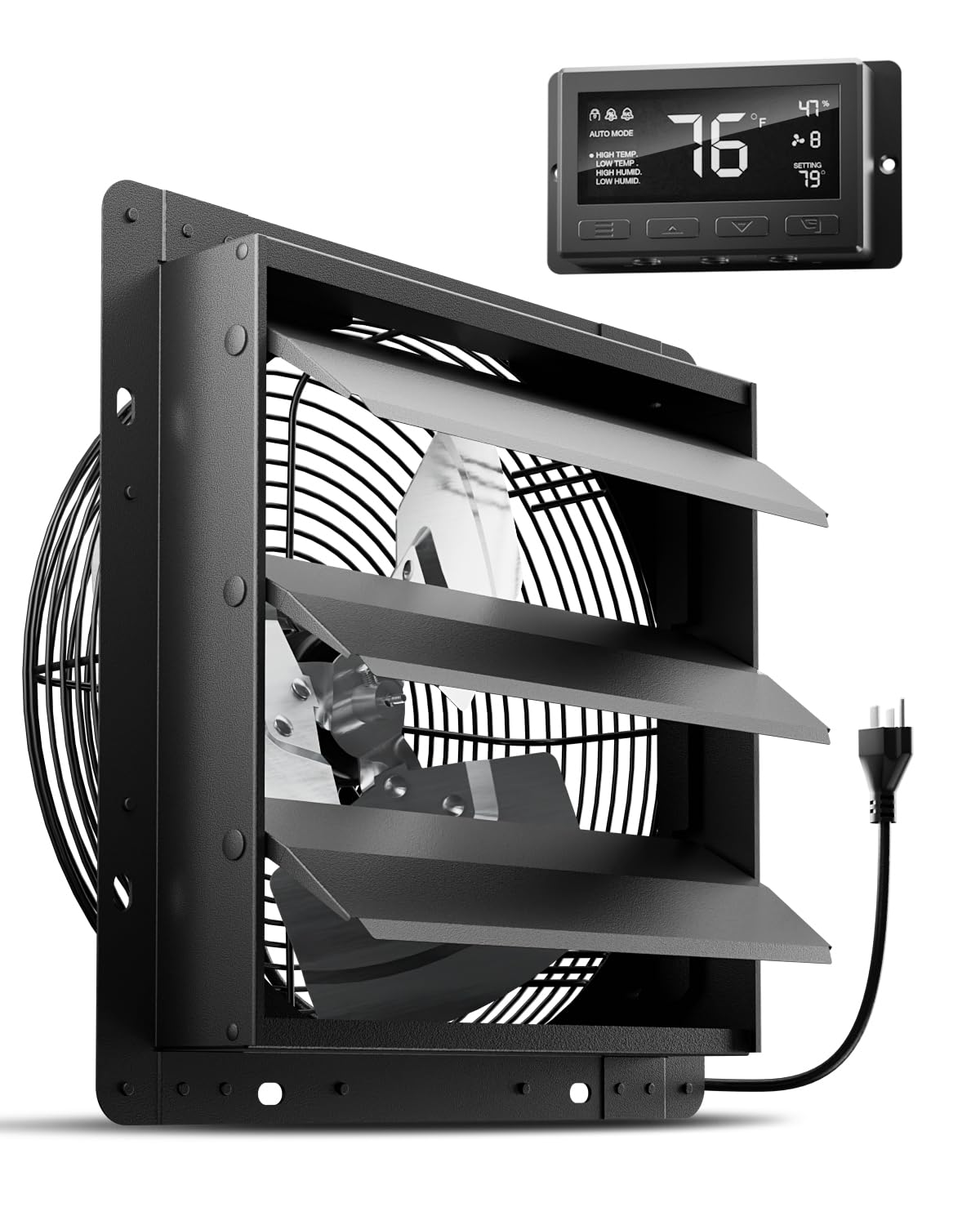
2. HG Power 12 Inch Attic Fan with Thermostat
A 971 cfm workhorse that quietly handles the small spaces a big fan can’t fit
The smartest thing about this fan is the motor. It uses an EC motor (electronically commutated — a design that runs cooler and quieter than a traditional AC motor), and owners say the airflow is more efficient because of it. The rating backs that up: the HG Power moves 971 cfm. That is a fraction of the 3000 cfm VEVOR further down, but for a small attic, a garage, or a greenhouse, 971 cfm is the right scale rather than overkill.
Control is the value story here. You set up to 10-level speeds and a 9-hour timer on the included controller, and it adjusts based on temperature and humidity on its own. Owners consistently report that it does what that controller promises — one buyer measured a roughly 15-degree attic drop on hot summer days with the fan barely audible. That combination of adjustable speed and genuinely low noise is a good fit for a shed or workshop where you are working right beneath it.
Two real caveats. First, the control panel is the mixed part of the picture — setting it up takes a little figuring out, and it is not instantly intuitive. Second, this fan arrived to at least one owner with broken louver fasteners that had to be repaired before install, so inspect the box on arrival. With a 4.0+ star rating and straightforward included hardware, it is an easy recommendation for anyone with a smaller or outbuilding space. Compared with the VEVOR Gable Mount fan, it is a smaller, lighter-duty option built for confined spaces.
The value case: an EC motor that runs quiet and efficient, 10 adjustable speeds, and a timer, all on a fan sized for a garage, shed, or greenhouse rather than a full attic.
Worth grabbing if: you are cooling a smaller space and want adjustable, automatic control without paying gable-fan money.
Give it a pass if: you expect a slick app interface and instant out-of-the-box setup.
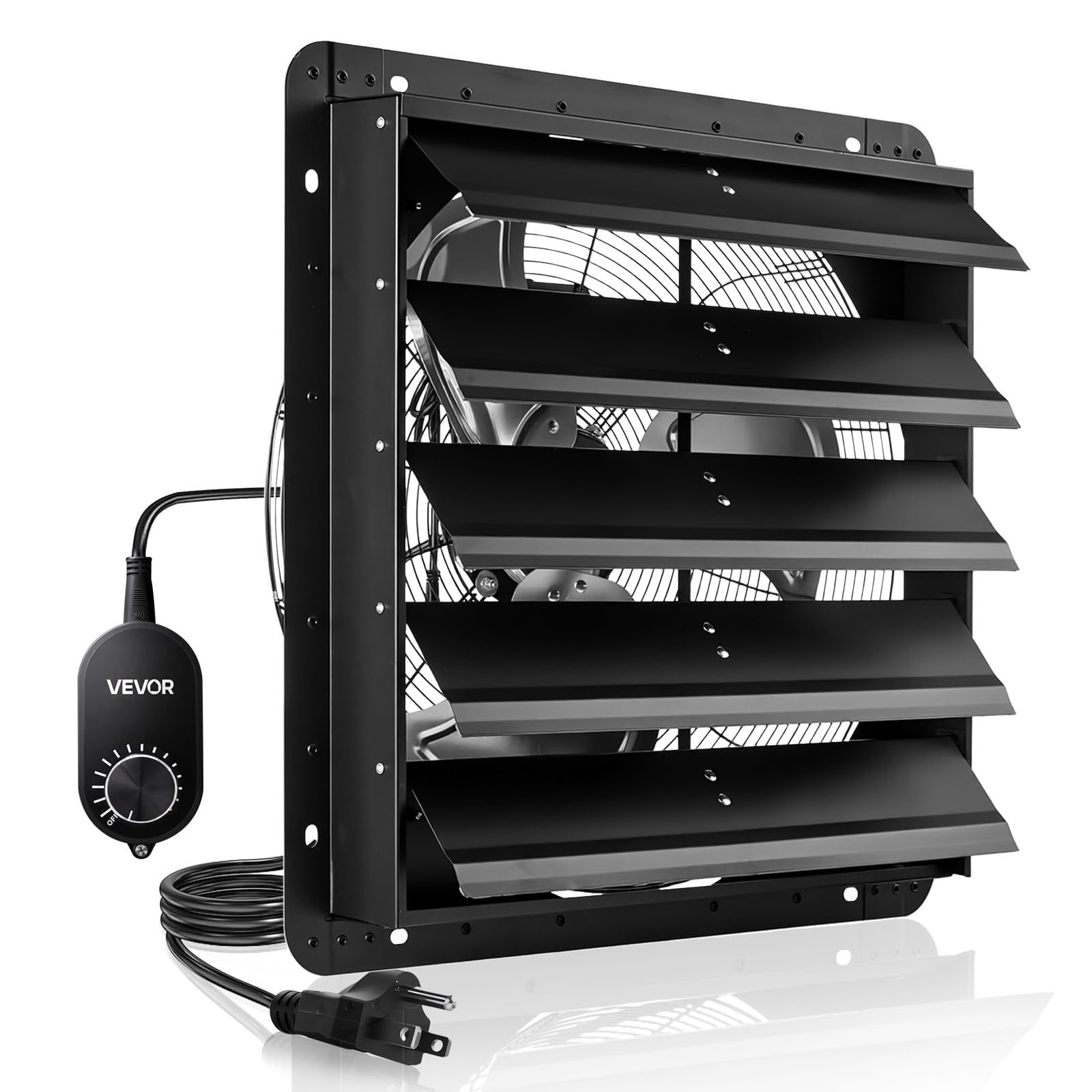
3. VEVOR 20” Exhaust Fan
Big steel, 3000 cfm, and a speed dial you can feather between a whisper and a blast
For a workshop, a chicken coop, or a garage that soaks up heat all afternoon, this is the pick where power sits front and center. It moves 3000 cfm and drives that with a 1500 r/min AC motor rated at 127W, pushing airflow up to 10 m/s. Put that next to the HG Power’s 971 cfm and the gap is obvious — this is the fan you choose when the space is large and the heat load is heavy.
The control is the standout feature. Rather than fixed steps, it uses stepless variable-speed control, so you can dial it from a gentle breeze to a full blast and land anywhere in between. It also includes an automatic shutter that opens when the fan is on and closes when it powers off, which helps keep rain and small debris out of the opening. The steel housing resists deformation in damp conditions far better than a plastic body would.
Two things buyers flag honestly. The speed control is the most-discussed and mixed aspect — several owners note the slowest setting is not much slower than full speed, and one pointed out the dial turned fully sets the fan to low, not high. Durability also draws mixed opinions, ranging from heavy-duty to units that failed early. With a 4.0+ star rating and a broad base of owners, most of that is normal wear-in rather than a reason to walk away. It is indoor-use only, so it belongs inside a structure.
The airflow gap: at 3000 cfm this fan outruns the HG Power 12 Inch by a wide margin — 3000 cfm against 971 cfm — making it the better match for large coops, shops, and sheds where a small fan would be swallowed up.
Reach for this if: your space is big and hot, and you want to set the fan speed by feel rather than fixed steps.
Look elsewhere if: you need a reliable low-end crawl for very gentle ventilation on a regular basis.
4. KEN BROWN 20 Inch Shutter Exhaust Fan

Plug it in, mount it, done — the 3500 cfm fan that asks nothing of your toolbox
Most people dread the electrical part of installing an exhaust fan. This one skips it entirely: a 1.65m (5.4ft) pre-installed power cord means no wiring and no assembly, so you mount it, plug it in, and you are ventilating within minutes. It still pushes 3500 cfm off a 120-volt, 60Hz supply turning 1309 rotations per minute, which is enough to pull heat, dust, and fumes out of a serious shop or garage.
The build is aimed at durability. The shutters and blades are high-grade aluminum, which shrugs off moisture and heat where steel or plastic would start to rust or warp, and the gravity shutters open and close with the fan on its own. Functionality earns the most praise from owners, with installation close behind — one long-time reviewer said it keeps the shop virtually dust-free.
Be honest about the noise before you buy: it is the mixed point here. Some owners call it very quiet, others find it a bit loud — that is normal for a fan moving this much air, and it is a shop-and-garage fan, not a bedroom fan. It weighs 19.7 pounds, so mount it into solid framing rather than drywall alone. At 4.0+ stars it sits alongside the VEVOR 20” on rating, but it offers more airflow (3500 cfm against 3000 cfm) and a simpler, wire-free install.
What owners keep coming back to
- 1.65m power cord and no wiring — mount, plug, done in minutes
- 3500 cfm of airflow on a standard 120-volt supply
- Aluminum shutters and blades resist rust and high heat
- Gravity shutters open and close automatically with the fan
Points to size up first
- Noise is a genuine split — fine for a shop, less so near living space
- At 19.7 pounds it needs solid framing, not a hollow wall
- Single speed via remote, with no gradual dial between low and high
Built for: garages, shops, and greenhouses where you want big airflow and zero electrical work.
Not for: anyone who needs it tucked quietly beside a bedroom or office.
5. VEVOR Gable Mount Fan, 14 Inch Solar Power Attic Exhaust Fan
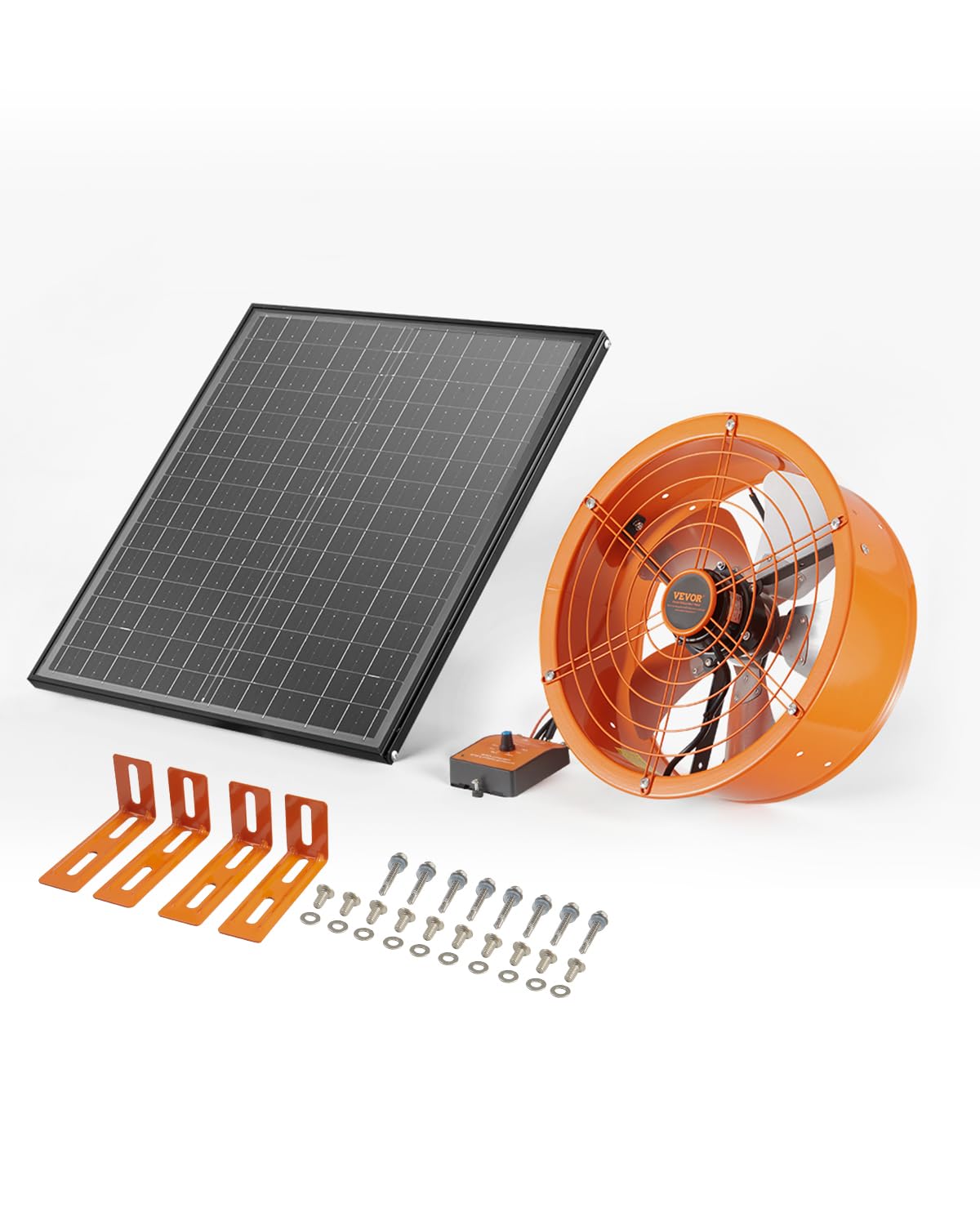
A solar-powered gable fan that covers a mid-size home and quiets down after dark
If running power up into your attic is the barrier, this fan sidesteps it. It draws on solar power to move 1300 cfm, enough airflow to cover areas up to 1850 sq. ft., and an adjustable thermostat turns it on and off based on the temperature around it so it is not running pointlessly. That combination of solar feed and coverage is why it takes the solar crown over the smaller 4SEASONS unit.
The airflow is the standout, with quiet operation close behind — owners describe it pulling hot, stuffy air out effectively while staying quiet enough to forget about, and note it lowers indoor temps by a few degrees. The build supports that: a high-strength steel housing that resists corrosion, aluminum alloy blades that stay unbent, and a protective mesh that keeps birds, leaves, and debris out of the housing.
Here is the trade-off a solar buyer should expect up front. Full-sun output drives how loud and fast it runs — the motor itself is quiet, but in full sunlight the sheer volume of air it moves becomes the noise, so a bright afternoon is the loudest time. It also ships with a plug-in option and one owner questioned whether that undercuts the solar purpose. With 4.5+ stars across a smaller base of owners, it is a strong, self-powered pick for a gable vent on a mid-size home.
The solar payoff: 1300 cfm with coverage up to 1850 sq. ft., a thermostat that only runs it when needed, and a mesh guard that protects the blades — all without new wiring unless you choose to plug it in.
Pick this one if: you have a gable vent and want to skip adding a dedicated circuit for the fan.
Steer clear if: you need a fan that runs at full tilt through cloudy weeks without the sun’s help.
6. Master Flow GAF 1500 CFM Powered Roof Mount Attic Fan
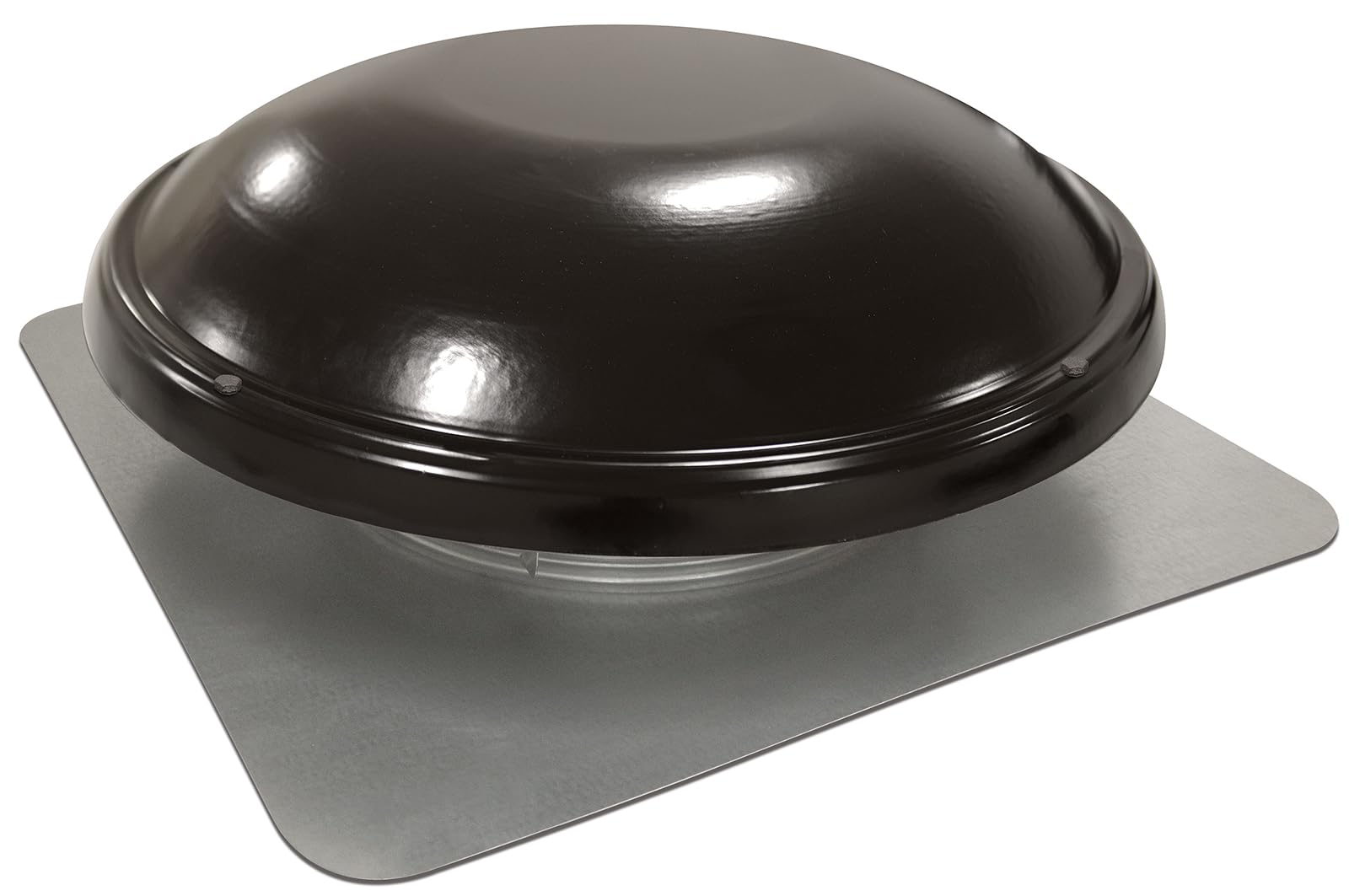
The roof-mount fan built for genuinely large attics — up to 2,800 square feet
When you have no gable vent to work with, or your attic is simply too big for a gable fan, a roof mount is the answer. This one moves 1500 cfm and is rated to ventilate attic spaces up to 2,800 sq. ft., so it handles far larger roofs than the 1850 sq. ft. ceiling of the VEVOR Gable Mount fan above. It comes with a thermostat controller, so it starts and stops on its own once the attic heats up.
Construction is where this fan earns trust. The housing and blades are galvanized steel (steel coated in zinc to resist rust), which stands up to the weather it will live in, and the thermostat is a simple bi-metal switch (two metals that bend with heat to open or close a contact) rather than a fussy electronic board — a design that tends to hold up over years on a roof. Cooling performance and quality are the two things owners bring up most, and the results speak plainly: one reviewer noted the attic finally holding a manageable temperature after a summer of overheating.
The catch is airflow. A roof fan pulls air only if fresh air can get in somewhere else, and one owner was candid that without a gable vent feeding it, the fan is not doing much — they planned to add a gable vent the following year. If your attic is sealed tight on every side, add intake before you add exhaust. One more note: this unit is not compatible with tile roofing systems, so check your roof type. It has a 4.5+ star rating.
Why the roof mount makes sense: 2,800 sq. ft. of coverage and a galvanized steel body that lives outdoors without complaint.
Suits you if: you have a large attic roof and no practical spot for a gable fan.
Rule it out if: you have tile roofing or a sealed attic with no intake venting.
7. 25W Solar Roof Vent Fan with 8 Inch Removable Roof Vents
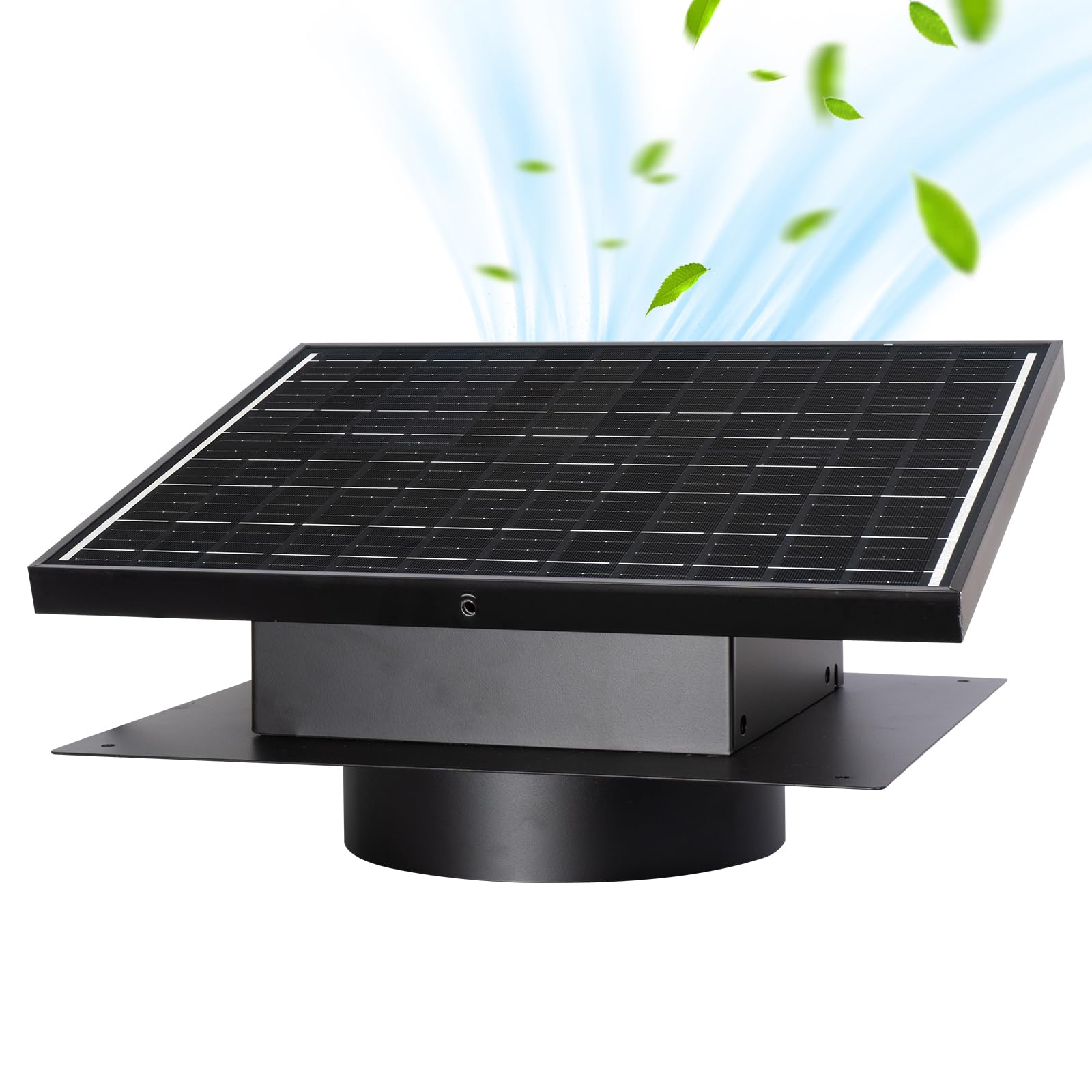
A fully solar roof vent for older homes with no air moving upstairs at all
Older homes often have a passive roof vent that does nothing on a still, hot day. This fan drops in to replace it and adds real movement. It runs on a 25W/22V single-crystal solar panel feeding an IP68 waterproof brushless DC motor — IP68 meaning sealed against dust and able to sit in water, so rain is not a concern. In full sun it can move up to 240 CFM, and when the sun fades it still lets passive air through.
The payoff shows up fast in a dark, hot attic. One owner swapped out a standard non-powered vent and reported their attic temp falling from the upper 120s°F to the upper 110s°F within the first hour, with the fan quiet enough to be inaudible from inside the house. The cover is galvanized steel with an aluminum mesh that keeps birds and small animals from moving in, and installation uses four mounting holes plus a pipe extension under the flange.
Two genuine caveats. It cannot store power — clouds or a shadow on the panel cut its speed sharply, and in heavy shade it can stop entirely, so it needs a genuinely sunny spot. A couple of owners also found it would not self-start and had to give the blades a nudge. Measure the footprint before ordering, too, since one installer noted the unit is shorter at the bottom than a standard vent and old nail holes had to be sealed. At 4.0+ stars it is the value option for a low-sun-limited attic rather than a heavy-duty workhorse. Set it beside the 400 CFM 4SEASONS and the airflow here is the modest one.
What it delivers
- 25W/22V solar panel and IP68 brushless motor — no electricity bill for running it
- Up to 240 CFM in full sun, with passive airflow once the sun drops
- Galvanized steel cover with aluminum mesh keeps birds and animals out
- Buyers report attic temps easing from the upper 120s°F into the upper 110s°F
What to plan around
- No battery storage — clouds and shade slow it or stop it entirely
- Some units need a manual push to start turning
- Footprint runs shorter than a standard vent, so measure and seal old holes
Ideal when: your roof is sunny, your attic has no power, and you want a simple no-wire upgrade.
Skip it when: the mounting spot sits in shade for much of the day.
8. 4SEASONS Solar Attic Vent Fan
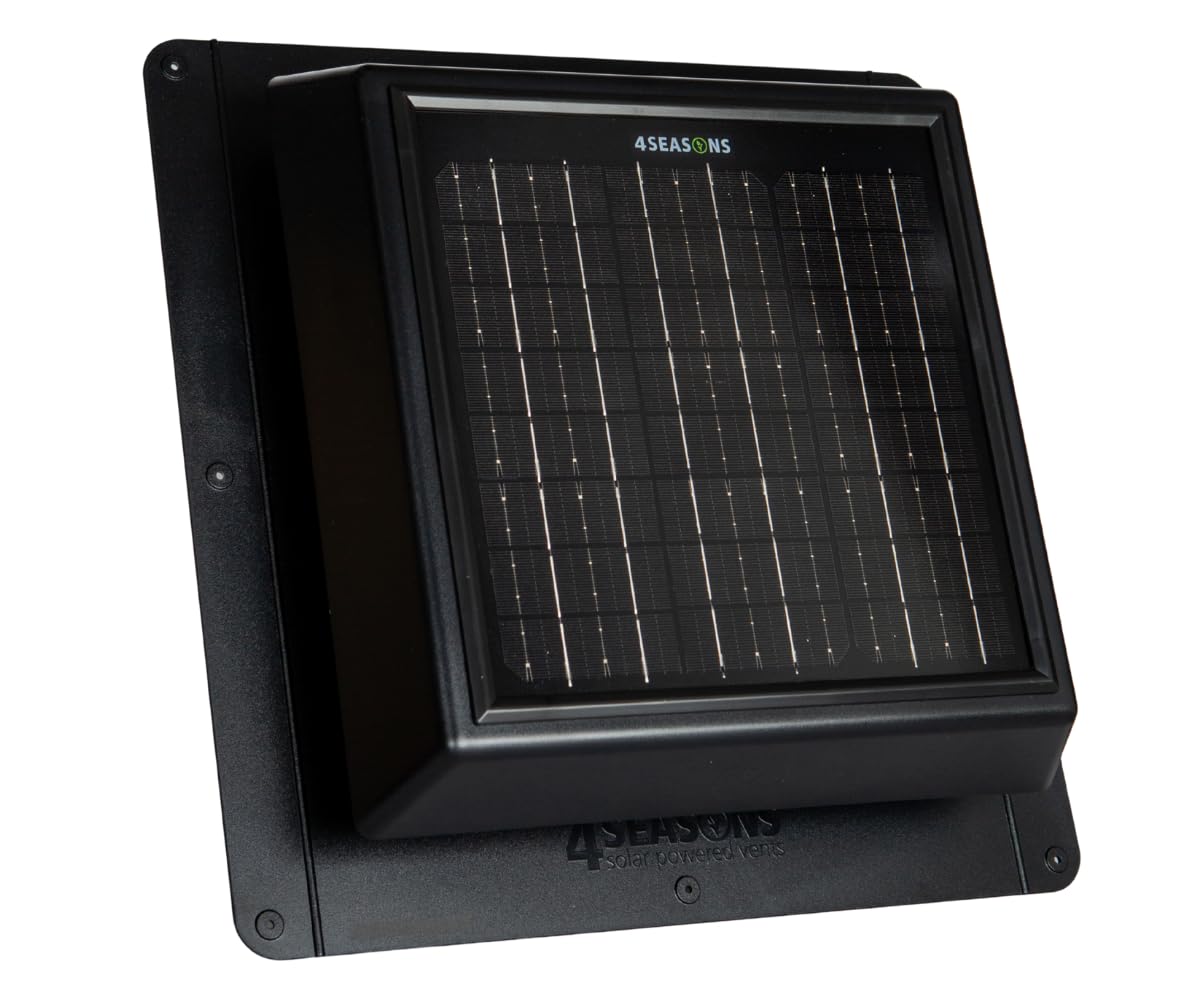
Independently tested solar venting for small attics that need no wiring at all
This is the pick for a small attic where running a circuit is more hassle than it is worth. A 12W monocrystalline solar panel powers the fan and it is CSA A93 certified — meaning an independent lab has tested it for safety and performance, which is a real confidence marker on a rooftop unit. It moves up to 400 CFM and ventilates attic spaces up to 500 sq. ft., with passive airflow continuing after sunset and no wiring required at all.
What wins people over is the install-and-forget experience. It ships fully assembled with integrated flashing built for standard sloped roofs, and owners describe the install as easy and the operation as quiet. The housing is impact-resistant polycarbonate rather than metal, and the brushless motor keeps vibration low so it does not work itself loose over time. It is the kind of fan that is working away without asking anything of you.
Set expectations on output before you commit. At up to 400 CFM this is a small-attic fan, and one owner with a 1000 sq ft home found two units were not enough and recommended four or more, so size accordingly. The other recurring note is durability — the polycarbonate housing is the fragility trade-off of a lightweight design, and a couple of owners reported cracking after an extended period. With a 4.0+ star rating and a solid base of users, it is a dependable, certified choice for a modest, sunny attic.
The certified angle: CSA A93 testing, a 12W monocrystalline panel, and up to 400 CFM for attics up to 500 sq. ft. — a low-maintenance, no-wiring option for smaller homes.
Right for you if: your attic is on the smaller side and you value independent safety certification.
Wrong fit if: your attic runs well past 500 sq. ft. or you expect it to shrug off rough roof work.
9. Iliving 36″ Wall Mounted Shutter Exhaust Fan

The 36-inch monster for barns and big shops where nothing smaller stands a chance
This fan is in a different league from everything above it. The 36-inch blades move 6128 cfm and iLiving rates it for 9000 SQF of coverage area, running on standard 120 volts at 1/2 HP and 6.00 amps with 825 rotations per minute. Put that up against the 3500 cfm KEN BROWN 20 Inch and the airflow here is in another tier — this is a whole-building fan, not an attic helper.
It is built like industrial equipment. The fully enclosed motor is thermally protected (it shuts down if it gets too hot) and permanently lubricated, meaning it needs no regular oiling, and the weather-resistant aluminum shutters hold up to moisture and heat better than the competition’s. Owners describe the airflow as genuinely impressive, with one noting a pair of these in a 2,800 sq ft metal building moved air so well there was a noticeable breeze across the space, and another keeping a 1500 square foot barn properly ventilated.
What to plan for: it is heavy, it is hardwired so it needs basic electrical knowledge, and while it is remarkably quiet for its size, a few owners still find it a touch noisy. It also requires real framing — one buyer used 2X4s to shore up the mount — so put it into structure, not siding. It carries a 4.5+ star rating and is the right tool when your space is measured in thousands of square feet.
The scale of it: 6128 cfm and 9000 SQF of coverage on a 1/2 HP, 6.00-amp motor — the largest fan here by a wide margin, suited to barns and industrial shops rather than a typical home attic.
Buy this if: you are ventilating a barn, metal building, or production shop and need industrial-grade capacity.
Think twice if: you want a simple weekend install — this one calls for electrical work and solid framing.
Know the Specs
CFM — Your Starting Number
CFM stands for cubic feet per minute, which is simply the volume of air the fan pushes out in one minute. It is the single best predictor of whether a fan will actually cool your attic. A big space needs a big number: the 6128 cfm iLiving handles whole buildings, while the 971 cfm HG Power suits a small attic or garage. If you buy too little, the attic stays hot and the money is wasted.
Thermostat vs Humidistat
A thermostat turns the fan on once your attic reaches a set temperature, so it is not running when it does not need to be — the Master Flow GAF and the VEVOR Gable Mount both rely on this. A humidistat adds humidity into the equation, running the fan on dampness as well as heat, which the Quietcool includes. In a humid climate, that extra sensor matters for keeping moisture off your roof deck.
Solar vs Plug-In Power
A solar fan runs on sunlight with no wiring at all, which is the appeal of the 4SEASONS and 25W Solar Roof Vent Fan. The trade-off is that clouds and shade cut its speed, and it stores no power for after dark. A plug-in or hardwired fan runs at full output whenever you want it, but you need an outlet or a circuit. Which one wins depends on how sunny your roof is and whether power is already up there.
Mount Type and Intake Air
A gable fan sits behind the triangular end vent, a roof fan sits on the shingles, and a wall fan goes through an exterior wall. Whichever you pick, remember that exhaust only works if fresh air can get in somewhere else — the Master Flow GAF owner who added an intake gable vent found the fan performed far better, and the KEN BROWN owner noted you must open a window or door or the fan starves for air.
Common Questions
How much CFM do I need for my attic?
Can I install an attic fan myself or do I need an electrician?
Do I need a gable vent for an attic fan to work?
Is a solar attic fan as powerful as a plug-in fan?
What do I do if my attic fan is too noisy?
How long should an attic fan last?
Will an attic fan lower my air conditioning bill?
Can I use an attic fan in a garage shed or greenhouse instead?
Does an attic fan need a thermostat or humidistat?
Should I buy one big fan or two smaller ones?
The Bottom Line
If your attic is hot, damp, and hard to reach, the attic ventilation system that solves the most problems at once is the Quietcool AFG SMT PRO-2.0 — it moves 1945 cfm, runs on just 120 Watts, and handles heat and humidity on its own with a plug-and-play install. If you are cooling a smaller attic, garage, or greenhouse and want adjustable automatic control, grab the HG Power 12 Inch. And for anything measured in thousands of square feet, the iLiving 36″ is the one to reach for. Whichever direction you go, check your attic’s intake venting first — an exhaust fan only works when fresh air can get in somewhere else.
How we choose
We do not accept paid placement. Every pick is matched to a real buyer and a real use-case; we do not hands-on test units.
Sources
Specifications: manufacturer listings and product documentation. Review insights: verified customer reviews, as of October 2026. Pricing: not shown on this page (it changes often); check the current price via the retailer link.
As an Amazon Associate, My Heart Lives Here earns from qualifying purchases. This does not affect which products we feature.