Heads up: This post contains affiliate links. As an Amazon Associate I earn from qualifying purchases, at no extra cost to you. Learn more
Specs are compiled from manufacturer listings and verified buyer reviews and can change over time — please confirm the key details on the product page before buying.
If your towels still smell damp an hour after they come out of the wash, the problem is not your detergent — it is the bacteria and fungus your detergent leaves behind. An antifungal laundry detergent is an additive you pour into the rinse cycle or the fabric softener drawer, and it kills the organisms that plain soap misses. The three picks below cover two everyday rinse-cycle sanitizers and one concentrated rescue formula for mold-contaminated fabric.
This guide is built by comparing the manufacturers’ published specifications and the patterns across verified customer reviews, so you get each pick’s real strengths and trade-offs instead of marketing spin.
Every option here states a real germ-killing claim rather than a scent claim, and the differences come down to how you dose them and what you are trying to save. This comparison of the best antifungal laundry detergent covers the rinse-cycle sanitizer that handles most households and the concentrat
Top Picks
How To Choose The Best Antifungal Laundry Detergent
First, decide if you want a sanitizer you add to every load or a rescue formula you pull out only when something has gone badly wrong. These are two different products, and buying the wrong one is the most common mistake.
Check the germ-killing claim, not the scent name
Decide where it goes in the wash
Most rinse-cycle sanitizers go into the fabric softener drawer or get added during the rinse, which means you keep using your normal detergent and just add this on top. Concentrated rescue formulas usually go straight into the wash drum with the load. Pick the routine you will actually keep up with, because a sanitizer you forget to add does nothing at all.
Match the formula to the fabric you are saving
If your concern is your family’s everyday clothes, bedding, and towels, a bleach-free color-safe sanitizer is the low-risk route — it will not fade blacks or damage delicates. If your concern is fabric that already smells of mildew and you are close to throwing it out, a concentrated formula built for post-remediation laundering gives you a real shot at rescuing it.
Check your machine before you buy
High-efficiency machines use less water, so you want a formula explicitly listed as HE compatible. Front-loaders and top-loaders dose differently too — some products call for one full cap in a front-loader and a different amount in a top-loader, so read the pack rather than assuming a single capful fits every machine.
Side-by-Side Comparison
| Model | Best For | Format | Size | Bleach-Free | Amazon |
|---|---|---|---|---|---|
| Lysol Laundry Sanitizer Liquid, Crisp Linen, 90oz★ Best Overall | Whole-family everyday loads | Rinse-cycle liquid additive | 90oz | 0% bleach | Amazon |
| Lysol Laundry Sanitizer Liquid, Crisp Linen, 41oz, 2Pk | Small cabinets and modest loads | Rinse-cycle liquid additive | 41oz, 2-pack | 0% bleach | Amazon |
| Remedy Laundry Detergent, Super Concentrated | Rescuing mold-damaged fabric | Super-concentrated wash liquid | 32 loads per bottle | Fragrance-free and dye-free | Amazon |
Detailed Reviews
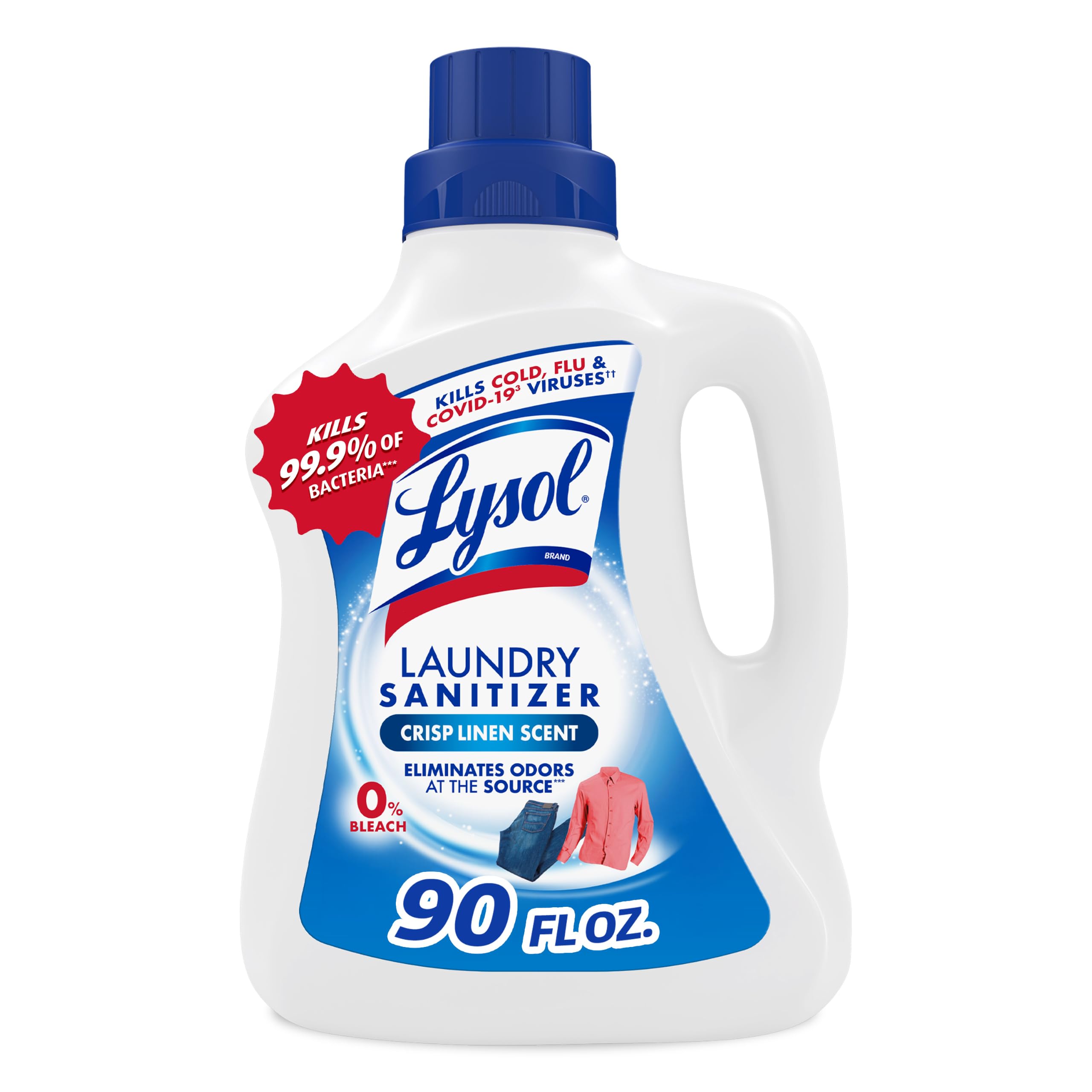
1. Lysol Laundry Sanitizer Liquid Crisp Linen 90oz
Our pick — 4.5+★ from 113,500+ verified ratings; the strongest balance of quality and price.
The big-bottle workhorse that turns a normal wash into a germ-killing one.
Buy this one if you want to sanitize every ordinary load without thinking about it. It is a detergent additive, not a standalone detergent: you keep your regular soap and pour this into the fabric softener drawer or the rinse cycle. The manufacturer states it kills 99.9% of laundry bacteria, including Staphylococcus aureus and Klebsiella pneumoniae at 21°C, plus influenza A (H3N2), human coronavirus, and RSV in a pre-soak. As a pre-soak it also kills SARS-CoV-2 in 5 minutes.
The formula is 0% bleach, so it will not strip color from blacks or wear through whites the way chlorine does. It is listed as safe for most washable fabrics, including delicates, undergarments, baby clothes, and bed sheets. It also works in cold water, which matters if you wash on cold to protect fabric but still want the sanitation step. Dosing is one full cap for front-load washers, with a different amount for top-loaders shown on the pack, and the 100 mL cap makes that measurement quick.
The 90oz bottle weighs 6.23 pounds, and that bulk is the trade-off — buyers report it lives under a utility sink more comfortably than in a tight cabinet. The smell side is where this earns its keep: it does not perfume a load, it removes the odor source, which is why households with dogs and sweaty athletic gear keep reordering it. As owners put it: “With kids, swimming, and life this gets the smells out.”
What earns it the top slot
- States a real kill claim — 99.9% of bacteria on laundry, plus flu, cold, and RSV viruses in a pre-soak
- 0% bleach, so colors stay safe and whites do not get eaten away
- Works in cold water and in both standard and HE machines
- Doses as one cap in the fabric softener drawer, so it folds into your existing routine
The honest catches
- The 6.23-pound bottle is awkward to store on a crowded shelf
Reach for this if: you want one bottle that sanitizes the whole family’s everyday laundry, from baby clothes to gym towels, without touching your normal detergent routine.
Look at the 2-pack instead if: shelf space is tight — the same formula comes in a 41oz two-pack that is a third of the height of this one.
2. Lysol Laundry Sanitizer Liquid Crisp Linen 41oz 2Pk
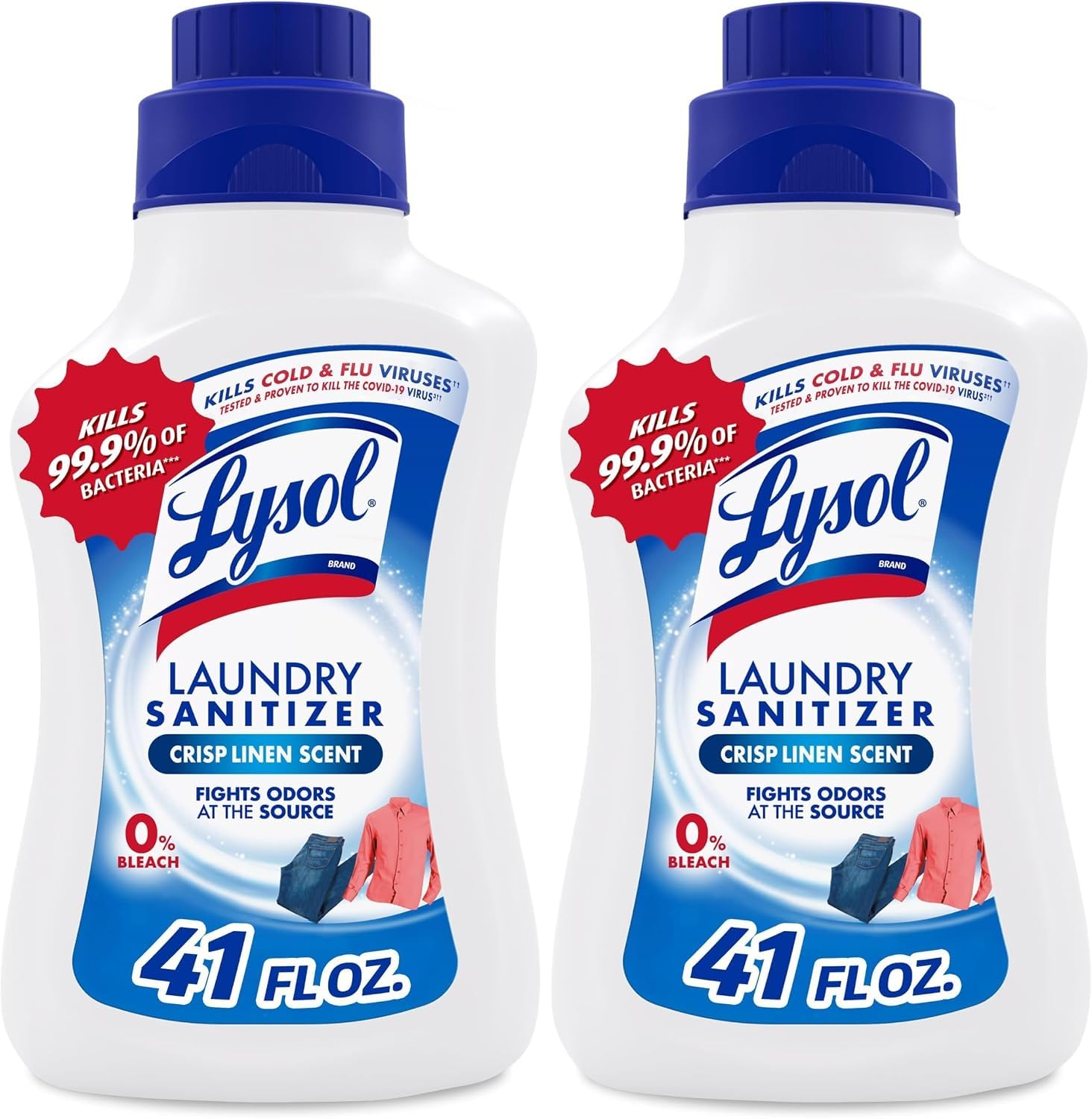
The cabinet-friendly twin pack for anyone who does not want a giant jug under the sink.
You get the same sanitizing claim as the 90oz and the same 0% bleach formula, but in two 41oz bottles instead of one big one. Each bottle measures 3.16 x 5.14 x 9.94 inches and weighs 3.58 pounds, compared to 4.16 x 7.5 x 11.31 inches and 6.23 pounds for the single large bottle — so it is noticeably more compact and easier to lift onto a high shelf.
What wins people over here is the effectiveness, and the scent runs a close second. It kills 99.9% of the bacteria detergent leaves behind on clothes, towels, and sheets, targeting the odor-causing bacteria behind sweat and mildew smells instead of masking them with fragrance. One owner summed up the difference as the gap between detergent-clean and actually clean. It is bleach-free, so whites and colors both come out unharmed, and it works in standard and HE washers, front-load or top-load, in cold water.
The one part people are split on is the cap. The recurring gripe is that the bottle can be stiff to open, so if grip strength is an issue, the larger bottle’s simpler pour may suit you better. That is a dosing complaint, not a cleaning one — the sanitizing job is identical across both sizes.
Where it beats the big jug: the 41oz twin pack stores in a standard cabinet and is easier to pour, while carrying the same 99.9% bacteria kill claim and the same 0% bleach formula.
The fair caveat: the cap can be hard to open for some hands, which is the most common note on this size.
Best for: smaller households, apartment cabinets, or anyone splitting one bottle for the laundry room and one for the garage.
Think twice if: you specifically want the biggest single bottle and a simpler pour — the 90oz takes this slot on both counts.
3. Remedy Laundry Detergent Super Concentrated

The concentrated rescue formula for fabric you were about to throw away.
This is the pick for mold and mildew that has already set in. It is pharmacist-formulated with a dual-surfactant cleaning system, botanically enhanced with citrus seed extract and tea tree oil, and it is designed for flood recovery, long-term storage, post-remediation laundering, and high-humidity environments. It is not a rinse-cycle additive you layer on top of detergent — it replaces the detergent, at 1 oz (1/8 cup) per load, giving you 32 loads per bottle.
It is fragrance-free and dye-free with no optical brighteners, which matters most if your skin reacts to scented detergent. Owners mention it gets the smell out rather than covering it. One buyer who washed an entire household’s clothing from a mold-affected home said the clothes “no longer have a smell.” Others say musty towels and forgotten wet washcloths come back genuinely clean, and people managing mold sensitivity and severe allergies often choose it.
Be straight about the two catches. It does not whiten — if you are also chasing dingy whites, this will not do that job, and you will want to keep a separate brightening step. And severe odors sometimes need a second wash. The bottles have a habit of arriving with a loose cap and some leakage in transit, so check the seal when your box lands.
Why mold-sufferers keep it stocked
- Built for post-remediation laundering, flood recovery, and high-humidity environments
- Fragrance-free, dye-free, and free of optical brighteners, so it suits sensitive skin
- 1 oz (1/8 cup) per load stretches to 32 loads per bottle
- Works in hot or cold water and is HE machine compatible
What to expect going in
- It does not whiten fabric — brightening whites is a separate job
- Severe odors can need a second wash
- Bottles have a reputation for arriving with a loose cap and some leakage
Pick this when: the fabric already smells of mildew and you would rather rescue it than replace it, especially if scented detergent irritates your skin.
Not the one for: your everyday family laundry — it does not brighten whites, and the rinse-cycle sanitizers above handle routine loads for far less per wash.
Know the Specs
Rinse-cycle additive vs. standalone detergent
A rinse-cycle additive is poured into the fabric softener drawer or added during the rinse, alongside your normal detergent. A standalone concentrated formula is dosed straight into the drum and does the whole job by itself. If you want a sanitizing step that you can add to any load without changing your soap, the additive route is the easy one. If you are fighting mold that has already set into the fabric, you want the standalone route.
What “kills 99.9% of bacteria” actually means
Bleach-free and color-safe
A 0% bleach formula sanitizes without chlorine, so it will not fade blacks or weaken whites the way bleach does. That is what makes a sanitizer usable on the whole family’s laundry — delicates, undergarments, baby clothes, and colored bedding included — rather than on whites alone.
Concentration and dosing
Super-concentrated formulas are dosed small: one ounce per load is enough to reach odors and contamination, which means one small bottle covers many loads. Standard sanitizers are dosed by the capful, with a full cap for front-load washers and a different measure for top-loaders. Either way, the dose is what determines whether the load actually gets sanitized — read the pack rather than guessing.
Common Questions
Will an antifungal laundry detergent work in my HE front-loader?
Can I use Lysol Laundry Sanitizer and Remedy at the same time?
Does a bleach-free sanitizer actually kill fungus and bacteria?
Where do I pour the rinse-cycle sanitizer?
How many loads does one bottle of the Remedy concentrate cover?
Is the fragrance-free formula the better pick for sensitive skin?
Can I use these on colors as well as whites?
Do I still need regular detergent with the Lysol sanitizer?
Does the Remedy concentrate work in cold water?
Will a musty smell come back after one wash?
The Bottom Line
For most households, the best antifungal laundry detergent choice is the Lysol Laundry Sanitizer Liquid, Crisp Linen, 90oz — it fits into your existing wash routine as a one-cap rinse additive, and with thousands of reviewers backing it, that consistency is why it holds the top slot. If cabinet space is tight, grab the Lysol 41oz 2-pack, which is noticeably more compact to store. And for mold-contaminated towels and bedding you are trying to save, the Remedy Super Concentrated formula is the one to reach for.
How we choose
We do not accept paid placement. Every pick is matched to a real buyer and a real use-case; we do not hands-on test units.
Sources
Specifications: manufacturer listings and product documentation. Review insights: verified customer reviews, as of October 2026. Pricing: not shown on this page (it changes often); check the current price via the retailer link.
As an Amazon Associate, My Heart Lives Here earns from qualifying purchases. This does not affect which products we feature.