Heads up: This post contains affiliate links. As an Amazon Associate I earn from qualifying purchases, at no extra cost to you. Learn more
Specs are compiled from manufacturer listings and verified buyer reviews and can change over time — please confirm the key details on the product page before buying.
If you want one straight answer: the Banyan Botanicals Amla Powder is the safest first buy for most people. It is the traditional whole-fruit form, USDA certified organic, and the only pick here rated 4.5+ stars across 300+ owner ratings. If you would rather swallow a capsule than taste amla, the Carlyle 1500mg and the Organic Veda 1500mg give you the highest mg-per-serving on this list. Everything below sorts the nine real options so you can match a bottle to how you actually take supplements.
This guide is built by comparing the manufacturers’ published specifications and the patterns across verified customer reviews, so you get each pick’s real strengths and trade-offs instead of marketing spin.
Amla comes in two forms — a loose powder you mix into water or tea, and a capsule you swallow whole — and the form usually matters more to daily consistency than the milligram count on the label. This guide ranks nine amla options by form, serving size, and how owners actually take them. Below you’ll find the best amla supplement picks for whole-fruit purists, capsule takers, and anyone chasing heart or cholesterol support.
Top Picks

How To Choose The Best Amla Supplement
The single biggest decision with amla is not the brand — it is powder versus capsule. A loose powder is the traditional whole-fruit form, and you control the dose by the spoon, but you taste every bit of it. A capsule hides the taste completely, but you are locked into whatever milligram amount the maker packed into each pill. Pick the form you will actually keep taking, then judge the label.
Powder or capsule — decide this first
Amla powder is the most traditional way to take the fruit, and it is usually the cheapest per gram because you are not paying for encapsulation. The trade-off is real: amla tastes sour and bitter, and it dissolves easily in warm liquid but not in cold. If you drink tea or a warm morning drink anyway, powder disappears into that habit. If you hate earthy flavors, a capsule is the difference between taking it daily and giving up in week two.
Read the serving size, not just the bottle size
Two bottles can both say “120 capsules” and deliver completely different amounts of fruit. Some products list the amount per capsule (for example 500mg), so two capsules make a full serving. Others list the amount per serving upfront. Check both numbers so you know how many pills you swallow a day — that is what determines whether a bottle lasts one month or two.
What the organic and testing labels really mean
A USDA organic seal or a CCOF certification means an independent body verified the growing and handling, not just that the brand used the word “natural.” Look for third-party testing or an ISO-accredited lab mention, because amla is a whole plant and purity testing is how you avoid heavy metals and fillers. These labels are the difference between a clean product and a marketing claim.
Side-by-Side Comparison
| Model | Best For | Form & Serving | Amla Amount | Count / Size | Amazon |
|---|---|---|---|---|---|
| Banyan Botanicals Amla Powder★ Best Overall | Traditional whole-fruit takers | Loose powder | Whole dried fruit | 3.5 oz bag | Amazon |
| Nutricost AmlaBest Value | Everyday capsule routine | Vegetarian capsule | 1000mg per serving | 120 capsules | Amazon |
| Carlyle Amla CapsulesHighest Dose | High-dose pill takers | Quick-release capsule | 1500mg per serving | 120 capsules | Amazon |
| AMLA Capsules (Aura) | Value hunters and immune support | Veg (HPMC) capsule | 1000mg per serving | 120 capsules | Amazon |
| Swanson Full Spectrum Amla Fruit | Easy-to-swallow daily support | Capsule | 500mg per capsule | 120 capsules | Amazon |
| ORGANIC INDIA Amla Powder | Wildcrafted powder fans | Loose powder | Whole amla berry | 1 lb | Amazon |
| Life Extension Advanced Lipid Control | Cholesterol-focused takers | Standardized extract capsule | 500mg amla extract | 60 capsules | Amazon |
| Organic Veda Amla Capsules | Skin, hair and beauty goals | Veggie capsule | 1500mg per serving | 300 capsules | Amazon |
| USDA Organic Amla Vitamin C (True Veda) | Non-synthetic vitamin C seekers | Plant-based capsule | Whole food amla | 60 capsules | Amazon |
Detailed Reviews
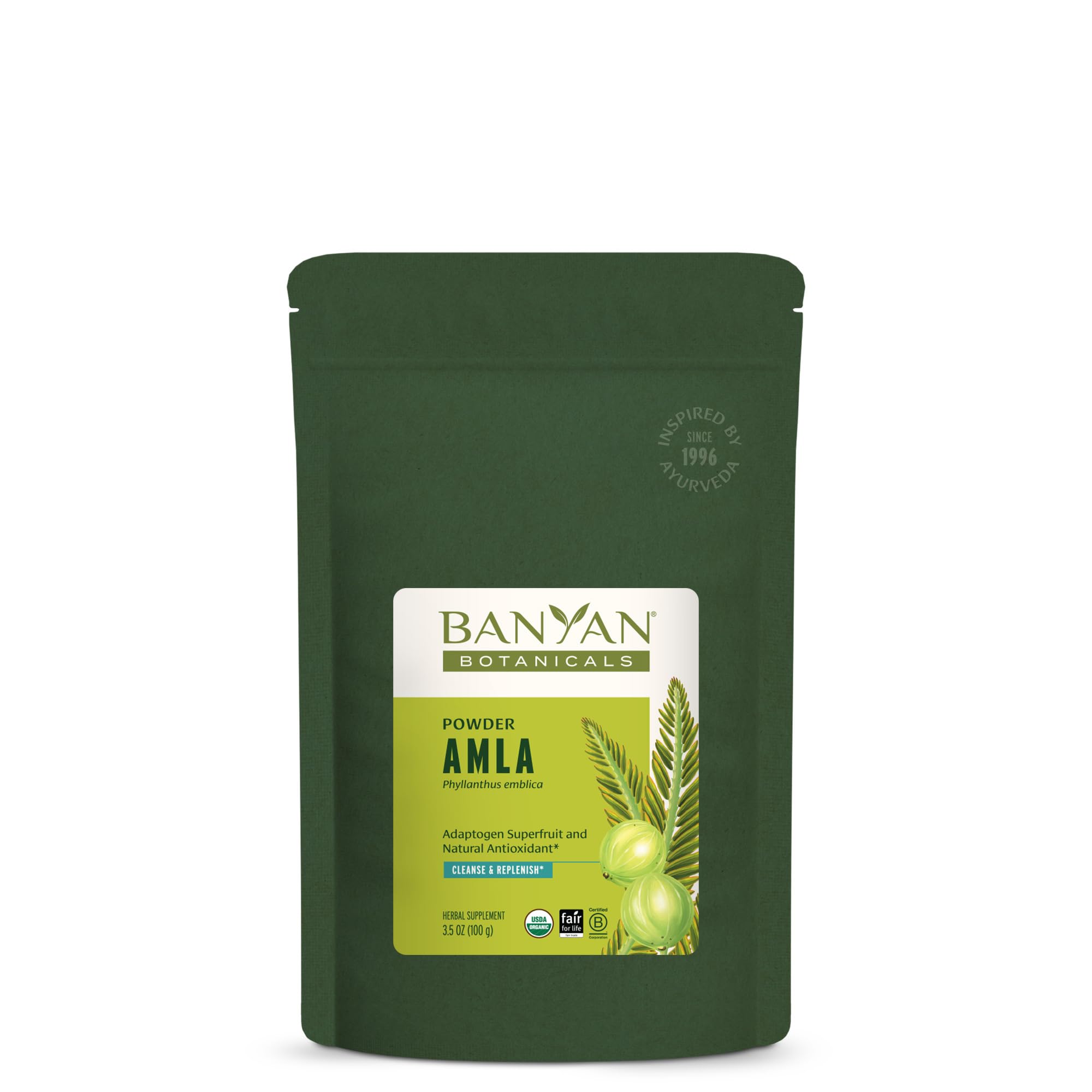
1. Banyan Botanicals Amla Powder
Our pick — 4.5+★ from 350+ verified ratings; the strongest balance of quality and price.
The 3.5oz bag of USDA certified organic powder that traditional Ayurveda users reach for first.
If you already drink a warm tea or a hot morning drink, this is the pick that disappears into your routine. It is amla (Phyllanthus emblica, the Indian gooseberry) ground from dried fruit — the most traditional way to take the herb. Banyan Botanicals builds the whole product on USDA certified organic herbs that are sustainably sourced and fairly traded, with third-party testing for quality and safety.
What wins people over here is the antioxidant content, which owners describe as the strongest around, plus the value of a bag that stretches a long time. One buyer summed it up: “Strongest, cheap antioxidant; bag lasts 6-12 months.” Mixability matters because amla is a whole fruit, and the common note is that it dissolves easily in warm water but not in cold — reporters say it mixes with hot water, juice, or sweetener. A little goes a long way at 1/4 to 1/2 tsp daily stirred into tea.
The honest catch is the taste. Amla is naturally sour and bitter, and the powder has a gritty texture, so it is not a spoon-it-dry product. The packaging is the other friction point — an occasional bag arrives crushed and leaking in transit, so many buyers order direct from the brand instead. Neither issue touches how the powder itself performs.
What the bag delivers
- USDA certified organic, sustainably sourced, and third-party tested for quality and safety
- The traditional whole-fruit form — no capsule to swallow, and the dose is yours to control
- A 3.5oz bag that buyers report stretching from 6 to 12 months at 1/4 to 1/2 tsp a day
What you trade for it
- Genuinely sour and gritty — it needs warm water, juice, or a sweetener to go down easily
- It will not dissolve in cold liquid
- The bag can arrive damaged via retail shipping; ordering direct has been the workaround
First bottle to buy: anyone who wants the traditional whole-fruit form and does not mind a sour, earthy taste in their morning drink.
Look elsewhere if: you cannot stomach bitter flavors — a capsule will keep you consistent where a powder will not.
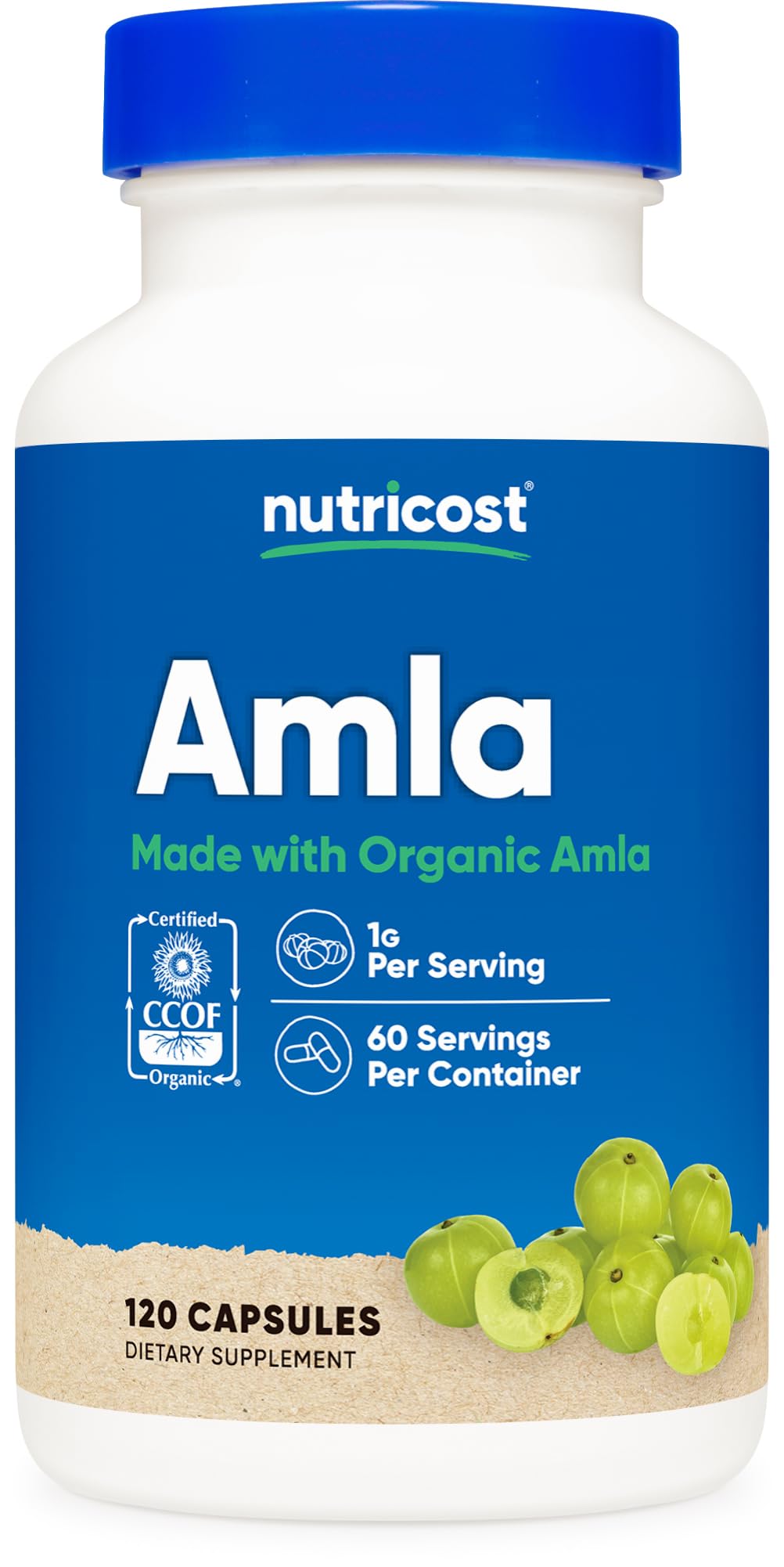
2. Nutricost Amla (1000mg) 120 Vegetarian Capsules, Gluten Free
A no-taste, 1000mg capsule routine built for people who want amla without the sourness.
The label math here is the draw: 500mg per capsule and two capsules per serving give you the full 1000mg, from a bottle of 120 vegetarian capsules that yields 60 servings. This is amla certified made with organic amla by CCOF, and it is gluten free, soy free, and non-GMO. It is also third-party tested by ISO-accredited laboratories and made in a GMP compliant, FDA registered facility — the production guardrails matter when you swallow a whole-plant capsule daily.
The thing everyone raves about is quality, and effectiveness is right behind it, with buyers taking it for blood sugar, cholesterol, and nerve support. One long-time taker reported morning blood-sugar readings of 80-110 within a week after other supplements failed. Others describe it as offsetting the digestive drag of other supplements they take. At 60 servings per bottle, this is one of the more efficient capsule formats on the list.
The recurring gripe is dosage sensitivity. Because amla is high in vitamin C, buyers caution against stacking it with an additional C supplement, and a few note it can trigger heartburn for people prone to reflux. The honest read: it suits most healthy buyers, but if you are sensitive to vitamin C or already on a C pill, that is the one thing to sort out first.
Where it earns its place: 120 capsules at 500mg each, third-party tested, and a full 60 servings per bottle — a clean, tasteless daily routine without a powder to mix.
The reflux check: amla is high in natural vitamin C, so if you already take a C supplement or are prone to heartburn, treat this as a stack to plan rather than a blind addition.
Reach for this if: you want a plain capsule, no powder, no aftertaste, and a bottle that lasts two months at a serving a day.
Think twice if: you are already topping up on vitamin C or your stomach reacts hard to acidic supplements.
3. Carlyle Amla Capsules 1500mg | 120 Count | Amalaki Fruit
The 1500mg-per-serving bottle for anyone who wants the most amla fruit in a single swallow.
At 1500mg per serving, this Carlyle bottle packs 50% more amla fruit than the 1000mg Nutricost capsules above, which is the biggest per-serving number you can get alongside the Organic Veda pick. It also ships heavier — 4.96 ounces versus the Nutricost bottle’s 3.2 ounces — a fair signal of more powdered fruit per capsule. Everything here is gluten free, wheat free, yeast free, lactose free, non-GMO, and made without artificial sweetener or preservatives.
Quality is what holds up best, and Carlyle markets it as laboratory tested with trusted ingredients. The serving format is genuinely convenient: quick-release capsules that go down without the sour amla taste, so the 1500mg dose is easy to keep up with day to day.
Be realistic about what 1500mg does and does not do. Effectiveness on this bottle draws a mixed response — some buyers find it works exactly as hoped, others report no change — and that split tends to come down to what you are taking it for and how long you stay with it. Side effects are likewise mixed; a sensitivity is possible, so if you know you react to new supplements, start with one capsule and give it time. It remains a solid high-dose option as long as you do not expect overnight results.
Why the dose matters
- 1500mg per serving — 50% more amla than the 1000mg options here
- 120 quick-release capsules, gluten free and non-GMO with no artificial sweetener
- Convenient format if you want a high dose without tasting amla at all
Where expectations run hot
- Results are genuinely mixed — some buyers notice nothing, so give it a fair run before judging
- Side effects are mixed too; start slow if you are sensitive to new supplements
Suits you if: you want the largest single-serving dose of amla fruit and you take it as a swallow-and-go capsule.
Pass on it if: you expect a fast, dramatic change — this is a keep-taking-it pick, not a quick fix.
4. AMLA Capsules 1000mg

The high-mg capsule that owners keep reordering for all-round daily immune and heart support.
This is the bottle with the strongest word-of-mouth on the list, and the reason is simple: it does a little of everything and it is easy to take. Each serving delivers 1000mg of raw whole green amla in an HPMC vegetable capsule — HPMC is a plant-based capsule shell, so there is no gelatin and no animal content. The maker says there are no artificial colors, preservatives, fillers, or additives, and each batch is third-party tested for impurities and heavy metals.
The trade-off is that a whole-food capsule gives you the full fruit but not a standardized extract, so how much you feel can differ from buyer to buyer. The other practical note is inspecting what you get: a fresher, lighter-colored amla powder reads as gently dried, while deep brown or grey powder usually means aged or heat-exposed fruit. This bottle sits at the reliable middle — real value, real reviews, no gimmicks — but it is still a whole-fruit product, not a clinical-strength extract.
Why the crowd likes it: a 1000mg raw whole-food dose, an HPMC veg capsule, 120 to a bottle, and third-party heavy-metal testing — the all-rounder that suits the widest range of daily users.
The freshness check: amla color is a real signal — light green or tan tells you it was gently dried, while deep brown powder points to older or heat-exposed fruit.
The safe pick if: you want one dependable, well-reviewed capsule for everyday amla without overthinking the dose.
Not the fit if: you specifically need a standardized extract for a targeted goal — this is whole fruit, not a clinical extract.
5. Swanson Full Spectrum Amla Fruit, 500 mg, 120 Capsules
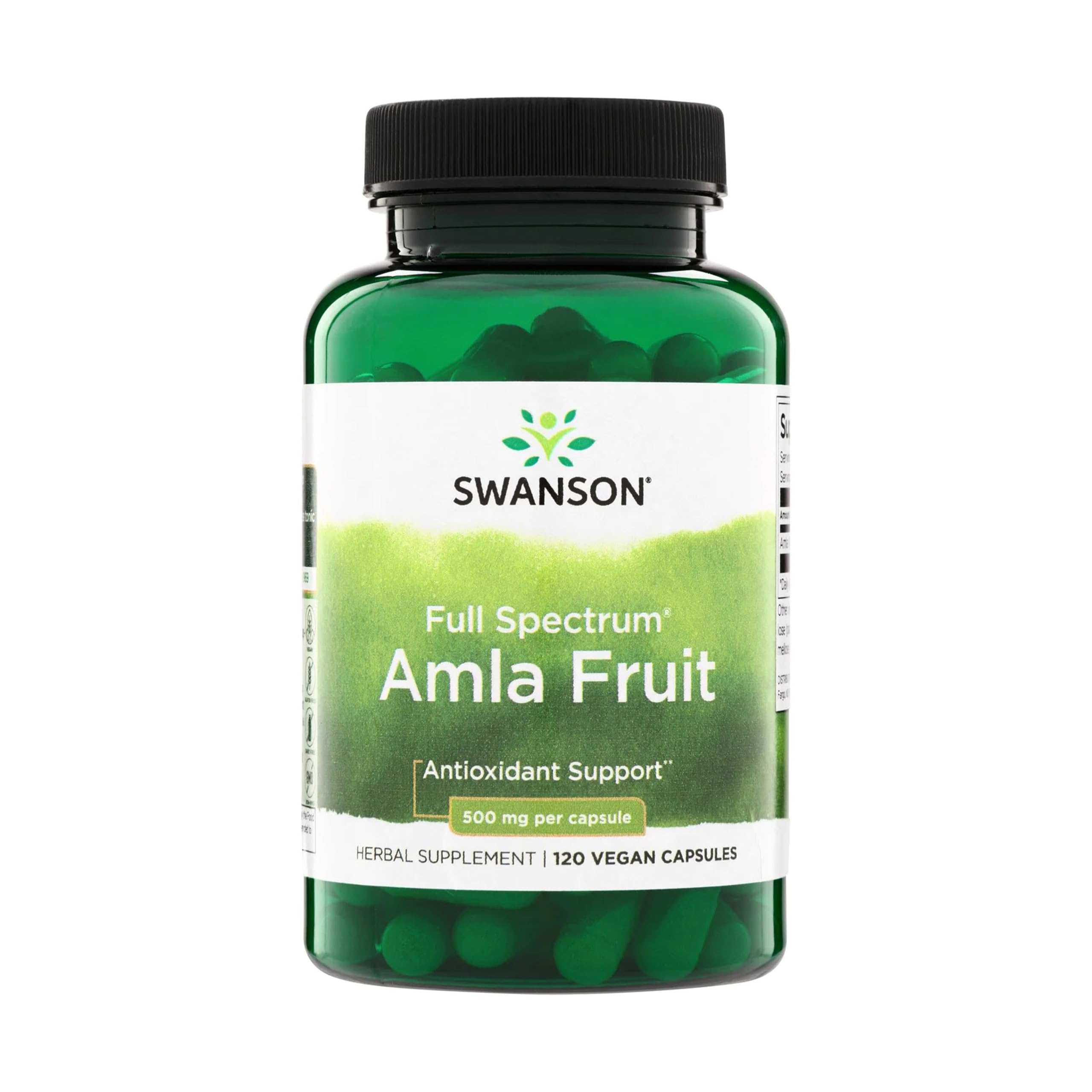
A lower, flexible 500mg capsule for anyone who wants to dial their amla dose gently.
The whole idea behind this Swanson bottle is a smaller step you can build on. Each capsule holds 500mg of powdered amla fruit, and the label directs two capsules once a day with water — so a full serving is 1000mg, but because each pill is 500mg you can start with one and scale up as you get comfortable. At 120 capsules that also makes the bottle last longer if you only take one cap a day.
For a lower-dose capsule, the reputation holds up well — quality is the most-praised strength, with effectiveness close behind and a loyal following that trusts the Swanson name. Customers note less inflammation and easier joint and foot comfort after regular walks. One of the simplest endorsements comes straight from a customer: “Swanson product are high quality.”
The part to weigh honestly is timing and tolerance. A few reviewers point out feeling nothing even after a month and plan to finish the bottle before deciding, which is fair with any whole-fruit capsule at this dose. The other caution is that side effects are mixed, and a small number of people report allergic-type reactions, so if you know you are sensitive to new botanicals, start with a single capsule. It is a gentle, trustworthy lower-dose pick, not a heavy hitter.
Why the lower dose has fans
- 500mg per capsule lets you start with one pill and build up, rather than committing to a full dose on day one
- 120 capsules — two per day lasts two months, one per day lasts four
- A long-standing name buyers already trust for quality
The fine print
- At a lower dose, some buyers simply do not feel anything and need a full bottle to judge
- Tolerance varies — a small number report allergic-type reactions, so begin with a single capsule
Good match if: you want to ease into amla slowly or prefer a lower, adjustable daily dose.
Choose differently if: you want a higher mg per pill to keep your daily pill count down.
6. ORGANIC INDIA Amla Powder, Amalaki Indian Gooseberry, 1 Lb

A full pound of wildcrafted amla powder for people who go through powder by the scoop.
Size sets this one apart — it is a 1-lb bag, which is far more powder than the 3.5oz Banyan option, and that matters if you take amla in a drink every single day. The story behind it is the selling point: this amla is wildcrafted from forests the government of India designates as organic environments, so the wild Amalaki trees are protected from over-harvesting. It is framed as a traditional Ayurvedic pick, with the whole fruit ground into a loose powder you mix into tea or warm water.
The honest warning is the flavor. Amla powder is naturally sour and bitter, and the recurring description is that it looks and tastes like dirt — this one is not for you if you are sensitive to earthy flavors. Effectiveness also gets mixed feedback, so go in expecting a keep-taking-it product rather than a fast change. Mixed into a strong tea or a juice with a little sweetener, though, it becomes a cost-effective daily habit for anyone who has already accepted the taste.
What the pound buys: wildcrafted amla from protected organic forests, in the traditional loose-powder form, sized so a daily tea drinker is not rebuying every few weeks.
The taste reality: amla powder is sour, bitter, and earthy by nature — plan on strong tea or juice with sweetener, or choose a capsule instead.
Buy this one if: you drink amla in a warm beverage daily and want a large, wildcrafted supply.
Skip powder entirely if: even a hint of earthy bitterness puts you off — a capsule serves you better.
7. Life Extension Advanced Lipid Control
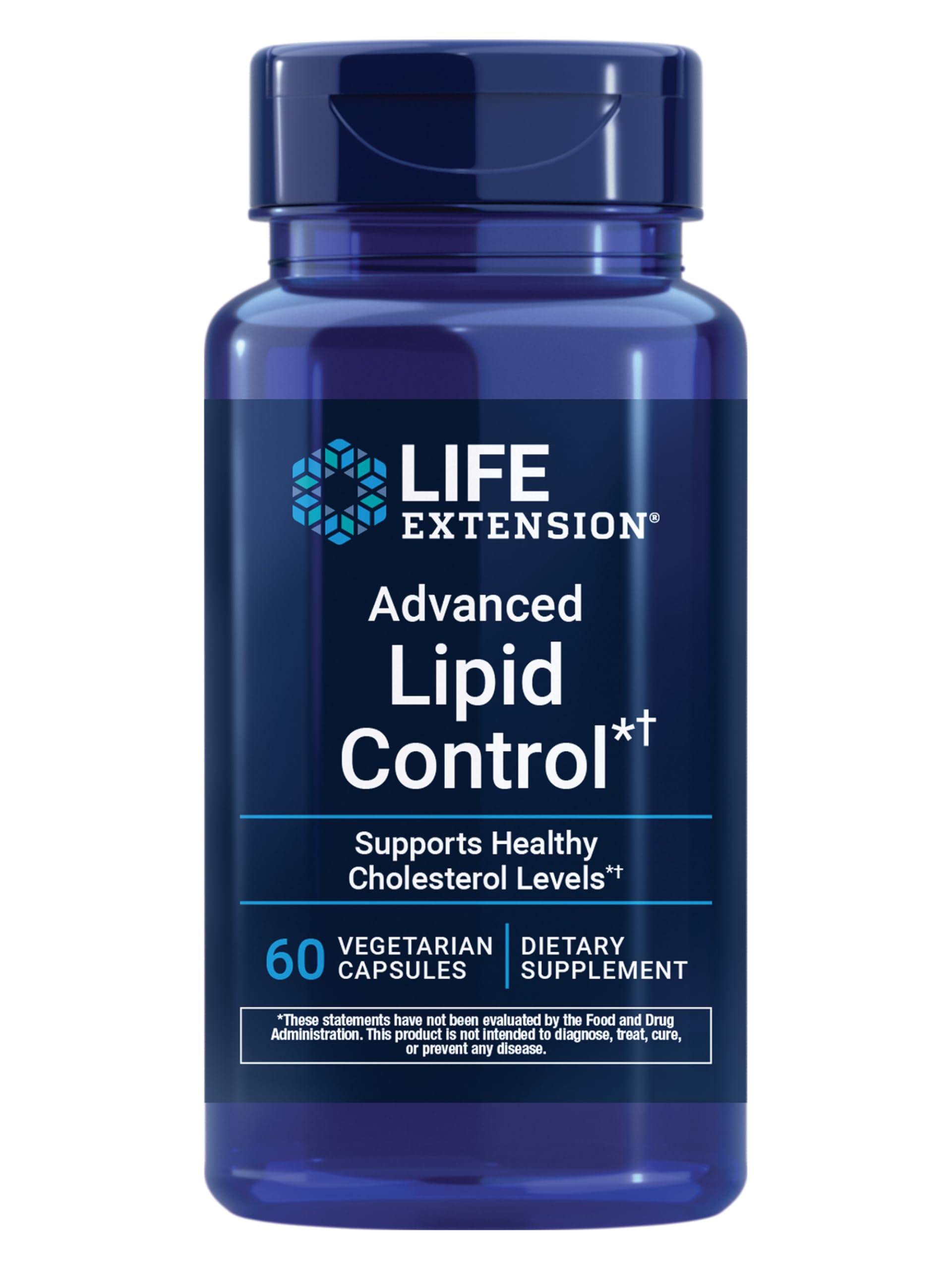
A standardized amla extract aimed squarely at heart and cholesterol support.
The formula is what draws buyers who are watching their heart numbers. Quality is the most-praised strength, with cholesterol support right behind it, and one reviewer noted it supports their cholesterol without prescription medication. For anyone already tracking lipids, this is the most targeted amla option on the list.
The caveat is that an extract is not a guaranteed result. Effectiveness draws a mixed response — some shoppers say it works well for them, others say it does not work at all — and side effects are mixed too, with some people reporting no reaction and others an adverse one. It is also a small 60-capsule bottle, so at a multi-capsule daily routine it runs out faster than the 120-count bottles here. Go in with realistic expectations and give it a fair trial.
Where the extract stands out: a 500mg standardized amla extract built around cholesterol, triglycerides, and c-reactive protein — the list’s most purpose-built heart formula, from a brand that provides a Certificate of Analysis.
The honest caveat: results split sharply — some buyers see clear support, others none — and with only 60 capsules, a daily multi-capsule routine empties the bottle quicker than the higher-count picks.
The targeted choice if: your priority is cardiovascular support and you would rather take a concentrated extract than a whole-fruit capsule.
Not your pick if: you want the most pills per bottle for the longest run — the 120-count options stretch further.
8. Organic Veda Amla Capsules – 1500mg, 300 Capsules
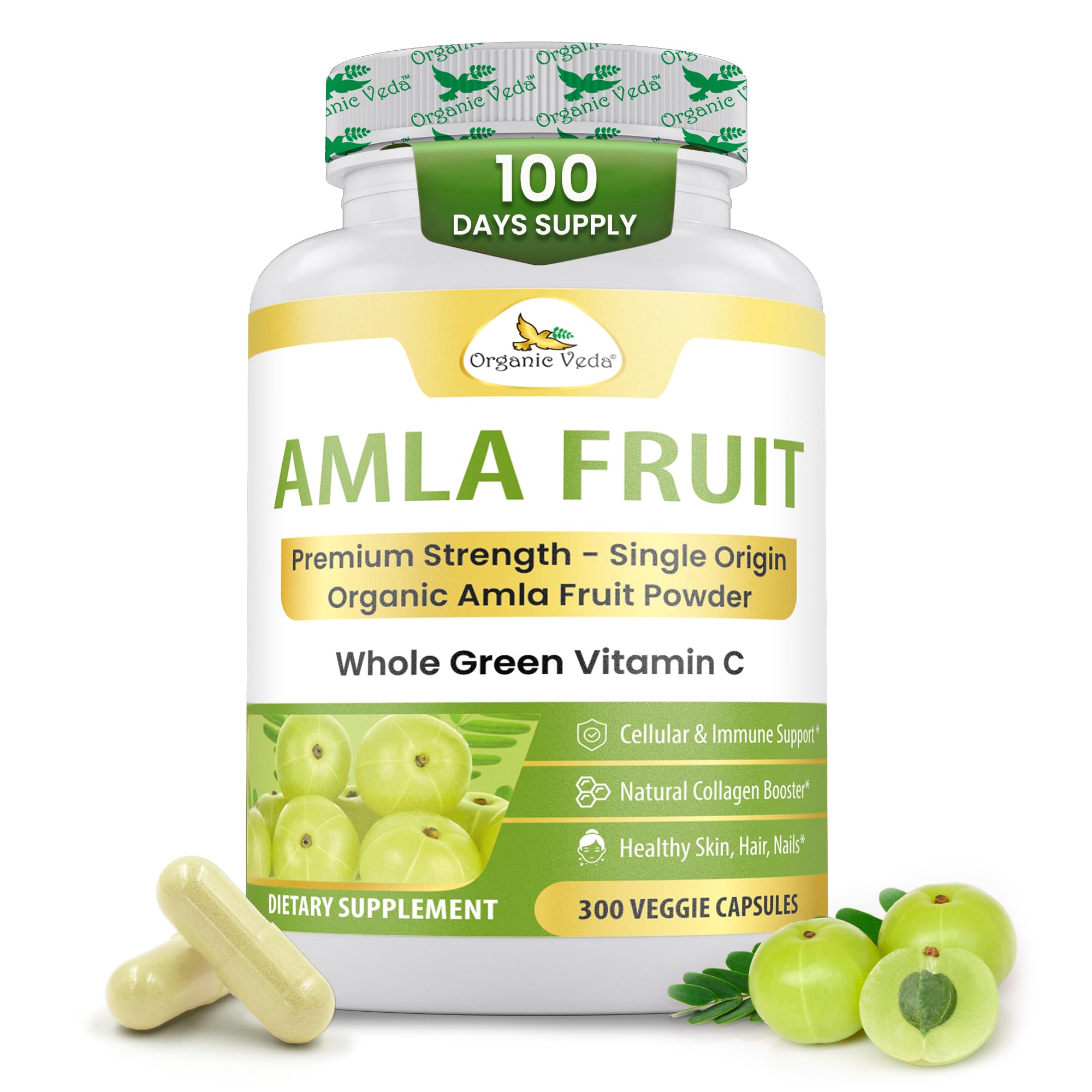
The 300-capsule, 1500mg bottle for beauty-first routines that run for months.
If you plan to take amla every day for the long haul, the arithmetic here is the appeal: a 300-capsule bottle at 1500mg per serving — the same high per-serving dose as the Carlyle pick — sourced from a single farm. Each serving delivers the entire organic amla fruit powder, so nothing is separated out of the fruit, and it is vegan, gluten-free, non-GMO, and preservative-free with no fillers.
The thing to keep in mind is that this is still a whole-fruit product, not a targeted extract, and it will not hit one narrow goal the way a standardized formula might. One owner reported that despite the neuropathy claims, it did not help them — a reminder that the same bottle lands differently from person to person. As a broad daily beauty-and-wellness capsule, though, the size and per-serving dose are hard to argue with.
Built for the long routine
- 300 capsules at 1500mg per serving — the biggest count on the list, so the bottle lasts months
- Entire organic amla fruit powder from a single farm; vegan, gluten-free, non-GMO, no fillers
- Aimed at skin, hair, and nail support as well as everyday immune and heart wellness
Set expectations right
- Whole-fruit formula, not a concentrated extract, so it is not purpose-built for one goal
- Results vary — one buyer found it did not help their specific concern
Reach for this if: you want a big bottle at a high per-serving dose and you care about skin and hair alongside general wellness.
Choose an extract instead if: you have one specific health target in mind and want a concentrated formula for it.
9. USDA Organic Amla Vitamin C Capsules

A whole-food amla capsule for anyone wary of synthetic vitamin C.
This True Veda bottle is aimed at buyers who avoid standard vitamin C pills. The pitch is straightforward: most vitamin C on the market is synthetic ascorbic acid, often derived from GMO corn and processed with chemicals, while this one is made from amla (amalaki) in whole-food form. It carries the USDA organic seal, which means the maker met higher regulatory standards for certification — and the plant-based capsules contain only organic amla fruit, suitable for vegetarians and vegans.
The extraction method is the technical story. A patented Natural Fusion Extract uses only water and clean carbon dioxide gas to pull the active components from the plant, so the whole-fruit nutrient profile stays intact rather than being stripped down. That is why the label leans on bioflavonoids and a clean ingredient list: no fillers, no binders, no additives, no preservatives, and testing at multiple stages of production.
Quality is the strength buyers praise most, with effectiveness second and easy swallowing and zero side effects coming up often — one customer observed new hair growth and planned to reorder. The catch is the size, at just 60 capsules, so a daily routine empties this bottle faster than the 120- and 300-count picks here. If a clean, non-synthetic, USDA organic label is worth a shorter bottle to you, this is the one.
The clean-label angle: USDA organic, whole-food amla rather than synthetic ascorbic acid, extracted with water and carbon dioxide and free of fillers, binders, and preservatives — the list’s purest vitamin C story.
The count to note: only 60 capsules per bottle, so a daily habit runs out sooner than the 120- and 300-count options elsewhere on this list.
Best for: buyers who specifically want non-synthetic, USDA organic, whole-food vitamin C from amla and will pay for the shortest, cleanest label.
Different fit if: you want the longest run per bottle — the higher-count capsules go further.
Know the Specs
Whole Fruit vs Standardized Extract
Whole-fruit amla is the entire dried fruit ground up or packed into a capsule, so you keep the full nutrient matrix — vitamin C, polyphenols, and the natural fiber together. A standardized extract is a concentrated dose of specific active compounds pulled from the fruit, usually built for one goal such as cholesterol support. Whole fruit tends to suit general daily wellness; an extract suits a targeted aim. Neither is “better” — they simply do different jobs, so match the form to what you want it for.
Milligrams Per Serving vs Per Capsule
The milligram number is only useful when you know whether it applies to one capsule or the whole serving. A label that reads 500mg per capsule and tells you to take two means a 1000mg serving — so the daily pill count is really what sets your dose and how long a bottle lasts. Always check both numbers before comparing two bottles, because a 120-count bottle at two pills a day is really only a 60-day supply.
Organic Certification and Third-Party Testing
A USDA organic seal or a CCOF certification is a real verification that an independent body checked how the herbs were grown and handled — it is not the same as a brand simply writing “natural” on the label. Third-party testing, often through ISO-accredited labs, checks the finished product for heavy metals and purity, which matters with any whole-plant ingredient. Pick a bottle that names its certification and its testing, and you have filtered out most of the guesswork.
Powder vs Capsule Format
Powder is the traditional form and is usually the cheapest per gram, but amla is sour, bitter, and slightly gritty, and it mixes into warm liquid — not cold. A capsule hides the taste entirely and keeps your dose consistent, at the cost of a higher per-serving price and swallowing pills. Decide your format first: the form you will actually keep taking beats the form with the best-sounding label on paper.
Common Questions
Should I take amla as a powder or a capsule?
What does 500mg per capsule actually mean for my daily dose?
How do I know if an amla product is actually organic?
How long does one bottle of amla last?
Is a whole-fruit amla capsule the same as an amla extract?
Can I take amla alongside my regular vitamin C supplement?
Why do some customers note amla did nothing for them?
What color should fresh amla powder be?
Will amla interact with medications I take?
Why is amla measured in milligrams if it is a whole fruit?
The Bottom Line
For most people, the amla supplement that makes the most sense is the Banyan Botanicals Amla Powder, because it is USDA certified organic, third-party tested, and the traditional whole-fruit form that a bag of powder lets you dose to taste — and it holds the highest rating of any pick here. If you would rather swallow a capsule, grab the AMLA Capsules (Aura) for its 1000mg whole-food dose and the widest owner approval. And if you are chasing a higher dose in a single serving, the 1500mg Carlyle Amla Capsules or the long-running 300-count Organic Veda Amla Capsules is the one to reach for. Whichever form you pick, the honest nudge — rooted in what buyers keep reporting — is that amla rewards consistency: choose the format you will actually take every day, then give it several weeks before you judge it.
How we choose
We do not accept paid placement. Every pick is matched to a real buyer and a real use-case; we do not hands-on test units.
Sources
Specifications: manufacturer listings and product documentation. Review insights: verified customer reviews, as of October 2026. Pricing: not shown on this page (it changes often); check the current price via the retailer link.
As an Amazon Associate, My Heart Lives Here earns from qualifying purchases. This does not affect which products we feature.