Heads up: This post contains affiliate links. As an Amazon Associate I earn from qualifying purchases, at no extra cost to you. Learn more
Specs are compiled from manufacturer listings and verified buyer reviews and can change over time — please confirm the key details on the product page before buying.
If you want alkaline water without hauling heavy cases home every week, the honest answer is to pick between two paths: bottled water with a high pH already in it, or a pitcher or under-sink filter that makes it from your own tap. Choose by volume: pay per bottle for occasional drinking, or buy a filter once for daily glasses at home. This guide covers both formats, with specs and reviews for each.
This guide is built by comparing the manufacturers’ published specifications and the patterns across verified customer reviews, so you get each pick’s real strengths and trade-offs instead of marketing spin.
The picks below are ordered from bottled cases to countertop pitchers to under-sink systems.
Top Picks
How To Choose The Best Alkaline Water
The first fork in the road is format, not brand. Bottled alkaline water is ready the second it arrives and needs no maintenance, but you are paying per bottle and storing 24 of them somewhere. A pitcher or under-sink filter costs more up front and then makes alkaline water from your tap for months.
Bottled vs. filtered — pick by how you drink
If you drink alkaline water mostly at a desk, in a car, or at the gym, bottled wins on convenience because there is nothing to fill or clean. If your whole household drinks it at home every day, a pitcher or under-sink system replaces a steady stream of plastic bottles with one filter you swap every couple of months.
What pH actually tells you
A pH number measures how acidic or alkaline a liquid is, on a scale where 7 is neutral. Bottled options here sit at a pH of 9.5 or higher, while pitchers typically raise your tap water by a set amount — one here adds up to +2.0 pH units. Higher is not automatically better for taste, so read the reviews on flavor as carefully as the pH claim.
Filter life and capacity, in plain words
Every pitcher filter has a lifespan measured in gallons or liters — the total volume it can clean before you replace it. A filter rated for 105 gallons lasts longer between swaps than one rated for 80 gallons, which matters because replacement filters are the real ongoing cost. Capacity is separate: it is how much water the pitcher holds at once, so a bigger pitcher means fewer refills.
The minerals question
Some filters strip everything out and then add minerals like calcium, magnesium, and potassium back in. Others are built to add a specific mineral — one here adds up to 18mg/L of magnesium — and some avoid adding sodium entirely. Decide which minerals you want before you compare labels.
Side-by-Side Comparison
| Model | Best For | Format | Capacity | Filter Life | Amazon |
|---|---|---|---|---|---|
| Essentia Ionized Alkaline Water★ Best Overall | Grab-and-go hydration | Bottled, 24 x 20 oz | 480 fluid ounces total | — | Amazon |
| Alkaline Water Pitcher 3.5 LitersBiggest Batch | Big-batch home filtering | Pitcher | 3.5 liters | — | Amazon |
| Santevia MINA Filter 3-Pack | Stocking up on replacements | Pitcher filter 3-pack | 80 gallons per filter | 2 months | Amazon |
| Alkanatur Alkaline Pitcher | Magnesium without sodium | Pitcher | 2.5 liters | 3 months | Amazon |
| PIURIFY Hydrogen Bottle | Hydrogen water on the move | Rechargeable bottle | 10 fluid ounces | — | Amazon |
| Waterdrop G5P500A | Fridge and ice maker hookup | Under-sink RO | 500 gallons per day | — | Amazon |
| Waterdrop G3P800 | Big households, fast flow | Under-sink RO | 800 gallons per day | — | Amazon |
Detailed Reviews
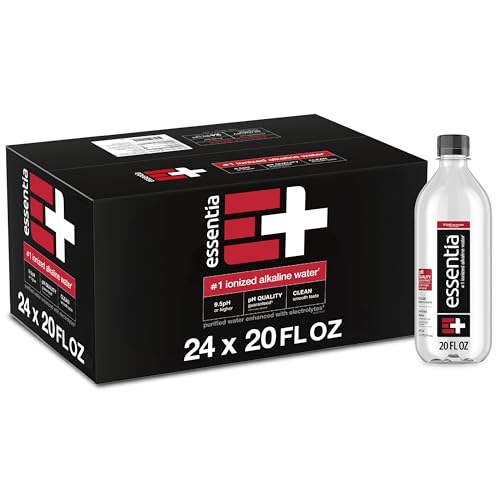
1. Essentia Ionized Alkaline Water 24 x 20oz
Our pick — 4.5+★ from 71,500+ verified ratings; the strongest balance of quality and price.
A 9.5+ pH bottle that needs no filter, no cleaning, and no counter space.
This is the pick for anyone who wants alkaline water to simply exist in the fridge, ready to grab on the way out. Each bottle is 20 fluid ounces, and you get 24 of them in the case — 480 fluid ounces in total. The water is purified through micro filtration and reverse osmosis, which is the process behind the 99.9% pure claim, then ionized to reach a pH of 9.5 or higher. Put plainly: the bitter, acidic-tasting bits are taken out, and that is why it goes down smooth instead of sharp.
What wins people over is the water itself — a huge share of buyers describe it as the best they have had, and taste runs right behind that in what people talk about. That tracks with the ionized finish: a clean, smooth sip with no metallic edge. It is also the easiest pick here to live with, because there is nothing to install, fill, or descale. If you drink alkaline water at a desk or in the car, that matters more than any spec sheet.
The catch is cost per ounce, and people are honest about it — value for money is the one thing buyers split on, with a large group calling it pricey for what is, at the end of the day, water. A pitcher will always work out cheaper over months. But the trade is convenience and consistency: you never wonder whether the filter seated right or when it needs swapping. The crowd favorite among all seven picks — 4.5+ stars across 71,000+ ratings — and the reason is simple: it always tastes the same.
Why This One Leads
- pH of 9.5 or higher, already ionized and ready to drink
- 99.9% pure through micro filtration and reverse osmosis
- Electrolytes added for taste, not just for the label
- Zero setup, zero cleaning, zero counter footprint
Where It Costs You
- Per-ounce cost is the one point buyers push back on
- 31.37 pounds per case, so someone has to carry it in
- No refill option if you run out mid-week
Reach for this if: you want alkaline water at a moment’s notice with no filter to babysit.
Look elsewhere if: you drink several glasses a day at home and would rather buy one filter than a steady supply of bottles.
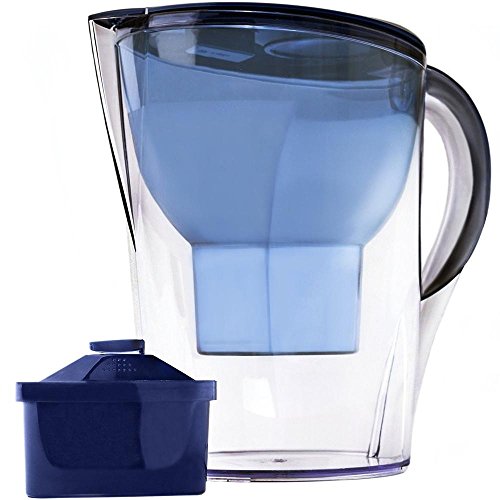
2. Alkaline Water Pitcher 3.5 Liters
The biggest pitcher here, sized to fill several glasses before you refill it.
The cartridge runs through seven stages: ion exchange resin, tourmaline, mineral balls, and carbon. In everyday terms, that stack pulls out chlorine, odors, and heavy metals, and the maker states it removes 90% of zinc, copper, lead, and pollutants. The body is food-grade AS and ABS plastic, and it is BPA-free.
Quality is what people talk about most here, with taste close behind — the water comes out tasting clean and that is the reason most people keep using it. The design helps: a slim body that fits in the fridge, a lid you can fill without lifting off, and an easy-pour spout that does not dribble down the side.
The honest part is the mechanics. Functionality splits down the middle, with some units working fine and others giving up quickly. Leakage shows up too — water dripping out and the filter not seating properly, letting unfiltered water slip past. Filter life is the other thing to watch. So the trade-off is real, but it is a known one: check the filter is seated firmly every time you swap it, and this pitcher delivers a lot of water for the space it takes up.
The size advantage: 3.5 liters means fewer refills than the 2.5-liter Alkanatur, and at 2 pounds empty it stays easy to lift out of the fridge door.
What to keep an eye on: seat the cartridge fully on every change — the recurring gripe is water sneaking past an unseated filter.
Right for you if: you want the largest countertop batch and do not mind checking the filter fit now and then.
Pass if: you want a set-and-forget pitcher — the leak and durability notes are the reason to look at the Santevia or Alkanatur instead.
3. Santevia MINA Alkaline Water Filter Value Pack, 3-Pack
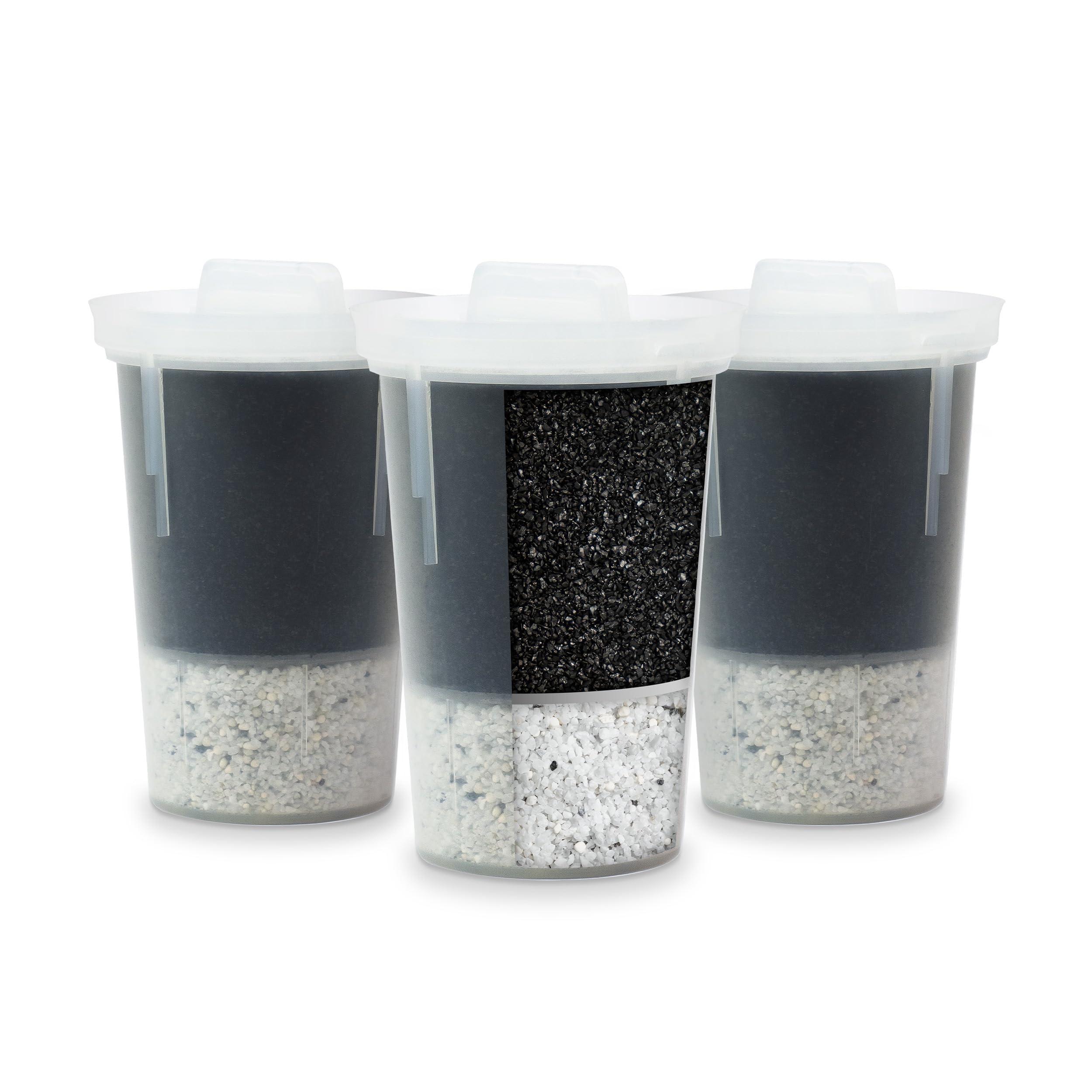
Three replacement filters in one box, so your pitcher never sits empty waiting on a delivery.
This is not a pitcher — it is a three-pack of filters for the Santevia MINA slim pitcher, and that changes who it is for. If you already run a MINA, this is the buy that keeps you stocked: each filter handles 300 liters, or 80 gallons, before you swap it, with a stated life cycle of 2 months.
Inside, a granulated activated carbon filter pulls out chlorine and pharmaceuticals, then adds calcium, magnesium, and potassium back in. It raises pH by up to +2.0 units, and the minerals are why the water reads as smooth rather than flat. Filter quality is what people single out most, and taste comes next — the water simply tastes fresh, which is the whole point with a filter.
One thing to plan around: at a 2-month life cycle, this box covers roughly six months of drinking, not a year. That is shorter than the Alkanatur’s stated 3 months per filter. The upside is that each filter is small and light, so storing a spare is no burden. If you want the longest gap between swaps, the Alkanatur filter runs longer per unit.
What it solves: no last-minute scramble when the filter runs out — three are already in the cupboard, each rated for 80 gallons.
The honest math: a 2-month life cycle means this pack covers about six months, so plan your next order before the third filter goes in.
Best match: existing Santevia MINA owners who want to buy filters in one go and forget about it.
Not the one for you: if you do not own a MINA pitcher, this box does nothing on its own — start with a full pitcher instead.
4. Alkanatur Alkaline Water Filter Pitcher
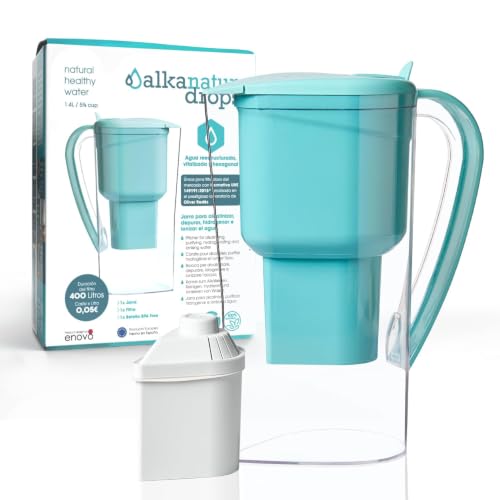
The pitcher that adds magnesium instead of sodium, and tells you exactly how much.
Most alkaline pitchers soften water by swapping calcium and magnesium out for sodium — this one does the opposite. It skips ion exchange resin entirely, alkalizes to a pH of 8.5 to 9.5, and adds up to 18mg/L of magnesium along the way. For anyone watching sodium, that is the whole reason to pick it over the others here. The filter also removes up to 99%+ of PFAS, fluoride, chlorine, heavy metals, microplastics, and more, and holds a stated UNE 149101:2025 certification — a European drinking water standard.
Quality is what people highlight most, with taste next — the water comes out clean-tasting instead of flat. Ease of use gets consistent praise too, and it earns it: the tank keeps filtered and unfiltered water separate, the 2.5-liter body fits most fridge doors, and each filter runs 3 months or 105 gallons. That is 50% longer per filter than the Santevia’s 2 months.
Two things to weigh honestly. The first is that a small group reports white particles floating in the water, which usually points to a filter that needs flushing before first use. The second is value — buyers split on whether the price matches the performance, so it is a considered buy rather than an impulse one. Neither is a reason to rule it out; they are reasons to flush the filter and go in with clear expectations.
Why it stands out: no sodium, up to 18mg/L magnesium, and a 105-gallon filter that lasts 3 months between swaps.
The note to hear: flush the new filter before your first pour — a few buyers caught white particles and it is usually a break-in issue.
Pick this when: you want magnesium in your water and would rather avoid added sodium, with a longer filter life than most pitchers offer.
Keep shopping if: you prefer a larger batch than 2.5 liters or want to spend less up front.
5. PIURIFY Hydrogen Water Bottle Generator, 6300+ PPB
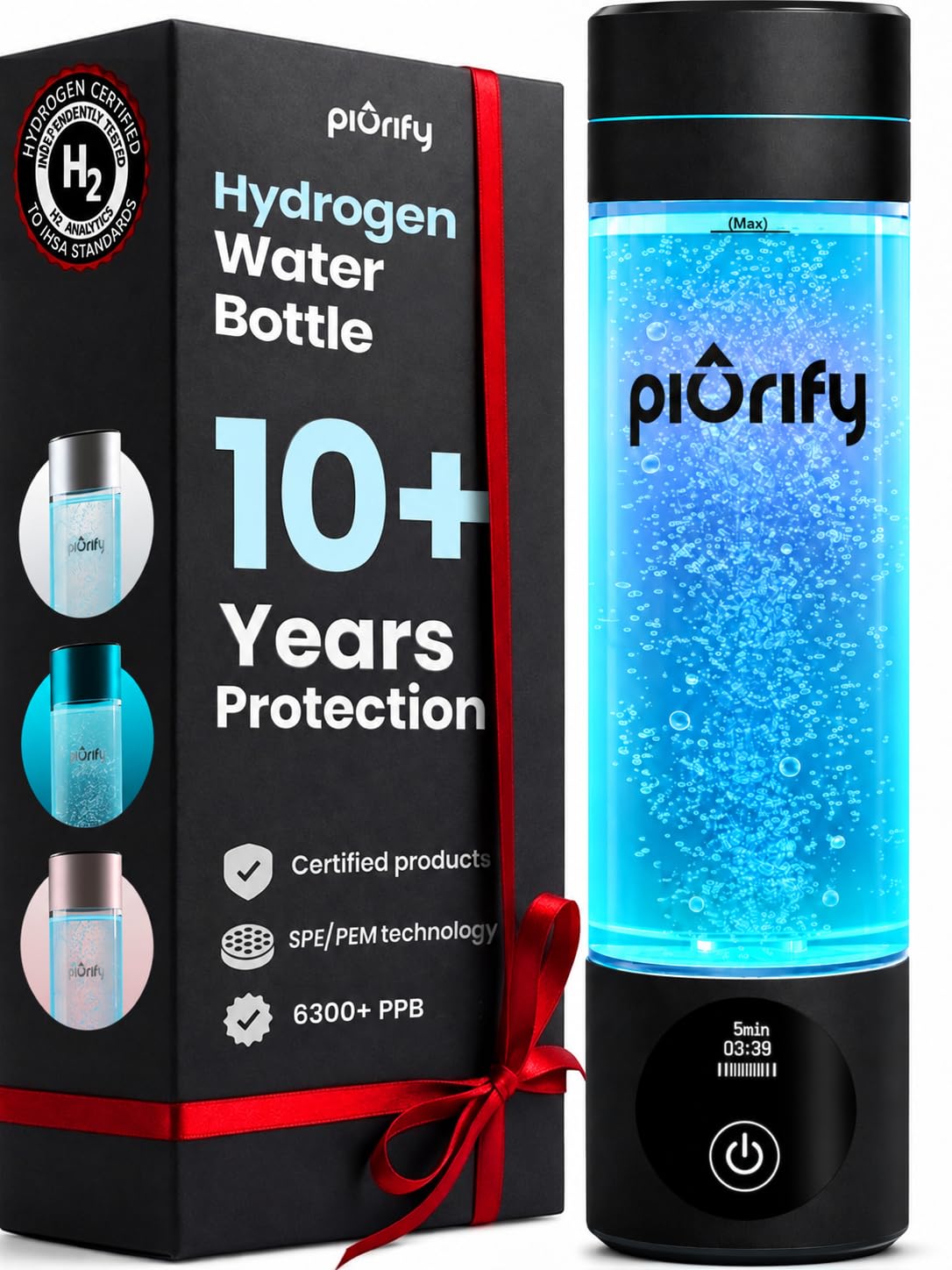
A rechargeable bottle that makes hydrogen water in ten minutes, no tablets and no refills.
This one is a different drink entirely. Instead of raising pH, it dissolves molecular hydrogen into your water using SPE/PEM technology — a sealed membrane that generates the gas cleanly. The numbers are specific: a 5-minute cycle gets you 2,550 PPB (parts per billion of dissolved hydrogen), and a 10-minute cycle gets you 4,100+ PPB. Run three 10-minute cycles and it reaches up to 6,310 PPB. The maker states it is lab-tested at 2.58–6.30 mg/L.
The bottle holds 10 fluid ounces and weighs 12.96 ounces, so it travels in a bag without dragging it down. An OLED display shows where you are in the cycle, and the body is food-grade PC rather than glass — a deliberate choice, since the gas and pressure can crack glass. A 10-year warranty backs it, and there is human support behind it rather than a bot.
Be clear on what this is not: it does not filter your tap water and it does not adjust pH. You fill it with drinking water you already trust. It is also a single-serve bottle, so it suits one person’s routine rather than a family’s worth of drinking water. If you want a whole-household fix, a pitcher or under-sink system does that job — this is the personal, portable option.
The cycle math: 5 minutes for 2,550 PPB, 10 minutes for 4,100+ PPB, or three 10-minute runs for up to 6,310 PPB.
Set expectations: it hydrogenates water, it does not filter or alkalize it, so start with water you would drink anyway.
Suits you if: you want portable hydrogen water on demand and like the idea of a 10-year warranty standing behind it.
skip it if: your goal is filtering tap water or raising pH — this bottle does neither.
6. Waterdrop G5P500A Reverse Osmosis Water Filter, 8-Stage
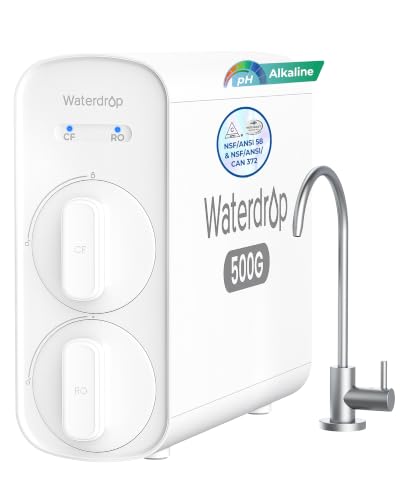
The under-sink system that makes alkaline water straight from the tap, no pitcher to fill.
If the pitcher refill cycle is what wears you down, this moves the whole job under the counter. It runs eight stages of filtration, including a 0.0001 μm RO membrane — a pore size small enough to block particles that size and larger — and then adds minerals like Ca²⁺, Mg²⁺, Na⁺, and K⁺ back in through alkaline mineralization. It reduces PFOA, PFOS, chlorine, lead, fluoride, and heavy metals along the way. Filtration is what people praise most here, closely followed by how well the unit performs day to day.
The flow is the standout spec: 500 gallons per day (GPD, meaning total volume per day), which fills a 6-ounce cup in 8 seconds. That is the difference between waiting and just filling your glass. It also runs a 2:1 pure-to-drain ratio, so for every two cups of clean water you get one cup of wastewater — a tighter ratio than older systems. Going tankless frees up to 70% of your under-sink space, and with Waterdrop XT you can route it to a fridge or ice maker.
The real caveats are installation and noise. This needs a hole drilled in the countertop for the faucet, so renters should check before buying. Noise splits both ways — some units run quiet, others develop an insistent beep over time. Water flow draws mixed notes too, with a few reporting a slow second filter. None of that is unusual for an under-sink system, but it is the honest picture.
What Earns It a Spot
- 500 GPD fills a 6-ounce cup in 8 seconds
- 8-stage filtration with a 0.0001 μm RO membrane
- 2:1 pure-to-drain ratio keeps wastewater down
- Tankless build frees up to 70% of under-sink space
The Practical Friction
- Faucet install requires drilling through the countertop
- Some units develop a persistent beep over time
- At 21.4 pounds, it is a two-person lift under the sink
The right call for: a household that wants alkaline water on tap and has a countertop they can drill.
Think twice if: you rent, or you want a filter you can set on the counter and move without tools.
7. Waterdrop G3P800 Tankless Reverse Osmosis System, 800 GPD
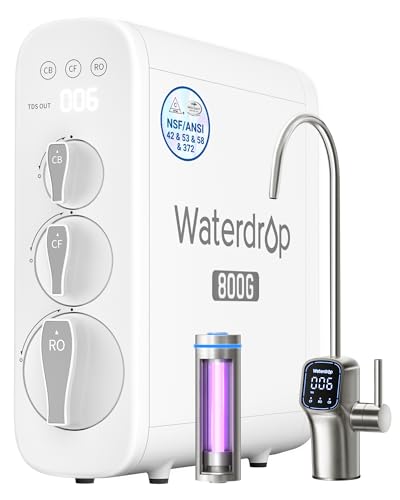
The big-household system: 800 gallons a day, a cup in five seconds, and a smart faucet.
This is the step up for a busy kitchen, and the gap between it and the G5P500A is right there in the numbers. It pushes 800 gallons per day against the G5P500A’s 500, and fills a cup in just 5 seconds versus 8. It also runs a 3:1 pure-to-drain ratio, so one cup of wastewater for every three cups of clean water. Ten stages of filtration reduce PFAS, fluoride, lead, chromium, iron, nitrates, and chloride, and it carries NSF/ANSI 42, 53, 58, and 372 certification.
The smart faucet is the detail people notice — an LED ring lights up when water flows and shows the TDS level (total dissolved solids, a rough read on what is in the water) at a glance, with a stated lamp life of up to 50 years. Quality is the top thing buyers talk about, with ease of installation right behind, and the water itself comes out tasting crisp. It is genuinely a low-maintenance way to get alkaline water at the sink.
The trade-off is long-term cost and reliability. Value is the split point — some find it well worth it, others say the maintenance cost runs high. Reliability draws harder notes, with reports of pumps failing and units quitting after roughly 15 hours of running. So this is the pick for someone who wants the top flow rate and accepts that a complex system needs care over the years.
Why it leads on flow: 800 GPD and a cup in 5 seconds beats the G5P500A’s 500 GPD and 8 seconds, and the 3:1 ratio trims wastewater further.
The long view: replacement filters and repairs add up over time, so go in expecting running costs beyond the initial buy.
Worth it for: a large household that wants the fastest flow and a faucet that reads water quality at a glance.
Look at the G5P500A instead if: you want the under-sink convenience without the higher running cost.
Know the Specs
What pH and PPB actually mean
pH measures how acidic or alkaline water is, on a scale where 7 is neutral. Bottled options here sit at 9.5 or higher, while pitchers usually raise your tap water by up to +2.0 units. PPB stands for parts per billion and shows up only on hydrogen bottles — it measures how much dissolved hydrogen is in the water, not how alkaline it is. Two different numbers for two different jobs, so do not read one as the other.
Filter life vs. capacity
Filter life is how much water a cartridge can clean before it needs replacing, measured in gallons or liters — one here handles 105 gallons over 3 months, another 80 gallons over 2 months. Capacity is how much the pitcher holds at once, like 3.5 or 2.5 liters. A big capacity saves you refills; a long filter life saves you money on replacements. They are not the same thing, and a pitcher can be strong on one and weak on the other.
GPD and pure-to-drain ratios
GPD means gallons per day — the total volume an under-sink system can produce in 24 hours. Higher GPD means faster filling at the faucet. The pure-to-drain ratio tells you how much water is wasted to make the clean stuff: 2:1 means one cup goes down the drain for every two you drink, while 3:1 wastes less. If water bills matter to you, that ratio is worth checking before you buy.
Certifications to look for
Look for NSF/ANSI numbers (independent standards for filtration performance) or a named European standard like UNE 149101. These tell you a third party verified what the filter removes, rather than taking the label’s word for it. One pitcher here carries UNE 149101:2025, and one under-sink system carries NSF/ANSI 42, 53, 58, and 372. Fewer certifications do not mean bad water, just less independent proof.
Common Questions
Is bottled alkaline water better than a pitcher?
How often do I need to change a pitcher filter?
Does alkaline water help with stomach acid?
What does a pure-to-drain ratio of 2:1 mean for my water bill?
Can a hydrogen water bottle replace an alkaline pitcher?
Do alkaline pitchers really remove fluoride and lead?
Will an under-sink RO system fit my kitchen?
How much water does a 3.5-liter pitcher actually hold for drinking?
Is it worth paying more for a higher-flow under-sink system?
Can I put alkaline water in a baby’s bottle?
The Bottom Line
For most people, the alkaline water that fits easiest into daily life is the Essentia Ionized Alkaline Water, because it is already at a pH of 9.5+ with nothing to filter, fill, or clean — and its 4.5+ star record over 71,000+ ratings makes it the safest first buy. If you want to stop buying bottles, grab the Alkanatur Pitcher for its magnesium and no-sodium formula. And if your whole household drinks at the tap, the Waterdrop G3P800 is the one to reach for, with 800 GPD and a cup in 5 seconds.
How we choose
We do not accept paid placement. Every pick is matched to a real buyer and a real use-case; we do not hands-on test units.
Sources
Specifications: manufacturer listings and product documentation. Review insights: verified customer reviews, as of November 2026. Pricing: not shown on this page (it changes often); check the current price via the retailer link.
As an Amazon Associate, My Heart Lives Here earns from qualifying purchases. This does not affect which products we feature.