Heads up: This post contains affiliate links. As an Amazon Associate I earn from qualifying purchases, at no extra cost to you. Learn more
Specs are compiled from manufacturer listings and verified buyer reviews and can change over time — please confirm the key details on the product page before buying.
If you want cleaner air without spending a fortune, the short answer is this: a mid-range unit with a true HEPA filter and a real air-quality sensor will handle dust, pet dander, smoke, and cooking odors in a normal bedroom or living room. You do not need to spend the most to get that. What you do need is to match the machine’s cleaning power to your room size, and to check what replacement filters cost before you commit.
This guide is built by comparing the manufacturers’ published specifications and the patterns across verified customer reviews, so you get each pick’s real strengths and trade-offs instead of marketing spin.
Every pick below fits the same budget ceiling, so the real differences come down to room coverage, noise, and how the sensors behave overnight. Here is what actually separates the winners in this air purifier under 200 roundup.
Top Picks
How To Choose The Best Air Purifier Under 200
The biggest mistake buyers make in this bracket is buying on brand name alone. A purifier is a fan, a filter, and a sensor. If the fan cannot move enough air for your room, the filter never gets the chance to work. So start with the room, not the logo.
Match the machine to your room size first
Every purifier lists a coverage figure, and those figures are quoted for different time windows. A unit rated for a large room in one hour is being generous to itself — the same machine often handles a much smaller room in a quarter of that time. Look at the “1 hour” number and treat it as your ceiling, not your target. Bedrooms and offices rarely need more than a mid-size unit, and buying oversized just means a louder fan running at higher speed for no benefit.
Look at CADR, the number the box hides in the fine print
CADR stands for Clean Air Delivery Rate, and it measures how many cubic feet of filtered air the unit pushes out per minute. It is the single most honest performance number on a purifier, because it combines airflow with how well the filter actually catches particles. Manufacturers sometimes bury it. High CADR means faster cleaning. Low CADR on a big room means the unit will be running at maximum speed forever, which is both loud and hard on the filter.
Decide if you want a sensor or a manual dial
An auto mode uses an onboard particle sensor to read the air and raise the fan speed when dust or smoke spikes. In practice this means the machine handles the work for you — it idles quietly most of the day, then ramps up when you cook or when the dog shakes. A manual unit is simpler and cheaper, but you have to notice the problem yourself before you turn it up.
Check the filter cost before the sticker
A cheap purifier with costly filters is expensive over three years. Some units use a single combined cartridge you replace in one piece; others split the HEPA and carbon layers so you can swap each separately and stretch the cheaper one longer. Both designs work. The one to avoid is a machine whose replacement filter is hard to find or sold in odd bundles, because a purifier with no fresh filter is just a noisy box.
Think about where the noise actually lands
Almost every purifier in this bracket is genuinely quiet on its lowest setting. The real question is what happens when the sensor triggers high speed at 3 a.m. A unit with a dedicated sleep mode dims its lights and locks the fan low. A unit without one may wake you. If the machine is going in a bedroom, sleep mode is not a nice-to-have — it is the deciding feature.
Side-by-Side Comparison
| Model | Best For | Coverage (1 hr) | Filtration | Noise Floor | Amazon |
|---|---|---|---|---|---|
| Honeywell Allergen Plus Compact★ Best Overall | Bedside use in small rooms | 530 sq. ft. | 3-in-1 HEPA, 360° intake | 20.81 dBA | Amazon |
| Coway Airmega 100Best Value | Larger open rooms and living areas | 810 sq. ft. | Pre-filter, deodorization, HEPA | Lowest fan speed | Amazon |
| Levoit Eleva 300XTop Performer | App control and smart scheduling | 161 CFM CADR | DuoShield split HEPA + carbon | 20 dB | Amazon |
| Medify MA-25 | Big room cleaning on a mid budget | 825 sq. ft. | True HEPA H13 | 19.8 dB | Amazon |
| Honeywell Allergen Plus HPA4300W | Whole-room coverage with a carry handle | 1718 sq. ft. | 4-layer 360° HEPA | Two lowest fan speeds | Amazon |
| Blueair Blue 311i Max | Deep cleaning in medium rooms | 2,107 sq. ft. | HEPASilent dual filtration | 23 dB | Amazon |
| Winix 5510 | Very large rooms and smoke control | 1881 sq. ft. | True HEPA plus carbon | 23.5 dB | Amazon |
| Shark Clean Sense HP102PET | Pet households and small rooms | 500 sq. ft. | NanoSeal anti-allergen | Ultra-quiet sleep mode | Amazon |
Detailed Reviews
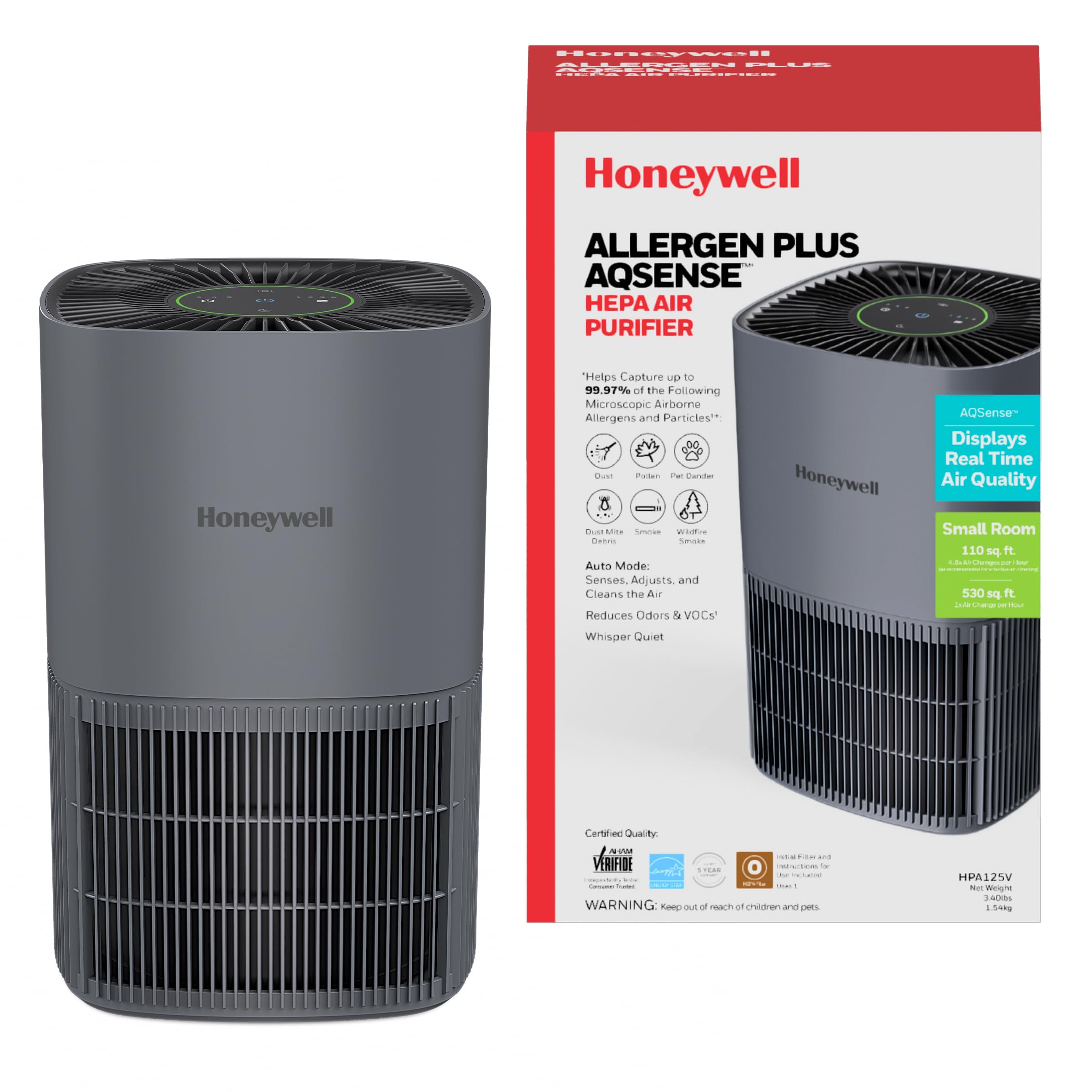
1. Honeywell Allergen Plus HEPA Air Purifiers
The tabletop unit that reads the room and quiets itself down before you fall asleep.
If your bedroom is where you actually notice bad air — the morning sniffles, the dust on the nightstand — this is the one to start with. It is a compact unit that sits on a nightstand or dresser and cleans 110 sq. ft. of room air up to 4.8 times every hour, with a rated 530 sq. ft. per hour at the top end. Compare that to the Coway’s 810 sq. ft. in the same hour window and you can see Honeywell is aiming at small rooms on purpose rather than pretending to be a whole-house machine.
The filtration is a 360° intake design, which means air gets pulled in from all sides instead of one grille. Inside, a pre-filter catches pet hair, a true HEPA layer captures up to 99.97% of allergens, and an activated carbon stage handles odors and VOCs (volatile organic compounds — the fumes that off-gas from paint, cleaners, and new furniture). The AQSense auto mode reads the room continuously and adjusts fan speed on its own, showing what it finds through green, yellow, and red indicator lights, so you can see at a glance whether the air is clean or whether something just kicked up dust.
The nighttime performance is the headline. Sleep mode drops the fan to as low as 20.81 dBA — a decibel is a unit of loudness, and 20.81 dBA is roughly the level of a quiet room — and the lights dim so they do not glow across the ceiling. The thing that wins people over is raw effectiveness; the second most-praised trait is how little noise it makes, which is exactly the combination a bedroom unit needs. Owners describe the auto mode catching odors, boosting when the air turns stale, and settling back down on its own, and one recurring note from cat owners is that the litter box smell disappears. The catch worth knowing is the touch panel: it is sensitive enough that a curious cat can turn the unit off with a paw swipe, and the unit sits low enough that pets reach it easily. If you have cats that investigate everything, plan to place it out of their reach.
What earns the top spot
- Sleep mode bottoms out at 20.81 dBA with dimmable lights, so it disappears into the background at night
- AQSense auto mode reads real-time air quality and adjusts fan speed, with green, yellow, and red indicators you can read instantly
- 360° filtration with a pre-filter for pet hair, true HEPA capturing 99.97% of allergens, and activated carbon for VOCs
- Compact 7 x 7 x 11 inch tabletop footprint that slips onto a nightstand or into a dorm room
The trade-offs to weigh
- The touch control panel is easy for pets to bump, and buyers report cats turning it off by accident
- At 530 sq. ft. per hour it trails the larger machines here on raw coverage, so it is a small-room tool
- High fan speed is loud enough to disturb sleep if auto mode triggers it at night
Made for: A bedroom, nursery, dorm, or home office where you want the machine to run itself and stay silent overnight.
Not the one if: You have cats that jump on furniture and press buttons, or you need a unit to carry a large open living space.
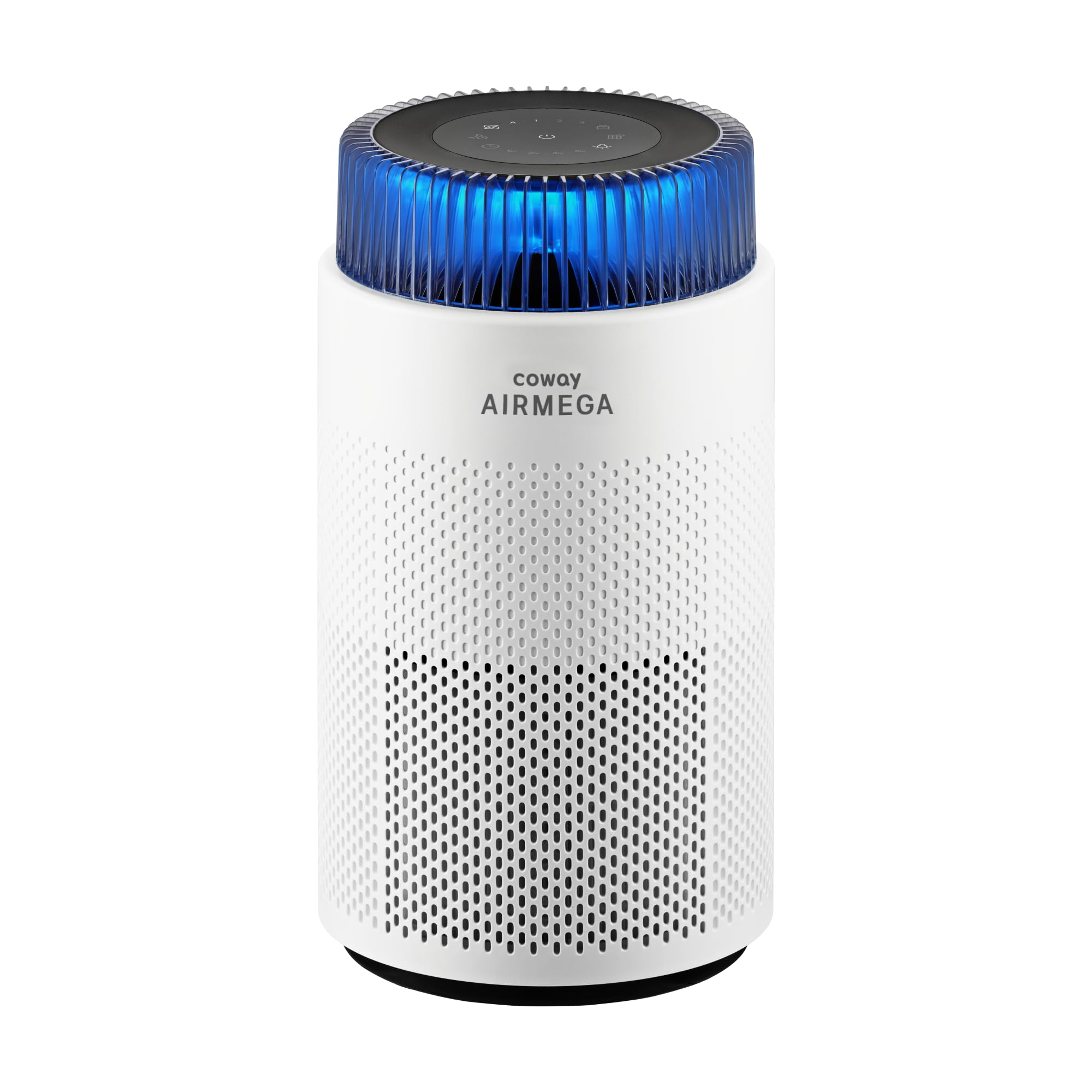
2. COWAY Airmega 100 Air Purifiers
The tall one that covers a big living room while sitting in a corner almost unnoticed.
A 810 sq. ft. rating at this price is the number that puts Coway in the conversation — that is 53% more coverage than the Honeywell compact above, and it is why this unit suits an open living room rather than just a bedroom. It cleans 405 sq. ft. in 30 minutes and pushes to the full 810 in an hour. The filtration stack is a pre-filter for the big stuff, a deodorization layer, and a true HEPA filter that cuts 99.97% of particles down to 0.3 microns, including pollen and other allergens, along with a reduction in VOCs and odors.
Auto mode does the thinking for you by watching air quality and adjusting fan speed in real time, and there is a three-speed manual setting — low, medium, high — if you would rather set it yourself. Sleep mode turns off the AQI and touch-button lights and drops the fan to its lowest speed so the room stays dark and quiet. The build quality is the trait that consistently stands out to owners, followed by the soft ambient light, which doubles as a night light without being intrusive. Owners mention it performing better than older purifiers they owned, and it has the smallest footprint of any machine here at 8.66 x 8.66 inches of floor space, though it stands 15.55 inches tall so it reads as a slim tower in the corner.
The honest catch: Noise is the split opinion here — some owners describe it as super quiet, especially on the lowest setting, while others find higher speeds noticeable. It is also not a silent machine at max, so if you want one unit to run loud in the kitchen while you cook and silent in the bedroom at night, this is more of a daytime-room choice. Filter replacement is a fixed cost to plan for, with the indicator lighting up after roughly five months of regular use. At 7.5 pounds it is also 0.2 pounds lighter than the Levoit Eleva 300X at 7.7 pounds, which matters only if you plan to move it between rooms often.
Worth it if: You want the most room coverage for the money and have a spot in the corner of a living area.
Skip the corner spot if: You need dead-silent operation at higher fan speeds in the same room where you sleep.
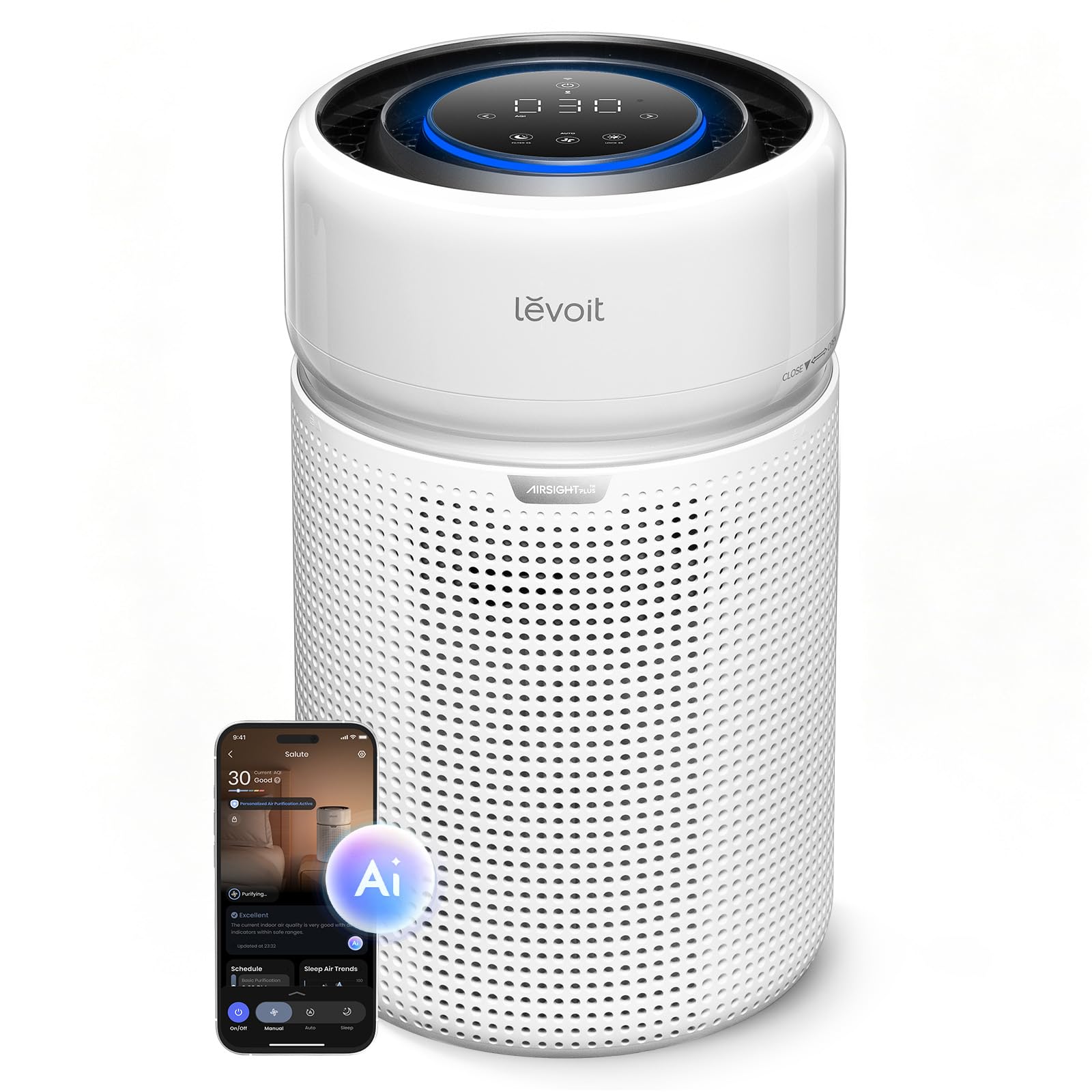
3. LEVOIT Eleva 300X Air Purifier
The app-controlled one that tells you exactly which particle is floating through your bedroom.
This is the pick for someone who wants data, not just a fan. The 3-in-1 sensor reads PM1.0, PM2.5, and PM10 — those are particle size classes in micrometers, with PM2.5 being the fine dust and smoke range that matters most for indoor air — and shows you the current state of the room in real time. The fully sealed HEPA system moves 161 CFM of filtered air, which stands for cubic feet per minute, and captures 99.97% of allergens down to 0.3 µm. Performance is by far the trait that carries this machine, with effectiveness right behind it, and both have thousands of owners behind them.
Sleep mode drops to 20 dB, which is quieter than a whisper in practice, and the screen automatically turns off for the night with a light sensor that adjusts brightness based on the room without you touching anything. You can disable that behavior in the app if you prefer. The DuoShield design splits the HEPA and activated carbon layers so you replace each on its own schedule instead of trashing a combined cartridge, and the second layer can be upgraded to a Smoke & Cooking, Pet, or Premium carbon filter for targeted gas and odor control. Filter life is rated at 2 years, and the unit is ENERGY STAR 3.0 certified with 7.5W average consumption — a watt is a unit of power draw, so 7.5W average is roughly the draw of a small LED bulb.
The VeSync app is where the smart controls live: real-time AQI, mode selection, schedules, timers, Alexa and Google Assistant connection, and filter-life tracking. Owners who run multiple units describe scheduling low speed during the day and high at night, and the app setup is consistently called easy. The thing to know before buying is its size: at 9.4 x 9.4 x 15.1 inches it occupies more surface area than the Honeywell compact, which is 7 x 7 x 11 inches — the Levoit is 34% larger in those dimensions — so it takes real estate on a nightstand. Customers note that the display can be brighter than expected on some units, though the light-sensor auto-dimming addresses that overnight.
Where it wins: Real-time particle readouts across three size classes, a two-year filter life rating, and a split-filter design that cuts long-term replacement cost. That smart sensor package is the reason it tops the app-controlled group.
Reach for this if: You want to see your air quality numbers live and control the machine from your phone on a schedule.
Look elsewhere if: You need something that fits on a tight nightstand — this takes up noticeably more surface than the compact options.
4. Medify MA-25 Air Purifier

A compact frame with the lungs of a much bigger machine, plus a lifetime warranty behind it.
On raw cleaning reach, this one punches at the top of the group. It cleans spaces up to 825 sq. ft. in one hour — that edges past the Coway’s 810 sq. ft. — and the filter is a true HEPA H13 that removes 99.9% of particles down to 0.3 microns, including allergens, VOCs, smoke, wildfire smoke, pollen, pet dander, dust, and smog. Two filters run side by side so a compact body can still move serious air. If you have a big room and a mid-range budget, this is the honest performance-per-dollar play.
Noise is where Medify sets expectations low and delivers. The lowest of three fan speeds runs at 19.8 dB — quieter than the Winix 5510’s 23.5 dB floor — while the top speed hits 49.3 dB, and sleep mode dims the panel lights completely for dark rooms. A decibel number that low on paper rarely survives real-world placement, so the practical note is that low is genuinely silent and high is loud; there is not much middle ground. Features include a touch panel, a 0-8 hour timer, fan speed control, a filter replacement indicator, and a child lock for households with kids or pets.
Owners are clear about what this unit does well: it clears a room fast, handles cat odor on the low setting, and stays easy to live with. The quality of the build is the strongest single trait, with effectiveness close behind. What shows up as the recurring gripe is the reliability picture — a subset of reviewers point out issues surfacing over time, so this is a machine worth registering for its warranty on day one and keeping filter changes on schedule. The replacement filter is listed at 2,500 hours, or roughly 3-4 months of regular use, and the listed part number is worth keeping on hand since these filters sell out during wildfire season.
Why it belongs here
- 825 sq. ft. in one hour with a true HEPA H13 filter rated to 0.3 microns
- 19.8 dB on the lowest setting with a fully dimming sleep mode
- Touch panel with a 0-8 hour timer, filter indicator, and child lock
- Backed by a USA registered lifetime warranty, with the replacement filter listed as B084Q965BF
What to plan around
- The high fan speed reaches 49.3 dB, so daytime use is where it belongs
- Replacement filters are the ongoing expense to budget for, and supply can run thin during fire season
- There is no air-quality sensor, so you raise the speed yourself rather than letting the machine react
Best for: Big rooms, apartments with open floor plans, and households that want maximum cleaning reach without stepping up in class.
One thing to accept: No onboard sensor — if you want the machine to notice the air got worse, this is not that machine.
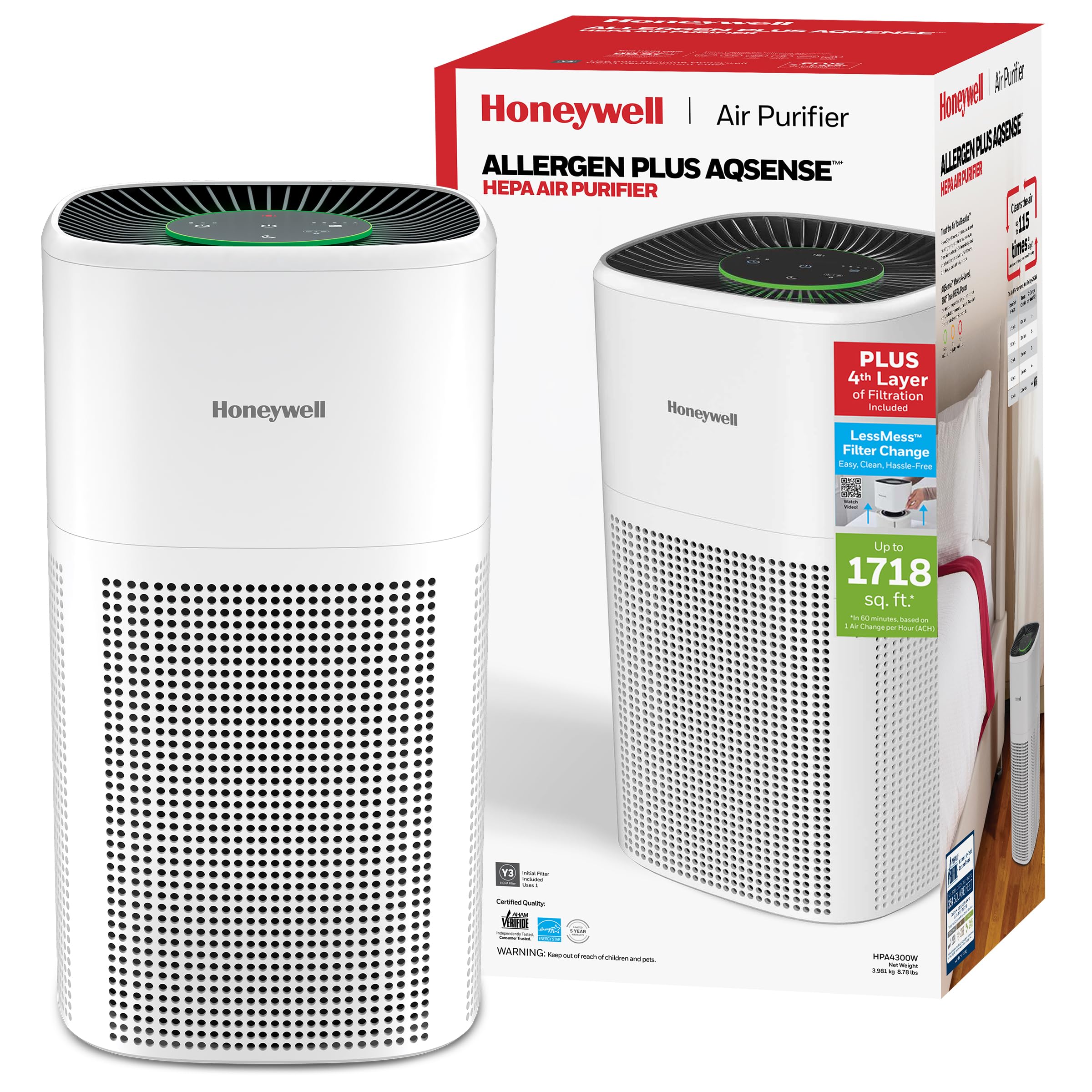
5. Honeywell HPA4300W Air Purifier
The carry-handle workhorse built to cover a whole floor, not just one corner of it.
If you measure a purifier by how much space it can honestly handle, this is the biggest number in the group: 1718 sq. ft. at one air change per hour, or 354 sq. ft. cleaned up to 4.8 times hourly for real turnaround. That is more than double the coverage of the Coway’s 810 sq. ft., and it is why this one suits an open-plan ground floor or a large master bedroom rather than a single small room. The 4-layer system wraps 360° around the intake: a pre-filter for pet hair, true HEPA capturing 99.98% of allergens, activated carbon for odors and VOCs, plus a fourth layer of protection the smaller Honeywell models do not carry.
Day-to-day ownership is where this machine earns its keep. The LessMess system swaps filters in one click with no dust cloud, and the carry handle means you can move it from the living room to the bedroom without wrestling it. Four cleaning levels, timer settings, sleep mode, a child lock, and a filter change indicator round out the controls, and AQSense auto mode watches real-time air quality with the same green, yellow, red indicator language as its compact sibling. The weight tells the story here — at 12.1 pounds it is the heaviest machine in this lineup, which is a point in favor of stability and a knock against carrying it upstairs.
Straight talk: The lowest two fan speeds are whisper quiet and the highest two are genuinely loud, which is the pattern owners keep landing on. The auto feature handles the transitions for you, which is the whole reason to buy this version over a manual dial. One honest note is that the 1718 sq. ft. figure assumes a single air change per hour — in practice, for a room you actually occupy, expect the useful range to be closer to the 354 sq. ft. “4.8 times per hour” number. The replacement filter is a planned expense, listed at up to 12 months of life.
Built for: A large open living area or a whole-floor placement where you want one unit to do the work of two.
Think twice if: You plan to move it room to room nightly — 12.1 pounds gets old fast on stairs.
6. BLUEAIR Blue 311i Max Air Purifiers
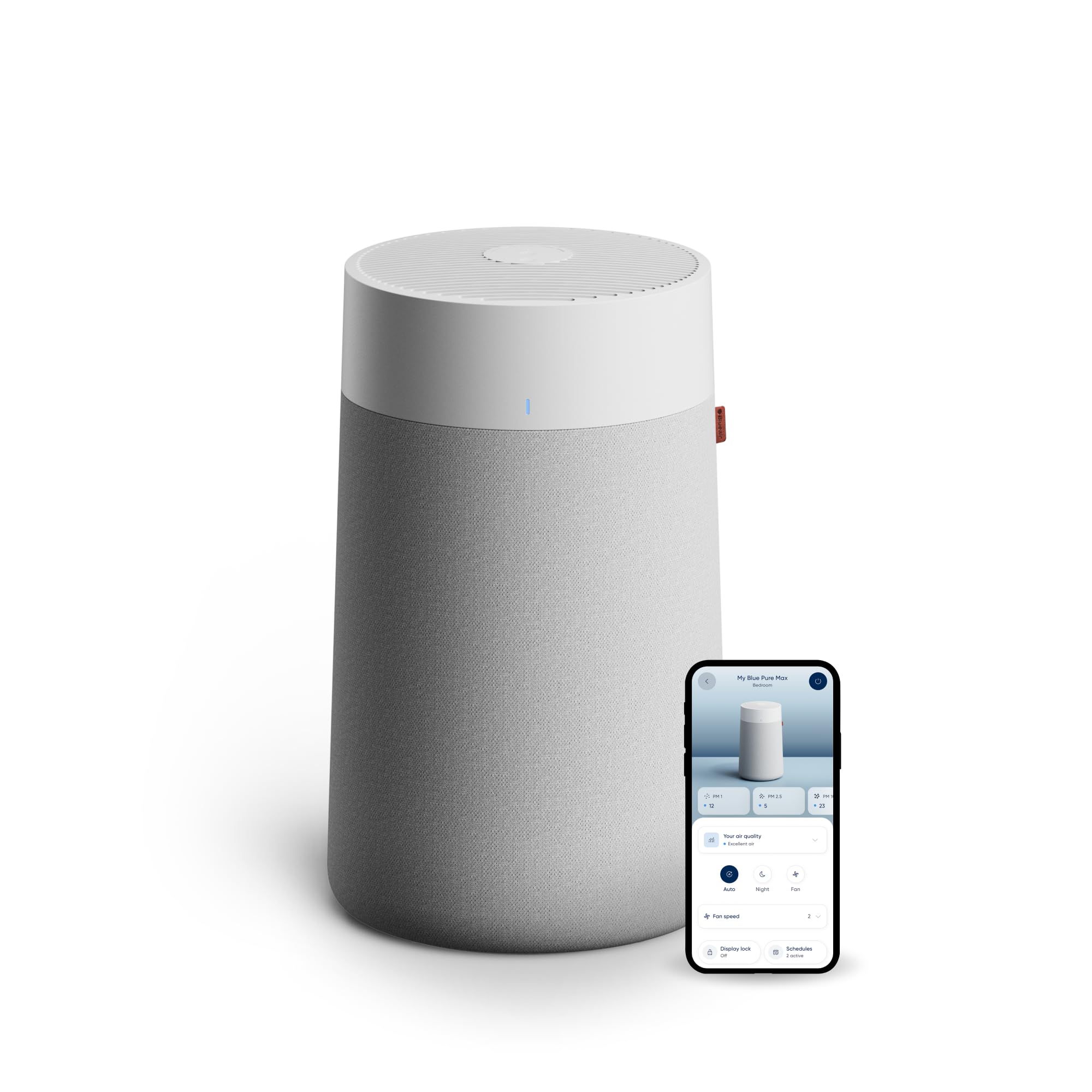
Scandinavian looks hiding a fan that clears a medium room in under a quarter hour.
The Blue 311i Max is the speed play. It cleans 439 sq. ft. in 12.5 minutes and reaches 2,107 sq. ft. in an hour, which is the largest stated coverage figure in this roundup. HEPASilent dual filtration — Blueair’s own name for combining electrostatic charging with mechanical filtration — captures 99.97% of airborne particles down to 0.3 microns, covering dust, pollen, pet dander, mold particles, and smoke. That combination of filtration depth and airflow is exactly what carries this unit’s reputation, with air quality results right beside it in owner feedback.
The 360° air intake pulls from every direction, wrapped in a fabric pre-filter that traps lint and pet hair before it reaches the main filter — and owners note the pre-filter is washable, which stretches the paid filter’s life. The companion app handles air quality monitoring, scheduling, and filter-life tracking, and built-in sensors raise fan speed automatically when pollution levels climb. In practice owners describe auto mode reacting quickly to cooking smoke and kicking down again once the room clears. The unit is QuietMark-certified and runs between 23–50 dB, which puts its quiet floor close to the Medify MA-25’s 19.8 dB and the Winix 5510’s 23.5 dB; on low it is genuinely unobtrusive, and on high it fades into the background as white noise rather than a nuisance.
Sizing is where you need to be realistic. At 12.5 x 12.5 x 19 inches it takes up more floor footprint than most of the machines here, so a corner of a bedroom or office is where it sits best. The one caveat owners keep flagging is the ongoing cost of replacement filters, which is worth checking before you commit. A few also note that the fan intake sits within reach of small objects — one account describes a toddler dropping a pen into the fan and needing screws and disassembly to retrieve it — so if you have curious little hands, placement matters. On the plus side, the unit restores your settings after a power loss.
Where it shines: Fastest stated cleaning in the group, with washable pre-filter and app scheduling built in.
Worth knowing: Replacement filters are the recurring cost, and the intake is low enough that small hands and small objects are a real consideration.
Suit yourself if: You want the fastest clean on the list and a machine that looks like furniture.
Consider the alternative if: You need the smallest possible footprint or plan to relocate it weekly.
7. WINIX 5510 Air Purifier

The one with a light sensor that switches itself into sleep mode the moment you turn off the lamp.
This is the most familiar name in the group for a reason, and the smart touch is what separates it: the unit automatically drops into a quiet, energy-efficient Sleep Mode when the room darkens, then returns to Auto Mode when light returns. That means you do not touch it before bed. The filtration stack is four layers — a washable fine mesh pre-filter, an advanced odor-control carbon filter, true HEPA, and a Plasmawave ionizer stage — and the HEPA layer captures 99.99% of airborne allergens including pollen, dust, smoke, and pet dander as small as 0.3 microns. Coverage is rated at 1881 sq. ft. in one hour, or 941 sq. ft. in 30 minutes, 627 sq. ft. in 20 minutes, and 470 sq. ft. in 15 minutes if you want to think about it in shorter windows.
Noise is the trait it is best known for, and the manufacturer lists the slowest speed at 23.5 dB, with the sleep mode being quieter still. Air quality is reported through a visual LED indicator, and the built-in sensor adjusts fan speed automatically in real time. The Winix Smart App adds remote control and monitoring, plus a filter-life tracker. Owners describe the machine running in a bedroom, eliminating a carpet smell within days, and staying quietly unnoticed on low or auto. Filter cost is where owners say this unit pays off: one buyer reports an OEM filter lasting a year of continuous use — which is a different lifetime than the Medify MA-25’s 3-4 month cadence, so if filter cost per year is your deciding factor, that gap matters.
The honest caveat is the app, which a segment of owners describe as laggy or slow to respond when they want to adjust the machine from their phone. If you want reliable app control for scheduling, the Levoit’s VeSync setup is the smoother experience in this list. The second thing to plan for is the unit’s size — at 11 x 15.9 x 25.2 inches and 13.3 pounds, it is the tallest machine here and it wants floor space, not a nightstand. A few owners also report a clicking noise developing on the sleep speed after some use, though note that the unit ships with a warranty and that a small number of reports does not define a machine this well-established.
What owners keep coming back for
- Auto sleep mode that triggers off the room light and returns to Auto when you wake
- True HEPA rated to 0.3 microns with a washable pre-filter and odor-control carbon layer
- 1881 sq. ft. coverage in one hour, with a 470 sq. ft. clean in 15 minutes if you need speed
- App support with remote control and filter-life tracking, plus an LED air quality indicator
Where it asks for patience
- The app is described as laggy and slow to respond by a portion of owners
- Tall footprint at 11 x 15.9 x 25.2 inches and 13.3 pounds, so it wants floor space
- Occasional reports of a clicking noise on sleep speed after extended use
Goes to bat for: Smoke, pet odors, and carpet smells in large rooms, with a sleep transition you never have to think about.
Hold off if: Phone app control is a must-have for you — the app experience lags behind the hardware.
8. Shark HP102PET Air Purifier

The smallest and lightest pick, built for the household with a dog that owns the couch.
At 5.85 pounds and 8.66 x 8.66 x 14.56 inches, this is the most compact machine in the roundup and the easiest to tuck under a desk or beside a bed. It cleans up to 500 square feet at one air change per hour, which is the smallest coverage number here — so this is a single-room unit, not a whole-floor workhorse. The filtration is a pet-specific NanoSeal anti-allergen filter that traps 99.98% of large, small, and micro-sized particles, exceeding HEPA standards per the manufacturer’s testing described as IEST-RP-CC007 for 1-0.2 microns.
Two features make this one interesting. First, the CleanSense IQ display shows air quality changing in real time, and the “Clean Air 100%” readout means airborne particle concentration from PM 1.0 to 10 is at or below the sensor’s detection limit — not that the room is pollutant-free, which is a useful distinction most purifier displays do not spell out. Second, and more unusual, is the filter-life math. The manufacturer lists filter replacement at every 6-12 months based on continuous use, and one owner reports getting four to five years out of a single filter in normal household conditions — an unusually long stretch compared to the Medify MA-25’s 3-4 month cadence. For pet households where dog hair is the daily battle, that filter economy is the point.
What earns its place: Air quality results are what owners talk about first, with quiet operation right behind. The auto-on behavior is another nice touch — the unit powers up when it detects poor air, and owners describe watching it ramp up when a dog runs through the room or candles get lit. It is also FSA and HSA eligible per the listing, subject to your health plan administrator’s requirements.
Fair warning: Filter-life and air-quality readouts are the split subjects here — some owners find the display reads 100% almost all the time, so if you want a machine that visibly reacts to every air event, the Levoit’s real-time particle readout will feel more informative. The blue status light is bright enough that some owners turn it off at night, and the display has no separate dimming called out.
Best pick for: Pet owners with a single room to cover, and anyone with a flexible spending account looking for a machine that fits under furniture.
Not for you if: You need 800-plus square feet of coverage in one machine or you want the sensor to react dramatically to every change.
Know the Specs
CADR and What It Actually Tells You
CADR stands for Clean Air Delivery Rate, and it is the number that combines two things: how much air the fan moves, and how well the filter catches particles along the way. It is usually given in cubic feet per minute, sometimes broken out by smoke, dust, and pollen because those particle sizes interact with filters differently. A high CADR number means the unit will clean a room faster, which lets it run at a lower fan speed to reach the same result — and lower fan speed means less noise. If a purifier lists a big coverage area but no CADR figure, the coverage number is worth less than it looks. Use CADR as your apples-to-apples comparison when two machines claim the same room size.
HEPA Ratings and the Micron Number That Matters
True HEPA is a specific filtration standard, not a marketing word — the filter is tested to capture 99.97% of particles at 0.3 microns, which is the size where filters are least efficient and therefore the hardest test. Some manufacturers list a smaller micron figure, like 0.1 or 0.01, which describes capture of smaller particles under those manufacturers’ own test conditions. Both numbers are useful, but do not confuse them with coverage. A filter rated to 0.3 microns does not clean a bigger room than one rated to 0.3 microns; it simply describes the smallest particle size tested. What actually matters for real-world use is the combination of true HEPA filtration and enough airflow to pass room volume through the filter repeatedly — usually measured as “air changes per hour.”
Common Questions
Will a purifier in this price range actually help with pet dander?
How big a room can a mid-range purifier really clean?
What does auto mode add over a manual fan setting?
How often will I have to replace the filter and what does that cost?
Is a 20 dB purifier actually quiet enough for a nursery?
Do i need an air quality sensor or is it a gimmick?
What is the difference between true HEPA and HEPA-type filters?
Can a purifier get rid of cooking smells and smoke in an open kitchen?
Are these safe to leave running all night and while away?
Do purifiers with a low micron claim clean a bigger room than one rated to 0.3 microns?
The Bottom Line
For most rooms, the air purifier under 200 winner is the Honeywell Allergen Plus Compact — because 4.8 air changes per hour in a 110 sq. ft. room, a 20.81 dBA sleep mode, and an AQSense auto mode that handles the work for you is the exact combination a bedroom actually needs. If you want to cover a large living area, the Coway Airmega 100 delivers 810 sq. ft. of coverage with an AQI monitor and a soft ambient light. And for the household with a dog and a single room to fix, the Shark Clean Sense HP102PET is the compact, low-weight pick built around pet filtration.
One honest nudge for the shopping cart: before you check out on any of these, look up the replacement filter price for the exact model you are buying. A purifier that runs on a filter you can actually afford to refresh is the one that keeps cleaning your air for years, not the one with the flashiest coverage number on the box.
How we choose
We do not accept paid placement. Every pick is matched to a real buyer and a real use-case; we do not hands-on test units.
Sources
Specifications: manufacturer listings and product documentation. Review insights: verified customer reviews, as of October 2026. Pricing: not shown on this page (it changes often); check the current price via the retailer link.
As an Amazon Associate, My Heart Lives Here earns from qualifying purchases. This does not affect which products we feature.