Heads up: This post contains affiliate links. As an Amazon Associate I earn from qualifying purchases, at no extra cost to you. Learn more
Specs are compiled from manufacturer listings and verified buyer reviews and can change over time — please confirm the key details on the product page before buying.
If your vintage camera’s built-in meter died decades ago, or you simply do not trust the phone app you have been squinting at, an affordable handheld meter is the fix. The short answer: the TTARTISAN Light Meter II is the one to start with, because it slides onto a cold shoe, runs up to 60 hours on replaceable batteries, and costs a fraction of a Sekonic. But it is not the right meter for everyone. If you shoot Leica glass and want a real viewfinder, the LightMate Area 2S is the sharper pick. And if you are measuring grow lights or checking a commercial lighting code, the Triplett LT80 and LATNEX LM-50KL are built for exactly that work.
This guide is built by comparing the manufacturers’ published specifications and the patterns across verified customer reviews, so you get each pick’s real strengths and trade-offs instead of marketing spin.
There are two very different jobs hiding behind the same phrase, so start by deciding which one you actually have. Here is how I narrowed this down to the affordable light meter picks worth your money and the ones to walk past.
Top Picks
How To Choose The Best Affordable Light Meter
Before you compare a single model, answer one question honestly: are you metering light for a photograph, or measuring light for a room? These are two different instruments that happen to share a name. An exposure meter tells you which shutter speed and aperture to set on a film camera. An illuminance meter tells you how many lux or foot-candles are hitting a surface, which is what you need for a lighting audit, a grow tent, or a code inspection. Buying the wrong one is the single most common mistake in this category.
One Reading Versus A Whole Scene
The metering angle is the width of the cone the sensor looks at, written in degrees. A narrow angle like 7° reads a small patch of light, which is what you want when you are metering a subject’s face across the street. A wide angle like 45° averages the whole scene in front of you. Neither is better — they solve different problems. If you shoot backlit portraits or stage work, narrow is king. If you want a quick average of a landscape, wide is faster and more forgiving.
Why EV Accuracy Beats A Long Feature List
EV stands for exposure value, and it is the number your meter produces when it reads the scene. Accuracy is measured in stops, where one full stop is a doubling or halving of light. A meter that reads within half a stop is doing well; a meter that drifts a full stop or more will ruin a roll of slide film before you notice. Vintage film cameras and slide film give you almost no room for error, so a tight accuracy spec matters more than a long menu of shooting modes you will never touch.
How You Power It Matters More Than You Think
There are two camps here: built-in rechargeable batteries charged by USB-C, and user-replaceable button or AAA cells. A USB-C meter is convenient and never leaves you hunting for the right battery. A replaceable-cell meter is still working in ten years, because you can swap the battery instead of retiring the whole unit. If you shoot often, USB-C wins. If you shoot twice a year and hate remembering to charge things, replaceable cells are the safer bet.
Mounting: Shoe, Handheld, Or Both
A cold shoe mount slides your meter onto the top of the camera so you can read it mid-shot without putting it down. A separate sensor on a wire lets you place the sensor under the light while you stand somewhere comfortable. Meters with a built-in sensor are smaller and faster for handheld use but force you to hold the whole unit where the light is. Think about whether you shoot on a tripod, handheld, or both before deciding which layout suits you.
Side-by-Side Comparison
| Model | Best For | Metering Angle | Battery | Weight | Amazon |
|---|---|---|---|---|---|
| TTARTISAN Light Meter II★ Best Overall | Cold-shoe film shooting | 45° average | Replaceable, up to 60 hours | 2.82 oz | Amazon |
| LightMate Area 2STop Performer | Leica and viewfinder metering | 17° (with OV-X1 viewfinder) | Rechargeable, 20+ hours | 1.23 oz | Amazon |
| LightMate AirPro | Retro dial shooters | 35° wide-angle | Rechargeable, 20+ hours | 5.3 oz | Amazon |
| Triplett LT80 | White LED and projector checks | — | 2 AAA batteries | 5.6 oz | Amazon |
| LATNEX LM-50KL | Lighting audits and inspections | — | 9V battery, ~200 hours | — | Amazon |
| CHI L.D. Light Meter Pro | Spot metering plus rangefinding | 7° ultra narrow | Rechargeable 370 mAh | 5.6 oz | Amazon |
| Extech LT40 | Everyday commercial lux readings | — | 2 AAA batteries | 4.9 oz | Amazon |
Detailed Reviews
1. TTARTISAN Light Meter II
A featherweight dial-driven meter that pops onto any cold shoe and reads in seconds.
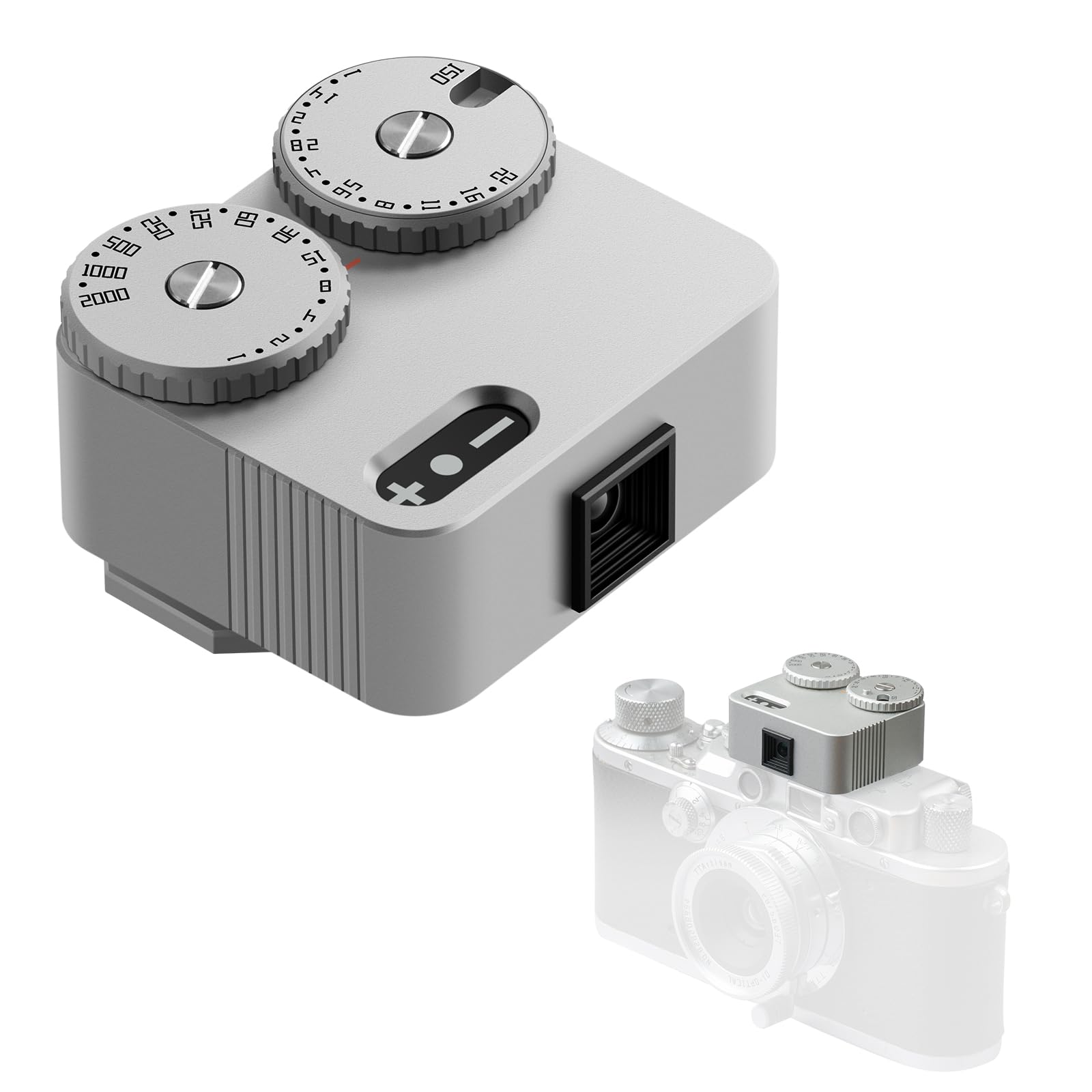
If you have a shelf of 1970s SLRs and rangefinders with dead or missing meters, this is the one to reach for first. The cold shoe mount adjusts across three positions, so it fits anything from an old Argus-style body to a niche rangefinder. The body is made from aircraft-grade aluminum and weighs just 34 grams — about 1.2 ounces — so your camera still balances the way it did before you bolted anything on. The 23-stop shutter speed dial and clicked aperture wheel stop accidental bumps from drifting your settings between shots.
The number that decides it for most buyers is runtime: up to 60 hours of continuous metering on user-replaceable batteries. That is three times the battery life of the LightMate Area 2S, which tops out past 20 hours, and it means a full season of weekend shooting without a charging cable in sight. Nothing is built in — you supply the battery — which is exactly why this meter will still work long after a rechargeable unit’s cell has swollen and failed. The sensor reads a 45° average, wide enough to read a landscape quickly without fiddling.
The honest catch is consistency. The function and quality of individual units draw split opinions in the review pages — some owners get flawless readings from day one and others hit trouble. The manufacturer’s rated life assumes careful battery installation, and the contacts are the fragile point, so treat the battery compartment gently and seat the cell straight. If your unit arrives working, expect it to keep working; if the dials feel loose from the start, return it inside the window rather than living with it.
Why Owners Keep It Mounted
- Up to 60 hours of continuous metering — three times the LightMate Area 2S
- 23-stop shutter dial and clicked aperture wheel resist accidental changes
- 34 grams of aircraft-grade aluminum adds almost no weight to a vintage body
- Adjustable cold shoe fits SLRs and rangefinders across three positions
The Caveat To Weigh
- Readings are split from the start — some units are flawless, others are not
- Floating contacts mean the battery needs careful, straight installation
- 45° average metering reads a scene, not a pinpoint spot
Who it suits: Shooters with one camera and one meter who want dials under their fingers and no charging routine to remember.
Worth knowing first: The unit-to-unit consistency is the gamble, so buy somewhere with a clean return policy and test it on day one.
2. LightMate Area 2S Light Meter
The viewfinder meter that weighs closer to a feather than a tool — 1.23 ounces, spot on for Leica bodies.
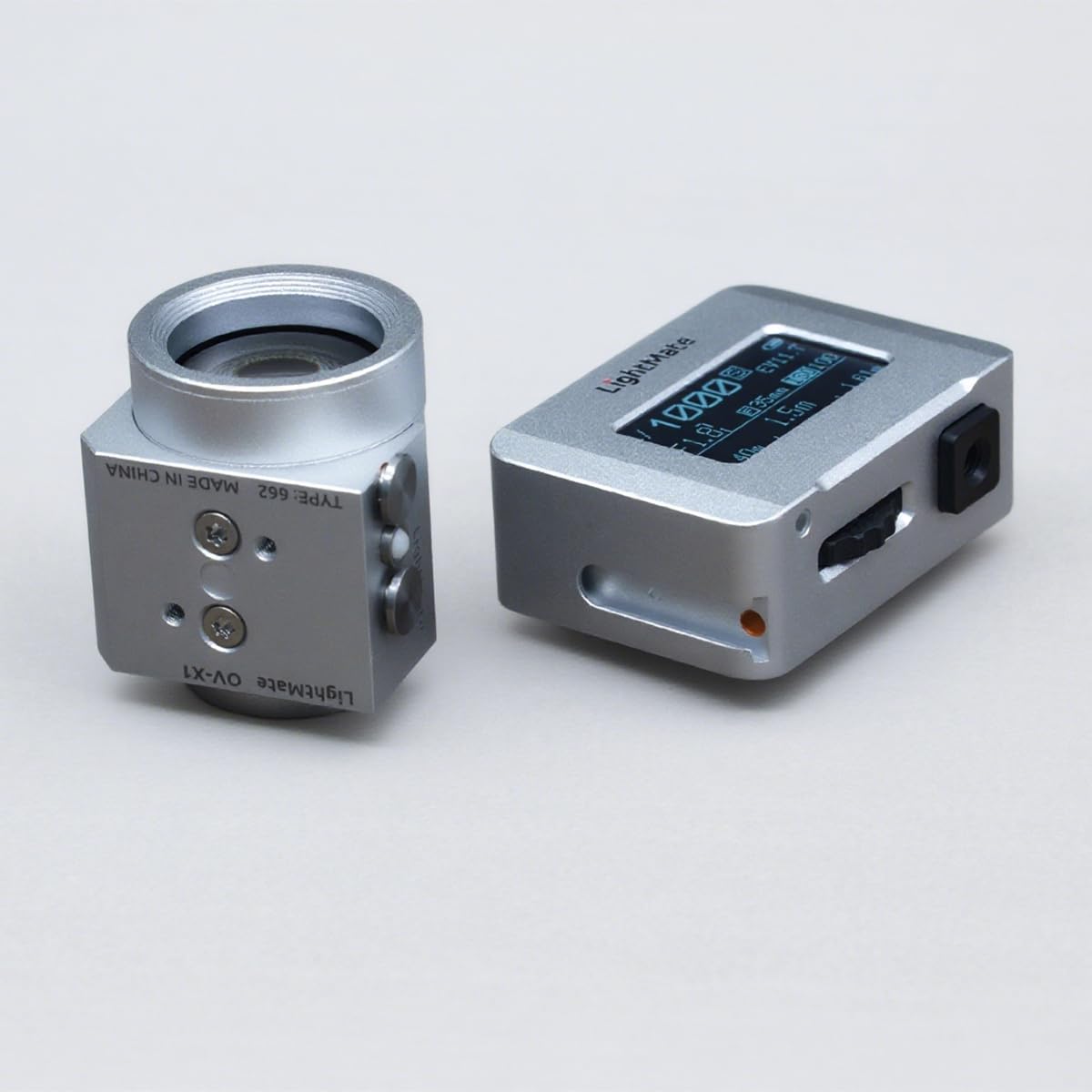
Here is the gap that sells this meter: the LightMate AirPro tips the scale at 5.3 ounces, while this one comes in at 1.23 ounces. If you shoot a Leica M with a wrist strap, that difference is the line between a camera that still feels like jewelry and one that pulls forward all day. The OV-X1 17° viewfinder clips onto the vfPort interface, letting you aim at the exact patch of light you want rather than pointing the meter and hoping. Inside is a 0.96″ OLED screen that stays readable even outdoors once you bump brightness in the Settings menu.
The feature set punches above its size. You get Aperture Priority, Shutter Priority, and Manual modes, selectable with a click of the M-button, plus Single Trigger, Continuous Trigger, and Average metering modes for different shooting scenarios. Dial step values switch between Full and X steps for aperture and Full and 1/3 steps for shutter speed, so the reading matches your lens and body mechanics exactly. Exposure compensation and ND filter compensation are both on board, and a digital depth-of-field readout uses hyperfocal distance for street work — you set your lens frame and focal length once and the meter answers the zone question for you. A built-in rechargeable battery covers more than 20 hours of use and holds standby charge for over six months switched off, topping up over USB-C.
The one thing to plan around is low light. This meter is at its strongest in normal daylight conditions; the spot read gets noisy in dim scenes, where an incident-style meter is the better call. Some owners also find their unit needs a small EV compensation offset before it reads true, so run one roll against a meter you trust before you commit a serious shoot to it. Buyers report that the removable viewfinder with its defined metering circle is the part they reach for most — that circle is what turns a vague reading into a decision.
What the viewfinder does: The 17° read shows you exactly what the meter is seeing, so bright and shadow areas get metered separately and you split the difference on purpose.
Where it gives ground: Low-light spot metering needs care, and a verifiable EV check against a known-good meter is smart before a paid shoot.
Reach for this if: You want viewfinder metering on a light body and would rather not carry a heavier meter all day.
Look elsewhere if: Your work happens at night — an incident meter handles low light better than a spot read.
3. LightMate AirPro Light Meter
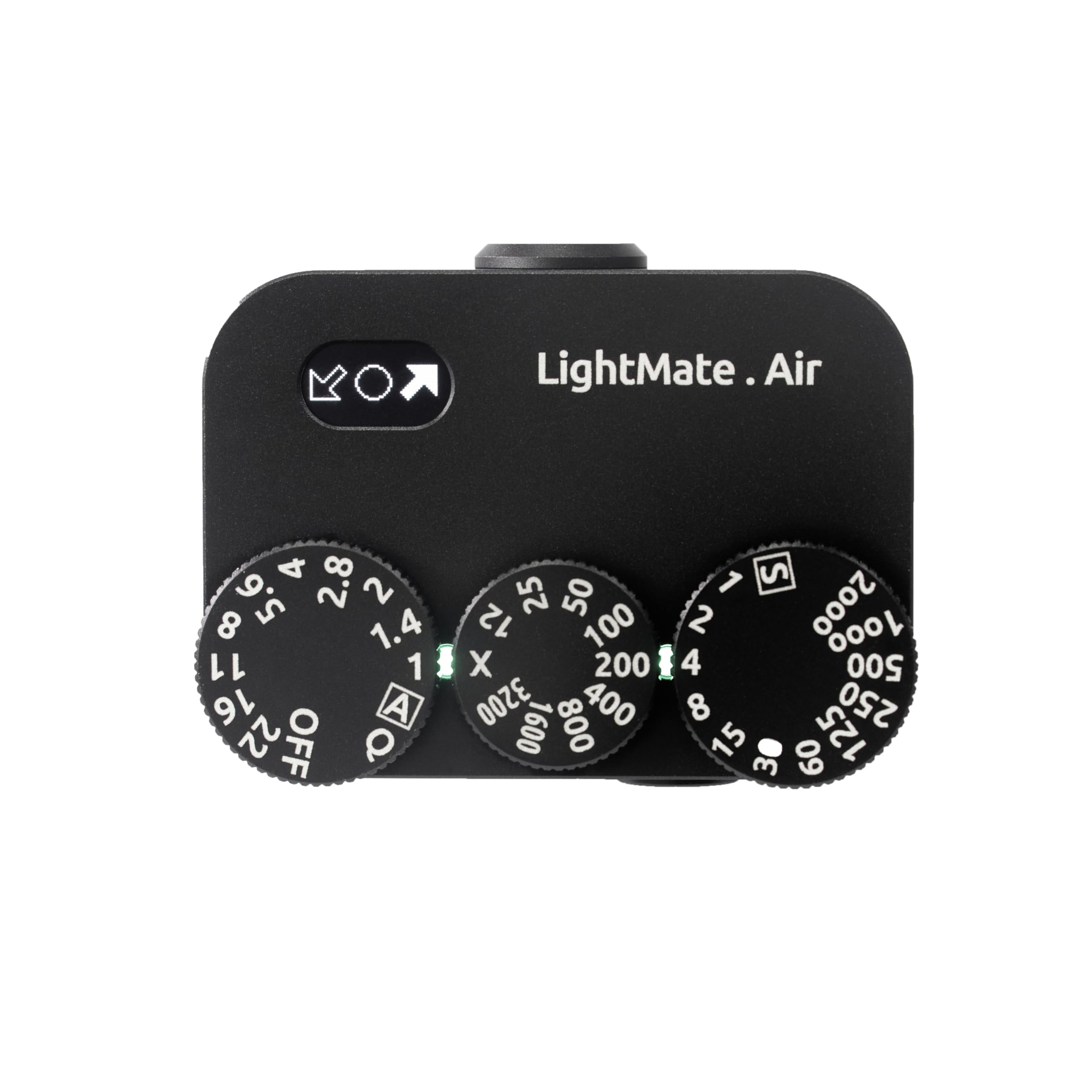
Three clicked dials, a full metal shell, and no menus to learn — the meter for people who hate screens.
Metering accuracy here is stated as ±0.1EV across an ISO range of ISO1 to ISO3200, with shutter speeds from 60 seconds to 1/2000s and apertures from F1 to F28. The read comes through a 35° wide-angle reflective sensor, which averages a scene the way an in-camera meter would rather than picking out a single spot. Owners say their readings land within half a stop, and one reviewer compared the AirPro against two other meters and found the numbers matched exactly. Those numbers mean something real: half a stop of error is invisible in print, so you stop second-guessing every exposure.
The build is the other half of the pitch. Three independent dials — one each for aperture, ISO, and shutter speed — give tactile and audible feedback as you spin them, so you know you hit the value without looking up. Half-stop resolution is adjustable to 1/3 or 2/3 stops, and the aperture and shutter auto modes can be locked down to 1/3-stop or full-stop increments. Over ten exposure indicators can be customized in Manual mode with your own color choices, plus dual LED cardinal point indicators. It runs on a built-in rechargeable battery via USB-C for over 20 hours of use and more than six months of standby. Metering is quick: click M for a manual trigger, long-press for auto trigger.
Weighing 5.3 ounces does not sound heavy — but here it is: the LightMate Area 2S sits at 1.23 ounces, so this meter is the noticeably heavier option in the same family. It also ships with two genuine annoyances. The [A] and [S] mode labels are confusing enough to trip up new owners, and some units arrive with stray Chinese characters on the display. Neither affects the reading, but neither is a defect you can fix. One buyer did get the wrong color shipped, so if the black metal finish matters to you, check what arrives before you mount it.
The Case For It
- ±0.1EV accuracy with readings that match other meters within half a stop
- Three dials with audible, tactile clicks — no touchscreen menus to navigate
- Full metal shell with dual LED cardinal indicators and over ten customizable exposure indicators
- USB-C rechargeable with 20+ hours of runtime and 6+ months of standby
Where It Rubs
- [A] and [S] labels confuse new users, and stray characters appear on some displays
- At 5.3 ounces it is the heavier option beside the 1.23-ounce Area 2S
The straight answer: A confidence meter for anyone who wants to feel the settings instead of hunting a menu — dial feedback plus half-stop accuracy is the whole promise.
The other side: Bring a light-touch attitude about labeling quirks and check your color on arrival.
4. Triplett LT80 LED Illuminance/Light Meter
Built to read white LED light properly — the range few cheap meters can handle.
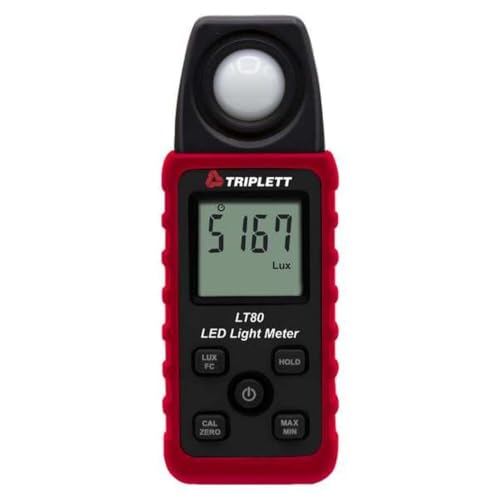
Most of the meters on this list measure whatever light falls on them. This one is tuned specifically for white LED sources, which is why it tops out at 40,000 foot-candles, or 400,000 lux. That headroom is not vanity spec. An owner grading projector bulb output needed readings above 300,000 lux and found the cheaper alternatives maxed out at 200,000. It also covers fluorescent, metal halide, high-pressure sodium, and incandescent sources, so one tool handles a mixed setup without guesswork. The sensor itself is a silicon photodiode with a filter that shapes the response for white-light reading.
The handling details are what make it a field tool rather than a shelf ornament. A 9,999-count LCD shows the reading with a Data Hold button that freezes the number while you write it down, and a Min/Max/Avg function recalls the highest, lowest, and running average of a measurement session. That averaging feature is the reason this meter gets recommended for grow setups and lighting surveys — you can sample a bank of LEDs and read the median instead of eyeballing a single flickering number. Auto power-off protects the two included AAA batteries, and it can be disabled when you need the meter to stay live between shots.
Where it gets picky is the spectrum. This meter is tuned for human-vision standards, not plant-growth standards, so a grow-light user who needs to track the photosynthesis spectrum may find the reading does not line up with a competing meter’s. That is not a fault — it is a different job. If you are checking classroom lighting, grow tents, projector bulbs, or commercial LED fixtures for human use, the Triplett reads what you need. If you are chasing a PAR-style reading for a hydroponic setup, this is not what you are buying.
The spectrum caveat: Human-vision tuning means this meter is the right tool for LED fixtures and the wrong one for plant-growth readings, so match it to the job.
The 9,999-count advantage: The extra digit matters in low-light work, where smaller displays bottom out before the reading does.
Buy it if: You are measuring white LED output, projector brightness, or commercial fixtures and need a genuine reading rather than an app estimate.
skip it if: Your light source is a grow light tuned for photosynthesis — the reading will not align with what a plant sees.
5. LATNEX Light Meter LM-50KL

Reads from 200 to 200,000 lux, and it arrives with a calibration certificate in the case.
This is the meter for people who need to document their readings, not just glance at them. The LM-50KL covers a range from 200 to 200,000 lux — or the same span in foot-candles if that is your unit — and measures LED white light alongside all visible-wavelength sources. The included calibration certificate is the detail that separates a professional audit tool from a hobby meter. If your reading has to stand up in a report, a certificate is worth more than any spec on the box. One owner tested theirs against a NIST-certified reference meter and found it read within two percent or better.
The sensor extends away from the body on 1.5 metres of wiring, so you can place the sensor under the fixture while you stand at the reading position and look at the display. That layout matters for tall ceilings, warehouses, and parking garages. A large bright LCD handles the display work with a data hold function to freeze readings while you log them, and the meter runs roughly 200 hours on a 9V battery with a low-battery indicator and overload warning to tell you when a reading saturates. The package also includes a carrying case and a 9V battery to get started.
The main limitation to understand is LED-specific. This meter reads LED white light well for general lighting work, but at least one owner found it under-read on a specific LED-lumen measurement task, registering only a fraction of the expected figure. That is an edge case within a narrow application, not a general fault, so if your job is a straight LED lumen check rather than a lux or foot-candle reading, verify with the manufacturer what the meter supports before you buy. Everyone else gets a tool that reads reliably across the range it is built for.
Certificate-backed confidence: The included calibration certificate is the reason this meter works for code inspections and documented audits rather than casual checks.
The LED edge case: A few buyers hit under-reading on specific LED lumen tasks, so confirm your use case if the meter will be driven hard on that job.
Made for: Facilities managers, inspectors, and anyone whose readings need documentation behind them.
Not for: A casual grow-tent check, where a cheaper meter will do the same job.
6. CHI L.D. Light Meter Pro
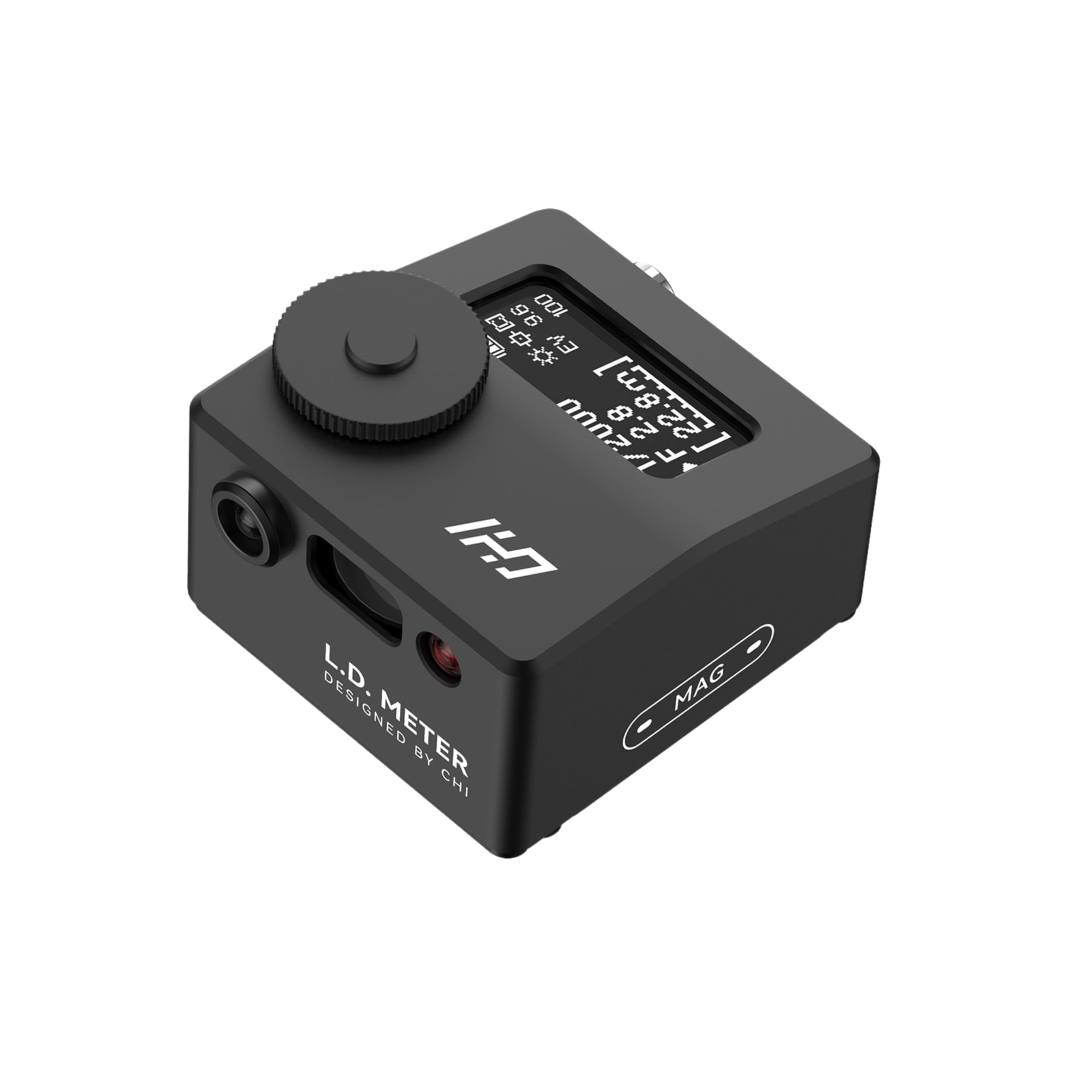
A 7° spot meter and a laser rangefinder in one pocket-sized body, built for scale-focus shooters.
If you shoot a scale-focus camera or a rangefinder with a tired patch, this is the pick that earns its badge. The Pro model offers 7° ultra-narrow spot metering, which reads a tight patch of light and works for backlit portraits and stage work where an average reading fails. The built-in laser rangefinder reads distance from 0.1 to 50 m with a continuous-on mode, so you get focus distance and exposure from one device with a single tap. A 0.96″ OLED screen shows ISO, shutter speed, aperture, distance, and EV together, and there is a rechargeable 370 mAh battery charged over USB-C with up to 90 days of standby.
The size is the quiet virtue here. At 5.6 ounces, it disappears in a shirt pocket and hangs on a camera without pulling the balance off. Owners describe the analogue feel of the interface as the reason they prefer it to menu-driven meters, and one owner verified the Pro model’s readings against two other meters and found them matching. The review pages sum it up: metering is accurate, the laser distance reading matches the camera’s own rangefinder, and it fits both hot and cold shoes with an adjustable bottom plate.
Two real trade-offs come with the design. The mounting method is a friction fit rather than a locking latch, so a few users have lost a meter that slid off the shoe during a shoot. And when the meter is mounted on the camera, the reading faces the front of the meter rather than the operator, which forces a small mental adjustment for close-up work. Neither problem breaks the tool, but both are the kind of thing you notice in the first week. Both are also fixable: a locking hot-shoe adapter for the mount, and a habit of checking readings handheld for macro work.
What Sets This One Apart
- 7° ultra-narrow spot metering pinpoints a subject in difficult light
- Built-in laser rangefinder reads 0.1 to 50 m and matches camera rangefinders
- 370 mAh rechargeable battery with up to 90 days of standby
- 0.96″ OLED shows ISO, shutter speed, aperture, distance, and EV together
The Two Real Grips
- The mount does not lock, so the meter can slide off the shoe in the field
- Reading faces front, forcing a mental flip for close-up metering
Built for: Scale-focus cameras and rangefinders that need precise focus distance and pinpoint exposure in one unit.
The precaution: Add a locking adapter so the meter stays on the camera, and carry a second one if the thought of losing it keeps you up at night.
7. Extech LT40 White LED Light Meter

One-handed, no wires, and a reading you can actually see — the working tool for lighting pros.
The reason this meter keeps ending up in tool kits is simple: the sensor is built into the body. No cord to tangle, no separate sensor head to lose, and you can hold the meter and take a reading one-handed while standing on a ladder. It reads both lux and foot-candles with a 4000-count backlit LCD, and it is tuned for LED sources alongside fluorescent and other lighting types. Owners describe it as compact compared to the Extech LT300 and accurate across the lighting types they have tested it against, and multiple owners have bought a second one after wearing out the first.
The feature set is deliberately plain. Data hold freezes the reading on screen while you write it into a log. A relative mode lets you zero the meter and read offset adjustments, which is useful for capacitance work and for comparing readings against a reference point. Auto power-off saves the two included AAA cells, and the meter auto-calibrates on power-on when the sensor cap is in place — it should read zero with the cap on, which is a quick sanity check before every session. Roadway night readings, industrial glare checks, and grow-light intensity are all common uses for exactly this model. A storage bag is included.
The honest limits are on the low end and in the dark. Below roughly 0.5 foot-candles, the reading stops being trustworthy — numbers that should be 0.1 or 0.2 come in as zero. And there is no backlight on the display, which is a problem for that same night-work use case. If most of your readings happen outdoors in daylight or in a lit building, neither issue will touch you. If your job is measuring very dim conditions or the inside of a night-shift space, plan around those two limits — the accuracy holds strongest in normal light.
What carries it: Built-in sensor means faster, cleaner one-hand readings than wired meters in the same class, and that is the reason it keeps getting rebought.
The two low-end limits: Readings below about 0.5 foot-candles and the missing backlight both push this meter toward daylight and lit-space work.
The right pick if: You are doing commercial readings with a spot-check cadence and want a tool that fits in a pocket without a cord.
Think twice if: The job sends you into very dark conditions where the low-end accuracy and missing backlight both matter.
Know the Specs
Metering Angle And Spot Versus Average
The metering angle is the width of the cone your meter reads, measured in degrees. A 7° angle is a spot reading — it sees a small patch of light, which is what you want for a subject’s face or a stage performer in a backlit scene. A 45° angle is an average reading — it sees a whole scene and splits the difference between bright and shadow areas. Neither is more accurate; they solve different problems. Pick the angle that matches what you actually shoot, not the number that looks most impressive on a page.
EV Accuracy And Why Half A Stop Matters
EV stands for exposure value — the number your meter reports so you can set aperture and shutter speed. Accuracy is measured in stops, and one full stop is a doubling or halving of light. A meter that reads within half a stop is considered tight; a meter that drifts a full stop can ruin slide film, which has very little latitude. When you see a spec like ±0.1EV, it describes how close the meter’s reading sits to the mathematically correct exposure value. Tight accuracy matters more than a long menu of modes you will never use.
Lux, Foot-Candles, And The LED Question
Lux and foot-candles are units of illuminance — how much light is landing on a surface. Lux is the metric unit, foot-candles the imperial one, and a meter that reads both is more flexible than one locked to a single unit. The tricky part is the light source: LED, fluorescent, metal halide, and incandescent lights emit different color spectrums, and a meter has to be tuned to read them correctly. A meter built for LED sources will return accurate readings on LED fixtures where an untuned meter over- or under-reads. Always confirm your specific light source is on the manufacturer’s supported list.
Power And Battery Reality
Two power philosophies live in this category: rechargeable batteries charged over USB-C, and user-replaceable cells like AAA or coin batteries. Rechargeable means no hunting for a specific battery type and no waste, and modern units hold standby charge for months. Replaceable means the meter still works in five or ten years when the rechargeable one’s built-in cell has failed. If you shoot weekly, USB-C is convenient. If you shoot sporadically, replaceable cells keep you from discovering a dead meter on the morning of a shoot.
Common Questions
Will an expensive light meter beat a free phone app?
Do I need a spot meter or an average meter for film photography?
How do I know if a light meter will fit my vintage camera?
What is the difference between an exposure meter and an illuminance meter?
Can a light meter read LED lighting accurately?
How long does the battery last on a meter like this?
Should I buy rechargeable or user-replaceable battery meter?
What does cold shoe versus hot shoe mean for a light meter?
Can I use one light meter for both film photography and lighting inspections?
The Bottom Line
For most shooters, the affordable light meter that earns the top spot is the TTARTISAN Light Meter II, because it delivers 60 hours of continuous metering — three times the LightMate Area 2S — plus a 23-stop shutter dial and a featherweight aluminum body for a fraction of what a premium spot meter costs. If you want the sharper viewfinder metering on a Leica, the LightMate Area 2S is the lightest pick here, and its 17° OV-X1 viewfinder plus three metering modes make it a full photographic tool. And for lighting work rather than photography, the Triplett LT80 is the one to reach for, with its white-LED tuning and 40,000 foot-candle ceiling. Every pick above is genuinely worth buying — the only wrong move is buying the wrong type of meter for the job you actually have.
How we choose
We do not accept paid placement. Every pick is matched to a real buyer and a real use-case; we do not hands-on test units.
Sources
Specifications: manufacturer listings and product documentation. Review insights: verified customer reviews, as of October 2026. Pricing: not shown on this page (it changes often); check the current price via the retailer link.
As an Amazon Associate, My Heart Lives Here earns from qualifying purchases. This does not affect which products we feature.