Heads up: This post contains affiliate links. As an Amazon Associate I earn from qualifying purchases, at no extra cost to you. Learn more
Specs are compiled from manufacturer listings and verified buyer reviews and can change over time — please confirm the key details on the product page before buying.
You want your bed to feel like a closed door — dark, private, and quiet — without blackout curtains or a renovation. That is exactly what an adult sleep pod does: it wraps your mattress in fabric and poles so light and company stay outside. Below you get eight real options, from a wearable blanket you can walk around camp in to a full twin-size enclosure that shuts out most of the room.
This guide is built by comparing the manufacturers’ published specifications and the patterns across verified customer reviews, so you get each pick’s real strengths and trade-offs instead of marketing spin.
Some of these are tents for your mattress. Some are liners you slip inside hotel bedding. One is a hooded blanket you wear. The best adult sleep pod is the one that blocks the light in the room where you actually sleep.
Top Picks

How To Choose The Best Adult Sleep Pod
Start with your mattress, not the product photos. A sleep pod is a fabric shell built to sit on top of a bed, so if it does not match your mattress size, the poles will bow and the doors will gap. Measure your mattress length and width before you read another word.
Light blocking comes in percentages you can compare
Manufacturers quote a light-blocking figure as a share of outside light the fabric keeps out. One twin tent here claims 95% effective shading, another claims 70%, and a third claims 80% blackout fabric on its doors. Higher numbers mean a darker cave; lower numbers mean you still see the outline of your room. If you sleep during daylight hours, that percentage is the first number you should check.
Mesh windows decide whether the pod breathes
Fabric traps heat. Mesh panels let air move while keeping bugs and light out. Look for how many doors or windows carry mesh — one model here runs three doors, each with its own mesh window, and another offers dual entries. A pod with no mesh at all will feel like a sauna by morning in a warm bedroom.
Pole thickness and frame stability
The frame is usually fiberglass poles that pop into place. One tent uses thickened 9mm fiberglass rods, which resist bending when you roll over. Fiberglass is light and springy, so it holds shape but can bow if the fabric is stretched too tight. A flimsier pole set means a tent that leans into your shoulder by 3 a.m.
Wearable pods versus bed tents versus liners
A wearable pod is a blanket with a hood that you wear — it travels anywhere and needs no poles. A bed tent covers the mattress and turns one bed into a room. A liner is thin cotton or satin you slip inside existing bedding to create a clean, personal barrier. They solve different problems, so pick the one that matches where the light and noise actually come from.
Side-by-Side Comparison
| Model | Best For | Type | Size | Weight | Amazon |
|---|---|---|---|---|---|
| ATEPA Blanket Poncho★ Best Overall | Campers and stadium nights | Wearable poncho | Long length | 1.4 lb | Amazon |
| Alvantor Pop Up Bed TentBest Enclosure | Dark, private bedroom sleeping | Pop-up bed tent | 77″L x 41″W x 41″H | — | Amazon |
| RIYDH Twin Bed Tent (3 Doors)Most Ventilated | Ventilation plus light blocking | Bed tent, 3 doors | 75″L x 39″W x 47″H | — | Amazon |
| ANC POP Starry Bed Tent | Kids and a pretty room | Bed tent, 2 doors | 78.7″L x 41.3″W x 47.2″H | 9 lb | Amazon |
| RIYDH Multi-Size Bed Tent | Larger mattresses and shared rooms | Bed tent, 3 doors | 75″L x 54″W | — | Amazon |
| Hug Sleep Hooded Sleep Pod Move | Wearable calming cocoon | Wearable pod | Medium | — | Amazon |
| Browint Silky Travel Sheet | Hotel and hostel bedding barrier | Zippered liner | 87″L x 41″W | 15.7 oz | Amazon |
| Cozysilk Cotton Liner | Breathable cotton on a budget | Zippered liner | 87″L x 33.5″W | 1.22 lb | Amazon |
Detailed Reviews
1. ATEPA Blanket Poncho
Our pick — 4.5+★ from 150+ verified ratings; the strongest balance of quality and price.
The one you can wear to the campfire, then fold into a pillow when you climb back in.
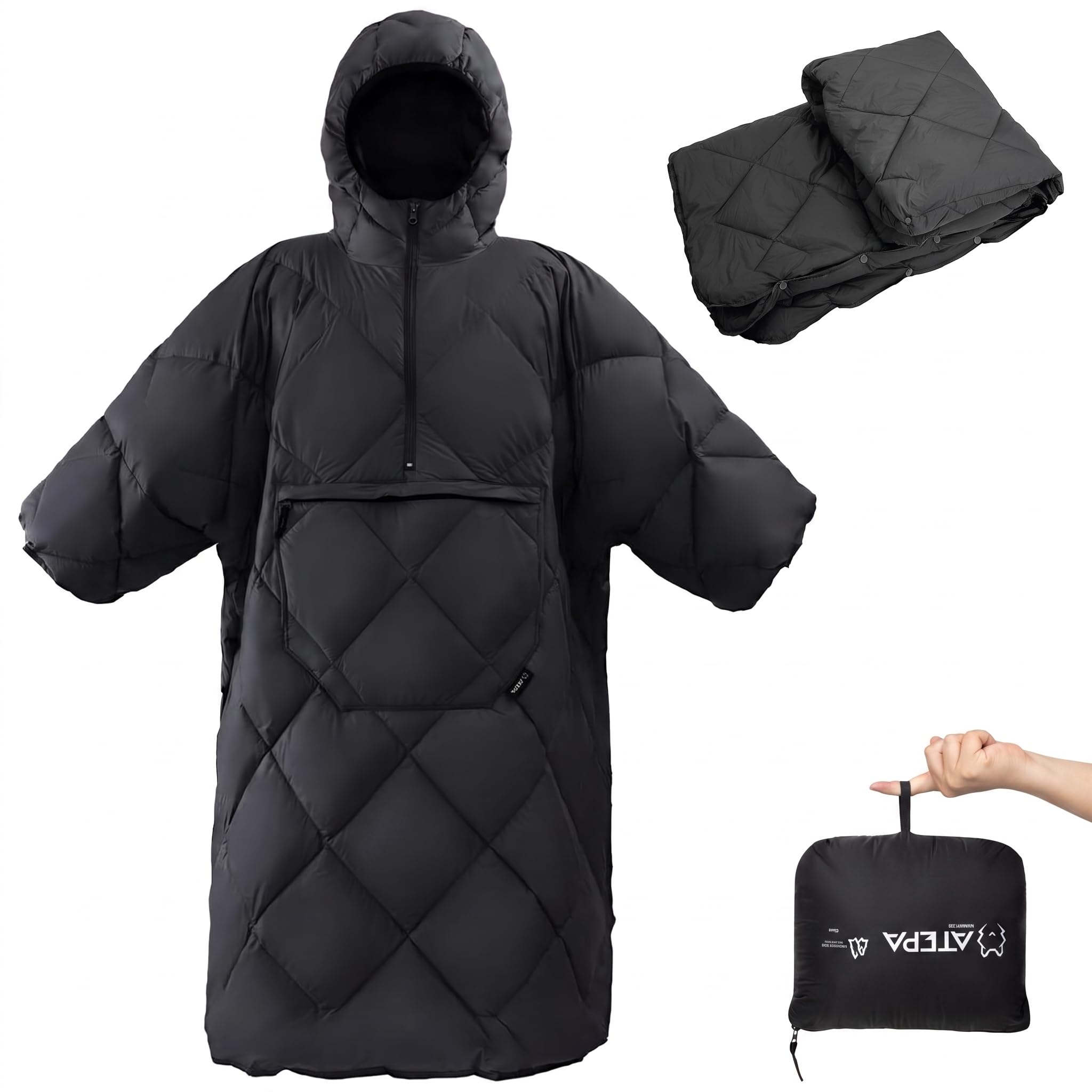
This pod does not need a bed at all. It is a quilted poncho you pull over your head, and it converts into a blanket or a camp jacket as the night changes. The real number here is 1.4 lb — light enough that you forget you have it on, yet warm enough that you are not reaching for a second layer around the fire.
What keeps it warm is 350G recycled down-alternative insulation wrapped in a 20D 400T nylon shell, with water-resistant diamond quilting on top. In practice, the fill traps body heat, the 20D 400T nylon shell cuts wind, and the diamond quilting keeps the insulation from bunching into one corner. ATEPA rates the comfort window at 45°F–68°F (7°C–20°C), which covers a cool campsite morning or a chilly stadium seat. It is deliberately not built for freezing conditions, and ATEPA says so plainly.
The fit is the quiet win. It is cut roomy enough to go over winter clothes, and the hood stays up on your head instead of sliding back the moment you lean forward. Owners keep coming back to how it looks — the appearance is the most praised part of the product by a wide margin, with warmth right behind it. When you are done, the whole thing stuffs into its own kangaroo pocket, which then doubles as a hand warmer or a camping pillow measuring 11.8 × 9.8 × 5.9 in. That means no separate blanket bag rattling around your pack.
Where it earns its keep
- Three jobs in one: poncho, blanket, and camp jacket
- Packs into its own kangaroo pocket and becomes a pillow
- Water-resistant, wind-cutting nylon shell over recycled insulation
- Roomy enough to layer over a hoodie or winter coat
What to weigh first
- Not a substitute for a real sleeping bag below freezing
- Lightweight warmth suits mild-to-cool nights, not deep cold
Made for: campers, festival-goers, and anyone who wants warmth that walks with them.
Not quite right if: you need a full mattress enclosure to cut out a bright room — this is a wearable, not a tent.
2. Alvantor Privacy Pop Up Bed Tent
Turn a shared room into a single dark doorway in minutes, no tools required.
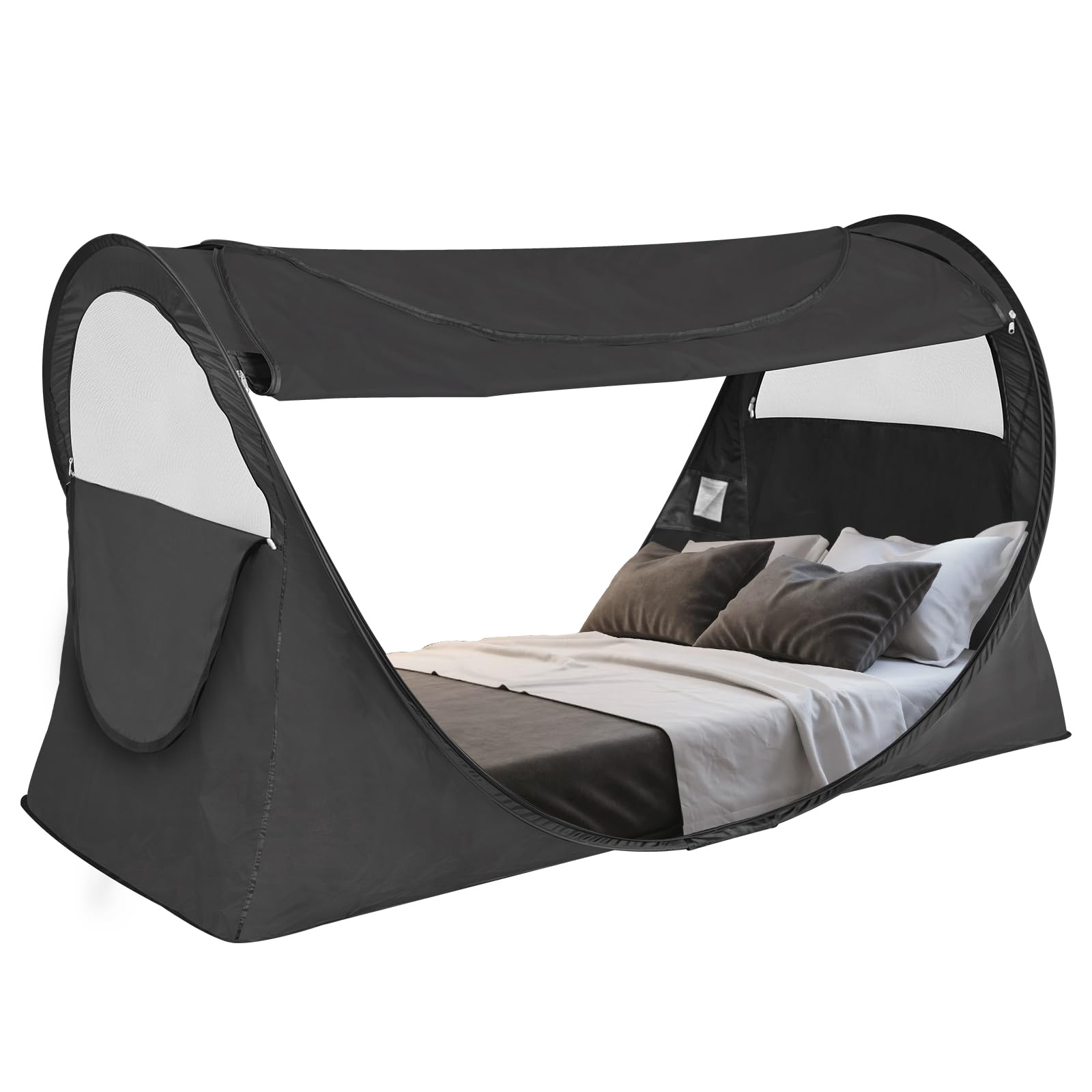
If your problem is a bright window and a roommate who keeps different hours, this is the pick. The blackout fabric is dark-colored on purpose, so the inside of the tent goes genuinely dim, and the shell is a washable polyester over fiberglass poles. It measures 77″L x 41″W x 41″H, which is sized for a twin mattress rather than squeezed onto one.
Two entries mean you are not climbing over the frame to get out at 2 a.m. Mesh keeps the air moving so the interior does not turn muggy. The thing that wins people over is how it looks — the appearance is the most-praised element by a huge margin, ahead even of the light blocking. It reads as furniture rather than a camping tent dumped on a mattress, which matters in a dorm or a visible corner. The 1,000+ owners behind its 4.0+ rating have kept it comfortably above average.
The catch is assembly. Setup opinions split cleanly — some get it up fast, others fight the pop-up frame the first time. Give yourself a calm twenty minutes on night one, and set it up before you are tired. Also note the bottom is not waterproof, so keep drinks off the mattress inside it. Against the RIYDH twin below, this one blocks more light but offers less headroom, since that tent stands 47″ tall.
The verdict in one line: the strongest dark-room enclosure here for twin beds, with a setup curve worth budgeting for.
Reach for it if: you share a room or a dorm and want your mattress to feel like a closed door.
Look elsewhere if: you want to sit up fully inside — the 41″ height is a lie-down ceiling.
3. RIYDH Twin Bed Tent
Three doors, three mesh windows, and a cable slot so your phone charges inside the tent.
This tent solves the biggest gripe people have with bed enclosures: stuffiness. Each of its three doors carries its own mesh window, so when you feel warm you open the mesh and air moves through. Close the door curtains and you get warmth instead. The fabric is rated at 95% effective shading, the highest light-blocking figure on this list, which means outside light barely registers once the doors are zipped.
The frame is strong fiberglass poles built to stay upright without collapsing, tipping, or bending. It stands 75″L x 39″W x 47″H, so you get more sitting-up headroom than the Alvantor above — 47″ versus 41″ — while giving up some width. Two mesh storage pockets, a night light hook, and openings for phone charging cables turn it into a usable little room rather than a sack. Quality is what people talk about most, and assembly praise comes right behind it, which is unusual for a pole-and-fabric tent.
Two honest notes. It aims at a twin mattress, so measure first if yours is full or queen. And the money question splits — plenty feel it earns its place, others think it should cost less. It is also the priciest of the pure tent options here, so weigh that against the third door and the cable opening.
Why it stands out: the three-door mesh layout is the most thoughtful ventilation design here, and the 95% shading figure is the most aggressive light claim on the page.
It beats the rest on: airflow control and headroom, for anyone who runs warm at night.
The trade-off: it is twin-only and sits at the high end of the tent tier.
4. ANC POP Bed Tent

A starry sky printed on the outside of a tent your kid will happily climb into.
This one leans into charm rather than maximum darkness. Light blocking reaches 70%, with 360° all-round privacy, so the room dims and your child gets a space that feels like their own. The print is the star — the constellation design has a roomy interior and a look owners describe warmly, and the blue shade reads almost indigo in person.
The build is a 9mm thickened fiberglass rod frame, which is the number to note: thicker rods resist the collapse that thinner frames suffer when a kid bounces on the mattress. The double zipper runs smoothly, and the whole tent unpacks to 78.7″L x 41.3″W x 47.2″H — a little longer than the RIYDH twin, which gives tall kids more stretch room. Owners say it assembles easily, and it has developed a following among families with special-needs children who need a bounded, private place to settle.
Heads up on weight and the floor: it tips the scale at 9 lb, so it is not something you move nightly. The bottom is also not waterproof, so plan around spills and damp floors. The 70% light-blocking figure is honest but modest — if your goal is pitch black for daytime sleep, the Alvantor or the three-door RIYDH will get you darker.
Best for: a child’s bedroom where the tent needs to feel inviting, not institutional.
Pick this one when: the sleeper is a kid who wants a fort, not an adult who needs a cave.
Skip the notion if: you want near-total darkness — 70% is a dim room, not midnight.
5. RIYDH Bed Tent

A bigger footprint for a wider mattress, and three doors that each peel back to mesh.
Wider beds need wider tents, and this one answers that. Its floor area is listed at 75″L x 54″W, so it fits a broader mattress than the 39″-wide RIYDH twin — that extra 15 inches of width is the reason to choose it. The frame uses sturdy fiberglass poles that hold their shape while you roll over, and it stays standing when a child is bouncing nearby.
Three big doors, each with two fabric layers, are the feature to understand. One layer is mesh that keeps mosquitoes out; the other is blackout fabric rated to block 80% of light. You cannot see inside from outside, so changing clothes in the tent works. A double mesh storage pocket, a charging cable opening, and a night light hook round it out — and the appearance is the most-praised thing about it, ahead of value and light blocking combined.
Set-up is where opinions split. Some find it super easy, others find the pole layout confusing. The manufacturer’s own warning is worth repeating: many buyers mix up length and height, so point the triangular accessories with openings toward the top. The floorless design is a genuine plus — you can slide the mattress in and change sheets without dismantling the tent. Note that the blackout figure here is 80%, which leaves more glow at the seams than the 95% RIYDH twin above.
Strong points worth the pick
- 75″ x 54″ footprint suits a wider mattress
- Three doors, each splitting into mesh and blackout layers
- Floorless so sheets change without a rebuild
- Storage pockets, cable opening, and light hook included
Know before you buy
- 80% blackout leaves more edge glow than the darker twin tents
- Pole direction confuses some first-time assemblers
The fit for: shared rooms and wider mattresses where a twin tent will not stretch.
The limit: if you want maximum darkness, the tighter twin options win.
6. Hug Sleep Hooded Sleep Pod Move, Wearable Blanket with Hood

No poles, no assembly — you climb in, hood up, and feel the fabric hug your shoulders.
This is the pod you can take on a plane. It is a pull-on hooded blanket made from 90% polyester and 10% spandex, so the fabric stretches with you in any sleep position. The draw is Deep Touch Pressure — gentle all-over pressure some sleepers find calming — delivered in stretch fabric instead of a weighted blanket’s load. The hood covers your head and the integrated foot pocket keeps your feet free to move.
The engineering story is HugStretch fabric: a 4-way stretch material built to breathe and help regulate body temperature rather than trap heat like a fleece throw. It also launches without you noticing — there is no frame to bump into and no carry bag to find. The quality of the fabric is the most-praised element, and improved sleep is the second thing owners mention. Side, back, and stomach sleepers can all wear it, and it goes in the washing machine.
Comfort and warmth split opinion sharply, and the price bothers enough buyers that value is the least-loved aspect of this product. Some find it too warm; others find it exactly right. Fit is also the most-misjudged part — because it is stretch fabric in sizes, get your size right before ordering. If you want a hard barrier to block room light, this is not that product; it is a wearable calm layer, and no more.
The plain read: a quality, portable wearable that some sleepers adore and others find too warm — comfort is the dividing line, not build.
Suits you if: you want the hug of a weighted blanket without the weight, and you travel.
Does not suit you if: you sleep hot or you need to shut out a bright room.
7. Browint Sleeping Bag Liner

A sheet you zip yourself into so hotel bedding never touches your skin.
Think of this as a personal bag inside a bed. It slides into a hotel bed, a hostel bunk, an RV mattress, or your own sleeping bag. The fabric is microfiber satin with French seams on every interior edge, so it feels smooth on your skin and survives repeated washing. It weighs 15.7 oz and packs into a 6.6-inch ripstop stuff sack with a hook loop. The size, 87″L x 41″W, makes it roomy for tall people and side sleepers.
The number that matters is the 9-foot full-length two-way zipper running down the left side and the bottom. It opens the whole liner so you can slide in and out without wriggling, and unzips at the foot so your toes can stretch. With both zips open it lies flat as a 7′ x 7’3″ sheet or an outdoor blanket — that double life is the most-praised feature. There is even a pillow pocket to stop your pillow slipping away overnight.
Browint claims a 5F+ warmth boost; treat the liner as a soft layer, not a substitute for bedding. The linen must stay dry, and the silky surface can feel slippery on a slick mattress if you roll around a lot. For anyone who wants a clean, private sleep surface in a hotel rather than a tent over the mattress, this does the job with almost no bulk in a bag.
Best for: frequent travelers who want their own familiar sleep surface on shared bedding.
Slide it into: hotel beds, hostel bunks, and road-trip mattresses.
Hold off if: you need a hard enclosure against light and noise — this is a barrier, not a tent.
8. 100% Cotton Sleeping Bag Liner with Zipper by Cozysilk
Breathable cotton that zips open with a rip, for overnight guests and camper beds.
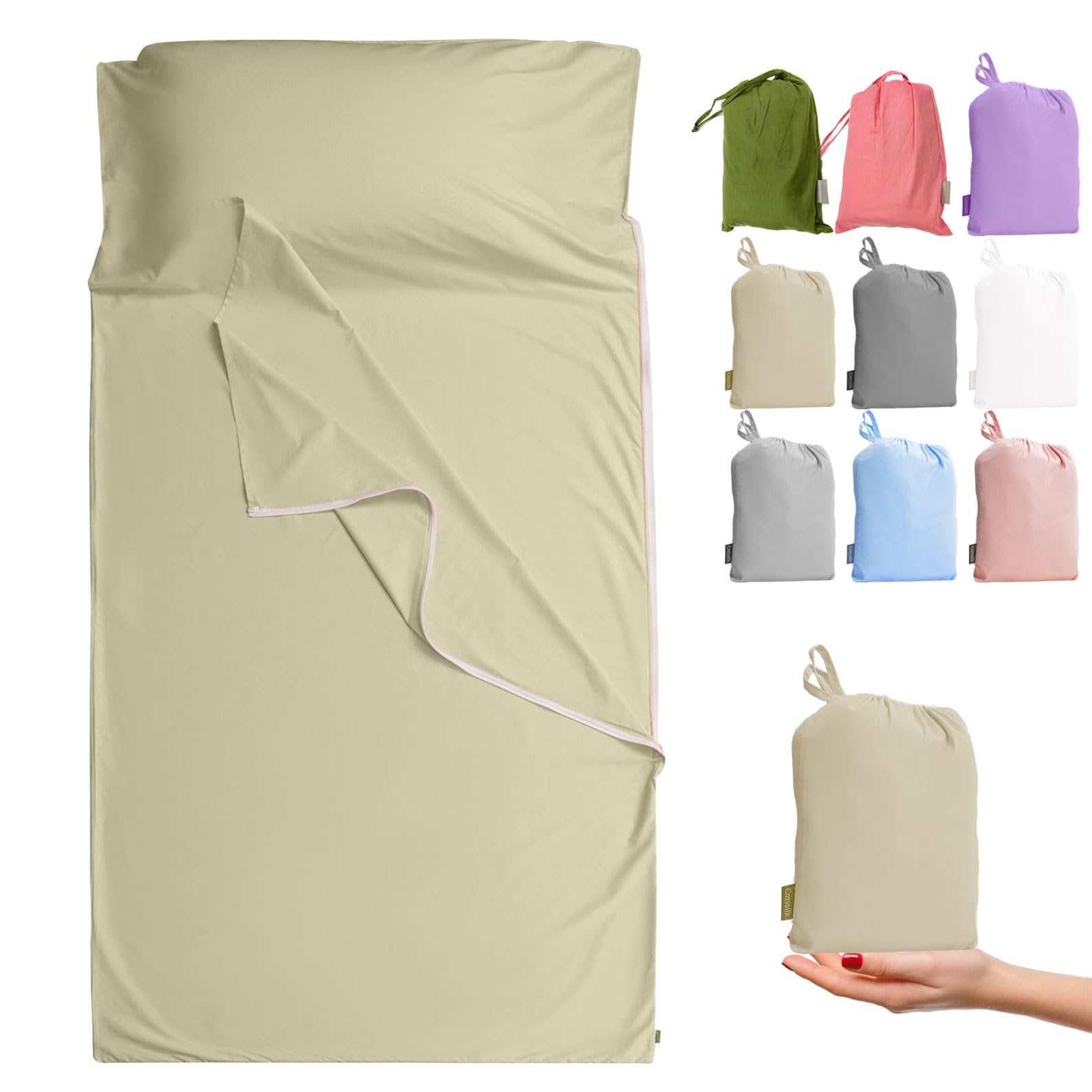
Cotton does one thing better than satin or polyester: it breathes. This single-size liner measures 87″L x 33.5″W and weighs 1.22 lb, folding into an 8.3 x 8.3″ pouch. Sink into it and the cotton sateen feels soft and cool against your skin, which is why people reach for it in a warm bedroom, an RV, or a guest bed that needs a clean top layer.
The clever bit is the zipper layout. A near-full-length zipper on the left lets you enter from one side, and the whole thing reverses so you can enter from the right. The tearaway zipper is the smartest detail — you sit up and rip it open like pulling a strip of tape, instead of fishing for a tab at 3 a.m. In double size you get two side zippers plus a bottom zip; the single includes one side and a bottom zip. It comes in three sizes: single at 33.5 x 87 inches, single luxury at 41 x 87 inches, and double at 71 x 87 inches.
Comfort is the top praised trait, with how well it washes close on its heels, and it is a well-liked option among a large owner base. Still, the sizing is the awkward part — a real share of people find the single too generous, while others want the extra width of the luxury cut. Zipper feedback is genuinely mixed too, so treat the teeth gently and zip slowly. If you love the feel of cotton and want a simple clean sleep sack, this is a smart budget entry.
Simple take: the cotton pick for breathability and value, with a sizing call to make before checkout.
Buy it for: cotton comfort and a fast-open zip at an entry-level price.
Think twice for: a snug, fitted feel — the single runs roomy, so check the three size charts.
Know the Specs
Light Blocking Percentage
This is the share of outside light the fabric keeps out, quoted by the maker. The figures on this list run from 70% up to 95%, so higher numbers mean a darker interior. If you sleep during daylight, compare the number before anything else.
Mesh Mesh and Ventilation
Mesh is a fine open-weave panel that lets air through while blocking bugs and glare. A tent with more mesh doors breathes better; a tent with none traps heat. Look at how many doors carry a mesh layer — one tent here runs three doors, each with its own mesh window.
Fiberglass Pole Frame
The frame holds the tent upright. Fiberglass poles are light and springy, so they pop into shape, and a thicker rod resists bending when you roll over. One model uses 9mm rods specifically to stop sagging. Thin poles are easier to carry but lean more under pressure.
Fabric and Breathability
Polyester is the standard shell here because it is durable and washable. Cotton liners breathe more but are thinner. A “20D 400T” nylon label means a fine, dense weave — D for denier (thread thickness) and T for thread count — which cuts wind without adding bulk.
Common Questions
Will a twin bed tent fit a full or queen mattress?
How dark does a blackout bed tent actually get inside?
Do bed tents get too hot to sleep in?
How long does a bed tent take to set up?
Can a bed tent be used outdoors?
What is the difference between a wearable sleep pod and a bed tent?
Is a sleep pod good for a child with sensory needs?
Are sleep pod tents machine washable?
Can two people share a sleep pod tent?
Does a sleep pod stop noise as well as light?
The Bottom Line
For most people, the best adult sleep pod here is the ATEPA Blanket Poncho, because it does three jobs — poncho, blanket, and camp jacket — at 1.4 lb and folds into its own pocket. If you want to shut out a bright room around a mattress, reach for the Alvantor Pop Up Bed Tent, which turns a shared room into a dark private corner. And if you run warm and want the most ventilation with headroom, the RIYDH three-door tent is the one to reach for, with its mesh windows and 95% shading.
How we choose
We do not accept paid placement. Every pick is matched to a real buyer and a real use-case; we do not hands-on test units.
Sources
Specifications: manufacturer listings and product documentation. Review insights: verified customer reviews, as of November 2026. Pricing: not shown on this page (it changes often); check the current price via the retailer link.
As an Amazon Associate, My Heart Lives Here earns from qualifying purchases. This does not affect which products we feature.