Heads up: This post contains affiliate links. As an Amazon Associate I earn from qualifying purchases, at no extra cost to you. Learn more
Specs are compiled from manufacturer listings and verified buyer reviews and can change over time — please confirm the key details on the product page before buying.
Joining glass to wood is one of the few household repairs where the wrong glue fails twice — once when the glass slides out of place, and again when you notice it a week later. You need a bond that grips smooth, non-porous glass without eating into the wood grain, and that stays clear so the join disappears. The short answer: epoxy gives you the strongest structural hold, PVA-style multi-surface glue wins for flat decorative panels, and cyanoacrylate (CA) glue with activator is the fastest fix for small joints that need to hold this second.
This guide is built by comparing the manufacturers’ published specifications and the patterns across verified customer reviews, so you get each pick’s real strengths and trade-offs instead of marketing spin.
Working time, cure time, and material compatibility decide whether your glass-and-wood joint holds a shelf ornament or carries a real load. Match those three specs to your exact repair, and you pick the right adhesive for wood to glass.
Top Picks

How To Choose The Best Adhesive for Wood to Glass
Glass is non-porous, so glue can’t soak into it the way it soaks into wood. That single difference explains most failures: a glue that dries hard and brittle can pop off smooth glass under a temperature swing, while a glue too thin runs down the pane before it grabs. A good wood-to-glass adhesive therefore needs two things working together — enough tack to stay in position, and a cured bond flexible enough to survive the two surfaces expanding at different rates.
Working time vs. full cure time
Working time (sometimes called open time) is how long you have to slide the pieces into their final alignment. Full cure time is when the joint reaches its final strength — and those two numbers can be very different. A CA glue with activator lists a 2-minute full cure, so you get one shot at placement. A cartridge epoxy lists 24 hours, which sounds slow until you realize the parts stay put while you walk away.
Matching the glue to the glass size
A small flat glass tile on a wooden coaster only needs to resist being knocked over. A heavy glass panel glued to a wooden frame needs to hold its own weight upside down. Bigger glass means more weight and more leverage at the edge — so go for the higher-strength structural option rather than the craft bottle. If the piece will sit in a bathroom or under a covered patio, check whether the cured bond is water resistant.
Clear-drying matters more than you think
Wood is light-toned and glass is see-through, so any cloudy seam shows through both materials at once. Look for a glue that dries crisp or invisible, and check that the clarity holds after cure rather than just during application. A white PVA that turns clear is fine for a mosaic; it is a mistake on a picture frame where you want the join to disappear under glass.
Watch the material-compatibility line
Read which surfaces the bottle actually lists. Some epoxies designed for wood still give mixed results on foam and metal. Some craft glues state outright that they will not bond metal to ceramic. Glass and wood together are usually a safe pairing — but only if both appear on the label.
Side-by-Side Comparison
| Model | Best For | Working / Full Cure Time | Glass Listed? | Form & Size | Amazon |
|---|---|---|---|---|---|
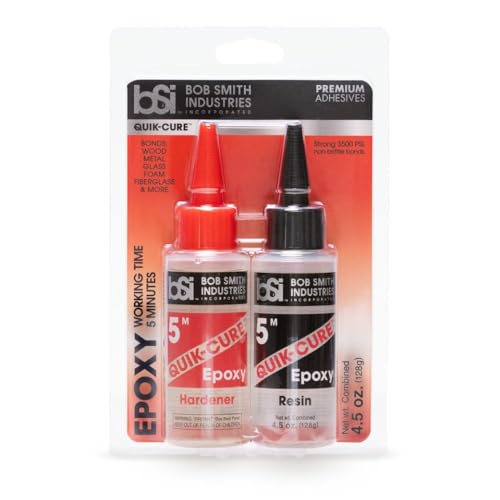
| Bob Smith Industries BSI-201 Quik-Cure Epoxy★ Best Overall | Strong structural joints | 5 min working / 10 min full cure | — | Bottle, 4.5 oz combined | Amazon |
| PC Products PC-Clear Epoxy Adhesive LiquidClearest Bond | Invisible glass-to-wood bonds | ~4 min working / 24 hr full cure | Yes | Cartridge, 50 ml | Amazon |
| Weldbond Multi-Surface Glue | Mosaic and craft panels | No clamp needed / 24 hr full cure | Yes | Bottle, 5.4 oz | Amazon |
| Loctite Power Grab Ultimate crisp | Exterior, wet-surface grabbing | Quick initial tack / 24 hr full cure | Yes | Cartridge, 9 fl oz | Amazon |
| CA Glue with Activator Kit | Fast fixes on small joints | Seconds with activator / 2 min full cure | Yes | 6 × 1.75 oz bottles + 2 sprays | Amazon |
Detailed Reviews
1. Bob Smith Industries BSI-201 Quik-Cure Epoxy
Our pick — 4.5+★ from 5,000+ verified ratings; the strongest balance of quality and price.
Ten minutes to a hard joint, and a 1:1 mix you cannot get wrong.
If you are gluing a glass panel into a wooden frame and you want it to stay there, this is the bottle to reach for. You get a five-minute working time — that is the window where you can still nudge the glass into place — and the maker says you can handle the parts after ten minutes. For a two-part epoxy, that is quick enough to keep a repair moving on a single afternoon.
The mixing is a straight 1:1 ratio of resin to hardener, which is the simplest kind of two-part glue to get right in a small kitchen. Miss the ratio and epoxy stays tacky; hit it and you get a cured bond that holds solidly. Owners rate it the equal of a hardware-store epoxy, and they keep coming back to the durability — joints stay put long after the repair.
Reviewers praise the build quality first and the bond strength second. Compare it with the CA kit further down this list: that one lists a 2-minute full cure against this bottle’s 10 minutes, so the CA glue is 5 times faster on paper. In practice that speed costs you placement time — the epoxy gives you five minutes to align glass on wood, which is what you actually need when the piece is heavy or oddly shaped.
Where it earns its keep
- Five-minute working time lets you re-seat glass on wood before it grabs
- Simple 1:1 resin-to-hardener mix removes the guesswork
- Holds solidly enough that owners call it hardware-store quality
- Handle the bonded parts after ten minutes instead of hours
The honest caveats
- Bonding strength draws mixed notes — foam and metal come up as weak spots
- Two-part mixing means waste if you only need a dab
- Glass is not on the listed compatible materials, so test a scrap piece first
Reach for it when: you need one strong joint that lasts, and you can spare ten minutes to let it set.
Worth knowing: It is the crowd favorite of the group at 4.5+ stars across 5,000+ ratings, and the price sits mid-pack rather than at the top.
2. PC Products PC-Clear Epoxy Adhesive Liquid, 50ml Cartridge
It goes on milky, then turns clear in the joint — glass and wood vanish into one another.
Here is the pick for anyone bonding glass to a visible wooden surface, where a cloudy seam would ruin the look. The liquid starts opaque when mixed and then clears to full cure, so it blends into the material around it. That is a different promise from a glue that merely dries clear — this one gets clearer over the 24-hour full cure.
Glass is explicitly on the compatible-materials list, along with wood, metal, ceramic, concrete, and fabric. The 50ml cartridge feeds a controlled bead, and the working time runs roughly 4 minutes before the joint starts to set. After one hour it cures for function — meaning it will carry a light load while you leave it alone to finish.
The temperature range is the detail that matters for a window frame or a covered porch piece: the cured bond handles continuous service from -20 to +200 degrees F. So a glass panel on a north-facing wooden door does not need to come inside when the season turns. It is a smaller bottle than the Quik-Cure, so plan it for one careful repair rather than a shelf of projects.
Best fit for this: glass on wood where the join sits in plain sight and a clear seam is the whole point.
Mind this: 24 hours to full cure is the slowest on this list — plan the piece so it can sit undisturbed overnight.
Best for: frames, glass tops, and decorative panels where the seam will be seen up close.
Find another bottle if: you need to move the finished piece the same day.
3. Weldbond Multi-Surface Glue for Mosaic, Wood & Ceramic
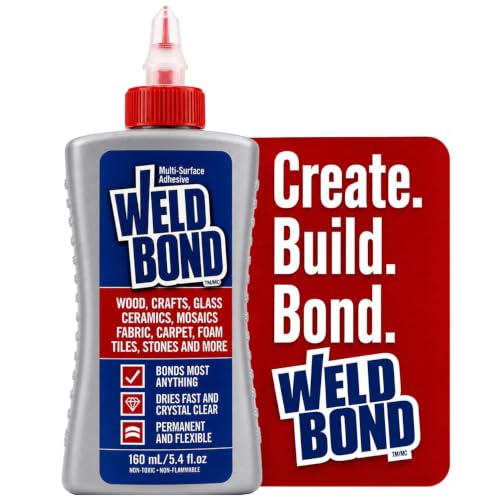
The kitchen-table glue with no fumes and a seam that disappears on glass.
Not every glass-to-wood job is structural. A mosaic panel, a glass tile on a wooden coaster, a decorative inset on a box — those need a glue you can use indoors with the windows shut. This PVA formula carries no solvents and no harsh fumes, which is why it turns up in classrooms and small studios.
The white glue turns invisible as it sets, so seams vanish on glass, acrylic, porcelain, and light-toned wood, with no yellowing and no cloudy halo around the joint. It dries in about 20 minutes with no clamping required, and then sands and paints like the wood around it. The precision tip lays a neat bead instead of flooding the piece, and thinning it with a little water lets you brush it on as a primer or sealer for porous work.
The cured PVA bond is water resistant, which suits indoor pieces and covered outdoor work. The caveat is straightforward and worth stating plainly: strength is where opinions split. Some owners find it stronger than plain white glue and bonded well; others found it was simply not strong enough for their job. Treat it as a craft and decorative adhesive, not a load-bearing one. If the glass has to hold real weight, the epoxy picks above are the safer call.
It suits: mosaics, tiles, and flat decorative glass where a clear seam and a fume-free workspace matter more than brute strength.
Choose the epoxy instead if: the glass panel carries weight or hangs at an angle.
4. Loctite Power Grab Ultimate crisp Construction Adhesive
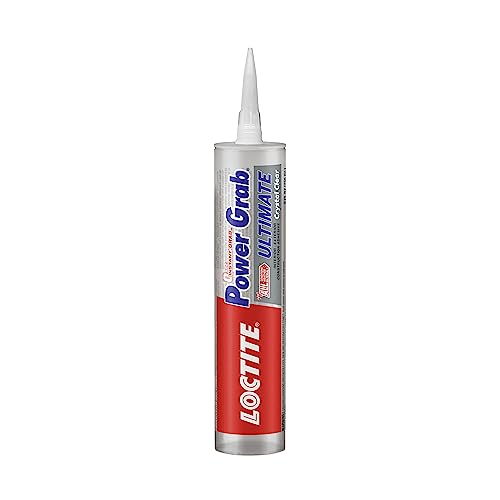
Built for the window frame that faces the weather, not the shelf ornament.
This one is a construction adhesive rather than a craft glue, and its case rests on conditions rather than delicacy. The cured bond is weatherproof, waterproof, and rated against extreme temperatures from 0°F to 140°F — so glass bonded to a wooden exterior door frame stands a better chance through a hard winter. It is also listed for wet surfaces and can bond two non-porous surfaces, which is the specific pairing glass-to-glass creates.
You get a seam that stays invisible: the crisp formula stays clear during application and after cure. The quick initial tack is designed to cut down on bracing and nailing, so you spend less time holding the glass in place. On weight, the 9-ounce cartridge is heavier than the PC-Clear’s 3.2 ounces, so overhead work on a ladder is easier with the smaller tube. The heavier tube also means more glue for a bigger panel job.
Honest read on the reviews: effectiveness is the most-discussed topic, and opinion splits both ways. Some owners call it perfect for their job; others found it did not perform as described. The grab is also a point to set expectations on — several notes suggest the “Power Grab” name oversells how much it holds before you brace the piece. A few found the tube hard to pump. Use a proper caulking gun, brace the glass while the tack sets, and this is a genuinely useful exterior option.
What it brings to the job
- Weatherproof and waterproof bond rated from 0°F to 140°F
- Works on wet surfaces and between two non-porous faces
- Stays crisp during application and after cure
- Quick initial tack reduces how much bracing you need
Set expectations here
- The name oversells the grab — several find it needs bracing anyway
- Durability opinions split; some jobs held, some did not
- Some find the cartridge stiff to pump without a gun
Pick this one if: your glass-and-wood joint lives outside and has to shrug off rain and temperature swings.
Look elsewhere if: you want a joint that holds itself the moment you press — this needs bracing while it tacks.
5. CA Glue with Activator — Thin, Medium & Thick Kit
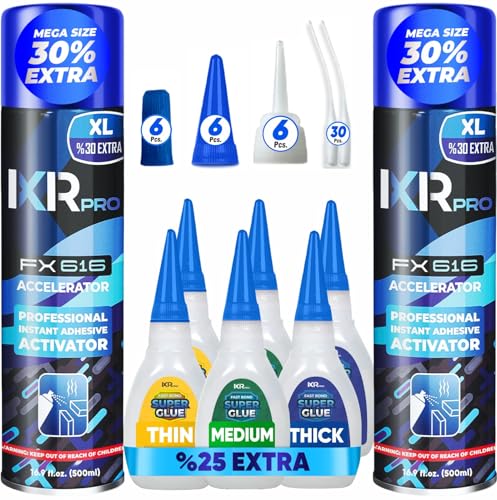
Six bottles, three thicknesses, and a two-minute cure when you mist the activator.
For a small glass-and-wood joint that has to hold right now, this kit is the fastest thing on the page. It lists a 2-minute full cure — 5 times quicker than the Bob Smith epoxy’s 10 minutes — and the activator spray is what makes that speed possible. Glue one surface, mist the other, press together.
The three viscosities are the underrated part. Thin CA penetrates hairline cracks and stabilizes porous wood, which is exactly what you want when a small glass chip is going back into a wooden repair. Medium gives balanced flow for tight joints, and thick fills gaps and buys you a little positioning time. Glass is on the compatible list alongside wood, metal, leather, ceramic, rubber, and most 3D-printing materials.
The kit is generous: 6 × 1.75 oz bottles, 2 large 16.9 fl oz accelerator sprays, 30 precision microtips, 6 clog-prevention pins, and 6 replacement lids. Buyers praise the quality of the glue most, and the small 1.75 oz bottles are why they reorder. The trade-off is real, though — adhesiveness is the most-discussed topic and it splits. Some get an instant strong bond; others note the glue running down a vertical glass face before it grabs. Set the piece flat if you can, and the thin formula behaves far better. It is also the heaviest container here at 2.5 pounds, which is the kit rather than the glue.
Why crafters keep it stocked: six bottles across three thicknesses plus microtips means a dab or a gap fill from the same box.
Work within this limit: thin CA runs on vertical surfaces — flat placement is where it shines.
Buy it if: you want a bond in seconds and like having every thickness on hand for wood and glass repairs.
Skip the vertical stuff: this glue needs the joint flat, or it heads downhill before it sets.
Know the Specs
Working Time (Open Time)
Working time is the window where you can still slide the glass into its final position before the glue grabs. The roughly 4 minutes on the PC-Clear cartridge means you place it fast and leave it. The 5-minute window on the Bob Smith epoxy gives you more room to slide a heavier panel around. Neither is “better” on its own: short is fine for a small tile, and generous is safer for a big sheet of glass on a wooden frame.
Full Cure Time
The point where the joint reaches its final strength. It can run from 2 minutes with an activator-sprayed CA glue to a full 24 hours on the PC-Clear and Weldbond bottles. A short full cure tempts you into handling the piece early; a long one asks you to plan the job so it can sit overnight. The number on the bottle is the one to trust when you are deciding whether you can use the finished piece today.
Non-Porous Bonding
Glass has no grain for glue to soak into, so the adhesive has to grip the surface directly. That is why a construction adhesive listed for two non-porous surfaces, or an epoxy, tends to be the safer bet on smooth glass than a glue formulated mainly for porous wood. Always check that the bottle names glass as a compatible material before you commit a piece to it.
Clear-Dry Clarity
On wood and glass the seam sits in plain view, so a cloudy halo ruins the finish. Look for a formula that dries clear — or, as with the PC-Clear, goes on opaque and clears as it cures. A white PVA that dries invisible works for mosaics and light-toned wood. Check the clarity holds after cure, not just during application, because that is the state the piece lives in.
Common Questions
What kind of glue actually bonds glass to wood?
Will a regular wood glue hold glass?
How long do I need to hold glass in place while it sets?
Can I use these adhesives outdoors on a glass window pane and wooden frame?
Does the glue dry clear, or will the seam show?
Is activator spray necessary for CA glue on glass?
How much glue do I need for a glass-to-wood panel?
Do I need to clamp glass to wood while the glue cures?
Will these glues hold glass on a wall-mounted wooden frame?
Can I thin a PVA glue for porous wood before bonding glass to it?
The Bottom Line
For most wood-to-glass repairs, the adhesive for wood to glass that earns first place is the Bob Smith Industries BSI-201 Quik-Cure Epoxy. It gives you a 1:1 mix, a five-minute working window, and a solid bond at a mid-pack price — exactly what a glass panel into a wooden frame needs. If the seam will be seen and you want it to vanish, the PC-Clear Epoxy clears as it cures and lists glass outright. For an exterior joint facing rain and frost, reach for the Loctite Power Grab with its 0°F to 140°F rating. And if you want the bond done in seconds with three thicknesses on hand, the CA Glue with Activator kit is the fast fix. Whichever you choose, test a scrap of the same glass on the same wood first — five minutes of testing saves a ruined panel.
How we choose
We do not accept paid placement. Every pick is matched to a real buyer and a real use-case; we do not hands-on test units.
Sources
Specifications: manufacturer listings and product documentation. Review insights: verified customer reviews, as of November 2026. Pricing: not shown on this page (it changes often); check the current price via the retailer link.
As an Amazon Associate, My Heart Lives Here earns from qualifying purchases. This does not affect which products we feature.