Heads up: This post contains affiliate links. As an Amazon Associate I earn from qualifying purchases, at no extra cost to you. Learn more
Specs are compiled from manufacturer listings and verified buyer reviews and can change over time — please confirm the key details on the product page before buying.
Regular super glue is the reason most silicone repairs fail. Ordinary cyanoacrylate — the thin, fast-setting stuff in every drawer — grabs hard plastics and metal, then peels straight off silicone rubber because silicone has a low surface energy. It actively pushes adhesive away. The fix is a glue actually formulated for silicone: either a rubber-toughened instant adhesive paired with a primer, or a one-part RTV sealant that cures into flexible rubber itself. Below are five that genuinely bond silicone, sorted by what each one is good at.
This guide is built by comparing the manufacturers’ published specifications and the patterns across verified customer reviews, so you get each pick’s real strengths and trade-offs instead of marketing spin.
You’ll see which tubes handle silicone-to-silicone, which cope with heat and water, and which ones owners keep rebuying. Pick the wrong chemistry and you’ll be peeling it off with a fingernail an hour later, so here is what actually holds.
Top Picks

How To Choose The Best Adhesive for Silicone Rubber
The single decision that matters most is chemistry, not brand. Silicone rubber has a slippery, low-energy surface, so most glues cannot wet it properly and simply lift off once they set. Two families of adhesive work here: instant adhesives (cyanoacrylate, often shortened to CA) that need a primer to grip silicone, and RTV silicones that cure into rubber and merge with the silicone you are repairing. Figure out which one your job needs before you buy anything.
Instant adhesive plus primer, or one-part RTV
If you need a bond in seconds and you are joining small parts — a gasket edge, a bezel, a hinge point — a rubber-toughened instant adhesive is the tool. It sets fast and gives you a thin, nearly invisible bond line. The catch is that silicone usually needs a primer applied first, because the glue cannot bite the surface on its own. If instead you are sealing a gap, filling a crack, or repairing a torn silicone sheet that has to keep stretching, a one-part RTV sealant is the better fit. It cures into flexible rubber over hours rather than seconds, and it does not need a primer on silicone rubber.
Cure time and flexibility
Read the cure time on the label in two parts: how long until the part stays put, and how long until the bond is fully strong. Some formulations reach handling strength in under 20 seconds but keep curing for a full day. Others stay workable for 20 minutes so you can reposition, then take days to fully harden. Pair that with elongation — how far the cured glue stretches before it cracks. Anything bonding a part that bends, squeezes or flexes needs a flexible cure, or it will crack at the joint the first time the silicone moves.
Heat, water and where the repair lives
Temperature range and water resistance decide whether a repair survives its environment. A shower door bracket, an outdoor gasket or an engine-bay part all see heat and moisture that a craft-room bond never will. Look for a stated service temperature range and a waterproof or moisture-resistant cure if the joint gets wet. For anything touching skin — prosthetics, cosplay suits, wearable pieces — check the formula is described as skin safe and will not harden or whiten, since a rigid cure on a flexible garment defeats the purpose.
Side-by-Side Comparison
| Model | Best For | Form | Full Cure Time | Best Substrate | Amazon |
|---|---|---|---|---|---|
| 3M Scotch-Weld PR100★ Best Overall | Fast, precise industrial bonds | Liquid instant adhesive | 24 hours | Plastic, rubber with primer | Amazon |
| Momentive RTV108Pro Grade | Gap filling and glass work | Paste RTV sealant | — | Ceramic, glass, silicone rubber | Amazon |
| Smooth-On SIL-Poxy | Flexible silicone-to-silicone repair | Gel RTV adhesive | 24 hours | Rubber, silicone, plastic | Amazon |
| YOTEBLE Silicone Glue | Skin-safe cosplay and doll repair | Liquid silicone adhesive | 1 week | Silicone | Amazon |
| Realth Silicone Glue 2 Pack | Budget craft and quick fixes | Liquid instant glue | 15 seconds | Silicone, TPU, TPR, TPE | Amazon |
Detailed Reviews
1. 3M Scotch-Weld PR100 Clear 20 Gram
Our pick — 4.5+★ from 500+ verified ratings; the strongest balance of quality and price.
The industrial-grade bench glue that grabs difficult surfaces in seconds
This is the pick for small, precise joints where you want the part to stop moving almost the instant you press it together. Handling strength arrives in less than 20 seconds, so you are not standing there holding a bezel steady with two fingers. It is a low-viscosity liquid, which means it flows into tight gaps instead of sitting on top, and it holds a thin bond line rather than a fat bead of glue you have to sand back.
This glue sticks to the hard-to-bond stuff. It is made for plastics, silicone rubber, EPDM (a type of synthetic rubber) and heavily plasticized PVC (soft vinyl with a lot of flex additive) — the exact materials that normal instant glue slides off. For silicone, you need a primer (a liquid that preps the surface so glue can grab): buyers report it “bonds silicone to silicone when used with 3M silicone primer.” That is not a marketing line, it is the actual method for this chemistry, and skipping the primer is the fastest way to a bond that peels. Once primed, the bonding quality is what wins people over, and it handles gasket attachment, small joint assembly, jewelry assembly, sporting goods and electronics work.
This glue handles real repairs, not just craft projects. Owners have used it to fix a radiator in seconds, a dishwasher-safe blender pitcher, stripped screws and eyeglasses, and describe it as holding better than cheaper instant glue. The dispenser is worth a note: it comes in a flexible squeeze bottle you pinch for one precise drop or squeeze for a steady bead, and owners do report the tip runs short for deep recesses, sometimes reaching for a syringe to get glue into tight spots. The honest catch is cost per ounce — this is a small container of potent glue, not a big bottle, and you pay for the 3M formulation. The full cure runs 24 hours, so plan the repair for when the part can sit.
Where this one wins
- Rebonds silicone to silicone once you apply 3M silicone primer, the exact failing point of generic instant glue
- Handling strength in less than 20 seconds, so small joints stay aligned without clamping
- Flexible squeeze bottle lets you meter a single drop or lay a steady bead along a gasket edge
- Dries clear and stays put on vertical surfaces instead of running down the part
What to plan around
- Needs a separate primer on silicone, so it is a two-step job rather than grab-and-go
- Small 20-gram container, and the per-ounce cost is the premium you pay of the group
- Dispenser tip is short for recessed spots, which can slow deep repairs
Reach for this if: you are bonding small silicone, plastic or rubber parts and want the joint to lock almost instantly with a thin, clean glue line.
Get the primer too: without 3M silicone primer on a silicone surface, this behaves like any other instant adhesive and gives up.
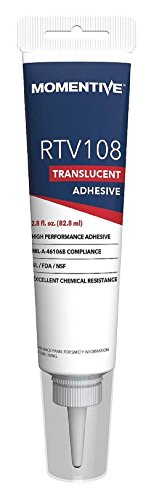
2. Momentive RTV108 Silicone Sealant 2.8 Ounce
A paste that fills cracks and clings to vertical surfaces without sagging
When the job is filling a gap rather than gluing two faces together, this is the one to beat. It is a one-part translucent RTV silicone — that is a sealant that cures into rubber when it meets moisture in the air — and it stays pasty instead of running. That paste consistency is what lets it sit on a vertical or overhead surface and fill gaps or cracks up to a quarter-inch wide without dripping down the panel.
This one skips the primer step entirely. It sticks to metals, glass, ceramic, silicone rubber and some rigid plastics straight from the tube, so repairs that stall on other products move forward. Sealing performance is the strength that stands out, and owners point again and again to hard jobs like glass shower door clamps and sliding-glass tub enclosure brackets — the kind of heavy glass that slowly slips down when you use a soft, never-hardening sealer. As one who has fiddled with frameless panels describes it: it is the one that finally held where a slow slide had beaten everything else.
This sealant shrugs off extreme temperatures. It holds -75 to +400 degrees F continuously and -75 to +500 degrees F short-term, so it survives both engine-bay heat and winter cold. It also carries some serious paperwork: it meets MIL-A-46106, NSF Standard 51, FDA 21 CFR 177.2600, USDA and UL component requirements. Two caveats worth knowing. It cures with a vinegar smell as it sets, and the small 2.8-ounce tube is not the cheapest way to buy sealant by volume — owners often note it is priced high and can be hard to find, which is why they budget for it rather than grab it casually.
The standout trait: paste consistency that will not sag on a vertical seam and seals a gap up to a quarter-inch wide in one pass.
Sized honestly: the vinegar odor during cure and the price-per-ounce on a small tube are the two things to expect going in — neither affects how the finished bond performs.
Best fit for: shower door and tub enclosure hardware, outdoor gaskets, and any repair that sees heat, water or a slope you cannot clamp.
Look elsewhere if: you want a fast, low-odor repair you can handle in seconds — this one needs cure time and smells while it sets.
3. Silicone Glue, High-Flexibility and Waterproof, Skin Color
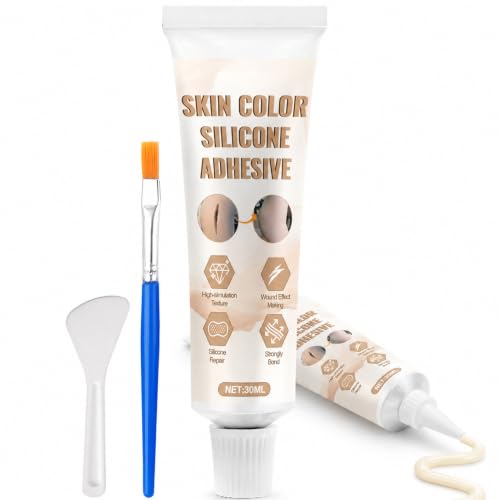
The skin-toned glue for anyone repairing silicone pieces that have to look untouched
This is the specialist for cosplay, doll and prop work, where the repaired spot needs to disappear instead of showing a shiny glue scar. It comes in a skin color, and the cured glue is designed to match silicone in both color and feel, so a patched area reads as part of the original piece rather than a patch. It is built for silicone, rubber and TPR materials, and it will not turn brittle or whiten after curing — which is exactly what you want on a flexible body piece that gets handled.
It handles the details that separate a good repair from a visible one. There is a fine-tip applicator for pinpoint accuracy on small tears and delicate edges, and a brush scraper is included for working the glue into a seam. For special-effects makeup, prosthetics, cosplay props and silicone product production, that precision matters, because a thick blob on a thin edge defeats the whole point. The cured bond is described as skin safe and dries to a silicone-like texture rather than a hard plug.
This glue rewards patience. The stated full cure time is a week, though users report it reaches a soft cure much sooner — around six hours to a working state, three days to fully set, with roughly 20 minutes of working time before it stops moving and about two hours for an inner layer to set. It also runs sticky and thin, so it grabs the tools as readily as the workpiece, and rubbing alcohol on the tools keeps the job clean. A few people noted it is best laid in thin layers, since piling it on at once gets messy, and one owner found it did not hold the fingers on a silicone reborn doll. For color-matched, flexible silicone work, though, the results are hard to argue with.
Why it earns a spot
- Skin-color glue that matches silicone in tone and dries to a silicone-like texture instead of a hard plug
- Fine-tip applicator plus included brush scraper for working small tears and seams without overspill
- Stays flexible after curing and will not whiten, so flexible pieces keep flexing
Where patience is required
- Stated full cure is a week, and the glue is thin and sticky, so it clings to the tools
- Best applied in thin layers; a heavy single pass gets messy and sets unevenly
- Not the pick for rigid joints or load-bearing repairs — this is a looking-good, moving-flexibly product
Built for: cosplay props, prosthetics, doll and squishy repair, and any silicone job where the color match matters as much as the hold.
skip it if: you need strength in a hurry on a rigid part — the slow cure and thin consistency suit careful cosmetic work, not heavy-duty joins.
4. Smooth-On SIL-Poxy Rubber Silicone Adhesive, 3 oz Tube
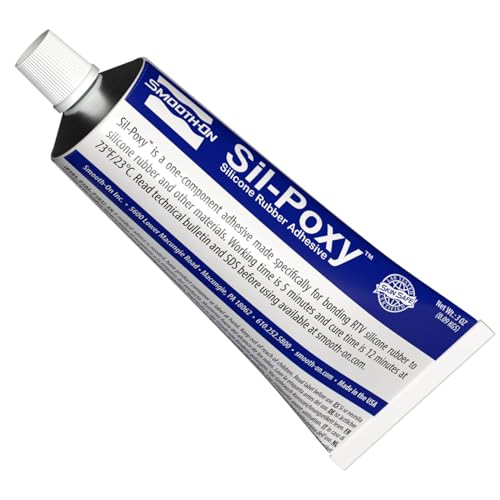
The flexible silicone weld that keeps stretching parts moving after the repair
Of the group, this is the one built specifically to join silicone to silicone and keep the joint stretchy. It creates a high-elongation bond — meaning the cured adhesive stretches a long way before it cracks — so torn silicone molds, prosthetics and moving parts flex without splitting open again. It works with both tin-cure and platinum-cure RTV moldmaking silicones, the two main families of mold rubber, which is why it turns up across so many different projects instead of just one kind.
It is not limited to silicone, either. The gel bonds silicone to plastics, ceramics, plaster and fabric, and once cured it resists water, sunlight and high temperatures. That combination is what makes it the choice for anyone whose repair lives outside or on a part that moves. The full cure is 24 hours. Owners describe the finished bond as strong and stretchy with no hard spots, sealing test pieces without a seam breaking, and compare the result to a silicone weld rather than a glued joint.
Cosplay and effects work is where it shows up most. It has fixed torn silicone breast plates, attached a zipper to a silicone body suit and repaired the faces on Halloween animatronics. Two honest notes come up. It leaves a bit of a shine on the repaired spot, which matters if you wanted a matte finish, and it has a strong smell that hangs around for a day after application. A several of owners also wish the tube went further for the outlay. None of that changes the bond quality — for flexible silicone-to-silicone repair, it does the job cleanly.
The defining spec: a high-elongation, high-flexibility hold designed not to crack on moving or stress-prone parts, bonding both tin-cure and platinum-cure silicones.
Set your expectations: expect a shiny finish and a strong odor that lingers a day — cosmetic trade-offs, not structural ones, and the seam stays sealed through water, sun and heat.
Pick this for: torn silicone molds, prosthetics, animatronics and any silicone-to-silicone repair on a part that has to keep flexing.
Know before you buy: the shiny finish and lingering smell are the two complaints that show up, so plan a matte topcoat or good ventilation if either matters to you.
5. Silicone Glue 30g 2 Pack
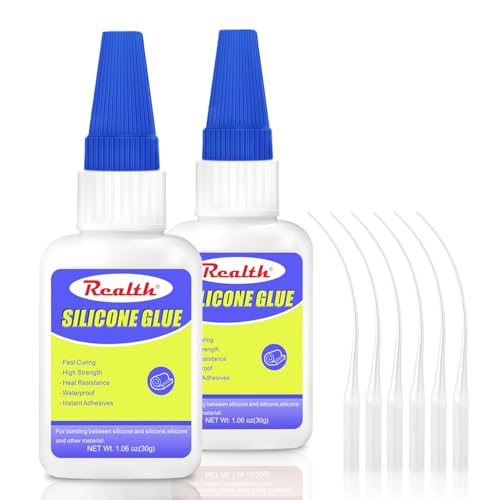
Two tubes, three droppers, and the fastest set time in this lineup
If you want to spend the least and get the most tubes, this two-pack is the entry point. You get two 30-gram bottles, which is double the piece count of the single-tube skin-color pick above, plus three precision droppers, an anti-clog cap and a low-odor formula. The stated dry time is 15 seconds, the quickest here, and it is built for silicone, silicone rubber, TPU, TPR and TPE — the soft, rubbery plastics that show up in phone cases, DIY crafts and toys. It dries clear, is described as waterproof, and claims not to yellow or cloud over time.
Where it genuinely shines is craft and quick-fix duty. It bonds kids’ squishies and both rigid and pliable plastics, and the dropper applicator keeps the glue off your fingers. On wood projects it sets fast enough that you do not get a second chance to reposition, so place the parts right the first time. The anti-clog cap and droppers are the kind of practical touches that make a cheap tube last longer on a shelf.
The caveat is the important one, and it is the reason this sits at the budget end. This behaves like a fast cyanoacrylate super glue, and at least one owner who bought it specifically for silicone parts found that it “does not work on silicone,” trying both platinum-cure and regular RTV silicone without success. Bonding performance is genuinely mixed across the reviews, with some users finding it works well and others hitting that same wall. So treat this as an excellent general craft glue at a low outlay — not a sure thing for a raw, unprimed silicone-to-silicone joint. If your job is genuinely silicone, budget for one of the formulations above and keep this for everything else.
Worth grabbing for: craft and general repair on soft plastics, TPU, TPR and TPE, where a fast 15-second set and two tubes for the outlay make sense.
Think twice if: your project is raw silicone-to-silicone — this one is the fastest and cheapest here, but silicone is exactly where it is most likely to disappoint.
Know the Specs
Cure Time and Working Time
Cure time comes in two stages and both matter. Working time is how long the glue stays movable so you can adjust the fit — some formulations lock in under 20 seconds, others give you around 20 minutes. Full cure is how long until the bond reaches its final strength, which can range from 15 seconds on a fast craft glue to 24 hours or even a stated week on a slow-setting silicone adhesive. Match the cure speed to the job: fast for small joints you can hold still, slow for pieces you need to line up carefully.
Flexibility and Service Temperature
Flexibility, sometimes listed as elongation, tells you how far the cured glue stretches before it cracks. A repair on a part that bends, squeezes or flexes needs a flexible cure that moves with the silicone, because a rigid glue will crack at the joint. Service temperature is the range the bond keeps working in — a wide range like -75 to +400 degrees F means the repair survives both a hot exterior surface and a cold one, which matters for anything outdoors or near heat. Check both if the repair lives somewhere harsh.
Common Questions
Can ordinary super glue bond silicone rubber?
Do I need a primer to glue silicone to silicone?
What is the difference between an instant adhesive and an RTV silicone adhesive for silicone?
How long does silicone adhesive take to fully cure?
Which silicone adhesive is best for a repair that gets wet or hot?
Is silicone glue safe to use on cosplay and prosthetics that touch skin?
Can I glue silicone to metal, glass or plastic?
Why did my silicone repair peel off even though the glue said it worked on silicone?
How much adhesive do I actually need for a small silicone repair?
Can silicone adhesive stick to TPE, TPU or TPR soft plastics?
The Bottom Line
The one that does the most jobs well is the 3M Scotch-Weld PR100, because it grips the difficult surfaces — silicone rubber, plastic, EPDM — that stall out ordinary glue, and it locks small joints in seconds once you add the primer. If your repair has to fill a gap in a vertical seam or survive heat and water, the Momentive RTV108 is worth the slow cure and the vinegar smell. For any silicone piece that needs to keep stretching and look smooth, whether it is a mold, a prosthetic or a cosplay suit, the high-elongation hold of the Smooth-On SIL-Poxy is the one to reach for. And if you just want a fast, low-outlay craft glue for soft plastics and quick fixes, the two-tube Realth pack does the everyday work at the budget end. Match the chemistry to your surface and the repair holds the first time.
How we choose
We do not accept paid placement. Every pick is matched to a real buyer and a real use-case; we do not hands-on test units.
Sources
Specifications: manufacturer listings and product documentation. Review insights: verified customer reviews, as of October 2026. Pricing: not shown on this page (it changes often); check the current price via the retailer link.
As an Amazon Associate, My Heart Lives Here earns from qualifying purchases. This does not affect which products we feature.