Heads up: This post contains affiliate links. As an Amazon Associate I earn from qualifying purchases, at no extra cost to you. Learn more
Specs are compiled from manufacturer listings and verified buyer reviews and can change over time — please confirm the key details on the product page before buying.
A chipped ceramic tile or a hairline crack in a sink is a small flaw that looks huge every time you walk past it. The right repair filler locks the chip shut and disappears into the glaze; the wrong one yellows, peels, or never hardens. Here are five that actually finish the job, sorted by what each one is genuinely good at.
This guide is built by comparing the manufacturers’ published specifications and the patterns across verified customer reviews, so you get each pick’s real strengths and trade-offs instead of marketing spin.
Some are paste kits you mix and sand; some are putty sticks you knead and press. Knowing which form your damage needs is most of the battle with adhesive for ceramic repair.
Top Picks

How To Choose The Best Adhesive for Ceramic Repair
Three factors decide whether your patch holds or fails — read them before you buy.
Match the form to the damage
A putty stick molds into a missing chunk or a rounded chip, while a two-part paste spreads flat and sands flush for cracks on a wall or floor tile.
Check the cure time against your patience
Fast epoxies let you handle the repair in minutes but need 24 hours to fully harden, so plan a patch you will not touch for a day.
Decide how much color matching you need
On a bright white tile, a plain white filler is fine, but on ivory or beige you want a kit with mixable pigments to hide the spot.
Side-by-Side Comparison
| Model | Best For | Form | Full Cure | Weight | Amazon |
|---|---|---|---|---|---|
| Endhokn Epoxy Putty★ Best Overall | Leaks and missing chunks | Putty stick | 24 hours | 300 g | Amazon |
| COCONIX Tile & Ceramic Repair KitTop Color Match | Color-matched tile chips | Paste + putty | — | 11.3 ounces | Amazon |
| Starbond 5 Minute Epoxy Pro Kit | Fast, strong structural bonds | Two-part paste | 24 hours | 8 oz. | Amazon |
| Ankita Tile & Ceramic Repair Kit | Floor tiles underfoot | Two-part paste | — | — | Amazon |
| Tub Repair Kit White (G009) | Tub and sink chips | Two-part paste | 12 hours | 5.8 ounces | Amazon |
Detailed Reviews
1. Endhokn Epoxy Putty, 10.5 oz White Putty Stick
Our pick — 4.5+★ from 1,000+ verified ratings; the strongest balance of quality and price.
The kneadable chunk-filler that works even underwater.
Missing a corner off a ceramic bathroom tile or sealing a dripping pipe joint? This putty stick is the one to reach for. It comes as 150 g of Part A and 150 g of Part B, which you knead together at a 1:1 ratio until the white stick goes uniform, then press into the gap — 30 minutes of molding time before it starts to set. The kit ships with two pairs of gloves, a scraper, and a manual. Because it cures fully hard in 24 hours, it can be drilled, sanded, and painted afterward.
What wins people over is how completely the repaired area hardens — a fragment pressed into a chip days later feels indistinguishable from stone. It holds its shape from -50 °C to 130 °C and keeps its grip below the waterline, which is unusual for a home filler.
White putty stick
- Works above and below water, so tub leaks and pool cracks are fair game
- 1:1 mix ratio keeps the math simple — no measuring cups needed
- Hardenable surface accepts paint, so you can blend it into a wall
Slow full cure
- Some units are reported to stay tacky for days rather than 24 hours — plan the patch so you can walk away
Grab for small fills: tile corners, pipe leaks, and anywhere a chunky filler beats a thin paste.
Skip on deep gaps: a hairline crack across a flat tile — this dries lumpy and is harder to sand flush than a two-part paste.
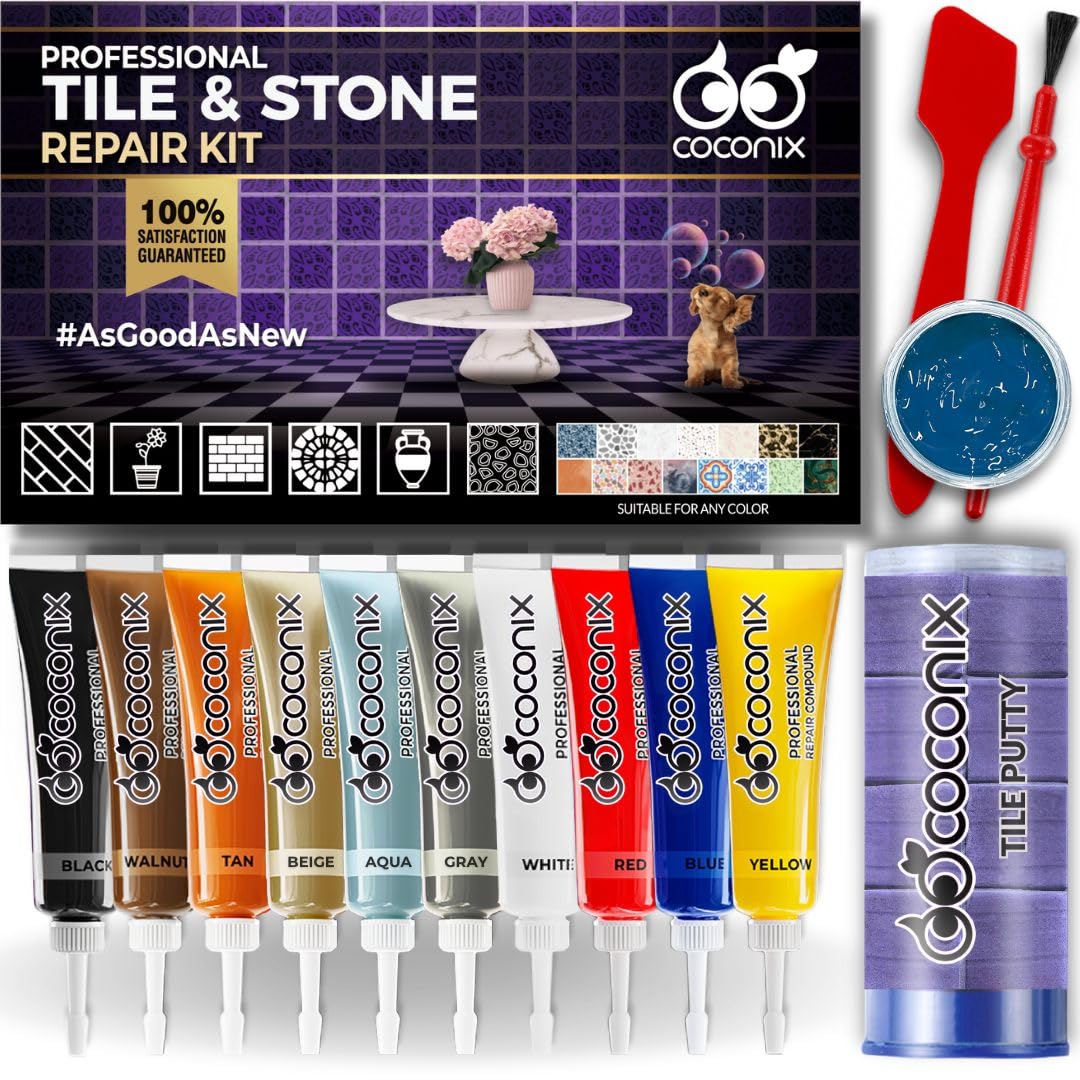
2. COCONIX Tile & Ceramic Repair Kit
Eleven color compounds mixed to disappear into your tile.
If the chip sits on a beige or terracotta tile and a white smear would look worse than the damage, this is the kit that solves it. You get a full color spectrum of compounds to blend, plus a mixing jar, tile putty, spatula, and applicator brush — 11 packs at 0.64 Fl Oz each, weighing 11.3 ounces total. Knead the putty, press it in, and the semi-gloss finish blends with the surrounding glaze.
Owners consistently report fast fixes — filling chips in a few minutes and getting a patch that is almost invisible. On terracotta especially, the matched color vanishes. What wins the crowd here is function: the paste works on tile floors and vertical surfaces alike, and it can save you the cost of pulling out a tile.
The catch is drying — a few users report the putty never fully hardens, so keep your patch level and don’t over-apply.
Try on cracked tiles: beige, terracotta, or slate-colored tile where the color must match.
Pass on large breaks: your tile is a pure high-gloss white and you want a guaranteed invisible seam.
3. Starbond 5 Minute Epoxy Pro Kit

The structural-grade two-part epoxy that cures clear and holds 2,600 lb.
When you are bonding a broken ceramic handle back to a mug or a cracked tile splashback back to the wall, you want shear strength, not filler. This epoxy delivers 2,600 lb of shear strength, cures clear, and hits handling strength in about 5 minutes before fully curing in 24 hours. By comparison, the Tub Repair Kit White takes 12 hours to fully harden — this is the quicker route to a usable bond if you are repairing something structural.
The flexible toughened formula is engineered to absorb vibration and stress without brittle cracking, which matters when the repair sits on a wobbling shelf or a running washing machine. It bonds wood, metal, glass, ceramic, and many plastics like ABS and PVC. The kit includes screw-cap bottles, mixing trays, and a clean mixing setup — no leaky syringes.
Mixing at 1:1 by volume keeps ratios predictable; users who have used thicker epoxies find this one sets faster than expected, so have your clamps ready.
Five minute set: ceramic repaired against a non-porous surface — a mug handle, a bolt hole, a joint that needs real tensile strength. Clear curing means the bond itself is hard to spot.
Short working window: chips that need a color match or a sandable filler — the clear finish will leave a visible sheen on a white tile and it is not designed to be sanded flush.
4. Ankita Tile & Ceramic Repair Kit
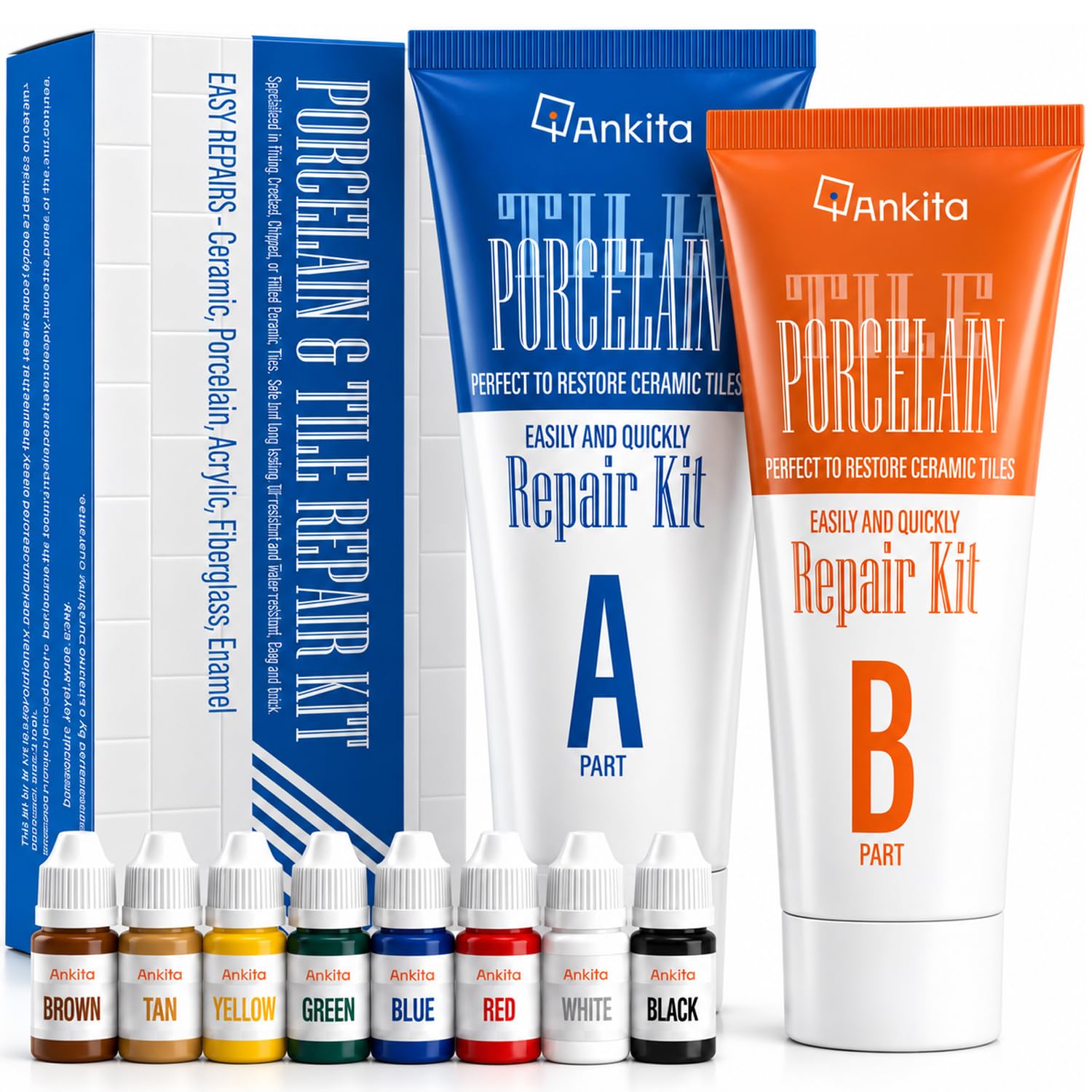
Built for the tile your foot lands on every morning.
A dropped pan can leave a pale chip that stands out against the glaze. This kit fills that spot with an epoxy paste that stays put on vertical surfaces without running, so towel-bar holes and chipped tile corners get filled cleanly. Eight pigments let you mix a shade from warm white through almond, beige, and gray, then sand the finished patch flush so it does not catch underfoot. It is fully two-part — Part A and Part B mixed — and cures hard without shrinking.
Where it shines is the hard, level finish: when you sand it back, the patch sits flush with the surrounding tile. For anything feet or cleaning mops will cross daily, that flatness is the real test.
The recurring sticking point is color matching — several users report a yellow cast over time, so blend a test dab and let it dry before you commit to the whole fill.
Buy for home fixes: floor and wall tile cracks that need a flat, traffic-ready surface.
Check size first: your tile is bright white and unfading — the yellowing risk is real.
5. Tub Repair Kit White (G009)

The small white kit that rescues a chipped tub or sink in a day.
For a chip in a fiberglass tub, a scuff on a porcelain sink, or a nick in the enamel, this compact 5.8-ounce kit does a single job well: two parts mixed 1:1, cured hard in 12 hours, then sanded smooth. It works across fiberglass, acrylic, ceramic, enamel, cast iron, porcelain, ceramic tile, toilet, and cultured marble — broad coverage for a 5.8-ounce tube. The repair is waterproof and firm once cured, with no unpleasant smell.
Owners think of it as the budget route to skipping a repair-shop visit, and shower floors that were chipped come out looking renewed. It is also a full 12-hour cure, so plan a patch you can leave untouched overnight.
The trade-off is cosmetic: the white runs a shade off and can yellow over time, and the included sandpaper tests the patience of some users. Consider that a fit issue for bright white surfaces rather than a defect.
Pick for tub chips: white tub, sink, or toilet chips where quick and cheap beats perfect.
Hold off on enamel: your fixture is a distinct ivory or beige — the shade will read slightly cold.
Know the Specs
Cure Time
The window before you can put weight on a repair — 5-minute handling strength is touchable but not load-bearing; full cure (often 12 to 24 hours) is when the ceramic joint is truly solid.
Mixing Ratio
One-part putty sticks skip it entirely; two-part epoxies need a firm 1:1 by volume, and a sloppy mix leaves sticky patches that never harden.
Common Questions
Can I use epoxy putty on a cracked ceramic tile?
How long before I can use a repaired sink again?
Why does my white repair turn yellow?
The Bottom Line
The adhesive for ceramic repair that earns the top spot is the Endhokn Epoxy Putty — 300 g of 1:1 stick that molds, hardens hard, and even works underwater, so both a chipped tub corner and a leaking joint are covered. If a beige or terracotta tile is the problem, the COCONIX kit and its 11 color compounds will blend better; for a structural bond rather than a fill, the Starbond epoxy at 2,600 lb shear is the stronger choice.
How we choose
We do not accept paid placement. Every pick is matched to a real buyer and a real use-case; we do not hands-on test units.
Sources
Specifications: manufacturer listings and product documentation. Review insights: verified customer reviews, as of November 2026. Pricing: not shown on this page (it changes often); check the current price via the retailer link.
As an Amazon Associate, My Heart Lives Here earns from qualifying purchases. This does not affect which products we feature.