Heads up: This post contains affiliate links. As an Amazon Associate I earn from qualifying purchases, at no extra cost to you. Learn more
Specs are compiled from manufacturer listings and verified buyer reviews and can change over time — please confirm the key details on the product page before buying.
Old gas smells like varnish and a dead mower, and the fast answer is that a good additive can save it — if you pick the right one for how long the fuel has been sitting. The trick is matching the bottle to your job: a heavy cleaner for fuel that is already gummed up, or a stabilizer for gas you are putting away for winter. Below are seven picks that actually do one of those two jobs well.
This guide is built by comparing the manufacturers’ published specifications and the patterns across verified customer reviews, so you get each pick’s real strengths and trade-offs instead of marketing spin.
You will see how each bottle cleans, stabilizes, handles water, and how much fuel it treats, so you can grab the one that fits your tank instead of guessing. These are the strongest options for anyone hunting the best additive for old gas.
Top Picks


How To Choose The Best Additive for Old Gas
The single biggest mistake is buying a stabilizer for fuel that is already stale — a stabilizer protects fresh gas, while a cleaner dissolves the gum and varnish old fuel leaves behind. Those are two different products. A stabilizer protects fresh gas so it does not break down during storage. A cleaner goes after the gum, varnish, and carbon that old fuel leaves behind in a carburetor or injector. Know which problem you have before you buy.
First, decide: are you storing fuel or rescuing it?
If you are putting a mower, boat, or generator away for the season, you want a stabilizer that slows fuel aging and protects the fuel system from corrosion. If the machine is already running rough on old gas, you want a cleaner that dissolves deposits. Some bottles do both — the Sea Foam Motor Treatment and the K-100 both claim cleaning and stabilizing — which is why they are popular for old gas specifically.
Watch the treatment ratio, not just the bottle size
Bottle size tells you almost nothing on its own. What matters is how many gallons a set dose covers. The Quicksilver Quickstor treats with 1 oz. per 5 gallons, and the Star Brite Pro Star uses 1 fl. oz. per 5 gallons. A one-gallon jug that treats up to 1280 gallons is a different kind of purchase entirely — that is bulk storage treatment, not a single-tank fix.
Ethanol and water are the slow killers
Modern pump gas often carries ethanol, which can pull moisture out of the air and separate in the tank. Additives that claim to handle water, phase separation, and corrosion are the ones worth a look for a machine that sits. Read the label for words like phase separation inhibitor, water removal, or corrosion protection — those are the claims that matter for stored fuel.
Side-by-Side Comparison
| Model | Best For | Stabilizes Fuel | Cleans Deposits | Format | Amazon |
|---|---|---|---|---|---|
| Sea Foam Motor Treatment (16 oz, 3 Pack)★ Best Overall | All-around old-gas rescue | Up to 2 years | Yes — fuel and oil | 16 oz, pack of 3 | Amazon |
| K-100 Gas Treatment 8ozBest for Carburetors | Cleaning carbs and octane | Yes — extended storage | Yes — gums and varnish | 8 oz bottle | Amazon |
| Chevron Techron Protection Plus | Small engines and powersports | Up to 2 years | Yes — carbon deposits | 10 oz, pack of 1 | Amazon |
| Quicksilver Quickstor | Boat and generator storage | Up to 2 years | Not stated | 12 oz bottle | Amazon |
| Star Brite Pro Star | Storage with fogging protection | Up to 1 year | Not stated | 16 oz bottle | Amazon |
| Fuel Stabilizer 24 oz (2 Pack) | Ethanol and water protection | Slows fuel aging | Detergent in formula | 24 oz, 2 pack | Amazon |
| Fuel Stabilizer 1 Gallon | Bulk long-term storage | Up to 3 years | Not stated | 128 oz jug | Amazon |
Detailed Reviews
1. Sea Foam Motor Treatment 16 oz Pack of 3
Our pick — 4.5+★ from 2,000+ verified ratings; the strongest balance of quality and price.
One bottle that dissolves existing gum and varnish, then stabilizes fresh fuel for up to 2 years.
Old gas in a mower or generator usually needs two things at once: the gum broken down and the tank protected from going stale again. This Sea Foam three-pack handles both. Add it to the fuel tank every 3,000 miles or before storage, and it works on gasoline and diesel alike — so the same bottle serves your truck, your boat, and your snowblower.
What wins people over here is the value of the three-pack — it is the most-praised thing about this bottle by a wide margin, and the cleaning power comes right behind it as the second most-discussed strength. Buyers report the cleaning shows up as smoother idling and less hesitation when you hit the gas, with fuel-efficiency gains they notice at the pump. The stabilizer side keeps gas or diesel fresh for up to 2 years, which is the number that matters if you park a machine for the off-season.
The weight tells the story of the deal: at 3.19 pounds for the three-pack versus 1 pound for a single 16 oz Sea Foam bottle, you are getting three full treatments in one order rather than a top-up. It is also the crowd favorite on this list, and for good reason — 4.5+ stars across 2,300+ owners backs up the everyday results. The catch is that it is a fuel-and-oil treatment, so it is not a dedicated ethanol or water-removal formula like the Ethanol Shield or the bulk jug further down — if your problem is phase-separated ethanol, those are the more targeted tools.
What earns the top spot
- Cleans injectors, carburetors, and chamber areas, then stabilizes fuel up to 2 years — one bottle for both jobs
- Works with gasoline, diesel, E10, and E85, so it covers every machine in the garage
- Three-pack format means you have a dose ready for each stored machine
Where it comes up short
- No dedicated ethanol or water-removal claim — a different bottle for that problem
- You have to remember the 3,000-mile dosing schedule to get the cleaning benefit
Go with this if: you want one bottle that rescues rough-running equipment and preps it for storage, all without buying two products.
Look elsewhere if: your tank has visible water or phase-separated ethanol — a formula built around water removal is the better match.
2. K-100 Gas Treatment 8oz
An 8 oz dose that dissolves carburetor gum, eliminates water, and boosts octane at once.
If a machine has been sitting so long the carburetor is gummed up, this is the bottle built for that exact job. K-100 claims to dissolve gums and varnishes, eliminate water and the problems that come with it, and boost octane all in one dose. It also revitalizes fuel and stabilizes it for extended storage, so it can clean a bad tank and then protect it while the machine waits.
What owners care about most is that it simply works — functionality is the aspect praised the most here, and the picture is a carburetor that clears up and machinery that starts and runs like new. That makes it a natural fit for a motorcycle, ATV, or older small engine that has been neglected. It burns cleanly and completely with no ash deposits, which matters in a small two-stroke or carbureted engine.
Be honest about the value question, though. Opinions on price for this 8 oz bottle are mixed — some find it worth the cost for the octane boost and cleaning combo, others find it on the pricier side. It is also the smallest bottle on this list at 8.1 ounces, so you are paying for a concentrated dose rather than volume.
Where it shines: water removal, gum dissolving, and an octane boot all in one 8 oz bottle — a strong choice for a neglected carbureted engine.
The honest caveat: the value verdict is split, and the bottle is small, so budget-minded buyers may want the larger multi-packs instead.
Reach for this if: your carburetor is gummed and you want a concentrated cleaner plus octane help from one small bottle.
Think twice if: you are treating a big tank or several machines — the small bottle goes quickly compared to a three-pack or jug.
3. Chevron Techron Protection Plus 10 oz

An alcohol-free, emulsifier-free formula that resists water uptake during storage.
Storage problems often start with water, and Techron’s angle is preventing it rather than chasing it. The formula is alcohol-free and emulsifier-free, so it does not contribute to water uptake the way some additives can. That makes it a sensible pick for a powersports engine or small engine you store in a damp garage or shed.
It combines three jobs: it stabilizes fuel up to 2 years, it cleans carbon deposits and dissolves gum and varnish, and it adds corrosion and rust protection across the whole fuel system. Package size runs 8.62 x 2.95 x 1.81 inches, a compact bottle that tucks into a toolbox or shelf without eating space. The build quality is the trait owners prize most, with the cleaning performance close behind.
Owners mention it keeps injectors clean and holds gasoline stable for up to two years, and they treat it as a cost-effective buy for the job. Where it differs from the Sea Foam three-pack above is focus: Sea Foam cleans the oil side too, while Techron sticks to the fuel system and goes harder on rust protection for severe conditions. If your old gas is in a boat, jet ski, or mower parked in the weather, that corrosion angle is worth the trade.
The real appeal: no alcohol and no emulsifiers, so it stabilizes and protects without inviting water in — ideal for powersports that live outdoors.
Best for: boat, ATV, jet ski, and small-engine owners who store equipment in humid or damp spots and worry about rust.
Not the pick for: anyone who also wants to clean sludge out of the crankcase — this bottle stays in the fuel system.
4. Quicksilver Quickstor Fuel Treatment and Stabilizer

A Mercury Marine OEM-spec stabilizer dosed at 1 oz. per 5 gallons for up to 2 years of storage.
Boat owners have a specific problem: fuel sits for months between outings, and an outboard that sputters in spring is an expensive day. Quickstor is built for that season, with a straightforward dosing rule — 1 oz. treats 5 gallons. It stabilizes fuel for up to two years and prevents both regular and ethanol-blended gas from breaking down and oxidizing.
The marine pedigree is what separates it: it is produced to meet Mercury Marine original equipment manufacturer specifications, the standard set by a marine engine maker. That is why it lands near the top for boats, generators, lawnmowers, and other powersports gear that goes into long storage. Quality is the strength praised most, with fuel stabilization close behind.
One thing it does not promise on the label is heavy deposit cleaning the way the cleaners above do — this is a stabilizer first. If your engine is already gummed, pair it or choose a cleaner; if the fuel is still good and you just want it to stay that way, this is the tidy one-bottle answer.
Why boaters pick it
- Built to Mercury Marine OEM specs — a standard that matters for outboards
- Stabilizes up to 2 years and blocks oxidation in ethanol blends
- Simple 1 oz. per 5 gallons ratio, easy to dose without a measuring headache
The flip side
- Stabilizer-focused, so it is not the fix for a tank that is already gummed up
Pick this for: outboards, generators, and mowers going into months of storage where oxidation is the enemy.
Skip it for: an engine that is already running rough — you want a cleaner in the tank first.
5. Star Brite Pro Star Gasoline Stabilizer
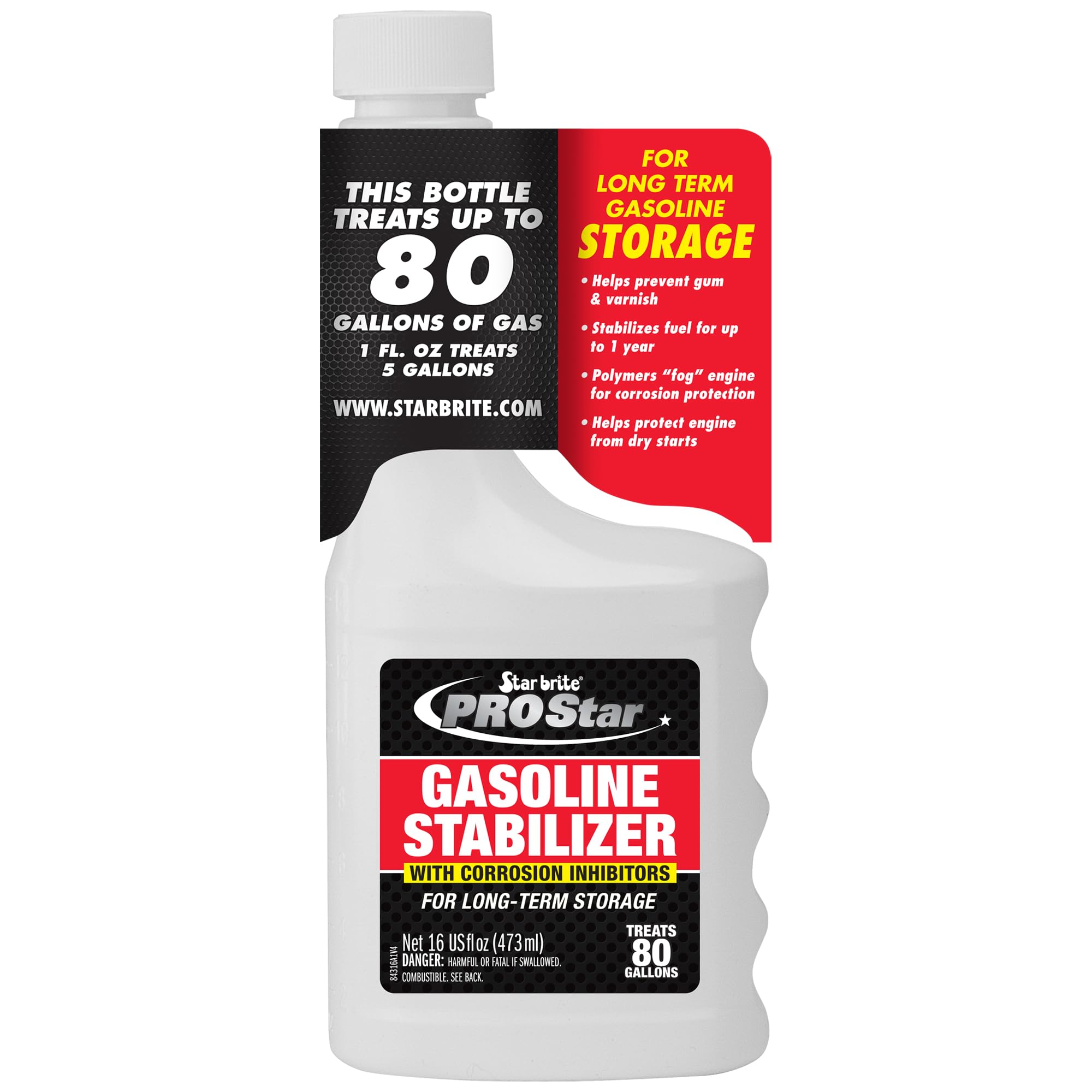
Stabilizes fuel for up to 1 year and fogs engine internals in the same 1 fl. oz. per 5 gallons dose.
Most stabilizers stop at the fuel. Star Brite combines stabilization with fogging protection, which is the coating that guards engine internals during storage. The application is built for cold-weather layup: add 1 fl. oz. per 5 gallons of fuel, fill the tank, and run the engine for 10 minutes. That short run pulls the treated fuel through the system so it is protected where it counts.
It is formulated to resist corrosion on fuel-system and engine components and works with ethanol blends like E-10 and other gasoline types. This 16-ounce bottle weighs 15.68 ounces, versus 8.1 ounces for the K-100 bottle, so there is more volume here to cover a full tank and then some. It stabilizes fuel up to 1 year — a shorter window than the 2-year claims on several bottles here, so plan to re-treat if a machine sits longer.
The concentrated mix means a small pour goes a long way, which suits one machine stored seasonally rather than a fleet. If your winter routine is fogging a mower or outboard by hand every fall, folding that step into the fuel additive saves you the separate can.
Best fit: a seasonal machine owner who wants stabilization and fogging in one pour instead of two separate products.
Trade-off to know: a 1-year stabilization window means a long storage needs a second treatment later.
Worth it if: you fog engines for winter and want that job combined with fuel stabilization in a single bottle.
Look elsewhere if: your equipment sits more than a year — the 2-year formulas are the safer bet.
6. Fuel Stabilizer 24 oz 2 Pack

A phase separation inhibitor plus antioxidants and anticorrosives aimed at ethanol-blend storage.
If you run pump gas with ethanol, this is the bottle aimed squarely at what ethanol does to a stored tank. It pairs antioxidants and anticorrosives with a phase separation inhibitor — the defense against the ethanol-and-water mix that turns a tank sour. There is also a phase-inhibitor role, an upper cylinder lubrication function, and rubber and plastic protection so seals do not dry out.
Owners get the most out of the easy, everyday performance: functionality leads the way, with water absorption and fuel retention named as clear strengths. Customers note it removes water from the fuel and extends shelf life, and it earns its keep in winter mower storage. The protection story extends to seals and rubber components that ethanol attacks. It also claims a proprietary detergent that reduces the need for higher octane as a machine ages, plus Combustion Cool Technology, which the maker lists as part of the formula.
The 2-pack format is the practical draw — 24 oz apiece, 3.19 pounds for the pair, compared to 1 pound for a single 16 oz Sea Foam bottle, so you are stocked for more than one machine. What it does not carry is a numbered stabilization window like the 2-year and 3-year claims elsewhere on this list; it talks about slowing fuel aging, not a month count. If you want a firm “stabilizes for X years” promise, look at the Quicksilver or the bulk jug.
Why ethanol users like it: a phase separation inhibitor plus rubber and plastic protection targets the exact damage ethanol blends do in storage.
What to note: no stated year count on stabilization — the claim is “slows fuel aging,” so heavy long-term storage is better served by a formula with a numbered window.
Choose this if: you are dealing with ethanol-blend fuel and want water, seal, and corrosion protection in a two-bottle set.
Consider an alternative if: you want a specific year figure on the stabilization and are storing fuel for years, not months.
7. Fuel Stabilizer 1 Gallon

A 128 oz jug that treats up to 1280 gallons and stabilizes fuel for up to 3 years.
This is less a single-tank fix and more a supply for someone with a lot of fuel to protect. One gallon treats up to 1280 gallons, stabilizes fuel for up to 3 years, and works in all 2 and 4-cycle engines. If you maintain several machines, a boat, or a fuel supply, the per-treatment volume here is a different class from the small bottles.
It is OEM tested, verified, and used, and it is built to prevent ethanol fuel problems and protect against corrosion. Owners rate it highly and it holds its own in the comparisons they make: reviewers point out it performs better than Sea Foam and regard it as better than Sta-bil. It also goes after water from condensation in gas tanks — the kind that collects in a partly filled tank over a winter.
At 8 pounds for the jug, it is the heaviest bottle here, so plan shelf space and a steady hand for the pour. The 3-year stabilization window is the longest on this list — longer than the 2-year claims elsewhere — which suits long-term storage of a machine you may not touch for seasons. The trade-off is commitment: you are buying a bulk container, so it makes sense only if you will actually treat enough fuel to use it.
Where the gallon earns its place
- Treats up to 1280 gallons and stabilizes up to 3 years — the longest window here
- Works in 2-cycle and 4-cycle engines and addresses ethanol and condensation water
- OEM tested and verified, with owner comparisons putting it ahead of rival brands
Who should pass
- Bulk format only pays off if you actually treat a large volume of fuel
- 8-pound jug is the heaviest and bulkiest bottle on this list
Reach for this if: you maintain a fleet, a boat, or a fuel supply and want the longest 3-year stabilization plus the lowest effort per gallon.
Pass if: you are treating one mower — a small bottle covers that job with none of the bulk.
Know the Specs
Stabilization window
This is how long the additive claims to keep fuel fresh before it breaks down. You will see up to 1 year, 2 years, and 3 years on these bottles. Match the number to how long your machine sits — a mower stored one winter is fine with a 1-year formula, while a boat or generator parked for multiple seasons needs a 2- or 3-year claim.
Treatment ratio
The ratio tells you how much fuel one dose covers — Quicksilver and Star Brite both use 1 oz. per 5 gallons. It matters more than bottle size, because a concentrated bottle can treat the same fuel as a larger weak one. Check the ratio before you assume a bigger jug is the better deal.
Cleaning versus stabilizing
Cleaners go after gum, varnish, and carbon in the fuel system; stabilizers keep fresh fuel from going bad. Some bottles, like the Sea Foam and K-100, claim both. If your fuel is already stale, you want the cleaning claim. If it is fresh and you are storing it, the stabilizing claim is what counts.
Ethanol and water protection
Ethanol blends can absorb water and separate in the tank. Additives that list a phase separation inhibitor, water removal, or water absorption are aimed at that problem. Corrosion inhibitors are the other half — they guard metal and rubber parts while fuel sits.
Common Questions
Can an additive really save gas that has already gone bad?
How long can I store gas with a stabilizer in it?
Do I need a different additive for ethanol-blended gas?
Will adding a stabilizer fix a rough-running engine?
How much additive do I add to a tank?
Can I use these in a two-stroke engine?
Is a cleaning additive different from an octane booster?
How do I get water out of a stored gas tank?
Does a bigger bottle always mean better value?
The Bottom Line
For most people, the additive for old gas that covers the widest range of jobs is the Sea Foam Motor Treatment three-pack, because it cleans the fuel system and stabilizes fuel up to 2 years in one bottle that works on gas and diesel alike. If your tank has ethanol and water trouble, grab the Ethanol Shield 24 oz 2-pack for its phase separation inhibitor. And for a long-term stash or a fleet, the 1-gallon Fuel Stabilizer stretches up to 3 years across up to 1280 gallons. The one nudge worth making: the Sea Foam three-pack is the most consistently praised bottle here, and it is the safest single starting point for old gas.
How we choose
We do not accept paid placement. Every pick is matched to a real buyer and a real use-case; we do not hands-on test units.
Sources
Specifications: manufacturer listings and product documentation. Review insights: verified customer reviews, as of November 2026. Pricing: not shown on this page (it changes often); check the current price via the retailer link.
As an Amazon Associate, My Heart Lives Here earns from qualifying purchases. This does not affect which products we feature.