Heads up: This post contains affiliate links. As an Amazon Associate I earn from qualifying purchases, at no extra cost to you. Learn more
Specs are compiled from manufacturer listings and verified buyer reviews and can change over time — please confirm the key details on the product page before buying.
You want sound that moves around the room and over your head, not a wall of noise from one bar. The picks below cover everything from a fully wireless package you can position in minutes to a 16-speaker Sony system that fills the whole room. What separates them is rarely raw power — it is how many channels you actually get, whether the rear speakers are truly wireless, and how much setup work you will tolerate.
This guide is built by comparing the manufacturers’ published specifications and the patterns across verified customer reviews, so you get each pick’s real strengths and trade-offs instead of marketing spin.
Below you’ll find a wireless package, several receivers, and full speaker systems, so you can judge which route fits your room. Use this guide to narrow down the best 7.1 Surround Sound System before you commit to a full install.
Top Picks


How To Choose The Best 7.1 Surround Sound System
Three things decide whether a package sounds genuinely rich in your room.
Channel count and decoding
A receiver with 7.2 channels can drive seven speakers plus two subwoofers, while a 5.2 unit leaves your back pair unused.
Wireless versus wired rears
Detachable wireless surround speakers save you running cable across the floor, but they still need power at each rear spot.
Subwoofer size
A 10-inch driver moves more air than a smaller cone, so deep bass is felt rather than merely heard.
Side-by-Side Comparison
| Model | Best For | Channels | Driver Size | Connectivity | Amazon |
|---|---|---|---|---|---|
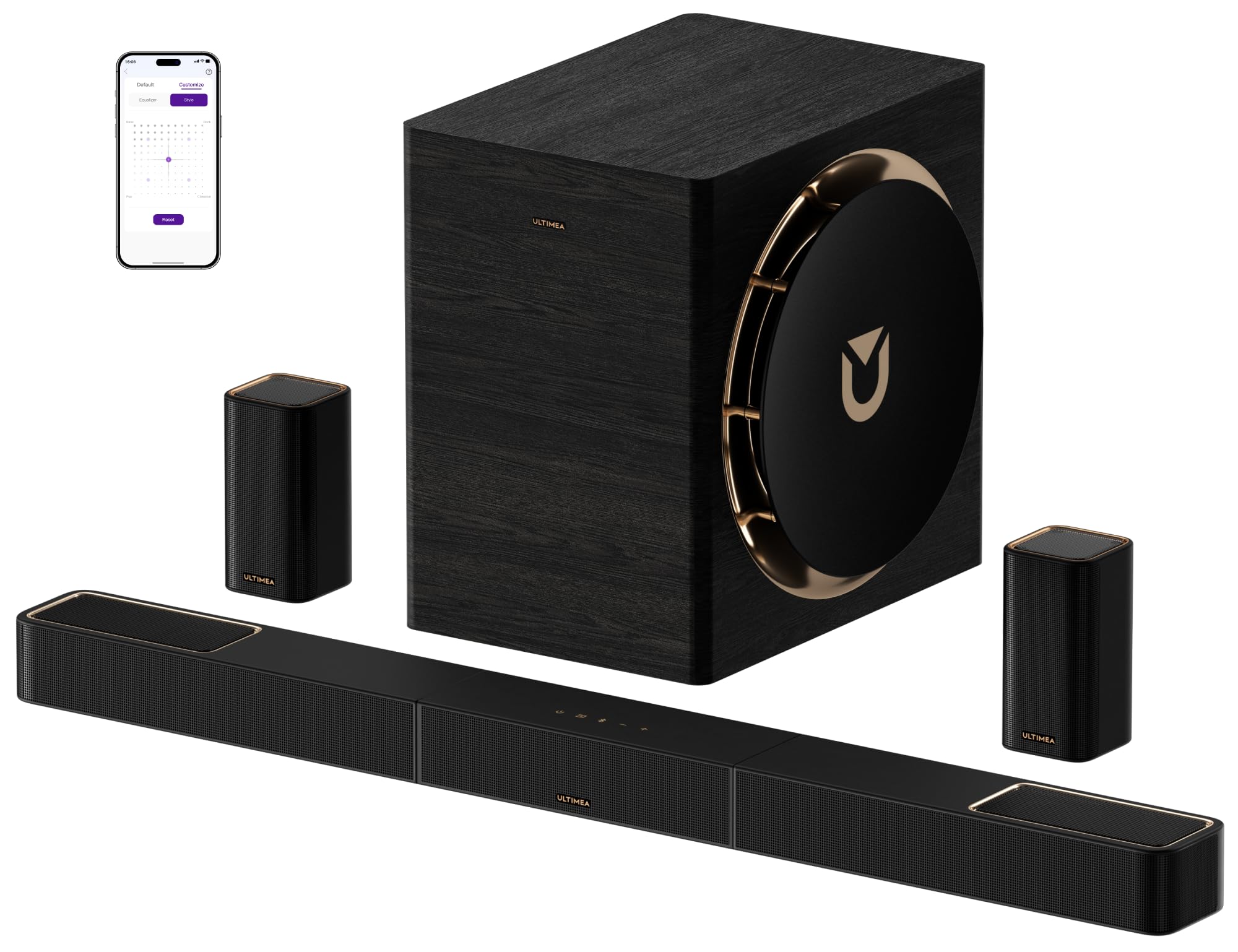
| ULTIMEA Skywave X70★ Best Overall | Wireless cinematic setup | 7.1.4 | 10 inches | HDMI eARC, Optical, Bluetooth, USB | Amazon |
| Klipsch Reference 5.2 PackSpeaker Kit | Full passive speaker kit | 5.2 | 6.5 inches | Wi-Fi | Amazon |
| Yamaha TSR-700Budget Receiver | Budget receiver brain | 7.1 | — | HDMI | Amazon |
| Denon AVR-X1700H | 8K-ready all-rounder | 7.2 | — | Bluetooth, Ethernet, HDMI, USB, Wi-Fi | Amazon |
| Onkyo TX-NR6100 | THX-certified amplification | 7.2 | — | Bluetooth, Wi-Fi | Amazon |
| JBL Bar 700MK2 | Detachable wireless rears | 7.1 | 10 inches | Bluetooth, HDMI, Optical, USB, Wi-Fi | Amazon |
| Fluance Elite SX71BR | Full 7.1 speaker system | 7.1 | 10 inches | Wired | Amazon |
| Sony STR-AN1000 | Multi-zone streaming receiver | 7.2 | — | Ethernet, HDMI, USB | Amazon |
| Yamaha RX-A2A | Premium build and calibration | 7.2 | — | Wi-Fi, Bluetooth, HDMI, optical, phono | Amazon |
| Sony BRAVIA Theater Quad | 16-speaker spatial audio | — | 36 millimeters | Bluetooth, Wi-Fi | Amazon |
Detailed Reviews
1. ULTIMEA Skywave X70 Surround Sound System
Our pick — 4.5+★ from 200+ verified ratings; the strongest balance of quality and price.
Fourteen channels of sound, zero speaker cable running behind your sofa.
The Skywave X70 is the pick that asks the least of you. It handles 7.1.4 channels — seven surrounds, one sub, and four height effects — over a dual 5GHz wireless link, so rain overhead and helicopters in the sky land where the mix put them. Its 10-inch wireless subwoofer reaches down to 20Hz with 980W peak output.
That driver is the biggest in this lineup, a full 10 inches against the 6.5-inch cones in the Klipsch Reference pack. What wins people over is the sound, and the build follows close behind. Setup draws praise too, helped by picture-based instructions in the box.
The honest catch is adjustability. There are 121 sound presets in the app, yet individual speaker levels are not separately adjustable, so fine-tuning a rear corner takes workarounds.
What earns its keep
- Fully wireless rears and sub — no cable runs
- 10-inch sub reaching 20Hz for felt bass
Where it asks patience
- Per-speaker level control is limited
Reach for this one if: you want an rich room without pulling carpet up for speaker wire.
Look elsewhere if: you plan to calibrate every channel individually.
2. Klipsch Reference R-625FA Home Theater Pack
Floorstanding towers and horn tweeters, delivered as one boxed speaker set.
This is the pick for someone who wants real passive speakers rather than a bar. Two R-625FA towers, two R-12SW subwoofers, a center, a bookshelf pair and an Onkyo TX-NR7100 receiver arrive together, backed by a five-year Klipsch warranty. Frequency response runs 38Hz to 21kHz at 96 dB sensitivity.
Here is the trade-off against the Skywave: this kit covers 5.2 channels against the ULTIMEA’s 7.1.4. You get fewer surrounds and no height effects unless the towers’ Atmos modules are wired to a receiver that drives them. What buyers respond to most is the sound the horn-loaded tweeters put out.
The balance point: tower speakers and twin subs give you scale a soundbar cannot match, but you are wiring every one of them and finding floor space for two cabinets.
Worth it when: you have a dedicated room and want speaker-cabinet sound from day one.
The catch: five channels of speakers, so a true seven-surround layout needs additions.
3. Yamaha TSR-700 AV Receiver
The receiver that turns your existing speakers into seven channels of surround.
If you already own speakers, the TSR-700 is the cheapest brain here to drive them. It runs 7.1 channels with Dolby Atmos and DTS decoding, passes 8K HDMI, and streams Spotify through MusicCast. Its footprint runs 16.87 inches deep.
Sound quality is where it earns its spot, and that is the part reviewers consistently like. The honest note is power stability: a share of units reportedly refuse to power back on, and initial setup is described as tricky. The build is described as mixed rather than praised.
Buy it deliberately: treat this as a value-first receiver for a spare room or a first surround build, and buy from a seller with a clear return window.
Fits best: a first 7.1 build where the speaker budget matters more than the box.
Think twice: if you want a receiver you set once and forget.
4. Denon AVR-X1700H AV Receiver

Seven channels, two subwoofer outs, and an 8K video path that will not go stale.
The X1700H is the safest receiver purchase on this list. It drives 7.2 channels at 80W per channel, handles Dolby Atmos and DTS:X, and adds Height Virtualization so you get overhead effects without ceiling speakers. Three 8K inputs and one output pass 8K/60Hz and 4K/120Hz, with HDR10, HDR10+, Dolby Vision and HLG supported.
It also sits at 13.3 inches deep, against the Yamaha TSR-700’s 16.87 inches, so it fits a shallower media cabinet. The build is the most-praised thing about it, with sound quality next in line. Reliability is genuinely mixed, and a few units stop working early.
Setup reality: the on-screen guide and colour-coded back panel make the wiring readable, though instruction quality divides opinion.
Choose it for: a future-proof 7.2 core with two sub outs and room-friendly depth.
Be aware: reliability is the split point, so keep the receipt.
5. Onkyo TX-NR6100 AV Receiver
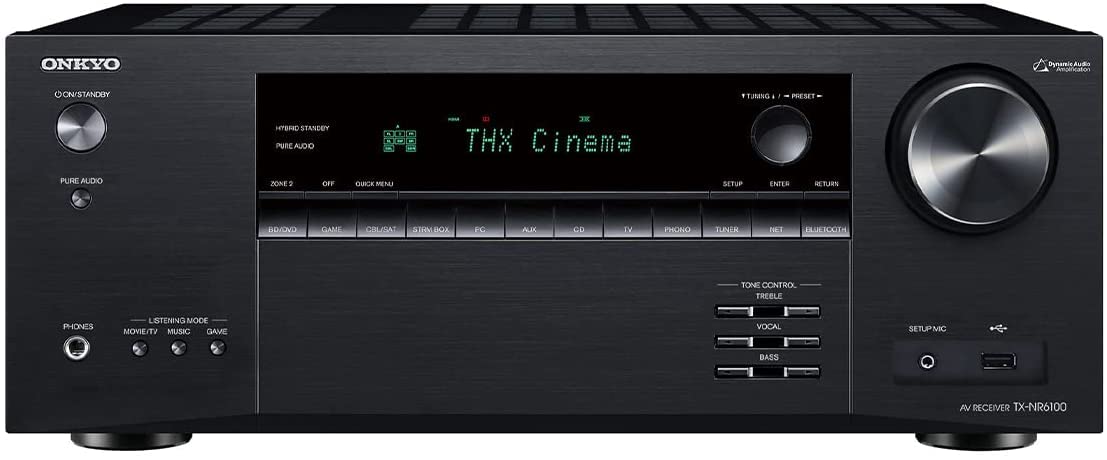
THX Select certification and 210W per channel, for a big room that needs headroom.
The TX-NR6100 pushes 210W per channel into a THX Select certified amplifier, decodes 5.2.2-channel Dolby Atmos and DTS:X, and takes 8K over HDMI 2.1 at 40Gbps on three inputs. A discrete Zone 2 handles audio and video in a second room.
Where the Denon above is steady, this one is more temperamental. Sound, functionality, video and customizability all split opinion. Reported issues include random audio drops, the on-screen display quitting, and some incompatibility with Sony TVs. Setup, by contrast, is the aspect owners praise most.
Why it stands out
- THX Select certified with 210W per channel
- Three 8K HDMI 2.1 inputs at 40Gbps
What to weigh
- Reported audio drops and display faults
Pick this if: headroom and THX certification matter more than a flawless display.
Only if you can test it: early — video and audio faults surface quickly.
6. JBL Bar 700MK2 Soundbar

Lift the two end caps off the bar and you have true 7.1 surround in seconds.
The 700MK2 solves the rear-speaker problem with hardware instead of cable. Two detachable speakers ride on the ends of the bar, then come off and sit behind you, giving 7.1 channels with no wires between them. It throws 780W max through a 10-inch wireless subwoofer, and adds Dolby Atmos and DTS Virtual:X for overhead movement.
MultiBeam 3.0 spreads the soundstage wider so off-centre seats still land inside it, and PureVoice 2.0 lifts dialogue during loud scenes. Sound is the clear draw here. The recurring gripe is rear-speaker charging — some units stop taking a charge properly, so check the rears light up before you rely on them.
Room fit: a bar with clips that become rears means the whole package packs down for a smaller room or a move.
Suits you if: you want surrounds only when the film calls for them and a clean wall the rest of the time.
Watch for: rear-speaker charging, the one part that splits feedback.
7. Fluance Elite SX71BR Speaker System

Seven matched cabinets and a 10-inch sub — the complete speaker half of a 7.1 room.
Fluance sells the full surround layout as one matched set: two three-way floorstanding towers, a center channel, two bookshelf speakers, two surround speakers and a DB10 powered subwoofer with a 10-inch driver. Every cabinet is timbre-matched, so voices move across the front stage without a tonal jump.
The cabinets are engineered MDF with a woodgrain finish, built to suppress the resonance that muddies dialogue. Isolation spikes come included for the towers. This is a wired, passive set — you supply the receiver, and the towers alone take real floor space.
The long game: a full lifetime parts and labor warranty on the speakers backs a set you can keep through several receiver upgrades.
Made for: a dedicated room where every one of the seven positions has a home.
Know first: no amplifier is in the box, so budget for a receiver alongside.
8. Sony STR-AN1000 7.2ch Home Theater 8K A/V Bluetooth Receiver

A streaming hub first, a surround receiver second — with three zones to spread around.
Six HDMI 2.1 inputs and two outputs carry 8K and 4K/120 through this 7.2-channel receiver, rated 165W at 6 ohms. Dolby Atmos and DTS:X decode object-based sound, and 360 Spatial Sound Mapping widens the stage beyond your physical speaker positions.
Zone 2 and Zone 3 push audio into other rooms, and “Works With Sonos” lets it join an existing Sonos setup. Chromecast, Spotify Connect and AirPlay are built in. Video formats include Dolby Vision, HDR10, HLG and IMAX Enhanced.
Where it fits: a house that already streams to several rooms and wants one receiver to be the hub rather than a single-room box.
Go for it if: multi-zone streaming and a deep HDMI 2.1 port count top your list.
Hold off if: you only need one room and simple wiring.
9. Yamaha RX-A2A AVENTAGE 7.2-Channel AV Receiver

Yamaha’s top-tier AVENTAGE line, at 25.4 pounds of chassis and calibration mic.
The RX-A2A is built for someone who cares how the box is made. It runs 7.2 channels with Zone 2, decodes Dolby Atmos and DTS:X, and offers seven HDMI inputs with eARC, three of them 8K60B and 4K120AB capable, plus ALLM and VRR for gaming. YPAO R.S.C. measures the room from multiple points, and Surround:AI reworks effects in real time.
Quality is the thing that impresses most here, with sound quality close behind. The friction points are real but specific: signal handling and setup split opinion, network functions go grey for some, and HDMI switching trips up a few.
Built to last
- AVENTAGE chassis with YPAO multipoint calibration
- Three 8K60B/4K120AB inputs with VRR and ALLM
Setup comes first
- Configuration is described as over-complicated by some
Best matched to: a buyer who values cabinet build and auto-calibration over a simple menu.
Consider instead: the Denon if network reliability worries you more than chassis quality.
10. Sony BRAVIA Theater Quad HT-A9M2

Four slim wireless speakers, sixteen drivers, and a room that gets measured for you.
The Theater Quad throws out the fixed layout entirely. Four wireless speakers hold 16 speaker units between them, each a 36mm driver, and 360 Spatial Sound Mapping builds the surround image from wherever you place them. Sound Field Optimization recalibrates to your room automatically.
Dolby Atmos, DTS:X and IMAX Enhanced all decode, and HDMI 2.1 gaming features cover 4K120, VRR and ALLM. Bass is the honest caveat: the subwoofers are optional additions (Sub 7, Sub 8, Sub 9), so deep low end costs extra. The Sony app also disconnects mid-setup for some buyers.
Placement freedom: a dual-purpose stand lets each speaker sit free-standing or mount flat to a wall, so no corner is off limits.
Reach for it if: you want spatial audio without a receiver in the chain and can add a sub later.
Pass if: you expect floor-shaking bass in the box.
Know the Specs
Channel Count
A 7.1 system gives seven surround speakers plus one sub; a 7.2 receiver adds a second sub output, and the.4 in a 7.1.4 label counts four height channels for overhead effects.
Wireless Versus Wired
Wireless rears skip the cable run to your sofa but still need power at each speaker, while passive sets like the Fluance need speaker wire from a receiver.
Common Questions
Do I need a receiver to use a 7.1 speaker package?
Can I get overhead effects without ceiling speakers?
Do wireless surround speakers still need power?
The Bottom Line
The 7.1 surround sound system that suits most rooms is the ULTIMEA Skywave X70, because a 7.1.4 layout with a 10-inch wireless sub covers overhead effects without a single speaker cable run. If you would rather build around real cabinets, the Fluance Elite SX71BR gives you seven matched speakers. And for a receiver-first build, the Denon AVR-X1700H is the steadier 7.2 core.
How we choose
We do not accept paid placement. Every pick is matched to a real buyer and a real use-case; we do not hands-on test units.
Sources
Specifications: manufacturer listings and product documentation. Review insights: verified customer reviews, as of November 2026. Pricing: not shown on this page (it changes often); check the current price via the retailer link.
As an Amazon Associate, My Heart Lives Here earns from qualifying purchases. This does not affect which products we feature.