Heads up: This post contains affiliate links. As an Amazon Associate I earn from qualifying purchases, at no extra cost to you. Learn more
Specs are compiled from manufacturer listings and verified buyer reviews and can change over time — please confirm the key details on the product page before buying.
The short answer: match the box’s cubic-inch capacity to your wire fill and its IP or NEMA rating to the weather it will face, and reject any lid that flexes under thumb pressure. A 4×4 box is the standard square footprint that fits most receptacles, switches and splices, so the real decision is depth, capacity and how well the cover seals. The picks below cover steel boxes for indoor rough-in and sealed plastic enclosures for outdoor gear. The RACO welded steel 25-pack is the strongest overall for conventional wiring work, and it carries a 4.5+ star score from 900+ buyers.
This guide is built by comparing the manufacturers’ published specifications and the patterns across verified customer reviews, so you get each pick’s real strengths and trade-offs instead of marketing spin.
You will see how capacity, depth and sealing separate these boxes. By the end you will know which one fits your job, whether that is a garage wall or a wet garden post, and how to read the numbers before you order the best 4×4 electrical box.
Top Picks


How To Choose The Best 4×4 Electrical Box
Buying on the 4-inch face size alone is the most common mistake, because depth and cubic-inch capacity vary widely between boxes that look identical from the front. A 4×4 box is 4 inches square on the outside, but two boxes with the same face can hold very different amounts of wire once you look at depth and cubic-inch capacity. Once depth and cubic-inch capacity fit your splice, the knockout count and cover are the only remaining checks.
Start with capacity, not the label
Capacity is measured in cubic inches — the actual internal volume where your splices sit. A deeper box gives you more of it, which matters when you are joining several cables or fitting a dimmer or GFCI device that takes up real space. The RACO unit carries 30.3 cu. in. inside a 2-1/8 in. deep shell. Compare that to the 21.0 cu. in. of the shallower steel boxes here and you can see why depth is the spec to check first.
Match the knockout count to your conduit
Knockouts are the pre-scored circles you push or twist out to feed conduit and cable through. The 8-pack here offers eleven 1/2-inch knockouts and six 3/4-inch knockouts, so you can run thin wires and larger gauge cable from the same box. Fewer knockouts means drilling your own holes, which is fine on plastic but awkward on galvanized steel.
Decide indoor steel or outdoor plastic
Galvanized steel is the right call for walls, ceilings and fire-rated assemblies. For a post, a fence or anything that gets rained on, you want a sealed enclosure rated IP67 or NEMA 4, with a gasket and a latch that clamps down evenly. Plastic also lets WiFi signals pass, which matters if a router or antenna lives inside.
Check the cover and the mounting hardware
The cover and gasket decide whether an outdoor box stays dry, not the body material. Look for a hinged cover with a real gasket and stainless hardware that will not rust shut. Several of the outdoor picks ship with a mounting plate, wall brackets and cable glands in the box, which saves a second trip to the hardware store.
Side-by-Side Comparison
| Model | Best For | Capacity | Depth | Material | Amazon |
|---|---|---|---|---|---|
| RACO 4 in. Square Welded Box, 25-Pack★ Best Overall | Whole-house rough-in | 30.3 cu. in. | 2-1/8 in. | Welded alloy steel | Amazon |
| LuSumtly IP67 ABS EnclosureBest Sealed Enclosure | Sealed outdoor splices | — | 5.51 in. | Virgin ABS | Amazon |
| Joinfworld Outdoor 6X6 Junction Box | Starlink and pump gear | — | 3.3 in. | ABS with 304 stainless latch | Amazon |
| namunanee Ventilated Outdoor Box | Router and camera power | — | 5.1 in. | ABS | Amazon |
| Copkim 8-Pack 4 x 4 Metal Box | Multi-box jobs | 21.0 cu. in. | 1-1/2 in. | Galvanized steel | Amazon |
| Qlvily 12-Pack 4″ Square Box | Contractor volume | 21.0 cu. in. | 1-1/2 in. | Metal | Amazon |
| Joinfworld 14X10X6 NEMA 4 Box | Big outdoor control gear | — | 6 in. | ABS and stainless steel | Amazon |
Detailed Reviews
1. RACO 4 in. Square Electrical Box 25-Pack
Our pick — 4.5+★ from 950+ verified ratings; the strongest balance of quality and price.
The deeper steel box that gives crowded splices somewhere to breathe
The number worth starting with is 30.3 cu. in. — the internal volume this box gives you for splices and devices. That is the most room of any steel box here, and it matters the moment you are joining several cables or fitting a bulky receptacle in a wall. Compare it to the 21.0 cu. in. of the shallower metal boxes below and the extra depth is the reason this one leads.
Construction is welded alloy steel with a powder-coated gray finish, and it is UL Listed and acceptable in 2-hour fire rated walls. The combination screw heads take a Phillips or a flat blade, so installation moves fast without hunting for the right driver. You can also run it without a bonding jumper in circuits up to 600V, which simplifies a service or feeder run.
Buyers single out the welded steel construction and the clean, solid welds. The welding reads clean and solid, and owners also use these behind Hubbell 9450a EV charging outlets where a rigid, flush box is required. One genuine limitation: 25 boxes is a contractor-scale quantity, so a single-room remodel will leave a lot of shelf stock behind. If you only need two or three, the smaller multipacks further down make more sense.
Where this box earns its keep
- 30.3 cu. in. of capacity in a 2-1/8 in. deep shell — 44% more room than the 21.0 cu. in. Copkim boxes
- Welded alloy steel with a powder-coated finish holds its shape and resists rust
- UL Listed and acceptable in 2-hour fire rated walls
- Combination screw heads accept Phillips or flat blade for faster installs
What to weigh first
- Sold only as a 25-pack, which is far more than a single-room job needs
- Steel is not the choice for a wet outdoor location without a proper sealed enclosure
Made for: anyone wiring a whole floor, a garage circuit or a job with several device boxes to fill, where deep splices need room.
Think twice if: you want two boxes and nothing more — the multipacks below fit that job better.
2. IP67 Waterproof Junction Box
A sealed plastic shell for splices that live where the weather gets in
IP67 is the headline here, and it is not a marketing word. That rating means the enclosure is built to keep dust out entirely and to survive temporary water immersion, backed by a built-in sealing gasket. If your splice sits on a fence post, a well head or a garden wall, this is the class of box you want.
The body is virgin ABS, which gives you impact resistance, UV protection and electrical insulation in one material. Stainless steel latches clamp the hinged door down, and the included mounting plate, stainless wall brackets, cable glands and DIN rail mean you are not drilling a bare box and hoping it seals. The ABS also drills without cracking, so custom openings are doable with a step bit.
Owners consistently praise the quality of the shell and the way the gasket around the door keeps water out, and the size leaves plenty of room to work. On weight, this unit comes in at 1.02 kg while the 6X6 Joinfworld below is 0.56 kg — the heft here reflects the thicker shell and hardware, though it also means a heavier load on a flimsy bracket. The honest trade-off is that ABS does not dissipate heat well, so do not stuff a hot-running power supply in here without ventilation.
The sealing story: a gasket that runs the full door perimeter plus stainless latches is exactly what separates a real outdoor enclosure from a plastic tub with a lid.
The practical catch: a closed ABS shell traps heat, so this is a box for connections and cool-running gear, not for a transformer that runs warm.
Go with it when: the splice is outdoors and you want a hinged door you can open for maintenance without fighting a screw-off lid.
Look elsewhere for: gear that generates real heat, since there is no venting here.
3. Joinfworld Outdoor Electrical Box 6X6 Junction Box
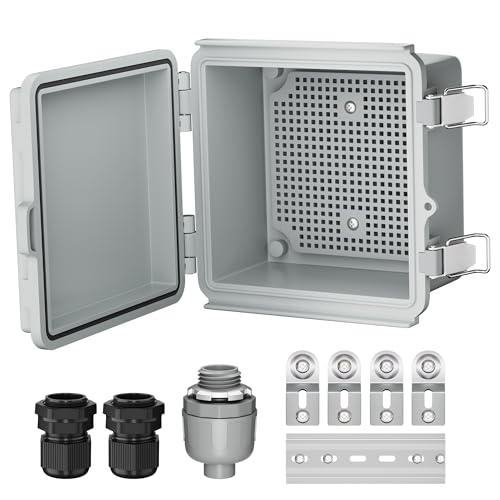
The plastic box that lets your signal out while keeping the rain off
Most enclosures are a signal dead zone. This one is not, because ABS plastic lets WiFi pass through rather than blocking it like a metal shell would. If a Starlink unit, a wireless bridge or a router lives inside, that single property is why this box belongs on the list.
The inner cavity measures 5.1″ x 5.1″ x 3.3″, and the box ships with two NPT1/2″ cable glands and one NPT1/2″ liquid tight connector for feeding wires in and out. An aluminum DIN rail is included, so a breaker, relay, timer or contactor mounts without extra fabrication. The stainless steel latch survives weather better than a plastic clip, and it meets IP67 and NEMA 6S specs.
Reviewers rate build quality highest, citing clean ABS molding and a stainless latch that clamps firmly. The water-tight seal holds through real rain, and the box arrives with everything needed for a surface mount. The one thing to plan around is the smaller interior — 3.3 inches of depth leaves less room than the deeper outdoor boxes if you are stacking several components. Check the internal dimensions against your gear before ordering.
The connectivity angle: a WiFi-friendly ABS body plus a stainless latch is a rare combination, and it is what makes this a sensible Starlink or wireless-accessory enclosure.
The fit check: 3.3 inches of internal depth is generous for a single board, tight once you add a DIN-mounted device and its wiring.
The right pick for: a wireless device or a DIN-rail component that needs a sealed home and a signal that still gets through.
Not the match for: large power supplies that need more internal air and depth than the cavity provides.
4. Outdoor ABS Electrical Junction Box, 9.2″ H x 7″ L x 4.6″ W

A box built to let heat escape instead of cooking what is inside
Two 1.77-inch heat dissipation holes on the sides set this box apart from every sealed enclosure here. That airflow keeps temperatures down so gear inside does not fail or act up. If a security camera power supply, a router or a surge protector runs warm, venting is the feature you want.
The vents are backed by rainproof louvers angled 45 degrees downward, sealed at the contact with waterproof strips and glue, so the airflow does not become a leak path. A simple non-slip buckle fixes the door, and padlock holes are reserved for a second layer of security. Mounting screws and a removable grill mounting plate are included for a wall or fence install.
Owners like the functionality and the size — it fits a Starlink Router, and one buyer notes it is spacious enough to hold EERO 7 Node equipment. The value reads well for what is included. The honest caveat is that ventilation and water-tightness trade off, so mount it where the louvers face down and the rain runs off, not into, the box.
The heat answer: 1.77-inch vent holes on both sides are the reason to pick this over a sealed box when equipment runs warm.
The mounting rule: the louvers only shed water if the box sits with them facing downward — flip it and the vent becomes a funnel.
Reach for this if: the equipment inside runs hot and needs airflow more than a fully sealed shell.
Skip this one if: you need a fully water-tight enclosure for a splice with no heat to shed — a sealed box is the better fit there.
5. 8 Pcs 4 x 4 Inch Metal Electrical Junction Box

Eight galvanized boxes with a knockout for nearly any cable
Knockout count is where this 8-pack stands out: eleven 1/2-inch openings and six 3/4-inch openings on each box. That spread means you can feed thin wires and larger gauge cable from the same box without drilling. The knockouts pop out cleanly, which keeps installation quick.
Each box gives you 21.0 cu. in. of capacity in a 1-1/2 inch deep galvanized steel shell. The galvanized finish resists rust over time, and the boxes are acceptable for use in 2-hour fire rated walls. They are built for home renovations, new builds and commercial jobs where several rooms need boxes at once.
Owners praise the galvanized finish and use the boxes as small junction boxes, and they rate the eight-box count as strong value. For a simple switch or receptacle, the shallower depth is not a problem.
What sells it: seventeen total knockouts across two sizes on each box is far more routing flexibility than you get from a single-knockout enclosure.
The numbers to respect: 21.0 cu. in. per box caps how many conductors fit — if your splice is heavy, a deeper box is the safer pick.
Choose it for: a renovation with several devices to mount and varied conduit sizes to run.
Look past it for: a single heavy splice where the 21.0 cu. in. of room runs out fast.
6. 12 Pack 4″ Square Electrical Box

A dozen square boxes for a whole panel’s worth of devices
Twelve boxes is the point here. If you are roughing in a basement, a workshop or a panel full of switches, this pack keeps you fed without a mid-job reorder. Each box gives you 21.0 cu. in. of capacity in a 4-inch square, 1-1/2 inch deep metal shell.
The box carries ten 1/2 inch knockouts and six 3/4 inch knockouts for conduit and cable routing, and the high-quality metal resists rusting. The trade size is 2-gang, but a single toggle switch cover only fits 1-gang, so match your cover plate to the opening you use. The square 4-inch face takes a standard square box style.
This is a plain workhorse pack with no exterior rating, so it is happiest indoors where the wall stays dry. The depth is the same 1-1/2 inch as the Copkim 8-pack, and the capacity matches at 21.0 cu. in., so choose between them on box count and price tier rather than on volume. For a job that needs a steady supply of standard boxes, this is the practical buy.
The volume logic: twelve 4-inch square boxes with two knockout sizes covers a whole floor of outlets and switches in one order.
The cover note: trade size 2-gang but single-gang plates only — check the cover you already have before installing.
Pick this pack when: the job spans many devices and you want standard boxes on hand.
Look elsewhere when: the location is damp — a plain steel box without a sealed enclosure is the wrong tool outdoors.
7. Joinfworld 14X10X6 Waterproof Junction Box, NEMA 4 Enclosure
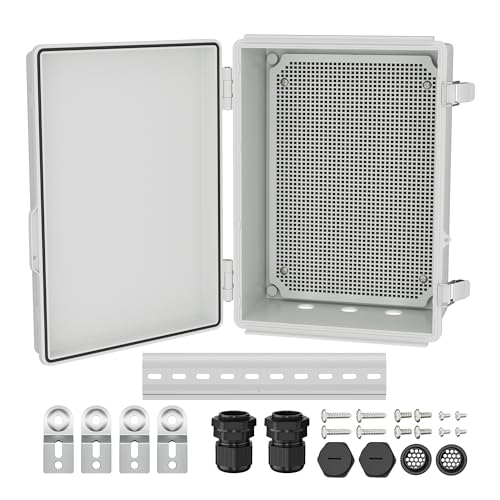
The large sealed control box for gear that needs real elbow room
When a component is too big for a 6-inch box, this 14x10x6 shell gives you a control-cabinet footprint with a NEMA 4 rating. That rating means it is built to keep out rain, splashing water and dust, which is the class of protection an outdoor control panel needs. For a holiday-light transformer, an alarm panel or a sprinkler controller, the size is the reason to pick it.
The ABS body offers electrical insulation and high impact resistance, and it receives WiFi signals well, so a router or booster inside still connects. Three 26.5mm holes are pre-drilled at the bottom for cable glands, conduit or an air vent, and plugs are included if you want to block them. A grid mounting plate, a 20mm DIN rail and two NPT 3/4″ cable glands come in the box, along with self-tapping screws and stainless wall brackets.
Build quality holds up outdoors — the box survives rain and the door seals tightly. The one thing to weigh is the 6-inch depth against the larger footprint: it holds a lot, but it wants a sturdy wall and room on the bracket. If your job needs a compact box, the smaller Joinfworld 6X6 is the trimmer choice; this one is for gear that will not fit there.
The size story: a 14x10x6 shell plus a DIN rail turns this into a small control cabinet rather than a splice box.
The honest trade: six inches of depth holds big equipment but adds real weight and demands a solid mounting surface.
Made for: a large controller, transformer or router that needs a sealed outdoor cabinet with mounting hardware in the box.
Overkill for: a single small splice — a compact 6-inch enclosure handles that with less bulk.
Know the Specs
Cubic-Inch Capacity
Capacity is the internal volume where your splices sit, measured in cubic inches. More capacity lets you join more wires or fit a bulky device without crowding. The RACO box carries 30.3 cu. in. while the shallower metal boxes hold 21.0 cu. in., so a heavier splice needs the deeper box.
Box Depth
Depth is the dimension from the back wall to the front opening. A 1-1/2 inch box is fine for a switch or receptacle, but a 2-1/8 inch box gives more room for devices and heavier splices. Depth and capacity move together, so check depth first when you have a crowded connection.
Knockouts
Knockouts are the pre-scored openings you remove to feed conduit and cable. Matching the knockout size to your conduit avoids drilling. The 8-pack offers eleven 1/2-inch and six 3/4-inch openings on each box, so thin wires and larger gauge cable can run from the same box.
IP and NEMA Ratings
These ratings describe how well the enclosure keeps out water and dust. IP67 means it is built to survive temporary water immersion and keep dust out. NEMA 4 means it resists rain and splashing water. A plain steel box has no such rating, so it belongs indoors where the wall stays dry.
Common Questions
How do I know how many wires a 4×4 box can hold?
Will a 4×4 electrical box work outdoors?
What does IP67 actually protect against?
Can I mount a WiFi router inside a plastic junction box?
What is the difference between a 1-1/2 inch and a 2-1/8 inch deep box?
How many knockouts should a box have?
Do I need a ventilated box for a security camera power supply?
What is the difference between NEMA 4 and IP67?
Why does the trade size say 2-gang when one switch fits?
The Bottom Line
For most people wiring standard devices into a wall, the RACO 4 in. Square Welded Box is the one to buy — 30.3 cu. in. of capacity, UL Listed construction and a welded steel body that holds its shape. If your splice lives outdoors, the LuSumtly IP67 Enclosure gives you a sealed, hinged home for it. And when the equipment inside runs warm, the namunanee Ventilated Box keeps the heat moving. Match the box to your wire fill and location, and you avoid both a cramped splice and a lid that leaks.
How we choose
We do not accept paid placement. Every pick is matched to a real buyer and a real use-case; we do not hands-on test units.
Sources
Specifications: manufacturer listings and product documentation. Review insights: verified customer reviews, as of November 2026. Pricing: not shown on this page (it changes often); check the current price via the retailer link.
As an Amazon Associate, My Heart Lives Here earns from qualifying purchases. This does not affect which products we feature.