Heads up: This post contains affiliate links. As an Amazon Associate I earn from qualifying purchases, at no extra cost to you. Learn more
Specs are compiled from manufacturer listings and verified buyer reviews and can change over time — please confirm the key details on the product page before buying.
Matching a speaker to your amplifier is the part most buyers get wrong. A 4-ohm bookshelf speaker asks your amp for more current than the 8-ohm box it replaced, and get that pairing wrong and you get thin sound at best, a hot amplifier at worst. So the real question is simple: which of these speakers actually sounds good on the gear you already own, in the room you actually have? The picks below answer that, from an entry-level pair that punches far above its size to a 3-way reference model for listeners who want every frequency handled by its own driver.
This guide is built by comparing the manufacturers’ published specifications and the patterns across verified customer reviews, so you get each pick’s real strengths and trade-offs instead of marketing spin.
You will see how driver size, crossover slope, and impedance change what you hear at your desk or couch. Every pick here is a passive or powered bookshelf designed to sit on a stand or shelf, not a floor-standing tower — which is exactly why the choices below matter for anyone shopping for the best 4 Ohm Bookshelf Speakers.
Top Picks


How To Choose The Best 4 Ohm Bookshelf Speakers
Start with your amplifier, not the speaker. A 4-ohm load (the electrical resistance the speaker presents to your amp) draws more current than an 8-ohm one, so check that your receiver or amp is rated to drive 4-ohm speakers before you buy anything on this list.
Check the impedance your amp can actually drive
Some speakers here, like the Polk ES20, are rated for both 4- and 8-ohm use, which gives you flexibility with most amplifiers and AV receivers. Others list a range such as 4-8 Ohms. The safest move is to confirm your amp’s published 4-ohm rating, then pick a speaker whose impedance sits inside it. If your amp only lists 8-ohm figures, a 4-ohm speaker will still play — it just works your amp harder at high volume.
Match woofer size to your room
A 4-inch woofer (the round driver that produces bass and midrange) keeps the cabinet small and easy to shelf-mount, which suits a desk or a tight living room. A 6.5-inch woofer moves more air for deeper, heavier bass, but needs more breathing room. In a small study, the smaller driver often sounds cleaner because it is not fighting the walls. In a medium living room, the larger driver gives movies and music real weight.
Decide passive versus powered before anything else
A passive speaker has no built-in amplifier — you supply the power, and you choose the electronics. A powered pair, like the Klipsch The Sevens, has amplification built in and plugs straight into a wall outlet, so a single HDMI cable can carry TV sound to it. Passive gives you upgrade freedom; powered gives you fewer boxes and fewer cables. Neither is better — it depends on whether you already own a good amp.
Look at the crossover slope for off-axis listening
The crossover is the circuit that splits frequencies between the tweeter (the small driver for highs) and the woofer. Its slope, measured in dB/octave, describes how sharply it cuts each driver off from frequencies it should not play. A steeper 18 dB/octave slope, as on the Micca RB42, tends to improve power handling and keep the sound more consistent as you move around the room. A gentler 12 dB/octave slope works fine for a single sweet-spot chair.
Side-by-Side Comparison
| Model | Best For | Woofer | Tweeter | Crossover Slope | Amazon |
|---|---|---|---|---|---|
| Micca RB42 Reference★ Best Overall | Small rooms, big bass | 4 in | 0.75 in silk dome | 18 dB/octave | Amazon |
| Micca MB42X G2Best Value | Desk and study systems | 4 in carbon fiber | 0.75 in silk dome | 12 dB/octave | Amazon |
| Klipsch R-40MTop Performer | Home theater punch | 4 in spun-copper | 1 in LTS aluminum | — | Amazon |
| Polk Signature Elite ES20 | Cinematic surround pair | 6.5 in | 1 in Terylene | — | Amazon |
| Edifier S1000W | Wi-Fi streaming, no amp | 5.5 in | — | — | Amazon |
| Polk Reserve R100 | Hi-res home theater | 5.25 in Turbine Cone | 1 in Pinnacle Ring Radiator | — | Amazon |
| KEF Q3 Meta | Room-filling stereo | 6.5 in | Uni-Q concentric | — | Amazon |
| Klipsch The Sevens | Cable-light TV setup | 6.5 in high-excursion | 90 x 90 Tractrix horn | — | Amazon |
| ELAC Uni-Fi Reference | Serious stereo listening | 6.5 in | 3-way design | — | Amazon |
Detailed Reviews
1. Micca RB42 Bookshelf Speakers
Our pick — 4.5+★ from 800+ verified ratings; the strongest balance of quality and price.
The small-woofer speaker that produces bass you can feel across a desktop.
The number that does the heavy lifting here is the crossover slope: 18 dB/octave, the steepest split on this list. That steep slope means each driver is cut off sharply from frequencies it should not play, which is why the RB42 handles power well and keeps its sound even as you move off to the side of your chair. In practice, you get clean, balanced tone from a cabinet small enough to sit beside a monitor.
The 4-inch woofer is built on a heavy steel frame with a coated pressed paper cone and a large rubber surround — construction you would expect in a costlier speaker. The 0.75-inch silk dome tweeter pairs with it on a form-cut bezel that keeps the two drivers close together, so highs and lows arrive as one sound rather than two. For a compact pair, the bass output is genuinely surprising.
The trade-off is that this is a passive speaker, so it needs a separate amplifier — it will not plug into a wall socket and play on its own. The 4-ohm load also means your amp should be comfortable driving that resistance. Give it a capable amp and it fills a small to medium room with lively, foot-tapping sound; underpower it and the 4-ohm load keeps it from opening up.
What earns its keep
- 18 dB/octave crossover — the steepest on this list — for strong power handling and even off-axis sound.
- 4-inch woofer on a heavy steel frame with a large rubber surround delivers bass beyond its size.
- 0.75-inch silk dome tweeter with a form-cut bezel keeps drivers close for cohesive sound.
- 10-element crossover with film capacitors and air core coils for clean tonal balance.
Where it asks something back
- Fully passive — a separate amplifier is required, and none is included.
- The 4-ohm load needs an amp rated to drive it comfortably at volume.
Reach for this if: you already own a decent amp and want the most balanced small passive pair on this list.
Look elsewhere if: you want a powered speaker that plugs into the wall with no amp at all.
2. Micca MB42X G2 Bookshelf Speakers
A compact passive pair tuned for the desk and the small living room.
For a first real stereo setup, the friendliest spec on this page is the impedance: 4-8 Ohms, which means this speaker sits comfortably inside what most amplifiers and receivers expect. Add the 86dB sensitivity (how loud it plays per watt) and it does not need a monster amp to reach a usable volume. Pair it with something modest and it will still fill a study with sound.
The 4-inch carbon fiber woofer handles bass and midrange while a 0.75-inch silk dome tweeter covers the highs, split by a 12 dB/octave crossover. Its frequency response runs 55Hz-20kHz, and power handling is 80W per speaker. Compared with the RB42 above, the crossover here is the gentler 12 dB/octave — fine if you mostly listen from one spot, less forgiving if you move around the room a lot.
The cabinet is ported, so it breathes through an opening rather than a sealed box, and the compact footprint suits shelf placement. In a near-field desk setup it punches above its price; owners also note it can be trickier to wall-mount cleanly. If that is your plan, budget a little time for the mounting.
The real draw: a wide 4-8 Ohm compatibility window and 86dB sensitivity make this the easiest passive pair here to match to an everyday amp, which is why it earns the value spot over more finicky 4-ohm-only designs.
A fair caution: the 12 dB/octave crossover is less steep than the RB42’s 18 dB/octave, so if you want the most consistent sound as you shift seats, the step up is worth considering.
Confident call: the smart starting point if you want small, amp-friendly bookshelf sound without overcommitting.
The one limit: wall-mounting takes patience — plan around it if that is your setup.
3. Klipsch R-40M Bookshelf Speakers
Horn-loaded highs that give action movies their bite and attack.
Home theater is where this speaker is built to live. The 90° x 90° Tractrix horn spreads high-frequency sound over a wide area, so the effects and dialogue in a movie reach more of the room rather than beaming at one chair. Paired with the 1-inch aluminum LTS tweeter on a Kapton suspension, the highs come through detailed and controlled, which is exactly the kind of punch and attack owners describe.
The 4-inch spun-copper TCP woofers borrow cone geometry from Klipsch’s Reference Premiere line, angled to give a smoother, more accurate response. The cabinet uses MDF with a scratch-resistant textured wood-grain vinyl, and hidden fasteners with low-profile magnetic grilles keep the front face clean. It is compact enough to tuck into a tighter corner, and it rounds out a surround setup well.
If you are pairing it as a centerpiece of a 5.1 system, its horn character can feel forward with music recorded to be gentle — some listeners love that liveliness, others want a softer touch. Know which camp you are in. For movies and games, that forward quality is the whole point.
Who it suits: a home theater built around clarity and attack, where a 90° x 90° horn keeps dialogue and effects spread across the seating.
Worth knowing: the spun-copper woofers and horn tweeter give a forward, lively sound that suits cinema more than mellow acoustic music.
Best for: a compact surround or movie system that needs punch from small cabinets.
Think twice if: you mostly play gentle acoustic music and want a relaxed, laid-back top end.
4. Polk Audio ES20 Bookshelf Speaker Pair

The bigger-woofer Polk that turns a movie night into a full surround event.
Size is the differentiator here. The ES20’s 6.5-inch woofer is 62% wider than the Micca RB42’s 4-inch driver, moving more air for deeper bass. Up top, a 1-inch Terylene tweeter pairs with it across a dynamically balanced acoustic array and precision crossovers, producing a wide, lifelike soundstage that helps dialogue stay readable during a noisy action scene.
Polk’s Power Port is tuned for 3dB more bass output than a conventional port while cutting turbulence, keeping low end tight instead of chuffy. The high sensitivity and 4- and 8-Ohm compatibility mean it will run on most amplifiers and AV receivers, including Dolby Atmos and DTS:X models. That impedance flexibility makes it the safest match in this group if your amp is not explicitly rated for 4 ohms.
Placement is genuinely versatile: use it as side, rear, or elevation surround, set it on a stand (sold separately), or wall-mount it via screw inserts and keyhole slots. Because it is timbre-matched to the wider Signature Elite series, you can grow it into a full 5.1 setup with an ES60 tower pair and an ES35 center. The catch is that a 6.5-inch woofer wants a little more room to breathe than a compact 4-inch cabinet — give it a stand rather than cramming it into a bookshelf.
Why the size pays off
- 6.5-inch woofer, 62% wider than the Micca RB42’s 4-inch driver, for deeper bass.
- Power Port adds 3dB of bass output while cutting port turbulence and distortion.
- Runs on 4- and 8-Ohm amplifiers, so it matches more gear with less fuss.
- Wall-mount via keyhole slots or rest on a stand for flexible surround placement.
The trade to weigh
- The larger cabinet needs more breathing room than a compact 4-inch model.
- Stands are sold separately if you want them off the shelf.
Pick this for: a surround or stereo setup where you want real bass weight and amp-friendly 4- and 8-Ohm flexibility.
Skip the wall nook: if you can only fit a tiny shelf, a smaller-woofer speaker leaves you more room.
5. Edifier S1000W Bookshelf Speakers

A powered pair that streams your whole library without an amplifier in sight.
This is the one that sidesteps the amplifier question entirely. The S1000W is active, meaning the 120W RMS of amplification is built in — no separate receiver required. Connect it to your home Wi-Fi, and it works with Alexa, supports AirPlay 2 and Spotify Connect, and handles audio up to 24bit/192kHz for high-resolution streaming. A 5.5-inch driver anchors each cabinet.
Connections run wide: Wi-Fi, Bluetooth V5.0, optical, coaxial, and AUX. You can group two or more of them over the app to play music across rooms, build a stereo pair, or fill the whole home. Buyers report it filling a 32×32-foot room at half volume, so most living rooms will have headroom to spare.
The honest catch sits with connectivity: Bluetooth pairing draws mixed results, and some users hit trouble connecting a turntable through it. Wi-Fi streaming is the smoother path, so lean on that rather than Bluetooth. There are also a few mixed notes on how the volume behaves at extremes. Set expectations there and this becomes a very easy, very connected centerpiece.
Why it stands out: built-in 120W RMS amplification plus Wi-Fi, AirPlay 2, and Spotify Connect means no amp, no receiver, and one app to run multi-room audio.
Where to be careful: Bluetooth and turntable connections are the weak spot — plan on Wi-Fi streaming for the steadiest experience.
Go here if: you want audiophile-style streaming without buying a separate amplifier or receiver.
Keep in mind: if Bluetooth or a turntable is your main source, expect to do a little troubleshooting.
6. Polk Audio R100 Bookshelf Speakers
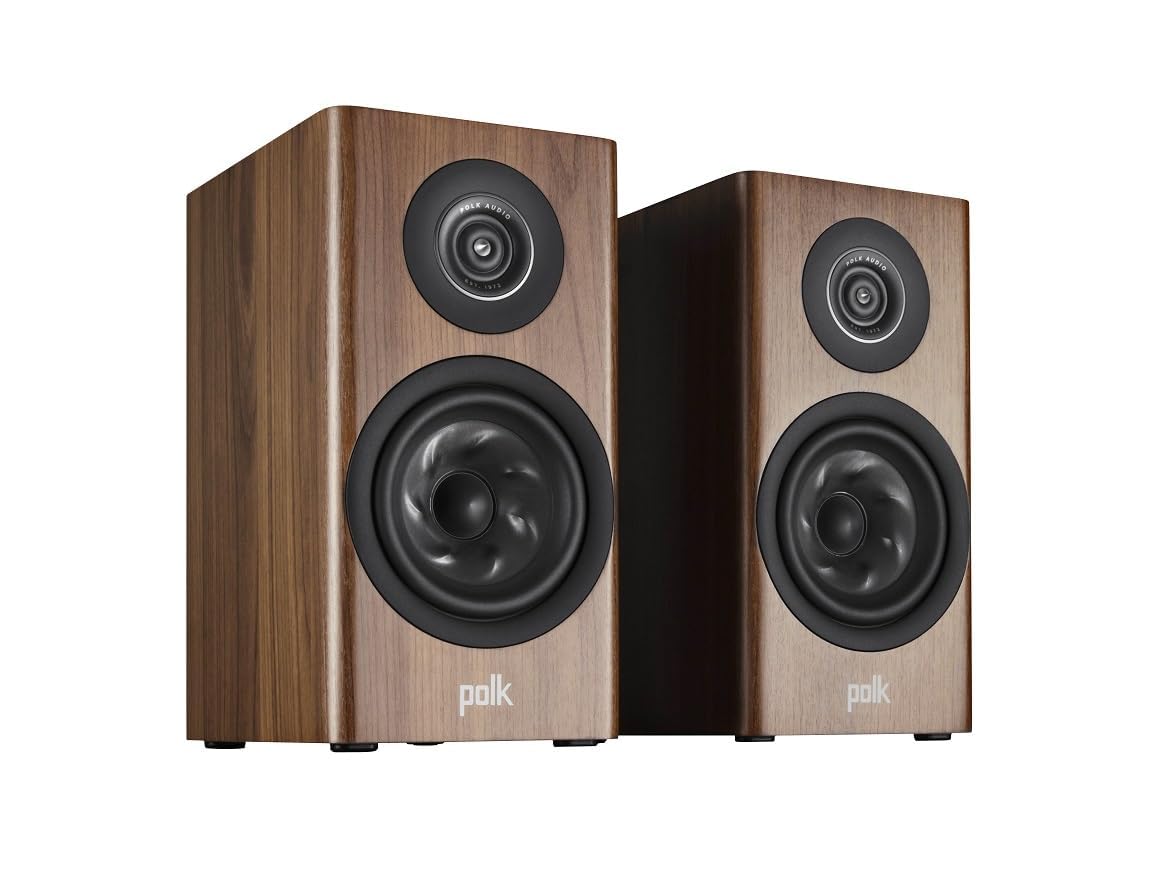
A small Polk with genuine hi-res credentials and a clever bass port.
The headline here is certification: the Reserve R100 carries Hi-Res Certification and supports Dolby Atmos and IMAX Enhanced, with playback of high-resolution formats like DSD, FLAC, WAV, ALAC, and MQA. If you keep a library of lossless files, this speaker is built to do them justice. A 1-inch Pinnacle Ring Radiator tweeter handles the highs and a 5.25-inch Turbine Cone woofer covers the mids and bass.
Bass comes through a bass reflex cabinet with a rear-firing port and Polk’s X-Port Technology with its Eigentone Filter, which is designed to strip out unwanted port noise for tight, clean low end. The cabinet is cross-braced to cut interior resonance, and acoustically inert magnetic grilles keep the front clean. Large 5-way binding posts make for a solid, loss-less cable connection.
It works as a front, side, or rear speaker in a multichannel system, so it slots into a surround build as readily as a stereo pair. The thing to remember is that a rear-firing port needs some space behind the cabinet — pushing it flat against a wall can blunt that careful bass tuning. Leave a little gap and it rewards you.
The deciding spec: Hi-Res Certification with DSD, FLAC, WAV, ALAC, and MQA support makes this the pick for listeners with a high-resolution file collection.
The honest limit: the rear-firing port wants a little breathing room behind the speaker, so plan placement rather than pushing it flat against a wall.
This is your match if: hi-res audio files and a flexible surround role matter more than cabinet size.
Give it space: a rear port and a bookshelf pushed to the wall do not get along.
7. KEF Q3 Meta Bookshelf Speakers

The midsize KEF built to fill a living room from any seat.
KEF’s signature move is the Uni-Q driver, which places the tweeter at the center of the main driver so sound spreads evenly across the room instead of locking into one narrow listening spot. Sitting off to the side, you still hear clear dialogue and natural detail — a real benefit for a living room where nobody fights over the center chair. A 6.5-inch driver gives it a fuller, punchier low end than a compact bookshelf.
Behind the sound is Metamaterial Absorption Technology, which reduces unwanted distortion so recordings come through cleaner rather than colored or harsh. This is a passive speaker, meaning a separate amplifier is required — but that also gives you the freedom to pick your own electronics and upgrade later. It plays well as a stereo pair now, then slots into a larger home-cinema system with a KEF subwoofer or more Q Series speakers down the road.
The step up in size is the point: it delivers more bass and scale than a compact model without the footprint of a large 3-way tower. That makes it a strong fit for living rooms and medium spaces where you want a bit more presence. Just know that 6.5 inches of driver means you should give it a stand and a little room rather than tucking it into a tight shelf.
The arguments for it
- Uni-Q driver spreads sound evenly, so off-center seats still get clear detail.
- 6.5-inch driver delivers deeper bass and more scale than a compact bookshelf.
- Metamaterial Absorption Technology cuts distortion for a cleaner, more natural tone.
The fine print
- Passive design — a separate amplifier is required, and none is included.
- Midsize cabinets need stand space and breathing room, not a tight shelf.
Made for: a living-room stereo or cinema setup where you want room-filling sound from more than one seat and already own an amp.
Look past it if: you have no amplifier and want a simple plug-in pair.
8. Klipsch The Sevens Powered Speakers

A powered Klipsch that upgrades your TV with a single HDMI cable.
The setup is the selling point: one HDMI-ARC cable runs from your TV to these speakers, and no AV receiver is needed. That same cable lets your existing TV remote control the volume, so there is no second remote to hunt for. With 192kHz / 24-bit decoding built in, it handles high-resolution audio on its own.
Behind the sound is a 6.5-inch high-excursion driver with digital signal processing, plus a 90 x 90 edge-to-edge Tractrix horn that transfers high frequencies into the room cleanly. Klipsch builds it with real wood finishes, metal controls, fabric grilles, and cork pads. Connectivity covers Bluetooth, optical, 3.5mm analog, RCA/Phono, and a subwoofer output, with left/right switching to help you place them in your space.
Owners consistently praise the sound: crisp at low volume and easily filling a room. The recurring gripe is elsewhere: connectivity and long-term reliability draw mixed feedback, with a portion of buyers reporting connection trouble or a failure after a month of use. Treat that as a known risk, not a certainty — many units run fine, but this is the pick where a good return window matters most.
The strongest case: single-cable HDMI-ARC TV hookup, the TV remote controlling volume, and 192kHz / 24-bit decoding — one of the simplest routes to better TV sound here.
The known risk: mixed reports on connectivity and reliability make this the pick to buy with a solid return window rather than blind.
Worth it for: a cable-light TV upgrade where HDMI-ARC and remote volume control matter most.
Be sure to: keep the return window in mind, since connectivity and reliability are the mixed spots.
9. ELAC Uni-Fi Reference Bookshelf Speakers

A true 3-way design for listeners who want each frequency kept separate.
Most bookshelf speakers here are 2-way, splitting the work between a woofer and a tweeter. This ELAC is different: a 3-way design gives the tweeter, the mid-range driver, and the bass driver each their own job, so each frequency band is reproduced without interference from the others. The result is a cleaner separation between vocals, instruments, and low end.
The 6.5-inch bass driver brings the heft you would expect from a speaker this size, and the walnut-with-black-baffle finish is built to sit proudly in a stereo or home-theater setup. Because the mid-range gets a dedicated driver, the critical vocal range is handled by something designed specifically for it rather than shared with the bass — a real advantage for listeners who care about how voices sound.
This is the top of the passive group and pitched at serious near-field and room listening. If your amp is modest, the extra drivers here will not show what they can do — budget for the electronics to match.
What makes it different: a genuine 3-way layout that hands tweeter, mid-range, and bass their own drivers, so each band plays without interfering with the others.
What it asks: a separate amp is required, and a 3-way design tends to want a capable one to shine.
For the dedicated listener: someone building a serious stereo or cinema system who wants true 3-way separation.
Only if you have the amp: pair it with modest electronics and the extra drivers go to waste.
Know the Specs
Impedance and Your Amplifier
Impedance is the resistance a speaker presents to your amplifier, measured in ohms. A 4-ohm speaker pulls more current than an 8-ohm one, so check your amp’s published 4-ohm rating before buying. Some speakers here, like the Polk ES20, are rated for both 4- and 8-ohm use, while others list a 4-8 Ohm range — both give you flexibility. A lower figure is not “worse” — it just asks more of your electronics at high volume.
Woofer Size and Room Fit
The woofer is the round driver that handles bass and midrange, and its size shapes both sound and space. A 4-inch woofer keeps the cabinet small and easy to shelf-mount, which suits a desk or a tight living room. A 6.5-inch woofer moves more air for deeper bass and a bigger sound, but needs stand space and breathing room. Match the size to your room and placement, not to a bigger-is-better rule.
Crossover Slope
The crossover splits frequencies between the tweeter and woofer, and its slope in dB/octave describes how sharply it cuts each driver off from frequencies it should not play. A steeper 18 dB/octave slope, like the Micca RB42’s, tends to improve power handling and keep sound consistent as you move around. A gentler 12 dB/octave slope, like the MB42X G2’s, works well for one fixed listening spot.
Passive vs Powered
A passive speaker has no built-in amplifier — you supply the power, so you pick your own electronics and upgrade later. A powered pair, like the Klipsch The Sevens or the Edifier S1000W, has amplification built in and plugs into a wall outlet, so a single cable can carry TV sound and there is less to wire up. Choose passive if you own a good amp; choose powered if you want the simplest path to sound.
Common Questions
Will a 4-ohm bookshelf speaker work with my home theater receiver?
What does 4-ohm impedance actually change in the sound?
Do I need a separate amplifier for a passive bookshelf speaker?
Is a 4-inch woofer too small for a living room?
What does a steeper crossover slope like 18 dB/octave do?
Can a powered bookshelf speaker replace an AV receiver for TV sound?
How much amplifier power do these 4-ohm speakers need?
Does speaker placement matter more than the speaker itself?
What does a 3-way design offer over a 2-way?
The Bottom Line
For most people, the 4 ohm bookshelf speakers winner is the Micca RB42 Reference — its 18 dB/octave crossover is the steepest here, its 4-inch woofer on a heavy steel frame punches past its size, and it stays balanced as you move around the room. If value and easy amp-matching matter more, the Micca MB42X G2 with its 4-8 Ohm rating is the friendlier entry. Want deeper bass and 4- and 8-Ohm flexibility in one, grab the Polk ES20. And for hi-res files in a surround build, the Polk Reserve R100 earns its place. The one honest nudge: check your amplifier’s 4-ohm rating before you buy any of them — that single spec decides whether these speakers sing or strain. Pick the passive pair that matches your amp and room, or go powered with the Klipsch The Sevens if you would rather skip the receiver altogether.
How we choose
We do not accept paid placement. Every pick is matched to a real buyer and a real use-case; we do not hands-on test units.
Sources
Specifications: manufacturer listings and product documentation. Review insights: verified customer reviews, as of November 2026. Pricing: not shown on this page (it changes often); check the current price via the retailer link.
As an Amazon Associate, My Heart Lives Here earns from qualifying purchases. This does not affect which products we feature.