Heads up: This post contains affiliate links. As an Amazon Associate I earn from qualifying purchases, at no extra cost to you. Learn more
Specs are compiled from manufacturer listings and verified buyer reviews and can change over time — please confirm the key details on the product page before buying.
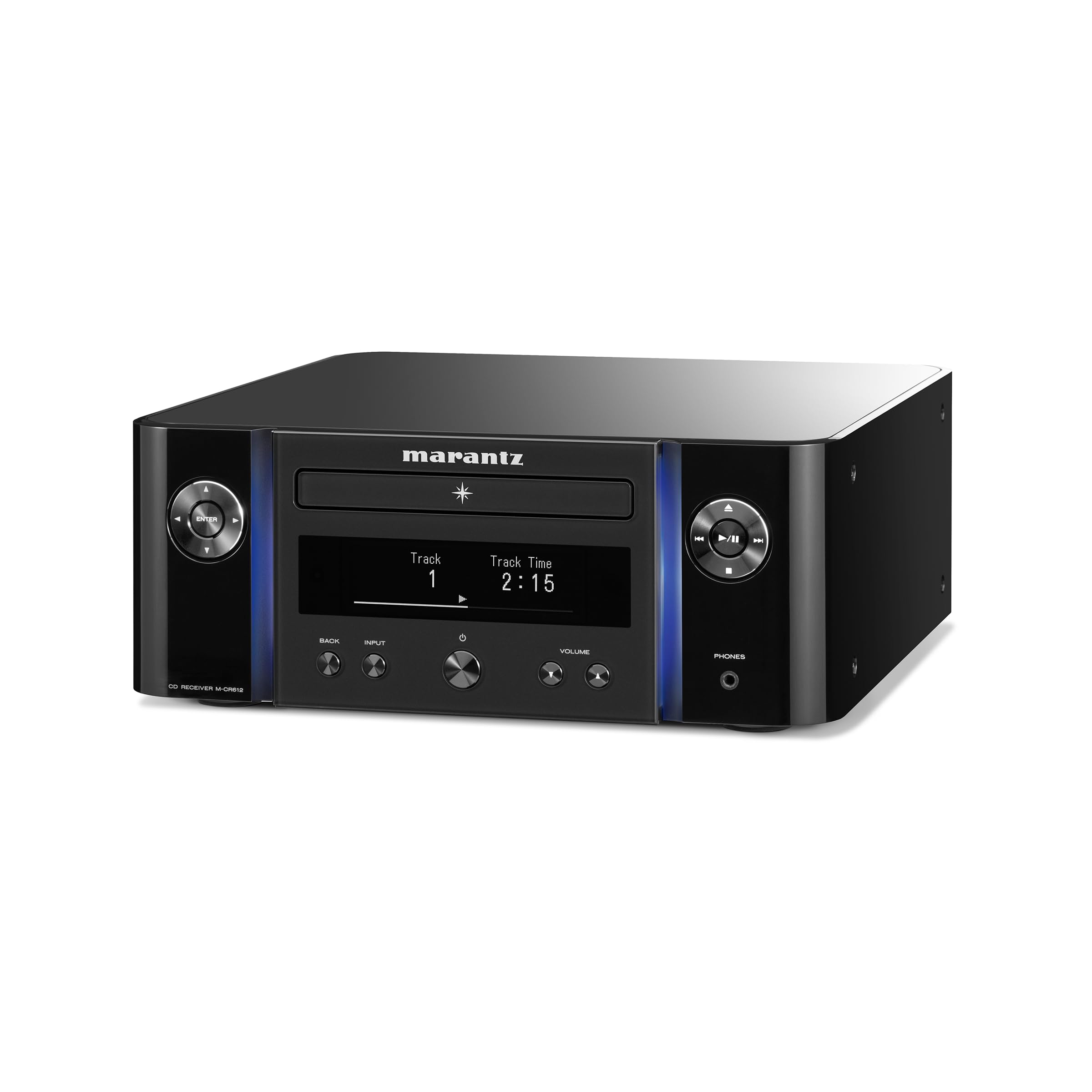
How many rooms do you actually want to fill, and can one box drive them without humming? For most people the Marantz M-CR612 is the one worth owning. It is the only pick here that pairs four channels of amplification with network streaming and a CD player in a 10.9-pound box. The rest of this list splits into two camps. Big-wattage Pyle workhorses are built for karaoke nights and rack shelves. Multi-zone Rockville units are made for routing different music to different rooms. You do not need to understand ohms (the electrical load a speaker puts on the amp) or bi-amping (using two amp channels to drive one speaker) to pick correctly. You need to know how many speaker pairs you are powering, if you want streaming built in, and how much hiss you are willing to tolerate.
This guide is built by comparing the manufacturers’ published specifications and the patterns across verified customer reviews, so you get each pick’s real strengths and trade-offs instead of marketing spin.
Some receivers here push four channels at 30 watts each while others claim peak figures in the thousands, and that gap changes what you can realistically power. Below you’ll find the spec-by-spec breakdown that makes a 4 channel stereo receiver the right fit for your speakers and your rooms.
Top Picks

How To Choose The Best 4 Channel Stereo Receiver
Four channels is a specific job. It usually means two pairs of speakers — a living room pair plus a kitchen pair, or a main pair plus a patio pair. The receiver’s whole purpose is to feed both without one pair stealing power from the other. Get the channel count and the ohm rating (the speaker load the amp is built to handle) right, and everything else is convenience.
Decide if you want zones or just channels
A plain four-channel receiver powers two speaker pairs off the same source at the same volume. A zoned receiver gives each pair its own volume knob and its own input, so the kitchen can play the radio while the den plays a record. If you only ever want the same music everywhere, a plain four-channel amp is cheaper and simpler. If family members disagree about what to hear, pay for zones — the Rockville units here are built around exactly that.
Read the wattage label twice: peak versus RMS
Peak watts describe a brief burst; RMS watts describe what the amp can sustain. A receiver advertising 1000 W peak may deliver far less continuously, while one quoting 62.5 W RMS per channel is telling you a steady, honest figure. For bookshelf speakers in a normal room, sustained RMS power in the tens of watts per channel is plenty. Chasing big peak numbers buys headroom for parties, not better sound at low volume.
Match the ohm rating to your speakers
Speakers present an electrical load measured in ohms, and lower numbers are harder to drive. Receivers here specify ranges like 2-8 ohms, 4-16 ohms, or 4-8 ohms — stay inside the stated range and the amp runs cooler and cleaner. Wiring two pairs of 8-ohm speakers to one channel can halve the load, so check the manual before you double up.
Side-by-Side Comparison
| Model | Best For | Power Rating | Zones / Channels | Inputs | Amazon |
|---|---|---|---|---|---|
| Marantz M-CR612★ Best Overall | Streaming and CD in one compact box | 60 W x 2 or 30 W x 4 channels | 4 channels, HEOS multi-room | Wi-Fi, Bluetooth, USB, CD, AM/FM | Amazon |
| Pyle PT390AUBest Value | Karaoke and PA on a budget | 300 W peak | 4 speaker pairs | USB, 2 RCA, 2 mic, AM/FM | Amazon |
| Rockville RPA40BT | Four rooms, four volumes | 62.5 W RMS per channel / 1000 W peak | 4 zones, up to 8 speakers | RCA, USB, SD, optical, FM, 2 mic | Amazon |
| Pyle PD3000BA | Big-room volume with a CD/DVD player | 3000 W peak | 4 channels | Optical, RCA, component, S-video, USB, 2 mic | Amazon |
| Pyle PD1000BA | Loud karaoke and movie nights | 1000 W peak | 4 channels | USB-A, FM, AUX, CD/DVD, 2 mic | Amazon |
| Rockville Home Matrix | Whole-home audio with source routing | 75 W RMS per channel / 150 W per zone | 4 zones, 8 channels | Bluetooth, USB, optical, coaxial, RCA, FM, 2 mic | Amazon |
Detailed Reviews
1. Marantz M-CR612 Network Audio Player
Our pick — 4.0+★ from 100+ verified ratings; the strongest balance of quality and price.
The one receiver here that streams, spins discs and powers two speaker pairs without a shelf full of extra boxes.
If you want four channels without a stereo rack, this is the pick. It delivers 60 W x 2 or 30 W x 4 channels — meaning you can run one pair hard or two pairs at half the power each. For a living room and a kitchen pair, 30 watts apiece is enough to fill both rooms comfortably. And it weighs 10.9 pounds, which is the sort of compact package you can tuck onto a bookshelf rather than dedicate a rack to.
What comes built in is where it separates from everything else on this list. A CD player reads WMA and MP3 discs (including CD-R/RW, the recordable and rewritable disc formats), so your old disc collection still plays. An AM/FM tuner pulls in radio without a separate box. A network streamer runs over dual-band 2.4 GHz and 5 GHz Wi-Fi — the 5 GHz band is the one that holds up in apartment buildings where everyone’s router is shouting at once. HEOS (the brand’s multi-room audio system) connects it to other HEOS speakers around the house, so this box becomes the brain of a whole-home setup rather than an island. You can also bark commands at it through Google Assistant or Apple Siri to change tracks, volume or inputs.
The trade-off is honest: sound quality draws mixed reactions, and some units have failed early. That is a real concern for a premium-tier purchase, and it is why the four-ohm and bi-amping support matters — this receiver is happiest with speakers it can drive easily. Pair it with efficient bookshelf speakers rather than brutal low-impedance towers, and give it breathing room. If you want a set-and-forget party amp, look at the Pyle units. If you want one box that handles streaming, radio and discs, nothing else here comes close.
Why this earns the top slot
- Four channels of amplification (30 W x 4) in a 10.9-pound box, so two speaker pairs without the bulk.
- Streaming, CD, AM/FM and Bluetooth all built in — no separate streamer or disc player to buy.
- Dual-band 2.4 GHz and 5 GHz Wi-Fi holds a stable connection in crowded apartment blocks.
- HEOS links it to other HEOS speakers for whole-home audio, and voice control works through Google Assistant or Siri.
- Supports bi-amping and 4-ohm speakers, giving you headroom for better speakers later.
The honest caveats
- Sound quality splits opinion — some love the detail, others find it thin.
- Some units have failed shortly after arrival, so buy from a seller with a clear return path.
- 30 W per channel across four speakers is modest power for a large, hard-to-fill room.
Reach for this if: you want one compact box to run two speaker pairs, spin your CDs and stream from your phone, all from a single remote and your voice.
Think twice if: you need to fill a big open-plan room at party volume — that calls for the higher-wattage Pyle options further down.
2. Pyle 300W 4-Channel Power Amplifier
A karaoke-first amplifier that takes two microphones and four speaker pairs without asking much of your wallet.
The PT390AU is built around a specific evening: someone hosting a party, two mics in hand, four speakers around the room. It gives you 300 W peak power across four pairs of speaker terminal binding posts, and it accepts speakers from 4 to 16 ohms — a wide, forgiving range that means most home speakers will work. The dual microphone inputs carry their own echo, bass and treble controls, so you can dial a voice in without touching the main EQ.
Seven inputs cover the bases: two microphone inputs, two RCA inputs (the red-and-white analog jacks), two RCA outputs, plus USB, MP3, AM/FM radio and a disc player feed. Blue LED-illuminated buttons let you find the source selector in a dark room, and the front LCD panel tells you which input is live and what the tuner is doing. A remote is included for adjusting from across the room. The rack-mount chassis has a listed footprint of 18.25 inches deep by 14.75 wide by 7 tall — deep enough that you should measure your shelf before ordering.
The hum is the thing to know about. Setup and operation are widely described as easy, and there is real power on tap for driving multiple speakers. But a persistent hum on all channels is the recurring complaint. That can often trace to a ground loop or a cheap cable rather than the amp itself, but budget accordingly for decent shielded cables. For karaoke and announcements at an entry-level price, it does the job it is sold for.
What it does well: the mic section is the star — echo, mic bass and mic treble on the front panel give you karaoke-ready control that most receivers at this level skip entirely. Four speaker pairs from 4-16 ohms means you can wire the whole ground floor to one box.
Where it stumbles: the hum issue is the one to plan around, and the 18.25-inch depth is more than many media consoles allow. Measure first, buy shielded cables second.
Pick it for: karaoke nights, PA announcements or a budget multi-speaker setup where two microphones matter more than audiophile purity.
Look elsewhere if: you want silent backgrounds between tracks — that is where the higher-tier Pyle units and the Marantz pull ahead.
3. Rockville RPA40BT 4 Zone Amplifier

Four separate zones, each with its own volume knob — the closest thing here to a whole-house audio brain.
Here is the spec that actually matters on this one: 62.5 W RMS per channel, which works out to 250 W total RMS, alongside a 1000 W peak figure. The RMS number is the honest one, and 62.5 sustained watts per channel across four zones is genuinely a lot of power for a home. Each of those four zones gets its own volume control and supports up to two speakers, so you can run eight speakers across four rooms from one chassis. Speakers from 4 or 8 ohms are compatible, and the frequency response spans 20Hz-20kHz — full audible range.
Bluetooth streaming works out to a stated 35-foot range, and inputs run RCA, USB, SD card, optical and FM radio with an auto-scan tuner, so both modern and older gear connects. There are dual 1/4-inch mic inputs on the front with echo, bass and treble controls, which makes it usable for karaoke or live announcements at a small venue. In practice, buyers report the fundamental problem is sound: multiple units arrive producing no output at all, and volume behaviour divides opinion. That is a serious reliability question on a four-zone box, so buy from a seller that honours returns and test every zone the day it lands.
What you are actually buying
- Four independent zones with individual volume knobs — genuinely different audio in different rooms.
- 62.5 W RMS per channel sustains real power, not just a peak headline.
- Optical, RCA, USB, SD and FM inputs cover old and new sources.
- Eight-speaker capacity (two per zone) suits a whole-home install.
Where the risk sits
- No-output failures turn up often enough to warrant a careful return policy.
- Volume control behaviour divides opinion.
- Bluetooth tops out around a stated 35 feet, so keep the phone in the same room.
The right buyer: someone wiring four rooms who wants separate volume per room and does not mind testing the unit thoroughly on arrival.
The wrong buyer: anyone who wants plug-in-and-forget reliability — the Rockville Home Matrix further down has a stronger record on performance.
4. Pyle PD3000BA 4 Channel Amplifier
The volume champion of this list — 3000 peak watts and a front-loading disc tray for movie night.
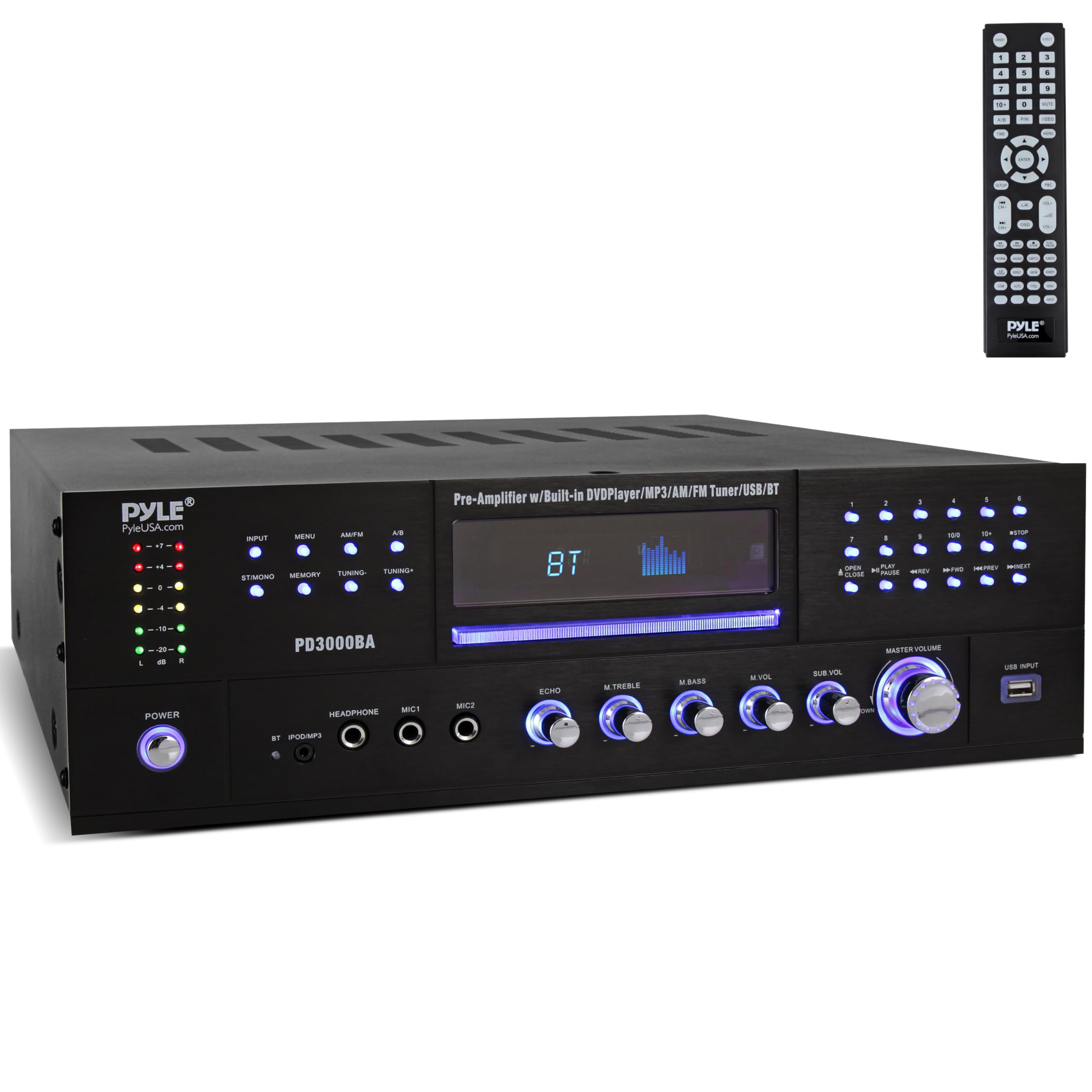
If raw output is what you are after, the PD3000BA’s 3000 W peak leads the field. It carries 3000 W peak power (the maximum burst the amp can deliver) across four channels and is rated for speakers from 2 to 8 ohms, so it can push demanding loads. Owners mention it running at high volume without distortion and handling big speakers with ease. That sound quality is the most-praised thing about it by a wide margin. A front-loading CD/DVD player with a digital audio converter (a chip that turns digital files into analog sound) backs it up, so a disc collection sounds better than the price tier suggests.
The input roster is unusually broad for a four-channel amp: headphone, optical, RCA, component video and S-video inputs, plus a subwoofer output and front right/left RCA outputs for monitoring. Bluetooth streams from a phone, tablet or Fire tablet with a stated range of 40-plus feet, which is enough to leave the phone on the couch. Rotary analog knobs handle mic EQ, tone and volume, and the LED level meter gives you a visual read on output — genuinely handy when you are setting levels for a party.
Reliability is the mixed bag. The FM radio section is the most frequent complaint, with some units working flawlessly and others losing the tuner. The remote draws its own share of gripes, so plan on using the front panel. Still, the value proposition is strong — the sound and the money both earn heavy praise — provided you go in knowing the tuner may be the weak link.
The case for it: 3000 W peak into 2-8 ohm speakers, a built-in CD/DVD player with a digital audio converter, and Bluetooth at 40-plus feet — a home theater and music center in one rack-mount chassis.
The catch: tuner reliability and the remote are the two recurring complaints. If FM radio is central to your day, look at a receiver with a stronger tuner record.
Best matched to: a movie-and-music room that needs serious headroom and still spins DVDs.
Not the one for: radio-first listeners — the FM section is the part most likely to disappoint.
5. Pyle PD1000BA 4-Channel Amplifier

A 20.5-pound karaoke and movie amp that pairs two microphones and throws a lot of peak wattage at them.
At 20.5 pounds, this is nearly double the weight of the Marantz, and that heft is the price of the bigger power supply inside. It pushes 1000 W peak across 2-8 ohm speakers — a third of the PD3000BA’s peak figure, but still plenty to drive a living-room system loudly. The 1000 W figure sits well ahead of the 300 W PT390AU’s peak, so if you are stepping up from the entry-level karaoke box, this is the meaningful upgrade in output.
Seven input paths cover headphone in, USB-A for an MP3 player, FM tuner, AUX, a front-loading CD/DVD player, two microphone inputs with echo, one RCA preamp output and two mono RCA outputs dedicated to a subwoofer. Bluetooth streams from a phone, tablet, laptop or computer, and bass and treble sit on rotary controls with digital selectors for finer shaping. A fluorescent display meter shows the function and input in use, and a remote comes in the box.
What owners respond to is the volume and clarity together — it is loud enough to hear a pin drop, with extra wattage in reserve for crisp sound, and the karaoke capability earns specific praise. Value is a recurring theme too. The 20.5-pound chassis is desktop-honest about its size, so reserve real shelf depth for it rather than squeezing it into a slim console.
Where it shines
- 1000 W peak with headroom to spare — described as crisp even at volume.
- Two mic inputs with echo make karaoke a first-class feature, not an afterthought.
- Front-loading CD/DVD player plus USB-A, AUX, FM and Bluetooth covers every source.
- Dedicated subwoofer outputs give you real low-end control.
What to weigh
- 20.5 pounds needs a substantial shelf and clearance for ventilation.
- Peak wattage is not sustained power, so do not read 1000 W as continuous.
Buy it if: karaoke and movie nights are the main event and you want output plus two mic channels in one box.
Choose the PD3000BA instead if: you need triple the peak headroom for very large rooms.
6. Rockville Home Matrix 4-Zone Receiver Amp

Eight channels of 75 W RMS that let four rooms play four different things at four different volumes.
This is the most ambitious zone-routing machine on the list. Its 600 W RMS output translates to 75 W RMS per channel across eight channels, or 150 W per zone — sustained power, not a peak-day headline. Eight channels means two speakers per zone across four zones, and the key feature is independent routing: each zone can be assigned its own source and its own volume. The kitchen can take FM radio while the den takes Bluetooth while the patio takes optical from a TV.
Inputs are the broadest here — Bluetooth, USB, optical, coaxial, RCA, FM radio and microphone — and RCA line outs let you add a subwoofer or an extra amp per zone. The mic section includes volume, EQ, echo and delay, plus a priority feature that automatically lowers the music when someone starts speaking, which is a genuinely thoughtful touch for announcements. It is app-controlled, ships with a remote, and is rack-mountable at 19 inches wide by 3.5 tall by 10.4 deep with detachable rack ears. It supports 4-8 ohm speakers, so check your speakers sit inside that window.
The honest picture: performance and ease of use win consistent praise, and build quality plus value follow close behind. The recurring caveats are sound quality, which divides opinion, and Bluetooth range, which is the most-discussed gripe — keep the source close rather than relying on it across floors. Wire the house with RCA or optical where you can, and Bluetooth becomes a convenience rather than the backbone.
The standout spec: 75 W RMS across eight channels with per-zone source assignment is a level of routing control the other picks here cannot match. The mic priority feature that ducks music when you speak is the sort of detail that shows someone thought about real installations.
The honest limit: Bluetooth range is the weak spot, and sound quality draws split opinions. Use wired inputs for the primary zones and this becomes a genuinely capable whole-home hub.
For the installer: anyone running four rooms with different sources who wants sustained 75 W per channel and app control.
Not worth it if: you only need one room — that is a lot of chassis and routing to pay for.
Know the Specs
RMS Versus Peak Wattage
Peak wattage is a brief burst the amp can survive; RMS is what it delivers continuously. A receiver quoting 62.5 W RMS per channel is telling you a sustained number, while a 3000 W peak figure describes headroom for transients. For everyday bookshelf listening, sustained RMS in the tens of watts per channel is sufficient. Buy on RMS and treat peak as a ceiling, not a promise.
Speaker Ohms And Load
Ohms measure how hard your speakers are to drive. Receivers here specify ranges such as 2-8 ohms, 4-16 ohms and 4-8 ohms. Stay inside the stated range and the amp runs cooler. Wiring two pairs of speakers to one channel can lower the total load, so confirm the amp can take it before you double up.
Zone Versus Channel
A channel is one amplified output; a zone is a group of channels with its own volume and source. Four channels can power two speaker pairs at one volume, while four zones let each pair play something different. If everyone in the house wants different music, pay for zones like the Rockville units.
Impedance, Bi-Amping And Heat
Bi-amping splits a speaker’s high and low sections across separate amplification paths, which some receivers here support. It needs matching speaker terminals and adds wiring complexity, so it suits buyers upgrading to serious speakers. Whatever the setup, leave ventilation clearance — amplifiers generate heat, and cramped shelves shorten their life.
Common Questions
Can a four-channel receiver power two pairs of speakers at once?
What is the difference between a zone and a channel on these receivers?
Will my 8-ohm speakers work with these four-channel amps?
How many watts per channel do I need for a normal living room?
Do these receivers need a separate Bluetooth adapter?
Can I use a four-channel receiver for karaoke?
Why do some of these amplifiers hum, and can it be fixed?
Is peak wattage like 3000 W the same as continuous power?
Can I add a subwoofer to a four-channel stereo receiver?
Do these receivers fit in a standard media cabinet or rack?
The Bottom Line
For four channels without clutter, the Marantz M-CR612 is the pick — streaming, disc playback and 30 W x 4 amplification in one 10.9-pound box, with HEOS extending it through the house. If output is your priority, the Pyle PD3000BA brings 3000 W peak and a CD/DVD player. The Rockville Home Matrix is the one for four rooms that each want their own source at 75 W RMS per channel (RMS being the continuous power it sustains, not just a peak). The PD3000BA and Home Matrix both sit near the top of the price ladder, but the Marantz remains the safest single-box bet if streaming and discs share equal billing.
How we choose
We do not accept paid placement. Every pick is matched to a real buyer and a real use-case; we do not hands-on test units.
Sources
Specifications: manufacturer listings and product documentation. Review insights: verified customer reviews, as of November 2026. Pricing: not shown on this page (it changes often); check the current price via the retailer link.
As an Amazon Associate, My Heart Lives Here earns from qualifying purchases. This does not affect which products we feature.