Heads up: This post contains affiliate links. As an Amazon Associate I earn from qualifying purchases, at no extra cost to you. Learn more
Specs are compiled from manufacturer listings and verified buyer reviews and can change over time — please confirm the key details on the product page before buying.
If your scanner keeps losing its place halfway around a smooth cup or a car panel, the fix is usually not a new scanner — it is the little reflective dots you stick to the object. Markers give the software fixed reference points, so it can stitch frames together instead of guessing. The picks below are sorted by what each one actually does well, starting with the 6.0 mm pad that has the deepest track record of just working.
This guide is built by comparing the manufacturers’ published specifications and the patterns across verified customer reviews, so you get each pick’s real strengths and trade-offs instead of marketing spin.
You will see how dot diameter, sheet count, and adhesive behavior change what a marker can do on curved, dark, or glossy surfaces. The right set is the one that matches your object size and your scanner’s tracking style, and this comparison of the 3d scanning markers lays that out in plain terms.
Top Picks


How To Choose The Best 3D Scanning Markers
The single mistake that ruins a marker purchase is buying the wrong dot size for the object. A dot that is too big will not sit flat on a tiny part, and a dot that is too small vanishes from the scanner’s view on a large panel. Get the diameter right first, then worry about sheet count.
Match the dot diameter to the object
A 6.0 mm inner diameter with a 10 mm outer diameter is the standard size, and it is the safe bet for most handheld scanning work. Smaller 3.0 mm dots pack more reference points into a tight area, which helps when you are scanning small parts or complex geometry. If your object is a smooth, featureless surface — a cup, a sculpture, a car door — you need markers because the scanner has nothing else to lock onto.
Watch the adhesive, not just the reflector
Reflective foil is what makes the dot visible to the scanner’s cameras. A matte finish on top of that foil cuts glare so the marker stays readable in bright workshop light. The adhesive matters just as much on the cleanup end: some dots peel off plastic cleanly and fight you on painted or textured surfaces. Think about where the dots are going before you commit to a full sheet.
Count sheets against your real workflow
A 500-dot pad suits occasional scanning and small objects. A 1500 or 2100 dot set makes more sense if you scan large assemblies, run repeated jobs, or work in a shop where dots get used up fast. Reusable dots that can be repositioned stretch a set further, but a disposable pad at a low count is still fine for one-off projects.
Side-by-Side Comparison
| Model | Best For | Marker Count | Dot Diameter | Item Weight | Amazon |
|---|---|---|---|---|---|
| 6.0 mm 3D Scanning Marker (1000)★ Best Overall | All-round scanning | 1000 | 6.0 mm inner / 10 mm outer | 1.44 ounces | Amazon |
| YOOPAI 6.0 mm (20 Sheets of 1000)Easiest Start | Beginners and mixed projects | 1000 | 6.0 mm inner / 10.0 mm outer | 1.44 ounces | Amazon |
| Marspark 30 Sheet 1500 Point | Large or repeated jobs | 1500 | 6 mm | 2.11 ounces | Amazon |
| PargaDeco 900 Dots | Brand-agnostic scanner use | 900 | 10 mm outer | 20.14 g | Amazon |
| Revopoint 6 mm (500 Points) | Revopoint owners | 500 | 6.0 mm inner / 10.0 mm outer | 0.634 ounces | Amazon |
| Rosjoy 2100 Dots (6mm & 3mm) | Mixed-size scanning sessions | 2100 | 6 mm and 3 mm mix | 2.39 ounces | Amazon |
| Creality Official 3.0 mm (1680 Dots) | Creality and multi-brand setups | 1680 | 6 mm inner / 10 mm outer | 1.13 ounces | Amazon |
Detailed Reviews
1. 6.0 mm 3D Scanning Marker for 3D Scanner, 1000 Dots
Our pick — 4.5+★ from 150+ verified ratings; the strongest balance of quality and price.
The tear-off pad that quietly keeps a handheld scanner locked on a smooth surface.
It earns the top slot on the longest track record here — 4.5+ stars from 150+ ratings — and one simple strength: it works. Each pad gives you 50 single-point markers per sheet on adhesive foil you peel and stick. The 6.0 mm inner diameter with a 10 mm outer ring is the size most handheld scanners are tuned to read, so you spend less time nudging dots around and more time capturing geometry.
The reflective foil is the whole point. On a smooth cup, a sculpture, or a flat car panel, the scanner has almost no surface texture to track, so it drifts. Stick a grid of these dots near the object and the software has fixed anchors, which keeps tracking stable and makes the scan faster and more predictable. That is why this set is commonly used in reverse engineering, quality control, and industrial work where repeatability matters. The pad format is the practical part: tear off a strip, apply, scan, peel back.
What wins people over is the plain functionality of the dots — they read, they track, they come off. The honest catch is quality consistency: some units are compared unfavorably to the stock Creality markers, so if you run Creality gear and expect an identical match, order one pad and test it before buying in bulk. For everyone else this is the low-risk default.
What earns its keep
- 6.0 mm inner / 10 mm outer size reads cleanly on most handheld scanners
- 50 markers per sheet on peel-away foil, so application is quick
- Keeps tracking on smooth surfaces that give a scanner nothing to grip
- 1000 dots cover a long run of projects before you reorder
Before you add to cart
- Quality can vary pad to pad, and some rate them below stock Creality dots
- No reusable backing, so each dot is a one-use item
Best all-rounder: Buy this if you want a proven 6.0 mm marker pad and you scan a mix of smooth and shaped objects.
Test first: Creality owners should run one pad before committing to a multi-pack.
2. YOOPAI 6.0 mm 3D Scanning Markers, 20 Sheets of 1000 Dots
A 1000-dot starter set built for people who have never stuck a marker on anything.
Twenty sheets of 100 dots gives you 1000 markers at a 6.0 mm inner diameter and 10.0 mm outer diameter — the same standard size as the top pick, but packaged in a way that is friendlier to first-timers. The dots sit on adhesive foil you press on and lift off whenever you like, with no special tool needed.
YOOPAI lists compatibility with Creality, Revopoint, and other scanner brands, which takes the guesswork out of whether the dots will register. The reflective surface is meant to reduce data loss on small or complex objects, so details are less likely to drop out mid-scan. Pasting at multiple angles is the other trick here: you place dots around the object so the scanner can collect reference points from different sides, which helps it build a complete model rather than a half-finished shell.
The one rule the maker stresses is size matching. Pick a dot that is too small or too large for the object and the scanner will not recognize it, which shows up as frames that refuse to stitch together. Treat that as a setup step, not a defect. At 4.5+ stars from a smaller pool of buyers, it is a sensible entry set.
Why it suits beginners: A 1000-dot, 20-sheet pad removes the commitment of a huge bulk box while still giving you the standard 6.0 mm size.
The trade-off: There is very little owner history behind it yet, so you lean on the spec sheet rather than a long record of scans.
Reach for this if: You are new to marker-based scanning and want a standard-size set that plays nicely with several scanner brands.
Look elsewhere if: You need a large installed base of owner feedback before you buy.
3. Marspark 30 Sheet 1500 Point 6mm 3D Scanning Markers

Thirty sheets and 1500 dots for the shop that scans all week.
That spread matters if you scan large assemblies or rerun jobs, because you stop rationing dots and start covering the whole object. It weighs 2.11 ounces, heavier than the 1.44-ounce 6.0 mm pad, which is simply what a bigger stack of sheets feels like in the hand.
These dots are made from PVC and built to hold firm during a scan, then lift without leaving residue behind. Marspark calls them reusable, so a dot that comes off cleanly can go back on another project. The reflective material is rated for stable tracking in both bright and dark environments, useful when you cannot control workspace lighting. Owner feedback points to the tracking working well, including clean compatibility with the Revopoint MetroX scanner.
The speed bump is removal on certain surfaces. Dots come off plastic very easily, but the same dots put up more resistance on car interiors — so if you are scanning automotive trim, plan for extra care at the peel-off stage. For a high-volume bench workflow, this set earns its place.
Where it pulls ahead: 1500 dots across 30 sheets means fewer mid-project reorders, and the PVC build is reusable when removed cleanly.
The part to plan for: Removal is easy on plastic and harder on car interiors, so factor in time and care on automotive panels.
Made for high volume: Choose this if your scanning bench goes through dots quickly and you want refill-free stretches.
Handle with care on trim: Automotive interior work calls for a slower, more patient peel.
4. PargaDeco 3D Scanning Dots, 900 Count

Nine hundred reflective dots pitched at Einscan, Creality, and Revopoint scanners alike.
If you own more than one scanner brand, this is the pack that avoids the compatibility question entirely. The listing names Einscan, Creality, and Revopoint by name, and PargaDeco is not tied to a single ecosystem the way the Revopoint set is. You get 900 dots total in a single pack, at a 10 mm outer diameter, made from polyethylene terephthalate — PET, the same clear plastic family used for drink bottles, chosen here as a thin, stable carrier for the reflective dots.
The specified inner size for these dots is not spelled out in the listing, so if your workflow depends on an exact inner diameter, confirm that before ordering. The item weighs 20.14 grams, and the set is sold as a disposable consumable rather than a reusable pad. For a mixed-brand shop, though, the cross-compatibility is the real argument.
The practical case: One pack that spans Einscan, Creality, and Revopoint means you can stock a single box instead of three.
Worth confirming: The listing does not publish an inner diameter, so check that figure if your scan process is size-sensitive.
Fit for a multi-brand bench: Take this when your scanners come from different makers and you want one dot stock for all of them.
Hold off if size is critical: Anyone who needs a documented inner diameter should verify it first.
5. Revopoint 6 mm 3D Scanning Markers, 500 Points
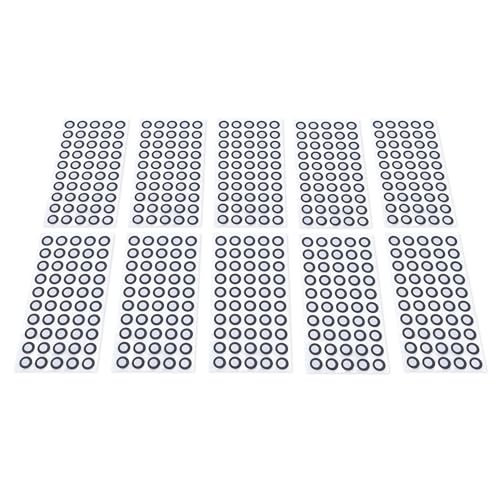
Half a thousand dots tuned for the scanner whose name is on the pack.
Revopoint makes scanners, and it makes these markers to go with them — which is the whole reasoning behind this pick. The set runs 500 points across 10 sheets at a 6.0 mm inner diameter and 10.0 mm outer diameter. Light and small is the point — this is a slim pad for focused jobs, not a bulk supply.
The reflective material is paired with a matte finish, a combination meant to cut glare and keep the dot readable across different lighting. Dots are designed to stay detectable from multiple angles, which supports the way a handheld scanner sweeps around an object. The adhesive holds through a scan and comes off without leaving residue. Material compatibility is broad — wood, metal, plastic, glass, stone — and it covers smooth surfaces and curved geometry where tracking usually struggles.
Are these the same dots Creality owners can swap in freely? Not necessarily, and that is the limit worth naming. This is a Revopoint-tune set with stated compatibility for mainstream handheld scanners, so owners of other brands should test a sheet first. For anyone already in the Revopoint camp, it is the natural match.
What it nails
- Built by Revopoint for Revopoint scanners, so matching is not a gamble
- Matte reflective finish is designed to lower glare in uneven lighting
- Adhesive releases without residue on wood, metal, plastic, glass, and stone
- Slim 0.634-ounce pad stores easily in a scanner case
The fine print
- 500 dots is a modest supply for large or repeated scanning jobs
- tune for Revopoint first, so other brands warrant a test sheet
The obvious match: This is the pick for Revopoint owners who want dots the maker designed for their scanner.
Other brands: Try one sheet before you buy several pads.
6. Rosjoy 2100 Dots 6mm & 3mm 3D Scanning Markers
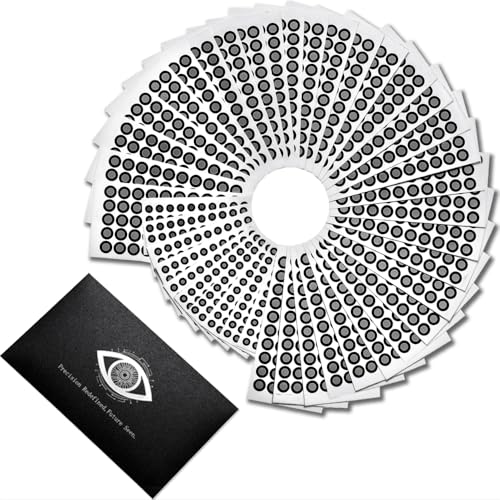
A two-size box that covers small parts and broad panels without a second order.
Most marker sets make you choose a diameter. This one splits the difference: 1600 dots at 6 mm and 500 dots at 3 mm, totaling 2100 points across 42 sheets. That is a lot of dots in one box, and it is the reason to look here even though the listing is newer than the others — you get a large-size set and a small-size set in one purchase. The 3 mm dots are the ones that make small parts and fine geometry practical, while the 6 mm dots carry the bulk work.
The reflective surface is professional-grade with a matte top for stable tracking in bright workshops and on dark surfaces. For curved or irregular objects, placing dots at multiple angles helps the scanner hold detail from every side. The adhesive is made to stay put during a scan and then release cleanly, and the PET/PVC build lets you reposition and reuse the dots across projects. That reusability is what stretches 2100 dots into a genuinely long workflow.
The size of the set is also its small chore: 42 sheets means a lot of dots to keep organized, so a divided case or labeled sleeves help. Beyond that, the pitch is straightforward — one box, two diameters, reusable adhesive.
Why the two-size split works: A 1600-plus-500 mix of 6 mm and 3 mm dots means you pick the diameter per object instead of working around one size.
One thing to keep tidy: With 42 sheets in the box, you will want a way to separate the two dot sizes so you are not hunting mid-scan.
Best for mixed geometry: Grab this if your scanning sessions jump between small parts and larger surfaces.
Organization required: Set aside a case to keep the 6 mm and 3 mm sheets apart.
7. Creality Official 3.0 mm 3D Scanning Markers, 1680 Dots

Creality’s own dots — 1680 of them, at a size that suits fine work.
Buying the manufacturer’s own markers is the surest way to know they behave the way your Creality scanner expects. This set is 20 sheets at 84 dots each, which works out to 1680 dots total. The dots use a 6 mm inner diameter with a 10 mm outer diameter on tear-off foil, and they stick on and peel back off when a project ends. Creality rates them compatible with its own scanners and with Shining 3D Einstar, Creaform, Peel3D, and Revopoint scanners, so the fit is not limited to one brand.
Creality pitches these for the same jobs as the rest of the category: reverse engineering inspection, optical surveying and mapping, and machine vision calibration. The tracking dots are described as easily picked up by the scanner, which is the quality you are paying for. At 4.5+ stars from a solid base of buyers, it is the most-reviewed pick here.
One honest note: the listing title reads 3.0 mm while the body specifies a 6 mm inner diameter and 10 mm outer diameter. Read the inner-diameter line, not the title, when you decide whether these suit your object size. If your work is fine detail on small parts, the actual 6 mm size may be larger than you were expecting.
Why the brand matters
- Creality’s own markers, so they match Creality scanner behavior
- Works across Einstar, Creaform, Peel3D, and Revopoint scanners too
- 84 dots per sheet across 20 sheets gives 1680 markers
- The most-reviewed set in this comparison
Read before you buy
- Title says 3.0 mm but the actual inner diameter is 6 mm
- Bigger than expected if you were set on very small dots
For Creality owners: The cleanest choice if you scan with Creality hardware and want markers made for it.
Check the size line: Anyone chasing a true 3 mm inner diameter should measure expectations against the stated 6 mm.
Know the Specs
Inner vs Outer Diameter
The inner diameter is the reflective dot itself, and the outer diameter is the full sticker including its border. A 6.0 mm inner diameter with a 10 mm outer diameter is the common size, and it is what most handheld scanners are set up to detect. The outer ring gives you a clean edge to line up and peel. Smaller dots put more reference points into a tight area, which helps on small parts, while larger dots are easier for the scanner to spot on broad, flat panels.
Reflective Foil and Matte Finish
The reflective foil is what makes the dot visible to the scanner’s cameras. A matte top layer sits over that foil to cut glare, so the dot reads clearly under bright workshop light or on dark surfaces. Without a clear reflective point, the scanner loses its place and frames stop stitching together — that is exactly the drift markers exist to prevent.
Adhesive Behavior and Removal
Good markers hold through a scan and lift without leaving residue. This is where surfaces differ: a dot that peels cleanly off plastic can grip harder on a car interior or a textured finish. Consider a reusable PVC or PET set if you plan to move dots between jobs, and reserve disposable pads for one-off projects.
Point Count and Sheet Count
Point count tells you the total markers in the box; sheet count tells you how they are organized. A 500-dot, 10-sheet pad suits occasional scanning, while a 1500 or 2100 dot set keeps a busy bench running. Match the count to how much surface area you scan per session, not to how big the box looks.
Common Questions
Will a 6 mm marker fit my handheld 3D scanner?
Do I need 3 mm or 6 mm dots?
Will the markers leave residue on my object?
How many dots do I need for one scan?
Can I reuse 3D scanning markers?
Are Creality markers compatible with a Revopoint scanner?
Do markers work on dark or glossy surfaces?
Why does my scanner fail to stitch scans together even with dots?
Are these markers disposable or reusable?
What is the difference between a diffuse reflection marker and a normal sticker?
The Bottom Line
For most people scanning a mix of smooth and shaped objects, the 6.0 mm 3D Scanning Marker 1000-dot pad is the safest buy — it has the longest track record here of just working, and the standard 6.0 mm inner diameter fits most handheld scanners. If you want to cover small parts and large panels without a second order, the Rosjoy 2100 Dots set gives you 6 mm and 3 mm in one box. And if your scanner wears the Creality badge, the Creality Official 1680-dot set is the match — just read the stated 6 mm inner diameter rather than the 3.0 mm in the title. Match the dot diameter to your object and the tracking follows.
How we choose
We do not accept paid placement. Every pick is matched to a real buyer and a real use-case; we do not hands-on test units.
Sources
Specifications: manufacturer listings and product documentation. Review insights: verified customer reviews, as of November 2026. Pricing: not shown on this page (it changes often); check the current price via the retailer link.
As an Amazon Associate, My Heart Lives Here earns from qualifying purchases. This does not affect which products we feature.