Heads up: This post contains affiliate links. As an Amazon Associate I earn from qualifying purchases, at no extra cost to you. Learn more
Specs are compiled from manufacturer listings and verified buyer reviews and can change over time — please confirm the key details on the product page before buying.
You plug a 300-watt inverter into your car’s 12V socket, hook up your laptop, and it either charges fine or trips out after ten minutes. The difference between those two outcomes is not the wattage number on the box — it is the waveform (the shape of the AC power the unit produces) and the real continuous output behind that 300W label. This guide separates the units that deliver clean, steady power from the ones that fold under a real load, so you can pick the right one for your road trip, campsite, or emergency kit.
This guide is built by comparing the manufacturers’ published specifications and the patterns across verified customer reviews, so you get each pick’s real strengths and trade-offs instead of marketing spin.
Some inverters label 300W but only hold a fraction of that under load, and the waveform type decides whether sensitive electronics survive. That is exactly what separates the picks in this breakdown of the best 300 Watt Inverter.
Top Picks

How To Choose The Best 300 Watt Inverter
The first thing to understand is that “300W” on the box can mean two different things. Some makers print the peak wattage (the short burst a unit can survive for a second and no more), while others print continuous watts — the power it can actually hold for the length of a drive. For anything you plan to run for more than a few minutes, continuous watts are the number that matters.
Pure Sine Wave or Modified Sine Wave
Pure sine wave means the AC output is a smooth, clean curve, the same shape your home wall outlet produces. Modified sine wave comes out in a stepped, blockier shape. Devices with motors, compressors, or sensitive power supplies (laptops, CPAP machines, nebulizers, some chargers) tend to run cooler and quieter on pure sine wave. Tough resistive loads like a lamp or a simple charger usually tolerate modified sine wave fine.
The USB-C PD Port Wattage
PD (Power Delivery) is the charging standard that tells a laptop how much power the port can hand over. A PD 65W port can fast-charge most modern laptops at full speed. A lower-wattage PD port still tops up phones and tablets quickly but will slow-charge a big laptop. Match the PD wattage to the biggest device you plan to plug in.
Idle Current and Cooling
Idle current is the trickle of power the inverter draws from your car even when nothing is plugged in and charging. Lower is better so it does not drain the battery when parked. A temperature-controlled cooling fan keeps the unit from overheating during long runs — some are near-silent, some are noticeable. Read the fan comments before you commit to a long drive.
Side-by-Side Comparison
| Model | Best For | Waveform | Continuous Watts | USB-C PD | Amazon |
|---|---|---|---|---|---|
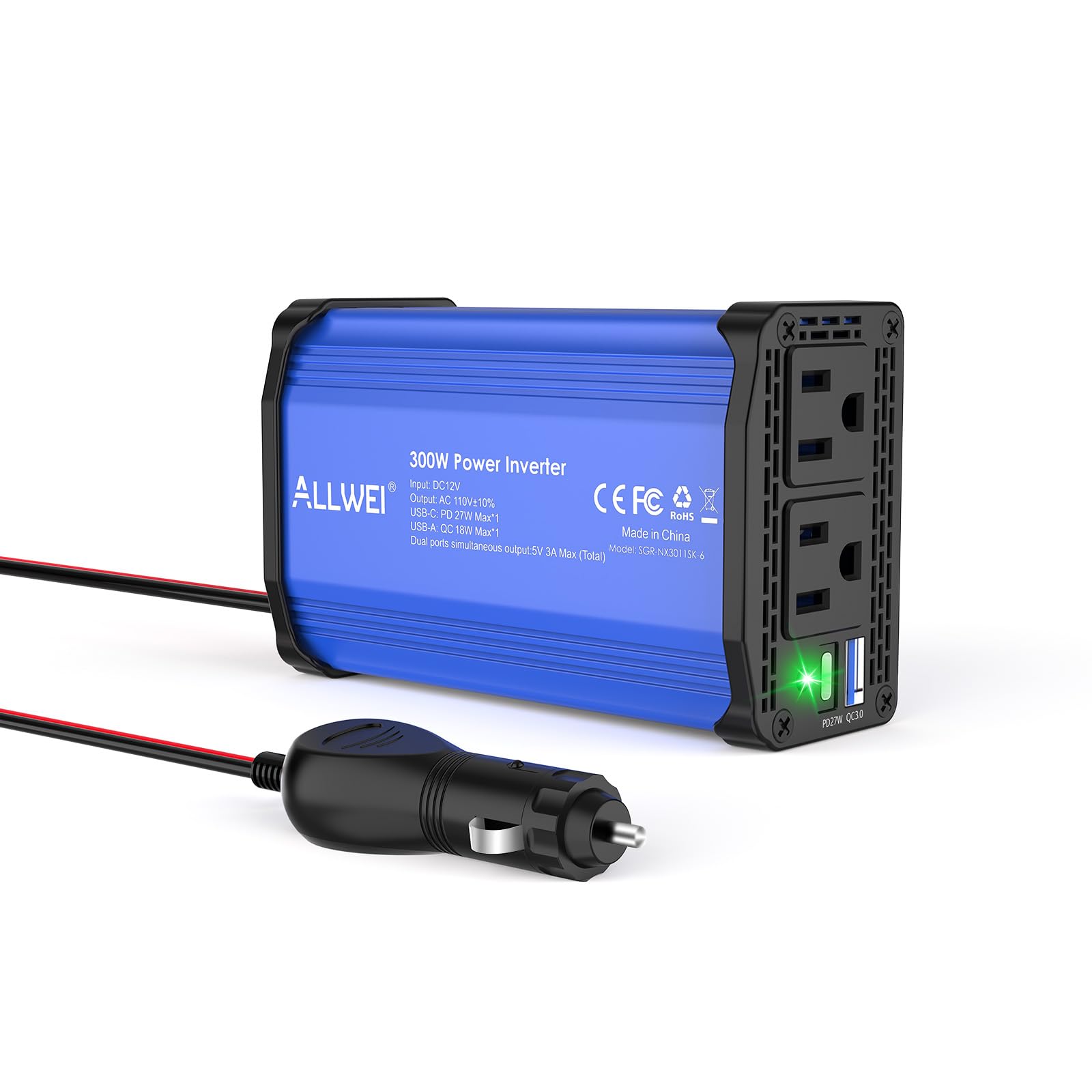
| ALLWEI 300W Car Power Inverter (Blue)★ Best Overall | Everyday road trips and van life | Modified Sine Wave | 300W | 27W | Amazon |
| Giandel 300Watt Pure Sine WaveBest Pure Sine | Clean power for sensitive electronics | Pure Sine Wave | 300W | — | Amazon |
| Giandel 300W Pure Sine Wave with USB-C PD 30W | Starlink, laptops, photography gear | Pure Sine Wave | 300W | 30W (60W max) | Amazon |
| ISELECTOR 300W Power Inverter (Red) | Fast laptop charging with QC | Modified Sine Wave | 300W | 65W | Amazon |
| DrimMek 300W Car Power Inverter | Compact glove-box backup | Modified Sine Wave | 300W | 65W (24W second port) | Amazon |
| BESTEK 300W Power Inverter | Dual AC gadgets on the road | Modified Sine Wave | 300W (700W peak) | 65W | Amazon |
| Cummins CMN400 | High-power AC devices on the go | Modified Sine Wave | 400W | Fast-charge 3.0A | Amazon |
Detailed Reviews
1. ALLWEI 300W Car Power Inverter
Our pick — 4.0+★ from 9,000+ verified ratings; the strongest balance of quality and price.
The glove-box-sized unit that runs two AC devices and two USB gadgets off one 12V socket.
What makes this one the pick for most drivers is the balance of ports and footprint. It runs a modified sine wave at 300W continuous across two AC outlets, so a laptop and a lamp can both draw power at once. A 27W USB-C PD port feeds a phone or tablet fast, and an 18W USB-A covers the older devices in your bag. The aluminum housing measures about the size of a cell phone, so it drops into a glove box without eating space.
This unit earns its keep on road trips and camping, where buyers report it simply works. Its 300W output (300 watts of continuous power) holds steady for laptops and small gear, so your devices keep charging on the move. The flexible plug-in setup fits vans and trucks. Reach for the battery clips when a device draws more than 180W, because the cigarette socket alone only tolerates so much. As owners put it, the fan is the dividing line: some barely hear it, others find it louder than expected. Expect a unit that quietly hums rather than runs silent.
Weigh the trade-offs before you buy. This is a modified sine wave design, which is fine for lamps, chargers, and most laptops but not ideal for gear with delicate power supplies. The 15.2-ounce body is light enough to leave in the car, though the fan noise is the most-discussed topic across the reviews, split down the middle between whisper-quiet and noticeable.
What earns its place
- 300W continuous across two AC outlets and two fast USB ports (27W PD + 18W)
- Cell-phone-sized aluminum body goes straight into a glove box
- Solid for road trips, camping, and van-life charging runs
Where it gives ground
- Modified sine wave, not pure sine — not the cleanest for fussy electronics
- Fan noise reads either near-silent or loud depending on the load
- Over 180W you need the included battery clips, not just the socket
Best for: Drivers who want a compact all-in-one inverter for phones, laptops, and small appliances on the move.
Think twice if: You need pure sine wave for a CPAP machine or medical device — those prefer the Giandel picks below.
2. 300Watt Pure Sine Wave Power Inverter
The pure sine wave unit that feeds laptops and chargers the same smooth AC curve as a wall outlet.
If you have ever watched a laptop charger whine or a device refuse to fire on a cheap inverter, this is the fix. The output is a pure sine wave — the same smooth curve your house delivers — stepped down from 12V to a 120V AC feed of 300W continuous. Two smart USB ports auto-detect a device and push up to 2.4 amps each. That means a phone, tablet, or power bank charges without you fiddling with settings.
What wins people over is reliability — it is the most-praised trait by a wide margin, and the theme is a unit that behaves like grid power rather than a rough approximation of it. Owners run string lights, laptops, and nebulizers off it without drama, and the 0.35A max idle draw keeps the battery from draining when nothing is plugged in. A replaceable 30-amp fuse and full protection against over-voltage, under-voltage, overload, and short circuit round out the safety side. The aluminum housing shrugs off drops better than plastic shells.
One honest note sits inside all that praise. The power output draws the most discussion and lands mixed — some devices pull a clean 300W, others find the unit cannot quite hit the number under a heavy load. At about 6.22 inches long and 1.7 pounds, it is a little chunkier than the ALLWEI above, so it wants a bit more console room. For most buyers the reliability record outweighs the size.
Where it shines: Pure sine wave output plus low idle current (0.35A max) make it the safe choice for delicate devices you care about.
Worth knowing: There is no USB-C PD here — the two USB ports are standard 2.4A, so a modern laptop charges from an AC outlet rather than a fast port.
Reach for this if: You want the cleanest power for laptops, cameras, and delicate electronics and do not need a USB-C fast-charge port.
Look elsewhere if: You want PD 65W laptop charging straight from a USB-C port — the ISELECTOR below does that.
3. 300 Watt Pure Sine Wave

The pure sine wave unit that runs a Starlink dish and a 17-inch laptop off one cigarette socket.
Photographers and remote workers are the audience here. This is a pure sine wave inverter with two AC outlets plus a USB-C PD 30W port and a QC3.0 USB, so you can run a Starlink setup, a tablet, and a laptop from one unit. Total distortion is low — under 3% THD, meaning the AC is clean enough for fussy gear — and the idle draw sits at 0.3 amps max (3.6 watts) so it will not quietly flatten your battery. Max efficiency reaches 91%.
Functionality is the thing that carries it — owners are doing more than charging phones. The pattern is a unit that powers a hotspot and a 17-inch engineering laptop together, and one that gets called into duty for photography strobes. Low power consumption and the quiet fan come up repeatedly, and the aluminum housing protects the internals from knocks. The cigarette plug slots straight into any 12V socket, so there is no wiring to figure out.
The catch worth naming: 250+ ratings is a smaller sample than the bigger names on this list, so if you weigh crowd size heavily, the ALLWEI and ISELECTOR outnumber it. The USB-C port is rated to a max of 60W in the spec block even though the port headline reads PD 30W, so match expectations to whatever your device actually asks for. Where it clearly wins is clean power for Starlink and laptop work at 4.5+ stars per rating, the highest score on this page.
Why it earns the top score
- Pure sine wave at under 3% THD — clean enough for sensitive gear
- Built for Starlink, 17-inch laptops, and photography strobes
- Low 0.3A idle current and 91% max efficiency
- UL approved fuses and aluminum housing
The honest limits
- Smaller review base than the bigger brands here
- USB-C tops out below the 65W units further down the page
Top of the pile for: Photographers, remote workers, and Starlink users who need pure sine power and clean charging together.
Not the pick if: You want the largest possible review record behind your purchase — pick the ISELECTOR or ALLWEI instead.
4. ISELECTOR 300W Power Inverter
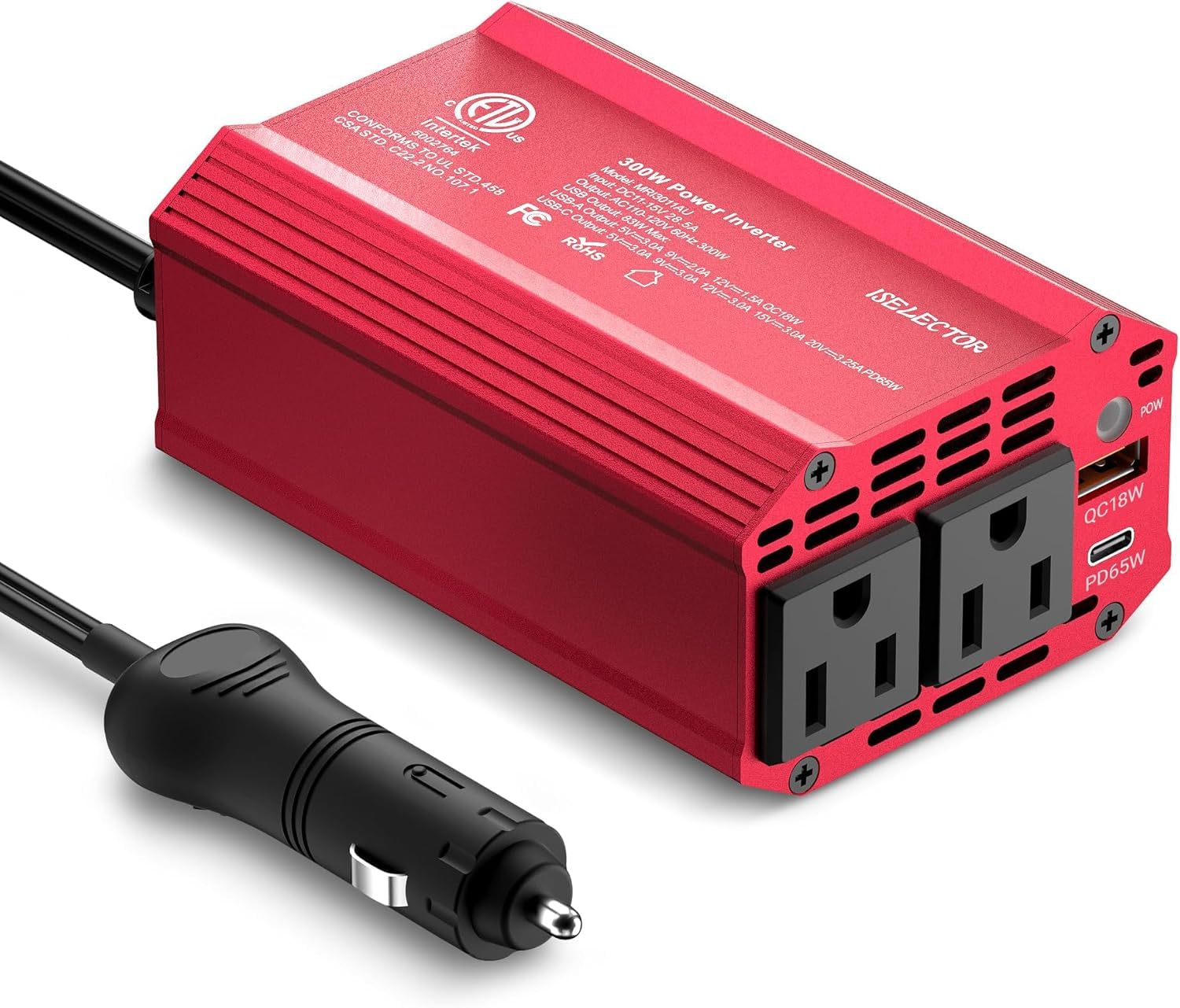
The 65W USB-C unit that fast-charges a laptop at full speed while an 18W QC port tops up a phone.
Here is the number that decides it for laptop owners: a PD 65W USB-C port. That port pushes more than twice the 27W you get on the ALLWEI, so it fast-charges most modern laptops at full speed while an 18W QC USB-A handles a phone alongside it. There are also two AC outlets, so you can run a laptop and a lamp or a small appliance at the same time. A built-in 40-amp fuse and LED indicators cover short circuit, temperature, and voltage protection.
The unit stays quiet and cool under use — noise and cooling are the two things people highlight most, and the pattern is a fan that ramps with load instead of droning constantly. It does not overheat on long drives, the compact 4.37 by 3.47 by 1.89 inch body stores easily, and the 23.8-inch cord with cigarette plug reaches most sockets. Drivers without an AC outlet in the car get the most out of it: phones, iPads, laptops, and string lights all run off the one unit.
Two points deserve a straight look. The output is modified sine wave, not pure, so a CPAP machine or fussy medical gear belongs with the Giandel picks instead. The charging speed lands mixed in the feedback — owners mention it fast in some cases and slower than expected in others, which is usually a cable or device mismatch rather than the port itself. Sizing is called out both ways too: some find it compact and easy to store, a few want it smaller.
Standout spec: PD 65W is the highest USB-C output among the modified-sine units here, plenty for a full-speed laptop charge.
Fair warning: Modified sine wave means sensitive medical or audio gear should look at the pure sine options instead.
For the laptop-on-the-go crowd: You want the fastest USB-C laptop charge in a compact plug-in unit with dual AC outlets.
Skip for: Medical devices and high-end audio that need a pure sine wave.
5. DrimMek 300W Car Power Inverter
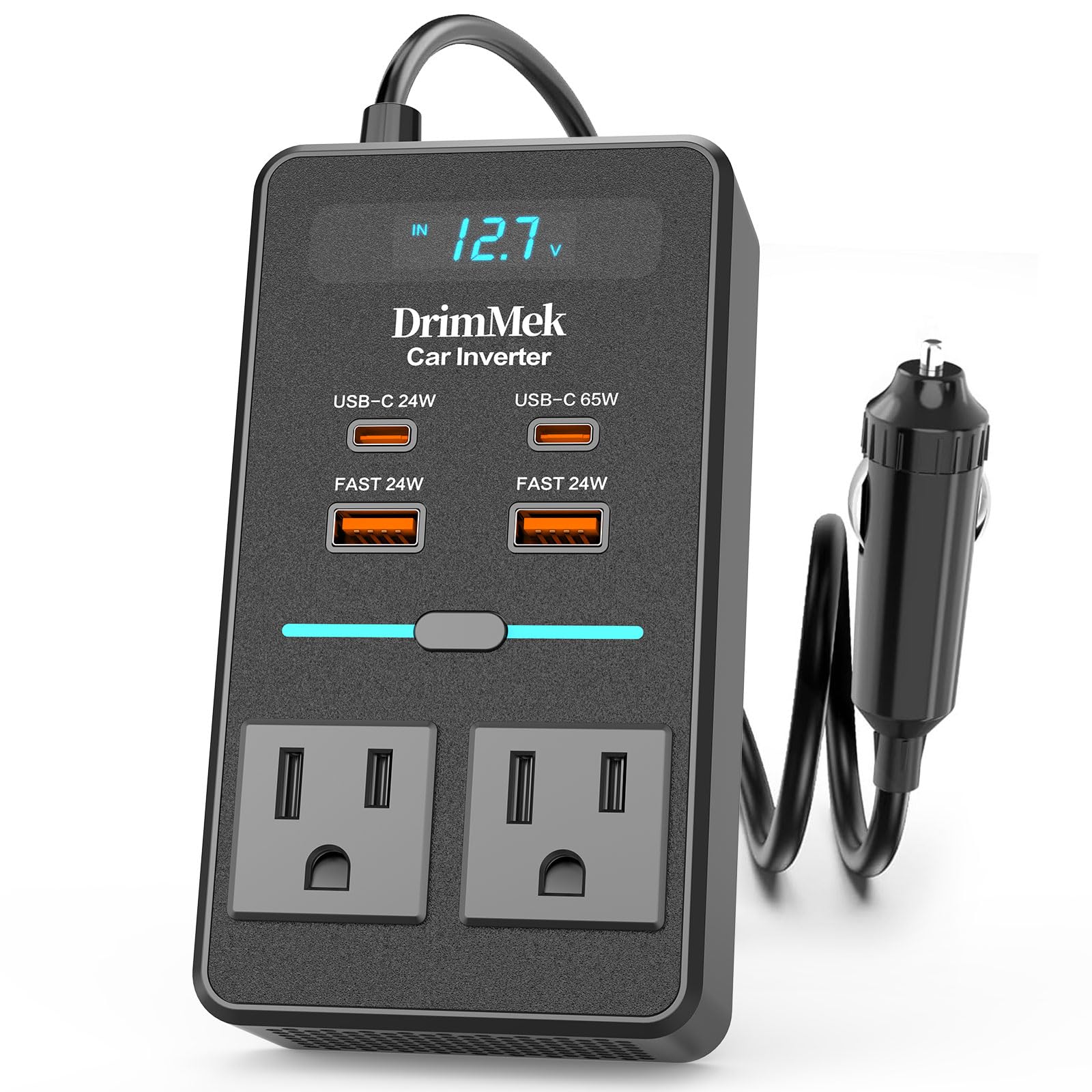
The six-port unit with an LCD that reads your car battery voltage while it charges.
This is the one for the family whose devices all need charging at once. It packs dual AC outlets, two USB-C ports (24W and 65W), and two USB-A 24W ports into an 8-ounce body that measures 5.5 by 3 by 1.4 inches. That is the thinnest unit here, so it slides under a seat. The LCD reads your car battery voltage in real time — a small detail that lets you spot a draining battery before it strands you. Protection covers overload, short circuit, overheat, and low voltage.
Charging speed is what earns the most praise, with the 65W USB-C called out for fast laptop charging and the multi-port layout winning over owners who run a laptop and a phone together. The fan only spins when it is needed, so most drives stay quiet, and the plug-and-play setup needs no installation. For a road-trip or emergency kit, portability and the multiple ports are the reasons it earns its spot.
One thing to check before you buy: it is built for a 12V outlet and the maker states it is not compatible with Teslas that use a 16V low-voltage system. Power delivery reads mixed — most get what they need, though occasional reports describe far less than expected, so test quickly after arrival. The modified sine wave also rules out delicate medical gear. Still, for raw port count and a compact build, it fills a gap none of the others here do.
Why you would grab it
- Six ports total — the most here — so the whole family charges at once
- 65W USB-C fast-charges a laptop while USB-A covers phones
- LCD shows live car battery voltage
- 8 ounces — the lightest, thinnest unit on this list
The trade-offs
- Not compatible with Teslas running a 16V low-voltage system
- Modified sine wave, not pure
- Power output lands mixed in the feedback
Suits: Big families or gadget-heavy travelers who want to charge everything at once off a thin, light unit.
Not for: Tesla owners on a 16V system or anyone running a CPAP machine.
6. BESTEK Power Inverter 300W

The dual-AC-outlet unit with an 11V-17V input range and a 5-year warranty.
For a road-trip crew that plugs in two household gadgets at once, this inverter does the job. It delivers 300W continuous with 700W instantaneous peak — the peak figure is the short surge it can survive, useful for a motorized item kicking on. Two AC outlets run dual 110V appliances, and the PD 65W USB-C plus QC 18W USB-A fast-charge a MacBook Pro, iPad, or iPhone. The wide 11V-17V input range is what makes it compatible with Tesla and other EVs, not just standard 12V cars. The 24-inch cord reaches most sockets.
Build quality is the trait owners call out most, and the picture is a unit that feels solid in hand and keeps running over time. Charging a laptop and a phone together on the two fast ports is the everyday use. The compact iPhone-sized body with an intelligent fan that auto-adjusts to load and temperature keeps the noise down on most drives. An ETL-certified 300W design with a built-in fuse rounds out the safety side, backed by a 5-year warranty and a 180-day money-back guarantee.
Now the counterweight. Reliability sits mixed in the feedback — most units keep going strong, though a few customers note a failure across repeated use. Noise and cooling are similarly split, with some drivers hearing more fan than others. Weigh that against the warranty, which is far longer than the 12 to 18 months most of the others here carry. If you want the tightest protection behind your purchase, this is the one to consider.
Why it earns a look: The 5-year warranty is the longest on this list, and the 11V-17V range keeps it working in Teslas and EVs that trip up narrower input spec.
What to weigh: Reliability and fan noise both read mixed, so buy for the coverage as much as the spec sheet.
Worth choosing if: You drive a Tesla or EV, need two AC outlets running at once, and want the longest warranty here behind you.
Look elsewhere if: You want the most consistent reliability record over sheer coverage length.
7. Cummins CMN400 400 Watt Car Inverter

The 400W unit that runs two 110V appliances without tripping the 300W ceiling.
If your gadgets draw harder than 300W can feed, this is where the list points. The Cummins CMN400 delivers 400W of AC power across two 110V outlets, so two appliances run together without the overload trip you hit at the 300W ceiling. A standard 2.4A USB and a fast-charge 3.0A USB-C cover tablets and phones. Short circuit, temperature, and overload protection keep the wired-in safety, and the full cable kit is in the box so nothing extra is needed. The backlit switch is easy to find in a dark cab.
It is a Cummins official licensed product, which is the reason many drivers reach for it over the unbranded options. The dual AC ports let you run a laptop and a small appliance at once without rationing power. The backlit power switch is a small touch that matters on a night drive. Build is modified sine wave like the cheaper units, so it still favors tough loads over delicate electronics.
Two trade-offs to size up. At 10.8 inches tall and 1.7 pounds-plus of body, it is the bulkiest unit here by a clear margin — this one lives in the trunk, not the glove box. The 50Hz frequency listing is different from the 60Hz most US gear expects, so check that your specific device tolerates it before you commit. For pure wattage headroom and the Cummins name, it is the premium call on this page.
Why it leads on power
- 400W output, the highest here, so dual appliances run without tripping
- Two AC ports plus 2.4A USB and fast 3.0A USB-C
- Full cable kit included and backlit switch for night use
- Cummins official licensed product
What to know first
- The bulkiest unit here — trunk storage, not glove-box
- 50Hz frequency listing differs from the 60Hz US devices expect
- Modified sine wave, not pure
Pick it for: You need more than 300W of headroom and want the Cummins brand and full kit behind it.
Pass if: You want a compact glove-box unit or run delicate gear that needs pure sine and 60Hz.
Know the Specs
Continuous vs Peak Watts
Continuous watts is the power the inverter holds for the length of a drive. Peak watts is the brief surge it survives for a second or so when a motorized device kicks on. A unit like the BESTEK lists 300W continuous and 700W peak. If you run a laptop for an hour, the continuous number is the one doing the work. Match your device’s running draw to continuous watts, not the bigger peak figure.
Pure vs Modified Sine Wave
Pure sine wave is the smooth AC curve your home outlet delivers. Modified sine wave is a stepped approximation. Laptops, CPAP machines, nebuliizers, and audio gear tend to prefer pure sine — they run cooler and quieter. Lamps, simple chargers, and most phones tolerate modified sine fine. If your device has a motor, a compressor, or a delicate power supply, err toward pure sine.
USB-C PD Wattage
PD (Power Delivery) is the standard that lets a USB-C port negotiate a fast charge with a laptop or phone. A 65W port fast-charges most modern laptops at full speed. A 27W or 30W port covers phones, tablets, and lighter laptops quickly but will slow-charge a power-hungry machine. Match the PD wattage to the biggest device you plan to plug in.
Idle Current and Fuses
Idle current is the power the inverter draws from your car even when nothing is charging. Lower is better so it does not drain the battery when parked. A built-in fuse — whether a 30-amp or 40-amp rating — is the safety valve that trips if a device draws too much, protecting both the unit and your vehicle. Replaceable fuses are a plus on long trips.
Common Questions
Will a 300W inverter run a laptop and charge a phone at the same time?
What is the difference between pure sine wave and modified sine wave?
Can I use a 300W car inverter to run a CPAP machine?
Why does my inverter trip out when I plug in a device rated near 300W?
Does a 300W inverter drain my car battery when the engine is off?
Will these inverters work in a Tesla or an EV?
Can a 300W inverter fast-charge a MacBook or a large laptop?
What does the 50Hz or 60Hz frequency rating mean for my devices?
Can I leave a 300W inverter plugged in all the time?
Do these inverters come with the cables needed to connect them?
The Bottom Line
For most drivers, the 300 watt inverter that balances port count, footprint, and price is the ALLWEI 300W Car Power Inverter, because it puts two AC outlets and two fast USB ports in a cell-phone-sized body. If clean power for delicate gear is your priority, the Giandel pure sine wave unit holds the top score on this page for sensitive devices like Starlink and laptops. And if you need more headroom than 300W can give, the Cummins CMN400 steps up to 400W with a full kit. Pick the one that matches the devices you actually run, and you will not be caught short on the road.
How we choose
We do not accept paid placement. Every pick is matched to a real buyer and a real use-case; we do not hands-on test units.
Sources
Specifications: manufacturer listings and product documentation. Review insights: verified customer reviews, as of November 2026. Pricing: not shown on this page (it changes often); check the current price via the retailer link.
As an Amazon Associate, My Heart Lives Here earns from qualifying purchases. This does not affect which products we feature.