Heads up: This post contains affiliate links. As an Amazon Associate I earn from qualifying purchases, at no extra cost to you. Learn more
Specs are compiled from manufacturer listings and verified buyer reviews and can change over time — please confirm the key details on the product page before buying.
A 3-way speaker splits the music into three jobs — bass, vocals, and highs — so each driver handles only what it was built for. The payoff is simple: you hear singers breathe, and bass notes stop blurring into the drumbeat. The catch is that “3-way” on a box tells you almost nothing about whether the speaker actually does that job well, so this guide sorts the real three-driver designs from the ones trading on the label.
This guide is built by comparing the manufacturers’ published specifications and the patterns across verified customer reviews, so you get each pick’s real strengths and trade-offs instead of marketing spin.
Bookshelf pairs, floorstanders, and powered studio boxes all land on this list, each matched to a room size and a job. Below you’ll find the models that actually justify their extra crossover componentry, laid out for a real living room rather than a showroom floor with the best 3 way speaker options worth shortlisting.
Top Picks


How To Choose The Best 3 Way Speaker
Most buyers walk in asking which speaker sounds best and walk out having bought the one with the biggest box. The smarter question is which speaker suits the room, the amplifier, and the music you actually play. Three decisions carry almost all the weight.
Match the speaker size to the room, not the spec sheet
A 5.12-inch woofer in a compact cabinet is built for a desk, a shelf, or a small lounge. It will fill that space cleanly and it will not overwhelm it. A tower with a 6.5-inch or 8-inch woofer moves far more air, so it suits a larger living room where the sound has distance to travel. Putting a giant floorstander in a tight room usually gives you boomy bass you cannot tame with the volume dial.
One practical note: a down-firing 8-inch subwoofer inside a tower keeps the cabinet footprint small while pushing low notes into the floor, which spreads bass in a way a front-firing box cannot. That makes a slim tower genuinely livable next to a sofa.
Check whether the speaker needs an amplifier
Passive speakers have no electronics inside — you supply the power from a receiver or integrated amp. Powered speakers have their own amplifiers built in, so you plug them into the wall and connect a source directly. If you already own a receiver, a passive pair is the natural fit. If you are building from nothing, a powered pair saves you a whole component and a set of speaker cables.
Impedance is the number to check here. A speaker rated at 8 Ohm is an easy load for almost any amplifier. A 6 Ohm rating (like the Sony SS-CS3) is still comfortable for most home theater receivers, but check your amp’s manual before pairing anything unusual.
Read the frequency response with one eyebrow raised
Frequency response is the range of notes a speaker can produce, written as a low number and a high number in hertz (Hz). A figure like 53 Hz at the bottom is a statement about bass depth. A figure like 50,000 Hz at the top is a statement about high-frequency extension far beyond what human hearing reaches.
That top number matters less than the bottom one for most listeners. Deep bass shapes how music feels; a 40 kHz ceiling mostly signals that the tweeter is well engineered. Both are useful, neither is the whole story — the crossover quality is what actually keeps the three drivers handing off cleanly to each other.
Side-by-Side Comparison
| Model | Best For | Woofer Size | Power Handling | Type | Amazon |
|---|---|---|---|---|---|
| Sony SS-CS5M2★ Best Overall | Small rooms and desks | 5.12 inches | — | Passive bookshelf pair | Amazon |
| Rockville RockTower 68CBest Value | Big sound on an entry budget | 6.5 inches | 125W RMS / 500W peak | Passive tower (each) | Amazon |
| Edifier MR5Studio Standard | Studio and desk monitoring | 5 inches | 110W RMS | Powered, Bluetooth | Amazon |
| ELAC Debut 2.0 F5.2 | Two-channel stereo listening | 5.25 inches | — | Passive floorstander (each) | Amazon |
| Sony SS-CS3 | Home theater front stage | — | 145W peak | Passive floorstander pair | Amazon |
| Edifier R2750DB MKII | TV and turntable setups | 7 inches | 144W RMS | Powered, HDMI eARC | Amazon |
| Fluance XL8F | Filling a large room | 8 inches | — | Passive tower pair | Amazon |
| KEF Q Concerto Meta | Detail-first critical listening | 6.5 inches | — | Passive bookshelf pair | Amazon |
Detailed Reviews
1. Sony SS-CS5M2 Bookshelf Speakers
Our pick — 4.5+★ from 200+ verified ratings; the strongest balance of quality and price.
Three drivers and a super tweeter in a box small enough for a shelf.
You get a full three-way speaker for a modest outlay. Sony fits three separate drivers into one compact cabinet: a 5.12-inch woofer for the low end, a high-precision tweeter for the top, and a wide-dispersion super tweeter that spreads the highest notes outward. That last driver is why two people on a sofa hear the same thing, instead of one person hearing the balance and the other hearing a dull corner.
The frequency response runs from 53 Hz to 50,000 Hz, which in plain terms means the box reaches genuinely low into bass territory and stretches far above anything your ears can register. The bass reflex enclosure (a ported cabinet that lets air escape to reinforce low notes) keeps that bass clean rather than boomy, and the reinforced cellular cone resists the flexing that smears detail during loud passages. It is also marketed as a natural match for Sony AV receivers, which matters if you already own one.
Clarity is what this pair is known for, and it is what wins people over. Value follows close behind: this is a speaker that does not demand you build a system around it. The thing to know before buying is that 5.12 inches of woofer has a physical limit — in a big open-plan room you will want a subwoofer underneath it. It earns its 4.5+ stars from 200+ owners and the top spot here.
Where it earns its keep
- Three dedicated drivers plus a super tweeter in a compact cabinet
- 53 Hz to 50,000 Hz response covers deep bass and Hi-Res highs
- Wide dispersion means the whole sofa gets the same soundstage
- Bass reflex porting keeps low notes tight rather than thick
What to plan around
- Passive design, so you need a receiver or amplifier to drive it
- A 5.12-inch woofer will not pressurize a very large room alone
Go this way: you want a true three-way pair that fits a shelf and pairs cleanly with an existing Sony receiver.
Look elsewhere: your listening room is open-plan and huge, where you would be adding a subwoofer from day one.
2. Rockville RockTower 68C Tower Speaker
A wood-grain tower with dual 6.5-inch woofers that undercuts everything around it.
Two 6.5-inch woofers, a 6.5-inch midrange, and a 1-inch silk dome tweeter — that is three drivers doing three jobs, and the pair of woofers is what separates this from most budget towers. The larger cones push more air than a compact bookshelf can, so bass has real weight before you ever think about a subwoofer. This cabinet measures 6.5 inches at the woofer against the Sony SS-CS5M2’s 5.12 inches, and that extra cone area is why low notes land with more authority here.
Power handling sits at 125W RMS (continuous, comfortable power) with a 500W peak figure for short bursts. Sensitivity of 87 dB means it does not need a monster amplifier to get loud, and the 8 Ohm impedance is an easy load for virtually any receiver. Frequency response of 30Hz to 20kHz covers the full musical range, and the vented MDF cabinet with rubber surrounds is built to hold that together over years of play.
The gold-plated five-way binding posts accept banana plugs, spade connectors, or bare wire, so setup does not require a special cable order. Buyers keep coming back to how much sound this price buys — it is the value play of the list and sounds like a much larger investment. Worth knowing: a small number of owners have had connector hardware work loose over time, so seat your cables firmly on day one. Note that the listing covers one speaker, giving you a matching pair only if you buy two.
The honest trade: furniture-grade wood grain and dual 6.5-inch woofers at an entry-level ask is the whole pitch. Just confirm you are ordering two cabinets if you want stereo — the listing sells a single tower.
Setup that pays off: the 8 Ohm rating and 87 dB sensitivity mean a modest receiver will drive these without strain.
Reach for this if: floorstanding presence and deep bass matter more to you than a compact footprint.
Think twice if: your amplifier is a small desktop unit — a tower this size rewards a proper receiver.
3. Edifier MR5 Bookshelf Speakers
The powered monitor that skips the amplifier and plugs straight into your desk.
No receiver needed here. Edifier builds the amplification in — 110W RMS of Class D power pushing a 101dB peak — so you run one cable to a source and you are listening. The driver layout is a 5-inch long-throw woofer, a 3.75-inch midrange, and a 1-inch silk dome tweeter, split by an active crossover (the electronic version of a passive crossover, filtering each driver before the signal reaches it). Response runs 46Hz to 40kHz, and the whole box measures 5 inches at the woofer.
The connectivity is where this earns its place on a studio desk. XLR and TRS inputs take professional gear, RCA and AUX handle consumer sources, and the front-panel 3.5mm jack means you can plug headphones in without reaching behind the cabinet. Bluetooth 6.0 adds wireless streaming with multi-point, and LDAC carries 24-bit/96kHz audio over that wireless link.
Room tuning is the sleeper feature. Two rear knobs adjust high and low frequencies by hand, or you open the EDIFIER ConneX app for presets covering low cut-off, desktop placement, and acoustic space. If your desk sits against a wall and the bass sounds thick, that adjustment is the fix. Clarity is this monitor’s strongest suit, with value close behind. The honest caveat: some owners find the adjustability controls fussier to dial in than a simple tone knob, so budget a few minutes with the app rather than expecting instant perfection.
Why a desk owner picks it: built-in 110W amplification, XLR and TRS for studio gear, plus LDAC over Bluetooth 6.0 — a complete system minus the amp.
The catch to weigh: deep tone-shaping lives in the app and rear knobs, which takes some patience on the first setup.
Best fit: a producer, editor, or serious desk listener who wants accurate sound without buying a separate amplifier.
Not the one: you already own a prized receiver and want passive speakers to hang off it.
4. ELAC Debut 2.0 F5.2 Floorstanding Speaker, Black (Each)
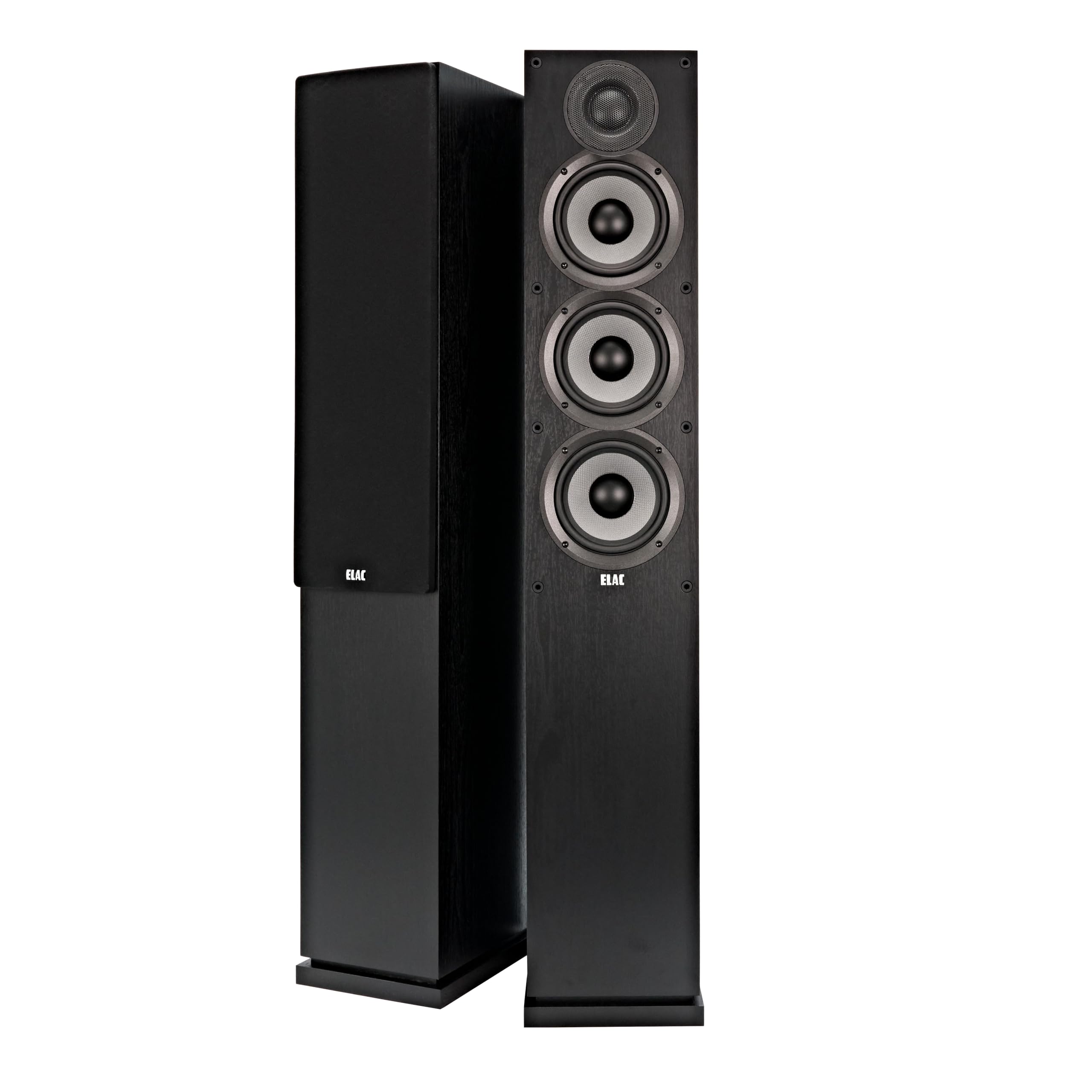
The two-channel purist’s floorstander, built around a single cloth dome tweeter.
Where most of this list chases features, ELAC chases cabinet discipline. Three 5.25-inch aramid-fiber woofers handle the low end, a dedicated midrange takes the vocals, and a 1-inch cloth dome tweeter reaches up to 35,000 Hz. Aramid fiber is stiffer and better damped than polypropylene or paper cones, which keeps the bass from smearing when the music gets busy.
The cabinet does more for sound than you might expect. Thick MDF walls with internal bracing cut down the panel vibration that colors sound in cheaper boxes. The tweeter’s waveguide (a shaped surround that controls how sound spreads out) improves directivity and reduces the diffraction that fuzzes up imaging. A 3-way bass reflex design means the ported cabinet reinforces low frequencies, so you don’t need a subwoofer in a normal room.
What people notice first is detail they had not heard before — layers in familiar recordings that cheaper speakers gloss over. The build and the appearance back that up, and the slim tower shape keeps floor space honest. One thing to plan for: this listing is a single speaker, so a stereo pair means ordering two. The room-filling quality is the other thing to size correctly — this speaker wants some breathing room from the back wall, and a tiny room wastes it.
The engineering argument: braced MDF cabinets and aramid-fiber cones attack distortion at the source, which is why this floorstander reveals detail a boxy competitor hides.
Confirm before checkout: the listing is for one speaker, not a pair.
Pick it when: you are assembling a serious two-channel stereo and want a floorstander that rewards careful placement.
Skip the idea if: you want a pair out of one box — you will need two orders here.
5. Sony SS-CS3 3-Way 4-Driver Floor-Standing Speaker (Black)

Four drivers per tower, tuned for the moment a movie soundtrack hits.
Four drivers in one cabinet is unusual at this level: a 1-inch polyester main tweeter, a ¾-inch super tweeter, plus the midrange and woofer handling the rest. The super tweeter is what stretches sound reproduction up to 50 kHz, and the 145W peak power figure gives headroom for the explosive passages in a film. Impedance is 6 Ohm, a slightly heavier load than an 8 Ohm speaker but still comfortable for most home theater receivers.
This is a bundle covering a stereo floor-standing pair, which makes it the most straightforward way onto this list to build a front stage. The strong cabinet design is credited with keeping the rich acoustics intact — a rigid box stops the walls from singing along with the drivers. Compared with the RockTower above, this Sony adds a fourth driver and takes the top end further, while the RockTower leans harder on dual woofers for raw low-end output.
Movie sound is the reputation here: dialogue stays clear, effects carry weight, and the cabinet looks good enough to leave in the open. The value question is answered plainly — this performs well above what it asks. Worth flagging honestly: check your receiver’s impedance rating before pairing, since 6 Ohm is not the easiest load on the shelf. And if two-channel music is your priority rather than film, the ELAC above shows more nuance in the mids.
Where it wins the room: a 4-driver tower pair with a ¾-inch super tweeter and 145W peak — a front stage that handles film dynamics without strain.
Check first: 6 Ohm impedance is a heavier load than 8 Ohm, so glance at your receiver’s spec sheet.
Built for: a home theater where the front pair has to carry dialogue and explosions on the same night.
Different tool needed: you listen mostly to acoustic music and want vocal nuance above cinema punch.
6. Edifier R2750DB MKII Bookshelf Speakers
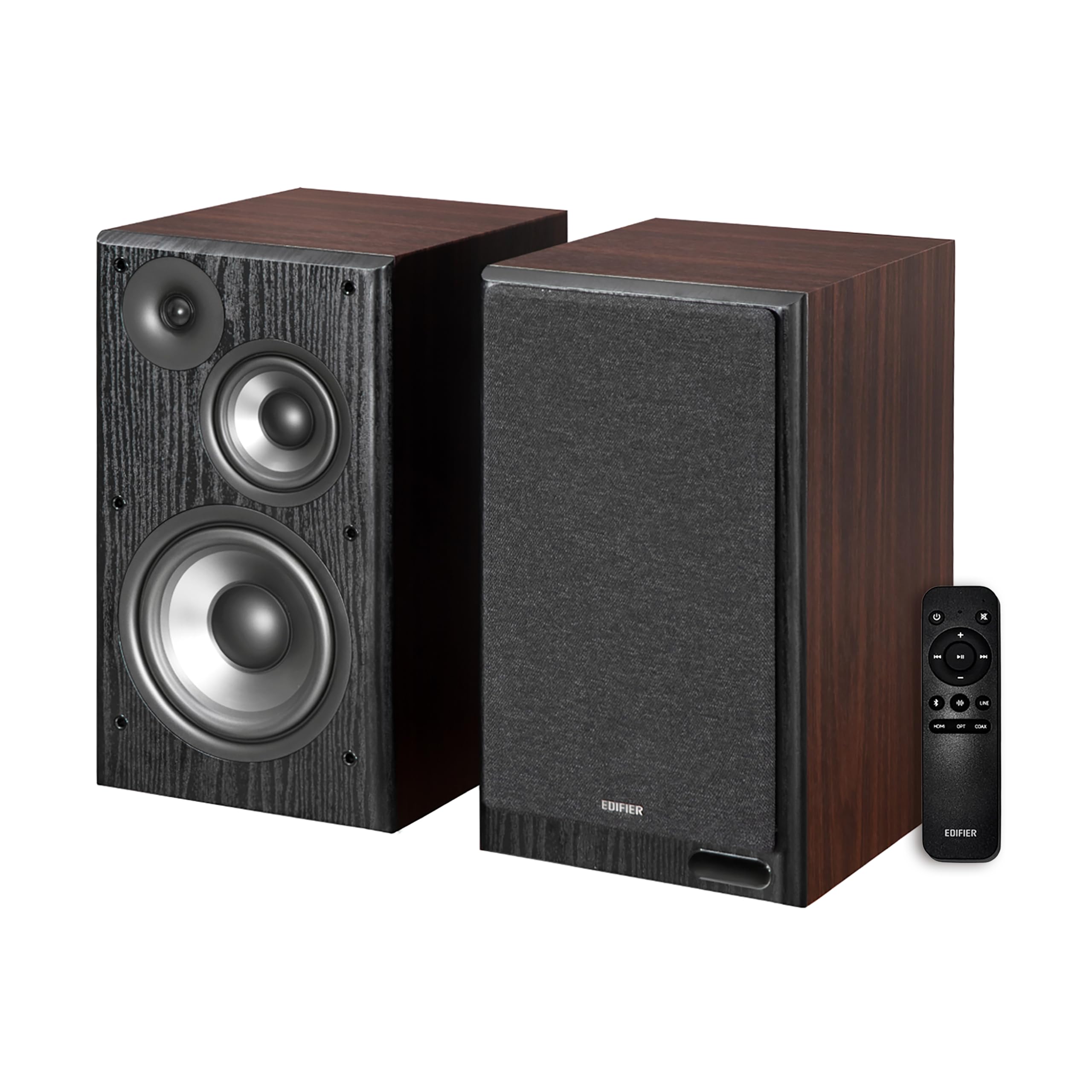
A 7-inch woofer, four amplifiers, and an HDMI port that talks to your TV.
You get more bass from a bookshelf pair than you’d expect. A 7-inch woofer, a 4.5-inch midrange, and a 1-inch silk dome tweeter are driven by four Class D amplifiers totaling 144W RMS. Four amps because the crossover is active, so each driver gets exactly the power it needs rather than sharing one feed. That 7-inch woofer is the biggest on any bookshelf pair here, and it is why bass has body without a subwoofer plugged in.
HDMI eARC is the headline connection. It takes the audio signal from a television over a single cable and lets your TV remote control the volume, which is a far tidier setup than routing through a receiver. Optical, coaxial, and line-in inputs cover a turntable, a projector, or a laptop. Bluetooth 6.0 with multi-point handles wireless, and LDAC carries Hi-Res Audio Wireless with 24-bit/96kHz processing through the built-in DSP.
A SUB OUT port lets you add an external subwoofer later, so the system grows with you. Control comes through four presets (Classic, Monitor, Dynamic, and Vocal) or a 9-band EQ in the EDIFIER ConneX app, plus a physical remote for everyday playback. That combination of connections is what this pair is known for, right alongside its bass. One adjustment to be aware of: some owners find the EQ controls less intuitive to dial in than a plain tone knob, so spend a few minutes in the app.
What it brings to a TV stand
- HDMI eARC, optical, coaxial, and line-in in one cabinet
- 7-inch woofer driven by 144W RMS across four Class D amps
- SUB OUT port for adding a subwoofer later
- Bluetooth 6.0 with LDAC and 24-bit/96kHz DSP
Worth knowing before you buy
- The app-based EQ takes more patience than a simple tone dial
- Active electronics mean more connections to manage than a passive pair
The right call for: a living room where the TV, a turntable, and a laptop all need to feed the same pair of speakers.
Better served elsewhere: you want the simplest possible signal path with no built-in electronics.
7. Fluance Reference XL8F Loudspeakers

Each tower hides a downward-firing 8-inch subwoofer under a slim footprint.
The design idea is clever: put the subwoofer in the floor. Two down-firing 8-inch subwoofers fire into the floor rather than out at you, which produces deep, undistorted low notes while keeping the cabinet narrow enough to live with. The frequency range runs 35Hz to 25KHz, and that 35Hz floor is the lowest bass figure on this list — it is what makes a soundtrack feel like it has weight.
Instruments keep their character thanks to woven fiber midrange drivers, which damp vibration and move linearly. Silk dome neodymium tweeters with off-axis dispersion mean the balance is wider than a single chair. The cabinet uses rigid internal bracing to cut resonance, and dual rear ports control the low end. Eight isolation floor spikes come in the box to decouple the towers from your floor.
This sells as a matched pair, which is the right way to buy a stereo tower setup. Sound quality is what carries it, and the build relative to what you spend is the second thing ears and eyes agree on. On placement: those rear ports want a little distance from the wall behind them, and the down-firing subs want a hard floor rather than deep carpet. Plan both before you position them and this tower pair behaves beautifully.
The spec that does the work: a down-firing 8-inch subwoofer in each slim tower delivers 35Hz bass with a footprint a normal living room can absorb.
Placement matters: rear ports need wall clearance, and the floor-firing subs work best on a hard surface with the included spikes fitted.
Made for: a large living room or media room where a pair of towers can breathe and low bass needs to fill the space.
Not your match: a small apartment where rear clearance and floor space are genuinely tight.
8. KEF Q Concerto Meta Bookshelf Speakers

The tweeter sits inside the midrange driver so sound arrives from one point.
Uni-Q is the reason this pair exists. KEF’s 12th generation array places the tweeter at the acoustic center of the midrange driver, so high and mid frequencies leave from a single point rather than two separated sources. The practical result is even dispersion — every seat in the room hears roughly the same detail instead of only the person in the exact center.
The Meta half of the name refers to Metamaterial Absorption Technology, a structure built to absorb 99% of the unwanted sound radiating from the back of the tweeter. Cutting that rear energy before it reaches your ears reduces the distortion that muddies high frequencies. Underneath sits a true three-way layout with a dedicated 6.5-inch hybrid aluminum bass driver — so bass, vocals, and treble each get their own driver rather than sharing duties.
This is a passive bookshelf pair, which means you choose the amplifier, and you can upgrade the amp or add home theater speakers later without replacing the cabinets. The real advantage is the driver: the KEF’s 6.5-inch bass driver beats the Sony SS-CS5M2’s 5.12-inch woofer, yet both pairs still fit on a shelf. Owners rate the sound as the best in its class, and the walnut cabinet looks like furniture rather than a gadget.
What you are paying for: a 12th generation Uni-Q array and MAT absorption that cuts rear-radiated distortion — engineering you can hear in the treble.
Plan the budget: this pair is the premium choice and it is passive, so a quality amplifier is a separate purchase.
For the listener who: sits down with an album and wants the room filled evenly, not just the center chair.
Check your expectations: you want deep floorstander bass — a 6.5-inch bass driver in a bookshelf cabinet has its own physics to work within.
Know the Specs
Driver sizes and what they do
The woofer is the large driver that moves air for bass — a bigger cone pushes more of it, which is why an 8-inch down-firing subwoofer reaches lower than a 5.12-inch bookshelf woofer. The midrange driver carries voices and most instruments, and a dedicated one keeps those frequencies separate from the bass so vocals stay clear. The tweeter handles the top end, and a super tweeter extends it further still. A 3-way design simply means each of those three jobs has its own driver and its own slice of the crossover.
Power, impedance, and sensitivity
RMS is continuous power a speaker can take comfortably, while peak is a short burst figure — 125W RMS with a 500W peak is a common pattern. Impedance, measured in Ohm, describes how hard the speaker is to drive: 8 Ohm is an easy load for nearly any amplifier, while 6 Ohm asks a bit more. Sensitivity in decibels tells you how loud the speaker goes on a given amount of power, so a higher figure means a smaller amplifier still fills the room.
Passive versus powered
A passive speaker contains no electronics and relies on your receiver or amplifier for power. A powered speaker builds the amplifiers inside, so you connect a source straight to it and cut a whole component out of the chain. Powered designs also usually add convenience like Bluetooth or HDMI, while passive designs let you choose and later upgrade the amplification yourself.
Frequency response readings
Written as a low figure and a high figure in hertz, frequency response describes the span of notes a speaker can produce. A low number like 30Hz tells you the bass reaches deep, while a high number like 50,000 Hz describes extension well beyond human hearing. Read the low figure for bass depth and treat the high figure as a sign of tweeter engineering quality rather than something your ears will directly register.
Common Questions
Do I need a receiver to use a passive 3-way speaker?
Is a 3-way speaker actually better than a 2-way design?
Will a bookshelf 3-way speaker fill a large living room?
What does the Hz range in the specs actually mean?
Can I connect a turntable to a powered bookshelf speaker?
Does 8 Ohm impedance make a speaker easier to drive?
What is a super tweeter and do I need one?
Can I add a subwoofer to a 3-way speaker later?
Does a floorstander sound better than a bookshelf pair?
How far should I place a rear-ported speaker from the wall?
The Bottom Line
For most rooms, the 3 way speaker worth starting with is the Sony SS-CS5M2 — it puts three drivers and a wide-dispersion super tweeter into a compact cabinet and pairs cleanly with an existing Sony receiver. If deep bass and a floorstanding cabinet matter more to you, the Fluance XL8F pair with its down-firing 8-inch subwoofers is the room-filler. And for a desk setup with no receiver in sight, the Edifier MR5 brings 110W of built-in power plus XLR, TRS, and LDAC wireless into one box.
How we choose
We do not accept paid placement. Every pick is matched to a real buyer and a real use-case; we do not hands-on test units.
Sources
Specifications: manufacturer listings and product documentation. Review insights: verified customer reviews, as of November 2026. Pricing: not shown on this page (it changes often); check the current price via the retailer link.
As an Amazon Associate, My Heart Lives Here earns from qualifying purchases. This does not affect which products we feature.