Heads up: This post contains affiliate links. As an Amazon Associate I earn from qualifying purchases, at no extra cost to you. Learn more
Specs are compiled from manufacturer listings and verified buyer reviews and can change over time — please confirm the key details on the product page before buying.
Keeping the fridge, the furnace and the well pump alive through a multi-day outage is the real goal, and a 26kW home generator is sized to carry a whole house rather than a few extension cords. The catch: “26kW” means something different on a standby unit than on a portable, and one of those numbers is a peak figure that only holds for a few seconds. The picks below split the two apart, so your money goes to the machine that actually matches your panel.
This guide is built by comparing the manufacturers’ published specifications and the patterns across verified customer reviews, so you get each pick’s real strengths and trade-offs instead of marketing spin.
Some picks here are permanently wired standby units, while others are rolling power stations you plug in yourself, so your first decision is if you want an electrician involved at all. Each machine below is matched to a panel, a fuel supply and a noise tolerance, and each is sized for a real outage rather than a summer brownout. You also get a clear look at what a 26kW home generator can and cannot do.
Top Picks
How To Choose The Best 26kW Home Generator
The number on the front of the box is the least useful thing you can compare. What decides whether your furnace starts on the first try is the running wattage (the power the unit can hold continuously), not the peak wattage (a short burst it can survive for seconds). A portable rated at 20,000 running watts and 28,000 peak watts is a 20,000-watt machine in real use.
Standby or portable, because that changes everything else
A standby unit sits on a pad outside, runs on natural gas or propane from your existing supply, and starts itself through an automatic transfer switch when the grid drops. A portable needs you to roll it out, connect it, and refuel it — and on most setups you must run cords or wire in a manual transfer switch or interlock kit.
That single choice sets your install cost, your fuel plan and your noise exposure. Standby units need a licensed electrician and often a gas line; portables need nothing but a dry spot and a can of fuel.
Fuel: what you already have in the ground
Natural gas never runs out during a regional outage, which is why standby units prefer it. Propane needs a tank you have to keep filled. Gasoline goes stale and needs stabilizing. Tri-fuel machines accept all three, so you can start on gasoline and move to propane or natural gas once you have a connection.
Clean power and sensitive loads
Total harmonic distortion, usually written THD, measures how dirty the AC waveform is. Under 5% THD is the usual bar for running a modern furnace board, a computer or a TV without glitching. Inverter units hold that figure tightly; conventional portables sometimes do not.
Side-by-Side Comparison
| Model | Best For | Power Output | Fuel Type | Type | Amazon |
|---|---|---|---|---|---|
| Jackery HomePower 3600 Plus & 2x200W Solar Panels★ Best Overall | Renters and plug-in backup | 3600W AC (7200W parallel) | Electric / solar | Portable power station | Amazon |
| Generac Guardian 26kWWhole-House Standby | Hands-off whole-house standby | 26 kW (26,000W) | Natural gas or LP gas | Permanently installed standby | Amazon |
| EF ECOFLOW Smart Home Panel 2 | Battery-system owners adding a panel | 12-circuit sub-panel hub | Solar, gas | Smart home panel | Amazon |
| Jackery Solar Generator 5000 Plus | Big appliances without fuel | 7200W AC (14,400W surge) | Electric / solar | Portable power station | Amazon |
| Westinghouse 28000 Peak Watt Tri-Fuel | One machine, three fuels | 20,000 running / 28,000 peak | Tri-fuel | Portable open frame | Amazon |
| Westinghouse 28000 Peak Watt Gas | Whole-house power on a budget | 20,000 running / 28,000 peak | Gasoline | Portable open frame | Amazon |
| Honda EU7000iS | Quiet overnight running | 7000W | Gasoline | Inverter portable | Amazon |
Detailed Reviews
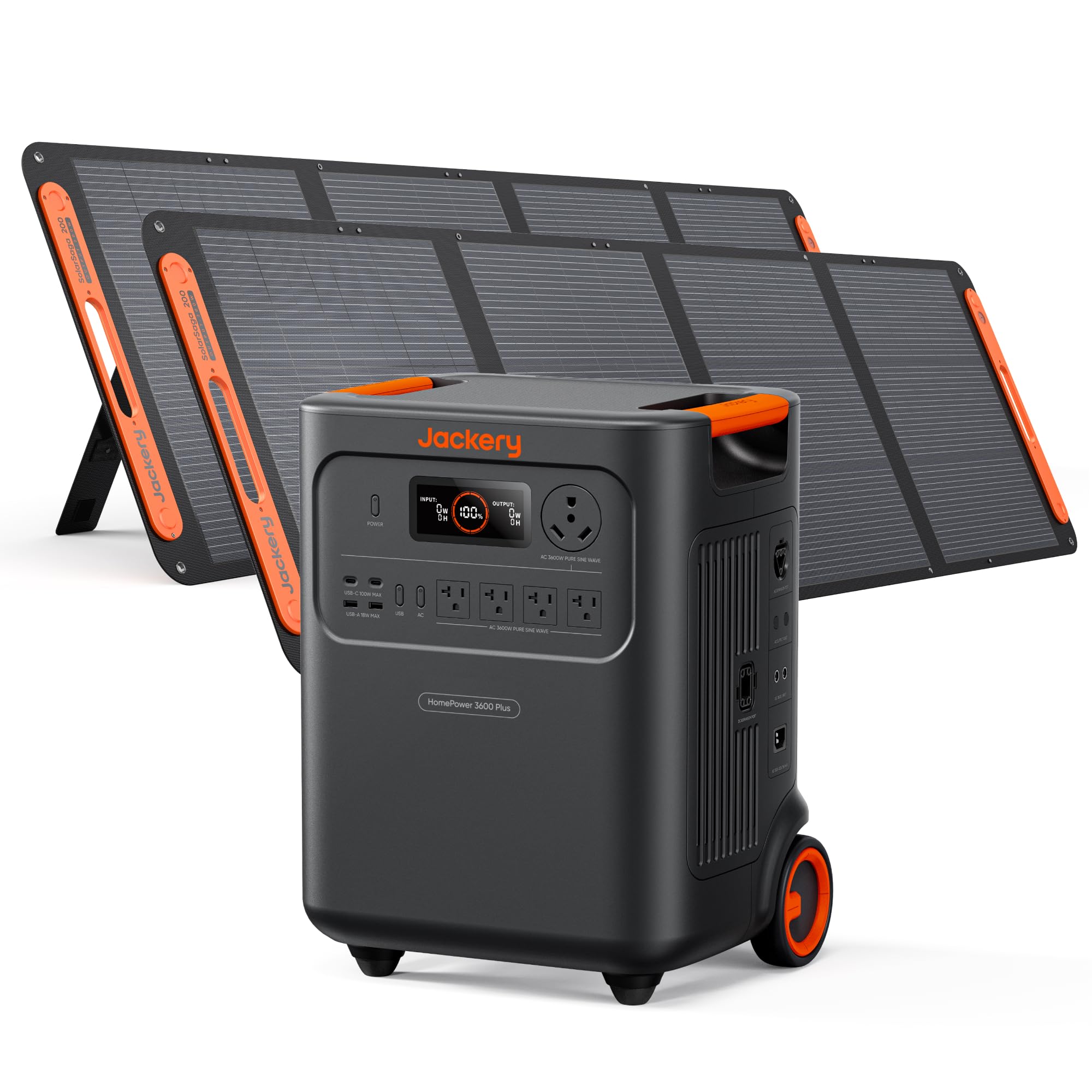
1. Jackery HomePower 3600 Plus & 2x200W Solar Panels
Our pick — 4.5+★ from 150+ verified ratings; the strongest balance of quality and price.
A 3584Wh battery backup on luggage-style wheels that runs indoors-adjacent with no exhaust.
This is the pick for the household that wants whole-home-style backup without pouring a concrete pad or running a gas line. You get 3600W of AC output from a 3584Wh battery pack (a battery capacity measured in watt-hours, so roughly the energy a 3.6kW load needs for an hour). Run a second unit in parallel and the output doubles to 7200W, and the pair delivers both 120V and 240V — the higher voltage being what your well pump and dryer need.
Compare it to the Westinghouse tri-fuel at 557 pounds, and this Jackery lands at 77.2 pounds. That is the difference between a machine you need two people and a ramp to move and one you roll by the telescopic handle into the garage. The ceramic membrane cells are rated to survive heat up to 302 °F and to 6,000 charge cycles, which the maker frames as a 10-year life. Those cells also keep working down to -4 °F, so a cold-weather outage is not the moment it quits.
It runs the well pump, space heaters and dryer you bought it for, and it does so without a pull cord. Recharging is quick for this class: hybrid AC plus DC charging takes 0–100% in about 2 hours, plain AC in 2.5 hours, solar in 4 hours. Setup is genuinely plug-and-play — press the power button and go — but if you plan to wire it into your panel, budget for the transfer switch hardware separately.
What earns its place
- 3600W output, 7200W in parallel, with dual 120V and 240V supply
- 3584Wh base capacity, expandable to 21kWh per unit
- Luggage-style wheels and telescopic handle make it movable by one person
- No exhaust, no fuel cans, no pull cord — safe to run indoors-adjacent
Where it asks something of you
- 77.2 pounds is still heavy to lift, even on wheels
- Panels and unit ship separately and may arrive in different boxes
- Parallel output and 240V require the matching second unit and cabling
Reach for this if: you rent, you cannot install a standby unit, or you want silent overnight backup for a fridge, furnace and a few lights.
Look elsewhere if: you need one machine to carry central air and an electric range simultaneously — a wired 26kW standby is built for that load.
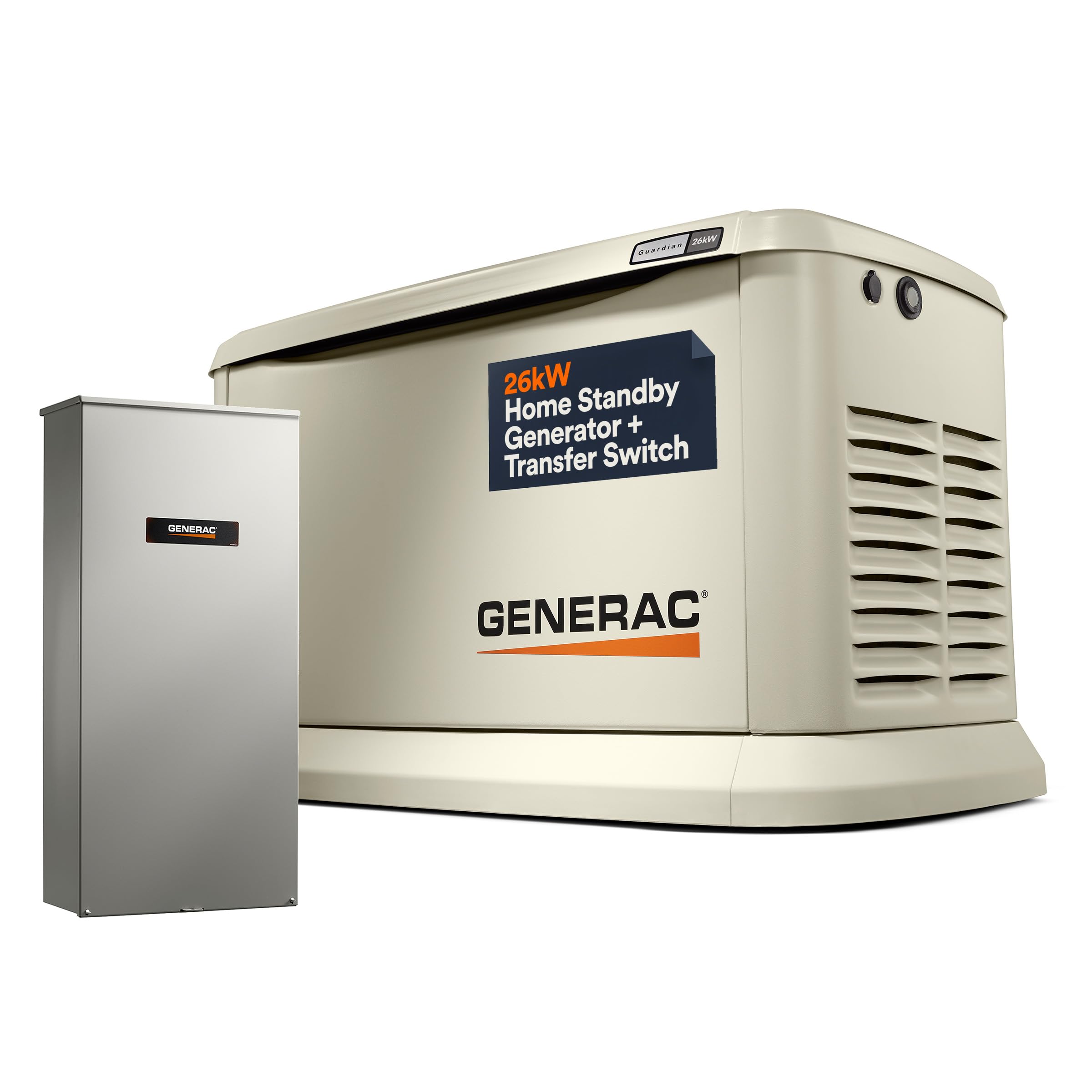
2. Generac Guardian 26kW Home Generator with Transfer Switch
A pad-mounted 26,000-watt standby that starts itself through a 200-amp transfer switch while you are asleep.
If your search started with the exact phrase in the title, this is the machine that number describes. True Power Technology puts out a clean, stable 26,000 watts with under 5% harmonic distortion, which is the threshold that keeps furnace control boards and computers from misbehaving. A 200-amp transfer switch is included in the box, so the unit can take over the whole service panel rather than a chosen list of circuits.
It draws from natural gas or LP gas, which means no refueling during a multi-day event as long as the utility line holds. The G-Force 1000 Series engine displaces 999 cubic centimeters, and the unit runs at 60 hertz — the standard US grid frequency — so your clocks and motors behave normally. Mobile Link Wi-Fi lets you check status and maintenance alerts from your phone while you are away from home.
Size it before you buy: 48.5″L x 25.1″W x 28.6″H on its pad, and this is not a weekend DIY job. Generac itself recommends a certified and licensed electrician for installation, and the gas connection is a separate trade. If you accept those two realities, you get a permanently installed, weather-enclosed unit backed by a 5-year limited warranty — the least fuss in this entire list once the work is done.
The 26kW promise, honestly: the number is real and continuous, and the included 200-amp switch means the whole panel can transfer — not just a sub-panel of chosen circuits.
The install bill is the real cost: it needs a licensed electrician and a gas connection before it does anything. That labor can rival the machine, and it is the one thing this pick cannot hide.
Best fit: a homeowner who wants to do nothing during an outage — no cords, no fuel runs, no cord-bundle anxiety.
Think twice if: you are in a rental or cannot commit to a pad, a gas line and a permit.
3. EF ECOFLOW Smart Home Panel 2

Not a generator — the switchboard that lets your battery bank take over in 20 milliseconds.
Here is the part most shoppers miss: this is the hub, not the power source. The Smart Home Panel 2 is a 12-circuit sub-panel that sits between your main panel and your EcoFlow batteries, so the circuits you care about keep running when the grid drops. Switchover happens in 20ms, which is fast enough that your fridge compressor and modem barely notice.
Owners praise the build: a steel sub-panel with a marking-off template, not a plastic box. Installation wins solid praise too, because a competent electrician has a familiar job here: the panel is 24.8″L x 14.9″W x 6.7″H and weighs 40 pounds, with a marking-off template included to line up the cutout. Pair it with up to 3 plug-and-play inverters and 15 stackable 6kWh batteries, or with 3 DELTA Pro 3 units and 6 extra batteries for 36kWh of storage.
The honest friction is that reliability and value both cut both ways here. Some buyers report the system works exactly as advertised for years, while others describe units that fail or batteries that stop charging, and a chunk of buyers question whether the price matches the experience. That split is the reason to buy it as part of a complete EcoFlow plan rather than as a lone experiment. It also requires professional installation before operation, so the box sits idle until an electrician is booked.
The argument for it
- 20ms automatic switchover means no manual breaker flipping in the dark
- 12 circuits at 120V, or 6 at 240V, chosen before the outage happens
- Backup Reserve, Self-Power, Scheduled Tasks and TOU modes in the app
- Scales to 36kWh when paired with DELTA Pro 3 and extra batteries
The honest friction
- Reliability feedback is genuinely mixed — some units fail, others run fine
- Needs professional installation before it does anything at all
- Batteries and inverters are sold separately, so the hub is only step one
Worth it when: you are already committed to the EcoFlow battery ecosystem and want the outage handled automatically.
Not your pick if: you want a single box that both generates and stores power.
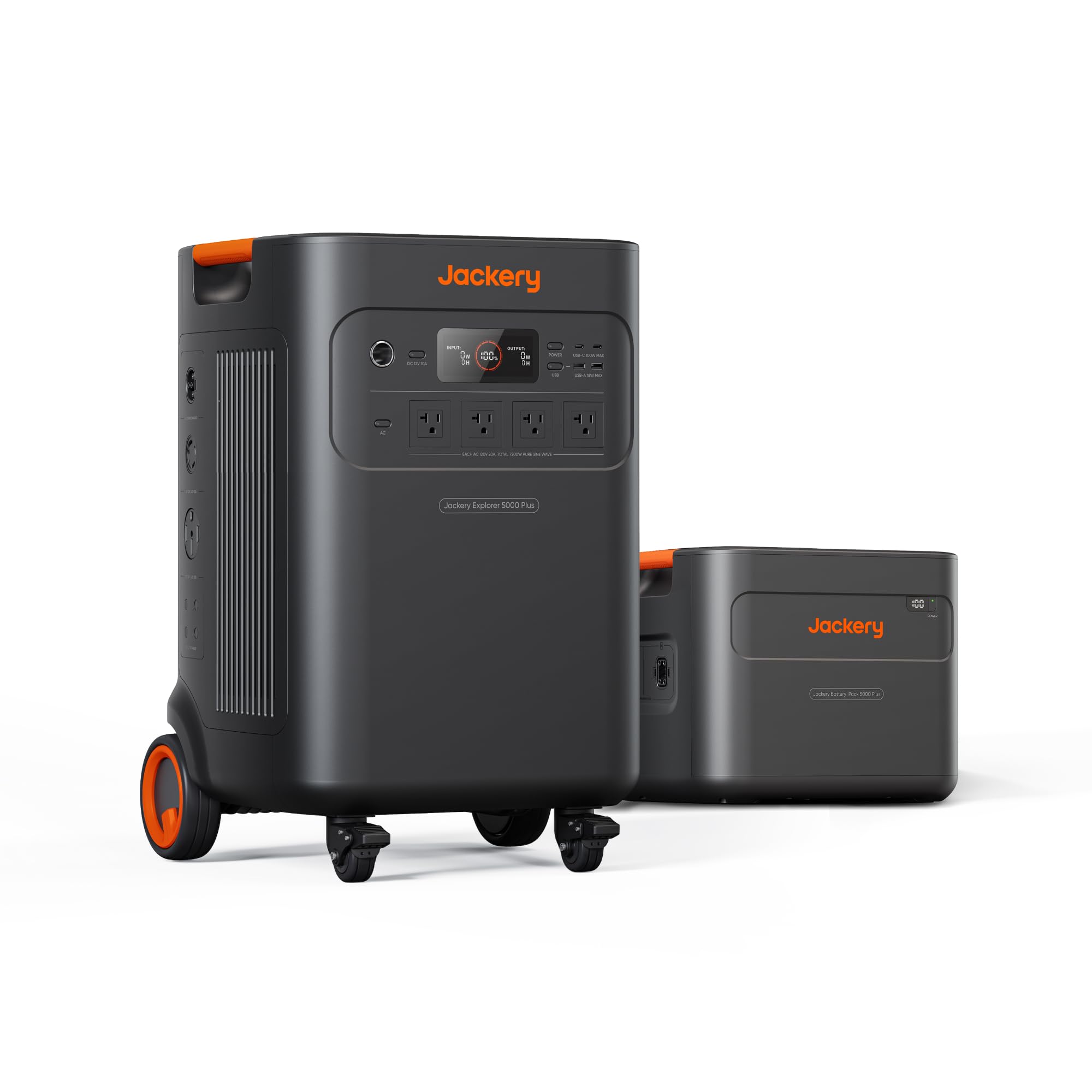
4. Jackery Solar Generator 5000 Plus with Extra Battery
Wants to run the five-ton AC and the water heater — and it gets closer than any other battery here.
Most battery systems tap out when the compressor kicks on. This one rates 7200W continuous with 14,400W of surge, and it supplies both 120V and 240V so a 5-ton AC or a water heater is on the menu. That 7200W is double the 3600W of the HomePower 3600 Plus above, and the 5040Wh base capacity is the bigger pack — expandable up to 60kWh if you keep adding batteries.
The LiFePO₄ cells are the durable, heat-tolerant chemistry, and the maker rates them for up to 11 years of daily cycling. Solar input tops out around 4000W and pulls the pack from empty to full in about 2 hours. Add the Jackery 60A Smart Transfer Switch and it can feed up to 12 circuits at 120V, or 6 circuits at 240V, so your chosen essentials stay live without extension cords across the kitchen floor.
Two things to plan around. At 216 pounds it is a stay-put unit — the wheels help, but you are not carrying it up stairs. And the extra battery adds physical bulk and cost, so budget for the full stack rather than the base unit. For a home that wants solar-fed, fuel-free backup with enough headroom for central air, this is the most capable battery pick on the list.
Where it beats the rest: 7200W continuous with a 14,400W surge ceiling is what lets big compressors start without tripping the unit — a limit most battery systems hit.
The catch: at 216 pounds, this is fixed equipment with wheels, not something you roll out for a tailgate. Plan where it lives.
Choose this one if your outage plan has to include a central air conditioner or electric water heater and you have a sunny spot for panels.
Pass on it if you want something you can toss in a truck bed for camping.
5. Westinghouse 28000 Peak Watt Tri-Fuel Home Backup Generator

Runs on gas, propane or natural gas — and starts from a key fob across the yard.
Three fuel options on one frame is the reason to look here. Gasoline gives you 20,000 running and 28,000 peak watts, and the same 999cc engine will accept propane or natural gas when supply is easier to come by. That flexibility matters in a regional outage when gas stations are dry but the propane tank on the patio is full. A 17.2-gallon gas tank carries you through long stretches without a refill run.
Under 5% THD keeps the waveform clean enough for phones, computers and TVs, and copper windings run cooler than aluminum. The engine uses full-pressure lubrication plus an automotive-style oil filter, which is the maintenance detail that separates long engine life from a short one. Automatic low-oil shutdown and a CO sensor that kills the unit on improve carbon monoxide are both standing in your corner.
On performance, owners agree it carries a whole house and then some. The caution is reliability: some owners mention it works like a champ, others report random shutdowns, so buy it where service and warranty support are easy to reach. And at 557 pounds, get used to the wheelbarrow-style wheels and foldable steel handle, because you are not carrying this anywhere. Pair it with the WATS200 automatic transfer switch (sold separately) and it starts itself.
What it brings to an outage
- Tri-fuel flexibility: gasoline, propane or natural gas on one engine
- 20,000 running / 28,000 peak watts on gasoline
- Remote start and push-button start, no pull cord in the rain
- CO sensor and automatic low-oil shutdown built in
What to weigh first
- 557 pounds — heavy even with the wheels and foldable handle
- Reliability feedback splits between flawless and shutdown-prone
- The WATS200 switch for automatic backup is sold separately
Made for: the household with uncertain fuel supply that wants one engine to handle whatever is available.
skip it if: you want set-and-forget standby — the auto-start depends on an extra switch you buy separately.
6. Westinghouse 28000 Peak Watt Home Backup Portable Generator
The gasoline-only twin that trades fuel flexibility for a lower entry point.
Same 999cc engine, same 20,000 running and 28,000 peak watts on gasoline, same 50A and 30A outlets ready for an interlock kit or a manual transfer switch. The difference is fuel: this one runs gasoline only. If you already have a fuel plan and you do not need propane, that is not a loss — it is a simpler machine with fewer things to go wrong.
Owners describe it as relatively easy to roll around on its heavy-duty wheels for a unit this size, and the electric start with auto choke fires it up without a wrestling match. Under 5% THD, copper windings, automatic low-oil shutdown and a CO sensor are all here, backed by a 3-year limited residential warranty and lifetime technical support. At 541.1 pounds it is marginally lighter than the tri-fuel version, which makes the wheelbarrow handle a little more welcome.
Buyers weigh it against whole-house Generac systems and come away happy with the spend. The trade-off you should expect is the same mixed reliability picture that dogs big portables — some run flawlessly for seasons, a few shut down after a few minutes of load. Buy it from a source that honors the warranty, run it on a schedule so a stale-fuel surprise never happens mid-outage, and it does the job.
The straightforward case: full-size home backup output with a manual transfer switch and interlock, and no premium for fuel options you will never use.
What it costs you: it is gasoline only, so fuel runs are part of your outage routine — plan cans and stabilizer before the storm, not after.
Best value match: anyone who needs 20,000 running watts and already keeps a stocked fuel supply.
Wrong pick if: your long-term plan is natural gas through a permanent connection.
7. Honda EU7000iS Inverter Generator
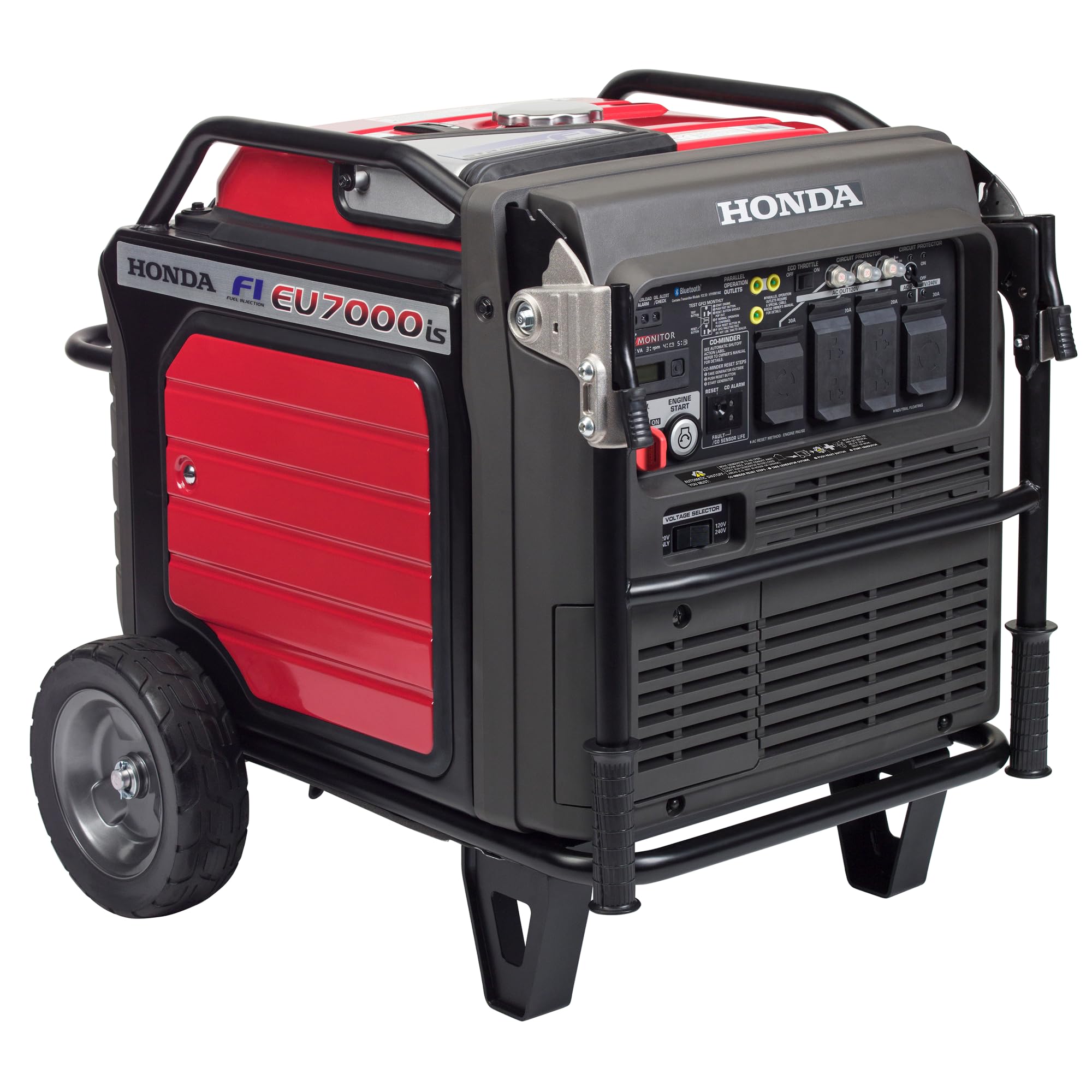
At 52–58 dB(A), it is quiet enough to run overnight under a bedroom window.
If a sleeping household and an open bedroom window are non-negotiable, start here. The EU7000iS runs at 52 to 58 dB(A) — measured sound pressure — which the maker compares to less noise than a normal conversation. On a quiet suburban street that is the difference between a generator you can tolerate overnight and one that has the neighbours texting you at 2 a.m.
Getting through the night also depends on run time: 5.1 gallons of gasoline carries it for 6.4 to 16 hours, and the Eco Throttle System (a feature that slows the engine to match the load) cuts engine speed instead of roaring at full tilt. Inverter technology (which converts engine power into steady, clean electricity) supplies power clean enough for computers. It delivers both 120V and 240V, so a manual transfer switch setup (a switch you flip by hand to feed house circuits) works. The My Generator app adds remote start, monitoring and service reminders over Bluetooth.
Two limitations to own up front. Output is 7000W, well short of the 20,000 running watts the big Westinghouse portables deliver, so this carries essentials rather than the whole house. And it is not available in California, where the EU3200IAC2 is the alternative. The My Generator app and the CO-MINDER shutdown, which cuts the engine before carbon monoxide builds near a home or camper, are the details that make this feel engineered rather than assembled. A 3-year residential warranty covers it from top to bottom.
Why it earns the premium
- 52–58 dB(A) makes overnight running realistic
- 6.4 to 16 hours on a 5.1-gallon tank with Eco Throttle
- Inverter output and 120/240V support for sensitive loads
- CO-MINDER auto-shutdown and Bluetooth app control
Where it stops short
- 7000W is essentials-only, not a whole-house load
- Not sold in California
- Gasoline fuel only, so refuelling is on you
The right buyer: someone whose outage plan centres on a quiet night, a running furnace and a charged phone — not central air.
Look elsewhere if: you need to carry the whole panel, or you live in California.
Know the Specs
Running watts vs peak watts
Running watts is what the machine can hold indefinitely; peak watts is a brief surge for motor startup. A unit marked 20,000 running / 28,000 peak is a 20,000-watt generator for planning purposes. Motors like a well pump or furnace blower can draw several times their label rating for a second or two, which is why the peak figure exists at all.
THD (total harmonic distortion)
THD measures how far the AC waveform strays from a clean sine wave. Under 5% is the common bar for sensitive electronics — furnace boards, computers, TVs. Inverter generators and battery stations tend to hold low THD tightly; a conventional port generator may not, which matters when the furnace is the thing you are protecting.
kWh and Wh for battery systems
A battery system is measured in watt-hours or kilowatt-hours, not watts. 3584Wh means the pack holds that much energy, so a 3600W load drains it in roughly an hour and a lighter load stretches far longer. Expandable capacity — to 21kWh on one unit, or 60kWh on another — determines how many days you can ride out an outage.
Transfer switch and interlock
An automatic transfer switch starts the generator and flips your home over without you touching anything. A manual transfer switch or interlock kit does the same job by hand. Standby units typically include the switch; portables often need one bought separately, which is a real line item to plan for.
Common Questions
Is 26kW enough to run a whole house?
What is the difference between a standby generator and a portable one?
Does a tri-fuel generator really run on natural gas?
Can I run a generator indoors or in a garage?
How long will a home generator run on one tank?
Do I need a licensed electrician to install a home generator?
What does THD under 5% actually protect?
Is a battery system better than a generator during an outage?
Can a portable generator connect to my home’s electrical panel?
How much maintenance does a 26kW generator need?
The Bottom Line
For most homes, the 26kw home generator decision lands on the Generac Guardian 26kW, because it is the one unit that genuinely delivers 26,000 continuous watts. It also includes the 200-amp transfer switch (the panel gear that switches your house from grid to generator) and starts itself on natural gas or propane while you sleep. If you cannot commit to a pad and a gas line, the Jackery HomePower 3600 Plus is the practical substitute: 3600W, silent, and light enough at 77.2 pounds to roll into the garage. And if overnight noise is the deciding factor, the Honda EU7000iS at 52 to 58 dB(A) (a decibel rating, where normal conversation sits around 60) is the one that lets everyone sleep. Whichever way you go, size for running watts first and peak watts second — that single habit is what keeps the lights on.
How we choose
We do not accept paid placement. Every pick is matched to a real buyer and a real use-case; we do not hands-on test units.
Sources
Specifications: manufacturer listings and product documentation. Review insights: verified customer reviews, as of November 2026. Pricing: not shown on this page (it changes often); check the current price via the retailer link.
As an Amazon Associate, My Heart Lives Here earns from qualifying purchases. This does not affect which products we feature.