Heads up: This post contains affiliate links. As an Amazon Associate I earn from qualifying purchases, at no extra cost to you. Learn more
Specs are compiled from manufacturer listings and verified buyer reviews and can change over time — please confirm the key details on the product page before buying.
If you are hanging a 24 x 36 print, the frame is not the decoration — it is the thing that either protects the print or ruins it. The single most important decision is whether the front pane is real tempered glass or a plastic sheet, because that one difference decides how sharp your artwork looks and how long it survives. Below you get six frames that genuinely hold a 24 x 36 with a mat, sorted by what each one is actually good at, so you can stop comparing and start hanging.
This guide is built by comparing the manufacturers’ published specifications and the patterns across verified customer reviews, so you get each pick’s real strengths and trade-offs instead of marketing spin.
Here is everything worth knowing before you commit to a 24 x 36 frame with mat.
Top Picks

How To Choose The Best 24 X 36 Frame With Mat
A 24 x 36 frame is a big piece of real estate on your wall, and the wrong one announces itself immediately — a wavy plastic pane, a mat that crops the edges of your print, or corners that open up after a month. Here is what actually separates a frame you keep from one you replace.
Start With The Pane, Not The Border
The front sheet is what your eye looks through every day. Real tempered glass stays perfectly flat and keeps the print crisp edge to edge. A polystyrene or plexiglass cover (a clear plastic sheet) is lighter and safer to ship, but it can flex and pick up fine scratches. On a print with fine detail or dark, even tones, a glass pane keeps edges sharp and reflections even where plastic softens both.
Worth knowing: tempered glass is heat-treated so it breaks into small blunt pieces rather than long shards. That matters at 24 x 36, where a large pane of ordinary glass can shed long shards if it breaks.
Understand What The Mat Actually Does
A mat is the cardboard border between your artwork and the frame edge, and it changes the visible size of your print. Most listings state that the visible opening runs about half an inch smaller than the print, which is deliberate — it stops the photo from sliding and dropping through. So a 24 x 36 frame with a mat for 20 x 30 gives you a wide border around a smaller image. A 24 x 36 frame that shows the full 24 x 36 without a mat is the poster route. Decide which look you want before you buy, because the mat is often the whole point of the frame.
Check How It Hangs Before It Arrives
Large frames fail at the hanging stage more often than anywhere else. Look for pre-attached hangers or included wall hardware, and check whether the frame is listed for both horizontal and vertical mounting. A 24 x 36 hung vertically on a narrow wall needs a different anchor point than the same frame lying wide over a sofa. Also check the backing system — turn buttons and slide-in backs make swapping a print a two-minute job, while a spring-action back means you press a clip to release the panel.
Match The Material To The Room
Solid oak, maple, walnut and aluminium all behave differently over years. Wood frames bring warmth and visible grain, and a mortise and tenon joint (where one piece of wood slots into a cut pocket in another) is the traditional sign of a corner built to stay tight. Aluminium brings a thin, modern profile and never warps. Plastic profiles are the budget route and can look surprisingly sharp in a high-gloss finish, but they will not take a knock the way wood does.
Weigh The Weight Before You Drill
A large glass-and-wood frame is a heavy object, and that weight has to go into a stud or a proper wall anchor. That is why two frames with identical outer dimensions can feel like completely different objects once you lift them. If you rent, or you are hanging on drywall with no stud where you need one, factor in a proper anchor before the frame goes up.
Side-by-Side Comparison
| Model | Best For | Frame Material | Front Pane | Listed Outer Size | Amazon |
|---|---|---|---|---|---|
| Homeforia 4×6 Mortise & Tenon Oak★ Best Overall | Small prints in real wood | Oak Wood | Tempered Glass | 6″L x 4″W | Amazon |
| MCS Everline 28×40 Matted to 24×36Best for Big Posters | Big posters on a budget | Plastic (PVC) | Polystyrene | 28″L x 40″W | Amazon |
| upsimples 24×36 Poster Frame | Light, clean gallery walls | Plastic | Plastic cover | 36.8″L x 24.8″W | Amazon |
| FLYJOE 24×36 Metal Frame | Slim modern framing | Aluminum | Tempered Glass | 36″L x 24″W | Amazon |
| Heimlove 24×36 Natural Maple | Handmade natural wood look | Wood | 2 mm tempered glass | 24″L x 36″W | Amazon |
| RICHFOCUS 27×40 Solid Walnut | Statement fine-art framing | Solid black walnut | 2 mm tempered glass | 40″L x 27″W | Amazon |
Detailed Reviews
1. Homeforia 4×6 Mortise & Tenon Natural Oak Picture Frame
Our pick — 4.5+★ from 600+ verified ratings; the strongest balance of quality and price.
Solid oak, real glass, and a joint most frames at this size never bother with.
This is the pick that proves a frame does not need to be huge to be built properly. It holds a 4 x 6 photo with the included white mat, or a 3 x 5 print, and it does it inside a frame with a 6″L x 4″W outer footprint. That is a genuinely small desktop piece — which is exactly why the comparison line at the top of this guide matters. Against the RICHFOCUS walnut frame at 40″L x 27″W, this Homeforia is a desktop ornament while that one is a wall statement, so read the dimensions before you assume they compete.
What wins people over is the value: the oak is real wood with visible grain and warm tone, not a printed veneer, and the front is genuine tempered glass rather than a plastic sheet. The corners are built with mortise and tenon joinery — one piece of wood slots into a cut pocket in the other — which is why the frame reads as furniture rather than packaging. It arrives with the wall kit included, mounts on a tabletop or the wall, and the back is medium density fiberboard (a dense pressed board that stays flat). For a bedside table, a desk, or a small entryway cluster, that is a lot of frame for an entry-level price.
The honest catch is scale. At 6″L x 4″W overall, this will not hold your 24 x 36 poster and it will not anchor a big wall — it is a small-format piece by design. Set your expectation to snapshot framing and this one is close to faultless. Expect it to frame a gallery wall of a dozen, and you have bought the wrong size. Its 4.5+ rating across 600+ ratings is the highest-rated record in this lineup.
What earns the top spot
- Real solid oak with visible grain and a warm finish, not a printed wrap.
- Tempered glass front instead of a cloudy plastic pane.
- Mortise and tenon corners — the traditional joint that keeps a frame square.
- Wall kit included, and it stands on a tabletop or hangs.
Where it stops
- A 6″L x 4″W outer size means small prints only — no 24 x 36 display.
- One frame per pack, so a gallery wall means buying several.
Reach for this if: you want real wood and real glass around a small print, at an entry-level tier.
Look elsewhere if: your artwork is 24 x 36 or 20 x 30 — this frame physically cannot hold it.
2. MCS Everline Poster Frame, 28×40 Matted to 24×36, Black
A 28 x 40 shell that drops down to a true 24 x 36 the moment you use the mat.
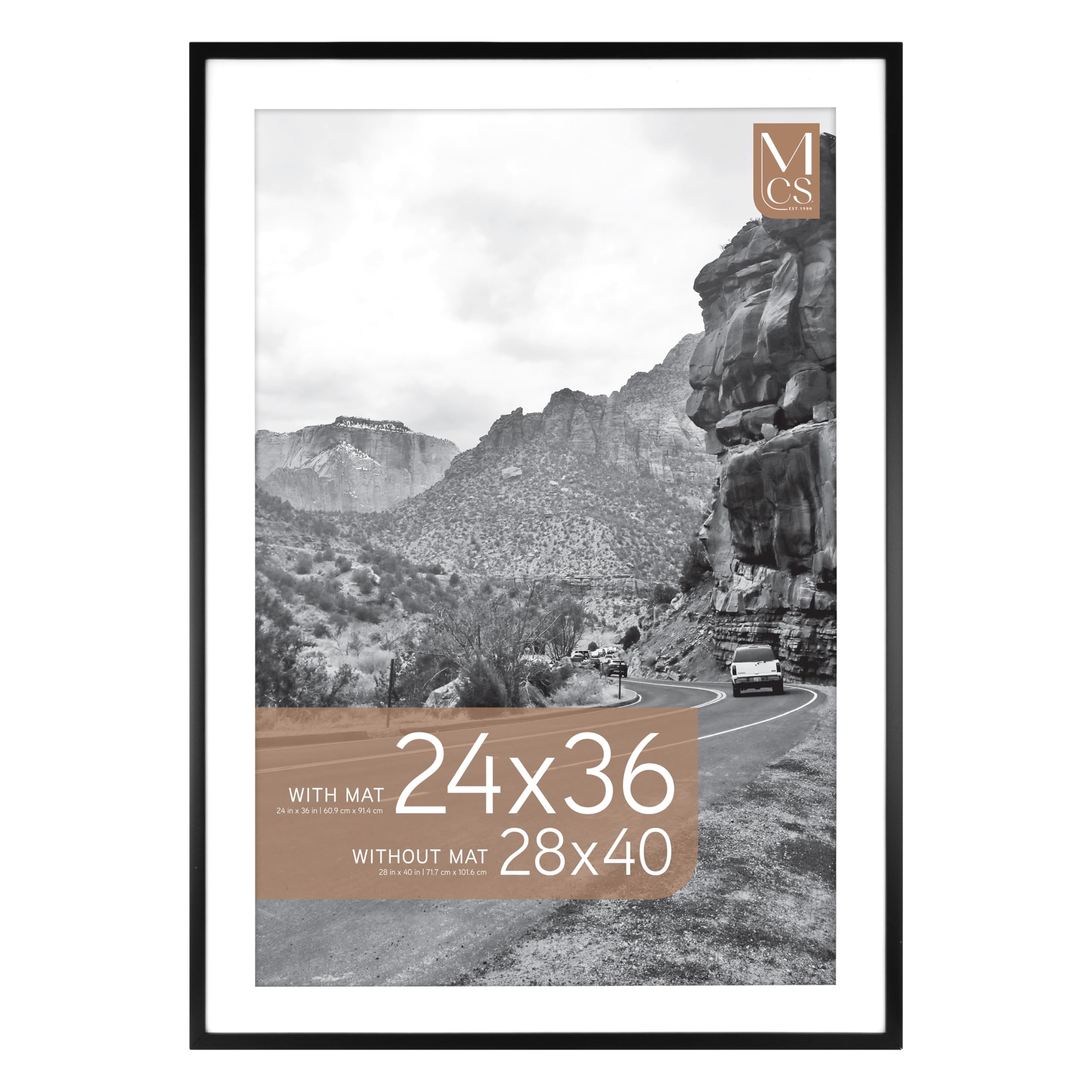
Here is the one that answers the question this whole guide is built around. The MCS Everline is a 28 x 40-inch frame, and the included mat brings the visible opening down to a 24 x 36 display. That extra mat border is what makes a 24 x 36 print look intentional on a wall instead of just big. The listing notes the mat is slightly reduced by 0.5 inches to keep the photo from shifting, so expect a hair of the image tucked behind the border — normal, and it is what stops the print sliding out of place.
The profile is PVC with a high-gloss black finish, the front is polystyrene (a clear rigid plastic sheet), and the backing is lightweight MDF. That combination is why this frame goes up without a fight — turn buttons open the back, the print slides in, and the pre-attached hangers take it horizontally or vertically. If your plan is a gallery wall of several large posters rather than one precious print, the light weight is an advantage, not a shortcut. It also explains why a frame this big does not demand a helper on hanging day.
Be clear-eyed about the pane. Polystyrene is plastic, not glass, so it will pick up surface marks over the years and it will never have the dead-flat clarity of a tempered pane. For a bright graphic poster at normal viewing distance that is fine. For a dark, detailed photographic print hung low where people lean in, the glass frames further down this list will serve the image better. That is the trade for the light weight and the accessible tier.
Where the value sits: the mat is included, the size is genuinely large, and the swap-out routine is as quick as it gets — a print change takes a moment, not an afternoon.
The honest limit: plastic front pane and a plastic profile mean this is a display frame, not an heirloom one. Weigh that against what you are framing.
Best matched to: big graphic posters, gig prints and kids’ art that will be swapped more than once.
The one caveat: a plastic front will never read as glass under a lamp — if clarity is the goal, keep reading.
3. upsimples 24×36 Poster Frame Black 1 Pack

The lightweight workhorse for anyone hanging a stack of posters on one wall.
If you are framing four or five prints at once, the maths changes completely, and this is where the upsimples earns its place. It is a 24 x 36 poster frame that takes a 20 x 30 print with the mat in, or a full 24 x 36 print without it. The display area runs about half an inch smaller than the print by design, so the artwork stays put instead of bowing out of the frame. Bursting at 36.8″L x 24.8″W overall, it is the widest listed outer footprint in this lineup — worth measuring your wall gap before it ships.
The practical wins are the ones you use every time you change what is on display. The backing releases with a spring-type action, so you press and lift rather than unscrew anything. Then it hangs horizontally or vertically off the same frame. Protective packaging is part of the design brief here too, which matters on a frame this large — a big plastic profile arriving creased is the usual failure mode on budget poster frames.
The honest trade is the pane, and it is worth naming plainly. The cover is plastic, not glass, and the frame profile is plastic too. That is what keeps it light enough to hang on a single hook and cheap enough to buy in multiples. Some corners of that plastic cover can arrive stressed or cracked, so open the box and check before the return window closes. Treat it as a good-looking display frame at an entry-level tier and it will do exactly its job.
The reason to pick it: light weight plus a spring-action back makes this the least fussy frame here to re-hang, which is why it suits rotating poster walls.
The reason to pause: a plastic cover in a big size rewards careful unpacking — inspect the corners on arrival.
Reach for this if: you want several large prints on the wall without a heavy anchoring job.
Look elsewhere if: you want a glass front against a detailed photo print — that is a higher tier.
4. FLYJOE 24×36 Metal Picture Frame
An aluminium edge so thin the artwork does the talking instead of the border.
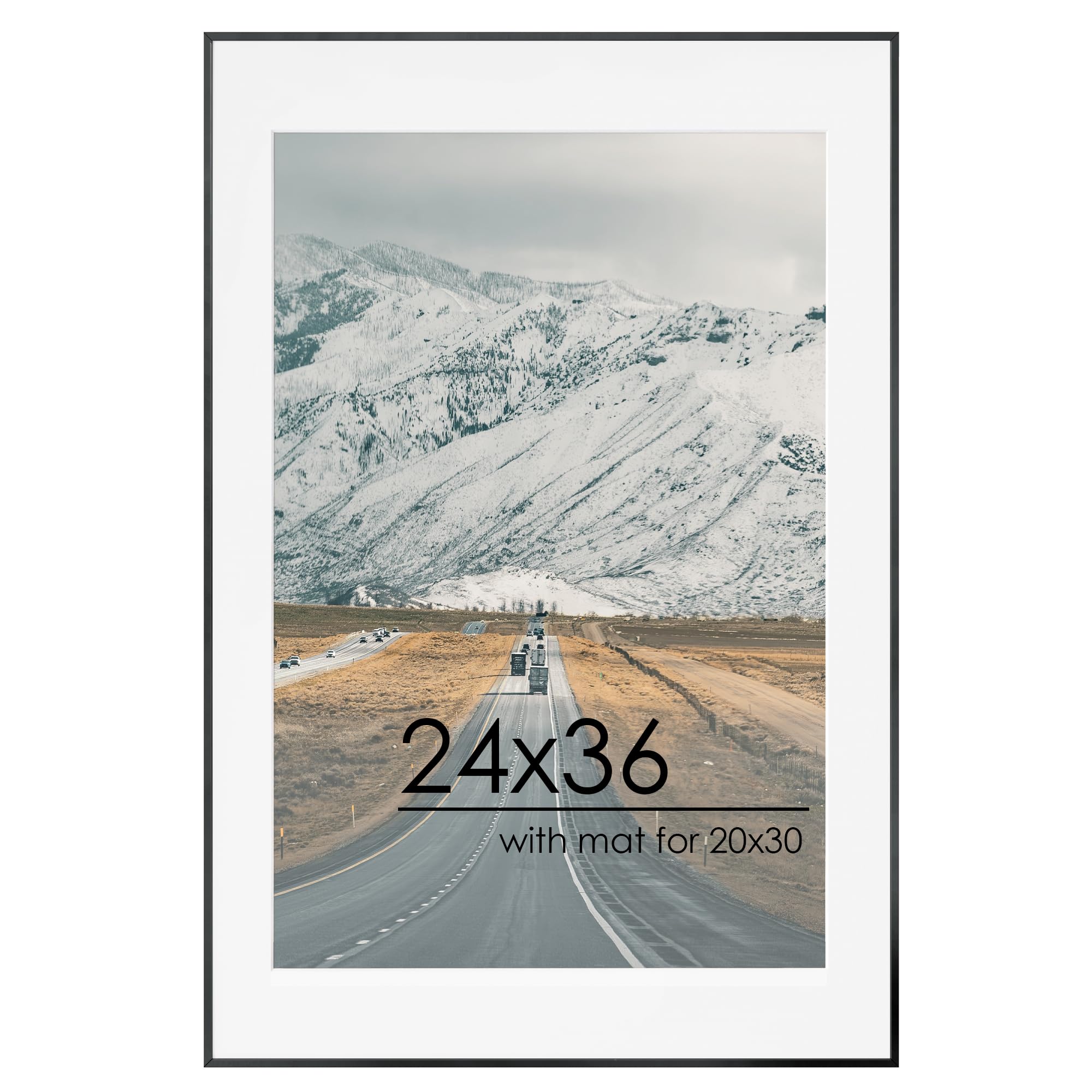
Serious framers talk about molding width the way cyclists talk about frame weight, and this is where the FLYJOE separates itself. The molding — the visible border width — is 0.3 inches, thin enough that the frame almost disappears and the print reads straight to the edge. Wrap that around a genuine tempered glass front with a polished edge, and you get the flat, glassy surface most poster frames in this tier simply do not offer.
The size flexibility is the part that quietly solves a lot of problems. Display a full 24 x 36 with no mat, or use the included mat for a 20 x 30 print. The measurements are stated plainly: a 19.5 x 29.5 visible area with the mat, and 23.5 x 35.5 without it. Note that half-inch shrink — it is intentional, and it is what stops a print from dropping through the opening. The overall frame measures 36″L x 24″W, mounts to wall or tabletop, and ships with hanging hardware and clip fasteners.
Now the part a careful buyer should hear. The hanging system on this one draws genuinely mixed reactions, with buyers finding it awkward enough to fight with, so budget a few extra minutes and read the hardware before you climb the ladder. The tempered glass is another point to respect: it is glass, and a handful of deliveries have arrived with damage. Inspect it in the box before it goes anywhere near a wall. Neither issue undermines what the frame is, but both change how you should receive and install it.
What makes it a finalist
- A 0.3” molding that keeps the focus on the artwork.
- Tempered glass with a polished edge instead of a plastic pane.
- Two display sizes from one frame — full 24 x 36 or 20 x 30 with the mat.
- Aluminium profile that will not warp over years.
What to plan around
- The hanging hardware gets mixed reports — read it through before mounting.
- Glass can arrive damaged, so check the pane on delivery.
Built for: modern interiors where a chunky wood border would fight the room.
Check first: the hanging kit and the glass on arrival — both need a look before you commit to wall.
5. Heimlove 24×36 Picture Frame Natural Maple
No two of these are the same piece of maple, and the maker says so deliberately.
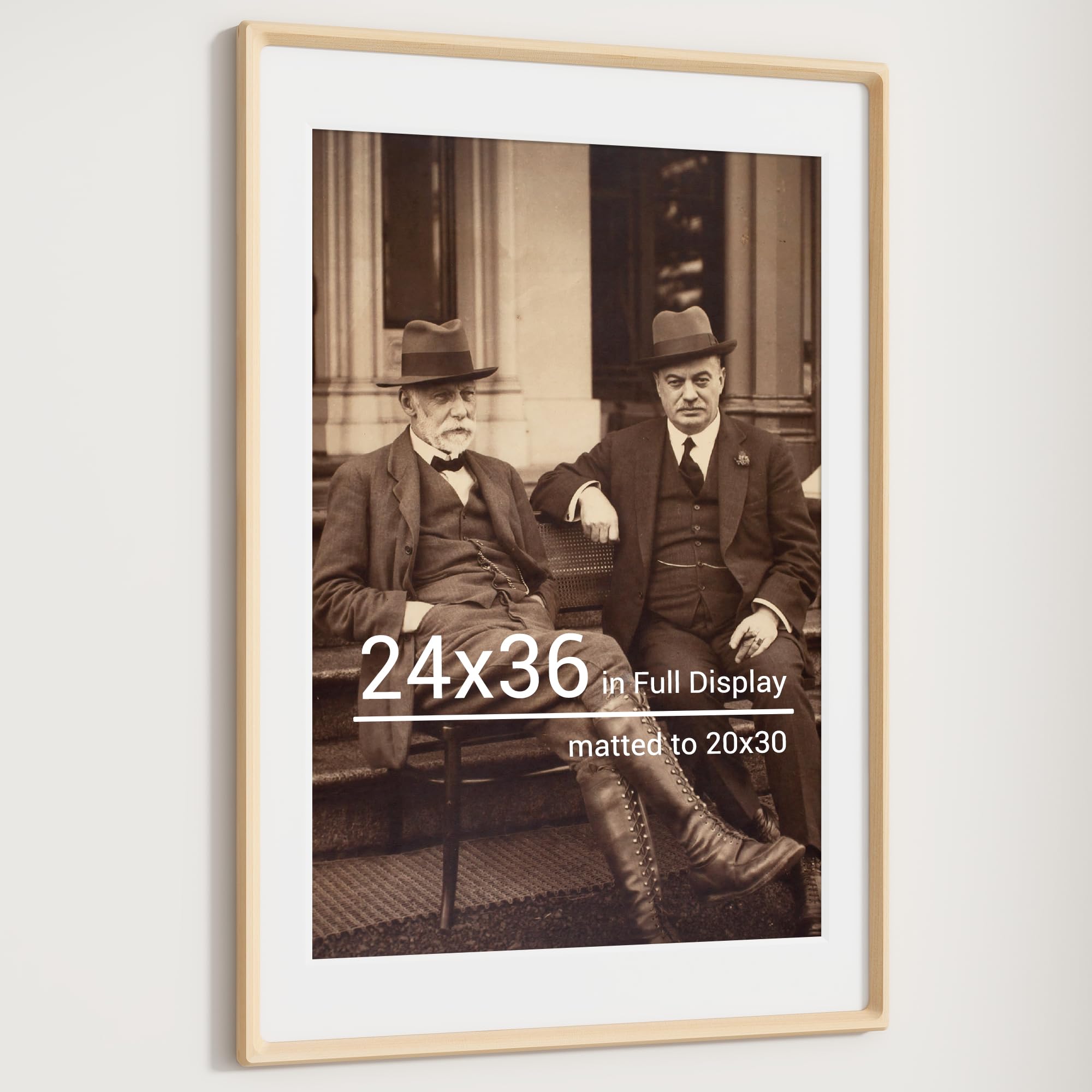
Most framed prints hang in a row and look like a set. This one is built on the opposite idea. The frame is natural maple wood with a satin finish, and because the grain comes from how the original tree grew, each frame carries its own pattern and colour variation. The maker states plainly that every one is unique. It holds a full 24 x 36 print with no mat, or a 20 x 30 print with the included mat, and the outer size is listed at 24″L x 36″W — proper wall-scale, not a desktop piece.
The construction claims are specific enough to check: every step from wood design and cutting through polishing and waterproof painting is described as done by hand. The front is 2 mm real tempered glass, which is the thickness that matters on a pane this size — thin enough to stay light, thick enough not to flex. Between the natural grain and the hand-finished surface, it suits a diptych or a single large print over a fireplace far better than a symmetric grid.
The catch is inherent to handmade wood. Grain and tone vary from frame to frame, which is the charm if you ordered one and a mild gamble if you ordered two expecting a matched pair. Read the finish description (matte) and the rustic styling as the design brief rather than a defect list. If you want uniformity, an aluminium or black plastic profile is the safer buy. If you want visible hand-worked grain rather than a uniform factory finish, this is the frame in this lineup built that way on purpose.
The character argument: real maple with visible grain variation plus a hand-finished surface gives a room a warmth that a uniform black profile cannot.
The gamble to accept: handmade grain is unique per frame — order two and they will not be twins.
Suits you when: one large print needs a single frame with genuine wood character.
Think twice when: you need a perfectly matched pair for a symmetric layout.
6. 27×40 Poster Frame Natural Solid Walnut Wood

Solid American black walnut, rounded corners, and a pane built to outlast the print.
The material list here is the reason this sits at the top of the tier. It is made from solid black walnut sourced in the USA, with a clear varnish finish that lets the light and dark streaks of the grain show through. The corner detail is the giveaway of quality on a frame this size: mortise and tenon joints, sanded flat, with rounded corners that are softer and safer than a sharp mitre on a big frame in a busy room.
Outer dimensions are listed at 40″L x 27″W, and the format is genuinely flexible — hang it horizontally or vertically, or stand it on a desk. That combination is rarer than it sounds on a frame this large. The glass spec is unusually well documented too: 2 mm tempered glass rated to block UV, moisture and dust, flat rather than flexing like thin plexiglass, and scratch and shatter resistant with polished edges. For a dark, detailed print where reflections and warping are the enemy, that flat pane is the whole argument.
Two things to weigh honestly. First, this is the heaviest class of frame in this lineup, and solid wood plus glass at 40″L x 27″W demands a proper anchor — it is not a single-hook job. Second, the frame has been reported to break on arrival in some cases, so open and inspect it before that window closes. Appearance is what gets praised most here, and a few buyers report some difficulty hanging it, so plan the mounting point before the box arrives.
Why it belongs here: solid walnut with visible grain, mortise and tenon corners, and a 2 mm tempered pane that stays flat — the physical build is the pitch.
The practical cost: wood and glass at this size is heavy, and heavy means a real wall anchor and a second pair of hands.
Choose this for: a single fine-art or photographic print that deserves a walnut frame and a glass pane.
Only if you can: find a stud or a rated anchor — this frame is not going up on a nail.
Know the Specs
Outer Size vs Mat Opening
The outer size is the full rectangle the frame occupies on your wall; the mat opening is what you actually see. These are not the same number, and the gap is the whole trick. A 28 x 40 frame matted down to 24 x 36 gives a wide white border around your print, while a 24 x 36 frame left unmatted shows the full image edge to edge. Most listings reduce the visible opening by about half an inch on purpose so the print cannot slide. Measure the wall, then measure what you want to see — not the other way round.
Tempered Glass vs Plastic Panes
A tempered pane is heat-treated so it breaks into small blunt pieces instead of long shards, and it stays perfectly flat across a large opening. A polystyrene or plexiglass cover is a clear plastic sheet — lighter, cheaper to ship, and safer for a child’s room, but it scratches more easily and can flex. On a 24 x 36 frame, a flat pane makes a visible difference: reflections stay even and fine detail stays sharp. Plastic is a legitimate choice when weight is the deciding factor.
Joinery and Corner Strength
Mortise and tenon is the traditional woodworking joint where one piece slots into a cut pocket in the other — a mechanical lock, not just glue. On a large frame it is the difference between corners that stay tight and corners that open as the wood moves with the seasons. Rounded, sanded corners also matter in a hallway, because a sharp mitre at this size is a real contact hazard.
Mounting and Hanging Hardware
Check three things: whether wall hardware is included, whether the frame handles both horizontal and vertical formats, and what kind of backing it uses. Turn buttons and slide-in backs let you change a print in a couple of minutes. Spring-action backs release with a press. Solid wood plus glass at this scale is heavy, so a rated wall anchor, not a picture nail, is the honest requirement.
Common Questions
Will a 24 x 36 print fit a frame described as 28 x 40 matted to 24 x 36?
What is the difference between a plastic pane and tempered glass on a frame this big?
Do these frames hang both horizontally and vertically?
Is a 20 x 30 print with a mat better than a full 24 x 36 without one?
How much weight does a solid wood 24 x 36 frame put on the wall?
Why is the mat opening slightly smaller than the print size?
Can I use a 24 x 36 frame without the mat?
Is real wood a better choice than aluminium for a large frame?
What should I check first when a large glass frame arrives?
Will a frame with mortise and tenon corners stay tight over years?
The Bottom Line
The best overall pick here is the Homeforia 4×6 Mortise & Tenon Oak Frame, because it is the only frame in this list that combines solid oak, real tempered glass and a proper mechanical corner joint without asking you to compromise on any of them. Yes, it is a small-format frame rather than a 24 x 36 — but for snapshot framing at that tier, nothing else here gets the material and the joinery right at once.
If your print is genuinely large, go to the MCS Everline for a 28 x 40 shell with a 24 x 36 mat opening, or the FLYJOE when you want tempered glass and a 0.3” aluminium border around it. For fine art that deserves solid American black walnut and a 2 mm tempered pane, the RICHFOCUS is the frame that holds the wall on its own.
One honest nudge: the Homeforia carries the highest rating in this article at 4.5+ across 600+ ratings — if your print fits its 6″L x 4″W outer size, that is the least risky buy on the page. Measure your artwork first, then pick the frame that matches its size. Each frame here is well built; the deciding factor is which outer size your print actually needs.
How we choose
We do not accept paid placement. Every pick is matched to a real buyer and a real use-case; we do not hands-on test units.
Sources
Specifications: manufacturer listings and product documentation. Review insights: verified customer reviews, as of November 2026. Pricing: not shown on this page (it changes often); check the current price via the retailer link.
As an Amazon Associate, My Heart Lives Here earns from qualifying purchases. This does not affect which products we feature.