Heads up: This post contains affiliate links. As an Amazon Associate I earn from qualifying purchases, at no extra cost to you. Learn more
Specs are compiled from manufacturer listings and verified buyer reviews and can change over time — please confirm the key details on the product page before buying.
You want firm, graduated squeeze that holds your legs through a twelve-hour shift — not a stocking that bags at the ankle or fights you every morning. That is the whole game with 20-30 mmHg compression leggings: the pressure has to be real, and it has to sit in the right place. Below are seven pairs that actually deliver firm compression, sorted by what they do best and what they ask of you in return.
This guide is built by comparing the manufacturers’ published specifications and the patterns across verified customer reviews, so you get each pick’s real strengths and trade-offs instead of marketing spin.
Firm compression only helps if you can actually get it on, so fit and donning effort matter as much as the pressure rating. Here is how the picks shake out for the 20-30 mmhg compression leggings.
Top Picks

How To Choose The Best 20-30 mmHg Compression Leggings
Firm compression is a two-part deal: the pressure has to be strong enough to do its job, and the garment has to be wearable enough that you keep it on past lunch. Most people buy on the mmHg number alone and then discover the real deciding factor is how the legging goes on, stays up, and feels against the skin.
Read the mmHg Number as a Starting Point
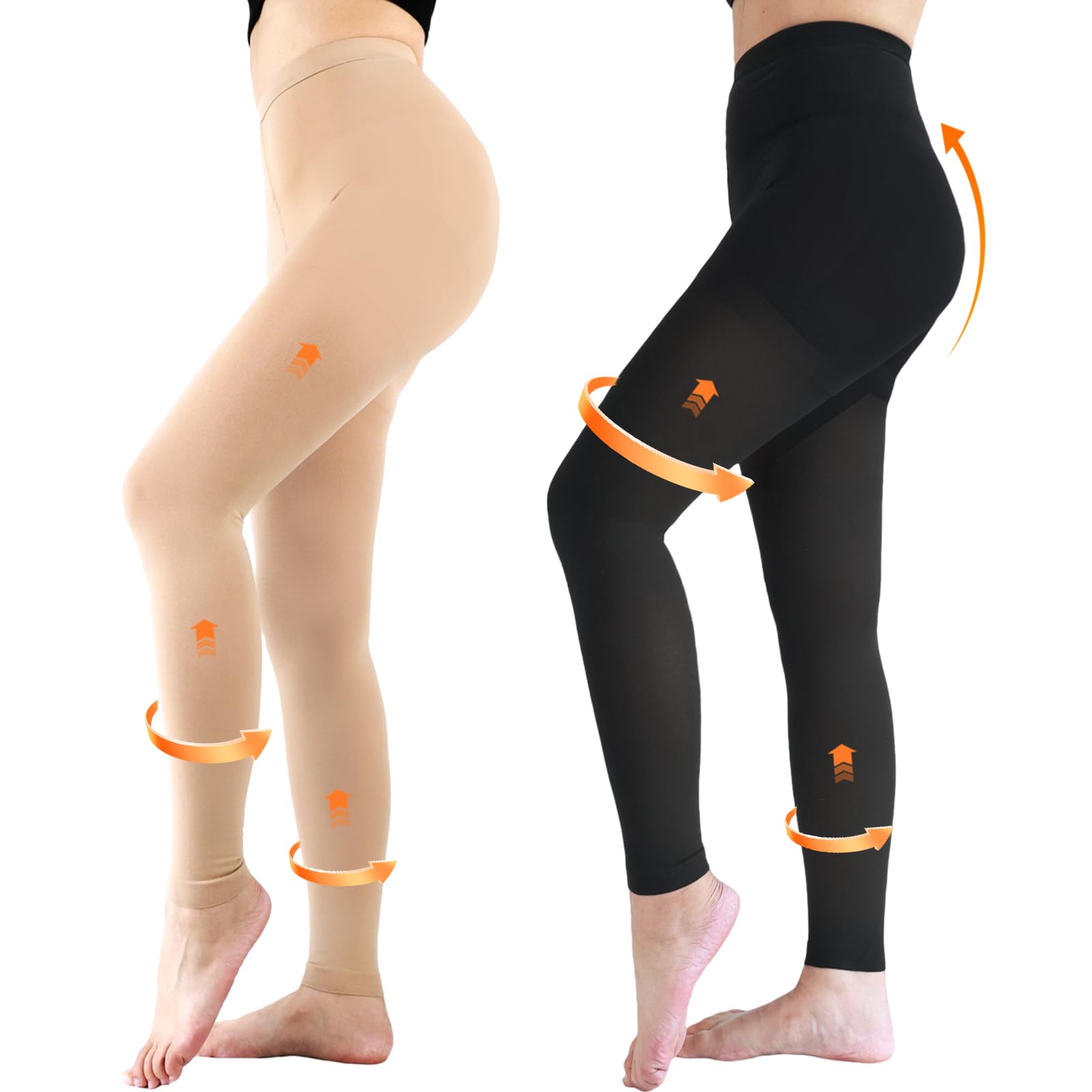
The 20-30 mmHg figure is a range, not a single pressure. Leggings in this class apply firm squeeze, and the pressure is highest at the ankle and eases as it climbs toward the thigh — that is what “graduated” means. A footless pair, an open-toe pair, and a waist-high stocking can all carry the same 20-30 mmHg rating while behaving very differently on your leg.
Footless, Open Toe, or Waist High
Footless leggings stop above the ankle so you can wear your own socks and shoes over them. Open-toe styles leave the toes free for ventilation. Waist-high stockings run all the way up for full-leg coverage. Pick the cut by where you want the squeeze to end, then confirm the sizing chart for that specific cut.
Fabric Blend and How It Goes On
Nylon and spandex blends stretch to let you pull the legging over your heel, but the tighter the knit, the more effort each morning takes. Note the material mix and the care instructions. Hand washing in a mesh bag with mild soap protects the elastic; chlorine bleach and fabric softener break it down.
Match Compression to Your Day
If you stand or sit for long stretches, firm graduated support across the whole leg is usually the priority. If you are specifically managing swelling in the lower leg, a footless or ankle-length cut may suit you better than a full stocking. Either way, check the size chart before buying — the wrong size turns firm compression into a wrestling match.
Side-by-Side Comparison
| Model | Best For | Compression Level | Style | Fabric | Amazon |
|---|---|---|---|---|---|
| Truform 20-30 Pantyhose★ Best Overall | Fashion-conscious all-day wear | 20-30 mmHg, graduated | Opaque pantyhose | — | Amazon |
| Bewzilove Medical Compression LeggingsBest Value | Good value two-pair set | 20-30 mmHg | Footless | 70% nylon / 30% spandex | Amazon |
| ABSOLUTE SUPPORT A717VV | Varicose vein support | 20-30 mmHg, graduated | Footless | — | Amazon |
| Up to 7XL Plus Size Pantyhose | Extended plus sizing | 20-30 mmHg, graduated | Open toe | — | Amazon |
| Bioflect Capri Leggings | Raised-knit micro-massage | Moderate compression | Capri | Bio ceramic knit | Amazon |
| JOBST Relief Waist High | Firm leg-fatigue support | 20-30 mmHg | Waist high, open toe | — | Amazon |
| CzSalus Flat Knit K2 | High-waist lipedema support | K2 (25-30 mmHg) | High waist, mid foot | 80% polyamide / 20% elastan | Amazon |
Detailed Reviews
1. Truform 20-30 Pantyhose
Our pick — 4.0+★ from 200+ verified ratings; the strongest balance of quality and price.
The firm stocking that hides under office wear and still squeezes like it means it.
Five separate intervals of therapeutic graduated compression is the detail that sets this one apart. The pressure starts firmest at the ankle and steps down across the leg, which is the shape you want if you are on your feet all day or parked at a desk for hours. And because it is opaque, it reads as ordinary hosiery rather than medical gear under a dress or skirt.
The crowd favorite here — 4.0+ stars across 200+ ratings — and it earns that with quality. Buyers regularly call these the best pair they have found online, crediting the graduated squeeze for easing swelling and tired legs. It is a soft, lightweight stocking for its compression class, which helps when you are already wearing it for ten or twelve hours.
Here is the honest friction: getting them on is the hard part. That is the most-discussed downside in this category, and this pair is no exception. Very tight and slightly short are the fit complaints that come up, so measure before you order and do not size down hoping for more squeeze. Treat the ankle edge gently too — that is where the knit wears first.
Where it wins
- Five graduated pressure intervals mimic the shape of a proper stocking
- Opaque finish passes as regular hosiery under workwear
- Soft, lightweight knit for a 20-30 mmHg class
- Eases swelling and leg fatigue over long standing or sitting days
What to expect
- Pulling them on takes real effort, especially first thing
- The fit runs firm — measure against the size chart
- The ankle edge is the first place the knit can wear
Reach for this if: you need firm graduated support that stays invisible under dresses and slacks.
Look elsewhere if: you want a legging you can yank on in five seconds flat — this one asks for patience.
2. Medical Compression Leggings 20-30mmHg
Two footless pairs and a nylon-spandex blend that skips the crotch-tear problem.
You get two pairs in the set, which matters because compression leggings get washed often. The 70% nylon and 30% spandex fabric is built to breathe, and the design specifically targets the two weak spots on any compression legging: slipping at the waist and tearing at the crotch. The footless cut means your socks and shoes go on over the legging, so you keep your own footwear.
What works for buyers is that it does its job without drama. Buyers consistently praise the 20-30 mmHg squeeze and call the leggings comfortable through a full day. Leg relief is a recurring theme, with the graduated squeeze doing the work from calf to thigh. The fabric reads soft against the skin rather than scratchy.
Two things to plan around. First, the fit splits: some wish the medium ran longer in the leg, so check the size chart rather than guessing. Second, the fabric is on the thicker side — great for coverage, less ideal under a tight skirt in summer. Neither is a dealbreaker, just things to know before you commit to a size.
What buyers prize: this is the pair people report reaching for because the compression works and the fabric holds its shape without slipping, all in a two-pair set.
And the reality check: thicker fabric means it layers less easily under a slim outfit.
Pick it when: you want a footless legging you can rotate two pairs of through the week.
skip it if: you need the thinnest possible layer under a fitted dress.
3. ABSOLUTE SUPPORT Footless Leggings

A footless legging sold with clear guidance on when to wear it — and when not to.
The manufacturer spells out the support story here: graduated 20-30 mmHg pressure applied to the lower leg to support blood flow and ease swelling. The generous footless cut covers the leg down to the ankle, so nothing interferes with your own socks and shoes. It reads as a legging, not a stocking, which makes it easier to build into a normal wardrobe.
Care instructions are listed plainly: hand wash or machine wash in a mesh laundry bag, warm water with mild soap, and skip the chlorine bleach and fabric softener that break down elastic. They also advise against sleeping in compression garments. It is a smaller player on the review front, so the confidence comes from the spec sheet, not a wall of testimonials.
The thing worth knowing before you decide: the manufacturer states that the right compression level depends on your own needs and history, and if you have a circulatory condition you should talk to a healthcare professional. That is not a reason to avoid the legging — it is a reminder to size and pace yourself correctly rather than guessing.
What the spec sheet promises
- Graduated 20-30 mmHg pressure down the whole leg
- Footless design keeps your own shoes and socks in play
- Clear washing and care guidance printed by the maker
Before you commit
- Fewer buyer reviews than the bigger names, so less crowd confirmation
- The maker says a health history check should guide your choice
- Footless means no toe coverage — plan around your footwear
Suits you best if: you want a footless legging and you like knowing exactly how to care for it.
One caution: the maker recommends checking your own health history before choosing this compression class.
4. Up to 7XL Plus Size Compression Pantyhose 20-30mmHg
The extended-size pair for anyone the standard charts leave behind.
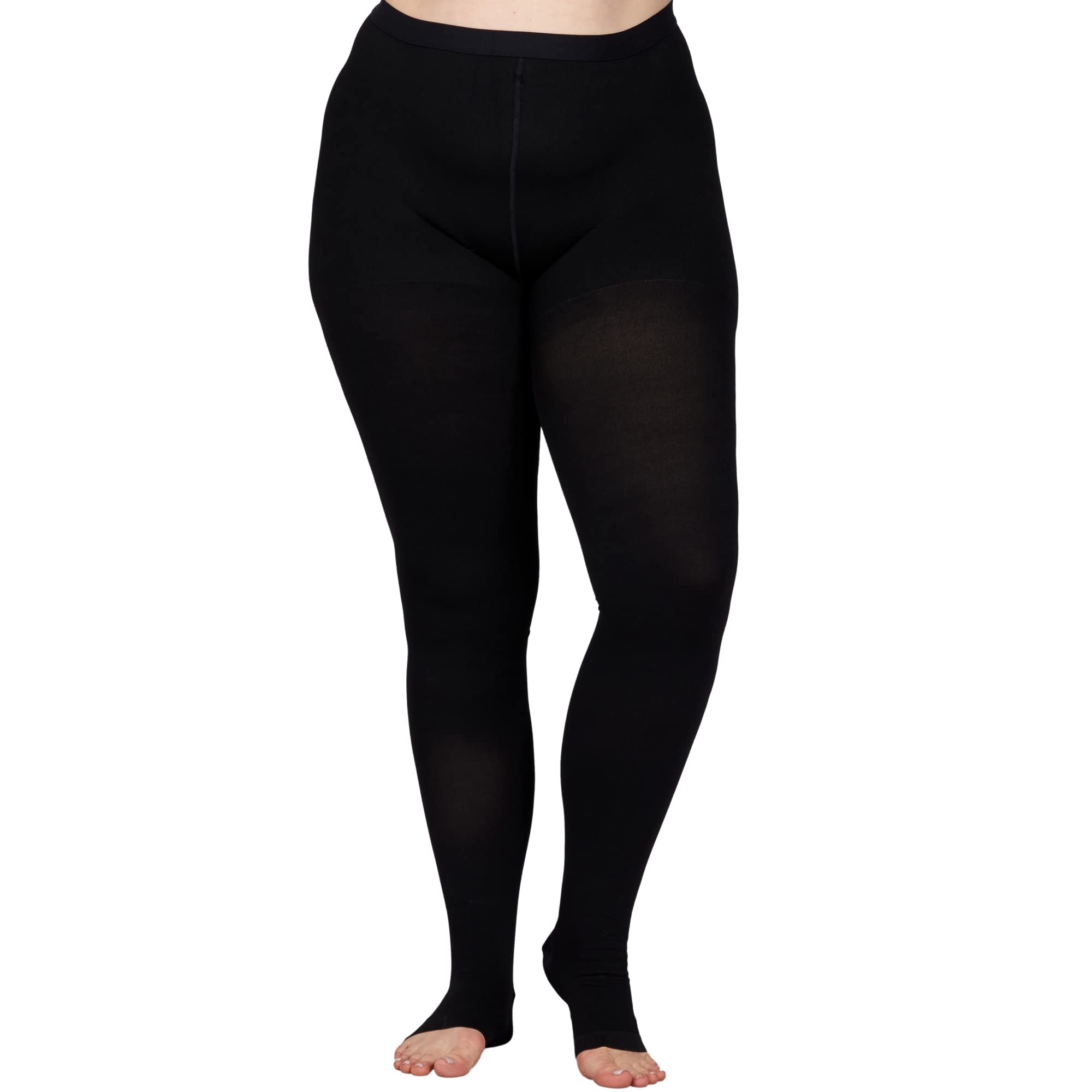
Sizing is the headline. This pair runs up to 7XL, which is the widest range in this lineup and the reason it belongs on the list. The 20-30 mmHg graduated compression is designed to support circulation and manage leg swelling and heaviness, with firm pressure for people who sit or stand for long stretches.
The cut also works overtime. The open toe keeps the foot free for ventilation and lets you wear shoes comfortably. And because the opaque finish covers like traditional tights, it slides under dresses, skirts, and workwear without announcing itself as medical gear. The maker lists nurses, teachers, and office workers among the people it suits.
One honesty note: buyer feedback here is thin, and the pair carries a lower score than the leaders, so go in with modest expectations and read the size chart carefully.
The case in one line: extended sizing up to 7XL plus an open toe and opaque finish — a practical pick for larger frames that need firm graduated support.
The trade-off: far less buyer feedback than the top names, so fit confidence is lower.
Best for: buyers outside the standard size range who still want 20-30 mmHg pressure.
Think twice if: you want the reassurance of many buyer reviews behind your choice.
5. Bioflect Capri Compression Leggings

The capri that trades bare pressure for a raised knit built to massage as it squeezes.
What separates the Bioflect is its construction, not its gauge. A raised 3D knit creates varied pressure points along the skin, so the legging squeezes and massages at the same time. The bio ceramic material is the manufacturer’s third ingredient, alongside a moderate compression level. It runs from S/M up through 7XL, which is a broad span for a premium garment.
What wins people over is quality and comfort. The leggings are praised for holding up exactly as expected, and the compression draws steady approval in a capri length that suits warmer days or underneath pants. The manufacturer positions the moderate compression for lipedema and lipo-lymphedema, with a raised knit built to conform to irregularly shaped limbs. The brand also notes discomfort is the top reason people quit compression garments — and pitches this pair as the softer route.
The catch is durability. Seams are the weak point, with the crotch seam and stitching called out as the areas that give. The waistband can also be tight or ride up depending on your shape, and pulling them on takes effort. Treat them gently, wash inside a mesh bag, and they will earn their keep — but they are a garment that asks for care.
What the raised knit delivers
- 3D micro-massage knit creates pressure points alongside moderate compression
- Available from S/M up to 7XL
- Bio ceramic fibers as the third element of the construction
- Capri length suits warm days and layering under trousers
Where it asks more of you
- Seams are the known weak point — the crotch seam in particular
- The waistband can run tight or shift on some body shapes
- Getting them on takes real effort
It is the one to pick if: you want a shorter capri with a raised knit that massages while it compresses.
And know this: the seams need gentle handling — wash in a bag and treat them kindly.
6. JOBST Relief 20-30 mmHg Waist High Compression Stockings

A waist-high stocking that reaches all the way up for full-leg firm pressure.
Where a footless legging stops at the ankle, this one runs all the way up to the waist. The open toe keeps things breathable, and the regular band is built in a waist-high cut that covers the thigh as well as the calf. The firm 20-30 mmHg pressure is what people come to this style for when they need support across the full length of the leg.
The compression is the part that earns its keep — steady 20-30 mmHg pressure that buyers report prevents leg fatigue through a long shift. It is a big brand in the compression space, and this waist-high design is one of its broader-coverage options. If you have been relying on a knee-high stocking and want more of the leg supported, this is a natural step up.
Two things temper the picture. Pulling them on is genuinely hard, and that comes up again and again. The fit is also a mixed bag: some find the waist-high band stays put while others report bunching around the knees. Give the seams extra care, and follow the size chart — waist-high stockings are less forgiving than leggings when the size is off.
What earns the spot: full leg-to-waist coverage with firm 20-30 mmHg pressure and an open toe for breathability — support that reaches the thigh, not just the calf.
What to plan for: harder to pull on than a footless legging, and the fit around the knee can vary.
Choose it if: you want firm support that reaches the thigh and waist, not just the lower leg.
Not for you if: you need something you can pull on quickly each morning.
7. CzSalus Flat Knit K2 Leggings

A high-waist flat knit built for higher-stage lipedema and lymphedema support.
The K2 designation means 25-30 mmHg, and this legging leans right into the top of that band. It arrives in a mid-foot length with a high waist, and the fabric is a flat knit of 80% polyamide microfiber and 20% elastan made in Italy. The maker builds it with a reinforced structure expressly for higher stages of lipedema and lymphedema, and the passive massage and compression are aimed at easing fluid drainage through the lymphatic system.
The lumbar compression is what people come back for. Buyers describe the K2 squeeze easing leg pain and swelling overnight and calming lipedema discomfort, and the flat knit stays soft against the skin. The high waist also helps with a problem shorter leggings cannot solve: keeping the garment up on a curvier shape.
Sizing is the thing to get right. These run small for the measurements printed on the chart, so size up rather than trusting the number you wear in regular clothing. The fabric can also develop holes after repeated wear, and getting them on takes real effort — which is normal for flat knit in this compression class. Measure, then measure again.
Why it holds the top of the range
- K2 = 25-30 mmHg, at the top of the typical firm-compression band
- High waist and mid-foot length for full coverage
- 80% polyamide microfiber and 20% elastan flat knit
- Soft texture for a garment in this pressure class
The sizing truth
- Runs small versus the printed measurements — size up
- Flat knit this firm takes effort to pull on
- Can develop holes after repeated wear
Worth it if: you need higher-stage lipedema or lymphedema support and want a high waist to keep it in place.
Size carefully: this runs small for the measurements on the chart, so order up.
Know the Specs
What 20-30 mmHg Actually Measures
Millimeters of mercury (mmHg) is the pressure unit used for compression garments, borrowed from blood-pressure measurement. A 20-30 mmHg legging applies firm squeeze, measured at its firmest point. The number is a range because the squeeze eases as it moves up the leg. Factory accuracy varies, which is why fit and sizing matter as much as the label.
Why Graduated Beats Uniform
Graduated compression is firmest at the ankle and eases as it rises toward the thigh. That gradient is what supports blood flow back up the leg. A uniform squeeze, by comparison, can pool pressure in the wrong place. When a pair advertises graduated pressure, check that the chart tells you where the pressure starts and how it eases.
Nylon, Spandex, Polyamide, and Elastan
Nylon and polyamide are the strong, smooth synthetic fibers that give the legging its structure. Spandex and elastan are the stretch fibers that let it pull on and snap back. A higher stretch percentage makes donning easier but can feel less firm. A flat knit versus a circular knit changes how the seams sit against your leg.
Footless, Open Toe, Capri, and Waist High
These describe where the squeeze ends. Footless stops above the ankle so you keep your own socks. Open toe leaves the toes free. Capri ends below the knee. Waist high runs up to the waist for full-leg support. Pick the cut by where you want the pressure to stop, then match the size chart for that specific style.
Common Questions
What does 20-30 mmHg mean on compression leggings?
Are 20-30 mmHg leggings the same as medical compression stockings?
How do I get firm compression leggings on without a struggle?
Should I size up or down in 20-30 mmHg compression leggings?
How long do compression leggings last before they lose their squeeze?
Can I sleep in compression leggings?
What is the difference between a footless legging and a waist-high stocking?
Are capri compression leggings as supportive as full-length ones?
Can 20-30 mmHg leggings help with varicose veins or swelling?
What fabric blend is best for firm compression leggings?
The Bottom Line
Your legs feel heavy by the end of the day, and you want firm pressure that actually stays put. For most buyers, the 20-30 mmhg compression leggings winner is the Truform 20-30 Pantyhose. It earns the top score in this lineup for three reasons: five graduated pressure intervals (the squeeze eases as it moves up your leg), an opaque finish that hides under workwear, and a soft knit for its class. Want a footless pair you can rotate two of through the week? Grab the Bewzilove Medical Compression Leggings, made from a nylon-spandex blend. And if you need higher-stage lipedema support with a high waist that stays put, reach for the CzSalus Flat Knit K2 — just size up against the printed chart. Get the fit right on any of these and the morning pull-on stops being a fight. Get the fit right and that firm squeeze is what leaves your legs lighter at the end of the day.
How we choose
We do not accept paid placement. Every pick is matched to a real buyer and a real use-case; we do not hands-on test units.
Sources
Specifications: manufacturer listings and product documentation. Review insights: verified customer reviews, as of November 2026. Pricing: not shown on this page (it changes often); check the current price via the retailer link.
As an Amazon Associate, My Heart Lives Here earns from qualifying purchases. This does not affect which products we feature.