Heads up: This post contains affiliate links. As an Amazon Associate I earn from qualifying purchases, at no extra cost to you. Learn more
Specs are compiled from manufacturer listings and verified buyer reviews and can change over time — please confirm the key details on the product page before buying.
Most trim jobs go wrong for one boring reason: you are dragging a hose behind you and fighting it into a corner. A 16-gauge finish nailer drives a thick-enough nail for baseboard, casing and crown, and the battery-powered ones let you walk into that closet without dragging anything. The short answer: buy cordless if you work alone and hate setup, buy pneumatic if you have a compressor and want the lightest tool in your hand at the best value.
This guide is built by comparing the manufacturers’ published specifications and the patterns across verified customer reviews, so you get each pick’s real strengths and trade-offs instead of marketing spin.
Below you get the real differences that decide a trim job: what goes in the magazine, what it weighs in your hand, and how the tool clears a jam in the middle of a run. A sensible shortlist helps you compare a 16g finish nailer on the specs that actually change how a trim job goes.
Top Picks

How To Choose The Best 16G Finish Nailer
A 16-gauge nailer (16G means the nail shank is a specific thickness in the gauge system) is the middle child of nail guns. It drives a thicker nail than an 18-gauge brad nailer, so it holds better on baseboard and door casing, but it leaves a bigger hole to fill than a brad. The first thing to settle is the longest nail the tool takes, because that sets what your job can even fasten. Everything below flows from that.
Nail length and gauge decide the job before brand does
On this list you will see tools running up to 2-1/2-inch nails, which is what a baseboard, a door casing and crown molding actually ask for. If a nailer’s stated ceiling is shorter than the trim you are installing, no amount of trigger control rescues it. Check the number before you check anything else, and confirm the tool takes 16-gauge fasteners and not 15 or 18.
Angled or straight magazine — and why it matters at a corner
An angled magazine tilts the nail strip so the tool’s nose can sit tighter into inside corners, which is exactly where baseboard and crown get awkward. A straight magazine lines the nails up vertically and is the classic trim layout. Angled buys corner reach; straight is the familiar layout most trim carpenters already drive.
Air hose or battery: the setup trade-off
A pneumatic nailer needs a compressor and a hose, but it is usually lighter in the hand and simpler inside. A cordless one removes the compressor, the hose and the gas cartridges from the equation, which is a big deal when you are working alone and repositioning a ladder every few feet. The trade-off is weight: you carry the battery and the body together, where an air gun carries neither.
The adjustments you will touch on every job
Depth adjustment sets how far the nail head sinks below the wood surface, and if it is tool-free you can correct it in seconds between a hard oak casing and a soft pine baseboard. A trigger selector lets you choose between firing one nail at a time or bump-firing in sequence. A jam release, ideally tool-free, is what saves a run when a nail misfeeds mid-board.
Side-by-Side Comparison
| Model | Best For | Power Source | Stated Weight | Nail Length Ceiling | Amazon |
|---|---|---|---|---|---|
| DEWALT 20V MAX* XR Finish Nailer, Angled, 16GA (DCN660D1)★ Best Overall | Cordless trim work in tight spots | 20V MAX* battery | 6 pounds | 16-gauge angled nails | Amazon |
| BOSTITCH Finish Nailer Kit, 16GA, Smart Point (BTFP71917)Best Value | Value trim kit with a case | Pneumatic (air) | 7.3 pounds | 2-1/2 inches | Amazon |
| Makita AF601 16 Gauge, 2-1/2″ Straight Finish Nailer | Lightest hand feel for long trim runs | Pneumatic (air, 70-120 PSI) | 3.8 pounds | 2-1/2 inches | Amazon |
| Paslode Cordless Finish Nailer 916200, 16 Gauge Angled | No-compressor work in corners | 7V Li-ion battery plus fuel | 10.6 pounds | 16-gauge angled nails | Amazon |
| CRAFTSMAN V20 Cordless Finish Nailer Kit (CMCN616C1) | Ready-to-run cordless kit | V20 20V MAX* battery | 9.1 pounds | 2-1/2 inches | Amazon |
Detailed Reviews
1. DEWALT 20V MAX* XR Finish Nailer, Angled, 16GA (DCN660D1)
Our pick — 4.5+★ from 800+ verified ratings; the strongest balance of quality and price.
The battery trim gun that kicks the compressor off your tailgate entirely.
This is the pick for the person who works alone and is tired of hauling air. The DEWALT is 100% battery powered, which removes the gas, the compressor and the hose from a trim job — you carry the tool and a battery, and nothing else. It runs on any of the batteries in DEWALT’s 20V MAX* system, so if you already own those packs, this is a bare addition to a platform you have rather than a new ecosystem. Because the motor is brushless (no carbon brushes rubbing inside), it is built to hold its runtime and its life over years of use rather than needing brush swaps.
Where it earns its keep is in awkward spots. The inline magazine (the channel that holds the nail strip in a straight line through the body) lets you hold the tool in more orientations, so it slips into tight corners where a bulkier shape fights back. Set the trigger for one nail at a time or for contact actuation, then dial the depth adjust without a tool to sink the head flush in soft or hard wood. When a nail misfires mid-run, the tool-free jam release and the stall-release lever get the driver blade reset without hunting for an Allen key.
The 2.0Ah battery in the kit is on the small side, yet what wins people over most here is the value — being able to go cordless without buying a whole new battery platform. Durability is genuinely split in the feedback: plenty of these run for years, and the recurring complaint involves the magazine, so treat that assembly with some care rather than dropping it off a ladder. With 4.5+ stars behind it, the overall picture is a tool most owners keep and use. It also weighs 6 pounds, which is heavier than its air-powered sibling below but far lighter than the gas-style cordless at 10.6 pounds.
What earns it the top spot
- No compressor, no hose, no gas cartridges — grab it and go
- Runs on any DEWALT 20V MAX* battery you already own
- Inline magazine reaches into tight corners and closets
- Tool-free depth, jam release and stall reset keep a run moving
- Brushless motor for runtime and long-term durability
Where it asks more of you
- Heavier in hand than an air nailer, since the battery rides along
- The magazine is the part to handle gently — that is the recurring gripe
- At 6 pounds it is not a featherweight for all-day overhead crown work
Reach for this if: you already run DEWALT 20V MAX* batteries and want trim work with zero hose setup.
Do not blame the tool if: your job needs the lightest possible hand feel or a nail longer than the angled 16-gauge strip it takes.
2. BOSTITCH Finish Nailer Kit BTFP71917
A case, a warranty and a nose that stops you scuffing the trim.
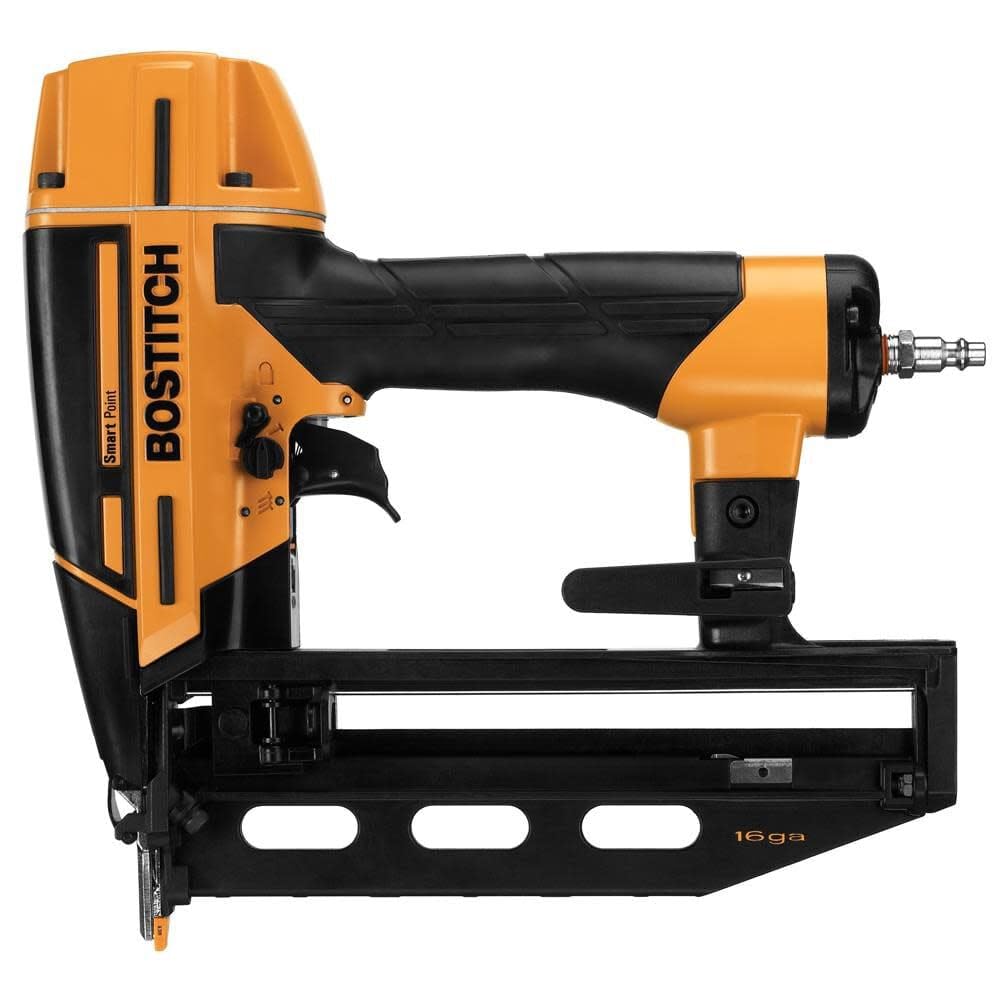
If you already own a compressor, this is the kit that saves you the most hassle per dollar. The BOSTITCH drives 16-gauge finish nails from 1-1/4-inch up to 2-1/2-inch, so the same tool covers baseboard, casing and crown. What it really does differently is the Smart Point nose (a slim, pointed front that positions the nail right where you aim it), and that is what so many buyers single out — it prevents the tool from marking the surface as it places a nail. On a painted molding, that means fewer sanding touch-ups before you fill and finish.
It is an oil-free design, which keeps oil stains off raw wood — a genuine concern when you are nailing a pre-finished casing you do not want to ruin. The Dial-A-Depth control sets countersink depth so heads sit flush or slightly below the surface, and the selectable trigger lets you fire one at a time or in contact mode for a faster run. A rear air exhaust keeps the blowback away from your face and the work, and the belt hook has an integrated pencil sharpener — a small thing that is oddly handy when you are marking cuts on the fly.
Do not overlook the kit contents: the nailer ships with a 1/4-inch air fitting, a carrying case and extra no-mar tips, plus a 7-year limited warranty (1 year in production use). That case matters if the gun lives in a truck bed. The recurring honest note is around durability — a few report the tool not holding up as long as expected, and jamming gets mixed feedback, so a clear, straight nail channel and a proper air pressure are your friends here. It weighs 7.3 pounds, which is heavier than the Makita below but still manageable for trim work.
Where the money goes: a complete kit — nailer, air fitting, case, no-mar tips and a 7-year warranty — for anyone already on air.
The honest catch: pneumatic means compressor and hose, and durability feedback is the weak spot here, so a well-regulated air supply and clean nails keep it working.
Best matched to: a compressor owner who wants a kit they can store and carry properly.
Think twice if: you work without air, or expect a lighter hand feel than 7.3 pounds.
3. Makita AF601 16 Gauge, 2-1/2″ Straight Finish Nailer
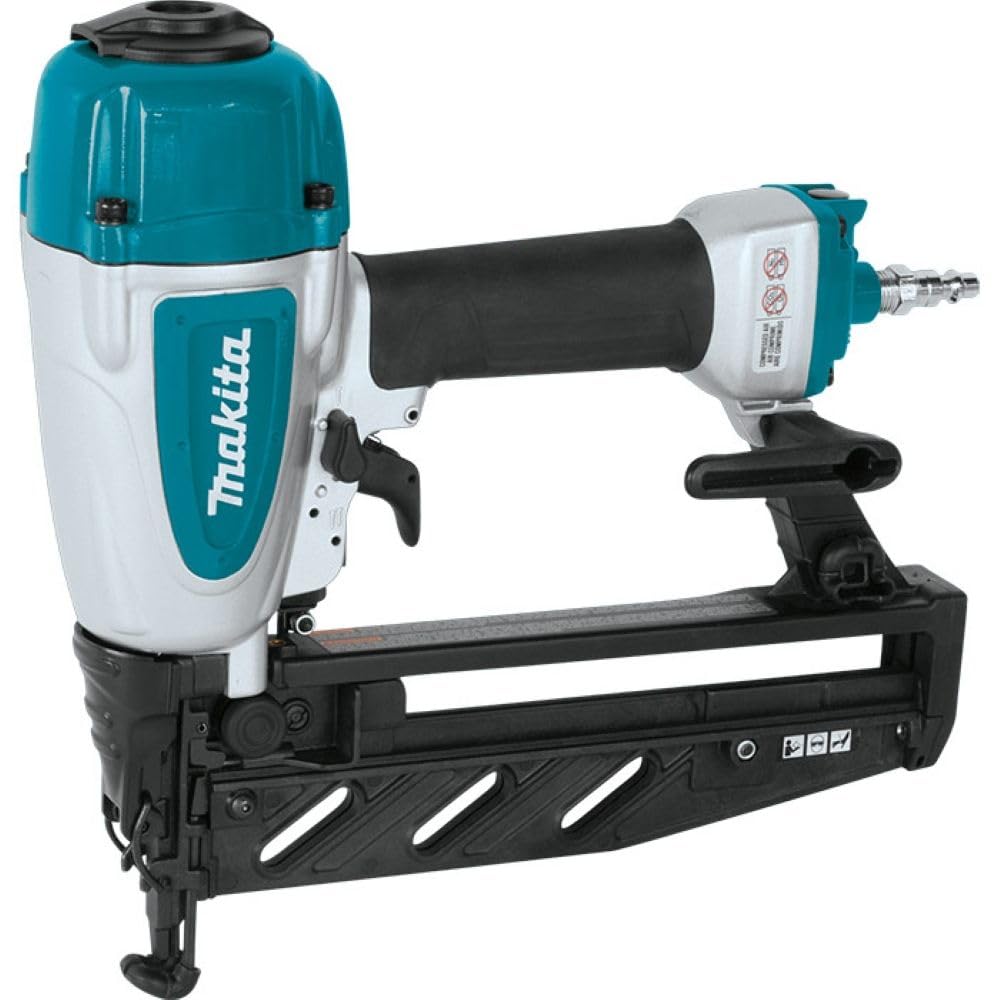
At 3.8 pounds, you can hold it overhead for the whole crown run.
Hold a trim gun at eye level for an hour and you understand why weight matters. This Makita comes in at 3.8 pounds, which makes it the lightest tool on this list and a real relief up a ladder on crown work. It runs on air in a 70-120 PSI range, takes 16-gauge nails up to 2-1/2-inch in a full-strip magazine, and shifts between sequential and contact firing with a two-mode selector switch. A nail lock-out (a safety that stops the tool firing on an empty magazine) protects both the work surface and the driver from dry-fires — no ugly blank marks and no wear from firing into nothing.
Three small extras stand out in daily use. A built-in air duster blows sawdust off a surface before you set a piece, which is genuinely useful on glue-up day. The tool-less depth adjustment lets you switch from flush to countersunk quickly as the material changes. And it ships with two no-mar tips, an air fitting, pneumatic oil and safety glasses in a tool case, so you are ready on day one. The motor design is aimed at delivering strong power for the weight, which is why buyers report it drives nails perfectly straight through the material.
Performance is clearly this tool’s strength — driving 16-gauge nails cleanly is what it does best. The honest trade-off is the rubber foot, which a few find comes off too easily and which colors the mixed durability notes; keep an eye on it and it is a non-issue. It is also an air tool, so a compressor and hose are the price of admission. Compare it to the BOSTITCH above and the gap is size, not capability — both run 2-1/2-inch nails, but the Makita is 3.8 pounds versus 7.3 pounds, a serious difference after an afternoon of overhead work.
The one to reach for when: your arms are in the air a lot and light weight beats every other feature.
Set expectations: you need air to run it, and the rubber foot is a part to check now and then.
4. Paslode Cordless Finish Nailer 916200
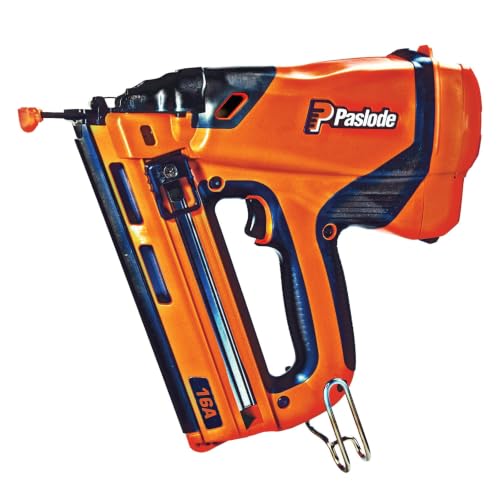
The cordless tool built to angle into corner work a straight gun cannot reach.
Corner work is where a straight magazine gives up and an angled one keeps going. The Paslode’s angled magazine reaches into tight spots, letting you place a nail right where crown molding or baseboard meets the wall in a corner — the spot you would otherwise fight to get flush. It is cordless with no hose, so you reposition a ladder without dragging air line behind you, and the no-mar tip keeps the smooth face of pre-finished trim free of scratches and marks.
The battery side is worth a close read. It runs a 7V Li-ion battery plus fuel, and Paslode states up to 12,000 nails per charge — enough for a full day of trim work without swapping packs. That is the whole value of a gas-and-battery design: you trade the compressor for a fuel cell, and you keep working. Do not miss the weight, though. This is the heaviest tool here at 10.6 pounds, and the gap is real: compared with the Makita AF601 at 3.8 pounds, you are carrying a much heavier gun for the sake of going cordless.
That trade-off is the whole decision. If being untethered in a corner is worth more to you than a light hand, the Paslode is a specialized, purpose-built answer. If you are working overhead for hours, the weight of 10.6 pounds will tell on your arms. It is a newer tool with a smaller track record than the older, more-established guns around it, so the weight and the fuel-cell habit are the two things to weigh before you commit.
Why corners are its home turf: the angled magazine and no-mar tip put nails exactly where baseboard and crown meet the wall.
The weight you accept: at 10.6 pounds — versus 3.8 on the Makita — it is a different tool for a different job, not a lighter one.
Choose this for: cordless corner work where reaching the spot matters more than a light hand.
Weigh the cost: 10.6 pounds overhead is a real tax, and it needs fuel as well as a charged battery.
5. CRAFTSMAN V20 Cordless Finish Nailer Kit CMCN616C1

Open the box, load the nails, and there is a charged battery waiting.
This is the kit for the first-time cordless owner who does not want to hunt for a battery. CRAFTSMAN includes the 16GA nailer, a V20 20V MAX* lithium-ion battery, the charger, and 100 two-inch nails plus 100 two-and-a-half-inch nails — so you can make a first run the same day. The fully cordless design eliminates the compressor, the hose and the gas cartridges, and the tool-free depth and jam settings let you correct a countersink or clear a jam without a tool in your hand.
It drives adhesive-collated 16-gauge finish nails and, according to CRAFTSMAN, holds consistent firing power across temperature swings and materials — useful in a cold garage. The handle is contoured and over-molded for grip, and the center of gravity is positioned to keep it balanced in hand. It weighs 9.1 pounds, which explains part of the constant trade-off of cordless trim tools: the battery and body together are simply heavier than bare air.
Reliability and overall quality are what owners come back to praise, and for a first-timer wrestling crown molding into a corner, a balanced cordless kit like this removes the hose fight. The mixed feedback is around battery life and charging, so plan on a spare pack if you work a long day, and note that at 9.1 pounds some find it heavy in extended overhead use. For a complete kit — battery, charger and a starter set of nails — it is the most self-contained option here.
The easy first pick if: you want a cordless trim kit with battery, charger and nails in one box.
Room to grow: buy a second V20 battery for long days, and be ready for 9.1 pounds in the hand.
Know the Specs
Gauge and nail length ceiling
Gauge is a measure of nail shank thickness — lower numbers mean thicker nails, so 16-gauge is a sturdier hold than 18-gauge brads but a subtler hole than a framing nail. The other half is the length ceiling: on this list the maximum is 2-1/2-inch, which is what baseboard, casing and crown need. Match both numbers to your trim: a tool capped at 2 inches cannot fasten 2-1/2-inch baseboard stock.
Weight and balance in the hand
Weight is what your shoulder feels by the third hour of overhead crown work. The lightest tool here is 3.8 pounds and the heaviest is 10.6 pounds, and that gap is what you feel when the gun is overhead. A balanced center of gravity and an over-molded handle help, but cordless designs carry a battery and body together, so budget for a heavier hand if you want to work untethered.
Mode selection and depth control
Depth adjustment sets how far the nail head sinks below the surface, so a tool-free dial lets you correct between a hard casing and soft pine without a tool. Trigger mode — sequential versus contact — decides whether you fire one careful nail at a time or bump-fire in sequence for speed. You will touch depth and trigger mode on nearly every job, so tool-free saves real minutes.
Jam release and dry-fire protection
A jam release is what gets you back to work when a nail misfeeds mid-board, and tool-free is the difference between seconds and a search for a hex key. A lock-out that stops the tool firing on an empty magazine protects the driver from dry-fires and keeps blank marks off your surface. Air tools also need a clean, regulated supply to avoid misfires that look like jams.
Common Questions
Can a 16-gauge finish nailer handle baseboard and crown molding?
What is the difference between an angled and a straight magazine?
Do I need a compressor to run a pneumatic finish nailer?
How long can a cordless finish nailer run on one battery charge?
What does tool-free depth adjustment actually do?
Why do finish nailers jam, and how do I clear one?
Is a 16-gauge nailer better than an 18-gauge brad nailer for trim?
Can I use one nailer for both baseboard and door casing?
Does a cordless finish nailer need fuel as well as a battery?
What nail length should I keep on hand for trim work?
The Bottom Line
For most people shopping a 16g finish nailer, the DEWALT 20V MAX* XR wins because it strips setup down to a battery you may already own and reaches tight corners with its inline magazine. If you already run a compressor and want a complete kit with a case and a 7-year warranty, the BOSTITCH is the value play. When the work is overhead and lightness is everything, reach for the Makita at 3.8 pounds. For corner work with no hose at all, the Paslode is the specialist. And if you want battery, charger and nails in one box, the CRAFTSMAN kit is the most self-contained start.
The one nudge worth making: pick the power source first, then the weight, then the nail length — those three decide whether a trim job is a pleasure or a wrestling match, and everything else is a detail you can fix with a dial.
How we choose
We do not accept paid placement. Every pick is matched to a real buyer and a real use-case; we do not hands-on test units.
Sources
Specifications: manufacturer listings and product documentation. Review insights: verified customer reviews, as of November 2026. Pricing: not shown on this page (it changes often); check the current price via the retailer link.
As an Amazon Associate, My Heart Lives Here earns from qualifying purchases. This does not affect which products we feature.