Heads up: This post contains affiliate links. As an Amazon Associate I earn from qualifying purchases, at no extra cost to you. Learn more
Specs are compiled from manufacturer listings and verified buyer reviews and can change over time — please confirm the key details on the product page before buying.
If your camper turns into an oven the moment the sun hits the roof, the fix is rarely a bigger air conditioner — it is moving air. A 12-volt fan runs off your camper’s own battery, so it keeps working when you are parked off-grid with no hookup in sight. This guide covers the roof-vent fans that pull hot air out of the ceiling and the plug-in fans that blow cool air at your face, so you can pick the one that matches how you actually camp.
This guide is built by comparing the manufacturers’ published specifications and the patterns across verified customer reviews, so you get each pick’s real strengths and trade-offs instead of marketing spin.
You can fit a 12V fan to a camper in three ways: swap out the whole vent assembly, drop a fan into the hole you already have, or plug one into the cigarette lighter. The picks below put the strongest all-rounder first, and each entry says plainly who it suits. Sorting by install type first narrows the field to the fans that actually fit your camper.
Top Picks

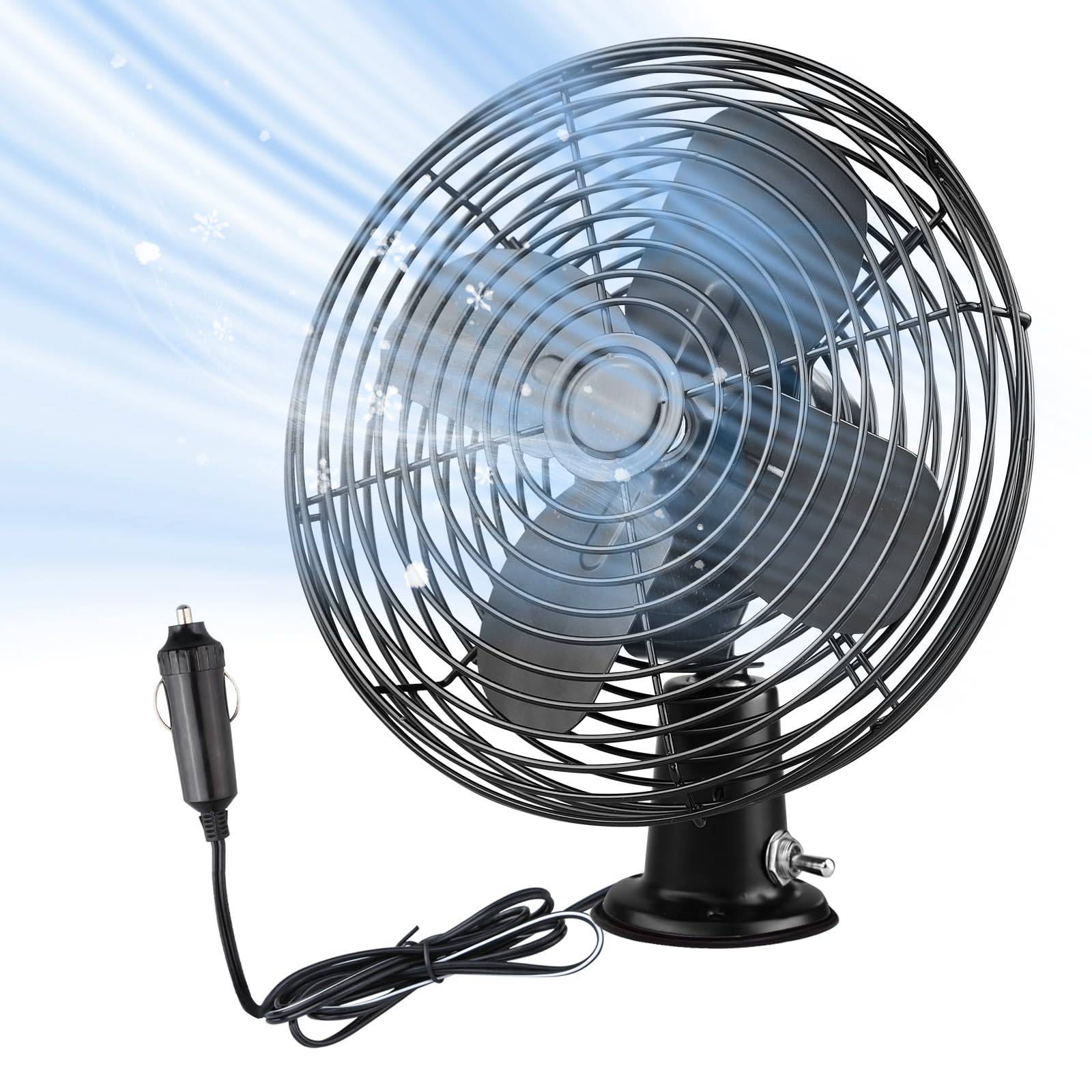

How To Choose The Best 12V Fan for Camper
Two very different products get called a 12V camper fan, and buying the wrong type is the most common mistake. One is a ceiling unit that mounts in your roof opening and exhausts hot air upward. The other is a portable fan that sits on a shelf or clips to a rail and blows air across the room. Pick the type first, then compare CFM and amp draw within it.
Roof vent fan or portable fan?
A roof vent fan replaces or upgrades the vent in your ceiling and moves air through the whole camper. If your rig already has a 14-inch ceiling opening, a vent fan drops in there. A portable fan is the better call when you want cooling aimed at a bunk, a dinette, or the cab, and you do not want to cut or wire anything into the roof.
What CFM actually tells you
CFM stands for cubic feet per minute — the volume of air the fan shifts every sixty seconds. A higher CFM empties a hot camper faster. That said, a fan rated at 900 CFM and one rated at 1100 CFM both clear a small trailer quickly; the bigger number matters most in a long motorhome where air has to travel further.
Check the opening size before anything else
Roof units are built for standard ceiling cutouts, and most of the picks here fit a 14-inch by 14-inch opening. Some also state a roof-thickness range, which tells you whether the unit will clamp down on a thin trailer roof or a thicker motorhome shell. Measure your opening and your roof thickness before ordering, because a vent fan that does not fit the hole is a return, not an upgrade.
How much battery the fan will use
Current draw is listed in amps, and low amps is what lets you run the fan all night without draining your house battery. A fan that draws under 0.5 amps, like the Caframo at 0.41, can run all night without flattening a house battery. A portable fan that plugs into the cigarette lighter draws from the same 12V system, so the same math applies.
Side-by-Side Comparison
Every row below uses the same three measurements so you can scan for trade-offs at a glance: the airflow rating in CFM, the fan blade size, and the installation type.
| Model | Best For | Airflow (CFM) | Blade Size | Install Type | Amazon |
|---|---|---|---|---|---|
| 14″ RV Roof Vent with 12V Fan★ Best Overall | Full vent replacement on a budget | — | 6 inches | DIY roof install | Amazon |
| CRAFTZONE 12V Portable Fan 9″Built For Work Rigs | Trucks, tractors and work rigs | — | 9 inches | Screw-mount | Amazon |
| XOOL 12V 6” Clip FanBest For Tight Spaces | Bunks, strollers and tight corners | — | 6 inches | Clip on | Amazon |
| Comoistar 12V/24V 8.5″ Fan | Reaching the back seats quietly | — | 8.5 inches | Clip on | Amazon |
| Caframo Ultimate 757 | Hard-wired, low-draw overnight use | 200 CFM | 6 inches | Permanent mount | Amazon |
| HENG’S Vortex I Upgrade Kit | Upgrading an existing vent in minutes | — | 9 inches | Replacement kit | Amazon |
| Starvent RV Roof Vent Fan | Six speeds and reversible airflow | 1100 CFM | 5 inches | Built-in | Amazon |
| MAXXAIR Maxxfan Deluxe | Rain-proof ventilation all day | 900 CFM | 12 inches | Fixed roof install | Amazon |
Detailed Reviews
1. 14″ RV Roof Vent with 12V Fan, 6″ Blades
Our pick — 4.0+★ from 900+ verified ratings; the strongest balance of quality and price.
One order gets you the lid, the frame and the fan — no separate parts hunting.
If your camper came off the lot with no roof vent at all, this is the complete way to fix that. The kit includes a 14-inch by 14-inch vent, a 12-volt fan with 6-inch plastic blades, the white interior garnish ring, and the screws, plus printed instructions. It fits roofs between 1-1/4 and 2-1/4 inches thick, so measure that edge before you order.
The 12-volt fan is reversible, which means it can pull air out or push fresh air in. Run it with the lid closed and the unit still moves air, so a rainy day does not shut your ventilation down. You can also leave it running while you drive. That combination — vent, fan and rain-capable airflow in one box — is what earns it the top slot.
The honest catch is the mechanism. The build and the crank assembly draw the mixed feedback here, with some owners finding the unit solid and others having the crank give out early. Treat the opening handle gently and it holds up. If you want a vent that you will crank open and shut twice a day for a decade, the pricier roof units below are the safer bet.
Why this earns first place
- Complete kit: lid, fan, garnish ring and screws all included
- Reversible fan moves air in either direction
- Works with the lid shut on rainy days
- Runs while you are driving down the road
- Simple two-wire hookup with printed instructions
The part to handle with care
- The crank mechanism takes gentle handling
- Build quality draws mixed verdicts across reviews
- Fits roofs only between 1-1/4 and 2-1/4 inches thick
Buy this if: your camper has no roof vent yet, or the old one is beyond saving, and you want the whole job in one order.
Spend more if: you rely on the vent daily and want a sturdier opening mechanism.
2. CRAFTZONE 12V Portable Fan, Heavy Duty 9″ Metal
A 9-inch metal fan that shrugs off dust, vibration and a bouncing tractor cab.
Tractors, forklifts, mowers, buses and boats all show up on this fan’s own fit list, and the metal housing explains why. The 9-inch blade sits in a reinforced frame built to take vibration and grit. It screws down to a 12V outlet and runs on two speeds, so setup is a basic fastening job rather than a wiring project.
What wins people over here is the sense that it is a serious piece of equipment — the build quality and overall caliber are the two things the review pages keep coming back to, with airflow close behind. It moves a lot of air for its size, and it is compact enough at 4.5 inches deep to sit on a dash or a shelf without crowding the space.
The honest catch is sound. Some love how quiet it runs and others find it loud on the high setting, so if you are noise-sensitive, plan on the low speed for long stretches. The two-speed choice is what lets you decide that trade-off yourself.
The value read: you are paying for a housing that does not rattle apart in a work environment, and it holds up as a value against that purpose.
Right for you if: your fan lives in a work vehicle or a cab that takes a beating.
Not the fit if: you need fine control — two speeds is all you get here.
3. XOOL 12V 6” Clip Fan, 360 Degree Rotatable
It clamps to a bunk rail, points anywhere, and tunes the breeze to any strength you like.
Its small footprint is what sets this one apart. It measures 6 inches deep, 5.91 inches wide and 5.91 inches tall, so it is the compact one of this pair. The Comoistar below spans 3.6 inches deep by 8.3 inches wide by 11.8 inches tall, a noticeably larger footprint to find a home for. When every inch of a camper is spoken for, that gap is the difference between fitting the rail and not fitting anything.
The blowing side is simple: a big dial gives you stepless speed control, which means there is no fixed setting menu — you just turn it until the breeze feels right. A 360-degree tilt rotation lets you aim it wherever you need it. It is rated under 50 decibels (a roughly quiet-conversation noise level), so it will not keep a sleeper awake. The tight safety grid keeps fingers away from the 6-inch blade.
One thing to know before you buy: this runs off a cigarette lighter socket and suits 12V vehicles, so it is not meant for a 24V truck. Owners also split on sound — many find it quiet, while a few hear a rattle from the clamp contact. Most people run it for the flexibility rather than for the noise figure; sitting in Florida heat, the thing that keeps them cool is the adjustable airflow plus the clamp that goes where the vents cannot.
Standout qualities
- Stepless speed dial, no preset steps to settle for
- 360-degree rotation aims air exactly where you want it
- Rated under 50 dB for quiet overnight use
- Large adjustable clamp suits rails, strollers and tents
- Compact 6-inch footprint fits where bigger fans cannot
Watch out for
- Not intended for a 24V truck
- Clamp contact can add a rattle some owners notice
Give it a look if: you want one small fan that clips on anywhere and puts the breeze on your face, not on the ceiling.
Keep shopping if: your rig runs a 24-volt system instead of 12-volt.
4. Comoistar 12V/24V 8.5″ Portable Fan

A long cord and an 8.5-inch blade that push cool air all the way to the back bunk.
The cord is the whole argument here. It runs 5.9 feet (1.8 meters), so the plug stays up front and the fan still reaches the rear seats, the bunk or the baby’s seat. The 8.5-inch blade is driven by a brushless motor and plastic blades that come together to keep the sound down, and one button drives the stepless speed control so nobody has to read a manual.
It takes either a 12V or a 24V cigarette lighter socket, so if you own a diesel truck and a camper, one fan covers both. Parents tend to notice the narrow-gap grille, which keeps small fingers away from the spinning blade. Owners describe the output as good airflow that stays super quiet, and the two reasons people keep it are fan quality and the quiet.
The reliability is where the picture isn’t entirely clean. Most units run beautifully, but a few stop working after the second use, and that is the split to know about. Mounting is another trade-off — it clips on, but some buyers found the clip less steady than they wanted. Neither is a reason to skip the fan; both are reasons to check your mounting spot before the first trip.
What buyers get: a strong, quiet, long-reaching breeze that plugs into either voltage system — exactly what a rear-seat camper needs.
What to watch: the reliability record has some off units, and the mounting clip could be steadier on rough shelves.
Best fit for: a camper with a rear bunk that the dash vents never reach.
Look elsewhere if: you want a permanent, rock-solid mount rather than a clip.
5. Caframo Ultimate 757 12V 2-Speed 7″ Fan

Half an amp on high and 200 CFM of air — that is the math that keeps a battery alive.
Here is what makes this one worth a hard look: it moves 200 CFM on the high setting while drawing only 0.41 amps, and on low it pulls 0.28 amps. That is the lowest draw of any fan in this group by a clear margin. Wire it into your camper’s electrical system, screw down the permanent mount, and you have a fan you can leave running through the night without watching your battery gauge.
The blades have no grill and are designed to absorb shock, and a FingerSafe design keeps hands clear of them. Two speeds cover the usual choices. Owners use it in 12×20 tents, in galleys and in cargo vans. Buyers report that airflow is the trait they praise again and again, by a huge margin over the next most-praised trait, which is how reliable it has been for them.
The catch is sound at the top end. Some owners find it super quiet and others find it a bit noisy on full speed, so pace your expectations for the high setting. It is also a permanent install: no plug, no clip, just wires. If you want something you can move around, this is not that fan. If you want something that stops eating your battery, it is.
The low-power case
- 200 CFM on high with only 0.41 amps of draw
- Low setting sips just 0.28 amps
- Shock-absorbing FingerSafe blades with no outer grille
- Permanent mount with direct wiring included
- Owners rely on it in tents, galleys and cargo vans
Before you commit
- Noisy on the high setting for some ears
- Permanent wire-in only, no plug-and-move option
For the off-grid camper: choose this when your battery budget is tight and you plan to run the fan all night.
Wrong tool if: you want to move the fan between the camper and the car.
6. HENG’S INDUSTRIES 90043-CR Vortex I Upgrade Kit
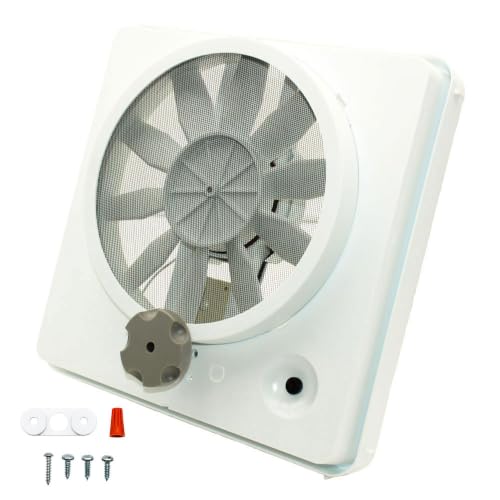
Fifteen minutes and a Phillips screwdriver turn a dead vent into a proper fan.
This is the pragmatic pick for the camper who already has a powered vent and just wants more air. Swap out the old screen for this kit and you get a 9-inch blade and a single-speed motor rated for up to 300% improved airflow over the stock unit, according to the maker. Owners consistently report the install takes under 15 minutes with nothing but a screwdriver. That speed is the real draw.
It is built to replace the fan in Heng’s, Ventline, Jensen and Elixir powered vents, and a non-powered vent can be converted with extra wiring. Performance is the thing people come back for — it performs better than the original and exchanges air through the trailer. What you get in return is a substantial jump in ventilation without lifting the roof.
The install is fast but the paperwork is thin. Instructions are slim or missing on some units, and the build quality is the other divide — most love it, a few found the assembly less solid than expected. If you are handy enough to reverse-engineer a simple 12V swap, the missing sheet is a nuisance, not a wall.
The case for it: the fastest route from a weak vent to real airflow, on a proven mount footprint.
The snag: thin or missing instructions and a fit that assumes you have a compatible powered vent.
Reach for this if: you have a standard powered vent and want more airflow without a full roof job.
Think twice if: your vent is unpowered — it means extra wiring to make the swap work.
7. Starvent RV Roof Vent Fan, 6-Speed Reversible

Six speeds and a blade that spins both ways, all through a smoke-tinted dome.
Here is a head-to-head worth stating plainly: this vent is rated at 1100 CFM, while the Maxxfan Deluxe below is rated at 900 CFM. In a long motorhome those extra cubic feet per minute are the difference between a hot rear bedroom and a liveable one. It fits standard 14-inch by 14-inch ceiling openings and handles roofs from 1.16 to 5.5 inches thick, so it covers most trailer and motorhome builds.
Six speeds give you granular control, and the reversible blade means it can pull hot air out or push fresh air in depending on the day. The fan blades are transparent so daylight still reaches the ceiling, and the smoke-colored dome filters the sun. A removable screen makes the inevitable moth cleanup easy, and the wiring is a clean two-wire design with the white interior trim and screws included. The motor ramps up and down rather than jolting on, which keeps the start noise low.
Two things came back mixed in the feedback: the build quality itself and the lid operation. Neither is universal, but both are worth a careful once-over when your unit arrives. Owners do say it is quieter and moves more air than some better-known roof fans, and the low speeds stretch well enough to lean on at night and lean on the air conditioning less.
What earns its price
- 1100 CFM of airflow, 200 more than the Maxxfan Deluxe
- Six speeds with reversible blade direction
- Transparent blades and a smoke dome keep the interior bright
- Removable screen for easy cleaning
- Fits 14×14 openings and roofs from 1.16 to 5.5 inches
The honest checks
- Build quality and lid operation both draw mixed reports
- It is a built-in full installation, not a quick swap
My pick for a big rig: a long motorhome with a hot back bedroom, where that airflow edge and reversible blade earn their place.
Overkill for: a tiny teardrop where a two-speed unit would already clear the air.
8. MAXXAIR Maxxfan Deluxe, 4-Speed with Rain Cover

The lid stays open in a downpour, so a rainy week never traps the hot air inside.
The rain cover is the defining feature. Every other roof fan here goes shut when the sky opens; this one keeps venting through a storm because the cover is built in. It fits 14-inch by 14-inch roof openings and roofs from 1-1/8 to 6-1/2 inches thick, the widest thickness range in this group, so it covers the thinnest trailer skin and the deepest motorhome shell.
The 12-volt motor moves 900 CFM through a 12-inch, 10-blade fan, with four speeds set from a flush-mounted keypad on the vent itself. That is 200 CFM short of the Starvent above, but you are trading raw airflow for the rain cover and the wider roof range. A bug screen keeps the insects out and comes off for cleaning. Owners like that it performs better than the stock vent that came with the rig, and it holds up even with the windows just cracked.
Price is where the split happens. Some find it a great value for the convenience, others feel it runs the wrong side of fair. That is the judgement call you make on the rain cover — for anyone who camps in wet climates, it is the reason to pick this fan over the rest. Reliability, performance and the install all land on the positive side.
The rain-cover argument: a vent you can leave open through a storm is a different kind of comfort, and the widest roof range here backs it up.
The cost of that convenience: it costs more than the other roof vents here, and the airflow sits 200 CFM under the Starvent.
Choose it if: you camp somewhere it rains, and you want ventilation even when the sky is against you.
Skip the spend if: you mostly camp dry and would rather have maximum airflow for less money.
Know the Specs
CFM (Cubic Feet Per Minute)
CFM is how much air the fan moves each minute — the bigger the number, the faster a hot camper empties. A roof fan rated at 900 CFM shifts a serious volume of air, while a 200 CFM cabinet fan is a gentler, more targeted breeze. Match CFM to length: a small trailer clears on a moderate rating, while a long motorhome needs the higher end to reach the rear.
Amp Draw
Amps tell you how fast the fan eats battery, and lower is kinder to your off-grid nights. A fan drawing 0.41 amps on high, like the Caframo, can run overnight; anything drawing noticeably more will pull a house battery down faster. Compare the fan’s amp draw against your battery bank’s usable capacity before you buy.
Roof Opening and Roof Thickness
Roof vent fans are built for a standard ceiling cutout, most commonly 14 inches by 14 inches, but each unit also has its own roof thickness range. A vent fan that clamps down on a 1-1/8 to 6-1/2 inch roof covers a far wider spread of vehicles than one limited to a narrow band. Measure both before ordering.
Reversible vs. Exhaust-Only
An exhaust fan only pushes air out, which clears heat and odors. A reversible fan can also spin the other way and pull fresh air in. Reversible gives you more control on still, warm nights; exhaust-only is simpler and often quieter.
Common Questions
Will a 12V camper fan drain my house battery overnight?
What size roof opening do I need for a camper roof vent fan?
Can I run a 12V fan off the cigarette lighter socket in my camper?
Is a reversible fan better than an exhaust-only fan?
How much airflow do I need in a small camper?
Can I leave my roof vent fan open in the rain?
Do I need to wire a roof vent fan into my camper’s electrical system?
How loud is a camper fan at night?
Will a metal 12V fan hold up in a truck or tractor cab?
Can a 12V camper fan also cool my car?
The Bottom Line
Starting from a bare roof? The 14″ RV Roof Vent with 12V Fan is the pick to reach for. One order gets you the lid, the frame, the blade and the screws, and its reversible fan still moves air with the lid shut. Want the highest airflow to clear a long motorhome? The Starvent RV Roof Vent Fan and its 1100 CFM rating (cubic feet per minute, a measure of how much air it moves) lead the roof group. Boiling in the cab of a truck or a tractor? The CRAFTZONE 12V Portable Fan is the one to reach for, because its metal housing was built for the kind of abuse a work rig hands out.
Whichever type you pick, match the fan to how you actually camp: roof vent for whole-camper airflow, portable for face-level relief, low amps for off-grid nights. Get the type right and the CFM and amp figures become a simple comparison.
How we choose
We do not accept paid placement. Every pick is matched to a real buyer and a real use-case; we do not hands-on test units.
Sources
Specifications: manufacturer listings and product documentation. Review insights: verified customer reviews, as of November 2026. Pricing: not shown on this page (it changes often); check the current price via the retailer link.
As an Amazon Associate, My Heart Lives Here earns from qualifying purchases. This does not affect which products we feature.