Heads up: This post contains affiliate links. As an Amazon Associate I earn from qualifying purchases, at no extra cost to you. Learn more
Specs are compiled from manufacturer listings and verified buyer reviews and can change over time — please confirm the key details on the product page before buying.
If your rack gear dies in a brownout, the fix is a UPS that actually fits your rack. A 10 inch server rack UPS is a battery backup unit sized for a smaller rack width, and the real trick is matching its form factor, outlet count, and backup capacity to what you plug in. The picks below cover rack-mount power for home labs and small offices, plus a couple of compact towers that sit beside the rack instead of inside it.
This guide is built by comparing the manufacturers’ published specifications and the patterns across verified customer reviews, so you get each pick’s real strengths and trade-offs instead of marketing spin.
You will see what each unit protects, how long it runs, and which rack it drops into without a fight. Every pick here spells out the size and load details so you can choose the right 10 inch server rack ups without guessing.
Top Picks


How To Choose The Best 10 Inch Server Rack UPS
Start with the rack, not the UPS. A rack unit is 1.75 inches tall, so a 1U unit eats one slice of rack space and a 2U unit eats two. Check your cabinet’s inside depth before anything else, because a UPS that is too deep hangs out the back or blocks your airflow.
Match the UPS type to your rack
Rack-mount UPS units carry mounting ears sized for a standard 19-inch rack. A 10-inch mini cabinet like the GeeekPi DeskPi RackMate has a narrower interior, so treat it as a shelf or cabinet for a compact UPS rather than a home for a 19-inch rack unit. Some UPS units ship with both rack and tower options, which gives you a fallback if the rack depth is tight.
Size the load in watts
VA and watts are two sides of the same measure. VA is the total capacity the unit can carry, and watts is the usable real power your gear draws. Most units list both, and the watt figure is what your devices actually consume. Add up your switch, modem, NAS, and router draw to pick the right size.
Battery type and replacement
Lead acid is the classic sealed battery in rack UPS units and needs replacing as it ages. Lithium Iron Phosphate (LiFePO4, a longer-cycling battery chemistry) appears on some newer models. A user-replaceable battery keeps the chassis and only swaps the cell, which saves money down the road.
Side-by-Side Comparison
| Model | Best For | Capacity | Outlets | Form Factor | Amazon |
|---|---|---|---|---|---|
| APC BE600M1★ Best Overall | Compact desk-side backup | 600VA class / 12 A | 5 backup + 2 surge only | Compact | Amazon |
| Amazon Basics 1500VA/900WMost Outlets | Biggest load on a budget tier | 1500VA/900W | 10 (5 backup + 5 surge) | Tower | Amazon |
| Tecmojo 1U Rack Mount PDURack Power Hub | Outlet expansion in a rack | 12 A max | 19 | 1U rack | Amazon |
| GeeekPi 8U Network Rack | The mini cabinet itself | 8U height | — | 10 inch cabinet | Amazon |
| GOLDENMATE 1000VA/600W | Pure sine wave in a tower | 1000VA/600W | 8 | Tower | Amazon |
| CyberPower OR500LCDRM1U | 1U rack with an LCD panel | 500VA/300W | 6 (4 backup + 2 surge) | 1U rack | Amazon |
| Eaton Tripp Lite SMART500RT1U | Short-depth 1U installs | 500VA | 6 (1 individually controllable) | 1U rack | Amazon |
| CyberPower OR700LCDRM1U | 1U rack with more capacity | 700VA/400W | 6 (4 backup + 2 surge) | 1U rack | Amazon |
| Eaton Tripp Lite SMART1500LCDXL | Biggest load with expandable runtime | 1500VA/900W | 8 | 2U rack | Amazon |
Detailed Reviews
1. APC BE600M1 UPS Battery Backup & Surge Protector
Our pick — 4.5+★ from 29,000+ verified ratings; the strongest balance of quality and price.
The reliable workhorse for keeping your router and switch alive when the lights drop
Most home racks live and die by the router and the modem. This APC keeps both running through an outage, and it does it at 23 minutes of runtime at a 100W load. That window is enough to let a connected computer shut down safely, and it arrives with 5 fully backed-up outlets to power your core gear. Pulling 12 A across the load makes it a sensible match for a switch, a router, and a small server.
The two extra surge-only outlets handle less critical gear without eating the battery. You get 10 hours of recharge time back to full, which is slow but stable for a sealed lead acid cell. The build is compact enough to sit in a 10 inch cabinet or beside it on a shelf. What wins people over here is quality — it is the most-praised trait by a wide margin in the ratings. Buyers report it connects to Unraid with very little fuss and guards against surges and fluctuations as well as full outages.
Understand the battery swap before you buy. The internal cell is replaceable via an APC replacement battery, APCRBC154, sold separately, which keeps the chassis alive. The honest gap is the mixed read on battery lifespan in the ratings, and one reviewer noted it stopped working after 10 months. Those are the outliers, not the pattern — most units hum along — but they are worth knowing.
What It Does Well
- Delivers 23 minutes of runtime at a 100W load for safe shutdowns
- 5 backup outlets plus 2 surge-only, with a 1.5A USB port that works during an outage
- Battery is swappable in minutes via APCRBC154, no whole-unit replacement
- An easy pairing for a router, modem, and NAS
Where It Falls Short
- The 10-hour recharge is slow if you get hit twice in one day
- Sealed lead acid cell will wear out over time
- Its 12 A draw is lower than the 12.5 A Amazon Basics unit above.
Right Choice For: A small home rack or desk setup where you need safe shutdown and phone charging during an outage, backed by the most-praised build quality in this group.
Little Catch: The 10-hour recharge means back-to-back outages push you to the edge, so plan your critical gear carefully.
2. Amazon Basics 1500VA/900W UPS
The heavy-lifting tower that carries the biggest load on this list
If your rack leans on a NAS and a desktop, this is the one that takes the weight. That extra hardware is why it weighs 11 kg, versus the 4.76 kg GeeekPi rack. A tower this heavy is a behind-the-desk or floor placement, not a shelf toss.
Runtime scales with load, and the numbers are honest. At half load (750VA/450W) you get roughly 10 minutes of backup, and at full load (1500VA/900W) it drops to about 1.5 minutes. That means you size your critical gear to half load for a comfortable shutdown window. The 6-foot power cord reaches a wall outlet from under a desk or inside an entertainment center. Automatic Voltage Regulation and simulated sine wave output keep your devices safe from brownouts without draining the battery.
The reliability is where buyers get split. Some say it works great, and some had a unit die inside the first stretch of use. It is a genuine mixed bag on the ratings, and the battery life reads the same way. None of it makes this a bad pick — the 10 outlets and 900 watts are real and useful — but if rock-solid uptime is your absolute requirement, a rack-tier name is safer.
Go With This If: You want the most outlets and the biggest wattage in a tower that sits beside the rack rather than inside it.
Try Instead: A rack-mount unit if the 13.7 x 3.9 x 9.8 inch tower footprint won’t clear your cabinet depth.
3. Tecmojo 1U Rack Mount 19 Outlet PDU
The rack’s outlet backbone, not a battery backup — read this before you buy
Here is the important distinction: this is a PDU (power distribution unit), not a UPS. It distributes and protects power, but it does not hold your gear up during an outage. What it does do is put 19 outlets in a single 1U span, with 16 facing the back and three on the front. Four USB ports add phone and accessory charging. A built-in 12-Amp circuit breaker cuts power on overload, so a runaway draw doesn’t cook your rack.
Quality is the most-praised trait here, with the metal housing and heavy-duty components earning the credit. Owners say it beats a typical surge protector on real-world function. The on/off switch on the PDU shuts off the back outlets — convenient for powered-down gear, but double-check before you rely on the rear row. It mounts in a standard 19-inch rack via ears on the back panel, so a 10-inch cabinet will not accept it.
The cord length and fit get mixed reads, which matters if your rack sits far from the wall outlet. It claims a 19″L x 5″W footprint, so measure your spare rail space first. The 12 A breaker also caps total draw, which is fine for network kit and a home theater but tight for a NAS or desktop.
Honest Placement: Pair this with a real UPS from this list — the PDU handles the outlets, the UPS handles the outage.
Watch The Rack Width: Its 19-inch ears fit a full-size cabinet only.
Reach For This When: You have a standard 19-inch rack and need one clean block of outlets with overload protection.
Look Elsewhere If: You need battery backup through an outage — this unit distributes power, it does not store any.
4. GeeekPi 8U Network Rack, 10 inch Mini Server Rack

The aluminum home for your 10 inch gear, so everything has a place
You need a place to bolt your compact gear before a UPS makes sense. This DeskPi RackMate T1 is a 10 inch wide cabinet at 8U tall, built from an aluminum alloy and acrylic frame. That 8U height is 14 inches of vertical space, with each U standing 1.75 inches. Its 11×7.8×16 inch footprint suits a small office or home lab. It weighs just 4.76 kg, far lighter than the 11 kg Amazon Basics UPS, so you can move it alone.
Size is the trait owners approve of most, and appearance runs a close second. The open design gives you front-to-back access to every device, which helps cooling and makes swaps quicker. Both side panels are translucent acrylic, so you can see the interior and add ambient lights if you like. It ships flat-packed with all the hardware, and assembly is straightforward. The acrylic panels also keep dust off your gear while trimming weight.
Value is the sticking point in the ratings — some say it is worth the price and others find it overpriced. Accessories and material also land as mixed, so understand the acrylic sides are a design choice, not a heavy-duty rack. Mounting hardware is included, but there is no rack rail kit implied beyond what ships in the box.
What It Solves: Gives small 10 inch devices a real 8U home with cooling-friendly open access.
The Fit Note: A full 19-inch rack UPS will not mount in here; size your UPS to a shelf or compact tower instead.
Best Suited To: Home lab builders who want a tidy aluminum cabinet for 10 inch components without a full server rack.
Consider The Trade-off: Acrylic sides keep weight down and visibility high, but they are not a steel enclosure.
5. GOLDENMATE 1000VA/600W Lithium UPS

A pure sine wave backup with a lithium cell built to outlast lead acid
The battery chemistry is the story. This runs on a LiFePO4 pack — lithium iron phosphate — which the maker rates for a lifespan of over 10 years and more than 5,000 charge cycles. A pure sine wave output feeds your gear a clean, smooth waveform, which matters for a NAS or a home server. The 1000VA/600W capacity sits below the Amazon Basics 1500VA/900W in total load, but the 8 outlets and 6-hour recharge keep it practical. It weighs 4.8 kg, so a single person can shift it.
Setup is a strong point — plug it in and the LCD panel shows battery and power status in real time. The communication port connects to a Windows PC, Mac, or NAS to trigger an automatic shutdown, and the maker says no extra software is needed. A built-in Battery Management System pairs with a cooling fan the maker lists under 50 dB, and that fan only spins up under heavy battery use. An automatic safety mechanism stops charging or discharging when it hits preset limits.
Two things to weigh. Power capacity gets mixed reads, and it is not the pick for high-power appliances. Check your outlet voltage too: it takes 90–140V AC input and is built for standard 110V household power. If your gear needs every watt, the 900W Amazon Basics unit carries more.
The Battery Case
- LiFePO4 chemistry rated over 10 years and 5,000+ cycles by the maker
- Pure sine wave output for sensitive gear
- 6-hour recharge with auto-shutdown to a PC, Mac, or NAS
- 8 NEMA outlets with a real-time LCD readout
The Honest Limits
- Not built for high-power appliances, per buyer feedback
- 600W falls short of the 900W Amazon Basics capacity
- The cooling fan kicks in under heavy battery use
The Pick For You: A home server owner who wants a long-life lithium battery and clean sine wave power with auto shutdown.
Know Before Buying: Verify your outlet sits in the 90–140V AC range and that your load stays within 600W.
6. CyberPower OR500LCDRM1U Smart App LCD UPS

The 1U rack unit that shows you its runtime instead of making you guess
For a small switch or a telecom install, this 500VA/300W unit slides into one 1U slot at a 9.25 inch depth. It carries six NEMA 5-15R outlets — four with battery backup and surge protection, two surge-only. A 10-foot cord reaches a wall outlet across the room. The multifunction LCD is the differentiator: it reports runtime in minutes, battery status, and power conditions so you see a problem before it takes the gear down. Automatic Voltage Regulation corrects small power swings without switching to battery.
Owners find it great for small networks and value money well spent; power capacity is what people praise most and value is the close second. Installation is a quick affair, and the compact size suits a tight cabinet. Remote management is possible only if you add the optional RMCARD205 management card, so plan for that if you want it off-site.
The noise is the split — some find it very quiet and a few report real fan noise, which matters if the rack sits in a room where you work. Battery life runs mixed, with some seeing over 20 minutes and others around 20 minutes at a 40% load. A 3-year warranty covers the batteries, and there is a connected equipment guarantee behind it.
Choose This If: You run a small switch or telecom stack in a 1U slot and want visible runtime readouts.
Think Twice If: You need more wattage — 500VA/300W is modest, and the 700VA CyberPower below carries more.
7. Eaton Tripp Lite SMART500RT1U 500VA UPS

Built for a shallow cabinet where a deeper 1U unit simply won’t close
The number that sells this one is the installed depth: only 11.8 inches. If your rack is a short-depth unit, most UPS bodies hang out the back, and this one slides in cleanly. It packs 500VA in a 1U chassis with six NEMA 5-15R outlets, and one outlet is individually controllable for load shedding. That means you can drop non-critical gear remotely and stretch the battery for the things that matter. It runs line-interactive with Automatic Voltage Regulation, correcting brownouts without draining the cell.
Connections are its hidden strength. USB, RS232, EPO, and an optional SNMP/Web card take it beyond a simple battery box. Watchdog application support plus OS and hard-reboot restart options make it suited to remote sites you can’t walk over to. Included PowerAlert software covers network power management and control. A 4.2 amp draw and a 12-hour recharge put it in the light-duty tier.
Now the honest part. Reliability is the trait that draws the most discussion, and it’s a mixed read — some report no issues, others note the unit cutting out. The 3.2-minute average battery life is short, and a buyer reported it only lasting three months. This is a fit for short-depth remote installs where the deep units won’t fit, not for a long-outage data closet.
Where It Shines: Short 11.8 inch depth plus load shedding and remote management ports make it a tight-cabinet specialist.
Match The Duty: A 3.2-minute average battery life suits graceful shutdowns, not long outage bridging.
Made For: Shallow-depth racks at remote sites where you need control ports more than long runtime.
Skip The Fit: A deeper cabinet with a bigger load is better served by the 2U Eaton Tripp Lite below.
8. CyberPower OR700LCDRM1U Smart App LCD UPS

The 1U step-up: more headroom for your server without leaving the rack
Compare this to the 500VA CyberPower above and the difference is headroom. This model carries 700VA/400W, so it swallows a slightly bigger load in the same 1U slot. Six NEMA 5-15R outlets give you four with battery backup and surge protection plus two surge-only. A 10-foot cord reaches far, and the multifunction LCD reports runtime in minutes, battery status, and power conditions. Automatic Voltage Regulation keeps small fluctuations from draining the battery, which extends its life.
Setup is what draws the most approval here, with value running a close second. The bright, readable display earns its own praise, and the metal chassis looks the part. It suits a home server or a security console well. Included PowerPanel Business Edition software downloads free for management. The same optional RMCARD205 card open up remote management, and a 3-year warranty covers the batteries with a connected equipment guarantee.
Battery life and noise both land as mixed in the ratings. Power capacity reads the same way, so don’t expect this to carry a big desktop rig. Simulated sine wave output means it’s built for gear without Active PFC power supplies, so check your server’s power supply before you commit.
Where It Wins: A real step up to 700VA/400W in the identical 1U footprint as the 500VA model.
The Caveat: Simulated sine wave and mixed power-capacity reads mean it suits lighter loads, not a high-draw PC.
Your Match If: You want a bit more capacity than the 500VA unit while keeping a bright LCD and free management software.
Look Elsewhere If: Your power supply uses Active PFC — simulated sine wave may not agree with it.
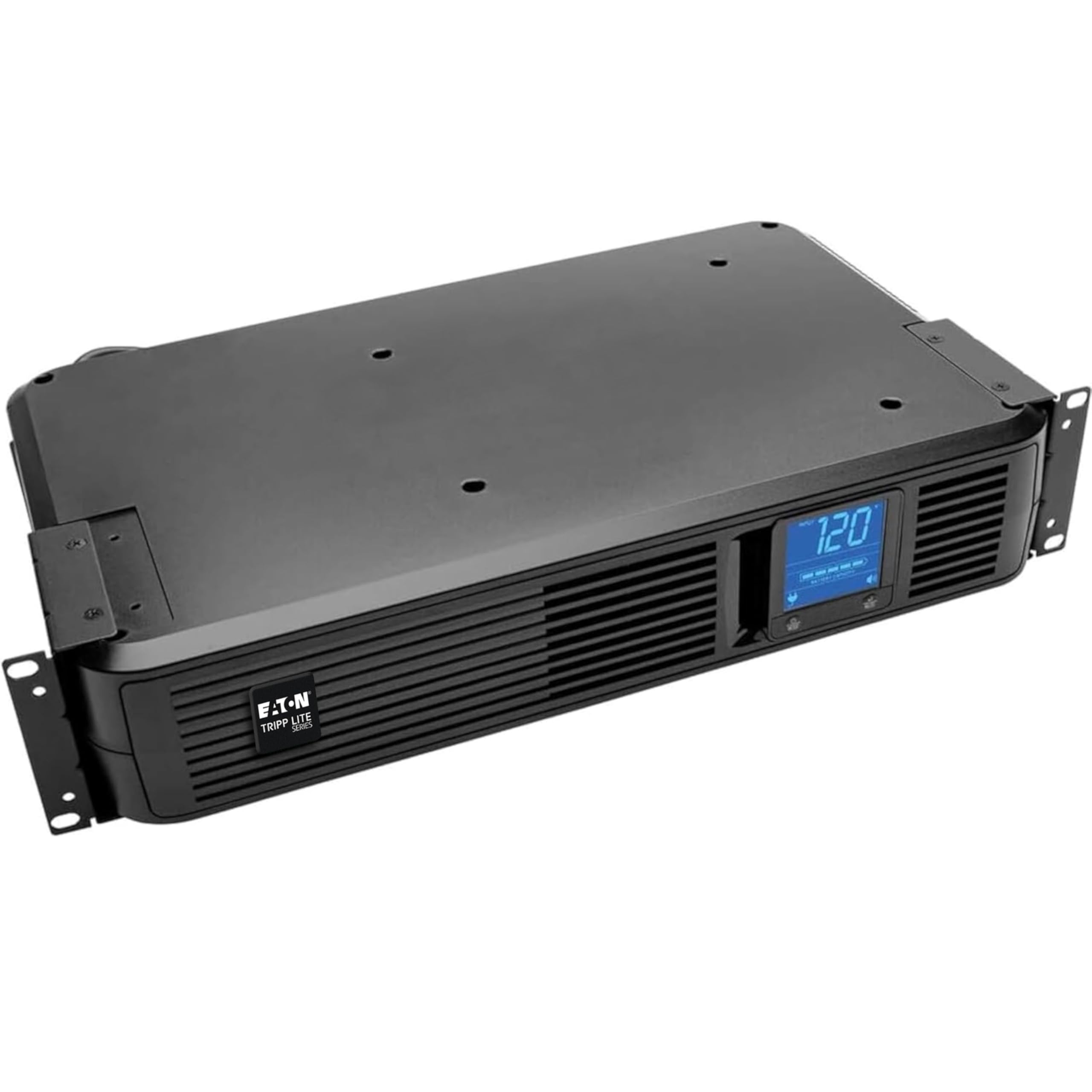
9. Eaton Tripp Lite SMART1500LCDXL 1500VA 2U Rack Mount UPS
The heavy rack anchor with room to add a second battery pack later
When the rack carries a real load, this 1500VA/900W unit is the match. Eight NEMA 5-15R outlets spread the draw, and it fits either as a 2U rack mount or a vertical tower via the included adapter. Its 10.5-inch depth gives it more body than the 11.8 inch 1U Tripp Lite above, but it also brings far more capacity. A 6-foot NEMA 5-15P cord connects to the wall. Automatic Voltage Regulation corrects brownouts and overvoltages to a safe 120V without draining the battery.
The expandability is the standout. Add the optional Eaton Tripp Lite BP24V15RT2U external battery pack, and the maker lists 30 minutes additional runtime at half load (450W) and 11 minutes at full load (900W). That pack mounts in 2U of rack space, so plan for four U total if you go that route. A large rotatable LCD monitors voltage, runtime, load, and battery mode. A 4.5-hour recharge is quick for this class, and internal batteries are user-replaceable. An RJ45 Ethernet port handles dataline surge protection up to 100 Mbps.
Output is Modified Sine Wave (PWM) in battery mode and Sine Wave in AC mode, which the maker lists for low total harmonic distortion. Coverage is solid: a 3-year limited warranty and a connected equipment insurance, plus reachable technical support. If a 1500VA tower is enough and you don’t need the external pack, the Amazon Basics unit carries the same 1500VA/900W in a tower.
Why Racks Choose It
- 1500VA/900W across 8 outlets in a 2U rack or tower format
- Optional BP24V15RT2U pack adds 30 minutes at half load, 11 minutes at full load
- 4.5-hour recharge with user-replaceable internal batteries
- 3-year warranty and connected equipment insurance
The Practical Notes
- A 10.5-inch depth needs measuring against your cabinet
- Adding the external pack eats an extra 2U of rack space
- Modified sine wave in battery mode, not pure sine wave
Built For: A rack carrying a NAS, server, and network stack that may need extra runtime through an add-on pack.
Before You Commit: Confirm you have 2U free now and possibly 4U if you plan to add the external battery pack.
Know the Specs
VA vs Watts
VA is the total capacity a unit can carry, and watts is the usable real power your devices draw. A 1500VA/900W unit gives you 900 watts of real load. Size your gear against the watt figure, because that is what your switch, router, and NAS actually consume. Higher VA means more headroom before the unit hits its ceiling.
Simulated vs Pure Sine Wave
Sine wave describes the shape of the power a UPS feeds your gear. Simulated sine wave is a stepped approximation and is fine for basic gear without Active PFC power supplies. Pure sine wave is a smoother, cleaner output, which suits sensitive equipment. Check your server’s power supply type before you buy either kind.
Rack Height and Depth
Rack height is measured in U, and each U is 1.75 inches tall. A 2U unit takes two slots and a 1U unit takes one. Depth is the number that traps buyers — a deep unit that won’t fit a short cabinet is a deal you regret. Measure your cabinet’s inside depth against the UPS body before ordering.
Battery Type and Runtime
Lead acid is the classic sealed cell and needs replacement with age; lithium iron phosphate (LiFePO4) is a longer-cycling chemistry on newer units. Runtime drops as the load rises, so a unit that rates a long time at a light load shortens fast at full draw. Recharge time tells you how soon the unit is ready for the next outage.
Common Questions
Will a 19-inch rack UPS fit inside a 10 inch mini cabinet?
How much runtime do I need for a home rack?
What is the difference between a rack PDU and a rack UPS?
Do I need pure sine wave or simulated sine wave for a server?
Can I replace the battery instead of the whole UPS?
How long does a lead acid UPS battery last?
Will a UPS stay quiet in a small room?
Can a rack UPS shut my computer down automatically?
Does the external battery pack add a lot of rack space?
What outlet and amperage do these UPS units need?
The Bottom Line
For most racks, the 10 inch server rack ups answer is the APC BE600M1, because it delivers 23 minutes at a 100W load, five backup outlets, and a swappable battery that keeps your router and NAS alive through an outage. If you want the biggest load and outlet count in a tower, reach for the Amazon Basics 1500VA/900W. And for a full rack install with room to grow, the Eaton Tripp Lite SMART1500LCDXL takes the 2U slot and accepts an external battery pack when you need more runtime. The APC is the crowd favorite at 4.5+ stars across 29,000+ owners, a signal that its safe-shutdown window and swappable cell keep people coming back.
How we choose
We do not accept paid placement. Every pick is matched to a real buyer and a real use-case; we do not hands-on test units.
Sources
Specifications: manufacturer listings and product documentation. Review insights: verified customer reviews, as of November 2026. Pricing: not shown on this page (it changes often); check the current price via the retailer link.
As an Amazon Associate, My Heart Lives Here earns from qualifying purchases. This does not affect which products we feature.