Heads up: This post contains affiliate links. As an Amazon Associate I earn from qualifying purchases, at no extra cost to you. Learn more
Specs are compiled from manufacturer listings and verified buyer reviews and can change over time — please confirm the key details on the product page before buying.
Buying the wrong cable here is easy, because most of them look identical in a photo and only reveal themselves once noise creeps into your mix. The short answer: if you are wiring a studio monitor, mixer, or audio interface, you want a balanced 1/4-inch TRS to XLR male cable, and the Mogami Gold is the one that stays dead silent. If you are plugging a guitar into a powered speaker on a tight budget, a plain unbalanced TS cable does the job for a fraction of the outlay.
This guide is built by comparing the manufacturers’ published specifications and the patterns across verified customer reviews, so you get each pick’s real strengths and trade-offs instead of marketing spin.
Below you will find balanced and unbalanced options sorted by real-world use, so you can match the plug to the socket and stop guessing. Every pick here earns its place in this breakdown of the 1/4 to xlr cable market, from patch leads to 25-foot stage runs.
Top Picks

How To Choose The Best 1/4 to XLR Cable
The first decision has nothing to do with brand. It is whether your gear needs a balanced connection or an unbalanced one, because that single choice filters the whole market down to a handful of correct answers.
Balanced or unbalanced — pick this first
A balanced cable carries the signal on three wires so noise gets cancelled on arrival. That is why a TRS (tip-ring-sleeve, the three-segment plug) to XLR male cable is the standard for studio monitors, mixers, and audio interfaces. An unbalanced cable runs the signal on two wires and is fine for short runs and simple setups, but it will pick up hum on longer distances.
Match the connector gender to your socket
XLR male plugs into a female socket, and the reverse is also true. If you are going from a mixer output to a powered speaker input, check which end is which before you order. Reversing the gender is the single most common ordering mistake in this category, and no amount of cable quality fixes a plug that will not seat.
Length changes everything
A six-foot run from interface to monitor is a different electrical job to a twenty-five-foot run across a stage. Longer cable means more opportunity to collect interference, so shielding quality matters more the further the signal travels. Buy the shortest length that reaches comfortably.
Side-by-Side Comparison
| Model | Best For | Signal Type | Length | Gauge | Amazon |
|---|---|---|---|---|---|
| Suanqi 1/4 Inch TRS to XLR Male 2-Pack★ Best Overall | Short patch runs and pedalboards | Balanced | 8 inches | — | Amazon |
| Disino Female XLR to 1/4 Inch TSBest Value | Dynamic mic into a guitar amp | Unbalanced | 6.6 feet | 20 AWG | Amazon |
| KINXIYU XLR Male to 1/4 Inch TS 20 FT | Long stage and live gig runs | Unbalanced | 20 feet | 22 AWG | Amazon |
| Disino 3.5mm to XLR Male 10 FT | Phone or laptop into a mixing desk | Unbalanced | 10 feet | 20 AWG | Amazon |
| BIFALE 1/4” TRS to XLR Male 2-Pack | Two monitors wired at once | Balanced | 6 feet | 22 AWG | Amazon |
| Pig Hog PX-TMXM25 | Long balanced runs to powered speakers | Balanced | 25 feet | — | Amazon |
| Mogami Gold TRS to XLR Male | Noise-free studio monitoring | Balanced | 6 feet | — | Amazon |
Detailed Reviews
1. Suanqi 1/4 Inch TRS to XLR Male Cable 2-Pack
Our pick — 4.5+★ from 700+ verified ratings; the strongest balance of quality and price.
The tiny patch pair that quietly stops hum before it ever reaches your amp.
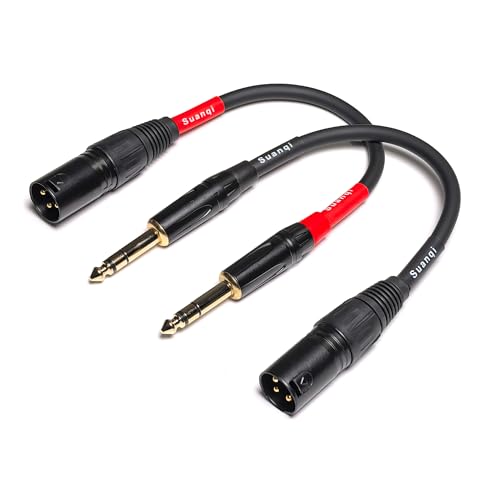
If your rig lives on a pedalboard or a desktop, you already know the problem: full-size cables turn into a coiled mess behind your gear. These Suanqi leads solve it with an 8-inch run, so the connection from your 1/4-inch output to an XLR male input stays short and tidy. Two cables come in the pack, which means you can wire a stereo pair or keep a spare in the bag.
The signal path is genuinely balanced, built from 4N oxygen-free copper with shielding wrapped around it. In plain terms, that is high-purity copper that resists corrosion and carries the audio cleanly, and it is the reason these cables run quiet. The connectors use 24K gold plating, which fights the tarnish that slowly degrades a cheap plug over years of use. The value is the draw: a balanced pair at entry-level money is rare.
Compatibility is broad: amplifiers, mixers, soundboxes, guitar tuners, and it slots neatly into a Line 6 HX Stomp setup. The flexible PVC jacket resists kinking and tangling, so the short run stays manageable in a crowded board. The limit is length. At 8 inches these are patch cables, not stage cables — if you need to cross a room, look further down this list.
Why These Earn The Top Spot
- Balanced 3-pin XLR to 1/4-inch TRS wiring keeps the signal clean
- Two cables in the pack for the same outlay
- 24K gold-plated connectors resist corrosion over time
- 4N oxygen-free copper conductors with shielding
The Limit Worth Knowing
- 8 inches only — a patch cable, not a run to the stage
- Red and black colourway is fixed, so matching a rig exactly is not possible
Made for: pedalboard and desktop rigs that need a balanced, ultra-short patch between a 1/4-inch output and an XLR input.
Pass on these: if you need to reach across a stage — the 8-inch length simply will not get there.
2. Disino Female XLR to 1/4 Inch TS Mono Jack Cable
The mic-to-amp workhorse that handles a dynamic mic without a single crackle.
Here is the cable for the singer who plugs a handheld dynamic mic straight into a guitar amp. The female XLR end takes the mic, the 1/4-inch TS mono jack goes into the amp, and the run measures 6.6 feet. The 20 AWG gauge is the thicker of the two gauges in this lineup — and it shows, because copper thickness is what keeps a quiet signal quiet.
Disino builds this with 4N oxygen-free copper, foil shielding, and a metal braid shield working together to block interference. That combo is why the audio arrives without hum or buzz. The 24K gold-plated connectors resist corrosion and, importantly, are sized right — they seat firmly rather than wobbling loosely or gripping so hard you fight to unplug them. This one gets along with common dynamic mics including the Behringer XM8500, XM1800S, and the Sennheiser E835.
Where it wins: the build quality is the headline, with a cotton yarn wrap inside to damp vibration and polyethylene insulation tuned to protect high-frequency detail. The cable measures 6.0mm across, which keeps it flexible without feeling flimsy.
What to weigh: this is an unbalanced TS cable, so it is built for shorter runs and simple setups, not long balanced studio lines. The plug fit also splits opinion — most get a snug seat, a few find theirs tighter or looser than they would like.
Reach for it if: you need a dynamic mic into an amp or mixer and want thick 20 AWG copper doing the work.
Look elsewhere if: your setup needs a balanced TRS connection — this plug is mono TS.
3. KINXIYU XLR Male to 1/4 Inch TS Cable, 20 FT

Twenty feet of braided copper for the player who needs to actually move on stage.
Length is the whole story here: 20 feet against the BIFALE pack’s 6. This KINXIYU runs 20 feet against the 6 feet of the BIFALE pack — a widely different reach for anyone wiring a live stage. That extra distance is exactly where a cheap cable usually fails, so the double shielding matters: a high-density bare copper braid plus aluminium foil working together to block electromagnetic and radio frequency interference.
The conductor is 22 AWG oxygen-free copper, and the outer nylon braid takes the scuffs and abrasion that stage life throws at a cable. The braid is rated for a 10000+ bend lifespan, and the metal housing at the connector ends protects the joint where cables usually fail. Buyers report 14 months of use without issues — the kind of durability that matters when you coil and uncoil every night.
The honest trade-off shows up in the sound. While this cable functions reliably and the durability holds up, the value and noise feedback both come in mixed, with some owners reporting noise issues. If your rig is sensitive to interference, test the run before you commit to a whole stage full of them. It is also an unbalanced TS cable, so balanced studio monitoring is not what it is built for.
The long-reach argument: 20 feet of double-shielded, braid-wrapped cable is the practical answer for reaching a pedalboard from a backline amp without dragging your gear across the floor.
The caution: noise can creep in for some setups, so a quick line check before the show is worth the two minutes.
Pick this when: the distance is the problem and you need braided, bend-rated cable to cover 20 feet of floor.
Choose a balanced option instead: if your chain is a studio line where hum is unacceptable.
4. Disino 3.5mm to XLR Male Cable, 10 FT

The adapter that turns a headphone jack into a proper mixing desk input.
Not every buyer needs a quarter-inch plug at all. If your source is a phone, tablet, laptop, MP3 player, or voice recorder, this Disino lead takes that 3.5mm headphone output and feeds it into an XLR input on a console or powered speaker. It is a 10-foot run, so you can leave the phone on the desk while you work the mixer.
One thing to understand before you buy: this is an unbalanced cable, and it merges left and right into a single mono feed. The L and R channels are soldered together and sent to XLR Pin 2, with Pin 1 and Pin 3 tied to ground. That is fine for playback into a PA, but it is not suitable for most balanced applications, so do not buy it expecting a stereo split.
The build is the same 20 AWG oxygen-free copper and high-density foil shielding you would want, keeping static and popping out of the line. The 3.5mm connector has 360-degree grip treads and a step-down design so it seats into recessed phone ports. The honest note on sound is that it comes through beautifully for most, though not every setup reports a normal-sounding result — worth a trial run if your signal path is unusual.
What It Delivers
- Connects phones, tablets, laptops, and MP3 players to an XLR input
- 20 AWG oxygen-free copper with foil shielding against interference
- Stepped 3.5mm plug with grip treads reaches recessed phone ports
- 10 feet of reach for desk-to-mixer routing
Before You Order
- Unbalanced and mono only — left and right channels are merged
- Sound quality feedback is mixed, so test it in your chain first
It fits: anyone playing audio from a 3.5mm device into a console, powered speaker, or mixing desk.
Not for: balanced studio routing or anyone expecting separate stereo channels.
5. BIFALE 1/4” TRS to XLR Male Cable, 6 FT 2-Pack
Built to survive a thousand plug-ins without giving up a clean, balanced signal.
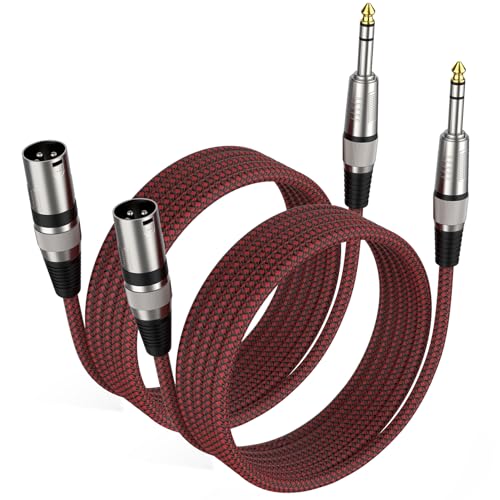
Two 6-foot balanced cables in one pack is the practical pitch, because most home studios run a pair of monitors and need both at once. The conductors are 22AWG 100% oxygen-free copper, and BIFALE claims that setup delivers pristine sound with no signal loss, no delay, and no noise. The balanced TRS-to-XLR-male wiring is what makes the difference in a monitor chain.
Durability is where the spec sheet puts its weight. The contacts are rated for 10,000+ plug cycles, and the cable itself for 26,000+ bends without losing flexibility. The PET braided jacket is claimed by the maker to be 10X more durable than PVC. The alloy metal connectors carry gold-plated contact points, and the temperature range runs from -4℉ to 194℉ so heat and cold are not a concern.
Cable thickness is where this one separates itself from the Suanqi patch pair above — the BIFALE gauge is 22 against the thinner build of some rivals, with a 7.0mm outer diameter for a sturdy feel. The cotton yarn core adds tensile strength so it survives being pulled across a desk. It runs alongside shotgun and condenser mics including the Nady CM-2S and Azden SGM-1X, plus studio and live use.
The standout number: a 26,000+ bend rating is the kind of figure that turns a cable from a consumable into a fixture in your rack.
Second thought: the 6-foot length suits a desktop studio but will not cross a room, and the red jacket is not going to blend into every setup.
The right fit: a home studio wiring two monitors who wants both cables in one box and a bend rating that will outlast the gear.
Consider another length: if 6 feet cannot reach your monitors from the interface.
6. Pig Hog PX-TMXM25 1/4″ TRS to XLR Cable
The long balanced run that treats distance as an afterthought.
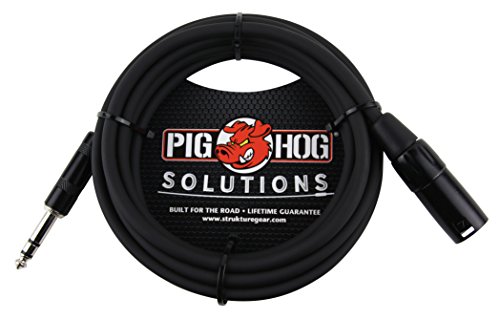
When the interface sits on one side of a room and the powered speakers on the other, 25 feet is the number that matters. This Pig Hog is a balanced TRS to XLR male adaptor cable, so the long run keeps the hum-cancelling benefit of balanced wiring. It is the only 25-foot option here, and that alone puts it in a category of one for studio layouts that sprawl.
What owners consistently note is how solid the thing feels, and how well made the connections are. The reinforced connections are the kind of detail that matters at 25 feet, where a loose joint is the most common failure point. Sound quality and reliability show up as the recurring strengths, and the construction gets mentioned as a stand-out in its own right.
It pairs naturally with musical instruments and powered monitor setups. The one thing to watch: this is one cable, not a pair, so a stereo monitoring setup needs two of them. And at 25 feet, coiling it up neatly becomes part of your routine.
Why it earns the premium label: a balanced 25-foot adaptor cable with a reinforced connection is a rare combination that solves a genuine studio problem.
Buy two: the pack holds a single cable, so a stereo pair is a double order.
Best for: a studio room that needs a balanced cable to cross real distance from rack to speaker.
Skip the double up if: you only run a mono monitoring chain — one cable is all you need.
7. Mogami Gold 1/4 TRS to XLR Male Cable, 6 ft

The studio cable that kills hum, buzz, and hiss at any volume.
The defining spec here is the Neglex star-quad design, which runs four conductors instead of two to cancel the noise cheaper cables let through. In plain terms, the extra wires work against each other so interference cancels itself out. That is why the line from your interface to powered monitors stays silent even with phones, routers, and power bricks sitting nearby.
Around that core sits a 100 percent coverage spiral pure-copper shield running the full length of the cable. That high-density coverage is what rejects the cellphone beeps and ground-radiated power hum that thinner braided or foil shields allow through. The result is a quiet background from the first plug-in, and the neutral, accurate tone means you hear the true signal from your interface rather than cable colouring.
Gold contact connectors lock in a tight, corrosion-proof fit, and every Gold cable carries a lifetime warranty against problems — even those that are your fault. What owners mention above all else is the quality: hum-free sound and complete silence at full volume. The recurring gripe is the cost, which lands at the top of this list without apology. If you are wiring a serious monitoring chain, it is the one to reach for.
Where It Stands Alone
- Neglex star-quad four-conductor design cancels interference through the cable
- 100 percent coverage spiral pure-copper shield runs the full length
- Lifetime warranty covers replacement for any problem
- Hum-free, dead-silent performance at full volume
The Honest Catch
- Priced well above every other cable on this list
- 6 feet only, so long room runs need another option
Made for: the studio desk that demands absolute silence between interface and powered monitors, backed by a lifetime warranty.
Think twice if: your budget is tight or you need a longer run — this is a 6-foot premium cable.
Know the Specs
Balanced vs Unbalanced Wiring
A balanced cable carries the signal on three wires, so any noise it collects on the way is cancelled when it arrives. That means a balanced TRS to XLR male cable can run longer distances without hum, which is why it is the standard for studio monitors and mixers. An unbalanced cable uses two wires, works fine over short runs, and is common for a mic into an amp — but over longer distances it tends to pick up interference.
TRS vs TS Plugs
TRS stands for tip-ring-sleeve, the three-segment plug on a balanced cable. TS stands for tip-sleeve, the two-segment plug on a mono unbalanced cable. Check your output before buying — a TS plug into a TRS socket will pass signal, but it will not give you the balanced benefit. Reversing plug gender is the other common mistake, so confirm which end is male and which is female on your gear.
Gauge
The gauge number refers to the copper thickness, and a lower number means thicker copper. 20 AWG is thicker than 22 AWG, and thicker copper can carry a signal with more resilience over distance. It is not the whole story — shielding and connector quality matter just as much — but it is a useful shorthand for build heft when you compare two cables side by side.
Shielding
Shielding is the metal or foil wrap around the conductors that blocks outside interference from radio signals and power hum. Foil shielding blocks high-frequency noise, braided copper handles a broad range, and combining both is the double-shielded approach. On a short cable the difference is subtle, but on a 20 or 25-foot run the shield quality is often what separates a clean signal from a buzzy one.
Common Questions
Will a 1/4 inch TRS to XLR cable work with my studio monitors?
What is the difference between a TS and a TRS 1/4 inch plug?
Can I use an unbalanced 1/4 to XLR cable for a long stage run?
Does the cable gauge actually affect the sound?
What does 24K gold-plated connectors actually do?
Can I connect my phone to a mixer with a 3.5mm to XLR cable?
Is a balanced cable really worth the extra cost?
How long will a braided 1/4 to XLR cable last?
Why does my cable pick up radio noise or a buzzing sound?
Can I run two powered speakers from one pack of cables?
The Bottom Line
The best balance of build quality and range for most rigs is the Suanqi 1/4 Inch TRS to XLR Male 2-Pack, because you get two balanced cables and gold-plated connectors for the money. If your desk needs a second pair of monitors wired at once, the BIFALE 6 FT 2-Pack adds a bend-rated braided jacket built for the long haul. And when silence between interface and speakers is the only thing that matters, the Mogami Gold is the cable the studio crowd keeps coming back to.
How we choose
We do not accept paid placement. Every pick is matched to a real buyer and a real use-case; we do not hands-on test units.
Sources
Specifications: manufacturer listings and product documentation. Review insights: verified customer reviews, as of November 2026. Pricing: not shown on this page (it changes often); check the current price via the retailer link.
As an Amazon Associate, My Heart Lives Here earns from qualifying purchases. This does not affect which products we feature.