Heads up: This post contains affiliate links. As an Amazon Associate I earn from qualifying purchases, at no extra cost to you. Learn more
Specs are compiled from manufacturer listings and verified buyer reviews and can change over time — please confirm the key details on the product page before buying.
If you rely on a CPAP, a night away from a wall outlet is the real problem — not the machine itself. The picks below all run your therapy off a battery, and the honest split is simple: light batteries fly with you, big batteries last multiple nights.
This guide is built by comparing the manufacturers’ published specifications and the patterns across verified customer reviews, so you get each pick’s real strengths and trade-offs instead of marketing spin.
The single number that decides everything is watt-hours, because that is what buys you hours of sleep. Here is how to match a battery to your machine and your trip with the cpap machine for travel.
Top Picks


How To Choose The Best Cpap Machine for Travel
Three things decide whether a travel battery actually works for you.
Watt-hours
More watt-hours means more nights off the grid, so a 95Wh pack and a 297.6Wh pack are not the same trip.
Airline limits
Packs under 100Wh are built for carry-on flying, while larger ones exceed the 160Wh TSA limit and stay on the ground.
Machine fit
Check the cables match your exact model, because a battery without the right DC cable will not power your therapy.
Side-by-Side Comparison
| Model | Best For | Capacity | Weight | Airline OK | Amazon |
|---|---|---|---|---|---|
| EASYLONGER ES960★ Best Overall | Multi-night camping | 297.6 Wh | 6.6 lb | No (over 160Wh) | Amazon |
| BLUETTI X30Home Backup Pick | Outage backup at home | 297 Wh | 4.1 lb | — | Amazon |
| Pilot-24 Lite (S9 cable)Automatic Backup | Power-outage protection | 95 Wh | 2.27 lb | Yes (under 100Wh) | Amazon |
| Pilot-24 Lite (car charger) | Road trips | 95 Wh | 560 g | Yes (under 100Wh) | Amazon |
| Zopec Explore Mini | Flying carry-on only | — | 1.1 lb | Yes (FAA carry-on) | Amazon |
| Freedom 160Wh | Long nights, no humidifier | 160 Wh | 3.59 lb | Yes (FAA carry-on) | Amazon |
| Pilot Flex Navy | Short hops, dual voltage | 98 Wh | 1.92 lb | Yes (under 100Wh) | Amazon |
| Zopec Explore 5700 | International travel | 5700 mAh | 1134 g | Yes (FAA-compliant) | Amazon |
Detailed Reviews
1. EASYLONGER CPAP Battery Backup ES960
Our pick — 4.5+★ from 150+ verified ratings; the strongest balance of quality and price.
The camper’s battery: a 297.6Wh pack that runs your CPAP for two nights or more.
The ES960 is the pack to buy if you sleep in a tent, an RV, or anywhere the wall socket doesn’t exist. Its 297.6Wh LiFePO4 (lithium iron phosphate) battery covers 2+ nights of therapy without the humidifier or heated tube, and the runtime shifts with your pressure settings. Buyers report it powers an AirSense 11 and clears 10 hours — the camping scenario it was built for.
Four cables are in the box, so it works with ResMed S9, AirSense 10/11, AirCurve 10/11, AirMini, Philips DreamStation 1/2 and Luna G3. It weighs 6.6 pounds against 1.1 pounds on the Zopec Explore Mini, so it is the stay-put pack, not the carry-on one. It also exceeds the 160Wh TSA limit, so this one stays out of the cabin.
Why it wins the shortlist
- 297.6Wh covers 2+ nights per charge
- FSA/HSA eligible with four cables included
The honest catch
- 6.6 lb and over the 160Wh flight limit
- Full recharge runs 5–8 hours
Built for: the multi-night camper who leaves the grid behind.
Not your pack: if you fly carry-on only.
2. BLUETTI CPAP Battery Backup X30 297Wh
A 297Wh bedside pack for storm season, with a handle and a carry bag.
The X30 is the outage pick. Its 297Wh reserve claims 5–7 nights on ResMed AirSense and DreamStation machines, and it weighs 4.1 pounds — noticeably lighter than the ES960’s 6.6 pounds. Three DC ports at 12V/5A, 15V/4A and 24V/4A handle the CPAP cables, and five labeled cables ship in the bag. What wins people over is how well it performs, and the build quality holds up.
The follow-up question is runtime. Compatibility is the other fit note: DreamStation users report it won’t work with their machines. Check your model against the cable list before you buy.
Performance first: the thing buyers rave about is steady output for small devices, with 100% of portability comments positive.
Reach for this if: you want a bedside backup for hurricane season.
Look elsewhere if: you run a DreamStation — compatibility is a known split.
3. Pilot-24 Lite 95Wh (S9 Cable)
A 95Wh aluminum-shell pack that cuts over the instant the grid drops.
This is the plug-it-in-and-forget-it pack. Leave it connected at home and it takes over automatically when the power dies, with no interruption to therapy. At 95Wh and 1.3 pounds, it sits under the 100Wh carry-on line, so it flies with you and recharges in 2–3 hours.
S9, AirMini and AirSense 10 cables all come in the box — uncommon at this size. Functionality is what earns the praise. The runtime, though, splits owners evenly: some get a full night, others barely see 3.5 hours. Note too — the AC power cord is not included, and this pack is priced like a premium one.
Where it earns its place
- Automatic switchover during outages
- Three machine cables included
What to plan around
- Runtime varies by machine and settings
Best fit: the home user who wants silent storm protection.
Think twice: if you want a guaranteed full night from a single charge.
4. Pilot-24 Lite 95Wh (Car Charger)
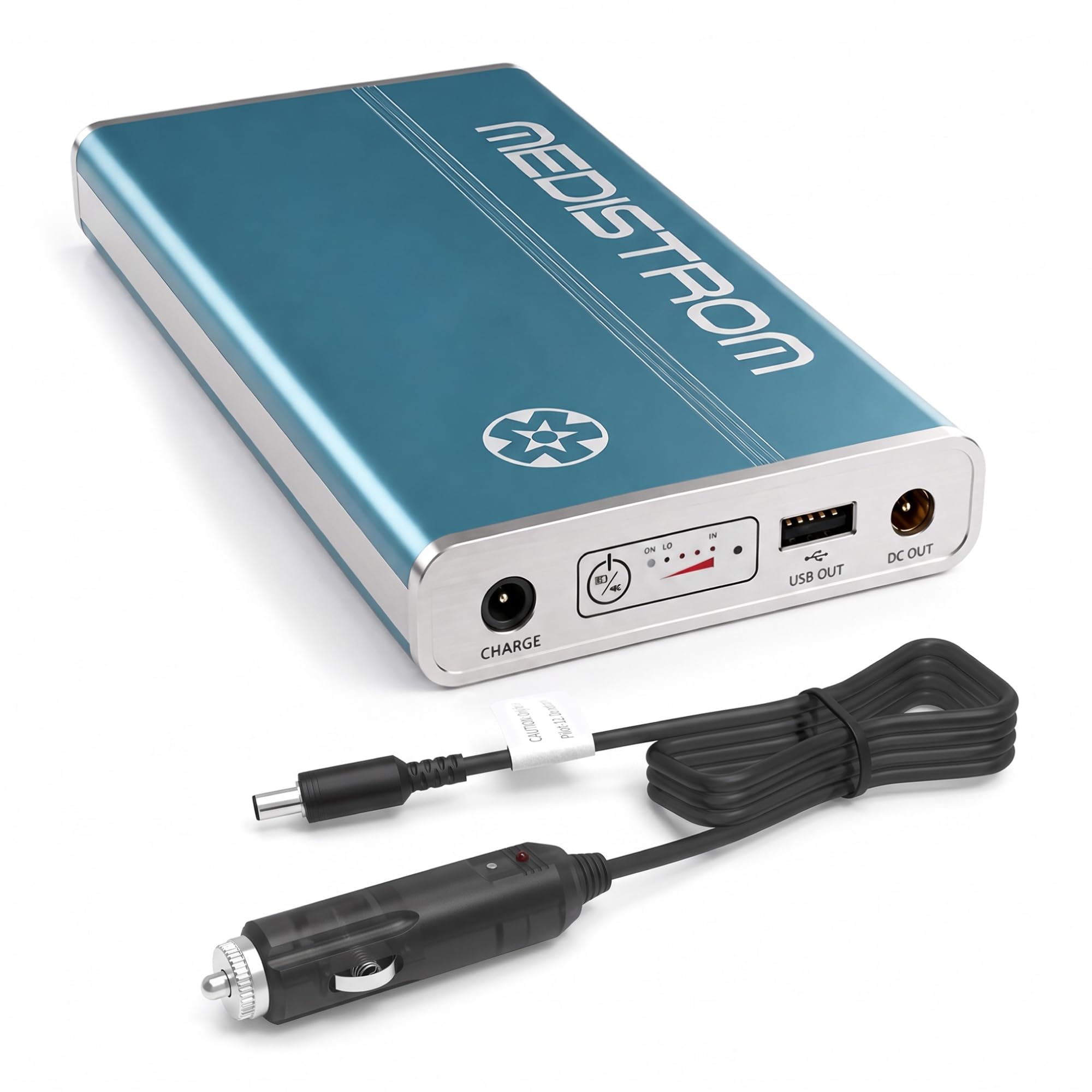
The car-charger twin, built for the dashboard and the campground alike.
Same 95Wh aluminum body as the S9 variant, but the box swaps in a car charger and ships AirMini and AirSense 10 cables. It powers phones and tablets too — useful when one battery is supposed to cover the whole trip. It stays under the 100Wh flight line and recharges in 2–3 hours.
The split here is wider than on its sibling. Owners mention anything from 19.75 hours down to 3 hours on a charge, and some units stop charging within a year. Power delivery itself draws the good word. Accessories are the variable — some boxes arrive missing cords, so check yours on arrival.
Power where it matters: steady output draws the positive comments, and portability is the second-strongest note.
Good match: the road-tripper who wants a dashboard charger in the box.
Consider the alternative: if runtime consistency matters more than the car cable.
5. Zopec Explore Mini CPAP Battery

Just 1.1 pounds and 6.5 x 3 x 1 inches — a pack that disappears in a carry-on.
If weight is the whole reason you are shopping, this is the number that matters. At 1.1 pounds it is 5.5 pounds lighter than the ES960’s 6.6 pounds, and it is 36% smaller in volume terms. Multi-voltage technology adapts to 24V, 12V and 19V devices, and solid-state cooling means no fan noise beside the bed. Recharge runs 1.5 hours on the included USB-C charger, and Zopec covers the battery for 18 months.
The open question is runtime. Owners consistently report it never lasts beyond six hours, so treat the “up to 2 nights” claim as the optimistic end. AirMini and AirSense 11 cables are included; every other machine needs a separately sold cable kit.
What makes it fly
- 1.1 lb and 1.5-hour recharge
- No fan, so quiet at the bedside
The trade you accept
- Runs on the short side of six hours
Pick it for: one short flight or a weekend with the AirMini.
Pass on it: if you need two full nights from one pack.
6. Freedom CPAP Battery 160Wh
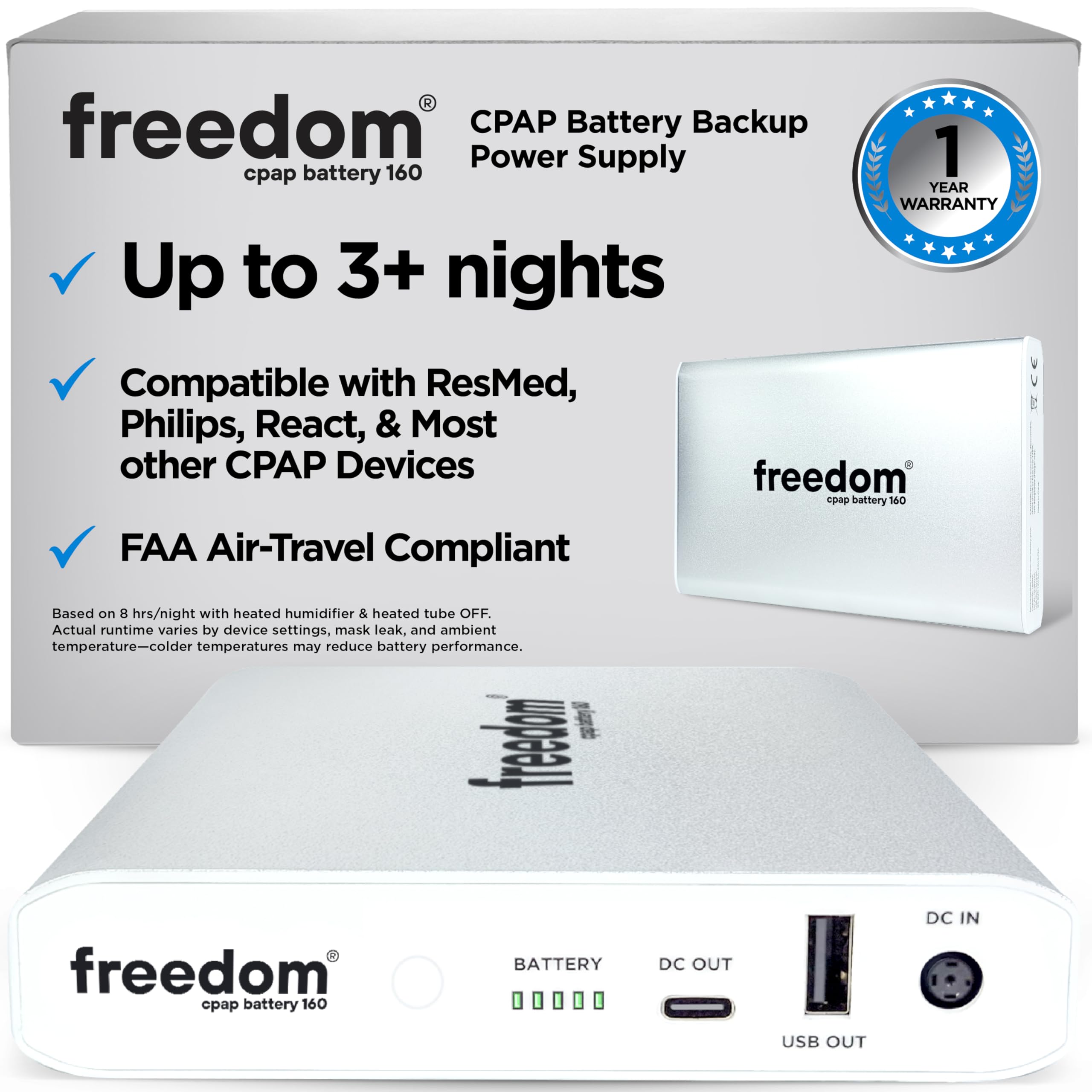
160 watt-hours that still legally boards the plane — a narrow but useful window.
The Freedom sits right at the top of the FAA carry-on allowance at 160Wh, so it goes in the cabin while bigger packs cannot. Battery Power Solutions publishes tested runs: up to 24 hours on AirSense 11, up to 30 on AirMini, up to 19 on AirSense 10, and up to 35 on DreamStation 2 — all at pressure 10, without a heated humidifier or tube. It weighs 3.59 pounds.
Portability is the strong suit, and camping is clearly the intended use. The caution is durability: a meaningful share of customers note units failing after a couple of uses, and battery life draws as much criticism as praise. Treat it as a good trip battery with a real longevity gamble.
The camp-friendly build: light enough to pack, and it supports most major CPAP machines from the start.
What to weigh first: long-term reliability is the consistent worry, so buy with that in mind.
Worth it for: travellers who need maximum watt-hours in the cabin.
Second-guess it: if you want a battery to last several seasons.
7. Pilot Flex Navy 98Wh CPAP Battery
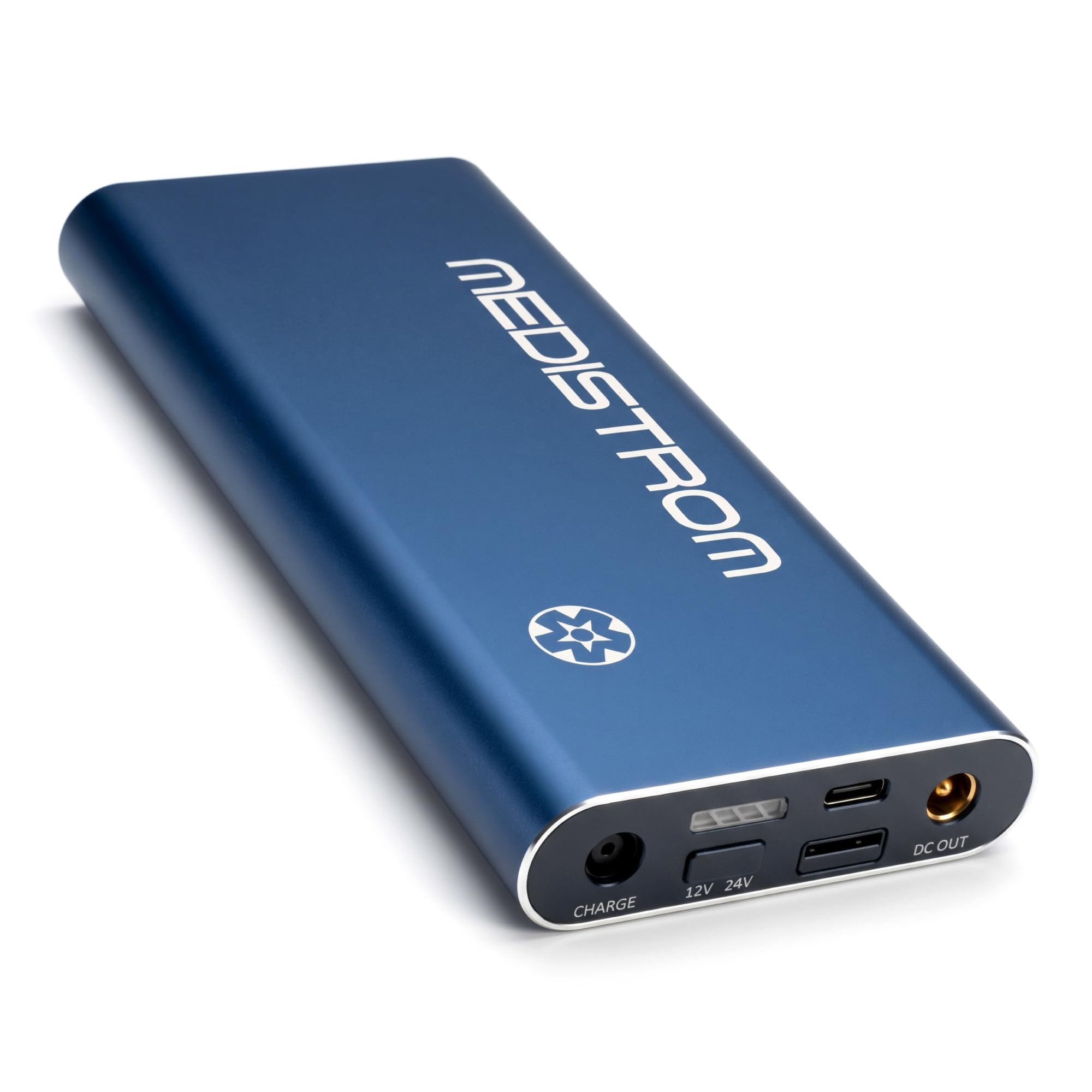
One 98Wh pack built to handle both 12V and 24V machines.
Dual-voltage support is the reason this pack earns a slot. It runs 12V and 24V machines from one body, ships AirMini and AirSense 11 cables, and weighs 1.92 pounds — heavier than the Zopec Mini but still carry-on friendly at 98Wh. Recharge takes 2–3 hours.
Owners are genuinely split here. Some find it great; others say it won’t power an AirMini for two full nights, and a few report the CPAP shutting down after about 15 minutes. It is a short-trip pack used within its limits rather than a nightly workhorse.
Reach for it: if you own both a 12V and a 24V machine and want one battery.
Better served elsewhere: if you need a guaranteed two-night run.
8. Zopec Explore 5700 Universal Travel CPAP Battery

The no-adapters pick, built for international sockets and mixed machine brands.
Zopec’s 5700 takes 110-240V input, so one power solution covers overseas travel without a pile of adapters. It handles ResMed, Philips Respironics and DeVilbiss machines, and the vendor claims 16–24 hours (up to 3 nights). That number only holds without the humidifier or heated tube — with either running, it struggles to reach 8 hours. Weight is 1134 g and it is FAA-compliant.
This is the one to buy if your itinerary crosses borders and machine brands. The vendor’s own runtime caveat is the thing to plan around, so pack it for a trip without heated humidification.
Why travellers pick it
- Works across brands without extra adapters
- Car charger included for the road
What limits it
- Rated runtime assumes no humidifier
The right call: for international trips with varied machines.
Not the right call: if you cannot sleep without the humidifier.
Know the Specs
Watt-Hours (Wh)
Watt-hours measure how much energy the pack stores, which is what buys your nights of sleep. A 95Wh pack covers a short trip; a 297.6Wh pack carries you several nights. Heated humidifiers and heated tubes drain that reserve faster.
Weight and Airline Limits
Lighter packs travel easier, but capacity usually follows size. Packs under 100Wh clear carry-on rules, and the FAA limit is 160Wh. Anything above 160Wh, like the 297.6Wh ES960, stays on the ground.
Common Questions
Can I take a CPAP battery on a plane?
How many nights will a 95Wh battery last?
Does the heated humidifier drain the battery faster?
The Bottom Line
For most people, the cpap machine for travel winner is the EASYLONGER ES960, because 297.6Wh covers multiple nights and it ships with four cables for the major machines. If you fly carry-on, grab the Zopec Explore Mini at 1.1 pounds. And for outage backup at home, the Pilot-24 Lite switches over automatically without you touching a thing.
How we choose
We do not accept paid placement. Every pick is matched to a real buyer and a real use-case; we do not hands-on test units.
Sources
Specifications: manufacturer listings and product documentation. Review insights: verified customer reviews, as of November 2026. Pricing: not shown on this page (it changes often); check the current price via the retailer link.
As an Amazon Associate, My Heart Lives Here earns from qualifying purchases. This does not affect which products we feature.