Heads up: This post contains affiliate links. As an Amazon Associate I earn from qualifying purchases, at no extra cost to you. Learn more
Specs are compiled from manufacturer listings and verified buyer reviews and can change over time — please confirm the key details on the product page before buying.
Buying insulation for PEX tubing goes wrong in one specific way: you grab a sleeve that looks like it fits, get it home, and find it was cut for copper. PEX pipe has its own outside diameter, so a wrap sized for 3/4-inch copper will hang loose on 3/4-inch PEX — and a loose wrap leaves an air gap where heat escapes and condensation forms. This guide picks apart what actually matters: wall thickness, inner diameter matched to PEX, whether the seam self-seals, and how the material holds up outdoors through a freeze.
This guide is built by comparing the manufacturers’ published specifications and the patterns across verified customer reviews, so you get each pick’s real strengths and trade-offs instead of marketing spin.
Some picks here are tubes, one is an elbow cover, and one is a stretch-and-wrap tape — so the first decision is which format your run actually needs. Here is how each option behaves on real PEX runs, which is the whole point of this guide to the best pipe insulation for pex.
Top Picks


How To Choose The Best Pipe Insulation for PEX
The mistake nearly every first-timer makes is buying by the pipe’s nominal size alone. “3/4-inch” on a PEX line and “3/4-inch” on a copper line are not the same physical outside diameter. If the sleeve slides on with room to rattle, you have not insulated anything — you have built a chimney for cold air. Match the inner diameter of the insulation to the actual outside diameter of your PEX, then let thickness and material do the rest.
Inner diameter first, thickness second
Inner diameter is the hole the pipe slides into. A pre-slit tube meant for 3/4-inch pipe is sized to grip that pipe snugly, and a snug fit is what stops air from moving along the length of the tube. Once the fit is right, look at wall thickness — the measurement of the foam between the pipe and the outside world. A 0.51-inch wall gives you more material to slow heat transfer than a 0.25-inch wall, but it also takes more room in a tight stud bay.
Closed-cell foam versus everything else
Closed-cell foam has sealed bubbles, so it resists soaking up water the way a sponge would. That matters on cold-water PEX lines, where condensation is the real enemy, and on outdoor runs that see rain and snow. A closed-cell rubber or polyethylene tube holds its shape and its insulation value far better in a damp basement than open, fibrous material does.
Does the seam hold shut?
A pre-slit tube is only as good as the seam that closes back up around the pipe. Some tubes rely on a self-adhesive flap, some on the foam’s own tension, and wrap tapes count entirely on their adhesive backing. If the seam pops open, warm moist air gets in, and the whole assembly loses its point. Check whether the seam needs extra tape or foil before you commit.
Side-by-Side Comparison
| Model | Best For | Format | Wall Thickness | Coverage | Amazon |
|---|---|---|---|---|---|
| K-FLEX USA Elastomeric★ Best Overall | Straight PEX runs and AC lines | Elastomeric sleeve | 0.25 inches | 6 linear feet | Amazon |
| Plerile Foam TubeThickest Wall | Tight bends and odd shapes | Cut-and-glue foam tube | 0.79 inches | Thermal insulation | Amazon |
| Redford Supply Co. Wrap | Awkward outdoor runs and fittings | Stretch-and-wrap tape | 3 inches | 42 square feet | Amazon |
| Frienda Elbow Cover 12 Pack | Elbows and corner joints | Pre-cut elbow covers | 0.39 inches | 12 Count | Amazon |
| FUYITE Foil Tube 12 Pack | Outdoor runs with sun exposure | Foil-faced pre-slit tube | 0.51 inches | 15.74 feet total | Amazon |
Detailed Reviews
1. K-FLEX USA 3/4″ x 6 ft. Elastomeric Pipe Insulation
Our pick — 4.5+★ from 150+ verified ratings; the strongest balance of quality and price.
The flexible rubber sleeve that bends around real PEX runs without splitting at the seam.
If you want one product to handle a straight cold-water PEX line and a tight AC refrigerant run with the same roll, this is the closest thing to a do-it-all pick. It is an elastomeric sleeve — a rubber-based tube that flexes rather than cracks — and that flex is what lets it follow a PEX line around a joist instead of fighting it. You get 6 linear feet in a single count, which covers a short run rather than a whole basement.
The wall comes in at 0.25 inches, a moderate thickness that slips into a stud bay without swallowing space. Compare that to the 3-inch foam wrap in this list and the difference is format, not quality — the K-FLEX is a sleeve you slide over a pipe, while the wrap winds around whatever shape you have. For straight PEX, the sleeve wins on speed. It is also the heavier of the two small-format picks at 16 ounces, so it feels like solid material in the hand rather than a flimsy pool noodle.
What wins people over here is the overall build quality, and the sealing tape is the detail that keeps coming up — it goes on sticky and seals the seam down flat rather than curling open a day later. Ease of installation gets the same warm reception, because there is no gluing and no wrapping, just slide and press. The fit is reported as spot-on for 3/4-inch lines, which is exactly the trait that separates a working install from a loose one. One caveat worth knowing: this is a short 6-foot length, so a long PEX run needs more than one roll, and that adds up.
Where it earns its keep
- Elastomeric rubber flexes around bends instead of cracking at the seam
- Self-sealing tape holds the slit closed for a snug, air-tight wrap
- 0.25-inch wall fits a standard stud bay without crowding it
- Genuine 6 linear feet of coverage per roll
What to plan around
- 6 feet goes fast on a long run — buy by the length you actually need
- One count per pack, so multi-run jobs mean multiple rolls
Reach for this if: you have straight PEX or AC lines and want a sleeve that slides on and seals without extra tape.
Look elsewhere if: your run is longer than a few feet or you are insulating elbows — this sleeve is built for the straight sections.
2. Plerile Water Pipe Insulation Tubing 3/4″ Foam Tube
The heavyweight foam tube for buyers who want maximum wall between pipe and cold air.
Start with the number that decides this one: a 0.79-inch wall thickness. That is the thickest foam wall on this list by a wide margin, and thickness is what buys you freeze protection and thermal lag. On a vulnerable outdoor PEX run or an unheated crawlspace line, more foam between the water and the weather is the whole point. The catch is that this much wall needs more clearance, so measure your stud bay or pipe chase before you commit.
The tube is rubber with a closed-cell structure — sealed bubbles that resist soaking up moisture — and it is designed as a cut-and-glue job. You size the piece, slice it, and glue the seam rather than relying on a self-stick flap. The maker also lists it as flame retardant and water-proof, and it is sold as a single tube rather than a pack. Think of this as the tradesman’s approach: a little more effort at the seam, less fighting with a flap that gives up later.
The high-quality foam construction is what people tend to notice first, and the weather protection holds up in practice — owners describe it shielding outdoor pipes and even wrapping odd household shapes that needed a padded cover. Honest trade-off to know: this is not a quick-wrap product. Shaping it around complex bends takes patience, and opinions on the actual thickness vary, with some describing a very thick wall and others finding it thinner than expected. Treat the 0.79-inch figure as your spec sheet reference and check it against the pipe diameter you are covering.
Built for the tough jobs: a 0.79-inch closed-cell wall is the most material per inch of pipe in this lineup — good for lines that face genuine cold or constant damp.
Know before you cut: this is a glue-the-seam tube, not a peel-and-stick one, so budget a little extra time and a tube of adhesive for the job.
The right call for: anyone insulating exposed or outdoor PEX who values wall thickness over installation speed.
Not the pick if: you are wrapping a maze of fittings — the wrap tape handles complex shapes with less fuss.
3. Redford Supply Co. 3 inch x 14 ft Outdoor Pipe Insulation Wrap
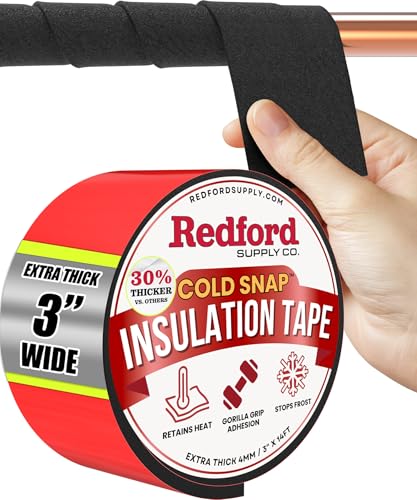
A 14-foot stretch tape for the fittings, bends, and awkward spots a rigid tube cannot reach.
Here is the honest version up front: this is the tool that solves the problem sleeves cannot, and it asks a little prep in return. The roll measures 132 inches long by 3 inches wide, which the maker translates to 42 square feet of coverage — a lot of ground for one roll. The ARCTIC EVA foam is built to stretch and contour, so it snakes around a PEX elbow or a valve cluster where a pre-cut tube would leave a gap. If your run has any complexity at all, a roll of this belongs in the kit alongside your sleeves.
Where it wins is the work itself. People describe the application as fast and stress-free — you wind it on and keep moving, with no gluing and no waiting. It holds up outdoors through winter duty, and the foam’s stretch is what makes that possible on irregular shapes. As a freeze-protection layer over an exposed outdoor water line, it does the functional job well.
The recurring gripe is adhesion — the tape’s own stick is the weak link, and quite a few buyers end up adding their own tape to hold the tail down. Our advice: treat the built-in adhesive as a helper, not the fastener, and finish each run with a wrap of proper tape. That single habit turns this from a fussy product into a genuinely useful one, and it is the most-discussed trade-off in the listing. It is still a strong option for awkward runs; just go in knowing the adhesive is not the star.
Why it belongs in the toolbox
- 42 square feet of coverage per roll handles fittings a tube cannot reach
- Stretchable EVA foam contours around elbows, valves, and tight bends
- Fast to apply — wind it on, no glue or curing time
- Built for outdoor freeze protection on exposed lines
The honest caveat
- The self-adhesive backing is the weak point — add mechanical tape over the end
- Thickness feedback is split, so layer it on critical freeze zones
Pick this when: your PEX run is full of bends, tees, and valves that a straight sleeve cannot cover.
Pair it with: a roll of quality tape — the wrap works best when the tail is secured properly.
4. Frienda 12 Pack 3/4 Inch Foam Pipe Insulation Tube Elbow Cover

Twelve pre-cut corner covers sized to land exactly where your PEX makes a turn.
The job this pack does is narrow and specific: it fills the elbows. Straight tube insulation leaves the corners bare, and a bare corner is where cold air finds the pipe. This set gives you 12 pre-cut elbow covers, each about 3.15 inches long with a 0.87-inch inner diameter suited to 3/4-inch copper pipe. Because the same sleeves are also used on PEX runs of matching outside diameter, they are a neat way to cover the turn without wrestling a straight tube around it.
Compared to winding the Redford wrap around every bend, these slip on in seconds — the pre-slit design means you clamp the foam over the elbow and it holds. The expanded polyethylene foam has a 0.39-inch wall, giving you a decent barrier with good flexibility and tear resistance. The maker also lists fireproof, heat insulating, and sound absorbing properties, and the foam can be pulled off and reused if you need to move it. The whole pack weighs just 1.76 ounces, so an entire box of them goes in one hand.
One fair note: feedback on this pack is genuinely split. Some buyers find the covers do exactly what they should, while others find them not suited to their exact pipe size or feel they do not hold up as expected. That is a fit question more than anything — measure your elbow’s outside diameter and confirm the 0.87-inch inner bore clears it. If it does, these are the cleanest way to finish your corners. If your numbers do not line up, a roll of wrap gives you more slack.
The practical read: pre-cut elbows save you from butchering a straight tube to cover a corner, and 12 pieces mean you can do a whole manifold’s worth of turns in one sitting.
Check your diameter: the 0.87-inch inner bore is the number that decides whether these work on your run — measure first.
Best matched to: a PEX installation with multiple elbows that need a clean, pre-shaped cover instead of wrap.
Think twice if: your pipe’s outside diameter differs from the stated 0.87-inch bore — that fit mismatch is the root of most complaints.
5. FUYITE 12 Pack 3/4” Pipe Insulation Foam Tube
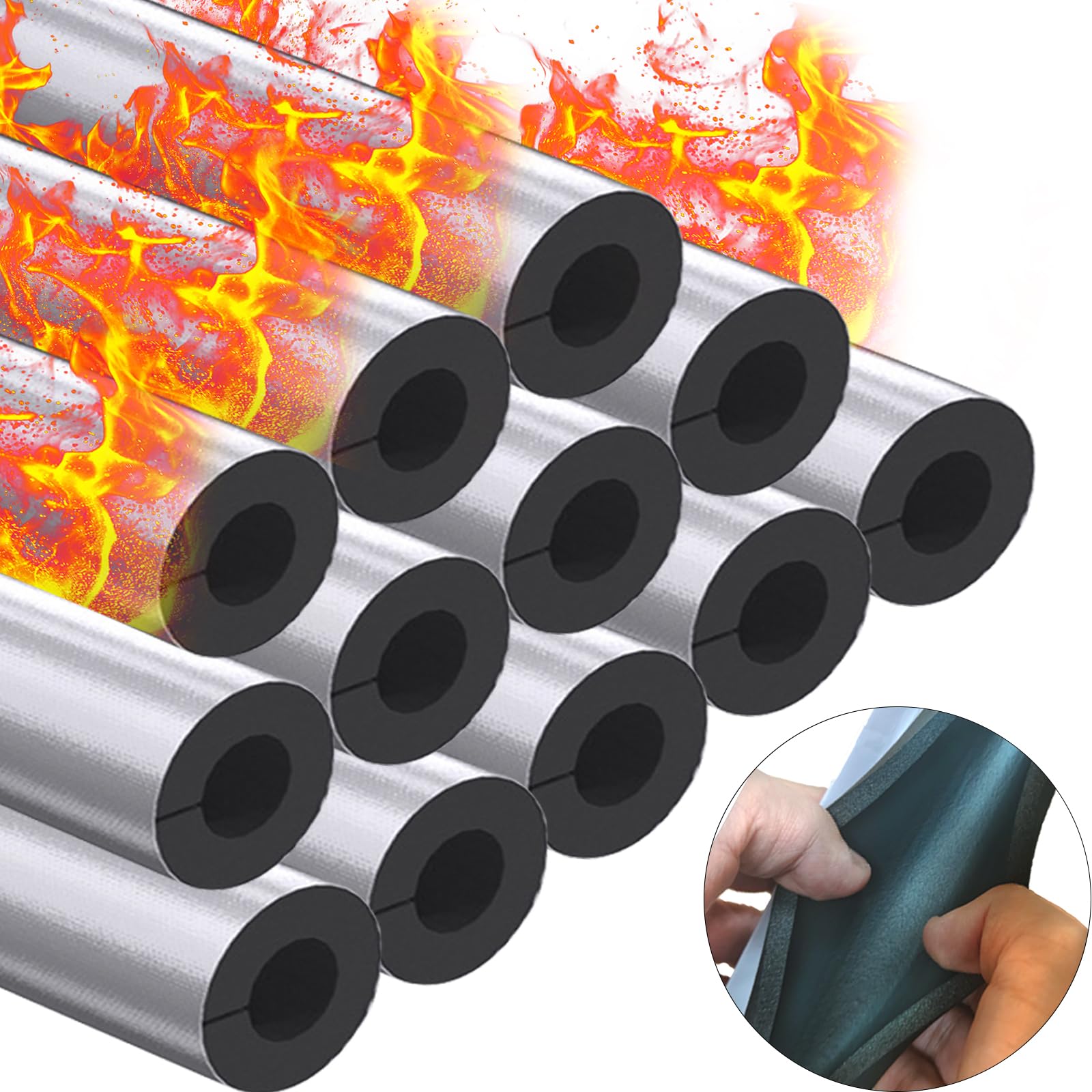
A foil-wrapped tube pack built to shrug off both winter freeze and summer sun.
The aluminum foil is the headline, and it earns the attention: a shiny metal face on the outside of the foam reflects heat and sheds water, which is why this is the pick for runs that face the sun rather than a basement ceiling. The set gives you 12 pieces, each 1.31 feet long, for 15.74 feet of total coverage in one box. Inner diameter is 0.8 inches with a 0.51-inch wall, and you cut each piece to the length your run needs. A 0.8-inch bore fits 3/4-inch pipe or smaller.
The foam is neoprene, which the maker notes as an alternative to older fiberglass pipe insulation — softer on the skin and easier to handle. Each piece is pre-slit with self-adhesive foil on the surface: you wrap it around the pipe, peel the backing, and press the seam closed. No extra tape required, which is a real difference from the wrap product’s adhesive struggles. The maker also claims the foil slows pipe aging by resisting water, oil, corrosion, and wear — a durable-skinned design rather than a bare foam shell.
One caveat: this listing carries the fewest reviews of the group, so the long-term story is thinner than the more established picks. The self-adhesive foil is also the piece to watch — press it down firmly along the whole seam, not just at the ends. Treat it as the outdoor and sunny-exposure specialist: 15.74 feet of foil-faced coverage, self-sealing, in one box.
What makes it the outdoor pick
- Aluminum foil face reflects summer heat and sheds water
- Self-adhesive seam means no extra tape needed
- 0.51-inch wall in a 0.8-inch bore sized for 3/4-inch pipe
- 15.74 feet total across 12 cuttable pieces
Keep in mind
- The smallest review base of the five picks, so the track record is short
- Press the foil seam down firmly or it can lift at the edges
Choose this for: outdoor PEX lines that bake in summer and freeze in winter — the foil face is the differentiator.
Skip the foil route if: the run is indoors and hidden, where a plain sleeve on the K-FLEX gets the same result with a longer track record.
Know the Specs
Wall Thickness (inches)
This is the amount of foam standing between your pipe and the outside air. A thicker wall slows heat transfer more and gives you a larger safety margin in a hard freeze. The trade-off is clearance — a 0.79-inch wall needs more room in a stud bay than a 0.25-inch one. Match thickness to how exposed the run is: thin walls for protected indoor lines, thick ones for outdoor and crawlspace runs.
Inner Diameter and Fit
The inner diameter is the hole the pipe pushes into. PEX has its own outside diameter, which does not always equal its nominal size — a sleeve labeled for 3/4-inch copper may not grip 3/4-inch PEX. Measure your pipe’s actual outside diameter and compare it to the listed bore (like the 0.8-inch or 0.87-inch figures here). A snug fit is what stops air from moving along the length of the tube.
Closed-Cell versus Open Foam
Closed-cell foam has sealed bubbles throughout, so it does not soak up water the way open foam does. On cold-water PEX lines, condensation is the enemy, and a closed-cell tube keeps its insulation value when things get damp. Open materials can hold moisture and lose effectiveness. If your run sits somewhere humid or outdoors, closed-cell is the trait to look for.
Coverage and Format
Coverage tells you how much pipe a pack handles — measured in linear feet, square feet, or piece count depending on the format. Straight sleeves run in linear feet, wrap tapes list square footage, and elbow packs list a count. Add up your actual run length plus a little extra for cuts and waste before you buy, and remember that a wrap roll goes further around fittings than a tube will.
Common Questions
Will 3/4-inch pipe insulation fit my 3/4-inch PEX line?
How thick should PEX insulation be for freeze protection?
Do I need a pre-slit tube or a wrap tape for PEX?
Can I use pipe insulation on hot-water PEX lines?
How long does foam pipe insulation last outdoors?
What is the difference between closed-cell and open-cell foam insulation?
Will the adhesive on a self-sealing tube hold up in rain?
How do I cover a PEX elbow without a bare gap?
Do I need to tape the seam on pre-slit pipe insulation?
Can pipe insulation be reused if I redo my PEX layout?
The Bottom Line
For most PEX projects, the pipe insulation for pex winner is the K-FLEX USA Elastomeric sleeve because its snug self-sealing fit and flexible rubber build handle both straight runs and AC lines without a roll of extra tape. If wall thickness is your priority for an exposed or outdoor line, the Plerile foam tube gives you the most material per inch of pipe at a 0.79-inch wall. And for a run full of elbows and awkward fittings, the Redford Supply Co. wrap is the one to reach for — just bring your own tape for the tail.
One last thought: if the job is a mix of straight lengths and turns, buying a sleeve pack for the straight runs plus a wrap roll for the fittings is the combination that covers everything without leaving a bare corner anywhere.
How we choose
We do not accept paid placement. Every pick is matched to a real buyer and a real use-case; we do not hands-on test units.
Sources
Specifications: manufacturer listings and product documentation. Review insights: verified customer reviews, as of November 2026. Pricing: not shown on this page (it changes often); check the current price via the retailer link.
As an Amazon Associate, My Heart Lives Here earns from qualifying purchases. This does not affect which products we feature.