Heads up: This post contains affiliate links. As an Amazon Associate I earn from qualifying purchases, at no extra cost to you. Learn more
Specs are compiled from manufacturer listings and verified buyer reviews and can change over time — please confirm the key details on the product page before buying.
If you want to lose weight by watching your blood sugar, the hard part is not finding a sensor — it is finding one that survives a full wear cycle. The category splits into two camps: continuous monitors that read you every minute, and breath or fingerstick meters that only show a snapshot. Each camp has genuinely good options and genuinely frustrating ones. This guide sorts them by what actually matters to you: how long the device lasts, whether the readings hold steady, and whether the app makes the data usable.
This guide is built by comparing the manufacturers’ published specifications and the patterns across verified customer reviews, so you get each pick’s real strengths and trade-offs instead of marketing spin.
If you have been comparing sensors, you already know the labels are confusing — so here is the plain-English version of the best Continuous Glucose Monitor for Weight Loss.
Top Picks


How To Choose The Best Continuous Glucose Monitor for Weight Loss
Weight loss tracking has two totally separate rhythms, and you need to know which one you want before you buy anything. A CGM watches your glucose every minute for days. A ketone meter tells you, once, whether your body is in fat-burning mode right now. Both are valid, but they answer different questions.
Decide if you want glucose insight or ketone confirmation
If you are learning how specific meals spike you, glucose tracking is the tool — it shows the curve after lunch, not a single dot. If you are running a low-carb or fasting routine and want proof you are in ketosis, a ketone meter answers that. Blood ketone strips give a number. Breath meters give a PPM reading (parts per million of acetone in your breath) without a lancet.
Understand what “wear time” really costs you
A CGM sensor has a fixed lifespan and then falls off or expires. The difference between a 14-day sensor and a 15-day sensor is one day of coverage per sensor, which matters when you are paying per box. Check how many sensors ship in the box before you compare anything else.
Factor the app into your decision
Every pick here has an app, and the app is where the tracking value lives. Some sync to Apple Health or Health Connect automatically. Some log meals and body weight so you can see trends side by side. Read how the app connects before you fall in love with the sensor.
Side-by-Side Comparison
| Model | Best For | Type | Wear / Use | Strips or Tests Included | Amazon |
|---|---|---|---|---|---|
| Keto-Mojo GK+ Glucose & Ketone Meter Kit★ Best Overall | Dual tracking without a subscription | Fingerstick Bluetooth meter | Per-test use | 140 strips (70 glucose, 70 ketone) | Amazon |
| Stelo Glucose Biosensor & AppPremium Pick | Longest wear time per sensor | Continuous sensor | Up to 15 days per sensor | 2 biosensors | Amazon |
| Lingo CGM 2-Pack | Minute-by-minute glucose curves | Continuous sensor | Up to 2 weeks per sensor | 2 sensors | Amazon |
Detailed Reviews
1. KETO-MOJO GK+ Glucose & Ketone Meter Kit, 140 Strips
Our pick — 4.5+★ from 550+ verified ratings; the strongest balance of quality and price.
Two meters’ worth of testing in one pocket-sized kit, and the strips are already in the box.
The first thing you notice is that this is not one meter — it is a glucose meter and a ketone meter sharing one body. That matters for weight-loss tracking because you can check your blood sugar before a meal, then check ketones to confirm you are burning fat, without buying two devices. And the kit does not nickel-and-dime you on startup: it lands with 70 glucose test strips and 70 ketone test strips, plus a lancing device, 20 sterile lancets, control solutions, and two AAA batteries already installed.
You get lab-grade ketone data with the GK+, which is why it beats the breath meters further down this list. A ketone strip reads your actual blood ketone level — the same chemistry a lab uses — while a breath meter estimates acetone in parts per million (a way to guess ketones from your breath). The GK+ runs on Bluetooth and pushes every reading into the free MyMojoHealth app. That app calculates a Glucose Ketone Index (GKI, a single number combining your glucose and ketone readings to show how deep into ketosis you are). Most people buy this for that GKI math. It also syncs with Apple Health, Cronometer, and Carb Manager, so your food log and your readings sit in one timeline.
The honest catch is the strip cost. The meter is a one-time cost, but you are buying replacement strips forever, and that recurring expense is the trade-off you accept in exchange for lab-grade blood numbers. A breath meter needs no consumables at all — that is the real fork in the road. For a dual tracker that arrives ready to test and feeds a serious app, this is the best-balanced pick in the category.
What earns the top spot
- Glucose and ketone testing in one Bluetooth meter, so you skip buying two devices
- 140 strips in the box — 70 glucose, 70 ketone — plus lancets, control solution, and batteries
- The free app calculates your GKI and syncs with Apple Health, Cronometer, and Carb Manager
- Strip foil wrapping keeps every test sterile until you open it
Where it asks more of you
- Replacement strips are a permanent running cost, and that is the most-debated point about this kit
- It is a fingerstick device — you are lancing a fingertip for every single reading
- Bluetooth pairing to the app is not flawless for everybody
Best for: anyone who wants both glucose and ketone numbers from one trusted meter and does not mind buying strips.
Think twice if: the idea of a lancet every day is the deal you cannot make — the breath meters below skip the needle entirely.
2. Stelo Glucose Biosensor & App, 2-Pack
Fifteen days of glucose data per sensor, with no needle and no prescription.
If you are the kind of person who wants to see the whole curve rather than one number, a continuous sensor is the right shape of tool. The Stelo puts a biosensor on your arm that reads glucose minute by minute, and each one is rated for up to 15 days of wear plus a 12-hour grace period. The box includes two biosensors, two applicators, and two overpatches — up to 30 days of coverage before you reorder.
That 15-day window is the longest wear time in this lineup, and it beats the Lingo sensors’ up-to-2-weeks spec on paper. In daily use, the appeal is that you are not poking anything. You eat, you glance at your phone, you see what that meal did. The app layers on AI-powered coaching, meal and activity logging, trend summaries, and pattern insights, and it syncs with Apple Health, Google Health Connect, and Oura.
Before you commit, check the eligibility line. Stelo is for adults 18 and older who are not on insulin. The maker explicitly says not to use it if you are on insulin, on dialysis, have problematic hypoglycemia (dangerously low blood sugar), are changing medication without a clinician’s guidance, or have a history of eating disorders. Beyond that, reliability is the recurring theme in owner feedback — plenty of people get a clean two weeks, and a meaningful number have sensors fail early or drop their Bluetooth link. The app-side experience is genuinely easy; the sensor hardware is where the variance lives. Start with one box and see how your body and your phone get along with it.
The 30-day math: two biosensors at up to 15 days each means one box roughly covers a month of continuous tracking, with two applicators and two overpatches included so you swap without buying extra supplies.
Set your expectation: the app experience is praised for being simple, but the hardware is where buyers report the most friction. A free replacement applies if a biosensor fails before its wear time is up.
Reach for this if: you are 18+, not on insulin, and want the longest single-sensor wear time in this group.
Look elsewhere if: you are on insulin or dialysis, or you want a device you can test on demand rather than wear continuously.
3. Lingo Continuous Glucose Monitor (CGM) 2-Pack
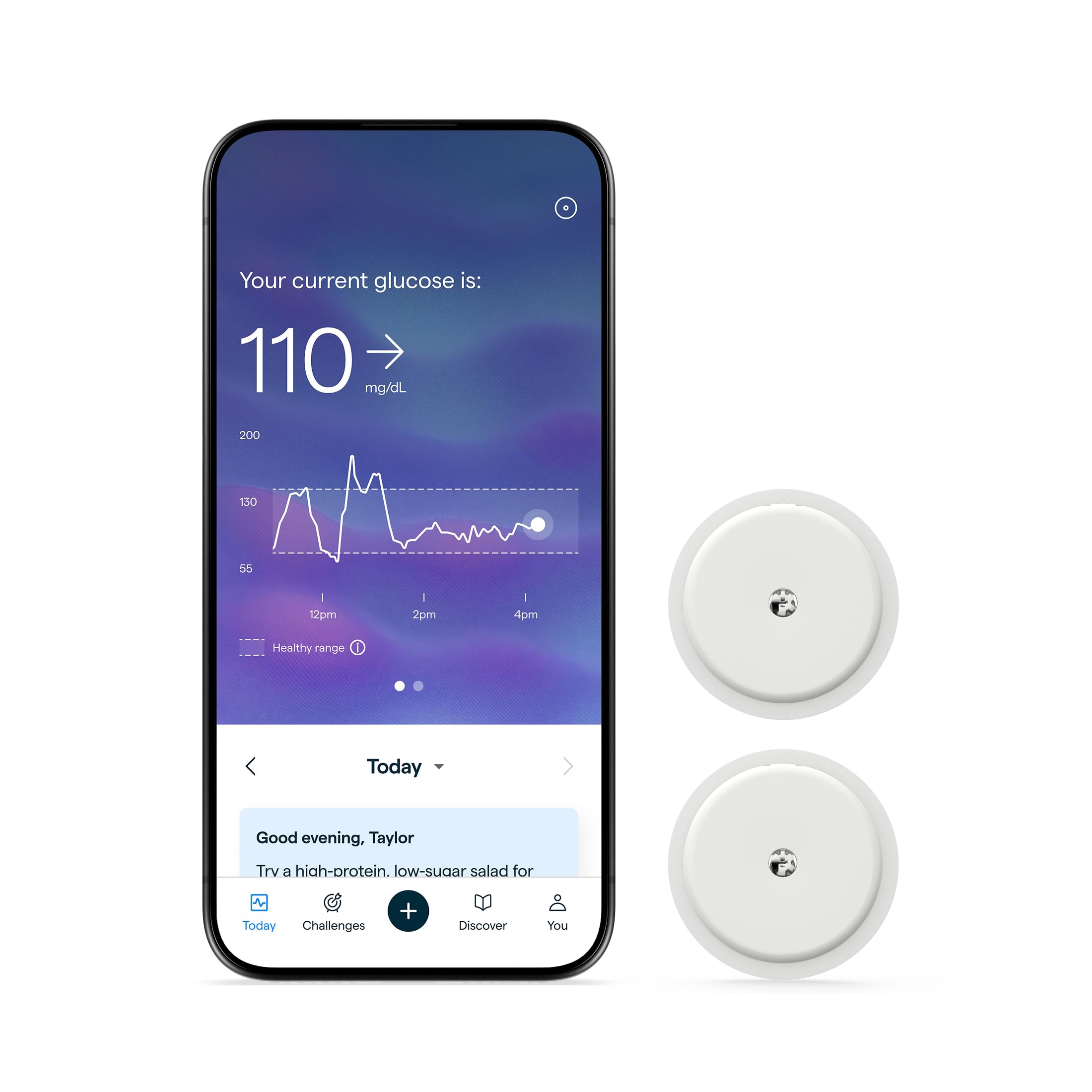
A sensor that turns every meal into a lesson, if the hardware cooperates.
The pitch here is nutrition coaching disguised as a sensor. Lingo reads your glucose around the clock and the app shows you how specific meals, workouts, and even sleep moved the number. That feedback loop is the whole point for weight loss — you see which breakfast spikes your glucose and which one holds steady, then you adjust.
Two details stand out on the practical side. First, it needs no prescription and is HSA/FSA eligible, which removes a real barrier compared to clinical CGMs. Second, it is designed to be painless — the biosensor attaches to the back of your arm and is water-resistant, so a shower does not end your tracking. Each monitor is rated for up to 2 weeks of minute-by-minute data, and the 2-pack gives you two sensors. It syncs with iOS and Android, plus Apple Health or Health Connect, so workouts auto-log into the app.
Here is the honest tension: the coaching app is ahead of the sensor hardware. Application is simple and the app is straightforward to operate, but owner feedback is dominated by early sensor failures, drop-offs, and Bluetooth connections that come and go. The maker does commit to a free replacement if a biosensor stops working before you have used it for 14 days. Treat that policy as part of the product — you may need it. If you want the richest coaching experience and can roll with a sensor swap now and then, this delivers the insight; if you want set-and-forget durability, look at the fingerstick kits.
The insight payoff: real-time glucose response to food, exercise, and sleep is exactly the data a weight-loss plan needs, and the app translates it into specific meal guidance rather than raw charts.
The hardware caveat: early sensor failures and spotty Bluetooth are the most-discussed frustrations, so plan for the free-replacement policy rather than assuming a perfect two weeks.
Suits you if: you want coaching-style food insight and the flexibility of no prescription and HSA/FSA eligibility.
Not your pick if: you need a sensor to survive every wear cycle without a hiccup.
Know the Specs
Wear Time vs. Test Count
Continuous sensors are rated in days of wear — Stelo at up to 15 days per biosensor, Lingo at up to 2 weeks per monitor. Fingerstick and breath meters are rated in tests instead, like the SMART meter’s cartridge rated for up to 320 tests. These are not the same unit, so never compare a 15-day sensor to a 320-test cartridge as if one is “better.” A sensor covers a stretch of calendar time; a test count covers how many discrete readings you get.
PPM and Blood Ketones
A breath ketone meter reports PPM — parts per million of acetone on your breath. A blood ketone meter reports the ketone level in your blood from a strip. The breath reading is an estimate derived from your breath, while the blood strip measures the blood directly. That is why the two numbers do not line up if you test both at once, and why breath meter owners describe readings as “mixed” more often than blood meter owners do.
GKI and Why It Matters
The Glucose Ketone Index combines your glucose reading and your ketone reading into one number that reflects how deep into ketosis you are. The Keto-Mojo GK+ app calculates it automatically from your paired readings. Without an app doing that math, you would be comparing two separate numbers by eye. For weight-loss tracking, GKI is the metric that tells you whether your current eating pattern is actually pushing you toward fat burning.
App Sync and Health Platforms
All the connected picks here sync somewhere. Lingo and Stelo both push to Apple Health or Health Connect; Keto-Mojo pushes to Apple Health, Cronometer, and Carb Manager; the KETOSCAN meters pair with the free KETOSCAN app. Check that your phone platform and your food-logging app are on the compatibility list before you buy — a great sensor with an app that will not talk to your log is half a tool.
Common Questions
Do I need a prescription for a continuous glucose monitor for weight loss?
Is a breath ketone meter as accurate as blood ketone strips?
How long does a CGM sensor stay on before it needs replacing?
Can I wear a glucose sensor in the shower or while swimming?
What is GKI and why does it matter for weight loss?
Do I have to buy test strips forever with a fingerstick meter?
Will a glucose monitor app sync with Apple Health or my food logging app?
Is a CGM better than a breath ketone meter for losing weight?
What does the sensor cartridge rating of 320 tests actually mean?
Can I use these devices if I am on insulin or have other health conditions?
The Bottom Line
If you want one device that covers both glucose and ketones and arrives ready to test, the Keto-Mojo GK+ is the pick — 140 strips in the box, a free app that calculates your GKI, and sync to Apple Health, Cronometer, and Carb Manager. If your priority is continuous, needle-free insight and you are not on insulin, the Stelo biosensor gives you up to 15 days of wear per sensor with a coaching app behind it. And if you want to check ketosis daily without a lancet or a strip cost, the Mini V2 breath meter is the simplest way in — three seconds of breath and a reading on the display.
The honest closing rule: weight loss tracking only works if you keep testing week after week. Pick the device whose routine you will actually follow — strips and an app for depth, or a breath meter for a daily two-minute habit. The best tracker is the one whose routine you will actually repeat every day.
How we choose
We do not accept paid placement. Every pick is matched to a real buyer and a real use-case; we do not hands-on test units.
Sources
Specifications: manufacturer listings and product documentation. Review insights: verified customer reviews, as of November 2026. Pricing: not shown on this page (it changes often); check the current price via the retailer link.
As an Amazon Associate, My Heart Lives Here earns from qualifying purchases. This does not affect which products we feature.