Heads up: This post contains affiliate links. As an Amazon Associate I earn from qualifying purchases, at no extra cost to you. Learn more
Specs are compiled from manufacturer listings and verified buyer reviews and can change over time — please confirm the key details on the product page before buying.
Those tiny moth-like flies sitting on your bathroom mirror are not coming from the air — they are hatching inside the slime coating your drain pipe, and no can of room spray reaches them. What actually works is a treatment you pour down the drain that either coats the pipe wall or eats the organic film the larvae feed on. Below are five drain treatments that do one of those two jobs, ranked by how reliably they finish the infestation and how much mess they leave behind.
This guide is built by comparing the manufacturers’ published specifications and the patterns across verified customer reviews, so you get each pick’s real strengths and trade-offs instead of marketing spin.
Drain flies breed in the slimy film inside pipes, so the right killer depends on where that film sits. Some options are gels that cling to pipe walls; others are microbial foams that digest the breeding ground itself. Match the formula to your drain: a rarely used guest drain needs a different approach than a kitchen sink you use ten times a day. This round-up of the best drain fly killer options helps you sort that out fast.
Top Picks

How To Choose The Best Drain Fly Killer
Drain flies breed in the thin organic film that lines the inside of a pipe, usually somewhere between the drain grate and the trap. Any product that only kills the adults you can see will leave the larvae untouched, and the swarm returns in about a week. So the first question is never “how strong is it” — it is “does it reach and stay on the pipe wall.”
Gel cling versus foam reach
A thick gel pours slowly and coats the vertical sides of the pipe, which is where larvae actually live. A foam expands into cracks and crevices a gel can miss, but foam depends entirely on its spray nozzle working. If the nozzle fails, you get nothing down the drain at all. Match the delivery method to the shape of your problem: gels for a straight sink or shower drain, foams for cracks, overflow holes, and floor drains set into tile.
What the pour volume tells you
Dose size matters more than bottle size. A formula dosed at 4 ounces per drain gives you a different number of treatments from one dosed at 8 ounces per drain, even when both bottles hold 32 ounces. Count your drains first — a main bathroom, a kitchen sink, a guest bath, and a floor drain is four separate pour points. Whatever you buy has to cover all of them across a repeat cycle of several days.
Repellent versus digester
Citronella and cinnamon oils push flies away from the drain. Microbial formulas work differently — the microbes consume the slime and grease the larvae feed on, so the breeding ground disappears. Repellents tend to act faster; digesters tend to hold the result longer. Neither is a one-pour fix, and both need repeat application until you stop seeing new flies.
Side-by-Side Comparison
| Model | Best For | Format | Dose Per Drain | Bottle Size | Amazon |
|---|---|---|---|---|---|
| Fly Away Fruit Fly Liquid Lure★ Best Overall | Kitchens and food areas | Liquid lure | — | 12 oz | Amazon |
| Invade Rockwell Labs Hot Spot+ Bio FoamDeepest Reach | Cracks, crevices and floor drains | Bio foam | — | 19 oz | Amazon |
| Green Gobbler Fruit Fly Killer Plus | Whole-house repeat treatment | Thick gel | 8 oz | 32 oz | Amazon |
| FLY-AWAY Drain Fly Killer | Septic systems and disposals | Gel | 8 oz (1 cup) | — | Amazon |
| Rockwell Labes InVade Bio Drain Quart | Ongoing drain maintenance | Microbial liquid | 4 oz | 32 oz | Amazon |
Detailed Reviews
1. Fly Away Fruit Fly Liquid Lure (12 oz)
Our pick — 4.0+★ from 400+ verified ratings; the strongest balance of quality and price.
A 12-ounce liquid lure you can leave sitting beside the fruit bowl without worrying about what is in it.
The reason this takes the top slot is the one thing every kitchen buyer checks first: what happens if it ends up near food. This lure is built on food-safe ingredients, which means it can sit on a counter beside produce, pets, and kids without a second thought. That single detail is what separates it from a drain gel you have to hide under the sink.
The maker describes a noticeable drop in fly activity within hours rather than days. It holds its potency for weeks, so you are not re-soaking a trap every morning. The bottle is a 12-ounce liquid lure that works on its own or as a refill for the Fly Away trap kit — so if you already own the kit, this is simply the top-up.
What wins people over here is the build and the lack of stink. It is made in the USA, and the smell is a non-issue in a room where you eat. Where it splits opinion is raw catching power — some households watch the trap fill within a day, while others see only a handful of flies take the bait. That is a real fit question, not a defect: a lure has to compete with whatever else is in your kitchen, and a busy fruit bowl will always out-attract a lure on a bare counter. Clean up ripening fruit first and this does far better.
What earns it first place
- Food-safe ingredients, so it can sit in a kitchen around food, pets, and children.
- Odour is a non-issue — no chemical smell hanging over the room.
- Keeps working for weeks instead of needing a daily refresh.
- Doubles as the refill for the Fly Away trap kit if you already own the housing.
Where it asks more of you
- It lures flying adults rather than flushing the drain, so pair it with a pipe treatment for a full clear-out.
- Catch rate varies by kitchen — a busy fruit bowl can out-compete it.
Reach for this if: you want something food-safe sitting out in a kitchen, restaurant, or bar where flies are landing on surfaces.
Pair it instead: if the flies keep reappearing from one specific drain, add a pipe-coating gel — a lure catches the adults but never touches the larvae.
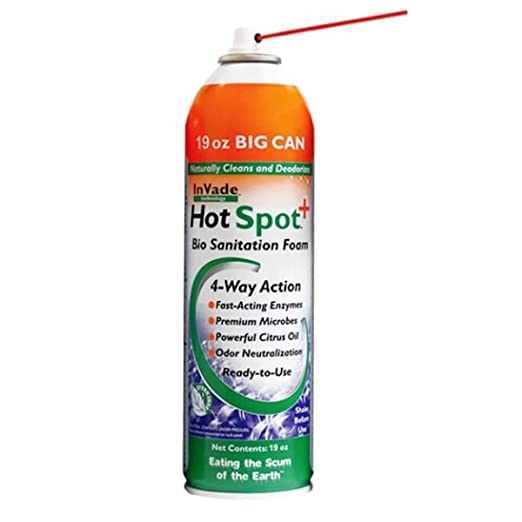
2. Invade Rockwell Labs Hot Spot+ Bio Foam 19oz.
The one that gets into the cracks and overflow holes a poured gel sails right past.
Here is the scenario this was made for: a floor drain set into tile with a grout line around it, or a sink with an overflow slot you can barely see into. A gel runs down the middle of the pipe; a foam expands outward and works into those gaps. The active ingredient is a premium microbe blend, so as it sits it feeds on the organic material that drain flies lay eggs in.
It arrives ready to use, and the maker lists it for drains, garbage disposals, litter boxes, trash cans, and stain work on carpets — soda, juice, milk, wine, beer, food residue, oil, urine, vomit. That range makes it the most flexible bottle here. Worth knowing before you order: the 24-inch hose is sold separately, and you must attach the supplied straw yourself. In package size it measures 10.08 x 5.12 x 2.87 inches, close enough to the FLY-AWAY that shelf space is not the deciding factor.
The honest catch is the hardware. The foaming action is the part buyers split on — some get a proper expanding foam, others find it barely sprays. More consistent is a gripe about the straw, which is fiddly to seat and tends to work loose mid-job, and the nozzle can give out after a single session. The cleaning result is the strongest thing about the bottle, and the scent is genuinely pleasant. If you buy it, tape or hold the straw firmly in place before you press the trigger, and treat it as a one-drain tool rather than something you will reuse for years.
Where it pulls ahead: foaming microbes reach crevices, overflow slots, and grout gaps a poured gel never touches, and the same can cleans drains, disposals, litter boxes, and trash cans.
The trade you are making: the straw and nozzle are the weak point — expect to fiddle with the straw and possibly lose the spray head after one use. The 24-inch hose for deep floor drains is a separate purchase.
Pick this one when: your flies are coming from a tiled floor drain, an overflow hole, or a crack you cannot pour into.
Think twice if: you want one bottle you can reuse season after season — the delivery hardware is the part that lets it down.
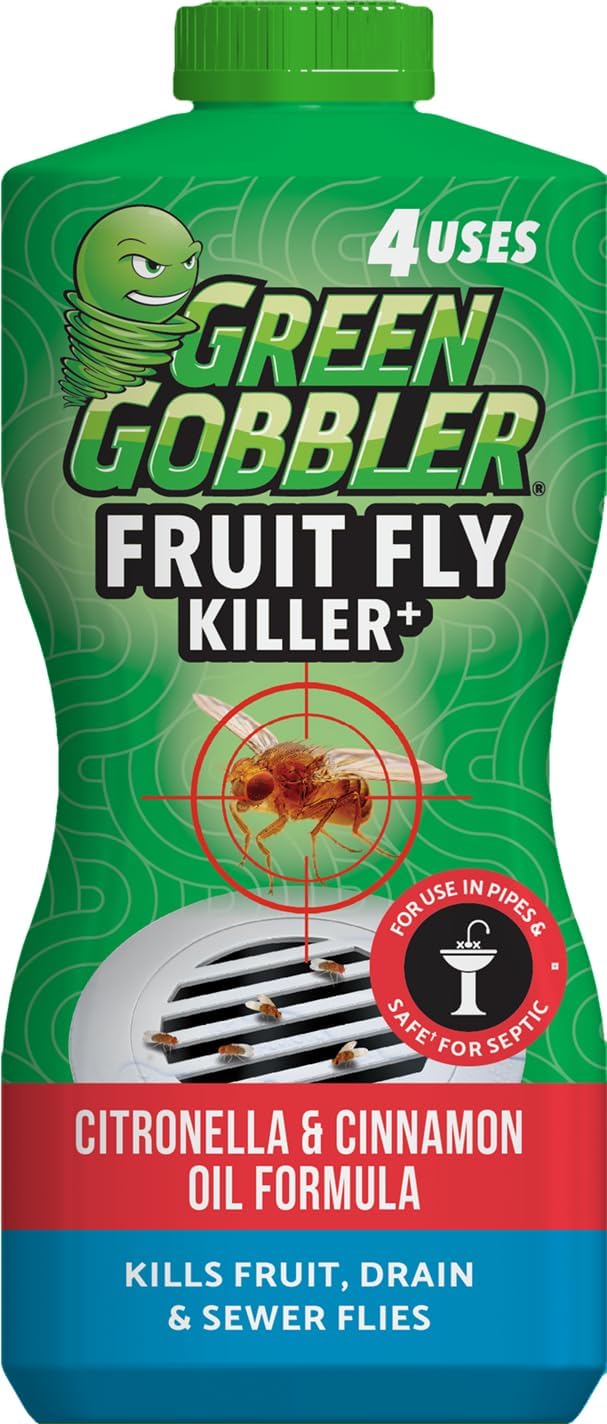
3. Green Gobbler Fruit Fly Killer Plus 32 oz Gel
A thick gel built to hang onto the pipe wall instead of rinsing straight through to the trap.
The whole point of a gel is cling, and this one is deliberately thick so it coats the pipe walls and the organic film the larvae sit in. You pour 8 ounces down the problem drain — an anti-glug bottle neck keeps it from splashing back up at you — and the maker rates one bottle at up to 16 drain treatments. Pour at night or whenever the drain gets the least use, then repeat daily until the flies stop.
Two things make it the easiest of the group to live with. The first is the scent: citronella and cinnamon oils, which buyers consistently describe as pleasant rather than chemical, and those same oils help push flies away from the drain. The second is compatibility — this gel is formulated to be safe in septic systems and works in garbage disposals, floor drains, kitchen sinks, bathrooms, and shower drains. It also handles fruit flies and sewer flies, not just drain flies.
Results are the most argued-about thing here. Some households report the flies gone within two weeks of the first application; others see no change at all. Some feel it is not good value if their infestation shrugs it off. Treat the two-week mark as the checkpoint. If you are still seeing flies after a full repeat cycle, the breeding site is somewhere the gel is not reaching, and you need a foam instead. Compared with the InVade Quart, this bottle sits taller in the hand at 3.25 x 3.25 x 10 inches, so it stores upright on a shelf edge rather than flat in a cabinet.
What it handles well
- Thick gel clings to pipe walls and drain surfaces instead of running past the larvae.
- Citronella and cinnamon oils give it a pleasant scent plus a repellent effect.
- Safe for septic systems and usable in disposals, floor drains, showers, and bathroom sinks.
- Anti-glug neck cuts splashing, and one bottle covers up to 16 drain treatments.
What to set your expectations on
- Results vary widely — some drains clear inside two weeks, others show no change.
- You have to repeat the pour daily, so it is a routine rather than a single fix.
Best for: a whole-house clear-out where you have several drains to treat and want one bottle that covers all of them.
Look elsewhere if: your drain is a tiled floor drain with gaps around the grate — a gel pours down the middle and misses the edges.
4. FLY-AWAY Drain Fly Killer

A gel that works as a grease digester as well as a fly treatment, and will not eat your pipes.
If your drain has been slow for a while, this is the pick aimed at both problems at once. It is a non-caustic, non-corrosive gel, so it goes after the flies without attacking the pipe, the garbage disposal, or the septic system. It also acts as a grease digester, which matters because a greasy film is precisely where drain flies set up home.
The application is straightforward: pour roughly 8 ounces (1 cup) into the drain, ideally when the drain is not in use, and make sure you hit all sides so it coats and clings to the pipe walls. Repeat daily until you stop seeing new flies. At 2.07 pounds it is marginally heavier in the hand than the Green Gobbler’s 2 pounds, and its package runs 10 x 3.46 x 3.39 inches — both numbers close enough that storage is not the deciding factor.
Where this stumble is consistency. Some drains clear completely; others see no effect at all, and a few find citronella-based options did the job this could not. Nearly everyone agrees on the smell — a clean, refreshing scent rather than a harsh chemical one. Go in planning the full repeat cycle rather than one pour, and if your drain is genuinely blocked by grease the digester side is working on a bigger job than flies alone.
What stands out: a non-caustic, non-corrosive gel that doubles as a grease digester, so it clears the film flies breed in without harming pipes, disposals, or the septic system.
Set your expectations: results are hit and miss across households, and the price sits at the higher end for a single bottle — commit to the daily repeat pour before you judge it.
Go this route if: your drain is slow, greasy, or on a septic system and you want a gentle formula that attacks the film, not the pipe.
Not the right fit if: you want a foaming treatment for a tiled floor drain with cracks around the grate — this one pours.
5. Rockwell Labes InVade Bio Drain Quart (32 oz)

Only 4 ounces per drain — the smallest dose here, which stretches a 32-ounce quart across a lot of pours.
This one is built for upkeep rather than a panic order. A dose is 4 ounces per drain, half what the Green Gobbler and FLY-AWAY gels call for, so a 32-ounce quart goes considerably further across a maintenance schedule. The active ingredients are microbes and citrus oil — the microbes break down the organic film, the citrus oil handles the smell.
The maker lists it for drains first, but also for sugar snakes in soda fountain drip trays, mop buckets, trash chutes, and urinals. That makes it the one bottle here that fits a commercial kitchen or bar’s daily routine as easily as a home bathroom. It also calls out odour alongside fruit, phorid, and drain flies, so you are treating the smell and the swarm in one pour. In physical size it runs 10.98 x 3.7 x 3.35 inches against the Green Gobbler’s 3.25 x 3.25 x 10 inches — tall and slim versus the rockwell’s flatter profile.
This carries the fewest owner notes of the five, so the picture is thinner than for the bigger bottles. What that means practically: go in with a repeat schedule rather than a single pour, and give the microbes a few days to work through the film. The small 4-ounce dose that makes it economical also means it is not the bottle for a heavy, long-standing infestation in one drain. That is a job for a full 8-ounce gel pour first, with this as the follow-up maintenance.
Why it earns a place
- 4 ounces per drain means more treatments per quart than the 8-ounce gels.
- Microbes and citrus oil tackle the organic film and the odour together.
- Works beyond drains — soda fountain drip trays, mop buckets, trash chutes, and urinals.
- Fits a regular maintenance routine rather than a one-off emergency pour.
What to weigh up
- A 4-ounce dose is gentle — a heavy infestation may need a stronger full gel pour first.
- Microbes need a few days to break down the film, so it is not an overnight clear-out.
Suits you if: you want to keep drains clean on a schedule and stop flies before they take hold, especially in a bar or commercial kitchen.
Start somewhere else if: you are mid-infestation right now and need a full-strength pour on day one.
Know the Specs
Dose per drain (ounces)
This is the amount you pour down one drain in a single treatment, and it decides how far a bottle actually goes. A 4-ounce dose like the InVade Bio Drain stretches a 32-ounce quart across many pours; an 8-ounce dose like the Green Gobbler or FLY-AWAY gels uses the same quart in half as many treatments. Count your drains before you buy, and factor in that most routines call for a repeat pour daily until the flies stop.
Gel cling versus foam expansion
A thick gel coats the vertical pipe wall, which is where larvae sit in the organic film — good for a straight sink or shower drain. A foam expands into crevices, grout gaps, and overflow slots that a poured liquid never reaches. The catch with foam is delivery: it depends on a spray nozzle and straw that can fail. Match the format to your drain shape, not to the size of the bottle.
Repellent oils versus microbes
Citronella and cinnamon oils repel flies from the drain and tend to act quickly. Microbial formulas work the other way — the microbes consume the slime and grease the larvae feed on, so the breeding ground disappears over several days. Repellents are quicker; digesters hold the result longer. Both need repeat application, and neither replaces cleaning out a visible film by hand.
Septic and disposal compatibility
Not every drain treatment is safe for a septic system or a garbage disposal. A non-caustic, non-corrosive formula is the one to look for if your drains feed a septic tank, and a gel rated for septic use will say so on the label. If you are on a septic system, check that line before you pour anything down a drain — the wrong formula can undo the balance you rely on.
Common Questions
Why do drain flies come back after I treat the drain?
Is a gel or a foam better for drain flies in a floor drain?
Are these drain treatments safe for a septic system?
How many drain treatments does one bottle give me?
Can I use a drain fly treatment if I have a garbage disposal?
Do these products work on fruit flies as well as drain flies?
Will a microbial drain treatment clear a grease-clogged pipe?
How long should I wait between drain fly treatments?
Why does the straw keep falling off my bio foam can?
Should I spray the flies on the wall or treat the drain?
The Bottom Line
For most kitchens and food areas, the strongest all-round pick is the Fly Away Fruit Fly Liquid Lure. Its food-safe ingredients mean it can sit out near produce, pets, and children while it pulls flies in. It holds 4.0+ stars across 400+ ratings. If your flies are coming from a tiled floor drain or an overflow slot you cannot pour into, grab the Invade Hot Spot+ Bio Foam, whose microbes expand into the cracks a gel misses. And for a whole-house clear-out with several drains to treat, the Green Gobbler 32 oz Gel covers up to 16 treatments at 8 ounces a pour. Whichever you pick, plan on a repeat cycle rather than a single pour. That is the difference between a clear drain and a swarm that comes back next week.
How we choose
We do not accept paid placement. Every pick is matched to a real buyer and a real use-case; we do not hands-on test units.
Sources
Specifications: manufacturer listings and product documentation. Review insights: verified customer reviews, as of November 2026. Pricing: not shown on this page (it changes often); check the current price via the retailer link.
As an Amazon Associate, My Heart Lives Here earns from qualifying purchases. This does not affect which products we feature.